


Reflections
-
It is weird to read my correspondences from the late August/early September
period, being the time of transition between my old function in life to my
new ...
14 years ago
Sir Henry at Rawlinson End (UK, 1980)
Directed by Steve Roberts
Starring Trevor Howard, Patrick McGee, Sheila Reid, Denise Coffey
In my review of Westworld, I argued that novelists who become filmmakers often lack the visual creativity to balance out the verbal richness of a given work. While certainly true of Michael Crichton's debut, this can also be applied to literary adaptations in general; the often-prolific use of voiceover and frequency of long speeches belie an unhelpfully literal approach to adaptation. Sir Henry at Rawlinson End proves the same can be true for spoken word albums. Vivian Stanshall's 1978 LP, culled from his stints on Radio 1 covering for John Peel, remains an irresistible slice of whimsical absurdity with wordplay which is utterly to die for. But in the hands of first-time director Steve Roberts, most of the charm and quality of Stanshall's work is eroded or withered away, resulting in a crushing disappointment.
 Sir Henry at Rawlinson End has been called everything from "the cinematic equivalent of cheese before bedtime" (The Big Issue) to "the missing link between Monty Python and Withnail & I" (Time Out). Set in and around the fictional English country manor of Rawlinson End, it follows a day in the life of Sir Henry Rawlinson (Trevor Howard), Great Aunt Florie (Sheila Reid) and various other eccentrics who inhabit or visit the estate. The film version extends the plot of the album, adding both the activities of a morose priest Slodden (Patrick Magee) and Sir Henry's attempts to exorcise the ghost of his brother, accidentally killed during a drunken fishing trip.
 The best way to understand the film is found in the words of Peter Sellers. When interviewed in 1972 just before a one-off Goon Show to mark 50 years of the BBC, he made the comparison between The Goons and Monty Python in terms of visual imagination on the part of the audience. Watching Monty Python's Flying Circus, you had a starting point for what the various characters could look like: in Sellers' words, "John Cleese always looks like John Cleese". Listening to the Goons, on the other hand, you had to create pictures of what the various characters looked like without much visual assistance, even from Spike Milligan's own drawings.
The great joy of Sir Henry as a record was Stanshall's skill with voices, accents and verbal acrobatics. Every sinew of the storyline was crammed full with wit and wordplay, with Stanshall's metaphors and imagery being up there with the best bits of Under Milk Wood. Dylan Thomas would have smiled favourably on corkers such as this: "A pale sun poked impudent marmalade fingers through the grizzled lattice glass, and sent the shadows scurrying, like convent girls menaced by a tramp." Like Under Milk Wood, the story of Sir Henry at Rawlinson End is secondary to the characters inhabiting it, whose every tic and foible is captured in superb detail by the rich language. With Thomas, it is the grotesquery of Mr. and Mrs. Pew, the melancholy of Polly Garter or the grief of the blind sea captain. With Stanshall, it is the absurdity and sheer lunacy of English aristocrats, from Sir Henry's simpleton son Hubert, "in his mid-40s, and still unusual", to walking encyclopaedia Reg Smeeton, who obsesses over the fact that there is no proper name for the back of the knees.
As delightfully hilarious as all of this sounds, it was always going to be difficult to capture the innate anarchy of Stanshall's unique mind. The very effect of adding a visual dimension takes away from the imagination of the record, offering a standardised version of events which, much like the Tele-Goons, will inevitably fall short of one's expectations. One could blame this on the director's inexperience or lack of talent: Roberts would later carve a niche for himself penning TV series based on successful Disney films. But Stanshall's close involvement, both at a script level and in a supporting role, leads one to conclude that it was simply a bad idea for anyone to attempt it. In adapting the album for the big screen, there has been a certain amount of plot-shuffling - understandable enough, and just about excusable considering the consistent quality of the material. But some of the best bits of the album are inexplicably missing. At only 73 minutes long, it is unlikely that they were cut for time, and more unlikely still that they were lost for lack of making sense. Most tragic is the omission of Sir Henry's monologue about Professor Molebottom, who in his mind "put the bounce in the bouncing bomb".
 The new additions to the story are poorly integrated, giving the distinct impression that the film would have been fine without them. Patrick Magee is a burning screen presence, as evidenced by his work with Stanley Kubrick in A Clockwork Orange and Barry Lyndon. But for all his charisma his character seems curiously pointless; his priest plots and glowers on the side-lines, but nothing ever comes of him being there. Harry Fowler's winkle-pickered Cockney is an obvious bum note, a pale imitation of Walker from Dad's Army. And the ghost exorcism plot is badly handled, arriving with some hokey special effects and being palmed off pretty quickly.
There have been a number of strange British cult films which have passed muster in spite of their shambolic narratives. Think of Richard Lester's The Bed-Sitting Room, co-written by Spike Milligan, or The Magic Christian starring Peter Sellers. But what saw these films through their short running times and perplexing turns of plot was a constant feeling that they were about something, even if they weren't going anywhere. Sir Henry at Rawlinson End, on the other hand, feels totally and indulgently aimless. It feels like the cast and crew were given a big house to play around in for a week - they shot everything they could, making it up as they went along and then tried to stitch it all together in the editing room. While the album may not have finished in an entirely satisfying way, it at least had the common decency to quiet while it was ahead. This hangs around for at least 20 minutes too long, ending with someone bungee-jumping off the battlements for no good reason.
 In amongst its disastrous execution, there are individual moments in the film which at the very least make it memorable. There is some pleasure in seeing Trevor Howard sending himself up so mercilessly; one can almost picture this is what his character in Battle of Britain might have become had he been given a peerage. He gets a number of pretty juicy lines which showcase his insanity - the best being, "I never met a man I didn't mutilate" - and his prisoner-of-war camp banter is quite fun.
Some of the visual decisions are also notable. Where The Bed-Sitting Room found Lester manipulating colour like his contemporary Nicolas Roeg, Sir Henry at Rawlinson End is shot entirely in sepia monochrome, reinforcing its amateurish, parochial feel. If one was feeling generous, one could call this a descendent of the early surrealist films, taking its place in the canon as a late-blooming English take on Luis Bunuel. In the end, however, there is precious little about Sir Henry at Rawlinson End that makes one feel anything like as charitable. It is a crushing disappointment for fans of the spoken word album, whose bizarrely annoying tone leaves no way in either for fans of English whimsy or for the casual viewer. The pockets of familiar bliss or tongue-twisting delight are padded out by incoherence, indulgence and irritation. In short, it proves that audience imagination is key to making these kinds of stories work, and that as a result, some things are best left unseen.
Rating:
Verdict: A crushing disappointment
Four Lions (UK, 2010)
Directed by Chris Morris
Starring Riz Ahmed, Kayvan Novak, Nigel Lindsay, Adeel Akhtar
Throughout his career on radio and TV, Chris Morris has proved his calibre not merely as a comedy writer and performer, but as a bristling and savagely intelligent commentator on current affairs. Like Peter Cook at his very best, he combines an urbane demeanour with a ruthlessly acerbic eye, delivering comedy of extraordinary craft and attention to detail. Four Lions, his first venture into feature filmmaking, continues his fantastic run of form, being one of the year's best films and one of the best black comedies of the last two decades. The comparison between Morris and Cook is not mere hyperbole. For all their reputations as rebels, and occasionally uncouth ones, there is a sparkling intelligence running throughout their work, so that even at their weakest they always feel on a different plane to everybody else. From the "good AIDS/ bad AIDS" conversations in Brass Eye to the darker moments of The Day Today, Morris has continually caught audiences between wincing and laughing hysterically, between revelling in the absurdity of life and being openly shaken by reality.
 But despite this rich pedigree, there is no sense in Four Lions of Morris re-treading old ground, in the tradition of TV performers who translate to the big screen. The only vague character similarity comes in Omar's security guard friend; his opening monologue about marathons and running distances is a distant cousin of Steve Coogan's pool attendant in The Day Today, who insists after an accident that, year after year, "no-one died". Neither is it the case that Four Lions feels televisual; Morris' comedy has never felt constricted by the limits of a given medium, and he makes the transition to cinema pretty effortlessly.
 Being a British comedy, there are moments in Four Lions which feature or heavily rely on big, broad sight gags. These are the kinds of laughs which populate the trailers, since they are perceived by marketers as bringing in a mainstream audience who do not follow either politics or Morris' career so closely. That's not to say that Morris put them in specifically to sell the film; while they don't reach the heights of the satirical and verbal comedy, they are executed in the best possible way. There is quite a bit of pleasure to be had from watching someone firing a grenade launcher the wrong way, or blowing up crows, or running awkwardly with hydrogen peroxide stashed under their arms.
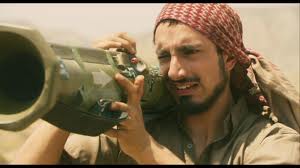 Had the use of such gags been more prolific, you could easily accuse Four Lions of exploiting its subject matter, barely scratching the surface in search of a cheap, mean-spirited laugh. But as the film moves on, all suggestions or hints of Carry on Bombing go out the window, as we grow in our relationship with the characters and view their actions in a more serious or pathos-ridden light.
 A key indicator of this is the sight of one of the bombers running towards the house with the explosives - he successfully mounts a wall, only to trip over a sheep and explodes before our very eyes. Whereas in previous scenes this would have induced a belly laugh, instead we sit there in shock, not quite believing what we have just seen. Morris has the confidence to keep the boundary between comedy and tragedy completely blurred; he doesn't feel the need to constantly get a laugh if a laugh is not what is needed at a given moment.
 Four Lions is an unusual comedy insofar as laughter or hilarity is not always the natural reaction which it produces. It sits in the company of Kind Hearts and Coronets or Dr. Strangelove, in which the overwhelming desire to laugh at the absurd or outrageous situations is balanced by an extraordinary sense of sadness or fear towards the characters. The final act of Four Lions, in which the four men decide to bomb the London Marathon, is up there with Charlie Chaplin's work in The Kid, or Buster Keaton at his most melancholic. Rather than lurch between laughing and lecturing, Morris invites us to recognise the sad and pitiful absurdity of what these four men are doing. While the four are all in some way stupid, disorganised and conflicted men, the film does not belittle them; it humanises them, allowing us to weep for their fate while laughing scornfully at the ideas which drove them to said fate.
 This marriage of tragedy and comedy is indicative of Morris' intentions as a comedian. Despite his uncanny ability to make people laugh, Morris has always had some form of serious intention behind his work, whether it's questioning stereotypes or approaching a controversial subject in a manner which cuts through all the hysteria and hyperbole of modern media. With Four Lions he has created a comedy which generates huge laughs in places while also raising all the difficult questions about the origins of terrorism in Britain, and if and how it can be combatted.
 The film is particularly strong at showing the impact of jihadist beliefs on the families of those engaged in terrorism. It cuts through all the nonsense of terrorists being portrayed as psychopathic loners, showing Omar (Riz Ahmed) as a family man attempting to reconcile his religious beliefs with his responsibilities as a husband and father. In one poignant moment, he tells his young son a bedtime story, explaining the principles of Islamic jihad in relation to The Lion King. In another equally sad scene, he poses as a hospital porter to get past police and say goodbye to his wife during her shift on reception. He says that he'll "be going now" and she glances back at him, tearful yet loyal to the last.
 Four Lions also shows the flawed, or at least unsympathetic, position of moderate Muslims, arguing that they are as potentially damaging to the public image of Islam as the suicide bombers. One of Omar's friends adheres very strictly to the teachings of the Qu'ran, to the point where he comes across as distant, arrogant and pious. While Omar does everything with his wife and doesn't force her to cover up, his friend refuses to stand in the same room as a woman; when questioning about keeping women in a cupboard during prayer meetings, he replies: "it was not a cupboard, it was a small room." At this point Omar and his wife respond by chasing him out of their house with water pistols, with Omar's wife declaring sarcastically that she is "out of control". It's a smart and funny way of showing the nuances of Islamic attitudes to women, which have all too often been reduced to simple-minded caricature.
 This scene leads onto one of the great set-piece gags in Four Lions (although gag is perhaps not the best way to describe it). At one point the four bombers meet at the house and discuss bombing the London Marathon. The camera keeps cutting between their conversations and the police pulling up outside a house, shot in night vision. This editing leads us to think that the bombers are going to be ambushed - only for the police to break into the 'study group' of the moderates, arresting the men and taking the women out of the 'cupboard'. Morris throws us a totally welcome curveball, and offers a memorable pay-off involving a freight container doubling for Egyptian soil and Weetabix being used as a bargaining chip.
 What makes Four Lions work as a study or satire of fundamentalism is that it doesn't claim to have all the answers for exactly why young people are doing this. Morris spent the best part of six years researching the film, and clearly understands that there isn't a one-size-fits-all answer to any aspect of this phenomenon. The film is concerned as much with exposing the hypocrisy of radical Islam as it is deflating the helpless, squirming responses of MPs and other authority figures. In putting every party, political or otherwise, under the spotlight, Morris is exposing and shaming the tendency to oversimplify the issues for the sake of sound-bites, or the cowardly approach taken by groups and politicians to avoid the issue altogether.
 Four Lions is a great black comedy which indicates that Chris Morris can be as good a film director as he is when working in TV or radio. It isn't quite perfect, relying a little too often on broad comedy in its first act, and there is the outside possibility that audiences will come away feeling that, in terms of pure laughs, they didn't get their money's worth. Make no mistake, Four Lions is an often hilarious film, but it is more than funny - it hits the rich seam of awkward or edgy comedy which leaves one feeling shaken as well as stirred. In short, it is an all-round triumph from one of Britain's greatest comedy talents.
Rating:
Verdict: One of the decade's best
Lord of the Flies (UK, 1963)
Directed by Peter Brook
Starring James Aubrey, Tom Chapin, Hugh Edwards, Roger Elwin
The ideas and imagery of Lord of the Flies have become so deeply engrained in our culture that it would be very easy to accuse any film version of skimming the surface. The concept of a dark beast lurking in the heart of well-meaning Man may be far more ancient than William Golding's novel. But there is a danger that any adaptation could embody the theme without doing justice to the story, relying on layman knowledge or consensus to carry the action. While this criticism can be fairly levelled against the 1990s version, there is no such cause for concern with the vision of Peter Brook. In adapting Golding's chilling and pessimistic novel, he has done justice to the source material while putting his own blend of artistic naturalism onto the story. The result is a subtle and sinister film whose sense of dread creeps up on you and eventually overpowers without warning. While aspects of it haven't aged that well, it still stands as the definitive adaptation.
 Brook's skill as a director, both on film and in the theatre, has always been allowing the material to speak for itself. The brand that is Peter Brook bestows upon a production certain expectations of quality, but this derives from a captivating whole rather than individual gimmicks. Brook clearly understands the pattern and composition of Golding's prose, and very rarely feels the need to impose his own attitude onto the visual rendering of it. This is a sign of confidence in both the source material and in one's capabilities as a director.
 The one notable exception to this comes in the opening credits. As the various names flash past, we see images of English civilisation at its supposed peak - all choir boys and straw boaters - intercut with ICBMs and B52s. In one particularly haunting image, we see the image of a bomber drawn on a boy's textbook in a photo full of smiling faces in uniform. This is a novel way of introducing the theme, and probably stems as much from the novel as from the experience of filming it. While much of Golding's work is about the threat of nuclear war, Brook shot large portions of the film in the Bay of Pigs, not long after the Cuban Missile Crisis.
 The central idea of Lord of the Flies is that Man is inherently savage: that within every seemingly civilised, rational and morally upright individual, there is a dark-hearted beast which will reveal itself even in the most innocent of circumstances. The film is the visual equivalent of a thought experiment, a philosophical game in which theories are tested hypothetically and judged according to the behavioural responses they produce. Golding concludes, as does Brook, that Man's murky, Hobbesian desire for self-preservation overrides everything else, to the point where tribalism is commonplace, murder is justified, and objective truth (should such a thing exist) holds no sway whatsoever.
 There has been some discussion over the years about the relationship between Golding's thesis and the Christian position on Mankind, i.e. the role of Sin, the long-term effects of the Fall, and the possible role of grace and redemption. Brook brings these discussions to the forefront and seems to suggest that the teachings of Christ provide no resistance to or adequate means of containing the beast, at least without proper application. The choirboys, who enter singing 'Kyrie Eleison' ('Lord, have mercy') along the beach, turn out to be the most ruthless, merciless and hierarchical group on the island.
 Lord of the Flies is not specifically anti-Christian because of this development. The characters are assessed and leaders emerge on the basis of physical strength and the ability to command respect. This is a quarrel between reason and instinct, between head and heart (or stomach), rather than an outright rejection of Christianity in favour of atheism or any other seemingly opposite doctrine. If anything Christian imagery abounds in Lord of the Flies, with the island serving as the world outside the Garden of Eden, the plane crash doubling quite literally for the Fall, and the arrival of the sea captain at the end as either the coming of Jesus or the arrival of the New Heaven and Earth.
 In its emphasis on instinct and tribalism, Lord of the Flies could come across as a purely nihilistic work - a film which explores the idea of life being totally pointless, and the only natural part of human behaviour being the desire for power which manifests itself in utterly amoral violence. But one of the successes of Brook's adaptation is to demonstrate how even the most morally skewed civilisation has some form of supernatural basis, either in its recognition of a God-like force, or its need to create such a force to justify itself.
 The warrior tribe formed by the choristers begin to talk about a beast which lives on the island, which must be contained by sacrifices or killed if the group is to survive. The sacrifices which they offer to the beast, in the form of a boar's head on a pike, immediately take on a supernatural quality, consolidated by the scenes of them hollering on the beach and dancing around the fire like Native Americans. The beast is like the distant, jealous God from the Old Testament: no-one has the courage to meet or confront the force which seemingly controls them.
 Both Golding and Brook are very even-handed in their treatment of both the political and supernatural aspects of the events on the island. The subtle orchestration of the meeting scenes, where the conche is passed around and people voice their opinions on what should be done, ably demonstrate both the strengths and weaknesses of both democratic government and militaristic barbarism. One of the most striking images in the film is that of the boar's head; as one of the boys stares at it, the camera zooms in onto the flies slowly eating it away. It's as disturbing and discomforting an image as the cockroaches at the start of Blue Velvet, both in its weight and in its ability to make one feel queasy.
 All of these visual and narrative touches are in keeping with the source material while putting a particular artistic and cinematic stamp on the events that unfold. This balance between loyalty and artistic licence allows Brook's adaptation to be entrist without being reductionist. In other words, you can read as much into the film as you like, without either having the themes shoved down your throat or feeling like you are watching something that has been severely abridged or bowdlerised. Considering how familiar the material is in English literature, this is quite an achievement.
 The performances in Lord of the Flies are all of a pretty decent calibre. Brook did not work from a specific script: in a foreshadowing of Mike Leigh's rigorous method of improvisation, he would give the young boys a rough idea of what would happen in a scene, and then allow them to ad lib with minimal prompting. It takes a while to adjust to their delivery, but they are generally convincing, particularly a young James Aubrey as Ralph.
 The problems with Lord of the Flies surround aspects of either the source or the adaptation which have dated. The ending of Lord of the Flies remains a classic deus ex machina (in more ways than one); with all that has gone before, it would have been scarier and more radical for the film to have ended with Ralph being killed, cementing the beast's triumph and subverting the Christian imagery. Aspects of the dialogue, such as the social attitudes of the boys, have not aged very well, and the sound design is occasionally a little stilted. Because of time constraints Brook was forced to record the sound for each scene after they had shot it, resulting in a couple of synching issues or odd deliveries.
 Lord of the Flies is a fiery and faithful adaptation which has more or less retained its potency after nearly 50 years. Notwithstanding the dated aspects and the on-going problem of the ending, it captures the pessimistic, despondent tone of Golding's work beautifully, and has many scenes capable of generating either outright scares or hideous chills. It remains the definitive adaptation of the book and one of the highlights of Brook's career in film.
Rating:
Verdict: A faithfully haunting adaptation
(500) Days of Summer (USA, 2009)
Directed by Marc Webb
Starring Joseph Gordon-Levitt, Zooey Deschanel, Chloe Moretz, Clark Gregg
As a film enthusiast you're always on the lookout for innovation in films - not specifically for films which move the goalposts and redefine our notions of cinema, but for those which take something well-worn and familiar and challenge it for a new audience. With this in mind, there is nothing that can get one's gander up more than a film which claims or thinks that it is being inventive, when in fact the merest glance beneath its surface shows that it is nothing of the sort. (500) Days of Summer comes at you with claims of being a genuine postmodern love story, an Annie Hall for the Twitter generation, or a rom-com for people who genuinely hate rom-coms. While it may not have the putridly glossy veneer of Sex and the City, the film ultimately shoots itself in the foot by being too kooky for its own good, and too structurally self-conscious to feel genuine. While there are still ideas and moments which sparkle, for the most part it feels disappointingly hollow.
 There's no denying that the makers of (500) Days of Summer had their hearts in the right place when setting out. In an age where cinema is increasingly and ever more cynically geared to the interests of teenage boys, romantic comedies or dramas with believable female protagonists are harder and harder to come by. The majority of contemporary romantic comedies are either predictable rehashes of stuff from the 1980s and 1990s, or vacuous vessels for product placement, offering women supposed material satisfaction in place of some more permanent form of happiness or self-esteem.
 Marc Webb's film is at its strongest when it attempts to puncture that self-contained, pre-packaged form of contentment. Joseph Gordon-Levitt writes greetings cards for a living, and struggles to remain optimistic or positive about the prospect of love in generalr. In one of the film's best scenes, he stands up in the middle of a meeting and lets rip about how hollow and meaningless love and happiness have become. Our culture has become so orientated around 'events', seeing emotion as something to be conveyed through commerce, that we are losing our ability to genuinely feel affection or understand each other.
 Somewhere within (500) Days of Summer, there is an edgier, more adventurous film which wants to use this premise to completely deconstruct the modern notion of love and romance. There is the potential within this material for something as scabrous and poisonous as Heathers, a ferociously funny film which ripped into the John Hughes view of high school by making you both squirm and howl with laughter. But try as he might, Webb can't seem to bring this desire to the surface for more than a few moments at a time. For all its claims of being left-field, indie-spirited and unconventional, (500) Days of Summer is structurally all too similar to the films whose clichés it claims to subvert.
 The single biggest problem with the film is that its structure of shuffled timeframes doesn't work. The film occupies the same kind of ground as Eternal Sunshine of the Spotless Mind, trying to depict or capture the seemingly random way in which memory works within the context of a failed romantic relationship. But where Michel Gondry used the shuffled structure with great intelligence, confounding our expectations and getting us to question our own memories, Marc Webb treats it as a gimmick, as little more than a device to distract from the conventional elements of the story.
 This lack of confidence in the use of non-linear narrative is shown by the presence of a narrator. Having a narrator in any kind of story gives a feeling of certainty to the direction and outcome of the plot. This is even true of film noir, where an unreliable narrator makes us certain that we should not trust anyone. When you have a film which sells itself on being free-spirited and unpredictable, you don't want any creative element which would suggest otherwise. The narration here is as pointless as the narration in The Big Lebowski; it cheapens the experience by introducing choreography into an atmosphere of spontaneity.
 In terms of the central relationship, there isn't a great deal about either Tom or Summer which hasn't been covered in some depth before. Dynamically they're very similar to the main characters in Annie Hall: Joseph Gordon-Levitt may not be as neurotic or self-hating as Woody Allen, but Zooey Deschanel is frequently as off-the-wall (and as annoying) as Diane Keaton. The idea of the relationship being important despite the fact that boy and girl do not end up together has been handled more conclusively in several other films. I don't recall either Annie Hall or Gregory's Girl having such a clunker of a final scene.
 The familiar elements of (500) Days of Summer keep coming to the fore as the film moves forward (and backward). The conversations surrounding musical taste are essentially the same as the arguments in Stephen Frears' High Fidelity, but with an indie gloss on top (in other words, substitute any other band for 'The Smiths' and you're home free). Summer may claim that romance is dead like it's a novel concept, but she is essentially playing the Billy Crystal role in When Harry Met Sally..., being the sceptical side of a relationship which treads on the edge of friendship. There's nothing wrong with making a love story with familiar scenes and plot points, but it helps if the film is happy with admitting this, rather than constantly avoiding the issue so that it can continue claiming to be original.
 One of the problems with the indie genre is that it attempts to compensate for the ordinary, often dull nature of its stories with unbridled levels of kookiness. While (500) Days of Summer isn't exactly off the radar, it contains any number of moments which will send the less tolerant among us running for cover. Some of the sillier romantic scenes are funny, like Summer's quip about her high school nickname, or the couple frolicking around in Ikea and remarking that "there's a Japanese family in our bathroom". But Deschanel's impromptu singing and the drunken karaoke scenes which follow are a clear sign of the plot running out of steam. And that's not to mention the completely misjudged musical number, which is closer to High School Musical than Singing in the Rain.
 The final, and most surprising, problem is the film's lack of interest in the motivations of its female character. While Tom gets his fair share of backstory about failed relationships, and those of his male workmates for comparison, we get no real indication of what has made Summer who she is, and why she behaves towards men in the way she does. One could argue that this is symptomatic of the genre as a whole, with the film becoming less of a rom-com than a bromance that happens to have girls in. But that does not excuse the lack of intrigue surrounding Summer, for which Zooey Deschanel must take some of the blame. Regardless of how underwritten she is, you cannot make us care about someone by staring doe-eyed into middle distance for two hours.
 The other performances in the film are a little more promising. Joseph Gordon-Levitt has proved his action chops in Brick and Inception, and he does the best he can with a role which requires him to be constantly either in a mood or blank-faced wonder. A pre-Kick-Ass Chloe Moretz is thoroughly impressive as Tom's worldly-wise younger sister, with both actor and character having wisdom beyond their years without looking like they are trying to play younger than themselves. And Clark Gregg is convincing as Tom's boss, coming across as creepy and unsettling without going over-the-top.
 (500) Days of Summer is a disappointing and deeply overrated addition to the rom-com genre. When stripped of all its hype and kookiness, it is essentially Annie Hall with shuffled timeframes, half the brains and less than half the conviction. Had Marc Webb the guts to risk being unpopular, and deconstruct the notion of modern love head on, it might have been more memorable, distinctive and enjoyable. One hopes that he will do a better job when dealing with Peter Parker.
Rating:
Verdict: Overrated and overly kooky


