


Reflections
-
It is weird to read my correspondences from the late August/early September
period, being the time of transition between my old function in life to my
new ...
14 years ago
Dances with Wolves (USA, 1990)
Directed by Kevin Costner
Starring Kevin Costner, Mary McDonnell, Graham Greene, Rodney A. Grant
It may be a clichéd complaint, but more often than not the Academy has got the Best Picture Oscar dead wrong. Sometimes, as with Crash, their mistake is obvious and the outcry is instant; on other occasions, as with Citizen Kane, both the Academy and the public have taken time to see the error of their ways. And then we have Dances with Wolves, which beat Goodfellas to the big gong to deny Martin Scorsese his Oscar for a third time. While not as crass a mistake as the others, time has not been kind to Kevin Costner's debut, which now seems long on principle but short on actual story. The obvious way to prey on Dances with Wolves would be to attack Costner's subsequent career. His later efforts behind the camera have left a lot to be desired, with Waterworld running hugely over budget and The Postman being the dictionary definition of tedious. His acting style and drawling delivery suggest a man who takes himself far too seriously, rivalling only Nicolas Cage for stony-faced absurdity. But a quick glance at his back catalogue reveals a slightly more complicated picture. Lest we forget, Costner was once an admired and popular actor, who acquitted himself perfectly well in No Way Out, The Untouchables and Field of Dreams. And for all the gaping flaws in his directorial efforts, you could never accuse him of going in with anything but the very best intentions.
 The most obvious quality of Dances with Wolves is that it is very even-handed towards its subject matter. It approaches the relationship between Native Americans and American soldiers with the same restraint and intelligence that Clint Eastwood applied to the subject of revenge in Unforgiven. There has clearly been a lot of effort expended by Costner and the writer Michael Blake to get away from the clichéd depiction of Native Americans as a backward, violent people, who deserved everything they got from the brave, civilised white men driving them off the land in the name of God and Progress.
 You also have to applaud Costner's ambition as a director. There are few actors, let alone big stars, who would have taken on such a big project first time out. Costner was shooting in mostly external locations for four months, including several elaborate sequences with hundreds of real horses and buffalo. His commitment was such that he nearly broke his back from doing his own stunts, and stumped up over $3m of his own money to cover the costs incurred by bad weather. Costner was prepared to take risks with Dances with Wolves, and that deserves praise regardless of whether the film works or not.
 A further point of admiration comes in Costner's decision to have much of the dialogue spoken in the Lakota language. The fact that the film grossed more than $400m worldwide, and $184m domestically, is a massive raspberry to the notion that Western audiences won't pay to watch films that aren't in the English language. But it also proves that the respect for the different cultures within the film is genuine, not just a device for boosting Costner's artistic standing. This remains the case even after Russell Means pointed out the flawed translations, which left all the men in the film speaking in the female Sioux dialect.
 In terms of the admiration it generates, Dances with Wolves is in the same league as Battle of Britain in terms of pure good will. But like Battle of Britain, this admiration does not guarantee good drama, and little by little Costner's film begins to look earnest to the point of being dul. It ends up stuck halfway between Unforgiven and Heaven's Gate, being neither as gripping nor elegiac as the former, nor as wretchedly pretentious as the latter. It never becomes as well-meaningly dull as Battle of Britain, but its flaws in terms of pacing and emotion cannot help but prey on our minds.
 The first 45 minutes of Dances with Wolves are very slow and very portentous. Costner is clearly pulling out all the stops to make us admire and believe in the character of John Dunbar, but he ends up both trying too hard and not enough. The opening battle sequence features Costner attempting suicide by riding straight at the Confederate front line with his arms held out in a messianic pose - a decision which results in sniggers or sneers rather than feelings of empathy. In the various scenes that follow, where Dunbar is sent out to the frontier, too much effort is expended trying to express his bravery and not enough made on showing him as a rounded human being.
 When I reviewed (500) Days of Summer, I argued that the presence of a narrator in any kind of film creates an element of certainty which can sometimes work against dramatic tension. In the case of Dances with Wolves, one could argue it is necessary since the diary is integral to the later stages of the plot. But while it is partially justified on a narrative level, Costner's delivery of it is frankly third-rate. His readings feel rushed and increasingly desperate, as he tries to convey the gravity of the situation without much success.
 The narration aside, there is precious little about Dances with Wolves which is rushed. At just over 3 hours long (4 hours in its Director's Cut), comparisons with Heaven's Gate are unavoidable; the project was even nicknamed 'Kevin's Gate' after the production delays were leaked to the press. Costner's film is nowhere near as baggy as Heaven's Gate, let alone as self-serving, but it is every bit as drawn out, especially in its final act. Had Kevin gone through with a pair of scissors and lost even 30 seconds from every scene, it would have made a world of difference.
 The biggest problem with Dances with Wolves is that it constantly tells us how important the events are without doing enough to show us why this is the case. There are many beautiful or poignant images throughout, from the hundreds of dead buffalo lying on the plains to the couple's departure from the winter camp. But these images don't carry the weight that they should because we haven't invested enough in the characters to make them any more than pretty compositions.
 The film is so respectful towards the Sioux that it is almost hesitant to scratch the surface and ask the difficult questions about how their society works, such as the relationship between fathers and sons, and the position of women. This is understandable up to a point, considering the negative depiction of Native Americans in Hollywood throughout the 20th century - a fact which, if you believe Marlon Brando, led him to turn down his second Oscar. But you would think that if Costner were brave enough to embark on something of such scale and ambition, the last thing he would be worried about was mildly offending people.
 Fortunately, the film does pick up after the first 45 minutes and has moments where the action and characters do take flight. Many of these scenes find Costner willing to let his hair down, whether it's dancing with Two Socks around the camp fire or giving audiences a clear view of his naked bottom. It is hard not to get swept up in the chases scene across the plains, diligently matched by John Barry's stirring score. And some of the lighter moments within the camp help us to relax as well; when Dunbar interrupts Kicking Bird's nearby lovemaking, Graham Greene's facial expression says it all.
 The romantic aspect of Dances with Wolves is well-played for an epic, if only because the central relationship develops at a reasonable rate. We don't get that agonising sensation as in Out of Africa, where we know the characters are meant to kiss and are begging them to get on with it. The scenes of Stands with a Fist interpreting between Dunbar and Kicking Bird are well-played, serving their purpose while conveying the sexual tension between the characters. Their relationship conveys the conflicted identity of the central characters and the possibility of future harmony between the nations.
 Dances with Wolves is ultimately a very middling film. It's too long to adequately serve its story, but not so long that we lose all patience with it. Its respect for its characters undercuts the drama, but not to the extent that we sit there drifting into a coma. And its direction is uninvolving, but not in an artsy, egotistical way. Calling it an average or ordinary film is to belie Costner's ambition, but any higher praise is impossible in light of its flaws. It remains significant but not stirring, admirable but not engaging, important but not profound.
Rating:
Verdict: Admirable but not always engaging
O Lucky Man! (UK, 1973)
Directed by Lindsay Anderson
Starring Malcolm McDowell, Ralph Richardson, Arthur Lowe, Graham Crowden
After If.... won the Palme d'Or at Cannes in 1969, Malcolm McDowell was desperate to work with Lindsay Anderson again. Teaming up with If.... screenwriter David Sherwin, McDowell spent the years in and around A Clockwork Orange churning out draft after draft of a screenplay based loosely on his life. Anderson wanted a film of epic proportions, and what he delivered is at once epic, joyous, frustrating and utterly perplexing. O Lucky Man! is the second instalment of Anderson's Mick Travis trilogy, following If.... and preceding Britannia Hospital. It is not so much a sequel as a companion piece to If...., with this Mick Travis being an everyman figure rather than just the grown-up version of the revolutionary schoolboy. Many of the cast of If.... return playing multiple, completely different roles, and aside from Travis there is little or no attempt made at direct continuity.
 Where If.... was based on Anderson's experiences at public school, O Lucky Man! is loosely based on the life of Malcolm McDowell, who started out as a coffee salesman before wandering into acting and being cast in If.... almost by accident. The story of Mick Travis has been likened to Candide, Voltaire's sprawling 18th-century epic about an everyman indoctrinated with optimism, who journeys out into the world on a series of exciting and terrifying adventures.
 As with Candide, O Lucky Man! has a picaresque structure, with an episodic, incredibly rambling storyline which is very difficult to summarise in a paragraph. It begins with Travis working for Imperial Coffee as a salesman and being put in charge of the North-East of England. Following his apparent success he is given Scotland as well, but ends up being interrogated by the military who believe he is a Russian agent. He manages to escape their torture after the base is attacked and evacuated.
 With no money to speak of, Travis volunteers for a series of experiments led by Dr. Millar (Graham Crowden), who talks about using science to unlock the full potential of mankind. Upon his discovery of a patient who is half-man, half-sheep, Travis flees in fright, hitching a lift to London with Alan Price's band and falling in love with their groupie (Helen Mirren). Having wangled his way into meeting her father, the richest man in the world (Ralph Richardson), Travis becomes his personal assistant, only to be dragged into shady government dealings and imprisoned for fraud. Upon release he is robbed and beaten up by the homeless, leading him to wander into an audition with a film director, played self-referentially by Lindsay Anderson.
 At this point you would normally have every reason to berate me for giving away the whole plot of the film. But the fact is that O Lucky Man! is very difficult to follow unless you have some prior idea of where it is going. At a slow-moving 183 minutes, it requires a massive amount of patience both to sit through and to tolerate the contrivances and oddities of its plot. There is still substance to be found, but many of its interesting ideas are severely compromised by their execution.
 As with Candide, O Lucky Man! is at heart a social satire wrapped up in romantic and adventure elements. Like Jonathan Swift's Gulliver's Travels, Voltaire was looking to create a work which could satirise society by means of elaborate, whimsical allegory - so elaborate and whimsical that it would slip through the net of church wrath or state censorship. Anderson attempts the same here with less immediate success, although his intentions are noble and his film has dated somewhat better than other contemporary satires, if only because its scope and themes are so universal.
 O Lucky Man! is a satire of commercialism and ambition in a capitalist society. Travis begins the film guided by optimism, ambition and his willingness to do anything to get rich. Even before his success with Imperial Coffee, he seems to have totally abandoned his revolutionary principles, acknowledging either through maturity or base self-interest that the only way to make it in life is to fake it. Anderson's re-tuning of the character reflects both the selling-out of many of his left-wing comrades and Britain as a whole, which was slowly eroding or reversing its post-war achievements (something he would return to in Britannia Hospital).
 The film is also about luck, with most of Travis' adventures coming about mostly from being in the right place at the right time. His success in the North-East comes largely from networking with the locals in a crowded showing of a porn film. When interrogated by the army, he begins to pretend that he is Russian to get it over with, and only escapes because the base is bombed. He becomes Sir James' assistant not because he has the skills or experience, but because he knew his daughter and just happened to be there when Professor Stewart (Crowden) committed suicide. "It's not what you know, it's who you know" may be a trite point to make, but Anderson plays it through with relish to show how hollow capitalist meritocracy can be.
 As perfectly valid and interesting as these points may be, they often get misplaced or buried amongst the increasingly ridiculous series of events. Travis is supposed to be an everyman and yet his experiences become so fantastical that even when the allegory is played for obvious effect, they never quite tap into the nub of the issues. One could argue that this was done out of respect for the audience, with Anderson believing they could fill in the blanks rather than needing to be lectured. But there is too little for us to grip onto in our bid to decode the most esoteric elements, and at its worst the film resembles Sleeper, having to constantly be outlandish or wacky to keep things moving forward.
 The tone of O Lucky Man! lurches around uncontrollably. The scenes in Dr. Millar's institute are played straight to maximise the horror, with certain scenes resembling H. G. Wells' The Island of Dr. Moreau. But other scenes are almost parodies of Anderson's earlier work - the scene where Travis attempts to coax Mrs. Richards out of committing suicide is a total piss-take of kitchen-sink dialogue. Mrs. Richards is played by Rachael Roberts, star of Saturday Night and Sunday Morning and This Sporting Life, who would tragically take her own life in 1980.
 The recurrence of cast members like Graham Crowden, Rachael Roberts and Arthur Lowe give the impression that O Lucky Man! was partly or wholly made to get the old gang back together. Anderson was less confident that he had been on If.... and parts of the film feel that he was making it up as he went along (albeit not without success). Alan Price's band were incorporated into the film as a modern-day Greek chorus because Anderson had wanted to make a documentary about them but couldn't afford the licensing costs.
 On top of all that, O Lucky Man! is littered with moments which are so completely out of left field that you have to pinch yourself. The strangest of these comes at Travis' trial when the judge goes back into his chambers, strips off to reveal next to nothing under his gown and is roundly whipped by the usher. Anderson could be making a point about public school habits or sexual perversity behind closed doors. But it does feel like we've wandered into the Monty Python sketch where the two judges strip off while talking about "waggling wigs" and "banging gavels".
 O Lucky Man! is a sprawling and bizarre follow-up from Anderson, which confuses as much as it stimulates or enthrals. McDowell is excellent in the lead, giving us some form of a charismatic anchor for the story as it floats on increasingly choppy waters. Like The Bed-Sitting Room before it, it has a number of interesting and relevant ideas which are let down by their peculiar execution, and both films require immense patience to be fulfilling. It's massively and tragically flawed, but somehow still compelling.
Rating:
Verdict: Sprawing but somewhat satisfying
Apocalypse Now (USA, 1979)
Directed by Francis Ford Coppola
Starring Martin Sheen, Marlon Brando, Robert Duvall, Dennis Hopper
When it comes to reviewing films, there are two kinds of masterpieces. One is the film in which every single scene is immaculately perfect, and your emotional involvement supports and compliments this perfection. The other, more contentious kind is a film which on paper is riddled with faults, but the experience of watching it is so intoxicating that all such faults can be forgiven or forgotten. With war films, the first camp is defined by Full Metal Jacket and the second by Apocalypse Now. Where Stanley Kubrick's film is meticulously constructed and judged to clinical precision, Francis Ford Coppola's is simultaneously a bloated, meandering mess and one of the greatest films of all time. Full Metal Jacket is the more accessible and perhaps more rewarding, but on the big screen Apocalypse Now is nothing short of knockout, as all the elements of Coppola's epic collide in a full-on and frightening story of darkness, madness and war.
 As with so many great films, the production history of Apocalypse Now leads us to believe that things should have turned out very differently. John Milius, who had written much of Clint Eastwood's dialogue in Dirty Harry, drafted a loose adaptation of Joseph Conrad's Heart of Darkness by the middle of 1969. Originally titled The Psychedelic Soldier, George Lucas was set to direct before being hired to helm American Graffiti. In 1974 the project came to Coppola, who had just seen both The Conversation and The Godfather Part II nominated for the Best Picture Oscar.
Shooting for the re-titled Apocalypse Now began in March 1976 and was scheduled to last for five months. Soon after shooting began, Harvey Keitel was replaced by Martin Sheen and in May the entire set was destroyed by Typhoon Olga. When filming resumed a month later, Marlon Brando turned up heavily overweight and completely bald; Coppola compensated by dressing him in black, shooting him in shadow and using a body double in the wide shots. While shooting the ending in 1977, Sheen suffered a heart attack and had to walk a quarter of mile to get medical attention. By the time Coppola finished editing the film for release in August 1979, Apocalypse Now was two years late and three times over budget. If you attempted to write down all the things that are wrong with Apocalypse Now, it wouldn't take you long to get quite a big list. For a start, the film is too long - or at least, it feels too long. The story of Captain Willard travelling up the Nung River unfolds at a very leisurely pace, with every section of the river having some major significance in terms of plot or mood. There is no montage or time-lapse footage of the boat rapidly reaching the Cambodian border, and the longer it goes on the less sure you feel that Coppola actually knew where the story was going.
 There is a very fine line in screenwriting between poetic and ponderous, and Apocalypse Now crawls along this line like the snail on the edge of a straight razor. The actual scenes of Brando reading poetry in the temple are dull; the fact that we can't always make out what he's saying annoys us at first, but after a few lines we couldn't care less. By the time you have reached the temple, you are more or less certain that there will be some kind of brutal final confrontation between Willard and Kurtz, so that even as you sit there soaking up T. S. Eliot, you wish that things would get a move on.
 Then there is the problem of characters. Martin Sheen is absolutely terrific as Captain Willard, and in spite of his incoherence Marlon Brando manages to match him in the last truly good performance of his career. But as is the way with epics, a lot of the supporting cast don't get even half the screen time they deserve. When you've got a film featuring Harrison Ford, Robert Duvall and Dennis Hopper, you expect them to be on screen a lot. But only Duvall gets the screen time and the character depth he needs, with the other two becoming largely superfluous.
 Finally, there are aspects of Apocalypse Now which reek of the indulgence present in New Hollywood and 1970s filmmaking in general. This is typified by Coppola's self-referential cameo as the director of a war documentary; Sheen walks into his shot at the river mouth, and he shouts: "Don't look at the camera! Keep on fighting!". If Coppola was making a point about the psychological role of a director, it's handled a lot more clumsily and self-importantly than Peeping Tom. Add in the sequence of a live cow actually being butchered and you have more than enough reason to dismiss this film.
 So far, Apocalypse Now would seem like the Vietnam equivalent of Gone With the Wind: commendable for its scale and ambition, but over-long with too many characters and several questionable scenes. And yet, for all the truth in what I have said, none of it really matters. For Apocalypse Now is not a film to be dissected but to be experienced; it will burn its way into your synapses in a mixture of horror and wonder. Watching it is less like making a Swiss watch than walking into a cloud of hallucinogenic vapours. If you refuse to go with it, you won't get it, but if you do, it'll be one hell of a trip.
 Instead of recreating the experience of Vietnam with a deliberate and calculated sense of hindsight, Apocalypse Now seeks to put the audience in the same place as the soldiers so they can decide how war felt and why men behaved the way they did. Because the script was written during the war, there is no attempt made by Coppola to lecture the audience one way or the other. There are no easy answers to the questions of right and wrong, and the film's slow, meandering tone is vital for us to soak up as much information as we can. Whatever our conclusions, we feel like we've been through hell with these characters, and been changed irrevocably by the horrors of war.
 So much of Apocalypse Now is about the chaos of war, and so it's appropriate (at least to some extent) that the film should feel out of control. The relaxed discussions at the beginning, in which Willard's mission is laid out, give us some kind of grounding so that we know where he will end up. But the film is populated by profound and moving insights into the inherent anarchy and absurdity of war. These range from Robert Duvall's insistence on surfing at the beach to the post near the Cambodian border where the troops are fighting without a commanding officer. These scenes produce reactions ranging from laughter to sadness to genuine fright, and often all three at once.
 Apocalypse Now keeps adding more and more literary aspects to its central story, like someone throwing books into a library that had just been set on fire. The final showdown between Willard and Kurtz is an inventive restaging of The Golden Bough, in which the murderer kills the mad king and becomes king himself. Much of Martin Sheen's dialogue is culled from Michael Herr's Dispatches, which would later be used by Kubrick on Full Metal Jacket. And Kurtz takes on aspects of both Eliot's 'The Hollow Men' and Genghis Khan, whom Coppola studied while the sets were rebuilt.
At the heart of Apocalypse Now is the darkness at the heart of all mankind, and the ability of such darkness to consume all that is good and just and sane if fully unleashed. Kurtz has tipped over into this darkness by his experiences in Vietnam. The war has caused him to see the futility and the nonsense in his orders, and he now lives out his days as a hollow man who has understood evil at the cost of losing his soul. Willard kills Kurtz to fulfil his mission, but the very act of obedience threatens to tip him over into the same darkness. Although he manages to resist, he leaves Kurtz's kingdom as a shell of a man, his life shattered by knowledge of that same evil. Apocalypse Now is a truly extraordinary piece of work which is fully deserving of its masterpiece status. In spite of its myriad flaws, it retains an indescribable aura which leaves us shrinking into our seats, mesmerised and paralysed with fear and wonder. It's a film which damaged both Coppola as a filmmaker and the New Hollywood movement, whose reputation for indulgence had finally caught up with them. But at the dawn of the blockbuster age, it is a fantastic last hurrah and remains one of the most extraordinary experiences in American cinema.
Rating:
Verdict: New Hollywood's last hurrah
Gone With The Wind (USA, 1939)
Directed by George Cukor, Victor Fleming & Sam Wood
Starring Vivien Leigh, Clark Gable, Leslie Howard, Olivia de Havilland
There's no getting away from Gone with the Wind, either as a darling of the Academy or as one of the most commercially successful films of all time. Nor is there any escaping its influence on filmmaking, from its direct impact on the golden age of Hollywood, through to less desirable legacies in the shape of Out of Africa and Heaven's Gate. With a reputation exceeding that of almost any other film, it is something that everyone should see once - but probably only once. Apart from anything else, you have to admire the sheer ambition of Gone with the Wind from a production point of view. The scale of filming is immense, taking in huge barren plains, long warm sunsets, sprawling towns and every kind of weather other than snow. At a budget of $3.9m in 1939, it was already the third most expensive film ever made, behind only Hell's Angels and the 1925 version of Ben-Hur. There is nothing about the production which feels cheap or half-hearted, with impeccable craftsmanship in every set and shot.
 This is more remarkable when you consider the film's complex and convoluted production history. David O. Selznick purchased the rights to Margaret Mitchell's Pulitzer Prize-winning novel for a record $50,000 in 1936. What followed was two years of bartering and in-fighting where Selznick and the executives at MGM and Warner Bros. grappled over matters of budgeting and distribution rights.
Gone with the Wind took nearly two years to cast, with Vivian Leigh only being installed as Scarlett a week before shooting started. Filming began in January 1939 and last for five months, during which time Selznick fired both the cinematographer Lee Garmes and original director George Cukor. His replacement, The Wizard of Oz director Victor Fleming, expressed dissatisfaction with the script, so Selznick and screenwriter Ben Hecht re-wrote the entire film in five days. In May, Fleming briefly left the production due to exhaustion, with Sam Wood being drafted in to cover. This version of events would seem to paint the production as one of ego gone mad - Selznick's, namely - and would set the film up to be a total catastrophe. But it's worth remembering just how radical aspects of Gone with the Wind were when it was first released, and how it courted controversy with the censors. This was the age of the MPAA's Production Code, in which there were clear lines between what could and could not be said or shown in a film. Clarke Gable's famous final line, "Frankly, my dear, I don't give a damn" sent shockwaves through the Code's administrators, and Selznick only avoided a hefty fine by an amendment passed by the MPAA board, which permitted the use of "damn" or "hell" within an appropriate historical context.
 For a film that went through three directors, two cinematographers and one of the most hands-on producers in the history of Hollywood, it is remarkable that Gone with the Wind still looks and feels like a single film. The visuals in places are exceptionally beautiful, particularly the bright pink sunsets and the composition of the battle scenes. One of the best sequences comes during the Civil War part of the story, which finds Vivien Leigh wandering through acres of injured men, lying and dying all around her.
 In terms of its themes, Gone with the Wind explores the concepts of chivalry and honour. It is nostalgic about the age of chivalry, in which masters and their companions went through life side by side, doing what is honourable and helpful to others even at the cost of one's own life or happiness. Scarlett's multiple unhappy marriages reflect this theme, as she repeatedly makes herself unhappy out of silent respect for the marriage between Ashley and Melanie. In turn Melanie thanks Scarlett for her loyalty, delivering the film's central lines as she lies dying: "Look after Ashley, Scarlett... but... don't ever let him know."
 Much of this review so far has focussed on the reputation of Gone with the Wind. The positive comments made therein would seem to confirm its status as the greatest American movie of all time. Sadly, this is not the case. For when stripped of its acclaim and its trophy cabinet full of Oscars, Gone with the Wind is riddled with myriad flaws which, while not totally scuppering it, severely tarnish its image.
 The first, and most obvious flaw, is that the film is way, way, WAY too long. Even if we take out the intermission and the title cards, it still overstays its welcome by at least an hour, insofar as the story could have been handled in a shorter time through a simple act of compression. There is an argument that today's audience are more impatient, and would not watch a four-hour film no matter how good it was - an argument supported by the initial screenings, in which the punters begged MGM not to cut a single frame. But there are whole sections of Gone with the Wind which are so baggy and repetitive that even devotes of The Deer Hunter would struggle to resist looking at their watches.
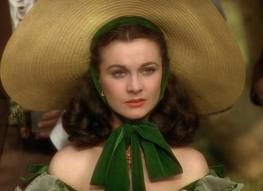 The first hour in particular is very difficult to get into, being populated by a huge number of characters who are all in some way unlikeable. The barbecue at Twelve Oaks consists essentially of spoilt rich people bitching about each other, with Vivien Leigh coming across as a childish brat who moans and screams and cries whenever she doesn't get her way. Leigh is a good actress who is undeniably beautiful, and very good at demonstrating the ambivalence of the character in her attitude to others. But we end up as ambivalent to her as she does to Ashley, and it take a lot of patience to stay with her character.
 Because the film is attempting to be so big in every single department, it ends up as the dictionary definition of sprawling. Although it just about manages to keep us focussed on the central characters (anchored by the great performance of Clarke Gable), the supporting cast is way too big, with potentially enthralling individuals endlessly drifting in and out. When characters do come back, they re-appear in the most contrived way imaginable; Sam, for instance, just happened to be sitting around the campfire when Scarlett was being attacked on the bridge.
 This brings us on the racial aspect of the film. The arguments here are the same as those surrounding The Birth of a Nation: do we accept the racial attitudes as a product of an historical period, or do we criticise such a revered film for being so deeply questionable? If we take the latter view, then the film is totally reprehensible, with almost every black character being reduced to pantomime; they never question their duty and seem incapable of functioning without being ordered around by impeccably dressed white nobles. If we accept the former, then the film is slightly more enjoyable, but the characterisation of Prissy as a screaming, incapable slave girl is still nothing short of toe-curling.
 In the last half hour, the film's poor storytelling is exposed and things get completely silly. In further testimony to it rambling, aimless style, most of the main characters are quickly killed off so that we arrive, very clumsily, at the union of Scarlett and Rhett. Every plot point in this section is prompted by an unfortunate death - Bonny falls from her horse like Scarlett's father, and Melanie falls mysteriously ill again, just so Scarlett can realise that Ashley never loved her. The plot drags laughably as we yearn to get to the staircase and Rhett's final line (which, of course, is not the end of the film).
 Gone with the Wind remains that most difficult of films: something which is so heavily flawed and hugely overrated, but also essential viewing for anyone who loves cinema. It is better than subsequent epic romances like Out of Africa because even at its weakest, baggiest moments it still feels like it is going somewhere. But its greatness is ultimately tarnished by its dated attitudes, poor storytelling and ramshackle structure. In short, it contains both the best and the worst that Hollywood has ever offered; it's massively, massively flawed, but also strangely irresistible.
Rating:
Verdict: Overrated but still essential


