
Reflections
-
It is weird to read my correspondences from the late August/early September
period, being the time of transition between my old function in life to my
new ...
14 years ago
Adaptation (USA, 2002)
Directed by Spike Jonze
Starring Nicolas Cage, Meryl Streep, Chris Cooper, Tilda Swinton
Although authors in general have pretty interesting lives, the physical act of writing is not particularly cinematic. Numerous filmmakers have tried to put writing on screen, but more often than not their efforts resemble po-faced versions of Monty Python's writing sketch, in which Michael Palin commentates on Thomas Hardy beginning his latest novel to a soundtrack of hysterical football supporters.
Adaptation is among the more successful attempts to put pen to paper on the silver screen. The reputation that Charlie Kaufman has accrued over the last decade leads us to expect the very best, and his screenplay is refreshingly loopy and intelligent. But it is not an unqualified success, being neither as tolerably quirky as Being John Malkovich nor as accessible in terms of characters as Eternal Sunshine of the Spotless Mind. The first hurdle which Adaptation has to overcome is the dangers associated with being self-reflexive. There is a very thin line between being self-aware and self-obsessed, and the more one points out how much what we are seeing is a construct, the greater the risk of a film becoming more of an academic discussion than an exercise in drama.
 There have been writers who have sought to deliberately exploit this alienating effect. Bertolt Brecht wrote plays whose characters constantly remind the audience that what they are seeing isn't real, so that they would ask deeper questions about the world around them. In a similar way, Kaufman wants to demonstrate the relationship between art and reality while giving the audience some form of artifice to pull them through. In wanting us to both unpick every line and enjoy the story in itself, he succeeds wholeheartedly on the first part and partially on the second.
 Adaptation is really two films running side by side. One is about a screenwriter struggling to adapt The Orchid Thief, and the other is about Charlie Kaufman struggling to be Charlie Kaufman, who also happens to be adapting The Orchid Thief. The film mixes personal insight into Kaufman's condition with more general ideas and comments about writing. It's hard to tell whether the Charlie Kaufman on screen is Kaufman himself, or a subtly exaggerated version as in Being John Malkovich. But in the end there is enough in the way of drama to prevent us expending all our energies on such restrictive lines of inquiry.
With this double-barrelled structure in place, Adaptation can begin to explore a number of themes, all of which use writing as a metaphor for modern life. The first of these is the classic conflict between creativity and commercial success, something which has been previously explored in films like Barton Fink. But where the Coen Brothers explored this in a contrast between John Turturro's character and the industry oddballs surrounding him, Kaufman and Spike Jonze try something a lot more introspective. Using seamless split-screen shooting, Jonze has Nicolas Cage playing both Charlie Kaufman and his fictional brother Donald. Charlie is the creative genius who believes in his principles and pushing the envelope of his art form - and who as a result is neurotic, depressed and exhausted. Donald, on the other hand, is a hack writer who is content to play the industry game and wants to be happy above everything else.
 The conventional thing to do would be to wage war between the brothers with Charlie coming out on top in a definitive triumph of art over money. It's a corner that Kaufman is entitled to fight, but he knows that being a screenwriter is not that straightforward - and he knows that we know it too. Instead of being constantly at loggerheads, Charlie and Donald begin to take on each other's traits, from Donald using Charlie's facetious suggestion in his script to Charlie attending a Robert McKee seminar.
 The point that Kaufman is trying to make is not simply the need to balance artistic purity with a sense of realism, but about how obsessing with one's art can lead one to lose sight of what really matters - the audience and happiness respectively. Charlie receives a drubbing from McKee for claiming that there can be no inspiration in ordinary life: in pursuing purity he has lost sight of whom he is serving as an artist. Donald is the device through which Charlie learns to adapt to the needs of the book, the needs of his audience and thereby to the needs in life in general.
Within this there is an existential comment about our perception and creation of personal realities. When asked by his agent what the problem with the book is, Charlie blurts out that it has no story, to which his agent calmly responds: "Make one up." In the absence of a defined progression from A to B in our lives - or at least, one that we can plainly perceive - we invent metanarratives and motivations for ourselves, if nothing else so that we don't have to spend all our time staring at a blank page. Adaptation also refers to evolution, which plays out in great detail in one of Charlie's early drafts. There is a discussion as to whether such change is mandatory, and if it is, then whether the need to show anyone is also mandatory. Meryl Streep's character begins as a clearly-drawn journalist, but as the film moves on we see the various changes which have occurred and how she has attempted to conceal these adaptations. There is a comparison with her character in Plenty, insofar as both women have their lives changed by chance encounters with men and spent the remainder of their lives becoming slowly disillusioned by a world which does not accept their new ideals.
 Some of you may have noticed that, in this review so far, I have devoted very little time to the director. That is less an indictment of Jonze's abilities than a reflection of the film's nature. Adaptation is a film in which the screenplay is the main player; it governs and determines everything, and Jonze's direction is appropriately understated to facilitate this. One could almost argue that Adaptation is the 8 1/2 of screenwriters, challenging both the auteur theory in which the director is king and audience perceptions that films are driven or dominated by actors.
 Then there is the group of New York intellectuals whose company Streep keeps; the dinner party sequence veers so close to the work of Noah Baumbach that had it gone on any longer, you would lose all patience with her character. The best performance by a mile is Chris Cooper, who genuinely inhabits John Laroche. You can almost smell the manky clothing and un-brushed teeth, and his rambling swathes of dialogue are both insightful and broadly comedic.
 Adaptation is another intelligent effort from Kaufman which is partially hamstrung by its character construction and Jonze's unwillingness to be more commanding with his camera. The ideas which the film raises are fascinating, and even Kaufman at his weakest is more insightful and engaging than half the screenwriters working in Hollywood today. But ironically for a film about writing, it would have benefited most from a director willing to put his foot down and create something a little less didactic.
Shadowlands (UK, 1993)
Directed by Richard Attenborough
Starring Anthony Hopkins, Debra Winger, Edward Hardwicke, Joseph Mazzello
If Alfred Hitchcock is the archetypal auteur, and Robert Altman is the ultimate actors' director, then Richard Attenborough is the consummate luvvie. Attenborough's career is that of someone so impassioned by acting and filmmaking that it leaches into every aspect of his craft, both in front of and behind the camera. Sometimes, as with Chaplin or moments in A Bridge Too Far, this passion becomes overbearing and compromises the integrity of what we are seeing. But sometimes, as with Shadowlands, it may be the thing which makes all the difference. Taken at face value, Shadowlands could almost have been a Woody Allen film: its central relationship is a late-blooming romance between an elderly, shy, somewhat neurotic man and an inquisitive, playful younger woman. It is also a textbook weepy, being a story which is rooted in tragedy and which will have you in tears by the end. But while it doesn't deviate massively from either mould, there is much about Shadowlands which is intriguing and stimulating.
For all the times when he has over-egged things, Attenborough does know how to assemble a top-notch cast, who sit in their parts like they were the only people who could possibly play them. Anthony Hopkins has a head start in this due to his experiences with Merchant Ivory, but even so he inhabits C. S. Lewis like no-one before or since. His accent may still be a Port Talbot brogue rather than a clipped Cambridge twang, and there are moments in which he is rather theatrical. But he remains utterly convincing and completely endearing to an audience.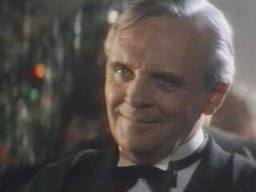 The theatrical moments of the film are not especially problematic either, for two reasons. Firstly, and perhaps obviously, it is adapted by William Nicholson from his original play. Because it is a direct adaptation by the same author, you can readily understand that the tone would be broadly similar, so that all the little flourishes which would occur on stage are captured and compressed on screen. But secondly, this is not problematic because the film does not feel stagey. Unlike Plenty, which tried to disguise its theatrical roots through clunky camera tricks, Shadowlands feels broadly cinematic and therefore when the moments of theatricality come, they do not disrupt proceedings too greatly.
Be that as it may, the film is guilty of one cardinal sin of stage-to-screen adaptations - namely that there are too many locations. There is a lot of travelogue footage in Shadowlands with the camera following our characters as tiny dots on a variety of landscapes, whether it's the hills of Herefordshire or the resplendent halls of Cambridge University. The film jumps from location to location a good deal more than it needs to, in an attempt to seem more epic, ambitious and by contrived extension cinematic. It doesn't quite fall into the trap of assuming that bigger scale equals better story, but on a number of occasions it comes perilously close.
The comparison between Shadowlands and Plenty goes beyond the technical accomplishments of the former. Both films approach the issues of routine and domesticity, and both feature women who don't fit into the very orderly, male-dominated world which is put before them. But what makes Shadowlands the more compelling is the dynamic of the central relationship, which in both films determines our ultimate response to the story. In Plenty, Meryl Streep's character is essentially passive-aggressive: she wants to change the world but not at the expense of moaning about how difficult her life is. This makes it more difficult for us to identify with her consistently, and we end up feeling sorry for Charles Dance having to put up with her. In the world of Susan Traherne, domesticity is a menace from which nothing productive or meaningful can emerge, and once a person has entered it their life is effectively worthless. Shadowlands is a lot more subtle and welcoming, with the settled nature of its characters serving as a springboard from which pure emotion can emerge. The need for Lewis and Joy Gresham to challenge each other, both personally and intellectually, gives us both a compelling drama and hope that we have not yet past our respective sell-by dates.
The great success of Shadowlands is its balance of the personal and the intellectual. The film raises a great number of fascinating theological questions to do with pain, suffering and the loss of childlike innocence, but it does not approach such questions with all the esoteric dryness of a Bible commentary. There is a rich vein of substance in the film which can be absorbed and will result in deep discussions afterwards. But the film can also be enjoyed purely as a romance, because its ideas are conveyed through characters we can relate to and conversations we can recognise. Much of the film is a debate about the role of suffering in human life - "the purpose of pain", as Lewis would put it. The film isn't afraid to confront this old chestnut of Christianity head-on, questioning the role of God in the events which transpire, both good and bad. Lewis is not immune from theological doubt, and is troubled so deeply by the loss of Joy that he erupts uncharacteristically when his academic friends try to comfort him. The early part of the film sees Lewis 'talking the talk' about pain and suffering, delivering lectures with an expression of sanguine satisfaction. But as the action moves on it becomes a film about 'walking the walk', putting Lewis' theories into practice and showing to what extent they bring comfort.
What makes Shadowlands so compelling as a religious or theological film is that there are no easy answers to any of the questions it raises. Joy criticises Lewis for his style of inquiry, quipping that "every time you ask a question, you know the answer already". The film is quite the opposite, neither giving a watertight theological explanation nor settling for a sentimental cop-out. We have to come to our own conclusions about where (if anywhere) morality lies, and whether Lewis was right to believe that God could still be at work in the midst of such tragedy. His passing words, that the pain of losing Joy is part of the deal of having a full life, leaves us hanging in the best possible way as we question our own attitude towards the Almighty. If anything, though, the central theme of Shadowlands is not whether pain is a justifiable part of life. It is mainly a film about openness, about baring one's soul and constantly questioning one's opinion of how the universe operates. The Narnia books are all about discovering and exploring fantastical new worlds, and yet Lewis himself a reluctant adventurer. His lecture on pain and suffering, which characterises God as a sculptor with a chisel, is repeated several times to show how he is set in his ways, whether by choice or unconsciously. The arrival of Joy is the beginning of a long period of questioning, which results both in deep sorrow and in levels of joy which he had never experienced before. As he says to Joy as she lies dying, "you've made me so happy... I didn't know I could be so happy."
 Shadowlands is a very moving film and may be Attenborough's best work, being tauter than Gandhi and more disciplined than Chaplin. Hopkins and Debra Winger anchor the film with convincing, understated performances, supported ably by Edward Hardwicke as Warney and Joseph Mazzello as Douglas. It isn't without its little problems, and it is too conventional in places, but as a piece it holds together and you find yourself getting swept up in the story. More than anything, this is a film made by someone with general affection for both the story and the characters, and it is made so well that a great deal of that affection is reflected back.
Rating: 4/5
Verdict: A top-notch thinking-man's tear-jerker
Plenty (UK/USA, 1985)
Directed by Fred Schepisi
Starring Meryl Streep, Charles Dance, Tracey Ullman, Sam Neill
Plenty belongs in the category of ‘miniature epics’, films which attempt the grand scale and sweep of Gone with the Wind, but on a fraction of the budget and often with a fraction of the story. They are normally romantic dramas or melodramas which have very little real depth but are involving and entertaining in passing. And Plenty is exactly that, containing little that will stimulate the deepest faculties, but also very little which is likely to offend or disgust. Being a romantic epic, we have to put up with a lot of contrivances, and it takes a good few minutes before we begin to absorb the themes of the film. We have to suspend disbelief very early on if we are to believe that Meryl Streep and Sam Neill can meet, make love and move on inside of ten minutes. This is arguably preferable to Streep’s subsequent epic Out of Africa, in which she and Robert Redford barely held hands before the hundred-minute mark. But it still feels incredibly abrupt, especially since the action quickly shifts forward to the post-war reconstruction.
Plenty is chiefly about how the high hopes and ideals which emerge from desperate situations like wars are gradually compromised by persisting institutions of reality, leading to feelings of disillusionment and personal failure. The characters make a series of highly idealistic statements throughout the film, such as “no-one will work soon” and “everyone will be rich soon”. The film ends with a flashback to Streep standing in a field on a French hillside, proclaiming that “there will be days and days and days like this” – a bitter irony considering all that has unfolded before this point. What makes Plenty different, and therefore interesting, is that this process of disillusionment is very gradual. There is no single earth-shattering event, like the ending of Chinatown, which causes the characters to resign themselves to the status quo and trudge off into oblivion. The path which the characters take is far closer to that which most of us take in our own lives. We start out with high hopes and relatively clear ambitions, and then we wake up one morning, forty years older and with barely a fraction of them fulfilled. The characters virtually sleepwalk into polite suburban society, and no-one other than Susan has the confidence or self-belief to fight it.
The theme of creeping domesticity runs throughout Plenty, and like the characters we don’t realise the futility and helplessness of the situation until it is too late to escape it. The speed at which their transformations occur varies markedly, and the film does a good job of linking these changes to a process of alienation, whether personal or political. Sir John Gielgud’s character is so effectively built up as a noble, old-fashioned patriot, that it makes perfect sense when he resigns at the height of the Suez crisis. The most poignant of these changes comes at the very end of the film, where Susan and Lazar meet for the second and last time. Up until now, Lazar has been the symbol of Susan’s dream, the yardstick for her own ambitions. But when he admits that he has slowly but surely become suburbanised, Susan’s dreams are shattered and she retreats hopelessly into the past. Within this general narrative about the battle between plenty and principles, there is an undercurrent about the marginal role of women. About halfway through we have a scene of a committee meeting discussing the logistics of the Queen’s coronation. Susan proposes a solution over when the toasts should be held, and is politely ignored by the chairman; a Viscount then makes an identical suggestion and it is heartily adopted. This theme is supported by Streep’s character, who is so forthright in her decisions and manner; she laughs in the face of rules and conventions, and in most of the scenes where she is surrounded by them she usually has a polite smirk on her face.
Unfortunately, this hints at one of the big problems with Plenty. Although David Hare’s script should be praised for making its characters believable, natural and three-dimensional, there are many long sections in which it neglects to make them likeable. We understand very early on about Susan’s moral compass, and how she must fight for what she believes in. But for a lot of the time she is either not doing this, or doing so in a way which makes it very difficult for us to empathise. Susan flits from one man to another seemingly on a whim, so that the passage of her character resembles Gregory’s Girl in reverse. When she asks Sting to father a child for her without any strings attached, she justifies it by saying: “perhaps I’m simply out of my time”. The camera then cuts back to Sting, who looks as baffled as we do. Elsewhere she behaves like a spoilt brat, moaning and complaining when things don’t work out; she throws a tantrum on the film set and fires a gun into the ceiling when Sting refuses to leave her. Hence when Charles Dance flings her into the chair and tells her how deeply selfish she is, we all sit their frantically nodding our heads.
An appropriate comparison would be with Julianne Moore’s performance in Savage Grace, which has certain sections which resemble Plenty’s level of sophisticated hysteria. Both Susan Traherne and Barbara Daly Baekeland get a kick out of being outrageous in polite company: compare Susan’s rant in the dining room with Barbara’s blistering tirade at the airport. But what separates the two is a layer of vulnerability and distress which an audience can connect with. When Barbara breaks down outside the airport, we genuinely understand how confused and betrayed she feels; we have witnessed her outrageous side, and then we come to understand it.
There are moments in Plenty where this happens, but they are few and far between and are not explored in nearly enough detail. Much of the script is occupied with bizarrely comic moments which feel like complete non sequiturs. The weirdest of these comes in the jazz café, where Tracey Ullman’s remarks: “that’s Alasdair, the one who’s meant to have hair on his shoulder-blades and apparently can crack walnuts in his armpits.” Later on Gielgud remarks that their Burmese guest “had his tongue so far up my fundament that all you could see were the soles of his feet”. Moments like this distract both us and the characters, undermining any sense of atmosphere that has been created. On top of this the film is incredibly stagey, with many overly long scenes packed with overly long speeches. A lot of Fred Schepisi’s direction seems pre-occupied with distracting us from this – in the long scene between Susan and the ambassadors, he flings in a few random zooms and dolly shots in a futile attempt to fool us. Ian Baker’s cinematography is dim and drizzly, and there is bad continuity in places; in one scene Sting’s hair is still ginger, as if he had come straight from the set of Dune.
Overall Plenty is a decent drama which is lifted by the good work of its cast. Alongside Messrs. Dance and Gielgud, Sir Ian McKellen puts in a good performance as the head of the diplomatic service, and there are pleasant cameos from Hugh Laurie and Hugo de Vernier (from the Pink Panther films). But despite its strengths the film is deeply flawed; it is too theatrical in its execution and has far too frustrating a lead to pass muster as a proper epic. Given the choice between this and Out of Africa, this is the better film, but its title aside it has little that could be called plentiful.
Rating: 3/5
Verdict: Passible but far from plentiful


