


Reflections
-
It is weird to read my correspondences from the late August/early September
period, being the time of transition between my old function in life to my
new ...
14 years ago
Four Lions (UK, 2010)
Directed by Chris Morris
Starring Riz Ahmed, Kayvan Novak, Nigel Lindsay, Adeel Akhtar
Throughout his career on radio and TV, Chris Morris has proved his calibre not merely as a comedy writer and performer, but as a bristling and savagely intelligent commentator on current affairs. Like Peter Cook at his very best, he combines an urbane demeanour with a ruthlessly acerbic eye, delivering comedy of extraordinary craft and attention to detail. Four Lions, his first venture into feature filmmaking, continues his fantastic run of form, being one of the year's best films and one of the best black comedies of the last two decades. The comparison between Morris and Cook is not mere hyperbole. For all their reputations as rebels, and occasionally uncouth ones, there is a sparkling intelligence running throughout their work, so that even at their weakest they always feel on a different plane to everybody else. From the "good AIDS/ bad AIDS" conversations in Brass Eye to the darker moments of The Day Today, Morris has continually caught audiences between wincing and laughing hysterically, between revelling in the absurdity of life and being openly shaken by reality.
 But despite this rich pedigree, there is no sense in Four Lions of Morris re-treading old ground, in the tradition of TV performers who translate to the big screen. The only vague character similarity comes in Omar's security guard friend; his opening monologue about marathons and running distances is a distant cousin of Steve Coogan's pool attendant in The Day Today, who insists after an accident that, year after year, "no-one died". Neither is it the case that Four Lions feels televisual; Morris' comedy has never felt constricted by the limits of a given medium, and he makes the transition to cinema pretty effortlessly.
 Being a British comedy, there are moments in Four Lions which feature or heavily rely on big, broad sight gags. These are the kinds of laughs which populate the trailers, since they are perceived by marketers as bringing in a mainstream audience who do not follow either politics or Morris' career so closely. That's not to say that Morris put them in specifically to sell the film; while they don't reach the heights of the satirical and verbal comedy, they are executed in the best possible way. There is quite a bit of pleasure to be had from watching someone firing a grenade launcher the wrong way, or blowing up crows, or running awkwardly with hydrogen peroxide stashed under their arms.
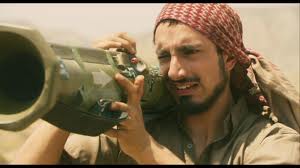 Had the use of such gags been more prolific, you could easily accuse Four Lions of exploiting its subject matter, barely scratching the surface in search of a cheap, mean-spirited laugh. But as the film moves on, all suggestions or hints of Carry on Bombing go out the window, as we grow in our relationship with the characters and view their actions in a more serious or pathos-ridden light.
 A key indicator of this is the sight of one of the bombers running towards the house with the explosives - he successfully mounts a wall, only to trip over a sheep and explodes before our very eyes. Whereas in previous scenes this would have induced a belly laugh, instead we sit there in shock, not quite believing what we have just seen. Morris has the confidence to keep the boundary between comedy and tragedy completely blurred; he doesn't feel the need to constantly get a laugh if a laugh is not what is needed at a given moment.
 Four Lions is an unusual comedy insofar as laughter or hilarity is not always the natural reaction which it produces. It sits in the company of Kind Hearts and Coronets or Dr. Strangelove, in which the overwhelming desire to laugh at the absurd or outrageous situations is balanced by an extraordinary sense of sadness or fear towards the characters. The final act of Four Lions, in which the four men decide to bomb the London Marathon, is up there with Charlie Chaplin's work in The Kid, or Buster Keaton at his most melancholic. Rather than lurch between laughing and lecturing, Morris invites us to recognise the sad and pitiful absurdity of what these four men are doing. While the four are all in some way stupid, disorganised and conflicted men, the film does not belittle them; it humanises them, allowing us to weep for their fate while laughing scornfully at the ideas which drove them to said fate.
 This marriage of tragedy and comedy is indicative of Morris' intentions as a comedian. Despite his uncanny ability to make people laugh, Morris has always had some form of serious intention behind his work, whether it's questioning stereotypes or approaching a controversial subject in a manner which cuts through all the hysteria and hyperbole of modern media. With Four Lions he has created a comedy which generates huge laughs in places while also raising all the difficult questions about the origins of terrorism in Britain, and if and how it can be combatted.
 The film is particularly strong at showing the impact of jihadist beliefs on the families of those engaged in terrorism. It cuts through all the nonsense of terrorists being portrayed as psychopathic loners, showing Omar (Riz Ahmed) as a family man attempting to reconcile his religious beliefs with his responsibilities as a husband and father. In one poignant moment, he tells his young son a bedtime story, explaining the principles of Islamic jihad in relation to The Lion King. In another equally sad scene, he poses as a hospital porter to get past police and say goodbye to his wife during her shift on reception. He says that he'll "be going now" and she glances back at him, tearful yet loyal to the last.
 Four Lions also shows the flawed, or at least unsympathetic, position of moderate Muslims, arguing that they are as potentially damaging to the public image of Islam as the suicide bombers. One of Omar's friends adheres very strictly to the teachings of the Qu'ran, to the point where he comes across as distant, arrogant and pious. While Omar does everything with his wife and doesn't force her to cover up, his friend refuses to stand in the same room as a woman; when questioning about keeping women in a cupboard during prayer meetings, he replies: "it was not a cupboard, it was a small room." At this point Omar and his wife respond by chasing him out of their house with water pistols, with Omar's wife declaring sarcastically that she is "out of control". It's a smart and funny way of showing the nuances of Islamic attitudes to women, which have all too often been reduced to simple-minded caricature.
 This scene leads onto one of the great set-piece gags in Four Lions (although gag is perhaps not the best way to describe it). At one point the four bombers meet at the house and discuss bombing the London Marathon. The camera keeps cutting between their conversations and the police pulling up outside a house, shot in night vision. This editing leads us to think that the bombers are going to be ambushed - only for the police to break into the 'study group' of the moderates, arresting the men and taking the women out of the 'cupboard'. Morris throws us a totally welcome curveball, and offers a memorable pay-off involving a freight container doubling for Egyptian soil and Weetabix being used as a bargaining chip.
 What makes Four Lions work as a study or satire of fundamentalism is that it doesn't claim to have all the answers for exactly why young people are doing this. Morris spent the best part of six years researching the film, and clearly understands that there isn't a one-size-fits-all answer to any aspect of this phenomenon. The film is concerned as much with exposing the hypocrisy of radical Islam as it is deflating the helpless, squirming responses of MPs and other authority figures. In putting every party, political or otherwise, under the spotlight, Morris is exposing and shaming the tendency to oversimplify the issues for the sake of sound-bites, or the cowardly approach taken by groups and politicians to avoid the issue altogether.
 Four Lions is a great black comedy which indicates that Chris Morris can be as good a film director as he is when working in TV or radio. It isn't quite perfect, relying a little too often on broad comedy in its first act, and there is the outside possibility that audiences will come away feeling that, in terms of pure laughs, they didn't get their money's worth. Make no mistake, Four Lions is an often hilarious film, but it is more than funny - it hits the rich seam of awkward or edgy comedy which leaves one feeling shaken as well as stirred. In short, it is an all-round triumph from one of Britain's greatest comedy talents.
Rating:
Verdict: One of the decade's best
The Magic Christian (UK, 1969)
Directed by Joseph McGrath
Starring Peter Sellers, Ringo Starr, John Cleese, Spike Milligan
If there was a category of films called 'WTF?!', then The Magic Christian would be the definitive example. Joseph McGrath's late-1960s satire assaults your senses and your intelligence over a disorientating and unrelenting 92 minutes. The result is both a colossal train-wreck and a memorable commentary on human greed, which if nothing else will make you laugh and freak you out. There are a number of reasons to get excited about The Magic Christian. It is based on the 1959 novel by Terry Southern, who co-wrote the screenplay for Dr. Strangelove. Stanley Kubrick hired Southern after Peter Sellers gave him a copy of the novel; Kubrick loved it and promptly re-worked Dr. Strangelove from a straight drama into a black comedy. The screenplay for The Magic Christian was co-written by Graham Chapman and John Cleese, just before they hit the big time with Monty Python's Flying Circus.
 The other huge draw of The Magic Christian is its cast, which reads like a who's-who of British comedy actors. Alongside Chapman and Cleese, who appear respectively as the Oxford boat race captain and Mr. Dugdale, the director of the auction, Spike Milligan turns up as a traffic warden whom Sellers bribes to eat his parking ticket. John Le Mesurier, who was in The Italian Job the same year, turns up as Sir John during the boat race, and Hattie Jacques cameos as Ginger Horton. There are also brief cameos by Christopher Lee as 'The Ship's Vampire', Raquel Welch as Priestess of the Whip (don't ask), Roman Polanski as a lonely drunk and an unrecognisable Yul Brynner as a drag queen singing Noel Coward's 'Mad About The Boy'.
 That last sentence should give you some idea of the sheer level of weirdness we are dealing with here. Like its contemporary The Bed-Sitting Room, the film has a very particular brand and style of humour, and once it has gotten into its stride it makes no effort to tone down or alter said style to achieve greater audience appeal. With this in mind, it is no surprise that the film was almost universally panned when first released, although both it and The Bed-Sitting Room have since been rehabilitated.
 On the one hand, there are many, many things wrong with The Magic Christian. Like a lot of 1960s comedies it is shambolically constructed with an episodic storyline, so that it ends up as less of a story than a series of sequences of famous people enjoying each other's company at our expense. McGrath had previously directed Casino Royale, the equally shambolic James Bond spoof which Sellers had left mid-shoot. Even at its best his direction is aimless and very sub-Richard Lester (who isn't that good in the first place).
 The story of The Magic Christian makes very little sense. After eccentric billionaire Sir Guy Grand (Sellers) decides on a whim to adopt a homeless orphan (Ringo Starr), they embark on a series of pranks designed (and I use that word advisedly) to prove that everyone had their price and will do anything, no matter how degrading, if enough money is offered. Grand supposedly gets this idea when buying a hot dog from a train: having no change he offers the man first a fiver and then a tenner, and the man crashes his hot dog stand off the end of the platform in excitement.
 What follows is a series of increasingly elaborate pranks which target the unsuspecting public (often played by famous people) in increasingly mean-spirited ways. Things begin fairly harmlessly with the parking ticket scene, or Guy going to a high-quality restaurant and behaving like a pig, eating caviar with his hands and throwing his food at the guests. But soon the tone of the pranks become more savage, with the boat race being sabotaged and ending with civil servants swimming for money in a vat of faecal matter from the local slaughterhouse.
 With scenes like this, you would imagine that The Magic Christian would come across as a hard-hitting if heavy-handed satire, in which the seemingly moral and upright citizens of the world are humiliated in such a way that we are forced to reflect upon our own selfish desires. Sometimes the film does manage this, but for all the moments in which it does there are at least as many moments where it loses sight of this message and settles for the weirdness of the scenes in and of itself.
 This is particularly evident in the centrepiece involving The Magic Christian itself, billed as the most advanced passenger cruiser ever made. Once the guests embark, all manner of things go wrong, starting with them being shown a film of a black man's head being transplanted onto a white men's body (questionable doesn't cover it). The ship's captain becomes steadily more drunk and is promptly kidnapped by a gorilla. Christopher Lee turns up and starts biting the passengers who flee to the hold, only to discover the engine room is filled with hundreds of topless rowers commanded by a whip-cracking Raquel Welch. They run off the ship, only to find that the whole thing was a simulator inside a London warehouse, with Sellers and Starr looking on completely deadpan.
 Other set-pieces are equally inexplicable. Whilst at a performance of Hamlet, the actor playing the title role (Lawrence Harvey) delivers the whole 'to be or not to be' speech as a striptease, for no apparent reason. On the train later on, Guy Grand holds a board meeting for designing a new car; the scene then cuts to an illustrative animation which is somewhere between Terry Gilliam's Python work and Yellow Submarine. Finally, on the same train, a series of Oriental gentleman rotate through hidden doors to sit next to a seemingly racist businessman, who is then dragged through the door, laughed at by divers in strobe light, and carted off the train by the Gestapo. The only natural response to such scenes is to sit open-mouthed, head in hands, going: "What the hell?!".
 On the surface, then, there is an awful lot wrong with this film. It's shambolically directed, the story is all over the place, and the main theme often gets lots amongst the cameos. And yet - somehow - it works. For starters, it is an achievement in and of itself that someone could make a comedy this spiteful and mean-spirited at a time when most mainstream comedies were light and frothy. Whereas The Party a year earlier was a playful throwback to the traditions of silent cinema, The Magic Christian points the way forward to darker, blacker comedies like Withnail & I and Heathers.
 The ultimate test of a comedy, past or present, is whether or not it makes you laugh. And The Magic Christian passes this test, even if, as in Dr. Strangelove, much of the laughter is awkward laughter. The art gallery sequence where Sellers cuts up a priceless Rembrandt is funny, and the following scene with Sellers bidding with klaxon horns and flashing lights showcases his brilliant comic timing. Sellers' characterisation is great, drawing on his work as Grytpype-Thynne in The Goon Show, and Ringo Starr is very sporting and convincing as a more deadpan Moriarty.
 The Magic Christian contains all that is good and bad about 1960s comedy. It is ramshackle in its construction, but no moreso than The Party, and it is very excessive and indulgent, but not to the point of utter frustration. Indeed, despite its myriad flaws it has aged considerably better than some of Sellers' other work from the same period. The film makes for enjoyably confusing viewing, and would make a good double bill with The Bed-Sitting Room. You'll laugh, you'll be confused, you might be offended - but somehow you can't bring yourself to hate it.
Rating:
Verdict: An enjoyably confusing shambles
Shock Treatment (USA, 1981)
Directed by Jim Sharman
Starring Cliff De Young, Jessica Harper, Richard O'Brien, Patricia Quinn
The only thing more foolish than remaking a cult film is making a sequel to one. This idea becomes worse still when that cult film happens to be The Rocky Horror Picture Show: no matter how many of the original cast return, it wouldn't be humanly possible for lightning to strike twice. For all its initial promise and moments of hilarity, Shock Treatment is a failure both as a sequel and in its own right. Shock Treatment could be called the middle instalment of an unfinished Rocky Horror trilogy. The unproduced third instalment, Revenge of the Old Queen, would have been set on the planet of Transsexual in the galaxy of Transylvania, with Frank N. Furter's mother (the Old Queen of the title) seeking revenge on Richard O'Brien's Riff Raff. While Brad Majors has become a Las Vegas go-go dancer and died from falling off a trapeze, Janet has become a mother through her night of passion with Frank in the first film, and brings their new-born child to this strange and twisted planet.
 Neither Shock Treatment nor Revenge of the Old Queen are direct sequels, retaining much of the same cast but playing different roles. Richard O'Brien and Patricia Quinn are still playing brother and sister, with Riff Raff and Magenta becoming Doctors Cosmo and Nation McKinley. Nell Campbell trades in Columbia for Nurse Ansalong, and Charles Gray's Criminologist becomes Judge Oliver Wright. They are joined by Barry Humphries, playing a Dr. Strangelove knock-off called Bert Schnick, and a pre-Young Ones Rik Mayall as 'Rest Home' Ricky. And in classic B-movie fashion, the main characters from the first film are played by different actors, with Cliff De Young taking over as Brad and Janet being played by Suspiria star Jessica Harper.
 Shock Treatment does attempt to tackle a number of interesting ideas surrounding the nature of television, using musical conventions to raise serious questions in a light-hearted way. To some extent it is about how advertising has come to dominate television and influence its content at the expense of serious programming. This is shown in Charles Gray's first scene, in which almost every word of his 'interview' is talked over by promo people and his disinterested host, played by Ruby Wax.
 The look of Shock Treatment is deliberately tacky and plastic. Everything within the TV station looks like an advert, with fake pinball smiles, garish 1950s colours and women who all resemble either air hostesses or fashion models. One song is set in a gallery of all the clichés of the American dream - the white picket fence, the perfectly sheared hedge and the man with his lawnmower. And there is the association of fast food consumption with being sane, which resembles a non-ironic mix of Monty Python's Appeal for Sanity with the New Seekers adverts for Coke.
 There is also an undercurrent in Shock Treatment about reality television. The population of Denton have given up their lives to become the permanent studio audience of this 24-hour TV station. Their entire existence is based around watching the lives of others, observing and obsessing over every last detail of relationships. The nature of the TV programmes such as Dentonvale reflect this voyeuristic desire; characters are committed to the asylum so that people can watch them go to pieces, all for the sake of entertainment.
 Sadly, all these interesting ideas end up getting lost as the film moves on. For all the subversive intelligence of O'Brien's ideas, his script and songs cannot convey them in a way which is meaningful, coherent or narratively sound. The result is a total mess which resembles channel surfing through a mixture of MTV and late-night game shows.
 The first and biggest problem with Shock Treatment is its story. In the case of Rocky Horror, the plot was assembled from different bits of B-movies and pushed forward by the songs: the familiarity of the references always gave you some idea of where it was going, or at least that it was going somewhere. Shock Treatment doesn't have those traditions to fall back on, and its existing plot is far too thin to stand on its own.
 Because the central story is so simple (Brad and Janet fall out, split and get back together), the film has to keep chucking different things into the mix to appear more sophisticated, until staying on top of it becomes as difficult as herding cats. There are too many characters on whom to focus, with both Rik Mayall and Nell Campbell being largely superfluous, and the rest are barely developed beyond suggestions of odd sexual preferences. In any case, the idea of real people being caught up in a lethal TV game show was handled better in The Running Man six years later.
 A related problem is that there is no strong central performance. In Rocky Horror, Tim Curry stole every scene that he was in, so that even if what was going on made no sense at all, there was a magnetism in the finished product which kept you interested. There is no such tent-pole in Shock Treatment: Cliff De Young is no Tim Curry, and he doesn't get enough screen time in either of his roles to build himself up. There is also no narrator who can come in to steer the ship: Charles Gray is shoved into the background and becomes a subplot with little bearing on events until the trite final revelation surrounding Brad and Farley.
 When The Texas Chainsaw Massacre 2 came out, Kim Newman wrote that it seemed to have been directed by someone who not only didn't make the first film, but who never actually saw it. And for all the good work that Jim Sharman did on Rocky Horror, there is a similar feeling with this film. Despite its deliberately tacky edges and madcap colour schemes, there is precious little of Rocky Horror's distinctive style remaining here. In fact, with all its 1980s fashion and emphasis on glamour, it begins to feel like a series of videos for The Human League or Michael Jackson.
 Then there are the musical numbers to worry about. The cast sing well enough, especially Jessica Harper in her musical debut. And there are one or two tracks which pass muster: the title track is catchy and 'Bitchin' In The Kitchen' is quite witty in combining marital frustration with household appliances. But the rest are just plain forgettable, with none of the syllable-stretching wit of O'Brien's earlier work. 'Little Black Dress' feels like an off-cut from Grease (and not in a good way), while 'Thank God I'm A Man' finds O'Brien ripping off Frank N. Furter's song from the first film.
 Worst of all, Shock Treatment is really quite dull. The cast clearly had a ball making it, but next to none of that fun rubs off on the people watching it. The story is too incoherent, the characters too uninvolvingly madcap, and after a while the deliberately plastic conversations between the presenters and audience becomes repetitive and tiresome. Even the prospect of Charles Gray singing and dancing - one of the highlights of the first film - isn't enough to rouse us: the sight of it just makes us wish that such an entertaining actor hadn't been so obviously wasted.
 Shock Treatment is a deeply disappointing misfire from Sharman and O'Brien. It was never going to match Rocky Horror on any level, and the creators deserve some credit for wanting to make something that could stand on its own and have something to say. But in the end all their efforts are in vain, with all that was magical and distinctive about Rocky Horror being mostly absent this time around. You won't need treatment after watching it, but to quote Rocky himself, it's a pretty big downer.
Rating:
Verdict: A disappointing misfire
The Life and Death of Peter Sellers (UK/ USA, 2004)
Directed by Stephen Hopkins
Starring Geoffrey Rush, Charlize Theron, Emily Watson, John Lithgow
It was always going to be difficult to make a film about the life of Peter Sellers. The man was an immensely complicated personality who claimed to have no underlying self. His life was a Molotov cocktail of drug abuse, women and heart attacks, interspersed with some of the finest character acting ever to grace the silver screen.
The Life and Death of Peter Sellers is an admirable attempt to portray or depict Sellers, recreating key scenes from his film career alongside problems in his personal life. But despite the best efforts of director Stephen Hopkins and a fine performance by Geoffrey Rush, it never quite satisfies either emotionally or biographically. Whether due to the physical limits of the production or the inherent complexity of Sellers the enigma, in the end it does little more than scratch the surface. On the plus side, Peter Sellers (as it shall hence be called) does a very good job of replicating the various period settings. There are all the usual batch of camera tricks, such as using green-screen to recreate streets, and the colours of the film have been manipulated to give the appearance of degraded stock. But on top of the usual whistles and bells, the film captures a number of moments in Sellers' life with such accuracy that it could pass off as a documentary. This is particularly true of the opening section where The Goon Show is recreated on stage, with all the riotousness and anarchy of the original broadcasts.
 The film simply wouldn't work if we didn't believe in the performance of the lead actor, and in this respect Geoffrey Rush is ideal. Although he has the aid of an army of wigs and vast quantities of make-up, he never lets the artifice dominate his characterisation of Sellers or the various roles therein. Rush goes through the same physical transformations of Sellers, moving over the course of the film from podgy to fighting fit and finally ghostly and frail. Most of all, he mimics Sellers' vocal performances very accurately, going beyond impersonation in almost every instance.
 But rather than just have Sellers playing the various characters from his films, Hopkins and Rush contrive to have Sellers playing most of the people around him as well. At key moments, the camera will go 'back stage' and we watch the same characters as played by Sellers. This self-reflexive tactic is unnervingly effective, because it reaches the very core of Sellers' character: he was only happy or honest when he was being other people. Seeing Sellers as Stanley Kubrick in the taxi, we get a more open insight to Sellers than we would ever get from the horses' mouth, and seeing him re-dub the scene of his wife leaving him conveys his desperate need to be loved at any cost.
 The other performances manage to match Rush in terms of quality, even if they don't all get the screen time they deserve. Emily Watson is very good as Sellers' first wife Anne Hayes, who struggles with his cruel streak and his distance from their children. Watson resists the urge to overegg the emotional torment, so that we are convinced that she still loves him even when his behaviour is at its most outrageous. John Lithgow is having a ball as Blake Edwards; even if he is occasionally larger-than-life, he taps into Sellers' ability to produce hatred and admiration often simultaneously. And Miriam Margolyes is a good choice for Sellers' mother, who dominates his early life and instigates his early attempts to get into film.
 On top of this, the film has a number of fantasy moments which are particularly touching. The best of these is the dream sequence in Sellers' head as he is being revived from his near-fatal heart attack. We see the various characters from his film career up to that point - Clare Quilty, Dr. Strangelove, Fred Kite etc. - gathering round his hospital bed, before Sellers rises up on a huge bomb and hits a button on his heart blowing them all up. It's a moment of brief assertion from Sellers, showing his determination to be taken seriously and not be defined or controlled by the other versions of himself on screen.
 Unfortunately, the problems with Peter Sellers eventually outweigh all the aspects of it which are successful. First off, despite its solid production values and fantastical ambitions, it remains very televisual. Doubtless the involvement of HBO, both financially and creatively, came with the very best intentions, and had the film not been released theatrically than this would not have been a problem. But on the big screen, Peter Sellers feels too compact and limited to cut the mustard, and the backstage sequences only reinforce the feeling that the world we are seeing on screen doesn't extend very far beyond it.
Tied up with this televisual nature is the problem of content versus length. Even with two hours to play with, there is far too much in Sellers' eventful life to fit around the constraints of a feature film. But rather than opt to tell the story in small segments, as a TV miniseries or whole season of shows, Hopkins and his team are forced to cherry-pick what they deem to be the most well-known or important bits. While the film therefore serves as a good introduction to both Sellers and his body of work, those more familiar with either will get frustrated by just how much has been omitted, and by how quickly the film gallops through his life. Sellers claimed that his time on The Goon Show was the happiest time of his life, and yet we only get about five or ten minutes of it, including Spike Milligan and Harry Secombe turning up briefly in later scenes. The film never touches on his relationship with The Beatles, or much of his film work in between Dr. Strangelove and the later Pink Panthers. Most annoyingly, there is nothing in it about his last two marriages, or the precise attitude he had towards his children.
 Because the film moves at such a pace, we find it hard to connect with Sellers as a person. This could, of course, be argued as the intention of the film - that Sellers shifted between characters so quickly that you could never see the real him. But in order for the film to work even as an introduction, we have to have some means of connection beyond his display of talent - and there are only fleeting opportunities in which this is possible. As with Mr. Nice, Bernard Rose's biopic of Howard Marks, there is a sense of information being intentionally withheld to such an extent that our ability to empathise begins to wane.
 Had the film been reconfigured for a TV series, we would have got a far greater insight into both Sellers and the various characters which filtered in and out of his life. When we are introduced to Maurice Woodruff, the fraudulent fortune teller played by Stephen Fry, we expect him to get a lot of screen time because of the level of influence he quickly comes to hold. Instead he only gets three scenes and dies off-screen without a second's acknowledgement, so that we never get a proper sense of how greatly Sellers depended on him.
 The Life and Death of Peter Sellers is a film whose failure may not be entirely the fault of its creators. Certainly compared to Hopkins' previous offerings - Predator 2, A Nightmare on Elm Street 5 - it is an undeniable work of genius. The problem may be the real Peter Sellers was simply too complex a man to be convincingly summarised in two short hours. In which case, the film is proof of its own failure, functioning as a workable introduction but being found wanting everywhere else.
Rating:
Verdict: Would have worked better as a TV miniseries


