

Reflections
-
It is weird to read my correspondences from the late August/early September
period, being the time of transition between my old function in life to my
new ...
14 years ago
The Go-Between (UK, 1971)
Directed by Joseph Losey
Starring Julie Christie, Alan Bates, Dominic Guard, Margaret Leighton
When I reviewed The King's Speech many months ago, I commented that "Merchant Ivory and their derivatives handled their stories with an emphasis on repression, creating scenes where humour was seldom tolerated and private anguish emphasised almost to the point of tedium." While particularly true of the Merchant Ivory stable, this criticism could easily be applied to The Go-Between, a film whose initial promise is ultimately strangled by poor storytelling and irritating characterisation. There's no denying that The Go-Between is good-looking. The film is shot by Gerry Fisher, who would later shoot William Peter Blatty's The Ninth Configuration and Aces High, a WWI drama starring Malcolm McDowell whose aerial scenes were reused in the final series of Blackadder. It is replete with painterly shots of huge fields, wide lakes and manicured lawns, which recall the landscapes of John Constable. The colour palette is quite bright for a period drama, and the summer setting invites us in.
 However, there is only so much of this visual poetry we can take before we start hankering for something resembling a plot. It is possible to make a slow, painterly film which also has narrative and thematic legs - Barry Lyndon being the best and most obvious example. Stanley Kubrick's 18th-century epic about ambition, materialism, war and honour manages to capture the pace of the past without boring us to tears in the process, something which The Go-Between struggles to do.
 It may be that the story of The Go-Between is more nuanced and involving as a piece of literature. A great deal many books rely so greatly on the subtleties of language that they are not naturally suited to visual media, whether film or television. Adaptations of Dickens or Bronte have generally got around this because the language is descriptive enough to create a ravishing visual world, and because there is an expectation with period drama that it once took an entire sentence to convey what we now say in a word.
 With The Go-Between, however, this approach doesn't entirely hold water. Harold Pinter's screenplay is largely faithful to L. P. Hartley's novel; considering Pinter's talent as a screenwriter, this would suggest that the story itself may be at fault. We spend an awfully long time waiting for anything to happen, and at 111 minutes the film is far too long for what is in essence quite a simple story. It attempts to compensate for this by inserting short snippets of Leo as an adult, talking to the now-elderly Marian. But there is not enough time devoted to these scenes in the main section of the film: they don't gain any meaning until the very end, in which case the sensible thing would have been to unite them as a separate epilogue.
 The Go-Between is essentially a coming-of-age story about forbidden or unrequited love. Leo's attraction towards Marian, played by Julie Christie, is echoed in Marian's relationship with Ted Burgess (Alan Bates), insofar as neither relationship can ever really come to fruition. Marian is deeply fond of Leo, and trusts him to deliver her messages to Ted, but in the end she is using him, stringing him along with little tasks which he thinks are winning her favour.
 As Leo grows to understand his role as "postman", he supposedly passes from a childlike adoration of women to a deeper understanding of the fairer sex. He becomes curious about how people express their love, pressing Ted Burgess to explain to him what "spooning" is. But unlike a more modern coming-of-age story, in which the male hero emerges wiser and more rounded in his view of women, Leo's experiences put him off women altogether; when he meets Marian again, he has become a shy, withered old man who never married. One could almost argue that The Go-Between is misogynist in its characterisation of Marian, whose so-called love is as poisonous as the deadly nightshade growing in her garden.
 Marian points to another problem with The Go-Between, namely the irritable nature of several characters. This is particularly the case with Julie Christie, who is a million miles from her more intriguing performance in Don't Look Now two years later. Here she is spoilt, stuck up and constantly preening, taking a repulsive pleasure in quietly belittling those around her. When Leo refuses to take her message, she throws a hissy fit, calling him ungrateful and treating him no better than the mud on her shoes. Whatever the intentions of Hartley or Pinter, we quickly lose patience with her, to the point where we almost stop caring about her relationship with Burgess.
 The other characters fare somewhat better, if only because they are so innocuous that we can't be bothered getting cross at them. Michael Gough looks the part as the father of the house, but his role and dialogue are very repetitive; his part becomes reduced to asking Leo if he is enjoying himself, while examining his barometer in the garden. Edward Fox is once again playing himself, letting the huge scar on his face do most of the acting, while Michael Redgrave gets far too little screen time. The only cast members who make any resounding impression are Alan Bates, who has charisma coming out of his ears, and the BAFTA-winning Margaret Leighton, who eventually comes into her own after spending most of the film just idly scowling.
 Like many period dramas, The Go-Between is also problematic in its rose-tinted view of the upper classes and its suspect attitude towards privilege. The central question in any character drama is this: why should we care about these people? It takes a long time to find any kind of satisfying answer, considering that the characters consider a croquet match to be arduous and constantly moan about the rain. In one early scene Leo remarks that he was born under Mercury, and Edward Fox tells him about Mercury being the messenger to the gods - a snooty comment which underscores their treatment of Leo is little more than an impressionable plaything.
 There are also a number of moments in The Go-Between which are unintentionally funny. The oddities of Edwardian English are played so unknowingly straight, and repeated so often, that the film's portrayal of the upper classes becomes a borderline parody. It's hard not to snigger at the near-constant mentions of bathing suits or the repeated comments of "What cheek!" when Burgess is found swimming in the river. At least with Chariots of Fire there was something meaty to chew on beneath all the "I say!"s and "What-ho!"s.
 Despite all these problems, The Go-Between just manages to scrape through once we stop thinking of it as anything more than tosh. Once we accept that the landscape and the rendering of rural England are the most that the film has to offer, we start to relax into it a little more and enjoy it almost in spite of its flaws. The cricket match is long and slow but quite pleasantly assembled, and although Dominic Guard's singing is toe-curling, the scene with Bates and Christie on the piano is perfectly passable.
 In the midst of all this gaiety, the film almost totally redeems itself with one of its final scenes. The confrontation in the haystack, where Marian's mother catches her with Bates, finds Pinter firing on all cylinders. The conversations between her and Leo beforehand contain much of his famously menacing wordplay, and Joseph Losey's camerawork is a lot more adept. The intense feeling of betrayal summed up in the silent exchange of glance is handled very well, undone only by a lazy cut to the present day.
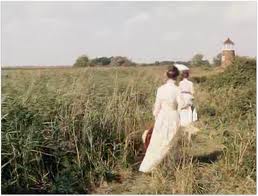 The Go-Between is a disappointing period drama which squanders a potentially interesting premise. Its myriad flaws with characterisation, storytelling and direction would normally produce a feeling of anger to match the disappointment. But ultimately it is too innocuous and escapist to be worth getting frustrated about. In the end the film is a beautiful series of landscapes with unlikeable, uninteresting people scattered therein. It's pretty, but it's also pretty dull.
Rating:
Verdict: Pretty, dull
In Bruges (UK, 2008)
Directed by Martin McDonagh
Starring Colin Farrell, Brendan Gleeson, Ralph Fiennes, Clemence Poesy
There have been a number of British gangster films in the last ten years which have re-approached well-worn crime thriller stories through distinctive dialogue, full-on violence and black humour. At its height this wave produced Gangster No. 1 and Sexy Beast, featuring barnstorming central performances by Malcolm McDowell and Ben Kingsley as near-mythical incarnations of evil. And while In Bruges never quite matches up to either of these, there is plenty in the way of humour and invention to render it thoroughly enjoyable.

 In Bruges is the debut film of playwright Martin McDonagh, most famous for his Leenane trilogy of plays - The Beauty Queen of Leenane, A Skull in Connemara and The Lonesome West. All three plays revolve around brutal acts of murder in which the death in question has left deep emotional scars on the perpetrators: in the case of The Lonesome West, it has caused the two brothers to divide the house precisely in two, with each brother owning what is on one side of a line.
 What connects all McDonagh's work is a rich streak of black, absurdist humour, which walks the same tightrope as Samuel Beckett or in some cases Spike Milligan between the utterly ridiculous and the drolly melancholic. The extremities of the characters in In Bruges are not simply a ploy on McDonagh's part to make a stock plot seem distinctive. They are there to deepen the archetypes and bring out more deeper, existential elements in the story and the characters, using banality to introduce depth.
 In Bruges begins with the same old story of a hitman (or hitmen in this case) hiding out in a foreign town after completing a job. Both men are faced with the prospect of being there for an undetermined amount of time, with nothing to do except spend their money and wait for instructions. Ken (Brendan Gleeson), the elder of the two, wants to take in the sights and wait patiently to move on, while Ray (an on-form Colin Farrell) is content to confine his sight-seeing to the bottoms of beer glasses.
 As with The American, Anton Corbijn's recent genre exercise, the characters in In Bruges carry guilt from a past mistake - in this case the death of a child during the assassination of a Catholic priest. Whole sections of the film tip their hat knowingly to Don't Look Now - so knowingly that Clemence Poesy feels the need to mention it on the set of the film-within-a-film. Just as Donald Sutherland keeps seeing images of a girl in red around Venice, and becomes convinced that he is seeing his daughter, so Ray's encounters with the dwarf actor are made all the more awkward by his memories of what went wrong.
 There are also strong connections with Bad Lieutenant, Abel Ferrara's striking depiction of Catholic guilt and redemption. Like Harvey Keitel's character, Ken and Ray are struggling with the ins and outs of judgement and redemption, struggling to come to terms with their purpose and meaning as they stare increasingly into the abyss. There are conversations about purgatory, and the film-within-a-film refers to Hieronymus Bosch, a 15th-century painter famous for his depictions of hell.
 Within this context, Bruges becomes the purgatory into which our characters have landed and whose attitude reflects their ultimate ability or willingness to escape. Ray feels immense guilt for what happened to the child, but this guilt is matched by a desire to atone and escape. His final words, as he is loaded into the ambulance and passes out, see him leaving purgatory, content with death over remaining there even if death leads to damnation. Ken, on the other hand, is more resigned to his fate and is less willing to put up a fight when Harry's angel of death arrives. Having killed many more men than Ray, he knows that he will never see heaven. Although he attempts to help Ray both in life and death, he ultimately allows death to find him and puts up very little resistance.
But by far and away, the biggest debt of In Bruges is to Harold Pinter, specifically The Dumb Waiter from which most of the premise is taken. It shares the central idea of two hitmen who spend most of their time talking and arguing about things which seem utterly irrelevant but are in fact nothing of the sort. And the final twist is the same, although this is revealed a lot earlier than in Pinter's script. The only massive departure, in terms of character at least, comes in the role of Harry, played with typical venom by Ralph Fiennes. Dumb is the last word you would use to describe his character, whose every word feels like an acidic curse even when he isn't swearing his mouth off. Because the genre ingredients are so familiar and knowingly played, there are two traps into which In Bruges could easily fall. The first is descending into total caricature, along the lines of Guy Ritchie's early efforts: the language and gestures become so ridiculous that all sense of believability is lost. Although Harry is particularly outrageous in his behaviour, the film stays just the right side of caricature, playing up the absurd elements while using the language and violence to keep us feeling threatened even as we laugh ourselves silly. A typical example of this would be Fiennes' first appearance, when he smashes his office phone to pieces in frustration. It's very funny to see a grown man concentrate his rage on something so small so repeatedly, but even as we laugh we realise that he is capable of doing the same thing to something more fleshy, with horrible consequences.
 The second, more common trap is that the ordinary nature of the story acts as a lead weight on the character development: in other words, the story is too thin or straightforward either to allow extended character development, or to give any reason for such a thing to occur. While In Bruges doesn't completely fall into this trap, its story is disappointingly simple once all the language, violence and pondering has been stripped away.
Because of its clear resemblance to Pinter's work, one could argue that this criticism should not be levelled against McDonagh but Pinter himself. Pinter was part of a theatrical tradition started by Beckett in which characters existed and acted regardless of or in absence of any story - Beckett's later plays often occur well after the action has taken place, and said action is only referred to in passing. But this paucity of actual plot has not prevented some of Pinter's other works from translating successfully to the screen, most notably The Birthday Party and Betrayal. In Bruges is caught between a rock and a hard place in its relationship to genre. On the one hand, the touchstones to previous crime thrillers are so clear that it struggles to escape from convention when it really needs to: we know more or less where it is going even before Harry arrives, and so its scope for exploring things on a profoundly existential level is limited. On the other hand, when it does manage to elevate itself above convention, there is not enough narrative drive in the characters to prevent their conversations from going around in circles. As The Bed-Sitting Room proved, it is difficult to put work in Beckett's vein on screen without it feeling lacking in narrative, something which is perhaps less of a problem on stage.
 While this aspect of In Bruges remains frustrating, the film is still thoroughly entertaining thanks to the quality of its cast. Fiennes is the highlight, with Harry being clearly modelled on the work of Louis Mellis and David Scinto: in his relentlessness and constant anger, he could pass for a cousin of Don Logan. That said, his performance wouldn't work without someone more understated to counterpoint him, and Farrell achieves that masterfully. Having drifted in his career between total fluff (Alexander) and pretentious waffle (The New World), he gets the balance spot on to deliver a performance of vulnerability and sympathy. Gleeson anchors things in another fine performance, and Clemence Poesy is every bit as sweet and charming here as she was in Philip Ridley's Heartless.
 In Bruges is an interesting, entertaining and often hilarious take on a well-worn story and subject area. It is ultimately a little too generic for its own good, with McDonagh wrestling with the self-imposed confinements of genre in an effort to combine existentialism and narrative. The result is a partial success which makes for great late-night viewing, and while not up there with Gangster No. 1 or Sexy Beast, it comes through with most of the goods and hints at better things to come for its director.
Rating: 
Verdict: Overly generic but highly entertaining
The Wicker Man (UK, 1973)
Directed by Robin Hardy
Starring Edward Woodward, Christopher Lee, Diane Cilento, Britt Ekland
Beneath the glittering skin of their acclaim, many of our most celebrated films have a dark underbelly, a troubled history or strange aura surrounding them which may explain or undermine their status. Sometimes such knowledge can render a film like Smaug the Dragon: spectacular and threatening at first glance, but ultimately vulnerable to attack. But with The Wicker Man, these tall tales and strange stories are just the clues we need in attempting to discover which makes this film so great. Any film which gets branded "the Citizen Kane of horror movies" has an awful lot to live up to. Quite apart from the blinding hyperbole in this statement, it's also an odd description considering that The Wicker Man for the most part isn't a horror movie at all. It has a loose connection with the giallo tradition of pulpy horror-thrillers, having been paired with Don't Look Now when first released. But The Wicker Man's visuals are much more downbeat and naturalistic, and the horror comes less from expression than from suggestion, cultivating a sense of creeping, shapeless dread which threatens to engulf everything.
 At its heart, The Wicker Man is a mystery film, with some of the more introspective elements of film noir but very little of that genre's visual style. Its low-budget aesthetic and initial focus on police procedure mean that it could pass off as an extended episode of Z-Cars, and Edward Woodward's character is a classic old-fashioned copper in the mould of Dixon of Dock Green. He is a pillar of the community with entrenched moral values, quick to make his opinions known and never taking 'no' for an answer.
But the film to which The Wicker Man owes the greatest debt, structurally speaking, is the Powell and Pressburger romantic drama I Know Where I'm Going!. Both films begin with the premise of our central character taking a journey to a mysterious place with a very clear purpose - Joan Webster to get married, Sergeant Howie to find the missing girl. And the central plot of both films is essentially a McGuffin, designed to keep said characters in one place so that their environment and the characters that populate it can trigger an important change. That is not to say that The Wicker Man doesn't work as a mystery in and of itself. On the contrary, it has to work. Because it doesn't romanticise Scotland in the manner of Powell's film, the plot has to be twisty and murky enough to keep Howie on the island out of his own curiosity. Although there are large mythical elements to the plot, these are not invoked in a broadly fantastical way, and so it simply would not be enough for the weather to be the only thing preventing Howie from going home. As he interviews the locals, gathering conflicting information, we become more engaged with what is going on, partly on an intellectual level as we try to figure it out, but also on an emotional level as we see Howie being utterly repulsed by the entire culture of Summerisle.
 Using the device of a police officer gathering information to solve a crime, The Wicker Man slowly reveals itself as a compelling and intelligent examination of a clash between two cultures, each being deeply entrenched but also seeming out of place with the real world. Howie's puritanical brand of Christianity is every bit as extreme and farcical as Lord Summerisle's praise for fire-jumping rituals, not to mention the May Day celebrations involving dressing up as Punch and decapitation. The 'paganism' practised by the inhabitants of Summerisle seems archaic and bizarre to our 'enlightened' eyes, but we do not embrace Howie's devoutness as an antidote to this. This is not a film which seeks to discredit paganism in favour of Christianity, or indeed the other way around. Its central purpose is to explore the flaws of both belief systems and their relationship with culture and human nature.
 Anthony Shaffer wrote The Wicker Man is an examination of different sides of human nature represented by Christianity and paganism. Shaffer's previous screenplay, Sleuth, had explored the idea of class warfare under the pretext that the different classes in the end need each other, and each has its own advantages and disadvantages. It is much the same with The Wicker Man, with paganism standing in for the animalistic side of humanity, which is primal and at one with nature to the point of worshipping it, and Christianity posing as civilisation, with mankind as the dominant force and the bearers of both morality and rationality.
 Because this symbolism is explored so intelligently, we can forgive the film for not being an entirely accurate depiction of pagan religion. The various rituals and myths in the film are cobbled together from ancient British folklore and scholarship which has long since come into question. But in the end it doesn't really matter that pagan communities don't necessary burn people as offerings to sun gods. What matters is the imagery this conveys, of the animalistic past of mankind lurking deep within each of us and finally exploding forth in a powerful but ultimately pyrrhic gesture.
 The final sequence with the titular wicker man remains terrifying, not just because of what we see on screen but because of what it conveys symbolically. Seeing a man being burned to death is frightening; the close-ups on Edward Woodward's face as he commits his spirit into God's hands are deeply chilling. This sensation is compounded by the choice of music: while Lord Summerisle leads his followers in a full-blown rendition of 'Sumer Is Icumen In', Howie screams the opening of Psalm 23 as the two deeply opposed belief systems continue to lock horns even in defeat. But as with Christ's death upon the cross, even in defeat there is a twist. If the sacrifice does not work, if the devil's plans do not come off, the people will turn on the devil himself and all that he has worked for will be undone.
The music of The Wicker Man hints at what makes has made the film so compelling for so long. Although there are sections of suspense, or intrigue, or outright horror, the primary mood of the film is one of total oddness. Halfway through the production, Robin Hardy announced to the surprise of everyone that the film was going to be a musical, with Paul Giovanni supplying both original score and several re-workings of English folk songs and nursery rhymes. The songs, coupled with the peculiar colour palette, make The Wicker Man border on the ridiculous, with the tone moving from the bawdy comedy of 'The Landlord's Daughter' to spiritual soul-searching as Howie attempts to pray. Christopher Lee may sing very well, but trying to take the fire-dancing song seriously will get you nowhere. This disparity between the subject and its presentation is what makes The Wicker Man so unusual and so memorable. But it also alludes to the difficult birth it had, in which Hardy's decision to add the songs was the least of its problems. The director, art director and producer fell out constantly, leading the latter to describe the film as being directed "in spite of Robin Hardy" rather than by him. Britt Ekland was incensed that her dialogue had been dubbed and that her nude dancing had been replaced by, in her words, "a big-butted body double". After the film was completed, its distributors cut and lost whole sections of the film, with Christopher Lee accusing British Lion boss Michael Deeley of burying the negatives in motorway landfill. The whole film had an aura of ill will surrounding it which makes it a small miracle that, in its 'director's cut' version (the best that survives), it works as well as it does.
 The Wicker Man remains a flawed but fascinating cult film which still has the ability to terrify after all these years. Woodward and Lee give excellent performances and the film is a smart and agile examination of sexual, cultural and religious tension, which sustains our interest through both the central mystery and the all-encompassing oddness of how it plays out. While not quite the masterpiece that it is often hailed to be, it remains a triumph of British filmmaking and a career high point for all concerned.
Rating: 4.5/5
Verdict: A fascinating culture-clash fable
The Bed-Sitting Room (UK, 1969)
Directed by Richard Lester
Starring Ralph Richardson, Arthur Lowe, Peter Cook, Dudley Moore
Nobody makes cult films like the British. From the chilling horror of The Wicker Man to the high-camp lunacy of The Rocky Horror Picture Show, Britain has produced more than its fair share of cinematic oddities which were just too much for the mainstream. And no film is more emblematic of this particular brand of oddness than The Bed-Sitting Room, a film which makes even The Man Who Fell to Earth feel disciplined and coherent. The Bed-Sitting Room began as a one-act play by Spike Milligan and John Antrobus, who had collaborated in the later years of The Goon Show. After a successful run at the Marlowe Theatre in Canterbury, it was extended into a full-length play and ran in London to critical acclaim throughout 1963. After a successful revival four years later, Richard Lester entered into discussions about making a film version.
Although Lester became successful through his work with The Beatles, his career had been kick-started by Milligan; their eleven-minute short, The Running, Jumping and Standing Still Film, was Oscar-nominated in 1960. As the decade wore on, Lester's output became more blackly comic in tone, particularly with the 'anti-anti-war' satire How I Won the War. Under these circumstances, The Bed-Sitting Room seemed the ideal project for the budding director. The presence of Milligan, both as a co-writer and in a supporting role, does lend comparisons to The Goon Show. Aside from its surreal, absurdist humour and madcap cast of characters, the plot is similar to an episode called 'The Nadger Plague', in which Eccles and Neddie Seagoon end up being turned into a gas stove and clock respectively. But in fact, the film is closer to Milligan's later work on the Q series, being every bit as visually outrageous and every bit as inconsistent.
This inconsistency derives mainly from the fact that there is no 'restraining device' on Milligan's humour - there is nothing to stop him or the plot wandering off on some stream of manic energy. In The Goon Show, having an audience meant that there was a cut-off point for the humour, either by laughter or by the 30-minute time limit. Even though The Bed-Sitting Room barely makes it to 90 minutes, bits of it feel much longer because there is no natural brake on proceedings. The lines come so quickly and the jokes from so far out of left-field, that we are given far too little time to stop, laugh and take it all in. On top of this, Lester is not the most accomplished director when it comes to narrative. Like Nicholas Roeg after him, his films often contain very odd experiments with colour; there is one whole section in which the screen is bathed in a mixture of red and green light, for no apparent reason. And like The Man Who Fell to Earth, the film gives very little clue as to the passage of time. In place of pace, we have long, lingering shots of the devastation of London, which in some way foreshadow the junkyard scenes in Superman III. The film has so many characters and stories running around and it really struggles to bring them altogether, even for a couple of scenes.
 Just as The Goon Show often poked fun at the army, health service and labour exchange, so The Bed-Sitting Room is a comedy about various British institutions. The film takes place after a "nuclear misunderstanding" which led to the shortest war in history - "two minutes, 28 seconds, including the signing of the peace treaty." All the institutions that made up mass society (the army, the postal service, the NHS and the church) are now being run by lone survivors. The film begins with a BBC newsreader moving from one abode to another, reading the last recorded bulletin before the bombs fell.
When questioned about the film's meaning, Milligan said it was a story of how, after the dust had settled, man would simply rebuild society and carry on as if nothing happened. Though it's a cliché, the film embodies the British spirit of 'keep calm and carry on'. One of the characters actually offers "we're British" as an explanation when asked why the survivors are carrying on, trying to live their lives as if nothing happened. Nobody ever talks about the bomb specifically, and the main advice of the police is just to "keep moving", never mind where to. By having characters carrying on as if nothing had changed, The Bed-Sitting Room is making two very different points. Firstly, it demonstrates how impersonal most social institutions are: without masses of people working as cogs in the machine, they are little more than empty shells. It makes no sense to have the whole National Grid being powered by a man on a bicycle. Neither is it common sense to crown the Queen's tea lady as ruler of the British Empire. The Bed-Sitting Room is absurdist both in premise and in purpose: it is absurd to cling on to the past and the familiar when the world has so irrevocably changed.
But if the film attacks institutions, it is a lot kinder to the characters that inhabit them. Out of the myriad plot threads and episodic bouts of nonsense, there emerges a central story about a pregnant woman and her lover; in the manner of Children of Men, she is effectively carrying the future of humanity. The second message of the film is that even in the midst of all this chaos and clinging futilely to the past, there is some kind of hope for the future. The film ends with a parody of the second coming, as Roy Kinnear warns people to repent and Peter Cook descends from the sky and tells the survivors that everything will be alright. Although The Bed-Sitting Room is designed to be a comedy, you won't spend an awful lot of time laughing. The film is not a failure because of that, since there are a great many comedies which don't provoke outright hilarity. You'd be hard-pressed, for instance, to find anyone who laughed during the montage of atomic explosions at the end of Dr. Strangelove. A number of moments will raise a chuckle, like Harold Wilson agreeing the rent of 10 Downing St. with Mao Zedong, or the scenes of Marty Feldman's mad nurse screaming down a zip wire and crashing into a tree. But the primary response to the film will be a mixture of sadness and bewilderment.
 There is a huge vein of Beckett-esque pathos surrounding these characters - the play was once described as "Waiting for Godot with better jokes". Two characters in the film end up mutating into inanimate objects; Lord Fortnum becomes the bed-sitting room, and Mother becomes a wardrobe. A third character, played by Arthur Lowe, ends up as a parrot which is eaten for dinner. When these characters 'speak' in echoed sentences, it is like hearing the ghosts of the past - the people who inhabited this world and these rooms, both of which are now seemingly useless.
There is, equally, a copious amount of scenes which cause you to stare at the screen in total bafflement. Take Harry Secombe's character, who lives underground, staring at old film stock and ranting about 'Haig the butcher'. In one very odd scene, he asks Mother to be his wife, because a cut-out on the wall cannot satisfy him. Instead of a bawdy sex scene, she then starts throwing crockery at Secombe, who tries to explain that he wasn't having an affair. Such oddness is textbook Milligan, but it comes so far out of nowhere that we fail to understand its relevance, either in that moment or in the story as a whole. The Bed-Sitting Room is a really ramshackle concoction and a bona fide cult film. It is absolutely a product of its time, and a classic example of a film which simply cannot be re-made. It's not as consistently funny as either The Goon Show or Monty Python's Flying Circus, and it does require an awful lot of patience. But there is some joy to be had both from its message and from watching an all-star cast of British eccentrics clearly having a ball. Recommend viewing for all who seek to be baffled.
Rating: 3/5
Verdict: Very British and very baffling
The Man Who Fell to Earth (UK, 1976)
Directed by Nicolas Roeg
Starring David Bowie, Candy Clark, Rip Torn, Buck Henry
Philip Ridley once said that “watching a film has always been both an experience and a process; we experience it first and we spend the rest of our lives processing it.” Each of us can cite examples of films which were memorable experiences to watch and which have dogged our imaginations since that fateful first viewing. Sometimes the film is so perfect we embrace it and analyse it ad infinitum; sometimes it is so hideous that we are repulsed and vow to avoid that area forever. And sometimes, as with The Man Who Fell to Earth, the experience is just so strange that we don’t know what to think. The Man Who Fell to Earth is a notable meeting point in many interesting careers. It was maverick director Nicolas Roeg’s follow-up to Don’t Look Now, a flawed but fascinating Gothic tale of grief and the supernatural. It was produced by Barry Spikings and Michael Deeley, who would later win Oscars for their work on The Deer Hunter. And it marked David Bowie’s first foray into film, having failed to get an adaptation of Nineteen Eighty-Four off the ground.
More than any of that, it is also one of the strangest, oddest and most baffling films ever to have come out of Britain – quite something for the country which gave us The Wicker Man. Roeg’s experimentation with colour, composition and narrative structure takes a relatively straightforward science fiction story and distorts it ruthlessly, creating something which is incoherent and indulgent, but utterly memorable. Based on a 1963 novel by Walter Tevis, The Man Who Fell to Earth is something of a bridge between the drug-induced hippie culture of the late-1960s and the post-Altamont paranoia of the 1970s. Its visual style is reminiscent of Michelangelo Antonioni, particularly The Passenger and Zabriskie Point. Both films rely on long slow scenes with lengthy takes, and the camera is as much in love with the landscape as it is with the characters dotted around it.
There are also hints of Andrei Tarkovsky in Roeg’s work. Like The Mirror, The Man Who Fell to Earth plays out like a stream of consciousness with no particular interest in narrative. And as with Solaris, part of what story there is includes a man wanting to rejoin his family on a distant planet. We watch David Bowie’s mind conjure up images of a strange desert world, and are not sure whether we are seeing what is real or illusion, the future or the past. One of the distinctive features of The Man Who Fell to Earth is its complete disregard for the passage time. Characters physically age, but there is no clue as to how much they age by or how long it has taken Bowie to accumulate all his wealth and power. Roeg deliberately sought to remove the “crutch of time” from his audience, a decision which makes the film deeply incoherent. Couple that with the generally slow pace of the film, which runs to two-and-a-half hours when fully uncut, and you would expect the whole project to collapse into a soupy heap.
This is avoided by Roeg’s striking visuals which pull us into the world of the film and keep us totally engrossed (if freaked out) by what is going on. Like Ken Russell before him and David Lynch shortly after, Roeg puts images on screen which are so horrifically beautiful that we can be fixated by what is happening even if we have no idea what is going on. The scenes of Bowie’s home planet, inhabited by hairless creatures with air packs and yellow eyes, is up there with the acid queen sequence in Tommy. The Man Who Fell to Earth is a deeply druggy film, right down to Bowie’s entrance which resembles footage of Syd Barrett (allegedly) tripping on mushrooms in a quarry. This psychedelic feel spilt over into the production, since the film was made at the height of Bowie’s cocaine addiction. Perhaps the only way to rationally understand the film is to liken it to an acid trip or lengthy state of drunkenness, in which little makes sense and one has little control over events playing out before you.
It’s therefore hard to know whether the film’s indulges with both time and content are deliberately intended to reinforce this effect or are simply a case of poor discipline. By and large Roeg is well-behaved behind the camera, choosing his angles for their propriety rather than to show off his skills as an editor. His use of zooms, while repetitive, does enhance the film, mimicking our wandering minds that focus on something on a whim for no good reason. That said, we do have to put up with the gratuitous shot of Candy Clark urinating in fear, in which the camera focuses tight on her underwear in a really uncomfortable manner. Being an X certificate film, The Man Who Fell to Earth also has its fair share of nudity and graphic sex. We get full frontal scenes of Clark and Bowie, and scenes of Clark and Rip Torn making love in a manner which resembles a mugging. Although none of these scenes are exploitative, they are far removed from the famously delicate love scene in Don’t Look Now. We also have to put up with a parade of teenagers staring at Torn’s genitals and remarking: “you don’t look anything like my father”.
But beneath all its incoherence and excess, The Man Who Fell to Earth is an insightful and powerful film about the destructive effects of wealth and the lifestyle that goes with it. Beyond the obvious irony of the story (a man sent to find water ends up becoming a drunk), the film demonstrates how someone of seemingly noble intentions can end up as a bankrupt vessel of decay. Thomas Jerome Newton begins with no emotions and a singular focus on his mission, setting up World Enterprises with the express purpose of helping his planet. But the longer he stays on Earth, the more Newton absorbs the lifestyle and values of our planet until he loses all desire to help anyone. Just as Charles Foster Kane was based on newspaper tycoon William Randolph Hearst, so there are shades of real life enigmas in Bowie’s performance. The most obvious comparison, aside from Hearst, would be with Howard Hughes. Both individuals are obsessive by nature, with the ability to conjure up wealth and power out of nothing. Like Hughes, Newton entertains the possibility of travel by seemingly unrealistic means. And like Hughes, Newton becomes a recluse who is both tormented and fascinated by film and television. Think of Newton as Kane’s mentally deranged, druggy half-brother – and even then, you’re only halfway there.
Much has been written about Bowie’s performance, which is the best of his erratic acting career. Bowie literally inhabits Newton to the extent that he lived the lifestyle of the character long after the film had wrapped. The covers of Station To Station and Low are stills from the film, and Bowie’s persona of The Thin White Duke was in some respects a perversion of Newton’s mental state. His performance is the mainstay of The Man Who Fell to Earth, the touchstone which sustains our attention and prevents us from being completely alienated. His pathos-ridden delivery and unusual beauty pulls us hypnotically into the world of Newton and his various pleasures, and the heartbreak is genuine as he slowly but inevitably falls apart. The Man Who Fell to Earth is a remarkable feat of science fiction which finds Roeg at the height of his powers. It can’t be called a masterpiece, because of its blatant disregard for anything resembling discipline or coherency. But it is a deeply cinematic experience with a sense of ambition and scope which is rare in filmmaking, even for the period in which it was conceived. It holds up both as a bona fide cult film and as the document of a bygone age, in filmmaking and in Western society. It’s baffling, bizarre and utterly bonkers, but never anything less than unforgettable.
Rating: 4/5
Verdict: Rambling and ridiculous but ultimately rewarding


