
Reflections
-
It is weird to read my correspondences from the late August/early September
period, being the time of transition between my old function in life to my
new ...
14 years ago
Porco Rosso (Japan, 1992)
Directed By Hayao Miyazaki
Starring Shuichiro Moriyama, Akio Otsuka, Tokiko Kate, Tsunehiko Kamijo
With Studio Ghibli films consistently topping the Japanese box office, Hayao Miyazaki could afford to take a few risks. Amid the constant clamour to bring Princess Mononoke to the big screen, he crafted Porco Rosso, a notable departure from the themes and characterisations of his previous work. But despite its more male-oriented storyline and realistic backdrop, it remains every bit as magical as the master's more direct dabbles in fantasy. Porco Rosso began life as a short promotional film funded by Japan Airlines. As the production grew, the airline continued to fund it and gave it in-flight distribution long before its theatrical release; in spite of this, it was still the highest grossing film in Japan that year. The legacy of the airline's involvement can be seen in the opening sequence, which lists the title and key cast members in ten languages.
Porco Rosso is a marriage between two related tropes or motifs in Miyazaki's work. On the one hand, the film is a tribute to European war films and the Hollywood romances of the 1940s, containing strong references to Casablanca and A Matter of Life and Death. On the other hand, the film contains Miyazaki's own perspectives on war, honour and gender equality, held together by his continued obsession with flight. The film was originally going to be set in Croatia, but was altered to fascist Italy and made darker following the outbreak of war in Yugoslavia. Like all of Miyazaki's work, the design of Porco Rosso is fantastic. The lovingly hand-crafted feel of the old-fashioned aeroplanes and the pilots' paraphernalia is immensely detailed, making even the most ridiculous of machines feel grounded in reality. The animation is much more kinetic than Nausicaa of the Valley of the Wind, so that while the flying sequences retain a poetry and grace, they are also a lot more exciting. The fly-by sequences, with the planes swooping low and causing chaos, are particularly well-executed so that they don't feel choreographed.
From a more narrative point of view, the great success of Porco Rosso is its ability to turn the most hackneyed elements of wartime romances into something new and interesting while simultaneously paying homage to these stories. Although the character of Marco is clearly inspired by Humphrey Bogart, you never get the sense of the film's creativity being held back by a need to be respectful to these archetypes. This is in stark contrast to Dreamworks, whose affection for old Hollywood and more adult movies frequently stifles the initial creative spark of their films. There are any number of scenes or elements in Porco Rosso which inject an air of surprise or unpredictability into familiar characters. The most obvious is the fairy tale element at the centre: the main character is a pig, but the rest of the cast accept his nature like he has been that way forever. There is a certain amount of prejudice that goes with Marco's nature, but this is more along the lines of racist epithets than sardonic, Pirandello-esque commentary.
Likewise, when the schoolchildren are kidnapped in the opening set-piece, they treat it as an adventure, causing havoc on the pirates' ship and willingly jumping overboard when it is forced to land (one of them explains that they are all part of the school swimming team). The central romance between Marco and Gina is only hinted at, and the ending on these grounds is surprising: as with Casablanca, their romance is not so much consummated as left hanging on an uncertain, slightly bittersweet note. All of these careful decisions mean that the film can get away with some of its more unusual creative choices. The build-up to the final showdown between Marco and Douglas is immense, leading us to expect a highly tense dogfight and a breath-taking climax involving burning planes and crash landings. But although this set-piece is dramatic, it isn't climactic in the traditional sense. There are dogfights and one huge belly laugh when Douglas gets hit by a spanner, but otherwise it's an internalised battle of wits with no real resort to spectacle.
 In any other film, such an approach would feel like a massive let-down - and considering Miyazaki's running theme of pacifism, it seems like an odd thing to build towards. Likewise, the ending of the showdown, in which Douglas and Marco have an improvised boxing match in the middle of the sea, could feel like the director resorting to violence to disguise the plot running out of steam. But somehow, neither of these things transpires. By the point at which we are blindsided by these events, we have become so lost in the wonder of Miyazaki that even the most outlandish decisions make a crazy sort of sense.
 Where much of Miyazaki's work has drawn inspiration from Alice in Wonderland or The Wizard of Oz, Porco Rosso bears a much closer resemblance to Biggles, Tintin or the boys-own adventure comics which inspired Indiana Jones. The male characters in particular are have-a-go heroes who dice with death on a daily basis, gallivanting all over the sea to fight with pirates and be back in time for tea and medals. This is present even in the title: 'crimson pig' could easily pass as an alternative nickname for The Red Baron.
But where other have embraced the nostalgic appeal of fighter pilots in and of itself, Porco Rosso places their breezy antics on an ever-darkening political landscape. The Mickey Mouse short which heralds the golden age of Hollywood by its reference to King Kong is counterpointed by Italy's gradual descent into fascism and the impact it has on both Marco and the pirates. Both sides find themselves increasingly obsolete in the new Italy, with their flamboyance and showmanship at odds with the cold harsh militarism of the mafia and fascist police. The film is also about challenging prejudice, not just with respect to Marco but to the wartime role of women. All the factory workers rebuilding Marco's plane are women, who not only retain their feminine features (e.g. working in dresses) but can do the job just as well as the men - as well as having better manners and actually taking baths, in marked contrast to the pirates. The character of Fio, who redesigns Marco's plane and becomes his mechanic, is every bit as independent and graceful as Nausicaa, and like Nausicaa her relationships with men are not governed primarily by sexual attraction.
 If all that wasn't enough, there is a fantasy sequence in Porco Rosso which is worth the price of admission alone. Having been chased by fascist pilots, Marco passes out and climbs above the clouds until he reaches a "cloud prairie" with no-one else around. Soon other planes, with their rotors no longer turning, rise out of the clouds and float up to join a belt of planes above. We realise we are seeing the afterlife of pilots, whose spirits live on to endlessly circle the skies. It's a really powerful, heart-in-mouth image which calls to mind W. B. Yeats' poem An Irish Airman Foresees His Death: there is the same sense of elegiac resignation in the fate of the pilots, who leave the horrors of the Earth behind to float forever in the skies they loved.
 Porco Rosso is a brilliant film and one of the very best of Miyazaki's career. It isn't quite a masterpiece, since it is slightly too long and like Howl's Moving Castle years later it is occasionally too wrapped up in its own whimsy. But those are small and forgivable flaws in what is otherwise one of the most enjoyable, magical and vibrant films of the 1990s, from a director on the cusp of true greatness with Princess Mononoke and Spirited Away.
Rating: 4.5/5
Verdict: A soaring work of brilliance
True Grit (USA, 2011)
Directed by Joel & Ethan Coen
Starring Jeff Bridges, Hailee Steinfeld, Matt Damon, Josh Brolin
Having built their reputation on a series of strange, quirky and often dark films, True Grit is the Coen brothers' first pure genre exercise. In adapting Charles Portis' novel for the big screen, they have created an elegantly crafted western with a number of good performances and a rousing soundtrack. But although this adaptation is more faithful to the source, its semi-skimmed relationship with the Coens' signature style means it can't be regarded as a complete success.
There are two clear reasons why True Grit would have appealed to the Coens. All of their films are in some way about money, whether it's Paul Newman trying to bankrupt the company in The Hudsucker Proxy or the conflict between commercial success and creative purity at the heart of Barton Fink. Though True Grit is a revenge story, there are financial elements to both the crime and the attempt to bring Tom Chaney to justice. Money crops up everywhere, from the amount Chaney stole and Mattie Ross' bartering over the ponies, to the $50 she offers Rooster Cogburn and the bounty waiting in Texas for LaBeouf. Secondly, True Grit shares the central theme of No Country for Old Men, namely someone thinking they have got away with the perfect crime and justice or vengeance eventually catching up with them. Josh Brolin plays the impulsive criminal in both films, although the nature of his perfect crime is different. Whereas as in No Country, he just happened to be there and got away with it because there were no witnesses, in True Grit his escape is guaranteed by a reluctance of bystanders to do the right thing.
 Running through True Grit is an attitude which is steeped as much in Biblical ideas of wrath and revenge as in the famous quote from Edmund Burke: "all that is necessary for the triumph of evil is that good men do nothing." When Mattie Ross arrives in the town to collect her father's body, she is met with hostility, suspicion, nonchalance or apathy - and in the case of the saddler, all four at once. In these moments the Coens' knack for quirky characterisation comes through, particularly in the droll and deadpan undertaker. When Mattie asks if she can sleep at the funeral parlour, he replies: "if you wanted to sleep in a coffin... it would be alright."
 The irony of True Grit is that in a part of America which is increasingly civilised and lawful (there are actually fair trials rather than kangaroo courts and lynching), the one force that can deliver real justice is a cantankerous old drunk who frequently borders on incompetence. Jeff Bridges departs heavily from John Wayne's interpretation, playing Rooster Cogburn as the embodiment of the Old West, reluctantly girding its loins to dole out justice in a way which, while effective, is frowned upon by modern-day lawyers.
Mattie Ross, played with grace and dignity by Hailee Steinfeld, represents God's judgement channelled through the determination and innocence of a child. She is the meeting point between the God portrayed in the Old Testament and Jesus in the New Testament: both are intolerant of sin and wrongdoing, but instead of fire and brimstone this is conveyed through innocence, purity and natural curiosity. This performance is again in contrast to the 1969 version, in which Mattie is 21 years old and already a wizened schoolmistress. The darkest and most interesting section of True Grit is its last 20 minutes, when we see the consequences of Mattie's vengeance (or search for justice - take your pick) catching up with her. Having pursued Chaney and achieved her goal, she falls into a dark pit and is bitten by a rattlesnake, an action which leads to her left arm being amputated. The Coens take the comeuppance of the revenge thriller's protagonist and use it to turn the whole idea of Biblical revenge on its head. Mattie may achieve the desired outcome, but that does not make her actions wholly right, and the act is not achieved without unforeseen sacrifice and undesired cost.
 The film is also beautifully shot by Roger Deakins, who won a BAFTA for his work. As on No Country, Deakins proves himself to have a great eye when it comes to westerns. He paints and captures the landscapes as arid and barren as you could possibly get, and the night shoots of Matt Damon being ambushed are particularly coherent considering both the wide angles and the limited natural light. The Coens are able to capture a whole range of elements in perfect detail, from the dry dusty ground kicked up by the horses trample to the glistening snow that surrounds our heroes as they track Chaney through the woods.
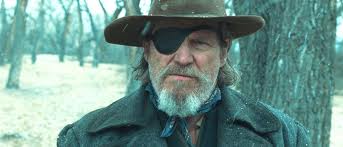 But for all its visual and thematic coherence, this version of True Grit is not without its problems. As on No Country, there is the simple problem of unintelligible dialogue. Jeff Bridges is a great actor, but Rooster Cogburn's accent and beard are so thick that you simply can't make out everything he says, at least not the first time around.
The film seems to assume some pre-knowledge of the dialect and that the viewer can paraphrase their way through conversations to get a general understanding of what is going on. But even though Bridges' delivery doesn't throw us off completely, it's still irritating when we consider how many potential zingers are hidden in this character. Furthermore, if we assume the dialogue is only supposed to be a guide, then surely that invalidates the Coens' desire for a more faithful adaptation: why attempt to be faithful to the source if you're not going to let all the words from the book be heard? Then there is the relationship which the Coens take towards their work. In their previous films, they have put their unique stamp on what are superficially straightforward stories, immersing themselves in the genre and characters and coming up with something genuinely quirky. Sometimes this makes their films distinctive, other times extremely grating, but even in their slip-ups there is a conscious decision-making which flows throughout every shot and line.
 The problem with True Grit is that the Coens' approach is much more stand-offish, in a way which detriments the film. There are big moments of full-on quirkiness which aren't in the novel, the biggest being the man riding through the woods wearing a bear costume, with a beard like that of the young wizard in Howl's Moving Castle. But these moments of full-fat Coens characterisation come few and far between, and they are so noticeable that all the stuff in-between starts to feel a little bit too ordinary. As much humour as there is in the conflicts between Mattie, Rooster and LeBeouf, the film never feels like it is pushing the genre envelope in the way that No Country or Blood Simple did.
 In the end True Grit is an interesting but incidental work from the Coen brothers. It doesn't have the full-blown original stamp of their other films, for better or worse, and is perhaps testament to the fact that filmmakers shouldn't always treat their source material with kid gloves. But as a piece of filmmaking outside, it is more stylish and better made than the original and the performances are all of a high calibre. If nothing else, it's a much better attempt at a remake than their botched look at The Ladykillers.
Rating: 3.5/5
Verdict: Enjoyable but hardly a full hand
Howl's Moving Castle (Japan, 2004)
Directed by Hayao Miyazaki
Starring Chieko Baisho, Takuya Kimura, Akihiro Miwa, Tatsuya Gashuin
There seems to be a misconception that Japanese animation is completely distinct and removed from its Western counterparts to the point of outright hostility. While the visual sensibilities of Pixar and Dreamworks don't reflect anime traditions, there is a greater exchange of styles and stories that one might expect. This is supported by the fact that it was John Lasseter, the creator of Toy Story, who first brought Hayao Miyazaki's work to American audiences. This cross-pollination of cultures is evident in both Spirited Away (which won Miyazaki an Oscar) and the follow-up Howl's Moving Castle. Where Spirited Away took the central idea of The Wizard of Oz (written by an American) and completely reinvented it, this film takes a Welsh novel and gives it the classic Miyazaki twist. The result is a very loose adaptation of Diane Wynne Jones' novel which has all the familiar Miyazaki trappings - it's filled with wonder, beautiful, and totally, lovably bonkers.
If you try to write out the plot of one of Miyazaki's films, you would quickly have to give up, either because of their complexity or for their tendency to seem like total nonsense when viewed in abstract. There's certainly a lot in Howl's Moving Castle which makes one laugh, if out of surprise as much as genuine humour. Quite apart from a metal castle which walks around the hilly landscape, we have a scarecrow that comes to life (another Oz reference), a boy who becomes an old man by putting on a cloak, and of course a talking fire (voiced by Billy Crystal in the English language version). As we have come to expect from Miyazaki, the animation is spectacularly beautiful and manages to marry an old-fashioned, hand-drawn aesthetic with more modern, CG-orientated techniques. Being a deliberately loose adaptation, the director doesn't make a concerted effort to situate us in a specific time and place; indeed that would be rather futile, since the doors of the house can lead to anywhere.
What we are given is a beautifully crafted, fantastical setting with heavy overtones of steampunk, a world which seems green and tranquil one minute and dark and aggressive the next. Howl's secret garden, with meadows filled with flowers and the mill with its slow-turning water wheel, is counterpointed by the battle scenes in the clouds, with Howl in bird form dodging missiles and strangely impossible aeroplanes being blown to smithereens. If we insist on imposing a time period, we seem to be in the early-20th century due to the presence of imperial regalia. It's not quite Wales, not quite continental Europe, and we're certainly not in Japan. For all its beauty, there is an appealing sense of the grotesque to Howl's Moving Castle. There's nothing approaching the darkness of Spirited Away or moments of Princess Mononoke, and the film's U certificate means there's nothing that will terrify very young children. But the animation is so organic and perfectly weighted that when the moments come they are emphasised. The blob-men who can seep through cracks in doors are incredibly creepy, as is the Wicked Witch of the Wastes herself (Oz again). When we first meet the Witch, she is simply intimidating. But by the time she has climbed all those steps, bathed in sweat and the fat rings becoming more apparent, there is very little about her that does not send a shiver down one's spine.
 For the most part, however, these sequences are balanced out by moments of genuine magic. The film doesn't waste time in introducing magic to Sophie's otherwise mundane life: by the ten-minute mark she has befriended a wizard and walked over the rooftops on thin air. The first time we see Calcifer, as two amorphous eyes peeping out from the ashes, we can't quite believe what we are seeing. The film has such a natural touch when it comes to the magical or supernatural that we feel instantly absorbed, and that has a much more powerful effect than any amount of dry exposition.
 But the heart of Howl's Moving Castle is rooted not so much in magic but in a great story about ageing, love and the burden of having a heart. Western culture is obsessed with youth and staying young at all costs: while experience is rewarded, old age is frowned upon as something unwanted, and the elderly are often regarded as being obsolete. How fantastic, then, to have a children's film in which the central protagonist, who rapidly ages against her will, ends up embracing her advanced years and seeing all the good in her new-found state?
When we first meet Sophie, she is drifting through life unsure what to make of herself. Her older sister berates her for not looking out for herself, and she seems lonely and unsuited to life as a hat-maker. When the Witch of the Waste first casts the spell on her, her reaction is largely one of panic, followed by funny consolations that "everything will be alright". But despite her considerable physical handicap, Sophie is not the type to sit around moping. Her age does not prevent her from either having adventures or saving those around her. When her youth is restored at the end of the film, her hair remains grey as a reminder of this precious knowledge of the value of age. Against this example of good will and charity, we have the character of Howl, a man of immense abilities and good looks but who is also distant and haughty. One of his very first conversations with Sophie inside the castle sees him screaming at her for mixing up the lotions, causing him to accidentally dye his hair. Howl dresses like the anime equivalent of a New Romantic, and his affection for Sophie appears to come from a desire more than anything to show off.
As the film wears on, however, we discover more about Howl's past and our opinion of him becomes more adjusted. The beautiful sequence of Howl catching Calcifer and swallowing a fallen star makes his predicament more tragic, and sets up a change in all that has gone before. Under normal circumstances this time travel plot point would seem like a clunky deus ex machina, but here it is handled sensitively and feels seamlessly integrated. Howl regains his heart and realises he must adjust to a life built around empathy; he may still have his powers, but now he is more aware of their consequences and his ability to use them for more than selfish gain. The film also deserves praise for the quality of its English language dub. The film is easy enough to understand through subtitles, but if one insists upon a dub then this is of a very high quality. The recording, which was personally supervised by Lasseter, took longer than expected because of the engineers getting wrapped up in the story. Whenever clips would be played back, they would spend so much time enjoying the film that they would forget to check the levels or that it had synced correctly. What more proof do you need?
 There are a couple of small weaknesses with the film which prevent it from being a classic. The tone of Miyazaki's work is often very whimsical, and there are moments in which one's tolerance for such whimsy is tested. In the last half hour the story starts to run out of steam as all the threads are tied up, and the revelation about Turnip Head's true identity doesn't completely hold up when you consider what comes straight afterwards.
 In all though, Howl's Moving Castle is a very good piece of animation with all the magic of Miyazaki's previous work and the spirit of the original novel. Its characters are well-rounded and engaging, and even when watched purely as escapism it never fails to make you smile. Despite its little flaws, which prevent it from being top-flight Miyazaki fare, it retains a radiance and playful joy which will guarantee that it ages well. It's not Spirited Away, but it's still really, really good.
Rating: 4/5
Verdict: Magical, beautiful and bonkers


