

Reflections
-
It is weird to read my correspondences from the late August/early September
period, being the time of transition between my old function in life to my
new ...
14 years ago
Gone With The Wind (USA, 1939)
Directed by George Cukor, Victor Fleming & Sam Wood
Starring Vivien Leigh, Clark Gable, Leslie Howard, Olivia de Havilland
There's no getting away from Gone with the Wind, either as a darling of the Academy or as one of the most commercially successful films of all time. Nor is there any escaping its influence on filmmaking, from its direct impact on the golden age of Hollywood, through to less desirable legacies in the shape of Out of Africa and Heaven's Gate. With a reputation exceeding that of almost any other film, it is something that everyone should see once - but probably only once. Apart from anything else, you have to admire the sheer ambition of Gone with the Wind from a production point of view. The scale of filming is immense, taking in huge barren plains, long warm sunsets, sprawling towns and every kind of weather other than snow. At a budget of $3.9m in 1939, it was already the third most expensive film ever made, behind only Hell's Angels and the 1925 version of Ben-Hur. There is nothing about the production which feels cheap or half-hearted, with impeccable craftsmanship in every set and shot.
 This is more remarkable when you consider the film's complex and convoluted production history. David O. Selznick purchased the rights to Margaret Mitchell's Pulitzer Prize-winning novel for a record $50,000 in 1936. What followed was two years of bartering and in-fighting where Selznick and the executives at MGM and Warner Bros. grappled over matters of budgeting and distribution rights.
Gone with the Wind took nearly two years to cast, with Vivian Leigh only being installed as Scarlett a week before shooting started. Filming began in January 1939 and last for five months, during which time Selznick fired both the cinematographer Lee Garmes and original director George Cukor. His replacement, The Wizard of Oz director Victor Fleming, expressed dissatisfaction with the script, so Selznick and screenwriter Ben Hecht re-wrote the entire film in five days. In May, Fleming briefly left the production due to exhaustion, with Sam Wood being drafted in to cover. This version of events would seem to paint the production as one of ego gone mad - Selznick's, namely - and would set the film up to be a total catastrophe. But it's worth remembering just how radical aspects of Gone with the Wind were when it was first released, and how it courted controversy with the censors. This was the age of the MPAA's Production Code, in which there were clear lines between what could and could not be said or shown in a film. Clarke Gable's famous final line, "Frankly, my dear, I don't give a damn" sent shockwaves through the Code's administrators, and Selznick only avoided a hefty fine by an amendment passed by the MPAA board, which permitted the use of "damn" or "hell" within an appropriate historical context.
 For a film that went through three directors, two cinematographers and one of the most hands-on producers in the history of Hollywood, it is remarkable that Gone with the Wind still looks and feels like a single film. The visuals in places are exceptionally beautiful, particularly the bright pink sunsets and the composition of the battle scenes. One of the best sequences comes during the Civil War part of the story, which finds Vivien Leigh wandering through acres of injured men, lying and dying all around her.
 In terms of its themes, Gone with the Wind explores the concepts of chivalry and honour. It is nostalgic about the age of chivalry, in which masters and their companions went through life side by side, doing what is honourable and helpful to others even at the cost of one's own life or happiness. Scarlett's multiple unhappy marriages reflect this theme, as she repeatedly makes herself unhappy out of silent respect for the marriage between Ashley and Melanie. In turn Melanie thanks Scarlett for her loyalty, delivering the film's central lines as she lies dying: "Look after Ashley, Scarlett... but... don't ever let him know."
 Much of this review so far has focussed on the reputation of Gone with the Wind. The positive comments made therein would seem to confirm its status as the greatest American movie of all time. Sadly, this is not the case. For when stripped of its acclaim and its trophy cabinet full of Oscars, Gone with the Wind is riddled with myriad flaws which, while not totally scuppering it, severely tarnish its image.
 The first, and most obvious flaw, is that the film is way, way, WAY too long. Even if we take out the intermission and the title cards, it still overstays its welcome by at least an hour, insofar as the story could have been handled in a shorter time through a simple act of compression. There is an argument that today's audience are more impatient, and would not watch a four-hour film no matter how good it was - an argument supported by the initial screenings, in which the punters begged MGM not to cut a single frame. But there are whole sections of Gone with the Wind which are so baggy and repetitive that even devotes of The Deer Hunter would struggle to resist looking at their watches.
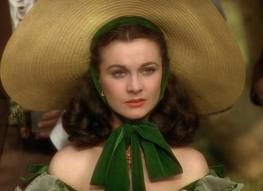 The first hour in particular is very difficult to get into, being populated by a huge number of characters who are all in some way unlikeable. The barbecue at Twelve Oaks consists essentially of spoilt rich people bitching about each other, with Vivien Leigh coming across as a childish brat who moans and screams and cries whenever she doesn't get her way. Leigh is a good actress who is undeniably beautiful, and very good at demonstrating the ambivalence of the character in her attitude to others. But we end up as ambivalent to her as she does to Ashley, and it take a lot of patience to stay with her character.
 Because the film is attempting to be so big in every single department, it ends up as the dictionary definition of sprawling. Although it just about manages to keep us focussed on the central characters (anchored by the great performance of Clarke Gable), the supporting cast is way too big, with potentially enthralling individuals endlessly drifting in and out. When characters do come back, they re-appear in the most contrived way imaginable; Sam, for instance, just happened to be sitting around the campfire when Scarlett was being attacked on the bridge.
 This brings us on the racial aspect of the film. The arguments here are the same as those surrounding The Birth of a Nation: do we accept the racial attitudes as a product of an historical period, or do we criticise such a revered film for being so deeply questionable? If we take the latter view, then the film is totally reprehensible, with almost every black character being reduced to pantomime; they never question their duty and seem incapable of functioning without being ordered around by impeccably dressed white nobles. If we accept the former, then the film is slightly more enjoyable, but the characterisation of Prissy as a screaming, incapable slave girl is still nothing short of toe-curling.
 In the last half hour, the film's poor storytelling is exposed and things get completely silly. In further testimony to it rambling, aimless style, most of the main characters are quickly killed off so that we arrive, very clumsily, at the union of Scarlett and Rhett. Every plot point in this section is prompted by an unfortunate death - Bonny falls from her horse like Scarlett's father, and Melanie falls mysteriously ill again, just so Scarlett can realise that Ashley never loved her. The plot drags laughably as we yearn to get to the staircase and Rhett's final line (which, of course, is not the end of the film).
 Gone with the Wind remains that most difficult of films: something which is so heavily flawed and hugely overrated, but also essential viewing for anyone who loves cinema. It is better than subsequent epic romances like Out of Africa because even at its weakest, baggiest moments it still feels like it is going somewhere. But its greatness is ultimately tarnished by its dated attitudes, poor storytelling and ramshackle structure. In short, it contains both the best and the worst that Hollywood has ever offered; it's massively, massively flawed, but also strangely irresistible.
Rating:
Verdict: Overrated but still essential
I Know Where I'm Going! (UK, 1945)
Directed by Michael Powell and Emeric Pressburger
Starring Wendy Hiller, Roger Lively, Pamela Brown, Finlay Currie
Romantic drama is a hard genre to get right, both on paper and on screen. Some are so light and frothy that they leave no lasting impression; others, like The Snows of Kilimanjaro, are overblown, overwrought and in most cases over-long. I Know Where I'm Going! is a textbook example of how to do this sort of film properly, taking a relatively simple story and making it memorable through a series of strong performances, a great script and remarkable direction. One of the common criticisms laid against romantic films, whether dramatic or comedic, is that they lack substance, relying on the charm of the performers to take an audience's mind off a highly clichéd or conventional premise. But while that criticism may carry a certain weight with regard to more recent rom-coms, it can't be fairly levelled against I Know Where I'm Going!. This is not because of the film's age, or its positioning in the golden age of melodramas. It is instead because the film is subtly inventive, adding precious moments of surprise in its every twist and turn.
I Know Where I'm Going! begins with a woman setting off to marry the man of her dreams, who is rich, powerful, influential and lives in the magical land of Scotland. These early scenes, with Wendy Hiller in full-on daddy's-little-girl mode, explore the age-old desire of young girls to be princesses and ride off into the sunset with a handsome prince. The twist, however, is that Joan Webster is not your average girly princess: she is a driven, ambitious woman who has known what she has wanted all her life. The opening credits explore her childhood in the manner of a BBC newsreel, showing a series of clear turning points underscored by Home Service narration. If the character of Joan Webster were to turn up in a film today, she would most likely be characterised as having OCD or some form of neurosis. Perhaps she would have been a suitable soul-mate for Jack Nicholson at the start of As Good As It Gets. She has her entire life planned out meticulously, knowing exactly what and who she wants and how she intends to get it. Her constant desire to get to the island comes as much from her compulsive urge to be punctual as the desire to meet the man she is marrying.
For the first ten minutes the film confronts this idea in a very broad, head-on way. We see Wendy Hiller in the railway carriage pouring over her routine, behaving in a very controlled and restrained manner. But for the rest of the film Emeric Pressburger's script explores her character and surroundings much more subtly. Superficially, the story of I Know Where I'm Going! seems very predictable - put simply, there's not that many men on the island. But the film plays out economically and keeps its emotions and dialogue in check, giving us a number of pleasant surprises along the way. The film is very good at planting seeds of doubt in Webster's mind, and demonstrating her infuriation at seeing her planned perfection disrupted. These disruptions start off very small, with her oversleeping and having to carry her clothes off the train in a heap. As the weather delays her trip to Kiloran, she slowly but surely begins to adjust to the landscape, even if she doesn't find herself warming to the place until the final reel. When she finally hears her fiancée on the radio, she assumes there is something wrong with his voice and asks him if he has a cold. These little moments don't seem like much when they first play out, but as the plot unfolds their significance becomes clear.
 Like many of their other films, I Know Where I'm Going! sees Powell and Pressburger dabbling in fantasy and applying magic to an otherwise realistic setting. These dabbles begin on the train to Glasgow, when Webster is sleeping with her wedding dress hanging in a see-through case above her. Suddenly the dress disappears and we move into her fantasy of being married - albeit jokingly, since she is being married to her fiancée's company, thanks to her father's confusion. Later in the same scene we see the train passing through tunnels made of tartan while the narrator whispers the chorus to 'The Bonnie Banks o'Loch Lomond'.
The film draws on a number of mythical elements which give depth and credibility to the situation. These range from the Laird's story about the Viking ship which anchored in the whirlpool Corryvreckan, to the practice of counting the beams and making a wish on the first night spent in a new room. To some extent these follow in the tradition started by Sir Walter Scott and carried on in Brigadoon, since they paint a fanciful portrait of the Highlands and Outer Hebrides. But the film is not entirely a tourists'-eye-view, and is populated with enough believable supporting characters to stop things drifting too far into fantasy. Although it seems an odd comparison, the story of I Know Where I'm Going! is not all that far removed from that of The Wicker Man nearly 30 years later. Both films centre on an individual who comes to a remote Scottish community driven by a singular urge to find someone. Both Joan Webster and Sergeant Howie are outsiders in this community and cannot comprehend its way of life - although the former doesn't have to put up with pagan worship or naked dancing. The central similarity, however, is that the goal of their respective characters is essentially a McGuffin. Just as the girl in The Wicker Man never really went missing, so we never meet Lord Beringer, or get to count his money. He might as well not exist, for his only function is to bring her to the island, and the weather does the rest in managing to keep her there.
 The mythical elements of the film are ultimately what lift it out of being predictable fare. The stories which Torquil regales to his guests include a tale about a rope being made of virginal hair which would never break, since true love is stronger than anything. The sub-plot surrounding the curse gives his character a sense of mystery, so that we enjoy their relationship while picking our brain as to what this curse could be. One of the best scenes in the film sees Torquil and Webster arguing on the stairs about the local customs and the latter's decision to go out in a gale to get to the island. When our leads do finally get together, their entanglement with the curse makes it seem a whole lot less contrived, while raising the question of whether their love was chance intervening on fate or fate playing out in a different way than they had intended.
 I Know Where I'm Going! has impressive production values for a film of its time and budget. The storm scenes, where the boat flounders and drifts into a whirlpool, are impressively executed. You do feel like you are in the boat with the characters, with the spray soaking your face and the boat lurching one way and then the other. Capturing the whirlpool and the boat involved a lot of complicated editing, with multiple location long-shots being spliced together with model shots and studio shoots in which the cast were doused in buckets of icy water. All Powell's efforts pay off, creating a storm sequence which is gripping and inventive.
The performances are also of a high calibre. Wendy Hiller is on great form as Joan Webster, nailing the character in the very first scene and displaying the same formidable femininity that would serve her well in The Elephant Man. Roger Livesey is a great match for her, combining humour, humility and a deep-seated integrity (plus he looks good in a kilt). Among the supporting cast, real-life Captain C. W. R. Wright is a well-chosen Colonel Barnstaple, and Valentine Dyall turns up in a rare non-villainous performance as Mr. Robinson. I Know Where I'm Going! is a top-notch romantic drama which is understated but ambitious and whose ideas remain fresh and engaging even after 65 years. The performances are charming and convincing, and really bring Pressburger's myth-injected script to life. It isn't quite the masterpiece that Martin Scorsese had claimed it to be, since its quirkier sections are occasionally overbearing (tea with the Robinsons, for example). But it marks a definite improvement on A Canterbury Tale and the start of the prime years of Powell and Pressburger's careers.
Rating: 4.5/5
Verdict: A properly magical love story
Blade Runner (USA, 1982)
Directed by Ridley Scott
Starring Harrison Ford, Rutger Hauer, Sean Young, Joe Turkel
There comes a point in the life of any true-blooded film reviewer when they must plant a flag in the sand and argue their case for the greatest film of all time. It's a daunting task, since the films which we most revere often take on an 'untouchable' quality. They resonate so strongly with us and are so perfect in construction, that we almost daren't approach them, lest our feeble words and platitudes fail to convey their majesty.
Blade Runner is everything you could want from a film, and so much more. It straddles genres ably, incorporating elements of science fiction, gothic horror, film noir and action-adventure. It achieves a perfect balance between style and substance, allowing for a bittersweet examination of complicated ideas amidst a vivid landscape of light and colour. It has the scientific head and cold surroundings of a perfect dystopia, but genuine characters and a heavy human heart. And once experienced in its fully-realised Final Cut, nothing will ever come close again. A quick glance at the production history, however, shows that things could have turned out very differently. The original screenwriter, Hampton Fancher, fell out with both director Ridley Scott and author Philip K. Dick, who resented the very idea of a Hollywood adaptation of Do Androids Dream of Electric Sheep?. Scott had only come to the project because of the pre-production delays on Dune. He took the job to rid him of that burden and to take his mind off the recent death of his brother.
Scott arrived in Hollywood expecting a free rein after the critical success of The Duellists and the ample box office of Alien. What he got instead was a heavy-handed studio and a very difficult Harrison Ford, who had just cemented his megastar status with Raiders of the Lost Ark. What followed were many miserable months of night shoots, funding issues and voiceover recordings, as the studio re-cut Scott's footage and made Ford record endless voiceovers in case the punters didn't get the plot. This disjointed and expository original cut received mixed reviews and underperformed commercially, and that, it seemed, was that. It has taken a long time for the true version of Blade Runner to come to the surface. But with every passing year, and every new cut that has come along, more of the true nature of this extraordinary work has come to light. Now we have the Final Cut, the only cut over which Scott had full creative control. It is Blade Runner at its most personal, complete and immaculate. Scott believes it to be his best and most personal film; on the basis of this cut, that's not about to change.
Most of the critics who praised Blade Runner the first time round were quick to dismiss the film is visually beautifully but lacking narratively. They were half-right. No-one could deny that the film is breathtakingly beautiful, with every shot perfectly composed and a score of both scenes and images which take one's breath away. The opening shots of the Los Angeles skyline are mesmerising, as is the image of a tower of flame arcing and reflecting in the eye of a nameless observer. These scenes embody what is so special about the film - its ability to take the vast, the mechanical and the dystopian, and find the personal, the hopeful and in human in everything we see. The film has been appropriately described as a neo-noir, since it takes the conventions of classic noirs like The Third Man and retunes them to better suit its own particular choices in terms of themes and character development. Scott clearly has great affection for the various noir motifs, filling his scenes with carefully chosen shadows and beautifully lit cigarette smoke. His visual decisions with both lighting and colour really bring out the sense of mystery and ambiguity which is at the heart of all great noirs. Even without the voiceovers, Deckard is a born natural in the role of unreliable narrator.
But there is so much more to Blade Runner than pretty experiments with light and shade. The true strength of the film lies in its myriad themes and complex exploration of ideas, ranging from man's environmental impact and the nature of advanced urban society, to the spiritual and existential quest for self-knowledge and the boundary between what is human and what is not. Scott's greatest trick is to bring out these ideas through the most subtle and intelligent of visual touches; his background in advertising allows him to offer us multi-layered imagery as a guide in place of dry philosophical meanderings. The most prophetic message of Blade Runner is that the future is far bleaker than we could have imagined. The society presented to us in Blade Runner is akin to our own in one key aspect: we are living with the consequences of what has gone before and are uncertain of where to proceed from here. In this Los Angeles, there is social decay, uneasy multiculturalism, widespread crime, prominent sexuality, massive inequality and an intelligent but emasculated underclass, both in our midst and 'off-world'. The predominant mood is one of gloom, struggle and pathos, embodied by the fact that it is nearly always raining.
 The replicants in Blade Runner make up this underclass, and are symbolic of both the persistence of slavery and the dangers of technological advancement. The twist is that their status as second-class citizens was not forced upon them by circumstances but preconceived before their creation. Just as all the newborns in Brave New World have their class and intelligence predetermined, so replicants are created with varying levels of intelligence and capabilities, and are all given a four-year lifespan - a failsafe against them 'developing their own emotions' and turning on their creators.
 Roy Batty's rebellion against his 'father', Dr. Eldon Tyrell, is both the monster turning on his master in the manner of Frankenstein and a powerful religious allegory of the distant relationship between God and Man. Roy, played with terrifying presence by Rutger Hauer, is the Prodigal Son whose intelligence and desire for consciousness lead him to his creator (whether literal or metaphorical). Tyrell is both a benevolent father and some form of monster, showing compassion and understanding while never properly accepting his 'son'. 'Man' rejects 'God', doing literally what Nietzsche described symbolically, and condemns Himself to a short life of loneliness and fear.
 But that is not the end, for one of the greatest themes of Blade Runner is salvation and redemption. Deckard's encounters between both Roy and Rachael are steeped in the idea that, in the midst of all this uncertainly and terrible injustice, hope can thrive and the true goodness of people can come through. The big question at the heart of the film is this: what does it mean to be human? How can we define what is human and what is not? And - perhaps more importantly - does it matter if we cannot?
So much ink has been spilled over whether or not Deckard is a replicant, and there are strong arguments on both sides; Scott believes that he is, Ford believes that he isn't. Perhaps the real answer lies in a third explanation, namely that the boundaries between human and non-human are now so blurred that definitions of what counts as 'human' are little more than irrelevant expressions of power. The concept of being 'human' is so complicated, so ambiguous and so multi-faceted, that to exclude or demarcate any one body from another through codes, whether moral or political, is pointless. In this situation the only thing that triumphs is love - whether the brotherly love of Roy sparing Deckard's life or the romantic love between Deckard and Rachael. Both these relationships begin with the lines between human and replicant clearly drawn; Deckard is down Roy, and the first time Rachael visits him he dismisses her fondest memories as "implants". But eventually both Roy and Rachael prove a certain kind of devotion toward Deckard, saving his life on one occasion each. These acts of compassion render Deckard's preconceptions obsolete. He undergoes the same act of soul-searching and reaches the same conclusion with both parties; replicant or not, so long as there is love, there is meaning. Both the tender love scene with Rachael and the heartbreaking 'tears in rain' sequence with Roy are the consummations of this revelation; as the dove flies into the sky, Deckard puts his old ways behind him, and surrenders himself to the only thing that matters.
 Blade Runner is by far and away the greatest film ever made. Every aspect of it from the acting to the Vangelis soundtrack is flawless, both in design and execution. The performances of Harrison Ford and Sean Young are mesmerising, and remain the highlights of their respective careers. It is also Scott's best film by a county mile; for all his great work on Alien and Gladiator, he has never bettered this. Most of all, Blade Runner is an extraordinary odyssey through the human psyche, taking characters in the gutter and using them to focus on the stars. It is, quite simply, perfection.
Rating: 5/5
Verdict: The greatest film of all time
Eternal Sunshine of the Spotless Mind (USA, 2004)
Directed by Michel Gondry
Starring Jim Carrey, Kate Winslet, Kirsten Dunst, Elijah Wood
Science fiction is one of the most malleable genres around: it can be light or dark, scary or funny, insightful or escapist. Most impressive, however, is its continuing ability to cross-breed with other genres, and in doing so produce great works in cinema and other media. In the past forty years we have been treated to sci-fi horror (Alien), sci-fi comedy (Dark Star), sci-fi action (Aliens) and sci-fi noir (Blade Runner).
Eternal Sunshine of the Spotless Mind is the latest addition to this cross-breed family: being equal parts Philip K. Dick and romantic comedy, it qualifies succinctly as a sci-fi romance. There have been previous science fiction films which have dealt directly with romantic love, but precious few have both the tenderness and intelligence which comes from the match made in heaven that is Michel Gondry and Charlie Kaufman. Because of its romantic elements, the film has been dismissed in some circles as an essentially shallow exercise, something which is visually enthralling but ultimately little more than a Hugh Grant rom-com with A-levels and shuffled timeframes. Some of the most damning criticism came from Rick Kisonak, who described it as “Love Story with frontal lobotomies” and concluded that it was “not a lot more than a thinking person’s 50 First Dates.”
 Such comments appear ludicrous even before half an hour has passed. For one thing, you never get the sense that Kaufman or Gondry are being overly complicated for its own sake. The visual and emotional tone of the film is not that of two intellectuals desperately trying to show off. The film is profoundly open-hearted and involving, combining existential parables with light-hearted humour and insights into the human condition which at no point feel preachy or pretentious.
One of the great triumphs of Eternal Sunshine is that it manages to be incredibly complicated and readily accessible at the same time. Like Inception after it, there are layers of hidden meaning within each image or scene, but part of the fun is getting lost in events as the plot barrels forward at a frightening pace. Gondry leaves little visual hints lying around, such as Clementine’s changing hair colour, so that if we stop and question where we are, there is a perfectly good explanation. But for most of the time, like Joel and Clementine, we are simply compelled to run headlong from one scene to the next with little care or concern except for the safety and happiness of the characters. In terms of its lineage, Eternal Sunshine is the film to which Kaufman has been working towards for his entire career. Like Being John Malkovich, much of the action takes place within the mind of its characters, and as with Adaptation we find different shades of the same character coming into contact with each other. From a sci-fi point of view, the film resembles Philip K. Dick in its fascination with paranoia and the blurring of identity, and there are clear hints of Total Recall in both the visuals and the film’s dreamlike state. Even the machine used to extract Joel’s memories of Clementine resembles the memory implant machine used in the Paul Verhoeven film.
 Gondry’s background in music videos gives him a concise and focussed method of storytelling; when you only have four minutes to get a message across, you can’t afford to be baggy or indulgent. You get the distinct impression that he is unflinchingly focussed on the characters and upon keeping Kaufman’s script moving forward. You therefore embrace his visual extravagance and unusual approach to special effect, both of which are defining features of the film.
 When Christopher Nolan was shooting the dream sequences in Inception, he strove to film as much as possible in-camera with mechanical effects. He did this on the grounds that if the actors were delivering their lines to green-screen, they wouldn’t believe in the world of the dream, and therefore neither would we. Gondry takes the same approach, shooting most special effects sequences in-camera using old-fashioned forced perspectives (or trompe-l’oeils). The scenes of Jim Carrey being bathed in the sink or hiding under the table have a very organic sense of the surreal they make memories physical rather than whimsical, rooting the chase and its flights of fantasy firmly in some form of reality.
 The film drifts seamlessly from memory to memory and back to the real world, resisting the constant urge to stop and explain where we are. By the time Joel has begun relating a memory to Clementine, that particular section of his mind begins to disappear; lights flicker off, fences disappear, frozen lakes turn into train stations and people vanish into thin air. Certain sections see Joel revisiting old memories which have fragmented. In one scene, he revisits a conversation in which all the characters’ faces have become blurred, resembling the freaky masks worn by the schoolchildren in Pink Floyd – The Wall.
Eternal Sunshine’s central thesis is that all events which transpire in our lives are at some point in time meaningful, and that any attempt to block out such experiences will only lead to recognition of their ultimate importance. The title, which comes from a poem by Alexander Pope, is deeply ironic; in being able to artificially forget bad memories, the characters are just as distressed if not moreso by what unfolds. The first time around, the sequence on the train to Montauk seems normal and straightforward. The second time round, we watch hindsight playing out and the true meaning and power of this scene becomes clear. In attempting to move on from Clementine, Joel discovers that their relationship (and the memories thereof) was the only time he was genuinely happy. He tries to preserve those memories not because he has forgiven her, but because otherwise his life may not have a cohesive sense meaning. One could almost argue that the film is an analogy for Alzheimer’s disease with Joel as the patient, struggling to remember others in order to make sense of himself.
Memories are a vital part of a person’s identity, and the film does an interesting job of showing how identities can be manipulated. Elijah Wood, in an really creepy performance, uses Joel’s memories to seduce Clementine, copying his ‘chat-up lines’ word for word. His character is desperate to be liked by women, and believes that the only way to achieve happiness is to impersonate other people. It is testament to Kaufman’s skills as a writer that scenes like these are not played for cheap, bawdy laughs – nor instead that the scenes of the technicians getting stoned never venture too far into Cheech and Chong territory. The film is anchored by the central performances of Jim Carrey and Kate Winslet, both of whom are often incredibly irritating. Like The Truman Show and Man on the Moon, Carrey’s wackiness is completely reigned in and he gives a brilliantly well-rounded performance full of pathos and subtlety. Winslet, on the other hand, is allowed to leave her ‘English rose’ image behind and play kooky, wacky and impulsive. But her feistiness and intensity hold our attention, creating a sense of mystery which engages us. The chemistry between these two give us an emotional bond around which Kaufman’s philosophising is anchored. When they decide to give things another go, it feels poignant and meaningful because of the genuine emotional journey we have taken with them.
 Eternal Sunshine of the Spotless Mind is a superb slice of science fiction with all the emotional intensity of a Mike Leigh film. It is the pinnacle of Gondry and Kaufman’s respective careers, being proof positive not only of their talents but of the continued relevance of romantic drama. In addition to its exemplary performances, the film is witty, insightful, tragic and humane, often all at the same time. It is one of the best films of the decade, and no amount of selective memory loss is going to change that.
Rating: 5/5
Verdict: Unforgettable


