


Reflections
-
It is weird to read my correspondences from the late August/early September
period, being the time of transition between my old function in life to my
new ...
14 years ago
Ladyhawke (USA, 1985)
Directed by Richard Donner
Starring Matthew Broderick, Rutger Hauer, Michelle Pfeiffer, Leo McKern
When it comes to 1980s fantasy, there are three broad categories into which films can fall. There are those like Flesh & Blood, which get the balance between substance and silliness spot on, marrying Machiavellian mercenaries to grin-inducing battle scenes. There are those like Excalibur, which take themselves so seriously that they're fatally dull. And there are those that are totally, utterly, and enjoyably silly - and into that category goes Ladyhawke. Ladyhawke is of historical interest due to its place in Richard Donner's career. The fiasco surrounding Superman II, on which he was replaced mid-shoot by Richard Lester, had thrown Donner's career off-course: he had to watch Superman II and III take huge amounts of money while he delivered flops like Inside Movies and The Toy. But either side of this film, he found himself very much in mainstream favour again, first with The Goonies and later with Lethal Weapon. It is interesting that a director whose place in history has been defined by blockbusters (including, of course, The Omen) should be capable of making something so delightfully odd in the midst of two more rounded and confident efforts.
 Like many 1980s fantasies, there are aspects of Ladyhawke to which time has not been kind. The most obvious of these is Andrew Powell's soundtrack, which was nominated for a Saturn award in 1985 but has since become regarded in some quarters as one of the worst ever composed. After Toto's contributions to Dune, it became more common for pop groups or composers to score films, due to the selling potential of the groups and the relatively cheap cost of synthesised music. But Powell's efforts go just too far even to be enjoyed ironically, with its overproduction and bouncy pop timbre frequently jarring with the quieter moments.
 The score is one aspect of Ladyhawke which confirms its inherent silliness, even before we get to the meat of the story. Another such aspect is its visuals, which manage to look lavish and professional while still feeling ropey and cheap. The film is shot by Vittorio Storaro, who famously shot Apocalypse Now - something which is evident in the multitude of blood-red, beautiful sunsets which are central to the plot. But in amongst the terrific scenes of frozen lakes, dark forests and crisp skylines, there are numerous scenes which look like they were filmed in a hurry, treading unintentionally close to Monty Python and the Holy Grail.
 This feeling of cutting corners is reinforced by the paucity of special effects. For a film in which people metamorphose into animals on a daily basis, the special effects of Ladyhawke are coy to say the least. Apart from a few shots where Michelle Pfeiffer's eyes change shape in close-up, all the big transitions happen off-screen; on several occasions Matthew Broderick leaves the room just beforehand, as though the actors had to go off-stage to change costumes. While Donner wouldn't have had access to the CG wizardry we take for granted, there was plenty of scope in the physical effects of the time to achieve something a little more palpable. Only four years earlier Rick Baker produced the definitive werewolf transformation for John Landis, in a film with half of Ladyhawke's total budget.
 Added to this shortcoming we have a number of plot holes which either confuse or produce unwanted tittering. First there is the problem of clothes: Rutger Hauer and Michelle Pfeiffer keep the same outfits throughout, but there's not much effort to keep the clothes together when one of the pair is in animal form. Then there is the question of memory. The film borrows the horror device of the person having no memory of what they did as a beast - so how come the hawk remembers to stay with her master, or the wolf not to eat his mistress? Finally, there are several blatant continuity errors. We are told that Pfeiffer appears as an eagle whenever it is daylight, and yet there are at least two scenes where it's daylight and yet she is still there. At least when Shrek half-inched the plot, it was consistent throughout.
 But in spite of these problems, Ladyhawke is a consistently entertaining little romp. Like Logan's Run nine years earlier, it's only when you stop trying to take it seriously that its ideas and emotional impact bubble to the surface. And like Logan's Run, this transition is cemented via a dominant performance by a great actor - not Peter Ustinov, but Leo McKern.
 Most famous for playing Horace Rumpole in the long-running TV series Rumpole of the Bailey, McKern had courted cult status at various points in his career: as veteran reporter Bill McGuire in The Day The Earth Caught Fire, as a recurring Number 2 in The Prisoner, and in his previous outing with Donner as a mad archaeologist in The Omen. But whereas that last appearance was a silly cameo in an otherwise seriously creepy film, here McKern brings weight and gumption to an otherwise facile concoction. Like Ustinov before him, he puts a brake on excessive silliness, if only for a moment, in order to steer the viewer towards the emotional heart of the film.
 Not only is McKern's delivery well-suited to disguising exposition, but he illuminates some cracking lines in the script. Most of the wisecracks go to Broderick, who is on very fine form; his soliloquys with God about telling the truth and resisting temptation are guaranteed to raise a smile. But McKern's timing is note-perfect, as he waits for a knight to fall right through the drawbridge before quipping: "Always walk on the left side!". Best of all comes when Broderick brings him the hawk after it has been wounded by an arrow. Having been told that he can't eat it, McKern bellows: "What? Is it Lent again already?!"
 While McKern's performance is the icing on the cake, the other major players are also firing on all cylinders. Rutger Hauer seems naturally suited to the historical romp, whether as a heroic figure here or as an antihero in Flesh & Blood. His typically brilliant screen presence, being equally charming and threatening, suits the personality of Navarre as a knight tormented by the woman he loves but cannot have. And while Michelle Pfeiffer's hair may be straight out of a pop video, she too fits her character very nicely. Her beauty conveys both the innate sense of mystery about Isabeau and the vulnerability of her predicament. She's so convincing, in fact, that you keep recognising her facial features in those of the hawk.
 Having these two charismatic performances goes some way in making the romance at the heart of the film feel believable. Somehow the grandiosity of the setting gives the relationship more weight, making it feel like there is more at stake than with similarly inseparable lovers in more mainstream rom-coms. The story is an interesting variation on the age-old tale of two people destined to be together but cursed to be apart, and for all the ridiculous elements within the central conceit it does end up pulling you in.
 This emotional pull is most evident in two scenes towards the end. The first occurs when Philippe finds Navarre lying next to Isabeau as a wolf. The sun begins to rise, Isabeau begins to change, and for a split second both see each other with human eyes. Navarre reaches out to touch Isabeau, only for her to change and fly away, leaving him beating the earth in frustrated rage. The other comes during the solar eclipse where the two are reunited and the curse is broken. The slow pacing and distance between them prior to their first real contact reinforces the strength of the bond between them.
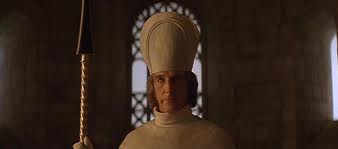 Ladyhawke also has its fair share of good action. Considering Donner's bad feelings towards Richard Lester (who can blame him?), it is ironic that his action sequences, in this film at least, take after Lester's finest work in The Three and Four Musketeers. The fight scenes have some pretty inventive slapstick and Broderick doing all manner of acrobatics, while Hauer gets to swashbuckle and head-butt to his heart's content. The highlight comes in the climactic fight in the church, ending with Hauer throwing his huge sword over several yards right into the heart of John Wood's scenery-chewing Bishop.
 Ladyhawke may not have aged as well as Flesh & Blood or Legend, but it remains a definite guilty pleasure and a bona fide cult film. Its flaws are all in plain sight - the soundtrack, the silly plot, the special effects - and yet none of them can completely eclipse the sheer enjoyment that it brings. If anything these flaws serve to make it more endearing, and more fun than mainstream fare like Robin Hood: Prince of Thieves. Donner would make more consistent features after this, but for pure and simple fun it takes some beating.
Rating:
Verdict: Silly but sublimely entertaining
Jaws (USA, 1975)
Directed by Steven Spielberg
Starring Roy Scheider, Robert Shaw, Richard Dreyfuss, Lorraine Gray
When interviewed for Bravo's The 100 Scariest Movie Moments, Clive Barker commented that sometimes the best ideas of how to scare people are so seemingly obvious that we overlook them without realising. In hindsight it seems absurd that no-one ever considered making a horror film about sharks before. And after Steven Spielberg set the bar with Jaws, no-one would ever come close again. Jaws is Spielberg doing what he does best: pure popcorn entertainment, with a school of memorable scenes, cracking dialogue and substance trickling through in amongst the thrills and spills. What seems on the surface to be a one-trick film drawn out over two hours gradually emerges as something which is not only scary but very well-made, with characters which are intelligently drawn and action scenes which communicate the themes rather than feeling like awkward set-pieces.
 Like Star Wars after it, you could be forgiven for hating Jaws given the legacy it has left behind. Apart from the three inferior sequels and dozens of derivative knock-offs, it was the film which invented both the summer blockbuster and the high-concept movie -a film which you could sum up in 25 words or less, which would be translated by producers Don Simpson and Jerry Bruckheimer into the aggressive money-driven ethos of modern Hollywood.
 Jaws has been blamed for everything from the death of New Hollywood to the infantilisation of mainstream cinema, and that's not to mention the recent criticism of conservationists about falling shark numbers. But whatever one's attitude to Spielberg in light of his subsequent career choices, it's at best guesswork and at worst sour grapes to argue that he intended any of these things to happen. Had he gone the path of his colleague George Lucas, and milked his hit for everything it had, only then would it be fair to pose such questions.
 With this in mind we have to re-assess Jaws as nothing more than a piece of entertainment. And on that level, it's undeniably brilliant. In adapting Peter Benchley's potboiler, Spielberg quickly dispensed of the melodramatic subplots involving extramarital affairs and power struggles on Amity Island. On this occasion, it was best to quite literally cut to the chase, with the shark becoming the centrepiece and fear being the driving force.
Spielberg once described Jaws as an aquatic version of Duel, his made-for-TV film from four year earlier about a man being chased by a truck. The comparison is very close both in Spielberg's knack for creating tension and in the characterisation of the villain. Both the truck and the shark are irrational forces of nature: they have no backstory, no character origin and no discernable motivation other than a relentless desire to kill. As a further connection, the deaths of both truck and shark are overdubbed with the sound of Godzilla dying from the 1954 original - an indication of Spielberg's affinity for B-movies and that he understands that monster movies can have a deeper significance. As with Duel, it doesn't matter that the monster in Jaws doesn't make a lot of sense. There was and is precious little to suggest that sharks prey on humans for sport; more people die every year from falling coconuts than being eaten by sharks. But the film is not so much about killer sharks as it is about characters being confronted by an unstoppable force which they never faced before and cannot hope to understand. It could almost be called the father of Hallowe'en in its contrast of peaceful, boring middle-class life with a ruthless, blood-hungry predator.
 This contrast is best observed in the opening section of the film. Having given us a great early jump with the death of the skinny-dipper, Spielberg withholds the shark to build up the relationships between the townsfolk. We see Roy Scheider's sleepy world slowly descend into panic and really feel his frustration when the town council and the press ignore his demands about closing the beach. As the children enter the water to swim and the attack begins, the dramatic irony kicks in and what was once a perfectly ordinary and rational community is torn apart forever.
 Much has been written about the production problems which Spielberg faced on Jaws which meant he could not shoot as much of the shark as he wanted. Three full-scale mechanical sharks were built for the production, and all three regularly failed due to everything from short circuits to corroding skin and getting caught in seaweed. Such failures were one of the main reasons the film went so far over-schedule and over-budget: what started as a $4m movie shooting for 55 days ended up as a $9m movie that shot for 159 days.
 In the end, the problems with the shark were not merely serendipitous: they helped to create one of the defining features of the film. Because he could not show the monster as he wanted, Spielberg had to improvise with different techniques which could hint at what the shark was capable of doing. It's testament to his ability as a filmmaker that he could achieve so much threat and suspense from little more than a dorsal fin and a few barrels - enhanced by his use of the former to comedic effect early in the film. Through these techniques, the shark takes on a quality of amorphous evil whose only real equal at the time was Rover from The Prisoner.
But as before, Jaws is less about the shark than the characters reacting to it, and no matter how much of the action revolves around 'Bruce', we keep coming back to the people. In its second hour, where most of the action takes places on the Orca, we genuinely bond with this foolhardy trio and soak up all the conflicts within their personalities. Brody's determination to protect his family is contrasted by Quint's obsessive streak and Hooper's feeling of being - no pun intended - a fish out of water. As with The Sting, Robert Shaw dominates every scene that he is in. His accent may be a little harder to pin down this time, but his piercing intensity and unkempt manner give him unrivalled screen presence. Although much of his early lines are played for comedy, to set him up as a loose cannon against the uptight Brody and Hooper, he gradually takes on a more intense, obsessive quality which lead you to wonder whether or not the shark has driven him mad.
 The best scene in Jaws comes when the three men are sitting in the boat at night and Quint begins talking about the sinking of the USS Indianapolis. In a speech co-written by John Milius (who scripted Apocalypse Now), he talks about his experience with sharks in the same way that Colonel Kurtz talked about horror - as something to be somehow embraced and understood, even at the cost of one's sanity or soul. The dialogue in this section is reminiscent of Ernest Hemingway's work in The Old Man and the Sea, with man and nature locked in battle, both mentally and physically, while all around there is only silence.
 Jaws remains a high-water mark in Spielberg's career and in those of all the performers. It isn't as relentless as Hallowe'en in its ability to sustain fear, and Spielberg's work on the Indiana Jones series would eventually surpass it. But that is mere nit-picking in the face of a film of great craft and vision, a film which proves that simple entertainment can be smart and that, under the right circumstances, people enjoy being scared.
Rating:
Verdict: Pure and simple terror
Apocalypse Now (USA, 1979)
Directed by Francis Ford Coppola
Starring Martin Sheen, Marlon Brando, Robert Duvall, Dennis Hopper
When it comes to reviewing films, there are two kinds of masterpieces. One is the film in which every single scene is immaculately perfect, and your emotional involvement supports and compliments this perfection. The other, more contentious kind is a film which on paper is riddled with faults, but the experience of watching it is so intoxicating that all such faults can be forgiven or forgotten. With war films, the first camp is defined by Full Metal Jacket and the second by Apocalypse Now. Where Stanley Kubrick's film is meticulously constructed and judged to clinical precision, Francis Ford Coppola's is simultaneously a bloated, meandering mess and one of the greatest films of all time. Full Metal Jacket is the more accessible and perhaps more rewarding, but on the big screen Apocalypse Now is nothing short of knockout, as all the elements of Coppola's epic collide in a full-on and frightening story of darkness, madness and war.
 As with so many great films, the production history of Apocalypse Now leads us to believe that things should have turned out very differently. John Milius, who had written much of Clint Eastwood's dialogue in Dirty Harry, drafted a loose adaptation of Joseph Conrad's Heart of Darkness by the middle of 1969. Originally titled The Psychedelic Soldier, George Lucas was set to direct before being hired to helm American Graffiti. In 1974 the project came to Coppola, who had just seen both The Conversation and The Godfather Part II nominated for the Best Picture Oscar.
Shooting for the re-titled Apocalypse Now began in March 1976 and was scheduled to last for five months. Soon after shooting began, Harvey Keitel was replaced by Martin Sheen and in May the entire set was destroyed by Typhoon Olga. When filming resumed a month later, Marlon Brando turned up heavily overweight and completely bald; Coppola compensated by dressing him in black, shooting him in shadow and using a body double in the wide shots. While shooting the ending in 1977, Sheen suffered a heart attack and had to walk a quarter of mile to get medical attention. By the time Coppola finished editing the film for release in August 1979, Apocalypse Now was two years late and three times over budget. If you attempted to write down all the things that are wrong with Apocalypse Now, it wouldn't take you long to get quite a big list. For a start, the film is too long - or at least, it feels too long. The story of Captain Willard travelling up the Nung River unfolds at a very leisurely pace, with every section of the river having some major significance in terms of plot or mood. There is no montage or time-lapse footage of the boat rapidly reaching the Cambodian border, and the longer it goes on the less sure you feel that Coppola actually knew where the story was going.
 There is a very fine line in screenwriting between poetic and ponderous, and Apocalypse Now crawls along this line like the snail on the edge of a straight razor. The actual scenes of Brando reading poetry in the temple are dull; the fact that we can't always make out what he's saying annoys us at first, but after a few lines we couldn't care less. By the time you have reached the temple, you are more or less certain that there will be some kind of brutal final confrontation between Willard and Kurtz, so that even as you sit there soaking up T. S. Eliot, you wish that things would get a move on.
 Then there is the problem of characters. Martin Sheen is absolutely terrific as Captain Willard, and in spite of his incoherence Marlon Brando manages to match him in the last truly good performance of his career. But as is the way with epics, a lot of the supporting cast don't get even half the screen time they deserve. When you've got a film featuring Harrison Ford, Robert Duvall and Dennis Hopper, you expect them to be on screen a lot. But only Duvall gets the screen time and the character depth he needs, with the other two becoming largely superfluous.
 Finally, there are aspects of Apocalypse Now which reek of the indulgence present in New Hollywood and 1970s filmmaking in general. This is typified by Coppola's self-referential cameo as the director of a war documentary; Sheen walks into his shot at the river mouth, and he shouts: "Don't look at the camera! Keep on fighting!". If Coppola was making a point about the psychological role of a director, it's handled a lot more clumsily and self-importantly than Peeping Tom. Add in the sequence of a live cow actually being butchered and you have more than enough reason to dismiss this film.
 So far, Apocalypse Now would seem like the Vietnam equivalent of Gone With the Wind: commendable for its scale and ambition, but over-long with too many characters and several questionable scenes. And yet, for all the truth in what I have said, none of it really matters. For Apocalypse Now is not a film to be dissected but to be experienced; it will burn its way into your synapses in a mixture of horror and wonder. Watching it is less like making a Swiss watch than walking into a cloud of hallucinogenic vapours. If you refuse to go with it, you won't get it, but if you do, it'll be one hell of a trip.
 Instead of recreating the experience of Vietnam with a deliberate and calculated sense of hindsight, Apocalypse Now seeks to put the audience in the same place as the soldiers so they can decide how war felt and why men behaved the way they did. Because the script was written during the war, there is no attempt made by Coppola to lecture the audience one way or the other. There are no easy answers to the questions of right and wrong, and the film's slow, meandering tone is vital for us to soak up as much information as we can. Whatever our conclusions, we feel like we've been through hell with these characters, and been changed irrevocably by the horrors of war.
 So much of Apocalypse Now is about the chaos of war, and so it's appropriate (at least to some extent) that the film should feel out of control. The relaxed discussions at the beginning, in which Willard's mission is laid out, give us some kind of grounding so that we know where he will end up. But the film is populated by profound and moving insights into the inherent anarchy and absurdity of war. These range from Robert Duvall's insistence on surfing at the beach to the post near the Cambodian border where the troops are fighting without a commanding officer. These scenes produce reactions ranging from laughter to sadness to genuine fright, and often all three at once.
 Apocalypse Now keeps adding more and more literary aspects to its central story, like someone throwing books into a library that had just been set on fire. The final showdown between Willard and Kurtz is an inventive restaging of The Golden Bough, in which the murderer kills the mad king and becomes king himself. Much of Martin Sheen's dialogue is culled from Michael Herr's Dispatches, which would later be used by Kubrick on Full Metal Jacket. And Kurtz takes on aspects of both Eliot's 'The Hollow Men' and Genghis Khan, whom Coppola studied while the sets were rebuilt.
At the heart of Apocalypse Now is the darkness at the heart of all mankind, and the ability of such darkness to consume all that is good and just and sane if fully unleashed. Kurtz has tipped over into this darkness by his experiences in Vietnam. The war has caused him to see the futility and the nonsense in his orders, and he now lives out his days as a hollow man who has understood evil at the cost of losing his soul. Willard kills Kurtz to fulfil his mission, but the very act of obedience threatens to tip him over into the same darkness. Although he manages to resist, he leaves Kurtz's kingdom as a shell of a man, his life shattered by knowledge of that same evil. Apocalypse Now is a truly extraordinary piece of work which is fully deserving of its masterpiece status. In spite of its myriad flaws, it retains an indescribable aura which leaves us shrinking into our seats, mesmerised and paralysed with fear and wonder. It's a film which damaged both Coppola as a filmmaker and the New Hollywood movement, whose reputation for indulgence had finally caught up with them. But at the dawn of the blockbuster age, it is a fantastic last hurrah and remains one of the most extraordinary experiences in American cinema.
Rating:
Verdict: New Hollywood's last hurrah


