

Reflections
-
It is weird to read my correspondences from the late August/early September
period, being the time of transition between my old function in life to my
new ...
14 years ago
The Eagle (UK/ USA, 2011)
Directed by Kevin Macdonald
Starring Channing Tatum, Jamie Bell, Donald Sutherland, Mark Strong
When Gladiator reinvigorated the swords-and-sandals epic, it was quickly followed by a host of films which sought to replicate its success by imitating part or all of its formula. But whatever the qualities of Troy, Alexander or even 300, there was always a niggling sense that we were getting something inherently inferior. Adding to this list of disappointments is The Eagle, the first big hiccup in Kevin Macdonald's career.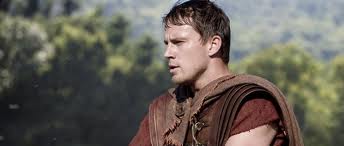 The Eagle's relationship to Gladiator is uncomfortably close right from the start. In the opening act, before Channing Tatum journeys over Hadrian's Wall, the film invokes or restages several key images from Ridley Scott's masterpiece, such as Marcus praying to the gods through smoke or laying out little figurines of his family. The first battle sequence is like the opening battle in Gladiator, only shot on a smaller scale and without a tripod. Last but not least, the central character is a soldier haunted by what has happened to his family, in this case the shame surrounding his father.
 There are other prominent references in the film which become all too apparent as the action plays out. The ending, where Marcus and Esca are pursued across the Scottish landscape by the Seal People, is very close to The Fellowship of the Ring. They are two small, vulnerable people being pursued by the 2nd-century equivalent of the uruk-hai, and Justine Wright's editing is very similar to those sequences. Even the sound design treads close to The Lord of the Rings, with the death throes of Marcus' horse sounding awfully similar to those of the cave troll.
 The crucial problem with The Eagle is that it fails to do what Gladiator did so well - namely balancing the macho and the metaphysical. Scott's film began and ended in the Elysian fields: its intense and often brutal battle scenes (including the fist-fight between Maximus and Commodus) were anchored around an exploration of politics, religion, gender and mortality. The Eagle doesn't have any such weight to carry around and its presentation is much more erratic: it amounts to lots of walking, then a battle, repeated a few times, with the odd little twist or idea thrown in along the way.
 A further comparison, this time with Scott's most recent effort, will help to shed further light on Macdonald's shortcomings. The central problem with Robin Hood was that it didn't know exactly what it wanted to be - a Batman Begins-like origin story, a political drama about working-class emancipation, or a bombastic action movie with pantomime villains. But even in the midst of making up its mind, Robin Hood did at least manage to tackle the political side of its story, albeit superficially.
 The Eagle has the opposite problem. It knows exactly what it wants to be, which is a very old-fashioned romp (and I use the term loosely) with characters which are all too clearly drawn and a fairly predictable storyline. Rosemary Sutcliff's novel, which had previously been adapted for Children's Hour in the 1950s, draws the battle lines between good and evil all too broadly, placing honour and valour over common sense and character development. Even when it's trying to subvert the central relationship between master and slave during the encounter with the Seal People, it still feels blinkered and obstinate as to where your loyalties should lie and to what extent.
 Whereas the novel was originally intended for children (more specifically young boys), there are numerous sequences in The Eagle which are unsuitable for younger audiences. For a 12 certificate film, it is pretty gruesome, with more than one instance of beheading and a fair amount of blood on screen. That said, you don't have to sit through all the really troubling stuff, like people's throats being slit (including a child's throat in one scene towards the end). And most of the time the battle scenes are so frenetic and rapidly edited that you can't exactly tell where people are getting hit, or with what - or, for that matter, why.
 The film is shot by Anthony Dod Mantle, whose credits include the Oscar-winning Slumdog Millionaire and Lars von Trier's controversial Antichrist. Dod Mantle is a pioneer of handheld digital photography, and he does add a number of notable visual touches which make The Eagle a little more distinctive. The opening shot on the river is like one of the woodland scenes in Antichrist: there is a similar sense of mystery in the wild surroundings of nature, albeit with less demonic threat. And some of his compositions are clever, such as showing characters' faces through water which is already reflecting the sky.
 But despite Dod Mantle's knowledge and expertise, the use of hand-held camera is inconsistent and ends up being detrimental. Notwithstanding the shortcomings of the battle scenes, the quieter sections find Macdonald's camera juddering and bouncing when the scene would be better served with a dolly or crane. Like the opening of The Bourne Supremacy, it takes a while for us to adjust to the aesthetic, and for the action to catch up with the frenetic camerawork. But whereas Paul Greengrass' film eventually got into its stride, The Eagle remains dodgy throughout, with Dod Mantle's camerawork hampering Macdonald's already lacklustre direction.
 What makes The Eagle so lacklustre is the lack of strong, charismatic performances. This is surprising considering Macdonald's back catalogue, which includes Forest Whittaker's terrifying performance as Idi Amin in The Last King of Scotland. Jamie Bell remains a decent actor with a certain amount of screen presence, and Mark Strong makes the most of a small supporting role. But all their best efforts are in vain due to Channing Tatum, who has the charisma and acting ability of a lump of granite.
 Because the film has no strong, charismatic protagonist, we aren't drawn into the story enough to make the substance feel intriguing. There is a couple of interesting ideas explored in The Eagle which are both interesting from a genre point of view and pertinent to 21st-century politics. One of these is the inherent instability of a conquering power, and the imperial force having to isolate an enemy rather than face it down and exterminate it. The very existence of Hadrian's Wall, as an imposed, artificial barrier between 'savage' and 'civilised', indicates that the occupying force is based upon fear, both in its methods of conquering and its view of other civilisations.
 When Marcus encounters the Seal People, he is confronted with a culture which operates along the same tribal lines as his own. There is a clear distinction made between Roman and Briton, observed in everything from speech patterns to physical features: there is a running comment about Roman soldiers being recognised by a helmet scar under their chin. Having spent all his life as part of the 'superior race', Marcus is forced into silence and submission as the master-slave relationship is reversed. Esca, meanwhile, is torn between his desire for vengeance against Rome and his professed loyalty to Marcus for sparing his life at the games.
 These are interesting ideas in and of themselves, but the film's structure never allows them to be explored in a satisfying amount of detail. More often than not The Eagle relies earnestly on genre expectations to sustain its appeal, giving us spectacle and plot devices but not much in the way of emotional engagement. The search for the missing roman standard, the eagle of the title, becomes almost secondary to the characters' endless wanderings, and the epilogue of them returning it to the senators is silly and clichéd.
 The Eagle is a big disappointment from Macdonald, failing as both a romp and a means of exploring interesting ideas within a genre. It's not without substance or individual scenes which are visually arresting: it's a better story than 300 and the battle scenes will just about satisfy teenage boys. But for those of us who want to think a little harder, it falls short of most of the marks set for it, never threatening Gladiator's mantle as the great historical epic of our time.
Rating:
Verdict: Macdonald's first real disappointment
This is a reprint of my review which was first published on Rotten Tomatoes about 2 years ago, with a couple of minor revisions. It appears here to mirror a series of reviews I had done for RT entitled 'From Burton to Nolan'.
Batman Begins (USA, 2005)
Directed by Christopher Nolan
Starring Christian Bale, Michael Caine, Liam Neeson, Katie Holmes
The words 'substance' and 'blockbuster' are rarely found in the same sentence. Nor indeed are the words 'auteur' and 'commercially reliable'. But Christopher Nolan is living, breathing proof that the two can come together and make astonishing work. Having won over mainstream audiences with Memento and Insomnia, Nolan uses his particular blend of non-linear storylines and visual hyper-realism to breathe new life into a long-dead franchise. With all the acclaim being accorded to The Dark Knight (most of which it deserves), it is easy to forget just how good or how strong Batman Begins is. It's not just good by Batman standards, or by prequel standards; it has its own, stand-alone identity, a headstrong independence which defies and ignores all that has gone before it. Gone are the Gothic spires of Tim Burton's Gotham City, or the day-glo camp of Joel Schumacher's costumes. This is a new whole new world, in all its meticulous and frightening glory.
 All of Nolan's films are stunning to behold, but Batman Begins takes his craft to new heights. He is famous for not using a second unit, allowing him to supervise and construct every shot just the way he wants it. This means there is no jarring difference between the film's dramatic scenes and the external effects designed to show us the city. Even in the most effects-heavy parts of the film, we never question who is behind the camera, guiding these scenes and determining their significance.
 Nolan has the same gift for visual verisimilitude as Ridley Scott, whose masterpiece Blade Runner was a major influence on the young filmmaker. Both directors are able to construct seamless, immersive worlds on screen which are simultaneously strange and familiar. They have a beauty which both comforts and surprises us, allowing the filmmaker to play with the clichés and always come up with something new. But while several of Scott's films are truly style over substance (Legend, Someone to Watch Over Me), Nolan has yet to make a film which forsakes narrative substance for the sake of visual splendour.
 What makes Batman Begins so rewarding, so gripping, and arguably so radical, is that there is a constant and unrelenting focus on the story. No matter how much we jump back and forth in time, or how many bad guys get hit, we never doubt that the movie is in control of itself and is yearning to move on to the next important piece of character development. The fact that we have to wait an hour before Christian Bale even dons the bat-suit is a clear sign that the filmmakers want to do this properly. They have avoided falling into the trap of either the original films, which often put the narrative on pause for a kid-friendly set-piece, or the Star Wars prequels, which waded through years of turgid back-story for a few minutes of vaguely dark action.
 Mark Kermode once described this film as "a little independent, weird, art movie, trapped within the body of a $140m blockbuster." And he wasn't far off. Batman Begins is much less a superhero film per se than it is a detailed philosophical examination of the nature of fear and morality in a chaotic world. Both our protagonists and his many enemies have fear and intimidation as their source of power -- the former by their bribes and weapons, the latter by stealth and an incorruptible desire to do good. But rather than keep it as a straight fight between good guys and baddies, the film questions the motivations of our hero on a frequent basis. The supporting cast, particularly his old flame, push him on his motivation for doing what he does, in the way he does, regardless of how little they actually know.
 This is a film in which the desire to do good can so easily be blurred into the desire for power; in which the lines between justice and vengeance are frequently re-drawn; and in which the triumph of good over evil is neither complete nor reassuring. In the film's closing scenes, Gary Oldman warns Batman that he is potentially doing more harm than good; this enemy may have been extinguished, but a darker menace lurks on the horizon which will be harder to defeat.
 At the centre of all this is the idea that to defeat evil, one must understand it and even adopt part of its methods if the ends justify the means. The League of Shadows, headed up by Ra's al Ghul, are a symbolic forewarning to Bruce Wayne of what he could become should he fully embrace his fear. Liam Neeson's character is a Nietzschean figure, who has channelled his desire for justice so purely that it has consumed all his remaining humanity. Bruce Wayne should if anything be more brutal, since he wishes to atone for the death of his parents. But when he is asked to slay the farmer, his humanity intervenes and he refuses. This pivotal scene confirms Wayne's incorruptible nature; he may become feared, but he will never let the fear become him.
 One criticism of this film from some quarters is that this new emphasis on darkness and philosophical soul-searching has taken all the fun out of the character. In fact one of the pleasant surprises about Batman Begins is the extent to which humour still resides. Not only do we get impressive popcorn-worthy action sequences, but we also have a script which grows more sarcastic and playful as all the battle lines are drawn. There aren't any laugh-out-loud moments, but that's not why the film exists.
 The film is inhabited by one of the best all-star casts outside a Robert Altman film. Christian Bale is brilliant as Batman, drawing on his great work in American Psycho to make Bruce Wayne totally three-dimensional. He plays Wayne with a tortured intensity which makes his pain all the more palpable. The supporting cast is completely solid, with the best performances coming from Cillian Murphy as the chillingly creepy Dr. Krane and Michael Caine as the affable father figure Alfred. Special mention should also go to Gary Oldman as Gordon and to Liam Neeson, who gives one of his best performances in years.
 The only real flaws with Batman Begins come when it attempts the widest possible appeal. The last twenty minutes, is completely over-the-top and rather cavalier on the part of the director. It's not so much a punch in the face as a flick on the nose; not especially painful, but you still feel annoyed that it happened. Moreover the opening scenes, before Bale reaches the monastery, are very jumpily edited so that only the most devoted will be pulled in.
 Nonetheless, Batman Begins is a really great film which does not deserve to be neglected in the wake of The Dark Knight's success. It is a stunning combination of style and substance which avoids all the pitfalls of its counterparts and predecessors. Together with The Dark Knight, it has become the gold standard against which all subsequent superhero films have been measured, and more often than not come up short. It may not be Nolan's best film - that remains Inception - but it is a fantastic demonstration of how art and money are not so easy to separate.
Rating: 
Verdict: The best Batman film


