


Reflections
-
It is weird to read my correspondences from the late August/early September
period, being the time of transition between my old function in life to my
new ...
14 years ago
The Deep Blue Sea (UK, 2011)
Directed by Terence Davies
Starring Rachel Weisz, Simon Russell Beale, Tom Hiddleston, Ann Mitchell
One of the hardest things to rationalise as a film reviewer is when a director you love suddenly gets it wrong. Reviewing the latest Michael Bay disaster, or Brett Ratner-driven slice of hackery, is pretty easy: simply string together four or five superlatives, add some moral outrage and leave it to stew in its own juices. What's not so easy is trying to explain how Terence Davies has gone from something as inspired as Of Time and the City to such an abject failure in The Deep Blue Sea. Davies' output as a filmmaker has always been an acquired taste - which, in this context, is equally a loaded phrase and a straight-up compliment. Whether you like his back catalogue or not (and even he has mixed feelings), he has a distinctive voice and series of interests which set him apart from the mainstream. He has campaigned tirelessly for the promotion of British cinema, furiously refusing to accept the perceived dominance of Hollywood, both financially and artistically.
 You couldn't put the failure of Davies' latest film down to him being out of his depth. He has dabbled in period drama before, most prominently in The House of Mirth 11 years ago. But more than that, he has an intrinsic understanding of 1950s Britain, retaining both a childlike fondness of its cinema and a very real understanding of its social problems, which he experienced as a child. Davies has frequently described his father as "psychotic", and in Of Time and the City he painfully records both the realisation of his homosexuality and his disillusionment with religion.
 One thing that The Deep Blue Sea has clearly in its favour is the way it looks. Florian Hoffmeister's cinematography is lush, glossy and full of rich colours, which somewhat evokes the work of the late great Jack Cardiff. The period details are immaculate, whether it's the costumes the characters wear or the songs they sing in the pub. It's not, or at least it doesn't appear to be, a pretend version of 1950s Britain, either dreamt up by the tourist board or dropped in from Hollywood.
 Equally compelling is Davies' choice of music. His films have been described as having a "symphonic" quality, which goes back not just to 1950s melodrama but to the silent films which ultimately inspired them. In this case Davies turns to Samuel Barber, peppering many of Rachel Weisz's scenes with those long, elegiac strokes of the bow for which Barber was rightly famed. You won't find the now-clichéd Adagio for Strings sneaking in under the radar, but what there is works resoundingly well.
 But for all its lavish grandiosity, the big failing of The Deep Blue Sea is something so ironically simple: we just don't care about any of the people on screen. Whether because of the source material, the performances or Davies' approach to either, this is a damning indictment of Davies as a filmmaker. What has united all of his work in the past is an intrinsic connection to the characters - we can empathise with and understand them even in the most fantastical situations. This is the first film which Davies has made in which we have no connection to the characters at all, unless 'connection' can include emotions like contempt, anger and disdain.
 Part of the problem lies in the casting of Rachel Weisz. Davies said that she was the only person who could play Hester Collyer, and looking at her you can understand why. Weisz does have a kind of classical beauty which recalls Deborah Kerr, and she wears period costume very well. But while she may look the part, she fails completely on a dramatic level, leaving us annoyed by every word and action of hers on screen.
 When Weisz was performing in A Streetcar Named Desire, she gave an interview bemoaning the lack of dramatic filmmaking in Hollywood. She pointed to the paucity of adventurous drama in a time of obsession with genre, and in particular to a dearth of decent female leads. It's hard to argue against that, but someone urgently needs to tell her that 'drama' and 'moaning for two hours' are not the same thing. Hester does nothing but cry, moan, scream, smoke and stare mournfully into middle distance. Weisz is worse here than she is in The Lovely Bones, so much so that at times you wish her character would just get on with it and top herself.
 The male characters in the film fare no better. Simon Russell Beale is a very talented Shakespearean actor, and as with Weisz he looks the part as the elderly judge firmly in his mother's pocket. But he very quickly drifts into a stiff-upper-lip stereotype, as the film makes no effort to challenge our expectations of his occupation or social standing. Tom Hiddleston gets an equally duff hand, starting and ending as a caricature, namely the pilot who can't get over the war and return to a normal life.
 It would be tempting in light of this to put Davies in the same camp as Noah Baumbach. He is guilty of the same cardinal sin of The Squid and the Whale: giving us a film without any empathetic characters, let alone an interesting story. The difference is that Baumbach seems to have genuine contempt for his audience, branding them as philistines if they don't understand why it is engaging to watch over-privileged pseudo-intellectuals whinging about their massive houses and expensive educations. Davies shows no such contempt: he has just mis-steped in such a dramatic way that this would appear to be the case.
 One could argue that the failure of The Deep Blue Sea is a failure of the source material rather than its cinematic execution. Terence Rattigan's later work, written after the Second World War, is by and large dated and uninteresting. Early-1950s theatre was an empty and nostalgic celebration of pre-war life, with plays which seemed to lack any bearing on or interest in reality. The Deep Blue Sea is no exception, and its celebration of the British stiff-upper-lip feels horribly stale in 2011.
 While all of this is true, however, the responsibility of making a film work ultimately lies with its director. There have been many filmmakers which have taken average scripts and acquitted themselves perfectly well: either of John Hillcoat's films are reasonable examples. But Davies makes the fatal error of assuming that we should care or be interested, rather than giving us any reason to of its own accord. He plays everything so straight that there is no way in for a modern audience, for whom the wartime attitudes seem at best admirably outdated and at worst totally absurd.
 The big dramatic problem with The Deep Blue Sea lies in Hester's frustration or repression - something Weisz would know all about from A Streetcar Named Desire. If you're going to show repression, there has to be a pay-off or some form of character development to make all this pressure worthwhile, whether it's a happy ending or a lonely suicide. But this moment never arrives; the central relationship is tedious, unbelievable, and goes absolutely nowhere.
 The Deep Blue Sea reminds us of two great periods of British filmmaking. Firstly, it recalls the great work of Powell and Pressburger in the 1940s and early-1950s, as they grabbed the conventions of melodrama by the scruff of the neck and produced works of profundity, nuance and visual splendour. And secondly, it reminds us just how important the British New Wave was in eroding these conventions, removing the veils of ignorance, escapism and denial which blighted so much of 1950s cinema.
 The Deep Blue Sea is caught between the devil and its title, lacking the brilliance of the former and the relevance of the latter. You sit there amongst the tedious story and annoying characters, yearning for Malcolm McDowell to burst in brandishing a machine gun and inform the characters that the world they knew and fought for is long gone. Only time will tell how damaging this will prove to Davies' craft as a filmmaker. It is at very best an admirable failure, being a beautifully shot folly for an audience that no longer exists.
Rating:
Verdict: An absolute and obsolete calamity
Wings of Desire (Germany, 1987)
Directed by Wim Wenders
Starring Bruno Ganz, Solveig Dommartin, Otto Sander, Curt Bois
In my review of The Lovely Bones, I wrote about the difficulties associated with depicting the afterlife on screen. The select group of films which manage to pull it off take one of two approaches: either they approach the subject in a manner which is fantastical but fleeting, or they characterise the next world as mundanely similar to the one we inhabit now. In Wings of Desire Wim Wenders gives us the best of both worlds, resulting on one of the most touching and moving films of the 1980s. Although he only began making documentaries late of his career, Wenders' approach to filmmaking is rooted in key aspects of the documentary tradition. He has the same attitude to people as Lindsay Anderson or Krzysztof Kieslowski: in depicting and recording their actions, he is completely understated and entirely respectful of people as they are. There is a further similarity to the British New Wave in his impressionistic use of voiceover. Not everything that is spoken is subtitled or attributed to a given individual, as in Anderson's short film Every Day Except Christmas, which looks at Covent Garden flower market.
As with the British New Wave, or more recently Terence Davies, Wings of Desire is a film which understands the level of gravitas which can be achieved through shooting in black-and-white. The film is shot by Henri Alekan, who also shot Jean Cocteau's La Belle et La Bête. There is none of the mystical manipulation of shadows from that film, but the film picks up on every wrinkle and slight smile on the actors' faces. The evocative and deeply elegiac visuals were achieved by rather unusual methods; Alekan draped an antique silk stocking over the camera to act as a peculiar filter. The central idea of Wings of Desire is that of angels wanting to be human. Damiel, played beautifully by Bruno Ganz, spends the film yearning to experience mortality - not as a path towards death, but as the physical sensation of being. He has long speeches in which he lists actions which seem trivial or odd to us as if they were the most valuable commodities in the universe. His love and affection for humanity is matched only by his desire to understand it, and becoming human is a way of manifesting or achieving both.
 In this intriguing premise, Wings of Desire takes a very interesting position on spirituality. In the first instance, it inverts or subverts people's impressions of heaven. The traditional worldview, upheld by much of Christianity, is that life is full of hardship and suffering, but when we get to heaven all such suffering will be allayed and we will understand what life was all about.
 But in the black-and-white world which they inhabit, it is the angels who are suffering or cursed, as they stand frustrated by their shadowy essence and perplexed as they attempt to unravel human existence. The people, meanwhile, while not permanently ecstatic or without worry, are more or less content within themselves. They have contentment even if they cannot explain or vocalise it - or if, in the case of the trapeze artist, contentment is to be found in loneliness.
 Following in the tradition of A Matter of Life and Death, Wenders shoots the scenes involving the angels in black-and-white while keeping the rest of the world in colour. In a subversion of 1 Corinthians, the angels' view of life is like a "poor reflection" of what life really is, and their striving towards reality is played out on one level like a detective story. Early on there is a scene of Damiel and Cassiel sitting in a car swapping notes like detectives on a stakeout. They invoke Philip Marlowe (Raymond Chandler's protagonist) and list random observations which seem completely unconnected, like clues in a case which seems impossible to solve.
 There is a further echo of this in the role of Nick Cave and the Bad Seeds. Near the beginning of the film the trapeze artist plays an LP of 'The Carny', which is followed by a performance in black-and-white by fictional band Crime and the City, whose singer writhes around like a young Nick Cave. Towards the end, the Bad Seeds themselves turn up in colour with Nick Cave singing in full voice. Guitarist Mick Harvey appears in both line-ups, reinforcing the theme of poor reflections. In an unusual blend of Christianity and humanism, we hear reality at the expense of seeing it, then we see the imitation as seen by the angels, and when Damiel is made human, we arrive at reality with all of our senses.
 A related aspect of the relationship between the earthly and the ethereal is found in Peter Falk's character, an actor playing an investigator in the film-within-a-film. Aside from his improvised conversations on the movie set, and his various 'private' thoughts about the part, Falk gets a couple of scenes at diners where Bruno Ganz is in attendance. On both occasions Falk uses the line, "I can't see you but I know you're there", and Ganz gives a slight, welcoming smile.
 There are three possible interpretations of these scenes. The first is that it is all coincidence; Falk is simply rehearsing a line and Ganz just happened to be there and think he was referring to him, as when someone remarks about seeing an angel at the circus. The second is that he really can see Ganz and is 'in on the joke', being a former angel himself: we don't know enough about him to rule this out, but there's not much evidence for this either. The third, and most poignant, is that Falk isn't sure whether or not someone is there - but he wants there to be; the possibility reassures him and brings a sense of peace.
 This last point hints to the second spiritual dimension of Wings of Desire, namely the role of angels and whether or not God actively intervenes in humanity. Instead of being active agents of God, the angels are there as observers to document humanity - hence why so much of their time is spend in libraries, soaking up the wisdom which Men have accumulated. They cannot stop death or heal the sick, and their actions do not always lead to positive outcomes. When Cassiel lays his hands on a man, the man's next action is to jump off a ledge, and both he and Damiel are tormented at being able to hear people's thoughts and do nothing to change them.
 But as with Falk's character, the people in Wings of Desire ultimately find solace in the knowledge that there are forces watching over them. There is a recurring image of the angels placing hands on people - not to heal or comfort, but just to acknowledge the person's presence and that they matter in the eyes of God. Even if the Almighty isn't constantly making Himself known, His presence is a force which sustains us - it makes us feel good to be alive, even if we cannot explain why.
The romance between Damiel and Marion is a beautiful counterpoint which ties all these elements together. There is the mutual irony of their predicaments: one is an angel who longs for earth, the other a performer whose profession sends her heavenward but for whom heaven is always out of reach. The scene where they meet in the bar and fall in love finds the two players meeting in the middle and sharing both worlds in a love that will last beyond the boundaries of this life. The dialogue, although rambling, has a real poetry to it which brings a sense of grandeur to what could be a very trite encounter. Wings of Desire is a beautiful, profound and deeply affecting film which remains one of the best films of the 1980s and a high point in Wenders' career. It is too long, with a very rambling structure, and the dialogue can sometimes be too artsy-fartsy for its own good. But those are miniscule flaws which are easily overlooked, in view of what remains an overwhelming experience.
Rating:
Verdict: A beautiful and deeply moving experience
Of Time and the City (UK, 2008)
Directed and narrated by Terence Davies
There are two main problems with contemporary documentary filmmaking. The first is that the films often become more about the personality of the people making them than the facts and arguments they are trying to present. Michael Moore may be the greatest culprit, but this trend can be traced back to Nick Broomfield’s Driving Me Crazy, in which all the dead-ends and failures of filmmaking were filmed in real time and included in the finished product.
The second, resulting problem is that the vast majority of documentaries end up, in some form or another, preaching to the converted. Environmental films in particular start out with the best intentions and a solid amount of resources, but a number of factors intervene which prevent them from having ‘mainstream appeal’. The subject matter may be too esoteric, the content may lecture the audience, or in the case of An Inconvenient Truth, you find yourself agreeing with everything being said whilst being bored senseless by the man who’s saying it. Of Time and the City should therefore be congratulated for avoiding both traps. Although it is unquestionably Davies’ most personal film, it is not marked by anything which could resemble arrogance or vapid self-promotion. It is instead a film of contrasts and contradictions, examining the ambivalent relationship one has with one’s origins, whether physical or cultural. It is a poignant and emotional examination of ageing, memory and coming to terms with one’s past.
 Things don’t get off to a very convincing start. The opening five or ten minutes, which feature contemporary shots of Liverpool’s religious iconography, feel very televisual. Part of this might be down to our reaction to seeing archive footage on the big screen – we are so used to seeing black-and-white newsreels in TV documentaries than it is easy to forget they were originally shown in cinemas. But even if certain elements of said footage are cinematic, they are still assembled and structured in a manner more befitting of television. Just as Danny, the Champion of the World suffered from the involvement of Thames Television, so the funding and expertise of BBC Films may explain the uneasy position Of Time and the City occupies on the big screen.
 The other immediate obstacle is Davies’ narration. Anyone expecting a film about Liverpool to be narrated by someone with a whining, nasal Scouse accent is going to be surprised (perhaps pleasantly). Davies’ voice is one of long, dolorous vowels and nervous consonants, and he expresses his opinions on a spectrum ranging from suppressed fury to jowly mourning via open-mouthed rapture. He resembles an old-school university lecturer, brought out of retirement to teach his favourite subject to a class of disinterested first-years. For anyone too young to remember Wallace Greenslade or John Snagge, it takes some getting used to.
But after this uneasy first quarter of an hour, the film begins to build and you start to get swept up in the images that unfold. There is no central narrative or thesis beyond a loose chronology, which takes us spontaneously from the Second World War to the present day. In one beautiful moment, Davies recalls a childhood memory of catching a ferry on a day trip across the Mersey. He narrates: “people got on board in black-and-white… they disembarked in colour”, and the footage mimics his narration. Even if it were little more than a collection of photographs set to music, one cannot deny that Davies is a skilful compiler. His choice of music and images mesh together beautifully, creating moments of great power in which one enhances the other. In one very poignant moment, he shows a collection of black-and-white images of abandoned factories, scoring them with Brahms’ Lullaby. It’s a tender and elegiac combination, casting a grey cloud of sadness over an already dark time in the city’s history.
Of Time and the City is on one level profoundly elegiac, with Davies mourning or remembering sadly all the images and traditions of his childhood years. There is something about black-and-white which brings out the earthy ruggedness in people, bringing all their crags and wrinkles to the fore. The section of Davies recalling Christmas in the 1950s is very evocative; it brings to mind the traditional seasonal images of Christmas past, without feeling in any way picture-postcard or chocolate box. But more deeply, Of Time and the City is about identity and memory, and how one shapes the other. The film is a cinematic scrapbook with Davies retracing his footsteps, trying patiently to hang on to his memories and to the city he once knew. Late in the film, he mournfully asks what has happened to his city, showing a montage of new housing developments and the changing shape of the riverside. But this is not some boring old fool moaning about the youth of today; this is a man remembering what he had, with mixed emotions, and trying to find glimpses of the good he knew in what he sees today.
Davies’ relationship with the past is far from straightforward, and the film is neither a breathless rant nor sentimental hagiography. There are great sections of him getting angry or expressing disillusionment with what was then the status quo. He lays into the monarchy during scenes of Elizabeth II’s coronation, calling it ridiculous to preserve such a thing out of tradition, and finding it obscene to stage such lavish ceremonies while millions were still on rations. In one laugh-out-loud moment he remarks: “the problem with being poor is that it takes up all your time; the problem with being rich is that it takes up everybody else’s.” On more than one occasion, he expresses distrust of the church, recalling how he discovered “it was all a lie” and calling himself a proud atheist. He even finds time to express contempt for The Beatles. But amidst his bouts of passionate fury, there are also plenty of moments with Davies embracing his past. He waxes lyrical about his love of film, expressing an almost religious passion for cinema as images of Gregory Peck and Ava Gardner grace the screen. He reads from T. S. Eliot’s The Four Quartets and P. B. Shelley’s Ozymandius like a priest might read from the Gospels: with reverence and a dry sense of humour.
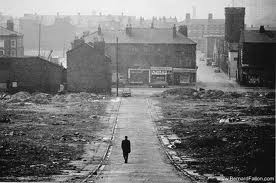 Of Time and the City is a deeply evocative film which examines memory, time and identity in the midst of a conflicted portrait of Liverpool. It takes a while to embrace its every idiosyncrasy, and its deeply personal tone may be alienating to some. But it crucially succeeds by not being entirely esoteric, providing a wide range of scenes and images which reach out to the viewer and invite you into this forgotten world. As a documentary it succeeds by conveying its message in an appealing and stimulating way, and by having an emotional core which feels honest and inviting.
Rating: 4/5
Verdict: A moving and elegaic portrait of Liverpool


