


Reflections
-
It is weird to read my correspondences from the late August/early September
period, being the time of transition between my old function in life to my
new ...
14 years ago
Tinker Tailor Soldier Spy (UK/ France, 2011)
Directed by Tomas Alfredson
Starring Gary Oldman, Colin Firth, Tom Hardy, John Hurt
You could be forgiven for approaching Tinker, Tailor, Soldier, Spy with some degree of trepidation. So many European filmmakers, who rocked the world with their first few features, went the way of the dodo after they started working in the English language. And considering just how good Let The Right One In was, you find yourself almost begging that Tomas Alfredson hasn't gone the way of Wolfgang Petersen. O, we of little faith. Within minutes of his second film beginning, Alfredson has laid all such fears to rest, allowing us to enjoy one of the very best films of 2011. His adaptation of John Le Carré's highly regarded novel is as distinctive and artistic as his debut, packing in a gallery of superb performances within a perfectly rendered period setting. While it never entirely hits the heights of Let The Right One In, it is a more-than-worthy follow-up from a director who seemingly can do no wrong.
 For starters, Tinker, Tailor, Soldier, Spy is truly beautiful to behold. Alfredson reunites with cinematographer Hoyte van Hoytema to create a highly evocative portrait of 1970s London. The screen is awash with faded greens and blues, and many scenes are shot partially or wholly in shadow to underscore the murky dealings that are afoot in the Circus. There is a perfect balance between artistic license and authenticity, creating a world which is both unique and instantly recognisable.
 Not only is Alfredson's vision of London so visually outstanding, it is also culturally nuanced. He identifies three separate cultures uneasily co-existing, evoking and demonstrating them through intelligent choices of music. We have the recent past, embodied by Tom Hardy's character, which is like a paler rendition of Life on Mars, complete with Mudd and David Bowie. We have the recent past, namely the 1960s, which is reflected in the Breathless-like scenes between Hardy and the girl in the convertible. And we have the Circus itself, which seems completely unchanged from the 1940s, or possibly earlier than that, as typified by the inclusion of a George Formby record when one of MI5's agents makes a call from a music shop.
 In Alfredson's hands, Tinker, Tailor, Soldier, Spy becomes a film about malaise and ennui. It depicts a Britain which is past its glory, not only as an imperial power but as an intelligence force: not only can it no longer conquer countries, but it is increasingly incapable of holding on to their secrets. The Circus increasingly positions itself as a buffer zone, refusing to admit reliance upon its American "cousins" and contenting itself with gathering intelligence about Soviet activity in Europe.
 The Circus is depicted as the very definition of old-fashioned. If there wasn't a close-up on the ticker-tape showing it was 1973, you would swear that this was the War Office and we were still fighting the Germans. All of the furniture, from the wooden chairs to the Bakelite phones, seems left over from the war, and in the libraries you can almost smell the dust on the shelves. It feels like an organisation built upon self-denial - a collection of people who continue existing without any real reason for doing so. Without any 'proper' wars left to fight, everything Britain stands for has become redundant, and no-one, not even Smiley, is willing to admit it.
 In the best possible way, the film is very slow-paced for a thriller. It would be totally inappropriate to tell Le Carré's story through Bourne-style shaky-cam and rapid editing, because the material and the technology surrounding it is does not have a 2011 sensibility. This is still an analogue world, in which conversations are transcribed off reel-to-reel tape recorders, bugs are hidden in lampshades, and people signal through flashlights and banging on walls.
The film is also old-fashioned (in a good way) by its methodical patience. With the exception of Control's outburst or Jim Prideaux beign shot, the conversations in Tinker, Tailor are quiet and considered, containing nothing that could be classed as histrionic. Smiley doesn't speak for the first fifteen minutes, and even when he is interrogating the Magic Circle he never shouts: he takes time to phrase his questions, refusing to give anything away and ensuring that he need not repeat himself. You could argue that this understatement and emphasis on method over movement is another period detail; because modern espionage is built around the internet, it makes sense for the camera to move faster and for things to be more action-packed. But it's also a reflection of Le Carré's sensibility. Where his contemporary Ian Fleming was drawn to the glamour of spying, Le Carré sought to dismantle all such illusions, emphasising the loneliness of spying and the moral ambiguity of the protagonists.
 If a James Bond film is like a shooting gallery intercut with car chases, Tinker, Tailor is like a tricky game of chess. It is a film about characters who are in the endgame: they see the doom of their organisation approaching, and it is a question of when and not if they will be dragged down with it. After Control and Smiley are forced out (with the former dying soon after), it becomes a scramble for power with Percy Alleline emerging as the leader. We follow Smiley as he navigates through the mind-games to uncover the mole - to find the king whom he will trap in an elaborate mate.
 The inward-looking nature of the Circus is reflected in the understated performances of an extraordinary ensemble cast. In many ensemble films, the cast often compete for attention by out-acting each other, but Alfredson is too smart to put up with any such nonsense. This is a film in which the tiniest little gesture can say everything about a character, whether it's the raise of an eyebrow, the twitch of a lip, or the slightly forced way that Colin Firth smiles at the ghastly Christmas party.
 Because the TV adaptation of Tinker, Tailor is so well-regarded, any new adaptation in any medium will have to be compared to it. And for all the brilliance and quality of Alfredson's work, there are a couple of areas in which the TV series has the edge. There is not much between them in terms of cast - Gary Oldman can hold his own against Sir Alec Guinness, and in Colin Firth's current form he is more than a match for Ian Richardson. But in compressing the novel or the series into just over two hours, there are two small flaws with this adaptation.
 Because the cast is so strong, and charismatic, you find yourself wishing to see more of them, something you do get with the TV series. When you've got someone as radiant as Tom Hardy, or as enigmatic as Benedict Cumberbatch, it doesn't seem fair to give them so little screen time. More to the point, a lot of the rich language of Le Carré's novel has been reduced. Bill Haydon's explanation of why he defected is reduced to a few teary sentences, and Smiley seems to centre in on Hayden relatively quickly. These shortcomings aren't enough to throw the whole film off course, but it does put you in the unusual position of wanting it to be half an hour longer.
 To be fair on Alfredson, he does make up for these tiny shortcomings by bringing out new aspects of the story, particularly the sexual nature of the characters. There are strong indications that Haydon and Prideaux were lovers, from the loaded glances at the Christmas party to the photograph of them together, which Haydon keeps when he raids Prideaux's flat. Haydon is ultimately killed by Prideaux by being shot under the eye: a tear flows from Colin Firth's eye, mingling with blood over the bullet wound, and the camera cuts to Mark Strong, also in tears.
 Tinker, Tailor, Soldier, Spy is an almost perfect film. Its flaws are so miniscule and yet so clear that they will drive you to the point of frustration. But no amount of lingering on them can detract from its status as one of the year's very best films. The performances are superb, the visuals are extraordinary, and Alfredson directs with a reserve and intelligence which is all too rare in modern filmmaking. A true gem.
Rating:
Verdict: Almost perfect
Carrie (USA, 1976)
Directed by Brian De Palma
Starring Sissy Spacek, Amy Irving, Piper Laurie, Nancy Allen
Like Jaws a year before it, Carrie is one of the great happy accidents in horror cinema. Stephen King almost threw away his debut novel out of artistic frustration, and was only paid $2,500 for the film rights. The production was underfunded by United Artists and its director, Brian De Palma, lacked commercial viability, having had only a modest hit with Obsession. But out of this potential disappointment came an engrossing and terrifying film, one of the best Stephen King adaptations and perhaps the high point of De Palma's career. Like a lot of Stephen King adaptations, there was a relatively small gap between Carrie being published as a novel and the film version being released. The only contemporary production with a shorter turnaround was Christine, which went from a novel in April 1983 to being filmed by John Carpenter that same summer and being released in December. Hence it is difficult to judge how much of the film's success lies in De Palma's direction and how much of it lies in the source material.
 De Palma's biggest contribution, from a narrative point of view, is to take such a relatively simple premise - a high-school girl with telekinetic powers - and explore it over 90 minutes with precious little in the way of padding. Because Carrie was originally intended as a short story, it has an inbuilt modesty which is absent from It or The Shining. But what it lacks in epic storytelling it, more than makes up for in its thematic depth and the intense believability of its characters.
 Carrie at its most basic is about the horrors of high school: the bullying, the peer pressure, the feeling of being an outcast and, in an exaggerated way, having to live up to the expectations of one's parents. Its influence can clearly be seen in everything from Michael Lehmann's cult classic Heathers to more mainstream efforts like Mean Girls. The opening sequence in the showers sets up the majority of the girls as school as utterly repulsive. Their rapid-fire, everybody-talks-at-once dialogue is obnoxious for all the right reasons, and their posing, pulchritudinous bodies are in stark contrast to Carrie, who is so gaunt and wiry that you might mistake her for Gollum.
 Within this context, Carrie's telekinesis represents her burgeoning adolescent rage. It begins as something over which she has very little control, but over the course of the film she learns to focus it and use it sparingly. The film uses telekinesis in the same way that Let The Right One In uses vampirism, as a means of expressing a deep emotional reaction to the world by placing it outside of oneself. But as with the final scenes in Let The Right One In, Carrie's abilities are not entirely within her grasp, and at the prom there is still a question of whether she is controlling her powers or the other way around.
 Carrie is also about the suffocating influence of religion, and in particular its role in the repression and persecution of women. Carrie's mother is a Christian fundamentalist who believes that menstrual bleeding is an indication of sin. When punishing Carrie she continually recites the phrase "Eve was weak" and forces her daughter to repeat it, to confess to a crime that she has committed simply by being born a woman.
 The mother, played with abandon by Piper Laurie, is essentially a sadomasochistic character. She derives pleasure in the form of spiritual vindication from both inflicting pain on Carrie and by condemning herself. By believing that all women are cursed and sinful, she is submitting herself and her daughter to a greater will, allowing herself to be punished both alongside her daughter and on her behalf. The deep bond between mother and daughter is paralleled by the bond between sex and spirituality. The mother's gasps as she dies are borderline orgasmic, and she dies in the same pose as the icon of Christ in Carrie's closet.
 The Biblical connotations of Carrie are not confined to the position of women. Carrie's bleeding is interpreted as not just punishment for her own sins, but for the sins of her mother and father. Towards the end of the film, it is revealed that Margaret White slept with Carrie's father outside of wedlock, the implication being that Carrie is illegitimate. The father left the family, perhaps because of the pregnancy, perhaps because he was intimated by Margaret's personality or her faith. For whatever reason, the mother's guilt for that sin is laid upon Carrie; she implicates her daughter because she cannot face and atone for her own sin.
 In this sense Carrie is immediately comparable to A Nightmare on Elm Street, which dealt with the theme of the sins of the father in a more surrealistic way. But there are also strong connections with Suspiria, Dario Argento's giallo masterpiece which was in pre-production when Carrie was released. Both films are very stylish and striking in their manipulation of colour. Mario Tosi's cinematography contains the same shimmering blues and Technicolor reds that Argento's work features in abundance.
But more than that, both Carrie and Suspiria have huge elements of fairy tales about them. Where Suspiria is modelled on Snow White and the Seven Dwarfs, Carrie is a reworking of Cinderella with the final act subverted. Instead of a handsome prince coming to save the day and everything working out fine, Carrie descends into hell, embracing her extraordinary powers and losing all feelings for anyone else. In this context Carrie's classmates are the ugly sisters (with the handsome prince being in on the act) and Margaret is the wicked stepmother, a further indication that Carrie is illegitimate. The film simply wouldn't work without the performance of Sissy Spacek, who is nothing short of phenomenal. Having first come to prominence in Badlands, Spacek was originally cast to play Christine Hargensen, the role which eventually went to Nancy Allen. Determined to change De Palma's mind, she smeared Vaseline into her hair and turned up to the final audition in a dress she wore in seventh grade. She brings a heart-breaking fragility to the role, making us feel so strongly for her character that we almost find ourselves cheering in the midst of her carnage. The image of the blood-stained Carrie walking home, or climbing the stairs into the attic, is simultaneously touching and terrifying.
 The only thing which prevents Carrie from being a full-blooded masterpiece is some of De Palma's visual trickery. Many of his decisions work well, adding to the tone and substance of the film. When Carrie and Tommy are dancing, the camera is at a Dutch angle and twirls around at a faster pace than the couple. This and the final dream sequence, which was filmed in reverse, successfully reinforce the magical, fairy tale quality of the story. And the use of slow-motion up to and include the pig blood falling do add a real sense of tension.
 But once the pig blood hits the fan, De Palma gets carried away and his visual decisions undercut the climactic scene. Using split-screen undermines the sense of unbridled panic we are meant to have: by asking us to focus on two different things at once, we both lose a sense of scale and find it hard to focus on the often-poetic justice being meted out to. The Metropolis-style kaleidoscope view of people laughing doesn't contribute all that much, and the looping of her mother's voice ("they're all gonna laugh at you!") makes the whole thing feel like the final groove of Sgt. Pepper.
 Despite its slightly botched ending and some overly conventional jumps, Carrie is a damn fine film which still has the power to unnerve after 35 years. Spacek's extraordinary performance is supported by some fine work from Nancy Allen and Piper Laurie, along with a brief appearance from John Travolta on the cusp of superstardom. Where De Palma's later works would be memorably shocking, this is shockingly memorable, and remains one of the high points of his often distinguished career.
Rating:
Verdict: First-rate teen terror
Wake Wood (UK/Ireland, 2011)
Directed by David Keating
Starring Aiden Gillen, Eva Birthistle, Timothy Spall, Ella Connelly
The revival of the Hammer brand is a cause for triumph and tribulation amongst horror fans. Nostalgia notwithstanding, the rebirth of Hammer in and of itself indicates some kind of bright future for British horror filmmaking. But with this there is the risk that the new output cannot live up to the past, either in quality or in the precise, easy-to-identify trademarks which made the originals so endearing. Whatever the merits of Let Me In, the Hammer-backed remake of Let The Right One In, it lacked the essential visual and structural qualities which we associate with Hammer: the slightly creaky, strikingly-coloured blend of Hollywood studio convention and European grand guignol, delivered in a distinctively British way via several buckets of blood. But there is no such trepidation with Wake Wood, which is Hammer through and through.
 The stable name may be from another era, but Wake Wood feels like a product of the 21st century. This is not the output of a single studio, churning out films like a factory, but a series of smaller, more disparate production companies who can use the brand to get the distribution they deserve. The opening credits of Wake Wood list more than a dozen companies before we reach the title, a sign of how thinly spread the funding is and the price we have to pay nowadays for interesting low-budget films.
 In terms of its place in horror, Wake Wood prominently references a number of films and texts which are held in high regard. The central story about a couple grieving for their dead daughter is a clear nod to Don't Look Now, as is the mention of red in the girl's vision and the images of her wandering the woods in the (yellow) raincoat. An d there are huge hints of The Wicker Man in this couple's status as outsiders chancing upon a 'pagan' community. It's as though the film was written by someone who saw both films on a double bill, forgot that they were two separate entities and wrote their own version of what they perceived to be a single story.
 Outside of these prominent references, the film also tips its hat to W. W. Jacobs' The Monkey's Paw and Stephen King's Cujo in the more graphic scenes with the dog. But although it's situated deep in a particular area of horror, Wake Wood does gradually gain its own identity. As the various genre elements begin to play out, they afford the director a chance to experiment while having the security of knowing the outcome.
That said, the first 45 minutes are very slow-burning and deeply generic. This is the section of the film which most reflects the modesty of the production. The visuals are washed-out with very standard camerawork and simple editing, and there isn't a great deal in the dialogue to pull you in. As with a lot of genre filmmaking, there is some pleasure to be had from seeing all the pieces fit together. But by the time we have reached the halfway mark, we begin to feel like something's missing. For a film situated so strongly in the more emotive, 'lost child' end of horror, Wake Wood has a surprising amount of gore. There are pockets of blood and guts throughout the running time, with some being designed to shock and others being used to contextualise the events - for instance, Patrick's work as a veterinarian which leads him to befriend and work for Arthur. The most memorable example involves one of Arthur's farm assistants being crushed to death by the back end of a bull as it is being moved into a metal pen.
 As well as testing the audience's mettle, the gory parts of Wake Wood convey one of the main ideas of the film. The cycle of birth, life and death (and re-birth) is presented as one with immense agony at both ends and a chance for happiness or peace in-between. Both the cow calves and the resurrected version of Alice emerge from highly painful births - the former requires a Caesarian section on the cow, the latter a corpse being mangled and crushed, like Burke and Hare without the jokes.
 After the initial agony of childbirth, whether personal or by proxy, the time shared by Alice and her parents is one of sheer joy. In contrast to the macabre and gruesome ceremony which brings Alice into the world, these scenes are shot in almost glaring sunlight with permanent smiles on the parents' faces. It's a moment of immense catharsis for Patrick and Louise, albeit one which slowly returns to grief and then fear as Alice's fate begins to unfold.
 At the centre of Wake Wood is the story of a couple struggling to come to terms with grief and being unable to let go of their daughter on a spiritual level. The film uses the language of horror - blood, guts, pagan rituals and strange goings-on in woods - to approach the issue of grief in a manner which feels a great deal more honest, brutal and genuine than any number of more mainstream, 'sensible' films. Compare this film to Rabbit Hole, in which all the grief feels choreographed and sanitised, and it's easy to see which approach is more effective at cutting to the emotional heart.
This asset is confirmed in the performances of Aiden Gillen and Eva Birthistle, which are very naturalistic and feel genuine even in the most absurd moments of the film. Birthistle has something of Julie Christie's torment about her performance, refusing to constantly break down and having some kind of relationship with her child which stretches beyond the boundaries of this world. Gillen, on the other hand, has Donald Sutherland's stubbornness, having a desire to move on and occupy himself (with cows instead of churches) while also wanting to do what is best for his wife. The supporting performances, however, are more of a mixed bag. Timothy Spall brings much in the way of presence as Arthur, but his Irish accent comes and goes as he drifts back into his natural brogue. The elderly locals who oversee the ceremony are given small speaking parts, but these mostly end up like the women with the second sight in Don't Look Now: there's no awkward clutching of chests, but some of their comments border on the ridiculous. And the scenes of the pagan ritual are both creepy and a little bit snigger-inducing: fans of Hot Fuzz will almost expect the characters to start mumbling about "the greater good".
 The final third of the film, in which Alice's return to the grave goes horribly wrong, is where Wake Wood finally gets into its stride and starts to deliver the nail-biting thrills that we had been hankering for. The film takes the ending of Don't Look Now and marries it to the opening of Hallowe'en, so the symbol of the parent's grief is not only a murderous force but a seemingly unstoppable one. This section is spoiled somewhat by Alice dragging her mother down to the grave with her, a la Sleepy Hollow - there is nothing the mother had done which would have made her deserve such a fate. But this is partially mitigated by the final scene involving Patrick reviving his dead wife, who is pregnant with a second child...
 Wake Wood is a modest but solidly made film which is destined for minor cult status. Despite being so deeply embedded in generic conventions, it manages to take on its own identity through some decent performances and an overall feeling of unease generated by what unfolds. It isn't perfect, with all the shortcomings of a low budget being in plain sight. But as a self-contained, 90-minute horror film, it bodes well for the return of Hammer, and sets the bar in place for The Woman in Black.
Rating:
Verdict: A modest but effective cult movie
Cronos (Mexico, 1993)
Directed by Guillermo del Toro
Starring Federico Luppi, Ron Perlman, Claudio Brook, Tamara Shanath
Well before the 'abstinence porn' of Twilight began to hit our screens, a whole wave of vampire films in the 1990s returned to the deep well of sex which had become the lifeblood of vampire fiction. We had Anne Rice's AIDS allegory Interview with a Vampire, John Landis' uneven crime drama Innocent Blood, and of course Francis Ford Coppola's bonkers version of Dracula.
But in the midst of these hypersexual offerings, a small Mexican film from a first-time director was helping to radically reshape the genre. Cronos, the debut by Guillermo Del Toro, demonstrated that vampire fiction could explore themes far more varied than sex, such as the fear of death, the loneliness of old age and the relationship between Mexico and the USA. A hugely influential work of horror cinema, it is every bit as striking and significant as Let The Right One In. When I reviewed The Usual Suspects, I remarked that one test of a good filmmaker is being able to take a hackneyed series of conventions, and create something which is both memorable and mindful of its genre origins. On this level alone Cronos is a triumph, since it is able to fulfil all the requirements of being a bona fide vampire film which approaching all the key plot points and characters arcs from distinctively unusual angles.
 Cronos may have a backstory about the origins of the vampire, followed by the introduction of our protagonists to said bloodsucker which results in quite a lot of gore. But Del Toro manages to achieve this while removing from the story all connotations of sex or lust. In place of Hammer's heaving bosoms and phallic fangs, he gives us skin peeling like wallpaper and the intricate clockwork of the Cronos device. The closest the film comes to anything sexual is a scene of Federico Luppi licking a nosebleed off a bathroom floor, which is shot with such clinical precision that there can be no room for erotic thoughts.
By refocusing the story around ageing and the fear of death, Cronos hits on the central dilemma in vampire fiction: would you rather live forever but lose your soul, or stay pure and human but live in constant fear of death? Both the elderly characters in the film choose the former, albeit for different motives and by entirely different means. Dieter, the dying businessman, makes a conscious decision to pursue the device: he owns the manual needed to operate it and believes it is the only thing that can keep him and his empire alive (and out of his nephew's hands). Jesus, on the other hand, is 'bitten' accidentally, and only comes to use the device frequently through observing its physical benefits. His desire, in the form of addiction to blood, is every bit as strong as Dieter's desire to possess the device himself, but it is not motivated by selfishness or a desire for power. Like Dracula, Jesus becomes weary of eternal life: he is worn down not by an army of brides, but by the constant torment of those who are jealous of his powers. In the end his remaining sense of self triumphs over the vampire he has become, and he sacrifices himself to protect his beloved granddaughter.
The theme of ageing is also conveyed in the visuals of Cronos. Guillermo Navarro's cinematography is very washed-out, with dark woods and fading reds to indicate how everything around the characters is very slowly dying or decaying. Even the brightest scenes in the film, like the New Year's party, are filled with pale colours and make use of shadows wherever possible.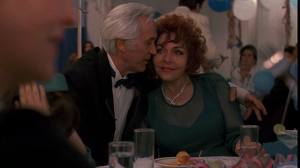 Beyond its direct connections with the vampire genre, Cronos is connected to other key figures in horror. The design of the Cronos device itself, with its peculiar blend of biology and mechanics, resembles the work of Clive Barker: its design as is intricate as the puzzle box in Hellraiser and there is the same suggestion of great evil being contained in or brought forth from something of great beauty.
 There are also connections with John Carpenter in the film's elaborate and highly convincing make-up. Del Toro's training under make-up artist Dick Smith shines through in his pursuit of organic, physical terror, and the work of his make-up artist M. Carrajal rivals anything which Rob Bottin achieved on The Thing. There is a further connection with Carpenter contained in a line where the device is dismissed as "just a toy". Like Carpenter in Hallowe'en, Del Toro is taking an aspect of horror which had become institutionalised and accepted, and proving that it could still scare you to death.
 Cronos is a deeply religious film, in its use of iconography and its exploration of the meanings to both life and death. Again, this is drawing on a classic trait in vampire fiction, namely that the act of being or becoming a vampire is a rebellion against the laws of nature (including death), which it was believed were set in stone by God. Though there is no scene of Jesus declaring war on heaven, as happens in the Coppola version, his faith is counterpointed by his growing dependence on the device, as demonstrated by him reciting the Lord's Prayer while allowing it to stab him a second time.
 There are other indications of these religious themes as well. The Cronos device was created by an alchemist, someone who brought the material and spiritual worlds together, using what became the scientific method to find the divine substance which could cure all disease and prolong life. The images of cockroaches bursting out of angels, or the device being hidden in said statues, hints at the threat which such a device poses to Christianity. By removing the certainty of death, it undermines the corresponding fear of death and damnation, and therefore makes it less necessary either to repent or to live a moral life.
 To add to its theological wrangling, Cronos also has political connotations. The film is a rich allegory for US-Mexican relations, in which America is the bloodsucker which takes without asking and refuses to yield. Dieter, the American, is determined not to let the Mexicans (in the shape of Jesus) get one over on them - the second they come up with something useful, the Americans want it for themselves and won't take no for an answer. There is a contrast between Federico Luppi's sympathetic, caring grandfather and Ron Perlman's aggressive and ambitious nephew. Perlman may slip in and out of Luppi's language, but he is only interested in himself - it is not communication, only giving orders in a language he thinks they can understand.
 The performances in Cronos are mostly of a high quality. Luppi is a great screen presence, seeming frail and vulnerable while coming across as a strong and determined character. Perlman, in his first of several collaborations with Del Toro, is a very fine match for him. His versatility with language is matched only by his desire to throw himself physically into the role. The only weak link is the young girl, played by Tamara Shanath. It isn't so much her performance as the limited extent of her character's development; we don't feel as strongly connected to her as we do with her counterparts in The Devil's Backbone or Pan's Labyrinth.
 Cronos is a great debut feature from one of horror's greatest directors. While not as perfectly formed as Pan's Labyrinth, it contains all the hallmarks of Del Toro's genius, from its powerfully unique visuals to its constant invention and intelligence even in the most trivial of moments. It's a top-notch chiller and a welcome shot in the arm for vampire fiction, proving that the genre is still able to stimulate as well as scare. It's not Let The Right One In, but it should be welcomed into anyone's collection.
Rating:
Verdict: Creepy, chilling and very clever


