
Reflections
-
It is weird to read my correspondences from the late August/early September
period, being the time of transition between my old function in life to my
new ...
14 years ago
Burke and Hare (UK, 2010)
Directed by John Landis
Starring Simon Pegg, Andy Serkis, Isla Fisher, Tom Wilkinson
Twelve years is a long time in filmmaking, and there are few directors who have recovered from such a prolonged absence. Even the late great Stanley Kubrick dropped the ball very slightly with Eyes Wide Shut. And considering the last few films that John Landis has made - The Stupids, Blues Brothers 2000 and Susan's Plan - there will be a great many people who would wish him to extend his 'retirement'. I say 'retirement', for in reality Landis has never gone away. He may not have made a feature film since 1998, but the most excitable director in American cinema has been very busy behind the scenes. On top of his TV work and a host of blink-and-you'll-miss-him cameos, Landis has spent his time re-mastering his classic works and directing commercials with his fees going to various charities. Like John Carpenter, Landis had become disillusioned with modern Hollywood and its obsession with marketing and opening weekends. He was offered several films during his hiatus, and turned them all because the scripts were just not up to snuff (no pun intended).
It's therefore no surprise that Burke and Hare sees Landis returning to his darkly comic roots. It's a film made exactly the way he wanted it, drawing on both the anarchy of his early comedies and his love of gothic horror and Ealing Studios. The result is a very funny comedy which is a million miles from the sacrilege of Blues Brothers 2000 or the banality of Beverley Hills Cop III. It isn't quite up there with his best work, but it is a very welcome return to form. Burke and Hare is essentially an old-fashioned Ealing comedy in the tradition of The Ladykillers and Kind Hearts and Coronets. This means dark humour, grotesque characters, and a central story about individuals doing questionable things to earn a crust, usually involving murder. Unlike the recent St. Trinian's reboots, Burke and Hare is not exploiting the Ealing label in a bid to bring in a wider audience; both its premise and execution are rooted in this 1950s tradition, and the film is knowingly affectionate towards these works.
Although the film is backed by Ealing Studios, its weaknesses smack of Hollywood's desire to be economical with the truth. Both director and main stars have referred to this as a 'Regency' film, when in fact by 1828 George IV had been on the throne for eight years; being of sound mind and having no heir, there was nothing to be Regent of. When characters speak of 'the King' or 'His Majesty', it's easy to think they're not sure to which king they are referring. Likewise there is the matter of accents. The film is accurate in giving the lead characters Irish accents, since Burke and Hare were Irish immigrants who had recently arrived in Edinburgh. But Landis apparently coached Simon Pegg and Andy Serkis by showing them Darby O'Gill and the Little People, a mid-1970s Disney offering notable for its farcical accents and Sean Connery singing (shudders). Their accents might not wander from country to country like Russell Crowe's accent in Robin Hood, but they are comedy accents in a way that might seem retrograde.
But to gripe about these things for too long is to miss the point. The film freely admits to play fast and loose with the truth, and there are certain details about the story of Burke and Hare which Landis gets right. Other versions of the story uprooted the characters to Victorian England, for the simple reason that there is an abundance of Victorian locations in which to shoot. Most of the shooting was done on location in Edinburgh, with the only set being the interior of the prison in the last ten minutes. The film also redresses the popular myth that Burke and Hare were body-snatchers or grave-robbers; they were something far more ingenious and entrepreneurial (if murder can be so described). Like his underrated comedy Into The Night, Burke and Hare is at heart a light-hearted, raucous romp with Landis' tongue firmly in his cheek. What he brings to the table is his not just his expertise when it comes to comic timing or staging set-pieces, but his love of mixing the gruesome with the hilarious. This is not a horror comedy in the manner of American Werewolf, but a lot of the jokes are designed to make you squirm in your seats, laughing out loud as the bones crack and the blood runs.
The film begins with Tim Curry, putting on a ripe performance as an old-school anatomist, conducting a vivisection. He slices through a man's leg, causing blood to spray all over his students, and gleefully remarks, "that would be an artery!". Then there is the sight of 'old Donald' 'lying' on Dr. Knox's table, having been folded in half to get him into a barrel. There are other, drier moments, such as Burke pretending to be William Wordsworth to get into a club, and Hare's comments about women "costing an arm and a leg".7 Burke and Hare is also visually impressive. The film is shot by John Mathieson, who has worked extensively with Ridley Scott since Gladiator. He captures the dark gothic quality of Edinburgh's streets, bringing a very Hammer-esque quality to the smoke-ridden passages through which drunken, lardy gentleman would wander to their doom. The film could almost be described as an affectionate parody of Hammer, combining stylish visuals with a modern, earthy sense of humour. This is supported by a brief cameo from Christopher Lee, who appears as a delirious soldier whom Burke and Hare ease into the next world (by sitting on him).
 This brings us nicely onto the issue of cameos. In the past Landis' desire to pack the screen with his best friends has often been distracting; in the second half of Into The Night, they pop up with such alarming frequency that we start to lose sight of the story. Here his choice of cameos is much more restrained and apposite; we still get old friends like Jenny Agutter turning up, but Landis times their appearances to perfection. In addition to Agutter's appearance as a hammy actress (knowing laugh), the best bit parts are Paul Whitehouse's drunken Scot, who survives being pushed down a hundred flights of stairs, and Michael Winner, who goes over a cliff in a stagecoach without so much as a "calm down dear!".
This restraint is what makes Burke and Hare so enjoyable, since it demonstrates that Landis has matured as a filmmaker. Most of the indulgences which marked his career after Into The Night have gone, as has his appetite for gratuitous nudity. Although both Isla Fisher and Jessica Hynes play bawdy, sensual roles, neither character is a bolt-on designed to bring in the lads' mag audience. Both characters end up as fleshed-out, ambitious, independent women, so that even during the sex scenes it doesn't feel like the plot is grinding to a halt to titillate teenagers. The film also deserves credit for addressing the moral issues surrounding Burke and Hare, rather than just playing out the story like Carry on Murdering. There is an interesting subplot involving an all-female production of Macbeth; while superficially a construct to bring Pegg and Fisher together, it is worked into the story very well. Pegg talks about Macbeth's internal struggle between good and evil, and his motivation lying ultimately in a desire to be loved. This and Dr. Knox's attempt to map the human body through photography tap into the central dilemma of their story. What Burke and Hare did was morally wrong, but does that make them vile people? And in the long term, were their gruesome killings strangely justified due to the advances in medicine?
 Burke and Hare is a welcome return for John Landis, both to the big screen and to form. The film succeeds as a comedy, with great jokes and great chemistry between Simon Pegg and Andy Serkis. Tom Wilkinson and Tim Curry relish their roles as the rivalling doctors, and Ronnie Corbett is very enjoyable as the head of the Militia. It may be old-fashioned and rough around the edges; certainly it's not up there with Trading Places or An American Werewolf in London. But it remains Landis' best work since Into the Night and could be the ideal starting point for a full-scale comeback.
Rating: 4/5
Verdict: A good old-fashioned return to form
Airplane! (USA, 1980)
Directed by David Zucker, Jim Abrahams and Jerry Zucker
Starring Robert Hays, Julie Hagerty, Leslie Nielsen, Lloyd Bridges
It’s long been argued that horror and comedy are very close together, something amply demonstrated by a wide range of directors. On the one-hand we have the blood-soaked romps of Sam Raimi and Peter Jackson; on the other hand, we have the dark quirky wit of the Coen brothers.
Airplane! demonstrates this affinity in a different way – by being so funny it’s physically painful. Thirty years on this spoof to end all spoofs will still have the corners of your mouth starting to ache as you constantly grin at the chaos unfolding. Most if not all of the jokes are laugh-out-loud funny and the film successfully sustains this hilarity over a breathless ninety minutes. While not quite the funniest comedy ever made, it is definitely in the top five. One could be forgiven for viewing Airplane! with some form of contempt because of the comedy legacy it has left behind. Its particular style of quick-fire wordplay and oddball slapstick has certainly produced a lot of funny work. But ever since the third Naked Gun film, the talents of Zucker, Abrahams and Zucker have steadily ebbed away, and somehow we have ended up with the Scary Movie franchise and the pathetic parodies of Jason Friedberg and Aaron Seltzer. Fortunately, one quick viewing of this trio’s first film is more than enough to put such feelings to bed.
Because of its incessant level of gags, the natural point of comparison would seem to be Monty Python and the Holy Grail. In fact, in my review of Holy Grail, I remarked that only Airplane! has ever matched the Pythons’ film for sheer unrelenting laughter. And there are technical similarities between the two films, since were both made by first-time directors on very low budgets, and neither has any kind of underlying political message – these are not comedies which argue that mediaeval warfare is barbaric or that air travel is inhumane. However, while Holy Grail feels meticulously mapped out and builds very subtly, Airplane! is a much more ramshackle concoction. The jokes are chucked at the screen in quick succession, and often the plot slows right down so all the gags have a chance to play out. In this way, the film owes much more to the farcical slapstick traditions of Blake Edwards and the early films Woody Allen. Think of it as The Party on a plane, or Sleeper without the time travel (or any of Allen’s neuroticism).
Airplane! is at heart a spoof or satire of disaster movies, a genre which gave us The Poseidon Adventure, Earthquake, The Towering Inferno and the Airport series from which this chiefly stems. The script is lifted virtually verbatim from Zero Hour!, a much-famed 1950s disaster movie starring Sterling Hayden, who would later play General Jack D. Ripper in Stanley Kubrick’s Dr. Strangelove. By coincidence, the career of Sterling Hayden helps to illuminate why Airplane! not only succeeds but flourishes. In Dr. Strangelove, Kubrick took a piece of serious-minded political fiction (the Peter George novel Red Alert) and restaged it as an absurdist comedy. He achieved this by casting ‘serious’ actors like Hayden and George C. Scott, and getting them to deliver their lines absolutely straight, to the point of tricking Scott over which takes were used in the final cut. The characters take the talk of ‘precious bodily fluids’ and ‘mineshaft gaps’ so seriously, that it is impossible not to burst out laughing as the situation gets ever more ridiculous.
 Airplane! works on precisely the same principle. Before their performances in this film, Robert Stack, Lloyd Bridges and Leslie Nielsen were respected, ‘serious’ actors; Peter Graves even turned it down as first, calling it “tasteless trash”. As in Dr. Strangelove, none of the actors in the film know that they are being funny; if any one character were in on the joke, the entire film would collapse. Under these circumstance, we laugh at the absurdity of the dialogue, and the visual gags come in to enhance lines which before wouldn’t have seemed funny at all.
 As with Holy Grail, it is impossible to point off every joke in Airplane!, but we can identify categories into which the various jokes fall. We have broad slapstick humour, such as the woman running into metal towers as the ‘train’ speeds away, and the later scene of the hysterical passenger being slapped. We have visual gags, such as Rex Kramer driving his car against an erratic backdrop and Dr. Rumake doing a spot of gynaecology in the aisle. We have moments of great wordplay, like the immortal lines: “Surely you can’t be serious?”, “I am serious – and don’t call me Shirley”. And there is a whole stream of running gags, from the faux-foreign language translations to Lloyd Bridges confessing he picked the wrong week to quit a certain vice.
 The film also finds time to satirise both war films and the growing trend of Vietnam films; the project was green-lit shortly after the success of The Deer Hunter and was shooting while Apocalypse Now came out. Ted Striker’s bad experiences in ‘the war’ mark him out as a Vietnam vet, but both the script and the use of black-and-white stock footage refer to World War II. Intercutting sounds of plane crashes with early footage of failed flying machines is a simple but effective way of satirising war, and Striker’s ridiculous ‘drink problem’ is a pithy send-up of the kind of trauma suffered by soldiers. It could be worse – he could be left thinking he was Ethel Merman.
Although it never relies on self-reflexivity, or any real sense of ‘knowingness’, Airplane! does contain several examples of what could be called self-reflective casting against type. These casting decisions don’t contribute a great deal to the experience of watching the film, but they are a demonstration of the writers’ intelligence and enough to raise a wry smile among film buffs. The most obvious of these is Kareem Abdul-Jabbar’s casting as Co-Pilot Roger Murdoch, who is revealed by the young boy Jimmy to be Abdul-Jabbar’s alter ego. Ethel Merman (in her last film role) plays the soldier who thinks he’s Ethel Merman, and June Cleaver, who starred in the squeaky-clean white suburban drama Leave It to Beaver, plays the woman who ‘speaks jive’ to the African-American characters. Some elements of Airplane! are questionable. On the one hand, accusations of racism are misplaced, since the ‘jive-speaking’ characters are not portrayed as being stupid, and the subtitling of their conversations into deliberately stuffy English is funny. And the really uncomfortable scenes of Peter Graves using sexually suggestive slang are deliberate bad taste and well-played. But there are moments in which the film becomes dumb or boring, usually in the sequences which involve relatively large amounts of nudity. As with John Landis’ Into the Night, the frequent presence of flesh seems unnecessary, not because it’s exploitative, but because it’s a cheap laugh, or in most cases, not a laugh at all.
 Airplane! is undoubtedly a comedy classic which has dated extraordinarily well for a parody. Perhaps the ultimate proof of its deserved reputation is that the films it satirised have long since faded from the public eye. What was once taken seriously, to the point of Oscar nominations, has faded in the face of a comedy that always hits its mark and pokes fun at areas where you thought there was no fun to be had. Most of all, it’s a hilarious and thrilling comedy ride which almost gives the Pythons a run for their money.
Rating: 4.5/5
Verdict: Relentlessly and breathlessly funny
Into The Night (USA, 1985)
Directed by John Landis
Starring Jeff Goldblum, Michelle Pfeiffer, Richard Farnsworth, David Bowie
Many of the big 1980s comedies we remember are largely admired for one thing: their complete light-heartedness and escapist feel, something totally removed from the darker, more complex, and in some cases less funny comedies of today. The problem, however, is that once all the nostalgic charm has worn off, films like Ghostbusters and Bachelor Party turn out to be ropey, flimsy and ultimately not that funny.
Into The Night, on the other hand, is a underrated comedy film which remains largely funny twenty-five years on. For its first two thirds it manages to deliver both light-hearted thrills and a decent amount of substance, satisfying those of us who like to laugh and think at the same time. It's also a turning point in John Landis' career, marking the end of his huge success in the early-1980s and hinting in its latter half towards his more rambling, self-indulgent work later on. It far from Landis' best work, but it is an entertaining and ultimately satisfying experience. For the best part of an hour, Into The Night is a very well-crafted, light-hearted comedy about suburban life and the unexpected. It is a film which depicts how domesticity and the individual routines of working life have sucked all the fun out of existence. Ed Okin, played by Jeff Goldblum, works in a brown office, drives a beige car, and lives in a boring house with a boring wife in a neighbourhood in which nothing seems to happen. Even the sheets on his bed are a drab, ordinary white; there is nothing in this house or the dialogue which occurs there that would make you envy his lifestyle.
Having this low-key, slow setup means that there is some kind of rationale behind the extraordinary events which unfold. Okin is someone who is literally restless: he cannot sleep because his life has become so dull and so orderly, that he can longer no find sense, or purpose, or enjoyment in what he does. His decision to drive to the airport is the first instance of him attempting to break free from this monotony, even if it amounts to little more than sticking one's toe in the water.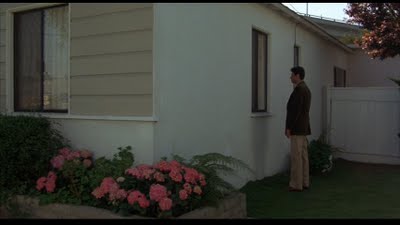 Hence when the series of events happen, they are much less contrived than one might expect. True, it's not like we've all had Michelle Pfeiffer fall on our cars whenever we randomly go for a drive. But there is nothing in the precise way in which the events play out which make the characters' circumstances seem unbelievable or ridiculous. The point that the film is making so well is that life needs to be unpredictable; in the case of the central character, it may be just what is needed to solve his problems.
But, as they say, be careful what you wish for. Much like Griffin Dunne's character in After Hours, Ed Okin has to live with the unpredictable consequences of such a miniscule decision. His ongoing decisions to help Diane are not motivated by a need for excitement: on the contrary, they are an increasingly desperate effort to return to the safety of his home. He keeps repeating the phrase, "this is too weird for me", because he simply isn't aware of what 'weird' is. As the film moves on, however, he and Diane develop a romantic attachment and his use of this phrase becomes less frequent. Though Okin may never fully embrace the world of intrigue to which Diane has introduced him, he has become more aware of how such a world works, how complex everything in comparison to his limited and frustrated worldview. He realises there is a whole other world out there which he never knew and which by the merest accident he has gain the ability to explore. His experience is an awakening -- or perhaps that should be asleep-ening, since the film concludes with Okin getting his first proper night of sleep in years.
As a comedy, Into The Night succeeds by being funny over its duration, with the humour coming as much from the subtlety of the central relationship as from the big set-pieces. There are several genuinely laugh-out-loud moments, most of them involving the incompetent Iranian henchmen. In one scene, their car crashes into a van in the airport car park while they are chasing Diane; they get out to face down the drivers, only to be greeted by four burly, muscular men, who look like the A-Team with even worse haircuts. Alongside these big set-pieces are more traditional Landis in-jokes and motifs. His love of old movies is shown during the scene in the deserted hotel room. A clip from Abbott and Costello Meet Frankenstein is playing on the TV screen, and at one point a character holds a knife aloft across the screen just as Abbott's chest is exposed. Likewise there is a reference to Get Carter in the beach scene, and the inadvertent carnage Ed creates on the film set is a possible nod to Animal House.
As far as casting goes, Pfeiffer is a straightforward choice, bringing to the role her irresistible combination of beauty, intelligence and vulnerability. David Bowie's cameo as a very English henchman is also a matter of common sense. But Goldblum, a year before his tour-de-force in The Fly, is far more unusual. He has a distant, alien-like expression, which makes it seem odd for Landis to cast him as an ordinary guy. But the decision pays off, with Goldblum's looks allowing him to play everything completely deadpan, adding to the intelligence of the comedy. The problems with Into The Night can be sub-divided into two groups. One group are general aspects of the film which haven't dated well or which seem questionable even for the time. Having just about put up with Dan Aykroyd blacking up in Trading Places, the issue of Landis himself appearing as a (highly stupid) Iranian does raise questions with regard to possible racism. This aspect could be mitigated as being part of a period attitude: this was in the day when The A-Team filmed Mr. T's stunts by covering a white stunt double in make-up and filming him from far away. But even with this caveat in place, the prospect remains a little unsettling.
What is more disagreeable, however, is Landis' continuing use of gratuitous nudity. When he was making Animal House, it was easy to forgive the odd glimpse of flesh for the sake of base titillation, on the grounds that young filmmakers rarely know what they're doing. Even the brief nudity in Trading Places was excusable, since it didn't detract massively from the plot. But when you're at the stage when you can afford cameos by Bowie and Jim Henson, there isn't much excuse for such adolescence, at least not to such an extent. The second group of problems relate to the second half of the film, which is much more contrived and drawn-out. The fact that the events stretch over two nights rather than one (as in After Hours) undermines some of the tension; the audience start to question the workings of the plot (e.g. why hasn't Ed's wife tried to find him?). Jeff Goldblum's conversation with Irene Papas feels like a badly drawn-out piece of improv that should have stayed on the cutting room floor. The ending itself is very drawn out and may cause you to lose patience as both coherency and sympathy begin to tumble.
 Into The Night is a decent effort from John Landis which makes for an enjoyable evening's viewing. Like Event Horizon many years later, it begins very substantially and keeps its eye on the ball for the first hour, before slowly descending into chaos and losing sight of its storyline. But even at its weakest points it is just about funny enough to sustain one's interest. It's too long, too contrived and is knocked into a cocked hat by After Hours. But as an overall experience, it's enjoyable, in a silly kind of way.
Rating: 3.5/5
Verdict: Two-thirds smart, one-third silly


