

Reflections
-
It is weird to read my correspondences from the late August/early September
period, being the time of transition between my old function in life to my
new ...
14 years ago
The Magic Christian (UK, 1969)
Directed by Joseph McGrath
Starring Peter Sellers, Ringo Starr, John Cleese, Spike Milligan
If there was a category of films called 'WTF?!', then The Magic Christian would be the definitive example. Joseph McGrath's late-1960s satire assaults your senses and your intelligence over a disorientating and unrelenting 92 minutes. The result is both a colossal train-wreck and a memorable commentary on human greed, which if nothing else will make you laugh and freak you out. There are a number of reasons to get excited about The Magic Christian. It is based on the 1959 novel by Terry Southern, who co-wrote the screenplay for Dr. Strangelove. Stanley Kubrick hired Southern after Peter Sellers gave him a copy of the novel; Kubrick loved it and promptly re-worked Dr. Strangelove from a straight drama into a black comedy. The screenplay for The Magic Christian was co-written by Graham Chapman and John Cleese, just before they hit the big time with Monty Python's Flying Circus.
 The other huge draw of The Magic Christian is its cast, which reads like a who's-who of British comedy actors. Alongside Chapman and Cleese, who appear respectively as the Oxford boat race captain and Mr. Dugdale, the director of the auction, Spike Milligan turns up as a traffic warden whom Sellers bribes to eat his parking ticket. John Le Mesurier, who was in The Italian Job the same year, turns up as Sir John during the boat race, and Hattie Jacques cameos as Ginger Horton. There are also brief cameos by Christopher Lee as 'The Ship's Vampire', Raquel Welch as Priestess of the Whip (don't ask), Roman Polanski as a lonely drunk and an unrecognisable Yul Brynner as a drag queen singing Noel Coward's 'Mad About The Boy'.
 That last sentence should give you some idea of the sheer level of weirdness we are dealing with here. Like its contemporary The Bed-Sitting Room, the film has a very particular brand and style of humour, and once it has gotten into its stride it makes no effort to tone down or alter said style to achieve greater audience appeal. With this in mind, it is no surprise that the film was almost universally panned when first released, although both it and The Bed-Sitting Room have since been rehabilitated.
 On the one hand, there are many, many things wrong with The Magic Christian. Like a lot of 1960s comedies it is shambolically constructed with an episodic storyline, so that it ends up as less of a story than a series of sequences of famous people enjoying each other's company at our expense. McGrath had previously directed Casino Royale, the equally shambolic James Bond spoof which Sellers had left mid-shoot. Even at its best his direction is aimless and very sub-Richard Lester (who isn't that good in the first place).
 The story of The Magic Christian makes very little sense. After eccentric billionaire Sir Guy Grand (Sellers) decides on a whim to adopt a homeless orphan (Ringo Starr), they embark on a series of pranks designed (and I use that word advisedly) to prove that everyone had their price and will do anything, no matter how degrading, if enough money is offered. Grand supposedly gets this idea when buying a hot dog from a train: having no change he offers the man first a fiver and then a tenner, and the man crashes his hot dog stand off the end of the platform in excitement.
 What follows is a series of increasingly elaborate pranks which target the unsuspecting public (often played by famous people) in increasingly mean-spirited ways. Things begin fairly harmlessly with the parking ticket scene, or Guy going to a high-quality restaurant and behaving like a pig, eating caviar with his hands and throwing his food at the guests. But soon the tone of the pranks become more savage, with the boat race being sabotaged and ending with civil servants swimming for money in a vat of faecal matter from the local slaughterhouse.
 With scenes like this, you would imagine that The Magic Christian would come across as a hard-hitting if heavy-handed satire, in which the seemingly moral and upright citizens of the world are humiliated in such a way that we are forced to reflect upon our own selfish desires. Sometimes the film does manage this, but for all the moments in which it does there are at least as many moments where it loses sight of this message and settles for the weirdness of the scenes in and of itself.
 This is particularly evident in the centrepiece involving The Magic Christian itself, billed as the most advanced passenger cruiser ever made. Once the guests embark, all manner of things go wrong, starting with them being shown a film of a black man's head being transplanted onto a white men's body (questionable doesn't cover it). The ship's captain becomes steadily more drunk and is promptly kidnapped by a gorilla. Christopher Lee turns up and starts biting the passengers who flee to the hold, only to discover the engine room is filled with hundreds of topless rowers commanded by a whip-cracking Raquel Welch. They run off the ship, only to find that the whole thing was a simulator inside a London warehouse, with Sellers and Starr looking on completely deadpan.
 Other set-pieces are equally inexplicable. Whilst at a performance of Hamlet, the actor playing the title role (Lawrence Harvey) delivers the whole 'to be or not to be' speech as a striptease, for no apparent reason. On the train later on, Guy Grand holds a board meeting for designing a new car; the scene then cuts to an illustrative animation which is somewhere between Terry Gilliam's Python work and Yellow Submarine. Finally, on the same train, a series of Oriental gentleman rotate through hidden doors to sit next to a seemingly racist businessman, who is then dragged through the door, laughed at by divers in strobe light, and carted off the train by the Gestapo. The only natural response to such scenes is to sit open-mouthed, head in hands, going: "What the hell?!".
 On the surface, then, there is an awful lot wrong with this film. It's shambolically directed, the story is all over the place, and the main theme often gets lots amongst the cameos. And yet - somehow - it works. For starters, it is an achievement in and of itself that someone could make a comedy this spiteful and mean-spirited at a time when most mainstream comedies were light and frothy. Whereas The Party a year earlier was a playful throwback to the traditions of silent cinema, The Magic Christian points the way forward to darker, blacker comedies like Withnail & I and Heathers.
 The ultimate test of a comedy, past or present, is whether or not it makes you laugh. And The Magic Christian passes this test, even if, as in Dr. Strangelove, much of the laughter is awkward laughter. The art gallery sequence where Sellers cuts up a priceless Rembrandt is funny, and the following scene with Sellers bidding with klaxon horns and flashing lights showcases his brilliant comic timing. Sellers' characterisation is great, drawing on his work as Grytpype-Thynne in The Goon Show, and Ringo Starr is very sporting and convincing as a more deadpan Moriarty.
 The Magic Christian contains all that is good and bad about 1960s comedy. It is ramshackle in its construction, but no moreso than The Party, and it is very excessive and indulgent, but not to the point of utter frustration. Indeed, despite its myriad flaws it has aged considerably better than some of Sellers' other work from the same period. The film makes for enjoyably confusing viewing, and would make a good double bill with The Bed-Sitting Room. You'll laugh, you'll be confused, you might be offended - but somehow you can't bring yourself to hate it.
Rating:
Verdict: An enjoyably confusing shambles
Stop Making Sense (USA, 1984)
Directed by Jonathan Demme
Starring David Byrne, Tina Weymouth, Jerry Harrison, Chris Frantz
There's a line in School of Rock where Jack Black talks about rock-and-roll being killed by "a little thing called MTV". The aesthetic sensibility of MTV (rapid cuts, flashy close-ups and rampant product placement) was at odds with the more elaborate, experimental end of rock which reached its peak in the 1970s. How ironic, then, that as said channel reached its peak, a concert film should come along which completely rejected the pop video aesthetic and redefined an entire genre. Where Gimme Shelter and The Last Waltz captured the ends of their respective eras, Stop Making Sense is a showcase for Talking Heads at their artistic and musical peak. It is also the film which put Jonathan Demme on the map; seven years later, he would win five Oscars (including Best Director) for The Silence of the Lambs. But looking at the film twenty-six years on, there is something faintly elegiac about it. It contains none of the vapid self-promotion which has dogged more recent concert movies, from Shine a Light to Rattle and Hum.
For a film about looking at a group of musicians for ninety minutes, Stop Making Sense is surprisingly cine-literate. The opening credits, with its elongated blank-and-white font, is an obvious reference to Dr. Strangelove (fittingly, since they were designed by the same man). David Byrne's 'machine gun stagger' across the stage during 'Psycho Killer' is a nod to the death scene at the end of A Bout de Souffle. More than that, though, the film is genuinely cinematic in a way that concert films very often aren't. Demme has always been an unfussy, understated director, and his camera is always keeping up with the players rather than the other way around. He possesses great technical know-how, knowing what to put the camera and how to shoot a performance so that the actors (or musicians) can just do their thing. Despite the level of meticulous planning that went into the tour, you get a real sense of kinetic energy existing on stage, something that a fussier director would quickly undermine.
Stop Making Sense is a showcase of Talking Heads at their very best, shortly after the release of Speaking In Tongues had brought them screaming into the mainstream. Their song-writing and musicianship is superb, producing a series of really catchy, rhythmical songs with ample room for improvisation. While later albums were dominated by David Byrne, here it feels like all four members are on the same page, working towards the same ends. But you don't have to be a fan of Talking Heads to understand just what makes this moment in their career so special. For one thing, the film demonstrates a rare level of confidence and exuberance which is absent in so much of modern music (read closely, Lady Gaga: 'confidence' and 'shock value' are not the same thing). Normally it is considered anathema for stage crew and roadies to share the stage with performers, unless there was an urgent technical problem that needed attention. But in Stop Making Sense, the stage crew are on for much of the first half, moving around equipment in the middle of songs; the band play on regardless, and even bring them all on at the end as a thank-you gesture.
 And then there is David Byrne, who in this film is confidence personified. Byrne has always been a charismatic front-man, but here he is positively hypnotic right from the opening. His jerky head moments, powerful voice and frenzied eyes lead you to focus only on him; during 'Psycho Killer', he holds the whole Pantages audience right in the palm of his hand. When he dances, his body moves like it's made out of plasticene, capable of being bent in all directions in perfect time to the music. His energetic repertoire ranges from doing laps of the stage being chased by a searchlight ('Life During Wartime') to cradling a lamp in his arms ('Naïve Melody (This Must Be The Place)'). And then there is 'the big suit', inspired by Japanese noh theatre, which is quite simply too cool for words.
 The film contains a number of interesting creative decisions which both add to the impact of the concert and make the film more cinematic. Stage crew notwithstanding, the band come on one at a time, only reaching full strength during 'Burning Down The House'. This is a great decision because it highlights the individual talent of the musicians, and creates some form of narrative thread without resorting to pretentious prog rock narration.
Byrne was very keen that there be as few distractions on stage as possible, to focus both the performers and the audience. To this end there are no water bottles, which could reflect the light, and all the amplifiers and musical branding have been painted over in matte black. There is also no coloured lighting, with Demme and cinematographer Jordan Cronenweth using several interesting means to get around this. During 'Once In A Lifetime', Byrne is lit up while the rest of the band are in darkness, and in 'Girlfriend Is Better', a technician walks around with a portable light, steadily moving turning instrument (and the big suit) into a series of creepy shadows. But the biggest innovation of Stop Making Sense comes in the relationship it strikes up between performers and audience. There are very few shots of the Pantages' crowd until the very last song of the show, and the recordings of their applause is turned down and pushed to the bottom of the mix. This makes the whole film feel incredibly intimate, like it's just you and the band having a long chat.
In something like U2-3D, the audience are put in the middle of a cheering crowd; their vision is obscured by waving hands and bobbing heads, and the experience is deeply claustrophobic. A show like this resembles an elaborate worship ceremony, with the band 'playing God' and inciting frenzied belief among those who have entered the temple. In Stop Making Sense, you still get the atmosphere, but everything is more settled and understated. While U2 fight to the last man for appreciation, Talking Heads know how good they are: they have nothing to prove, which means everyone can relax and just enjoy the music. There are a couple of false notes which undermine the film's status as "the Citizen Kane of the concert movies". The first is the very common mistake of mismatched film and audio. Because the film was shot over three nights, there are a number of amusing continuity errors - for instance, Tina Weymouth's bass keeps changing colour. More troublingly, Chris Frantz will sometimes hit a cymbal, or a guitarist strike a chord, and no sound will come out. This is partly understandable given the arrangement of microphones, but for purists it can very be annoying.
The other issue is perhaps more petty, and that is the appearance of The Tom Tom Club, the spin-off band of Tina Weymouth and Chris Frantz. Midway through the second half, they come on to perform 'Genius Of Love' while Byrne goes off to put on the suit. You can understand this decision logistically, but the song itself is quite weak. Tina Weymouth's natural range and calm delivery is at odds with the prominent funk percussion and Frantz' powerful backbeats; it's like the singer from The Party trying to compete with a Brazilian samba orchestra.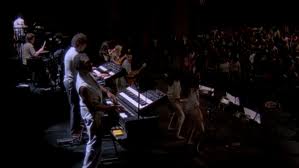 Despite these niggles, Stop Making Sense remains a remarkable piece of work, both for Demme and for Talking Heads. The fact that the band never toured again after this cements its status, and confirms its importance as a document of just how good they were. All of Demme's subsequent concert films, including the excellent Prairee Wind, owe a debt to this film, and it raised the bar for all concert movies to follow. Most of all, it proves the value of the music even to people indifferent towards the band, and for that feat alone it deserves the highest praise.
Rating: 4/5
Verdict: Intimate and innovative
Airplane! (USA, 1980)
Directed by David Zucker, Jim Abrahams and Jerry Zucker
Starring Robert Hays, Julie Hagerty, Leslie Nielsen, Lloyd Bridges
It’s long been argued that horror and comedy are very close together, something amply demonstrated by a wide range of directors. On the one-hand we have the blood-soaked romps of Sam Raimi and Peter Jackson; on the other hand, we have the dark quirky wit of the Coen brothers.
Airplane! demonstrates this affinity in a different way – by being so funny it’s physically painful. Thirty years on this spoof to end all spoofs will still have the corners of your mouth starting to ache as you constantly grin at the chaos unfolding. Most if not all of the jokes are laugh-out-loud funny and the film successfully sustains this hilarity over a breathless ninety minutes. While not quite the funniest comedy ever made, it is definitely in the top five. One could be forgiven for viewing Airplane! with some form of contempt because of the comedy legacy it has left behind. Its particular style of quick-fire wordplay and oddball slapstick has certainly produced a lot of funny work. But ever since the third Naked Gun film, the talents of Zucker, Abrahams and Zucker have steadily ebbed away, and somehow we have ended up with the Scary Movie franchise and the pathetic parodies of Jason Friedberg and Aaron Seltzer. Fortunately, one quick viewing of this trio’s first film is more than enough to put such feelings to bed.
Because of its incessant level of gags, the natural point of comparison would seem to be Monty Python and the Holy Grail. In fact, in my review of Holy Grail, I remarked that only Airplane! has ever matched the Pythons’ film for sheer unrelenting laughter. And there are technical similarities between the two films, since were both made by first-time directors on very low budgets, and neither has any kind of underlying political message – these are not comedies which argue that mediaeval warfare is barbaric or that air travel is inhumane. However, while Holy Grail feels meticulously mapped out and builds very subtly, Airplane! is a much more ramshackle concoction. The jokes are chucked at the screen in quick succession, and often the plot slows right down so all the gags have a chance to play out. In this way, the film owes much more to the farcical slapstick traditions of Blake Edwards and the early films Woody Allen. Think of it as The Party on a plane, or Sleeper without the time travel (or any of Allen’s neuroticism).
Airplane! is at heart a spoof or satire of disaster movies, a genre which gave us The Poseidon Adventure, Earthquake, The Towering Inferno and the Airport series from which this chiefly stems. The script is lifted virtually verbatim from Zero Hour!, a much-famed 1950s disaster movie starring Sterling Hayden, who would later play General Jack D. Ripper in Stanley Kubrick’s Dr. Strangelove. By coincidence, the career of Sterling Hayden helps to illuminate why Airplane! not only succeeds but flourishes. In Dr. Strangelove, Kubrick took a piece of serious-minded political fiction (the Peter George novel Red Alert) and restaged it as an absurdist comedy. He achieved this by casting ‘serious’ actors like Hayden and George C. Scott, and getting them to deliver their lines absolutely straight, to the point of tricking Scott over which takes were used in the final cut. The characters take the talk of ‘precious bodily fluids’ and ‘mineshaft gaps’ so seriously, that it is impossible not to burst out laughing as the situation gets ever more ridiculous.
 Airplane! works on precisely the same principle. Before their performances in this film, Robert Stack, Lloyd Bridges and Leslie Nielsen were respected, ‘serious’ actors; Peter Graves even turned it down as first, calling it “tasteless trash”. As in Dr. Strangelove, none of the actors in the film know that they are being funny; if any one character were in on the joke, the entire film would collapse. Under these circumstance, we laugh at the absurdity of the dialogue, and the visual gags come in to enhance lines which before wouldn’t have seemed funny at all.
 As with Holy Grail, it is impossible to point off every joke in Airplane!, but we can identify categories into which the various jokes fall. We have broad slapstick humour, such as the woman running into metal towers as the ‘train’ speeds away, and the later scene of the hysterical passenger being slapped. We have visual gags, such as Rex Kramer driving his car against an erratic backdrop and Dr. Rumake doing a spot of gynaecology in the aisle. We have moments of great wordplay, like the immortal lines: “Surely you can’t be serious?”, “I am serious – and don’t call me Shirley”. And there is a whole stream of running gags, from the faux-foreign language translations to Lloyd Bridges confessing he picked the wrong week to quit a certain vice.
 The film also finds time to satirise both war films and the growing trend of Vietnam films; the project was green-lit shortly after the success of The Deer Hunter and was shooting while Apocalypse Now came out. Ted Striker’s bad experiences in ‘the war’ mark him out as a Vietnam vet, but both the script and the use of black-and-white stock footage refer to World War II. Intercutting sounds of plane crashes with early footage of failed flying machines is a simple but effective way of satirising war, and Striker’s ridiculous ‘drink problem’ is a pithy send-up of the kind of trauma suffered by soldiers. It could be worse – he could be left thinking he was Ethel Merman.
Although it never relies on self-reflexivity, or any real sense of ‘knowingness’, Airplane! does contain several examples of what could be called self-reflective casting against type. These casting decisions don’t contribute a great deal to the experience of watching the film, but they are a demonstration of the writers’ intelligence and enough to raise a wry smile among film buffs. The most obvious of these is Kareem Abdul-Jabbar’s casting as Co-Pilot Roger Murdoch, who is revealed by the young boy Jimmy to be Abdul-Jabbar’s alter ego. Ethel Merman (in her last film role) plays the soldier who thinks he’s Ethel Merman, and June Cleaver, who starred in the squeaky-clean white suburban drama Leave It to Beaver, plays the woman who ‘speaks jive’ to the African-American characters. Some elements of Airplane! are questionable. On the one hand, accusations of racism are misplaced, since the ‘jive-speaking’ characters are not portrayed as being stupid, and the subtitling of their conversations into deliberately stuffy English is funny. And the really uncomfortable scenes of Peter Graves using sexually suggestive slang are deliberate bad taste and well-played. But there are moments in which the film becomes dumb or boring, usually in the sequences which involve relatively large amounts of nudity. As with John Landis’ Into the Night, the frequent presence of flesh seems unnecessary, not because it’s exploitative, but because it’s a cheap laugh, or in most cases, not a laugh at all.
 Airplane! is undoubtedly a comedy classic which has dated extraordinarily well for a parody. Perhaps the ultimate proof of its deserved reputation is that the films it satirised have long since faded from the public eye. What was once taken seriously, to the point of Oscar nominations, has faded in the face of a comedy that always hits its mark and pokes fun at areas where you thought there was no fun to be had. Most of all, it’s a hilarious and thrilling comedy ride which almost gives the Pythons a run for their money.
Rating: 4.5/5
Verdict: Relentlessly and breathlessly funny
The Party (USA, 1968)
Directed by Blake Edwards
Starring Peter Sellers, Claudine Longet, Denny Miller, Steve Franken
During the filming of A Shot in the Dark, the friendship between Blake Edwards and Peter Sellers steadily deteriorated. In between The Pink Panther and its sequel, Sellers had been Oscar-nominated for his work in Dr. Strangelove, finding Stanley Kubrick a more rewarding director with whom to work. Within days of the shoot ending, Sellers left Hollywood and vowed never to work with Edwards again. It would take something very unusual to bring this now-legendary partnership back together. It is tempting to dismiss The Party as a Pink Panther film without the heist, since its central character and particular style of bawdy slapstick is very close to the antics of Inspector Clouseau. It hasn’t dated as well as Dr. Strangelove, nor is it as cohesive as A Shot in the Dark. But The Party still has a lot in its favour, resulting in a breezy and inventive comedy which is very light on its feet.
From a technical point of view, The Party is distinctive because of the manner in which it was created, and the resulting innovations which were necessary to make it fit together. Edwards’ original screenplay was some 63 pages long, less than half the length of a standard film. He did this to allow the cast to improvise to a greater extent than had been previously allowed, something which doubtlessly tempted Sellers back to the fold. They weren’t exactly making everything up as they went along, but characters who started off as walk-ons ending up as strong supporting roles. Because so much of the film is improvised, Edwards needed to shoot the film in order, from multiple angles, and review the footage almost instantaneously – otherwise there would be no continuity and great bits of improv would be lost. Under normal circumstances this would be impossible; celluloid has to be developed overnight to be shown in the rushes the following day.
To get around this, Edwards’ producers mounted a video camera onto the side of the film camera, so that a scene would be captured simultaneously on film and on tape. The tape could then be played back via monitors within five minutes of the word ‘cut!’. This innovation, which is now common practice, saved the production a fortune on reshoots and allowed the actors to improvise more freely, safe in the knowledge than not all their extra lines would end up on the cutting room floor. The film contains all that is good and bad about Blake Edwards. He is a director who knows how to do physical slapstick and make one joke lead into another, rather than simply serving up a series of set-pieces. The film has a real sense of flow, with one embarrassing moment moving seamlessly to another, and all the while the farcical atmosphere is escalating. The small setting of one house (purpose-built for the film) not only creates a natural tension, but means that there is very little need to resort to lengthy camera tricks for the more elaborate stunts. Sellers’ chicken may clearly be on a wire when it flies off his plate, but all the falls into the foam and pool are for real.
 As well as sustaining momentum, the film utilises a number of great running jokes, both visual and verbal, to keep us entertained. Visually we have Wyoming Bill’s crushing handshakes and the infamous drunken waiter; his tussles with the head waiter and constant swigging of anything alcoholic are very well-played, and he becomes one of the most endearing characters in the film. Most of the verbal running gags come from Sellers, as we would expect: his delivery of “howdy part-en-er!” and “birdy num-num” becomes an integral part of his character.
This latter part, however, also hints at the downside of Edwards’ particular style of writing and directing. Although the humour is sustained more or less throughout, the characterisation is pretty thin. We follow Sellers and Claudine Longet throughout, and they do seem genuinely likeable and three-dimensional. But with a couple of other exceptions, the other characters seem to float in and out as the film sees fit. We would like to spend more time with Wyoming Bill or the drunken women with the Martini glass, and find out what happens to them. But the scale and attention span of the film makes them much more incidental. While that may reflect the feeling of being at a party, it is not very rewarding beyond this experience. Both Blake Edwards and Mel Brooks were huge silent film fans whom at one point in their careers used their reputation to effectively make a modern silent film. Both The Party and Silent Movie mimic beautifully the style of comedy associated with Charlie Chaplin or Jacques Tati. You can watch the dinner scene in The Party with the sound off, and it is still every bit as funny. The difference, however, is that Brooks is able to create characters than seem to exist beyond the boundaries of his affectionate parody. In The Party, the jokes are funny, but you don’t identify as strongly with the characters in the brief gaps in-between.
There has been a great debate about white actors ‘blacking up’ to play non-white roles. This issue flared up as recently as 2007, when Canadian poet Orville Lloyd Douglas criticised the casting of white actress Angelina Jolie as the multi-racial Mariane Pearl in A Mighty Heart. The debate surrounding blackface (and indeed its derivatives) is much more complex than it would first appear. If one makes the blanket assumption that all blacking up is racist, than we neglect the possibility of films using this device and its image to send up racism: think of Spike Lee’s Bamboozled or Robert Downey Jr.’s character in Tropic Thunder. The temptation is to go the other way and see blackface as a product of its time, and therefore acceptable within the context of the film. Seems fine, but by that logic The Birth of a Nation is all well and good because it pre-dates the civil rights moment. Even with the racism taken out of it, D. W. Griffith’s film is still hagiographic to the point of being insulting.
A good compromise would be that, in a comedy like this, the device is okay so long as the comedy does not rely on it; in other words, the bulk of humour should not derive from belittling the Hindu character or making fun of his race. The Party is not a film about exposing the prejudices of the rich; they certainly have no problem with a Hindu being present at a party of otherwise white men and women, any more than they have a problem with hiring Russian dancers. For the most part the film avoids the trap of The Millionairess and does not solely rely on Sellers’ accent to provide the laughs. Because so much of Tati-esque comedy is about escalation, The Party does become ridiculous as it heads into the last ten minutes. The introduction of a baby elephant into the house, which then floods and fills with foam, is every bit as over-the-top as the ending of The Pink Panther Strikes Again, with the disappearing castle and Cato’s attack in the collapsing bedroom. Although the film was made in the year of the May rising in France, any suggestion that the film has a hippie undercurrent should be taken with more than a pinch of salt. Both this sequence and Longet’s dreary song are only superficially political, and are in the context of a film more interested in creating anarchy than bringing people together to solve it.
 The Party is not the finest hour of either Sellers or Edwards, being neither as fluid as A Shot in the Dark nor having the acerbic bite of Dr. Strangelove or The Magic Christian. But it is more than just an incidental collaboration, containing bona fide examples of both parties’ technical skill and charismatic way of working. It’s a breezy ninety minute romp which never overstays its welcome and generally overcomes its flaws. Certainly when it comes to 1960s comedies, you could do a hell of a lot worse.
Rating: 3.5/5
Verdict: Breezy, flimsy fun


