
Reflections
-
It is weird to read my correspondences from the late August/early September
period, being the time of transition between my old function in life to my
new ...
14 years ago
We're very nearly at the end of 2010, and with much of the Christmas dinner still working its way through my system, it's time to sit back, take stock and put forward my Top 10 list comprising the best films of this year.
I could waste time repeating all the usual caveats about having not seen everything, and all this being just opinion, but to be honest if you've been reading my reviews you probably know that already. Instead, let's just dive straight in.
10. The Arbor
A gripping if uneven documentary about the life and legacy of playwright Andrea Dunbar which straddles the divide between fiction and reality. By having the cast lip-sync to recordings of Dunbar's friends and relatives, what could be a straightforward biopic is transformed into a Rashomon-like exploration of the fractured nature of truth and how the past lingers in the present. One of the most unusual films of the year and a must-see for anyone interested in the documentary tradition. Full review available here
9. The Illusionist (L'illusionniste)
Seven years after he charmed the pants off us with Belleville Rendez-Vous, Sylvain Chomet returns with an equally charming and uniquely crafted effort based on an unfilmed screenplay by Jacques Tati. While not as compelling or rounded as his debut, the film is still a visual delight with beautiful design and characterisation rooted in dry wit and subtle pathos. The film marries a well-judged relationship between an ageing illusionist and a young fan with social undercurrents about the decline of variety and the age of rock'n'roll.


 Full review available here
8. Burke and Hare
John Landis returns to the big screen in style with a really good black comedy about enterprising 18th-century murderers. Simon Pegg and Andy Serkis enjoy strong chemistry as the gags flow thick and fast, and the film is rooted in Landis' brilliant combination of horror and humour. Its lush period setting accurately recalls the classic Ealing comedies of the 1950s, and the film's knowing economies with the truth work largely to its advantage. Worth seeing just for the cameos from Paul Whitehouse and Tim Curry. Full review available here
7. Green Zone
One of the most underrated films of the year and another solid addition to the Paul Greengrass canon. A very well-constructed, technically accomplished and ultimately substantial conspiracy thriller, with Matt Damon cementing his status as one of Hollywood's best leading men. Bourne-style action set-pieces are ably intertwined with relevant discussions of the role of media in modern warfare and the fragmented nature of both the enemy and the allies. A film which ticks all the action movie boxes and hurls The Hurt Locker into the middle of next week. Full review available here
6. The Ghost Writer
What looked at one point like Roman Polanski's last film now stands as a fine addition to a stunning back catalogue. While ultimately a minor work which draws heavily on The Tenant, the film is a great old-fashioned thriller in its own right; a film which is less about political allegory and more about the powers-that-be and the faceless, nameless figures which try in vain to keep them in check. Ewan McGregor gives his best performance in years as the title role and the final shot is textbook Polanski: chilling, bitter and cynical. Full review available here
5. Scott Pilgrim vs. the World
Edgar Wright's third film is a visually astounding and heartfelt love letter to all things comic-book and video game, with a beautifully-judged coming-of-age story at its centre. Career-best performances from Michael Cera and Mary Elizabeth Winstead elevate the film above other quirky teen affairs to create a film as much about accepting responsibility as it is about defeating psychic vegans. A hilarious film which never misses a beat. Full review available here
4. Kick-Ass
After grabbing our attention with Stardust, Matthew Vaughn turns comic-book conventions on their heads in this flesh-ripping adaptation of Mark Millar's comics. The film combines knowing humour with rich pastiches of Batman and Spiderman, approaching the darker and tougher aspects of comics while keeping its tongue firmly in cheek. Visually outstanding and with brilliant stunt choreography, this represents a real departure from the light-to-dark cycle of comic adaptations and set the bar high for Christopher Nolan's next work. Full review available here
3. The Social Network
David Fincher returns to form spectularly with an intelligent, intriguing and labyrinthine examination of the founding of Facebook. Combining the visual intimidation of Zodiac with a razor-sharp script from Aaron Sorkin, Fincher manages to do what Noah Baumbach never managed: to take a bunch of hideous, chauvinistic intellectuals and make them engaging and entertaining. But the film is also a gripping analysis of the way in which technology comes between friends, the ruthlessness of capitalism and the changing nature of nerds. Full review available here
2. A Single Man
Colin Firth gives a career-best performance in Tom Ford's ravishing and heartbreaking debut based on a story by Christopher Isherwood. Ford's outstanding visual palette, which draws on the work of Michelangelo Antonioni, is the fitting sheen to a tender examination of grief and the powers of deception which we employ to protect ourselves in everyday life. The film is less a thesis on sexuality than a poignant and meticulous portrait of one man struggling to appear in control when everything about him hints towards chaos and meltdown. An emotional triumph. Full review available here
1. Inception
Having come perilously close with The Prestige, Christopher Nolan finally delivers his masterpiece with a daring blockbuster notable not only for its intelligence but its nuance and emotional resonance. What begins as a heist movie set inside the minds of its protagonists blossoms into a full-blown examination of dreams, addiction, grief and redemption, contained in a brilliantly designed cinematic world and underscored by spectacular action. Inception is the pinnacle of Nolan's career, marrying thematic complexity with visual astonishment to create a memorably mesmerising masterpiece. Full review available here
Honourable Mentions
Shutter Island (USA, dir. Martin Scorsese)
The Kids Are All Right (USA, dir. Lisa Cholodenko)
The Killer Inside Me (UK, dir. Michael Winterbottom)
Winter's Bone (USA, dir. Debra Granik)
Roll on 2011 :)
Daniel x
Green Zone (USA, 2010)
Directed by Paul Greengrass
Starring Matt Damon, Greg Kinnear, Brendan Gleeson, Jason Isaacs
It's been a bad year to be a blockbuster. Most of the films which were predicted to be sure-fire money-spinners have ended up either underperforming or flopping altogether. For whatever reason (piracy, high ticket prices, sequel fatigue, sporting events), audiences have, relatively speaking, stayed away in their droves this summer. And the moment the alarm bells started ringing was when Green Zone, with a healthy budget of $100m, took less than $20m on its opening weekend in the States.
In hindsight, it's a shame that audiences stayed away, because Green Zone is a highly effective, intelligent conspiracy thriller which beats The Hurt Locker in the rapidly-increasing sub-genre of Iraq war films. While nothing like as radical or innovative as his previous works, particularly The Bourne Ultimatum, it is a very solid and well-rounded addition to the Paul Greengrass oeuvre. It's inevitable to compare Green Zone and The Hurt Locker for the simple fact they cover the same war and came out around the same time. One could almost call them our equivalent of Platoon and Full Metal Jacket - although neither comes remotely close to the quality of Stanley Kubrick's work. Green Zone is the better film, though, for two reasons.
Firstly, it is generically speaking much more sure of itself. The conspiracy elements of The Hurt Locker felt tacked-on and distracting, while Green Zone follows through with its thriller premise to a very satisfying conclusion. Secondly, for a similar reason, it has the strength of its convictions. Greengrass never resorts to sentimentality to get his message across, unlike the scenes at the end of The Hurt Locker showing Jeremy Renner's failure to cope with domesticity. That said, The Hurt Locker does have a better opening. The first 20 minutes of Green Zone do feel flat and generic, covering ground which seems very familiar. Greengrass' familiar 'shaky-camera' shooting style can be alienating at first; unlike The Bourne Ultimatum, the opening sense of disorientation does not add anything to the story or the experience of watching the first few scenes play out. These scenes give the first indication that Greengrass is in danger of becoming a prisoner of his own technique. Much like Nick Broomfield before him, he may soon be at the point of needing to adopt an alternative approach to prevent any unnecessary self-indulgence.
Much of the criticism surrounding Green Zone has centred on either the technical front (like the camerawork) or the overly familiar narrative. But while the opening may seem too familiar to be properly engaging, both of these elements eventually sort themselves out and the film does evolve into a highly effective conspiracy thriller. We might not want the constant cutting and juddering of the camera in the opening, but by the time we reach the big chase in the last half hour we have become used to it and the technique makes a lot more sense. When Jason Isaacs was promoting Green Zone, he remarked at how Greengrass' organic technique has been poorly imitated since the success of the Bourne films. Many films he had worked on, he said, aimed to be like the Bourne films, only to be shot in a conventional way but with the camera being deliberately juddered or scenes shot out of focus. It is fair to say that the pale imitations of 'shaky camera' have become so commonplace that when the real thing returns it could be treated with suspicion. The fact remains that Green Zone is the real deal - proper, organic filmmaking, directed with intelligence and integrity for both actors and audience.
As for the familiarity with the plot, this is a combination of two factors. On the one hand, we have the generic outline of a conspiracy thriller, which typically involves our protagonist becoming embroiled in a series of ever-darkening circumstances which leads him to the centre of an elaborate web. On the other hand, we have the varying accounts of and reports into the Iraq War, and the spectrum of public opinion - including a great many people who believe, like the film, that the war was fought and justified under false pretences.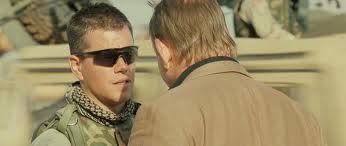 But just as the Bourne series took the familiar elements of the spy thriller and cleverly inverted them, so it makes sense to make a film about Iraq which is centred around the idea of a conspiracy. Sure, not every film about the war should be an exercise in finger-pointing or creating hate figures. But because Green Zone focuses so tightly around the search for WMDs and the nature of intelligence, shooting and structuring it like a thriller does the material more justice. The film is meticulous researched, so that even the most outlandish moments feel grounded in reality. Only Greengrass could have gotten away with the scenes by the swimming pool in the Imperial Palace, or Jason Isaacs' Village People moustache.
Sticking with the Bourne comparison, the film departs from the conventional thriller in the nature of the antagonist our hero is facing. The Bourne films, but Ultimatum especially, played upon the idea of modern good and evil being fragmented, with the various security agencies fighting as much amongst themselves as they were against any 'common enemy'. The thesis of Green Zone is that the war was fought not simply on the whim of power-mad politicians, but on bad journalism. It depicts a network of denial and self-deception which stretches right to the top, and every individual's crime is that they simply didn't question what they were told or where it came from. What this allows Greengrass to do is to take a subject matter which is familiar to many and add a vital air of unpredictability. To simply have Chief Warrant Officer Roy Miller going on a one-man crusade against his government would be entertaining up to a point but not especially insightful. So in addition to the shady presence of Greg Kinnear, we have the double-agent stand-ins that are the Special Forces (Mr. Isaacs and company), along with the mixed loyalties of the Iraqi citizens themselves. The only real foundation of hope (excluding Matt Damon) is Brendan Gleeson's sympathetic CIA agent, and his power is virtually eliminated halfway through.
 Green Zone's central message is this: no kind of information can be taken for granted. Just because something is said to be true by a large number of people, that does not make it automatically true. This may seem like cod postmodernism, but it is a poignant commentary not just on modern journalism, but on the information age as a whole. With so much data being made readily available, it is now easier than ever before to spread rumours, myths, half-truths and downright lies. The whole idea of collaborative history and social commentary, through Wikipedia and social networking, is immensely attractive. But the film clearly warns about the dangers of accepting truth by consensus rather than through meticulous individual soul-searching.
 Green Zone is an entertaining, compelling and highly intelligent thriller with a series of solid performances. Matt Damon continues his good run from Invictus with a convincing portrayal, which puts fairly clear water between him and Jason Bourne. It isn't a great film by any means; certainly the lacklustre opening makes it pale in comparison to both The Bourne Ultimatum and United 93. But it is so much more than just another Iraq conspiracy movie, and it deserves to be seen.
Rating: 4/5
Verdict: Gripping, insightful and compelling


