


Reflections
-
It is weird to read my correspondences from the late August/early September
period, being the time of transition between my old function in life to my
new ...
14 years ago
Love Like Poison (France, 2011)
Directed by Katell Quillévéré
Starring Clara Augarde, Lio, Michel Galabru, Stefano Cassetti
For all the doom and gloom around sequels, prequels, reboots and remakes, 2011 has also been a year of striking debut features. Adding to The Guard, Sarah's Key and Oranges and Sunshine, we now have Love Like Poison from French-Ivorian director Katell Quillévéré. What appears on the surface to be just another coming-of-age story slowly reveals itself as a subtle, haunting and emotionally charged look at religion, sexuality and adolescence. Love Like Poison is set in the Brittany countryside and follows a 14-year-old girl called Anna Falguères (Clara Augarde) as she prepares to take Catholic communion for the very first time. Her mother and father are recently estranged, and the former increasingly seeks comfort in the company of local priest Père François (Stefano Cassetti). Both women are left to care for Anna's bedridden grandfather, who spends his days listening to old records and smoking cigars. While all this is going on, Anna is being wooed by Pierre, a boy younger than her who loves his football and loves her even more.
 The first real asset of Love Like Poison is its strong colour palette. Tom Harari's cinematography is melancholic and beautiful, resting on a prominence of blues and in particular whites. The white is not intrusive like the shimmering walls of a hospital, but pale, wan and pure like the chalk cliffs of the French and English coasts. Sometimes it is so bright that it drowns out the characters, like the yardsticks of purity to which they must aspire, knowing full well that their desires will cause them to fall short. In one scene where Père François lies praying in his bed, his black clothes fade into the dark blue covers, like he is sinking or even drowning in the gathering darkness.
 In its evocative and symbolic use of colour, the film draws an immediate comparison with Three Colours - Blue. The visual similarities are clear, with both Krzysztof Kieslowski and Quillévéré using different shades of blue to emphasise the sadness, grief and alienation which surrounds the central characters. And there is a narrative similarity in that one of the central characters has lost her husband, and is finding it hard to connect with the world around her. But whereas Kieslowski took a very humanist perspective, focussing on the hidden reserve of Juliette Binoche's character, Quillévéré is more concerned with the conflict between three kinds of devotion - to God, to one's family, and to the passion of young love. It takes more of a religious angle, albeit one in which religion does not come up with all of the answers.
 The central character in Love Like Poison faces three different but related dilemmas as she moves to take her first step into adulthood. The first concerns her attitude towards religion and the church. Anna's faith at the beginning of the film seems well-rooted and taken for granted: she keeps a picture of Christ at her bedside, and attends church with her family, of her own will as much as out of ritual. But by the end of the film this has grown lukewarm, as she faints in front of the Bishop and remains silent when he asks questions to the congregation, asking them to affirm their faith. There has not been a decisive volte-face on Anna's part, but doubts have entered her life which makes an outright committal impossible.
 The second dilemma concerns Anna's attitude towards her family. There are a number of awkward conversations between Anna and her mother as her confirmation approaches. Anna asks her mother about what she looked like at her age, and gets an inconclusive answer. Later her mother comes into the bathroom as she is topless, saying that she wants to look at her; Anna unfolds her arms to reveal her bare breasts and snipes sarcastically: "Do I turn you on?" Anna has to care for her mother for much of the film, and is determined not to end up like her, looking upon her relationship with Père François with some suspicion.
 In her effort to avoid turning into her mother, Anna turns towards the affections of her estranged father. When he first returns home to deal with the death of Anna's grandfather, he seems to genuinely want to bond with her, taking her to the beach and talking about coming to live with him in Quimper. But as the action moves on the distance between them re-emerges: he leaves without a moment's notice to return to his new life, leaving Anna angry and alone.
 This encounter leads onto the third of Anna's dilemmas, namely her relationship with and attitude towards men. Her grandfather is dismissed as harmless but becomes pervy as the film rolls on, fantasising over a magazine and getting turned on by Anna washing him. Both her father and the priest come across as well-meaning but ultimately incompetent, or at least too at odds with their own desires to be of any real use. Pierre, on the other hand, begins very aggressively, pinning her down on the rock to kiss her when they are out in the woods. But by the time they take their tops off they are on equal terms, and when Anna kisses Pierre in his room, she seems to have come into her own.
 What makes Love Like Poison interesting as a coming-of-age film is that the struggles of the central character don't feel isolated, like some weird disease which only affects young people. The adults in the film have the same concerns and qualms with regard to religion and relationships, and there are no convenient plot devices to tone these down. Where American coming-of-age films tend to portray the step into adulthood as something with a definite endpoint, with the lines between child and adult clearly drawn, the characters in Love Like Poison are still walking the treacherous emotional path that Anna has just begun to explore.
 Love Like Poison is a deeply atmospheric film. Beyond its visual claustrophobia, its use of sound and music in particular is haunting and thought-provoking. In one early scene, when Anna wanders through the ruins to meet the priest, a version of 'Greensleeves' can be heard. This folk tune, erroneously attributed to Henry VIII as a love song to Anne Boleyn, has strong sexual connotations: "green gown" was a euphemism for prostitute, since such garments would disguise any grass stains caused by outdoor lovemaking.
 Over the end credits, where Anna seems to have found some kind of uneasy peace with Pierre, there is a choral version of Radiohead's 'Creep', previously used on trailers for The Social Network. Although the effect is not as powerful as in Fincher's film, it cements the tone of unease and eeriness which lifts the film while keeping the air close and thick with rumour. Like Tinker, Tailor, Soldier, Spy, Love Like Poison is a film in which on the surface nothing is happening, but in fact there is so much going on.
 There are a couple of flaws with the film which stop it totally achieving a knock-out punch. Apart from some standard quibbles over paucity of plot and occasionally languorous pacing, the main concern is over the amount of nudity. For the most part the film handles the matter sensitively, if not poetically; while it doesn't shy away from nudity as a concept or rite of passage, it doesn't by and large see this as an excuse for ill-judged gratuity. But while the woodland scenes are well-judged by showing hardly anything, the sight of the old man's erection is disgusting, even when it's in his trousers, and when Anna lifts her dress to show him her womanhood, it feels totally unnecessary to both plot and mood.
 Love Like Poison is a very promising debut effort which both avoids the clichés of coming-of-age stories and does just about enough to cover up its own flaws. Katell Quillévéré directs with finesse and sensitivity, creating an atmosphere of great unease and a host of complex characters, anchored by Clara Augarde's great central performance. You will want to spend some time afterwards trying to work out where you stand with regard to the people on screen, especially over Anna's state of mind in the denouement. While not perfect, it contains much to be admired, along with a great deal that will linger.
Rating:
Verdict: A striking and haunting debut
La Haine (France, 1995)
Directed by Mathieu Kassovitz
Starring Vincent Kassel, Hubert Kounde, Said Taghmoudi, Abdul Ahmed Ghili
Whenever French cinema comes up in conversation, it's very easy to be dismissive. Quite apart from their artistic legacy within the medium, Jean-Luc Godard and others within the nouvelle vague have created a stereotype of French cinema - namely as something slow, pompous, and with little bearing on reality. Even if these attributes are not remotely accurate, they persist to such an extent that we treat any exception to them with great surprise. And there is no greater exception than La Haine, a positively incendiary film which proves that there is more to French cinema than staring soulfully into middle distance. La Haine is the debut feature from Mathieu Kassovitz, whose subsequent career has left a lot to be desired. While he has been pretty consistent in front of the camera, with supporting roles in Amelie and The Fifth Element, his directorial work has been at best erratic. After seeing this film, you would never have predicted that such a talented observer of human behaviour would end up helming something as deeply derivative as Gothika. But putting that aside, his debut is remarkable both in its socio-political analysis and as a very visceral piece of filmmaking.
 Realist cinema has always had an ability to shock audiences, either by pushing the envelope of what can be shown on screen, or by tackling subjects which were deemed 'unsuitable' or 'inappropriate' but which form integral parts of our social fabric, for good or ill. When Saturday Night and Sunday Morning was first released in 1960, it was given an X certificate; when reclassified it in 2002, it got a PG. This was not because the film has become tame with the passage of time, or conversely because society has gone rapidly downhill. It is because the film was such a radical departure from the expectations of the public and in particular the censors; not knowing how to react, they made sure that relatively few people saw Karel Reisz' film the first time round.
 There is a close comparison with Saturday Night and Sunday Morning in the structure of La Haine and in its depiction of the misery of urban life. Both films are set around the actions of a close-knit group of characters over a short period of time, in this case a single day. The world of La Haine is much more angular and masculine, with the characters having very little time for women socially, and the humour is quite a lot darker. But the films do share a central theme of characters being trapped in the underclass, and being deeply unsure of their place in society in spite of all their posturing.
 Vinz, Said and Hubert go about their business with a conflicted sense of ambivalence about the world around them. On the one hand, they are desperate to get out of the banlieues by whatever means: Hubert wants to move away, while Vinz talks about killing policemen, as if being sent down for life is better than living there for another day. On the other hand, the close affinity between the characters, the confidence they exude, and the sheer number of contacts they have, give the impression of people being embedded within a culture or community, with a fear of outsiders which is as strong as the fear people have towards them.
 La Haine has a very convincing verité style which embeds us in the world of the characters. The opening credits contain documentary footage of Paris rioting between 1986 and 1996; the film was made during the tail end of these riots, and is dedicated to all those who perished in them while it was being made. The dramatic sections are shot in the same hue of black-and-white as the opening footage, creating a smooth transition from the general picture into this specific story.
 This approach works so well that we find ourselves asking exactly the kind of questions we should with this kind of film. How much of what we are saying is real? Where does reality end and the acting begin? Where, if anywhere, does the director's creative license enter the fray? When we actually sit down and think about it, in terms of the camera always being in an ideal position at the exact time of the action, such questions do become a little redundant. But the fact that we ask them at all, and for so long, is a validation of the film's approach.
 Not only is La Haine very realistic, it is also deeply cine-literate. Some of the references are upfront, such as Vincent Cassel recreating a scene from Taxi Driver in front of a mirror, and the film's meticulous approach to realism and use of non-professional actors looks back to The Battle of Algiers. But others are more thinly-veiled, or at least open to degrees of interpretation. The scene where a rap DJ plays music out of his window, and the camera pans over the open spaces between the buildings, is like an ironic rendering of the scene in The Shawshank Redemption where Andy DuFresne treats his fellow inmates to an opera record.
 La Haine explores hatred between individuals and groups of people in a variety of interesting ways. On one level it is a film about racism, depicting a society dominated by white, 'respectable' people who have little or no idea about what goes on the poorer areas of town. The make-up of the central trio - one Black, one Jewish, one Arabic - reflects three groups which have traditionally been the subject of discrimination and exploitation in France (the latter being a further connection with The Battle of Algiers). Because the police force and media are dominated by white people, our three main characters are alienated and made to feel like scapegoats for the country's problems.
 On another level, the film explores class hatred and the general fear of outsiders. In the later stages of the film, the three men wangle their way into an art gallery, where free drink is being given out at the launch of a new exhibition. Said attempts to hit on a couple of women there, telling them that his friends are sensitive and write poetry, but the women see right through them and are quick to dismiss their half-arsed attempts to be 'cultural'. The men respond by smashing up the artwork and swearing profusely as they leave, alienated by the stuck-up attitudes of their fellow countrymen and -women.
 La Haine also explores the possible ethics of violence, and how characters' attitudes change when threatened by or possessing a gun. Early on Vinz reveals that he has found a gun which went missing from a policeman on the night of the riots. Carrying it around in the back of his trousers, he becomes as sociopathic as Travis Bickle, feeling he can take on the world and is willing to die if he takes a few policemen with him. But in the few instances where he gets the chance to use it, he hesitates, being as much of a coward as he claims the police to be. In the end he who lives by the sword dies by the sword, as the film concludes with Vinz being shot in the head at point-blank range.
 The thrust of these three analyses is that in an advanced capitalist society such as France, society is constantly on the brink of descending into civil war. The widening gap between rich and poor, coupled with continuing racial discrimination, has led to rising crime, drug use and anger at the powers-that-be, who talk about help and fair treatment but continue to look down on the banlieues. The film begins and ends with Hubert's story of a man falling from a 50-storey building, repeating the phrase "So far, so good" until he lands. The fall is not important; what is important is what happens when he lands, and how hard he lands.
 There are a couple of problems with La Haine. Although the characters remain engaging throughout the 90 minutes, it can sometimes feel like we are going round in circles; in its weaker sections the film can feel like talking followed by shouting, repeated ad nauseum. Equally problematic is the bizarre scene of the old man who finds the young men in the toilet. He tells a story of him and a friend travelling through Siberia on a train, stopping to defecate off the back of the train and his friend freezing to death. It's a very odd bit of absurdist humour which jars with everything around it.
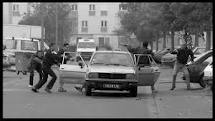 In spite of these small distractions, La Haine is still a very powerful film. Its political and social arguments are still fresh and relevant after 16 years, and Kassovitz' direction is by and large exceptional. It is a shame that, out of the main players, only Vincent Cassel has continued to garner the attention he deserves. But as both a document of a troubled past and a stark warning for the present, La Haine remains essential viewing.
Rating:
Verdict: A remarkably realistic debut
The Skin I Live In (Spain, 2011)
Directed by Pedro Almodovar
Starring Antonio Banderas, Elena Anaya, Marisa Paredes, Jan Cornet
I first saw the trailer for Pedro Almodovar's The Skin I Live In at the Tyneside Cinema in Newcastle, while waiting patiently for Sarah's Key to start. The trailer was immensely creepy, and my immediate reaction was the exclamation: "Blimey! He's turned into Georges Franju!". It was through such a reaction that I was compelled to return the following week, to catch one of the most intriguing films of the year. If Black Swan was Darren Aronofsky's version of Suspiria, The Skin I Live In is Pedro Almodovar's take on Georges Franju's horror classic Eyes Without A Face. He takes the premise, plot and iconic imagery of what is still one of the scariest horror movies ever made, throws in his trademark blend of melodrama, gender politics and soap opera, and then cranks everything up to eleven. The result, like Black Swan, is frequently ridiculous, but also strange, engrossing and intensely memorable.
 Although precious little of his career has been based in or concerned with horror, Almodovar knows the genre well enough to pay knowing tribute to several iconic entries in the canon. The references to Eyes Without A Face are clear both in the film and in its publicity, especially in the white face mask which our heroine wears for most of the film. The plot loosely follows the same arc, although instead of stealing other people's faces, the obsessive mad scientist irrevocably alters a criminal's identity and gender as payback for what happened to his wife and daughter.
 Antonio Banderas' character looks back to the cinematic tradition of mad scientists, beginning of course with Rotwang from Metropolis. But his closest equivalent is Vincent Price in The Abominable Dr. Phibes, a campy, schlocky B-movie in which Price plays a zombie scientist who recreates the Biblical plagues of Egypt to avenge the death of his wife. Finally the surgical sequences, which are particularly graphic, recall the famous eye-slice sequence in Un Chien Andalou, whose surrealist sensibility mirrors Almodovar's interest in the supernatural.
 Mark Kermode remarked that one unique aspect of cinema is its ability to make acts of painstaking construction inherently seductive. In other words, watching someone assembling a gun or performing an operation on screen has an engrossing quality, so that we are drawn in even knowing that what we are seeing is, on one level, totally repulsive. If the surgical scenes in The Skin I Live In are anything to go by, Kermode was right on the money. There is something inherently sinister about surgical equipment on screen, but even as we recoil at what may (or may not) be happening, Almodovar's camera is coaxing us to lean in for a closer look.
 The Skin I Live In has a number of deeply uncomfortable scenes which in the hands of a lesser filmmaker would cause the whole project to collapse. The scenes of Vicente being hosed down and kept prisoner in the cellar are very close to the aesthetic of so-called torture porn. But even in its most tortuous moments the film never tips over into the territory of Captivity, i.e. condoning or encouraging any sadism on our part.
 A similar issue could be taken with the amount of nudity in the film, and particularly with the way in which it is presented. In one lengthy scene, Robert Ledgard (Banderas) begins to cover 'Vera' in the new skin which he has been cultivating. We see Vera's exposed breasts and genitalia in close up over a long take, while Robert guides the new material over her body with tweezers. As before, it's uncomfortable, but Almodovar holds his nerve and prevents the scene from becoming gratuitous through very careful editing.
 Like all the best horror films, The Skin I Live In is not gruesome or graphic for its own sake. It's very rare to get a horror film about gender politics, let alone one whose approach is so nuanced and intelligent. Where previous efforts like Teeth eventually abandoned or distorted their feminist credentials, this film puts its audience through the mill if it has t, in order to keep its sense of conviction.
 The film explores the notion of gender identity, and to what extent one's gender is defined by one's physical appearance. When Robert captures Vicente, wanting revenge for the rape of his daughter, the easy thing to do would be to castrate him, in the manner of Hard Candy or Teeth. Instead, Robert's retribution is more twisted, giving Vicente a vagina so that he has to experience some degree of womanhood for the rest of his life.
 After his daughter's death, brought on by a Repulsion-like fear of men, Robert takes his guinea pig a little further. What started as an act of retribution steadily transmutes into something a great deal more twisted, as Vicente is shaped into a near-perfect copy of Robert's wife, who is isolated from the outside world and used by Robert for sexual pleasure. In these scenes Robert truly emerges as a monster, who has forsaken the life-saving benefits of his research to satisfy his urges and atone for his mistakes.
 The film's exploration of gender identity is concentrated in the behaviour of 'Vera'. For most of the film we believe convincingly that she is wholly a woman - even before the massive twist, we don't have any reason to doubt that she identifies as such. Once we know what has been done to 'her', we come to believe that one's identity is indeed determined by physical factors. But as with Eyes Without A Face, the final rebellion turns all of this on its head, with 'Vera' revealing what or who she truly is in the gripping final scene.
 Like most of Almodovar's work, The Skin I Live In combines this twisted and sinister storyline with laugh-out-loud, awkward humour. The jokes frequently come at the expense of the characters involved, particularly 'Vera'. In one scene, Robert brings out a box of dildos of increasing size, and lays them out on the table while instructing his most prized possession about how and when to use each one. The camera then cuts to the line of dildos, with Vera looking startled behind her mask in the background.
 The Skin I Live In is at heart a melodrama: it has a relatively simple story (albeit one with a cracker of a twist), which relies on the memorability of the characters to give the story depth and credibility. Almodovar's characterisation is complex but very overt, and the manner in which he introduces characters tells us pretty much all we need to know. When we first meet Antonio Banderas, he is giving a lecture in which the lights cast deep shadows under his eyes: before he has even said a word, we know he is up to no good.
 Because The Skin I Live In is so deeply rooted in melodrama, it does require a lot of patience both to buy into the various twists and to put up with the more histrionic sections of the plot. Flashing back to events six years prior to the beginning works very well, but if you find yourself getting incredulous over the central plot device, you'll struggle to put up with the man dressed as a tiger. As with Black Swan, there is a sense of the ridiculous in all of this, but as long as we are in the zone with the characters, that sense should not override our enjoyment.
 The Skin I Live In is one of the most intriguing and engrossing films of 2011. It is a little too long, and we do have to hold our nerve in the more ridiculous moments. But with enough patience the substance and chills of Almodovar come surging through. Antonio Banderas gives his best performance in quite some time, and Elena Anaya is a great match, having previously shone in the underrated Savage Grace. It's a twisted, creepy and tantalising work, which in its finest moments gives Black Swan a run for its money.
Rating:
Verdict: The Spanish Black Swan
Spetters (Netherlands, 1980)
Directed by Paul Verhoeven
Starring Hans von Tongeren, Toon Agterberg, Maarten Spanjer, Renee Soutendijk
Long before he unleashed his particular brand of filmmaking on an unsuspecting Hollywood, Paul Verhoeven was kicking up a fuss in his native Netherlands with a series of playfully provocative films. Having won acclaim for period dramas Katie Tippel and Soldier of Orange, Spetters was the film which set the tone for his later career: lambasted in the press but loved by audiences, and with Verhoeven always having the last laugh. Spetters is a coming of age film set in and around Rotterdam, which follows the stories of three young men aiming to become motocross racing champions. In the manner of all Verhoeven films, it marries full-on sex, violence and strong language with subtle and often intelligent insights into the human condition. The title epitomises this, being both slang for pretty young men and a word meaning 'splatters' - the sound the chip pan fat makes when the female lead tips it down the naked chest of a leather-clad thug.
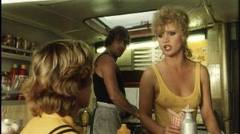 Spetters is what you would get if you put The Wild One, Rebel Without A Cause and Saturday Night Fever in a blender, and then inhaled the contents in the middle of a drunken rave. The latter is most evident in the cocky attitude of the male characters, along with a scene early on of the mechanic Eef showing off in the disco, only to be outclassed by an unnamed rival. The costumes take on elements from all these films, with Eef's penchant for leather nodding towards Marlon Brando and Rutger Hauer's perfect silver hair rivalling anything that John Travolta could produce.
 As you would expect from a coming of age film, much of Spetters is concerned with our male protagonists trying to score with women and coming away with a little more than bruised egos. And coming in the middle of the gross-out wave of Animal House, Porky's and Lemon Popsicle, it's only natural to anticipate that such scenes would leave a sour, guilty taste in the mouth. But such scenes are also a showcase for Verhoeven at his best: setting up a given situation, allowing things to turn a little seedy, and then defying our expectations with a cracking punch-line.
 Two examples in Spetters illustrate this ability. The first comes in the disco when one of the men starts chatting up a black woman. He buys her a beer and starts to stroke her leg, flirting with her in a typically unsubtle way. Despite her protestations, he puts his hand under her dress - and brings it out with a strange yellow gunk on his fingers. We grimace in disgust, only to burst into raucous laughter when the woman lifts up her dress to reveal a jar of mustard between her legs. Talk about taking precautions.
 The second such instance comes soon after, when two of the bikers and their respective girlfriends have snuck onto a building site to have sex. Having chosen their spots, one of the girls reveals that she is on her period - which the boyfriend grossly demonstrates by bringing up two bloody fingers. Hearing his friend moaning and panting next door, he asks the girl to fake having sex with him, and together they try to out-moan their friend. Having assumed that the other couple are having great sex, Verhoeven then cuts to a wide shot which shows said couple doing exactly the same!
But the wild antics of these men are not confined to the bedroom. The racing sequences in Spetters are shot with real energy and panache: Verhoeven gets his camera in close and uses long takes, so that when the spectacular crashes happen, we think that people are genuinely getting hurt. The sense of youthful vigour present in these scenes prevents them from becoming gratuitous: Verhoeven clearly identifies with the drives and urges of these young men, and has sought to communicate this in the most natural way he knows. Having taken its time in setting up the three main characters, Spetters really gets into gear when the main love interest arrives in the shape of Fientje, played with feisty abandon by Renée Soutendijk. She arrives inauspiciously with her brother in tow to run a fast food van in the centre of town, but over the course of the film she seduces all three men, ruining the life of Rien and Eef and changing Hans' destiny forever.
 The film sets up Fientje as a dangerous outsider whom the community does not accept. The only reason the police allow her and her brother to stay is because she gives the officer a 'cup of coffee' (in other words, a sexual favour). Eef's father, who is a devout Calvinist, goes so far as to brand her a "whore of Babylon". But as with Verhoeven's subsequent works, particularly The Fourth Man and Basic Instinct, the role of 'evil women' is not quite as clear cut as would first seem.
 Spetters, like all Verhoeven's best work, calls characters' identities into question and leaves us confused as to whom we are really rooting for. The device of seduction is employed to show just how much there is to becoming a man - in other words, there is more to finding out who you are than losing your virginity, or scoring with the best woman in town. Fientje's own motivations are up for debate: she starts as a serial maneater, a femme fatale who wants Rien's riches for a new fur coat. But in the end she is confused as the others, unsure of herself and of her fate.
 There is some kind of moral point in the fate of the three men. Rien is seduced by the money Fientje gets him through sponsorship, but he ends up losing the only woman he really loved. When he finally gets the chance to express it, he is unable to do so: the accident has claimed not only his ability to perform sexually, but all his accompanying confidence and self-esteem.
 Eef desperately wants to seduce Fientje, but the more time he spends with her, the more he becomes convinced that he is deceiving himself - a conviction which culminates in him coming out as gay and hooking up with her brother. It's an odd way to find yourself, but the end point, the realisation of identity, is the same. Meanwhile Hans, the best-endowed of the group, should be first in line to claim Fientje as his own. But being too shy and inept to pull her, he ends up making something of himself and wins her heart by seeing her as something more than a possible conquest.
 Naturally, all this seduction results in a lot of nudity. Sometimes the flesh-bearing is funny, such as an early sequence of Rien, Eef and Hans in the garage measuring their manhoods with a spanner. But others are deeply uncomfortable, like the very tough sequence of Eef being gang-raped in the subway after stealing from a gigolo. Even for long-term Verhoeven fans, who are used to this kind of thing, you will start to lose patience as the film tips further into lazy soft-core territory.
 Alongside its rampant nudity, Spetters pulls no punches when it has to get violent. Outside of the dangerous racing early in the film, there is one particularly wince-inducing moment where Rien suffers an accident that will leave him crippled. Having been hit in the face by a bag of orange peel, Rien goes flying from his bike, rolls down the verge and (in tight close up) catches his leg on a stone pillar. Having made us squirm and then laugh before, Verhoeven turns that approach on its head to effectively show the demise of this character. The end comes with Rien trundling his electric wheelchair back to the motorway to kill himself - a scene made all the more harrowing by the fact that actor Hans von Tongeren took his own life two years later.
 Spetters is a visceral and often hilarious comedy-drama which offers plenty in the way of thrills and spills. Like a lot of coming of age stories, its plot is far too thin, and it resorts to a few too many gross-out moments to keep us interested. But in the sections when it works, it finds Verhoeven firing on all cylinders, delivering substance in the midst of violent sleaze. It's not up there with The Fourth Man or his early work in Hollywood, but it remains good, guilty-pleasure fun.
Rating:
Verdict: Raucous and relentless


