


Reflections
-
It is weird to read my correspondences from the late August/early September
period, being the time of transition between my old function in life to my
new ...
14 years ago
Jaws (USA, 1975)
Directed by Steven Spielberg
Starring Roy Scheider, Robert Shaw, Richard Dreyfuss, Lorraine Gray
When interviewed for Bravo's The 100 Scariest Movie Moments, Clive Barker commented that sometimes the best ideas of how to scare people are so seemingly obvious that we overlook them without realising. In hindsight it seems absurd that no-one ever considered making a horror film about sharks before. And after Steven Spielberg set the bar with Jaws, no-one would ever come close again. Jaws is Spielberg doing what he does best: pure popcorn entertainment, with a school of memorable scenes, cracking dialogue and substance trickling through in amongst the thrills and spills. What seems on the surface to be a one-trick film drawn out over two hours gradually emerges as something which is not only scary but very well-made, with characters which are intelligently drawn and action scenes which communicate the themes rather than feeling like awkward set-pieces.
 Like Star Wars after it, you could be forgiven for hating Jaws given the legacy it has left behind. Apart from the three inferior sequels and dozens of derivative knock-offs, it was the film which invented both the summer blockbuster and the high-concept movie -a film which you could sum up in 25 words or less, which would be translated by producers Don Simpson and Jerry Bruckheimer into the aggressive money-driven ethos of modern Hollywood.
 Jaws has been blamed for everything from the death of New Hollywood to the infantilisation of mainstream cinema, and that's not to mention the recent criticism of conservationists about falling shark numbers. But whatever one's attitude to Spielberg in light of his subsequent career choices, it's at best guesswork and at worst sour grapes to argue that he intended any of these things to happen. Had he gone the path of his colleague George Lucas, and milked his hit for everything it had, only then would it be fair to pose such questions.
 With this in mind we have to re-assess Jaws as nothing more than a piece of entertainment. And on that level, it's undeniably brilliant. In adapting Peter Benchley's potboiler, Spielberg quickly dispensed of the melodramatic subplots involving extramarital affairs and power struggles on Amity Island. On this occasion, it was best to quite literally cut to the chase, with the shark becoming the centrepiece and fear being the driving force.
Spielberg once described Jaws as an aquatic version of Duel, his made-for-TV film from four year earlier about a man being chased by a truck. The comparison is very close both in Spielberg's knack for creating tension and in the characterisation of the villain. Both the truck and the shark are irrational forces of nature: they have no backstory, no character origin and no discernable motivation other than a relentless desire to kill. As a further connection, the deaths of both truck and shark are overdubbed with the sound of Godzilla dying from the 1954 original - an indication of Spielberg's affinity for B-movies and that he understands that monster movies can have a deeper significance. As with Duel, it doesn't matter that the monster in Jaws doesn't make a lot of sense. There was and is precious little to suggest that sharks prey on humans for sport; more people die every year from falling coconuts than being eaten by sharks. But the film is not so much about killer sharks as it is about characters being confronted by an unstoppable force which they never faced before and cannot hope to understand. It could almost be called the father of Hallowe'en in its contrast of peaceful, boring middle-class life with a ruthless, blood-hungry predator.
 This contrast is best observed in the opening section of the film. Having given us a great early jump with the death of the skinny-dipper, Spielberg withholds the shark to build up the relationships between the townsfolk. We see Roy Scheider's sleepy world slowly descend into panic and really feel his frustration when the town council and the press ignore his demands about closing the beach. As the children enter the water to swim and the attack begins, the dramatic irony kicks in and what was once a perfectly ordinary and rational community is torn apart forever.
 Much has been written about the production problems which Spielberg faced on Jaws which meant he could not shoot as much of the shark as he wanted. Three full-scale mechanical sharks were built for the production, and all three regularly failed due to everything from short circuits to corroding skin and getting caught in seaweed. Such failures were one of the main reasons the film went so far over-schedule and over-budget: what started as a $4m movie shooting for 55 days ended up as a $9m movie that shot for 159 days.
 In the end, the problems with the shark were not merely serendipitous: they helped to create one of the defining features of the film. Because he could not show the monster as he wanted, Spielberg had to improvise with different techniques which could hint at what the shark was capable of doing. It's testament to his ability as a filmmaker that he could achieve so much threat and suspense from little more than a dorsal fin and a few barrels - enhanced by his use of the former to comedic effect early in the film. Through these techniques, the shark takes on a quality of amorphous evil whose only real equal at the time was Rover from The Prisoner.
But as before, Jaws is less about the shark than the characters reacting to it, and no matter how much of the action revolves around 'Bruce', we keep coming back to the people. In its second hour, where most of the action takes places on the Orca, we genuinely bond with this foolhardy trio and soak up all the conflicts within their personalities. Brody's determination to protect his family is contrasted by Quint's obsessive streak and Hooper's feeling of being - no pun intended - a fish out of water. As with The Sting, Robert Shaw dominates every scene that he is in. His accent may be a little harder to pin down this time, but his piercing intensity and unkempt manner give him unrivalled screen presence. Although much of his early lines are played for comedy, to set him up as a loose cannon against the uptight Brody and Hooper, he gradually takes on a more intense, obsessive quality which lead you to wonder whether or not the shark has driven him mad.
 The best scene in Jaws comes when the three men are sitting in the boat at night and Quint begins talking about the sinking of the USS Indianapolis. In a speech co-written by John Milius (who scripted Apocalypse Now), he talks about his experience with sharks in the same way that Colonel Kurtz talked about horror - as something to be somehow embraced and understood, even at the cost of one's sanity or soul. The dialogue in this section is reminiscent of Ernest Hemingway's work in The Old Man and the Sea, with man and nature locked in battle, both mentally and physically, while all around there is only silence.
 Jaws remains a high-water mark in Spielberg's career and in those of all the performers. It isn't as relentless as Hallowe'en in its ability to sustain fear, and Spielberg's work on the Indiana Jones series would eventually surpass it. But that is mere nit-picking in the face of a film of great craft and vision, a film which proves that simple entertainment can be smart and that, under the right circumstances, people enjoy being scared.
Rating:
Verdict: Pure and simple terror
Wake Wood (UK/Ireland, 2011)
Directed by David Keating
Starring Aiden Gillen, Eva Birthistle, Timothy Spall, Ella Connelly
The revival of the Hammer brand is a cause for triumph and tribulation amongst horror fans. Nostalgia notwithstanding, the rebirth of Hammer in and of itself indicates some kind of bright future for British horror filmmaking. But with this there is the risk that the new output cannot live up to the past, either in quality or in the precise, easy-to-identify trademarks which made the originals so endearing. Whatever the merits of Let Me In, the Hammer-backed remake of Let The Right One In, it lacked the essential visual and structural qualities which we associate with Hammer: the slightly creaky, strikingly-coloured blend of Hollywood studio convention and European grand guignol, delivered in a distinctively British way via several buckets of blood. But there is no such trepidation with Wake Wood, which is Hammer through and through.
 The stable name may be from another era, but Wake Wood feels like a product of the 21st century. This is not the output of a single studio, churning out films like a factory, but a series of smaller, more disparate production companies who can use the brand to get the distribution they deserve. The opening credits of Wake Wood list more than a dozen companies before we reach the title, a sign of how thinly spread the funding is and the price we have to pay nowadays for interesting low-budget films.
 In terms of its place in horror, Wake Wood prominently references a number of films and texts which are held in high regard. The central story about a couple grieving for their dead daughter is a clear nod to Don't Look Now, as is the mention of red in the girl's vision and the images of her wandering the woods in the (yellow) raincoat. An d there are huge hints of The Wicker Man in this couple's status as outsiders chancing upon a 'pagan' community. It's as though the film was written by someone who saw both films on a double bill, forgot that they were two separate entities and wrote their own version of what they perceived to be a single story.
 Outside of these prominent references, the film also tips its hat to W. W. Jacobs' The Monkey's Paw and Stephen King's Cujo in the more graphic scenes with the dog. But although it's situated deep in a particular area of horror, Wake Wood does gradually gain its own identity. As the various genre elements begin to play out, they afford the director a chance to experiment while having the security of knowing the outcome.
That said, the first 45 minutes are very slow-burning and deeply generic. This is the section of the film which most reflects the modesty of the production. The visuals are washed-out with very standard camerawork and simple editing, and there isn't a great deal in the dialogue to pull you in. As with a lot of genre filmmaking, there is some pleasure to be had from seeing all the pieces fit together. But by the time we have reached the halfway mark, we begin to feel like something's missing. For a film situated so strongly in the more emotive, 'lost child' end of horror, Wake Wood has a surprising amount of gore. There are pockets of blood and guts throughout the running time, with some being designed to shock and others being used to contextualise the events - for instance, Patrick's work as a veterinarian which leads him to befriend and work for Arthur. The most memorable example involves one of Arthur's farm assistants being crushed to death by the back end of a bull as it is being moved into a metal pen.
 As well as testing the audience's mettle, the gory parts of Wake Wood convey one of the main ideas of the film. The cycle of birth, life and death (and re-birth) is presented as one with immense agony at both ends and a chance for happiness or peace in-between. Both the cow calves and the resurrected version of Alice emerge from highly painful births - the former requires a Caesarian section on the cow, the latter a corpse being mangled and crushed, like Burke and Hare without the jokes.
 After the initial agony of childbirth, whether personal or by proxy, the time shared by Alice and her parents is one of sheer joy. In contrast to the macabre and gruesome ceremony which brings Alice into the world, these scenes are shot in almost glaring sunlight with permanent smiles on the parents' faces. It's a moment of immense catharsis for Patrick and Louise, albeit one which slowly returns to grief and then fear as Alice's fate begins to unfold.
 At the centre of Wake Wood is the story of a couple struggling to come to terms with grief and being unable to let go of their daughter on a spiritual level. The film uses the language of horror - blood, guts, pagan rituals and strange goings-on in woods - to approach the issue of grief in a manner which feels a great deal more honest, brutal and genuine than any number of more mainstream, 'sensible' films. Compare this film to Rabbit Hole, in which all the grief feels choreographed and sanitised, and it's easy to see which approach is more effective at cutting to the emotional heart.
This asset is confirmed in the performances of Aiden Gillen and Eva Birthistle, which are very naturalistic and feel genuine even in the most absurd moments of the film. Birthistle has something of Julie Christie's torment about her performance, refusing to constantly break down and having some kind of relationship with her child which stretches beyond the boundaries of this world. Gillen, on the other hand, has Donald Sutherland's stubbornness, having a desire to move on and occupy himself (with cows instead of churches) while also wanting to do what is best for his wife. The supporting performances, however, are more of a mixed bag. Timothy Spall brings much in the way of presence as Arthur, but his Irish accent comes and goes as he drifts back into his natural brogue. The elderly locals who oversee the ceremony are given small speaking parts, but these mostly end up like the women with the second sight in Don't Look Now: there's no awkward clutching of chests, but some of their comments border on the ridiculous. And the scenes of the pagan ritual are both creepy and a little bit snigger-inducing: fans of Hot Fuzz will almost expect the characters to start mumbling about "the greater good".
 The final third of the film, in which Alice's return to the grave goes horribly wrong, is where Wake Wood finally gets into its stride and starts to deliver the nail-biting thrills that we had been hankering for. The film takes the ending of Don't Look Now and marries it to the opening of Hallowe'en, so the symbol of the parent's grief is not only a murderous force but a seemingly unstoppable one. This section is spoiled somewhat by Alice dragging her mother down to the grave with her, a la Sleepy Hollow - there is nothing the mother had done which would have made her deserve such a fate. But this is partially mitigated by the final scene involving Patrick reviving his dead wife, who is pregnant with a second child...
 Wake Wood is a modest but solidly made film which is destined for minor cult status. Despite being so deeply embedded in generic conventions, it manages to take on its own identity through some decent performances and an overall feeling of unease generated by what unfolds. It isn't perfect, with all the shortcomings of a low budget being in plain sight. But as a self-contained, 90-minute horror film, it bodes well for the return of Hammer, and sets the bar in place for The Woman in Black.
Rating:
Verdict: A modest but effective cult movie
Cronos (Mexico, 1993)
Directed by Guillermo del Toro
Starring Federico Luppi, Ron Perlman, Claudio Brook, Tamara Shanath
Well before the 'abstinence porn' of Twilight began to hit our screens, a whole wave of vampire films in the 1990s returned to the deep well of sex which had become the lifeblood of vampire fiction. We had Anne Rice's AIDS allegory Interview with a Vampire, John Landis' uneven crime drama Innocent Blood, and of course Francis Ford Coppola's bonkers version of Dracula.
But in the midst of these hypersexual offerings, a small Mexican film from a first-time director was helping to radically reshape the genre. Cronos, the debut by Guillermo Del Toro, demonstrated that vampire fiction could explore themes far more varied than sex, such as the fear of death, the loneliness of old age and the relationship between Mexico and the USA. A hugely influential work of horror cinema, it is every bit as striking and significant as Let The Right One In. When I reviewed The Usual Suspects, I remarked that one test of a good filmmaker is being able to take a hackneyed series of conventions, and create something which is both memorable and mindful of its genre origins. On this level alone Cronos is a triumph, since it is able to fulfil all the requirements of being a bona fide vampire film which approaching all the key plot points and characters arcs from distinctively unusual angles.
 Cronos may have a backstory about the origins of the vampire, followed by the introduction of our protagonists to said bloodsucker which results in quite a lot of gore. But Del Toro manages to achieve this while removing from the story all connotations of sex or lust. In place of Hammer's heaving bosoms and phallic fangs, he gives us skin peeling like wallpaper and the intricate clockwork of the Cronos device. The closest the film comes to anything sexual is a scene of Federico Luppi licking a nosebleed off a bathroom floor, which is shot with such clinical precision that there can be no room for erotic thoughts.
By refocusing the story around ageing and the fear of death, Cronos hits on the central dilemma in vampire fiction: would you rather live forever but lose your soul, or stay pure and human but live in constant fear of death? Both the elderly characters in the film choose the former, albeit for different motives and by entirely different means. Dieter, the dying businessman, makes a conscious decision to pursue the device: he owns the manual needed to operate it and believes it is the only thing that can keep him and his empire alive (and out of his nephew's hands). Jesus, on the other hand, is 'bitten' accidentally, and only comes to use the device frequently through observing its physical benefits. His desire, in the form of addiction to blood, is every bit as strong as Dieter's desire to possess the device himself, but it is not motivated by selfishness or a desire for power. Like Dracula, Jesus becomes weary of eternal life: he is worn down not by an army of brides, but by the constant torment of those who are jealous of his powers. In the end his remaining sense of self triumphs over the vampire he has become, and he sacrifices himself to protect his beloved granddaughter.
The theme of ageing is also conveyed in the visuals of Cronos. Guillermo Navarro's cinematography is very washed-out, with dark woods and fading reds to indicate how everything around the characters is very slowly dying or decaying. Even the brightest scenes in the film, like the New Year's party, are filled with pale colours and make use of shadows wherever possible.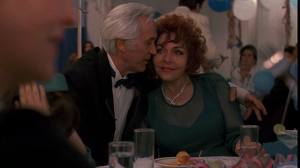 Beyond its direct connections with the vampire genre, Cronos is connected to other key figures in horror. The design of the Cronos device itself, with its peculiar blend of biology and mechanics, resembles the work of Clive Barker: its design as is intricate as the puzzle box in Hellraiser and there is the same suggestion of great evil being contained in or brought forth from something of great beauty.
 There are also connections with John Carpenter in the film's elaborate and highly convincing make-up. Del Toro's training under make-up artist Dick Smith shines through in his pursuit of organic, physical terror, and the work of his make-up artist M. Carrajal rivals anything which Rob Bottin achieved on The Thing. There is a further connection with Carpenter contained in a line where the device is dismissed as "just a toy". Like Carpenter in Hallowe'en, Del Toro is taking an aspect of horror which had become institutionalised and accepted, and proving that it could still scare you to death.
 Cronos is a deeply religious film, in its use of iconography and its exploration of the meanings to both life and death. Again, this is drawing on a classic trait in vampire fiction, namely that the act of being or becoming a vampire is a rebellion against the laws of nature (including death), which it was believed were set in stone by God. Though there is no scene of Jesus declaring war on heaven, as happens in the Coppola version, his faith is counterpointed by his growing dependence on the device, as demonstrated by him reciting the Lord's Prayer while allowing it to stab him a second time.
 There are other indications of these religious themes as well. The Cronos device was created by an alchemist, someone who brought the material and spiritual worlds together, using what became the scientific method to find the divine substance which could cure all disease and prolong life. The images of cockroaches bursting out of angels, or the device being hidden in said statues, hints at the threat which such a device poses to Christianity. By removing the certainty of death, it undermines the corresponding fear of death and damnation, and therefore makes it less necessary either to repent or to live a moral life.
 To add to its theological wrangling, Cronos also has political connotations. The film is a rich allegory for US-Mexican relations, in which America is the bloodsucker which takes without asking and refuses to yield. Dieter, the American, is determined not to let the Mexicans (in the shape of Jesus) get one over on them - the second they come up with something useful, the Americans want it for themselves and won't take no for an answer. There is a contrast between Federico Luppi's sympathetic, caring grandfather and Ron Perlman's aggressive and ambitious nephew. Perlman may slip in and out of Luppi's language, but he is only interested in himself - it is not communication, only giving orders in a language he thinks they can understand.
 The performances in Cronos are mostly of a high quality. Luppi is a great screen presence, seeming frail and vulnerable while coming across as a strong and determined character. Perlman, in his first of several collaborations with Del Toro, is a very fine match for him. His versatility with language is matched only by his desire to throw himself physically into the role. The only weak link is the young girl, played by Tamara Shanath. It isn't so much her performance as the limited extent of her character's development; we don't feel as strongly connected to her as we do with her counterparts in The Devil's Backbone or Pan's Labyrinth.
 Cronos is a great debut feature from one of horror's greatest directors. While not as perfectly formed as Pan's Labyrinth, it contains all the hallmarks of Del Toro's genius, from its powerfully unique visuals to its constant invention and intelligence even in the most trivial of moments. It's a top-notch chiller and a welcome shot in the arm for vampire fiction, proving that the genre is still able to stimulate as well as scare. It's not Let The Right One In, but it should be welcomed into anyone's collection.
Rating:
Verdict: Creepy, chilling and very clever
The Fog (USA, 1980)
Directed by John Carpenter
Starring Adrianne Barbeau, Tom Atkins, Jamie Lee Curtis, Janet Leigh
Having caught the public's imagination with Hallowe'en, John Carpenter needed another big hit to cement his position as an ascendant low-budget filmmaker. After the release of Hallowe'en in October 1978, he began his working relationship with Kurt Russell on the Elvis TV-movie, which famously beat a re-run of Gone With the Wind in the American ratings.
The Fog is the kind of film that Hallowe'en would have been if Carpenter were not so adept at marrying storytelling to special effects. It contains a number of technically impressive set-pieces which foreshadow more expensive mainstream films, along with all Carpenter's directorial trademarks including a very good score. But although the story is as brutally simple as its predecessor, the film ultimately fails to make the most of it and ends up surprisingly dull. Like Prince of Darkness after it, The Fog is on one level Carpenter's tribute to one of his favourite horror writers - in this case Edgar Allan Poe rather than H. P. Lovecraft. The film begins with a quote from Poe and a spooky prologue in which John Houseman sets the scene. This scene is very well-played, not only in creating the mood but in the level of horror it orchestrates. The fact that there are children present leads us to believe that the story is just another old wives' tale to stop people going out at night. But Houseman's delivery is so precise and dolorous that we can't help wondering whether we're mistaken.
 Sadly, the suspense created in these first five minutes is completely undone by the following forty. With the exception of the prologue the first half of The Fog is very dull, with very little going on that is engaging or threatening in any way. Carpenter sets up a host of different characters who begin interacting in various ways, but none of these encounters on their own are enough to sustain our interest. Our emotional responses vary from annoyance directed at Janet Leigh to confusion as to how Tom Atkins and Jamie Lee Curtis ended up sleeping together so quickly.
 Such shortcomings in the characters undercut the film's ability to truly frighten us. Until the sequence in the lighthouse with the burning driftwood, The Fog simply isn't scary, and its attempts to rectify this are desperately obvious. The scene of Father Malone reading from Blake's diary is so hokey that all we can do is smirk, and elsewhere all Carpenter comes up with is a few loud bangs in broad daylight. Even the elaborate opening involving clinking glass and car alarms contains nothing which is capable of generating a sustained level of terror.
 In the absence of either engaging characters or proper scares, all we have left to admire in this section of The Fog are the special effects - which, as it turns out, are quite impressive. The low budget meant there simply weren't the resources to fill entire streets with artificial fog, let alone make it move in a certain way. To get around this all the wide shots of the coast and Antonio Bay's streets are done with scale models shrouded in black cloth, something you wouldn't notice unless you had studied the production in detail.
 As for the fog itself, it's real fog. In contrast to the blatant CGI used in the remake, Carpenter used machines known as mole foggers to generate the sepulchral clouds and then guide them as best he could with carefully positioned fans. Dean Cundey, Carpenter's long-time cinematographer, lights the fog to get the greatest amount of menace out of what is essentially an inanimate object. When it's coming in off the sea, it shimmers with an iridescent blue, while in the boy's house it is the same lurid combination of red and green of 1950s Hammer.
 Fittingly, it is one particular special effect which finally kicks The Fog into life (and no, it's not the TV turning itself on in the manner of Poltergeist). It comes when Adrianne Barbeau is in the radio station testing some pre-recorded demo tapes near the piece of driftwood her son found on the beach. While her back is turned, the wood begins to drip with water, until it works its way into the tape machine and garbles the sound. Barbeau turns round to find the writing on the plank has changed from 'Dane' to '6 will die', and then the whole thing bursts into flames.
 Quite apart from its technical proficiency, this sequence is the first time in the film where we have both a real sense of tension and a provable physical threat. The execution of this scene conveys the supernatural elements of the story - water catching on fire - while retaining the physical grounding of the film's villains. And because the action happens so close to us on screen, we feel the beginnings of a connection to these characters and their rapidly darkening predicaments.
But again there is a problem. As the screen time accorded to the ghosts increases, we begin to ask questions about how they function on a physical level. Blending a supernatural force with natural elements (i.e. ghosts in fog) is a hard act to pull off, and as the film rolls on more inconsistencies come to light. Perhaps this is a result of the various production problems, which necessitated reshooting a third of the footage. The Fog never sets out any kind of parameters in which the fog or the ghosts operate, and yet every time we try to impose our logic on it, it very quickly defies it. We assume that the fog has no power of its own - until it creeps of its own accord into the boat's generator. We accept that the ghosts cannot have influence without the fog - until the driftwood gets soaked. And we embrace the fact that the ghosts are physical, having to knock on doors rather than walk through them - except at the end, when they magically re-materialise in the church. Errors like this not only make the film confusing but work against our desire to become involved in the story and our desire to be scared by it.
Fortunately, there is just enough in the way of atmosphere created in the last half hour to prevent The Fog from completely collapsing. Carpenter's dynamic score is well-matched to the ominous shots of the fog creeping in off the coast, and several of the set-pieces work pretty well. The scene of Jamie Lee Curtis being attacked by the reanimated corpse is pretty creepy, as is the final confrontation in the church involving Father Malone and the shimmering cross. The performances in The Fog are also pretty decent. Adrianne Barbeau, who was then married to Carpenter, gives a convincing performance as a local radio DJ, even if she does spend a little too much time screaming out repetitive instructions. Hal Holbrook brings a brooding presence to Father Malone, turning his few lines into something which seems more significant. And Janet Leigh gives her all in her last film role, sharing scenes with two graduates of Hallowe'en - one being Nancy Loomis, the other her real-life daughter Jamie Lee Curtis.
 The Fog is a disappointing follow-up to Carpenter's greatest work. Its special effects, score and performances are just about enough to carry it through its running time, and there is some appeal in seeing a cutting-edge horror filmmaker re-approach an old-fashioned ghost story. But while technically interesting, it's also narratively inept, coming nowhere near the heights of its predecessors or Carpenter's subsequent greatness on Starman and The Thing.
Rating: 2.5/5
Verdict: Technically interesting but narratively inept
Prince of Darkness (USA, 1987)
Directed by John Carpenter
Starring Donald Pleasance, Jameson Parker, Victor Wong, Lisa Blount
With any kind of film surrounding the supernatural there is a very fine line between profound and preposterous, between the sublime and the ridiculous. Prince of Darkness desperately wants to be taken seriously, but it ends up every bit as laughable and stupid as Exorcist II: The Heretic. While not John Carpenter's worst film (that honour is reserved for Ghosts of Mars), it remains one of his most obvious and embarrassing failures. Prince of Darkness is the middle instalment of Carpenter's 'apocalypse trilogy', three films which share the premise of a deadly force which could destroy humanity if fully unleashed (the others being The Thing and In the Mouth of Madness). For all the pretentions and incoherence of the latter, Prince of Darkness is by far and away the weakest of the trilogy. What should have been an interesting take on an age-old battle between good and evil ended up as a higgledy-piggledy hotchpotch of incongruent ideas, resulting in a rubbish horror movie which neither scares nor thrills.
To be fair, Prince of Darkness is at least trying to explore a number of interesting ideas. Its central thesis is that evil is something physical, something which can be studied scientifically rather than being confined to ethics and theology. Good and evil are characterised as matter and anti-matter, and just as God came to Earth in human form to save Mankind, so evil has to inhabit the physical to unleash its full potential. There is also within the classic fear of the unknown, which Carpenter had previously explored in both Hallowe'en and The Thing. There are some fairly standard discussions about quantum theory, Schrodinger's Cat, and how logic breaks down at a sub-atomic level. But apart from the last five minutes, and scraps of expository dialogue throughout, these themes are barely addressed in a head-on way. The film is a mishmash of horror clichés, assembled and directed in a shambolic manner which you would not normally associate with John Carpenter. The screenplay seems to have enough ideas for three or four very different films. But rather than elaborate on any particular one, Carpenter decides to throw them altogether in the hope that all the pieces would fit.
 The plot of Prince of Darkness starts out relatively straightforward: there is a green canister in an abandoned church which has sentience and intelligence, and may or may not be the Devil. But then we have to believe that this liquid has the ability to move objects through telekinetic power, and that people can become possessed by having the liquid squirted into their mouths. And then, we have the twist involving a world behind mirrors, which probably served as the inspiration for Into the Mirror over 20 years later. And then, there's a whole caboodle about shared dreaming caused by tachyon beams from the future. The film keeps piling one badly executed plot point on top of another until all credibility has evaporated.
This overburdening of the plot also causes a disturbing number of plot holes, some of them amusing, some of them annoying. For instance, if the canister containing the green liquid is supposed to be impregnable, how come is it leaking out and collecting on the ceiling? Come to think of it, why is it defying gravity by leaking upward? And why, oh why, do the people just stand there, open-mouthed, so the liquid can be sprayed straight at them? Then there are all sorts of questions raised by the concept of shared dreams. The dreams are supposedly a message from the future, warning against the return of Satan. But if Satan did return, bringing the 'anti-God' with him, surely the universe would have been destroyed and there would be no way to send the message? Alternatively, if our heroes succeed in stopping him, surely the messages wouldn't exist in the first place, and therefore the dreams would stop at the end of the film? And why do the dreams change after Danforth has gone through the mirror?
 The film is also sub-standard on a visual level. There are several half-decent locations, like the abandoned church and the university campus which resembles the quiet suburbia of Hallowe'en. And some of the special effects are okay, like the swirling canister or the decaying flesh make-up on the 'chosen one'. Beyond that, it's just another haunted house, populated by characters who deliver cheesy lines about the church being abandoned and how "this place gives me the creeps". Carpenter is a great low-budget filmmaker, but he simply doesn't do anything interesting with the location, using very conventional architecture as the main sort of threat.
 Much of Prince of Darkness is completely ridiculous, being hugely derivative of other, better horrors. The motley bunch of devil worshippers outside the church, including rock legend Alice Cooper, are a straight lift from both Rosemary's Baby and George Romero's zombie films, due to their silence and unified motion. There have been dozens of films about demonic possession, but the use of water as diabolical ectoplasm is a total rip-off of The Exorcist. The regenerating flesh of the 'chosen one' is second-rate H. P. Lovecraft, and Donald Pleasance's seemingly mad priest is pinched from Patrick Troughton's character in The Omen.
But the biggest debt owed by Prince of Darkness is to the Quatermass series. Carpenter was a big fan of Nigel Kneale to the extent that he credited his screenplay to 'Martin Quatermass'. Ironically, Kneale was irritated by this association, due to his bad experience as the original screenwriter of Hallowe'en III: Season of the Witch. The idea of an ancient evil being something physical (or at least quantifiable) was handled superbly in The Quatermass Experiment, which took a ghostly story about possessed astronauts and turned this into a physical threat every bit as terrifying as the Thing. Prince of Darkness is like a poorly scripted, badly made version of that story, with all the true terror taken out. We then come to the small matter of characters. Even when Carpenter was soft-peddling, he could always be relied upon for interesting, offbeat characters who would rise to the challenge. In Prince of Darkness, the acting is wooden, the characters are bland, and the character development is almost non-existent. Brian and Danforth go straight from meeting for coffee to sleeping together, and even though there is only one kiss between them for the rest of the film, we have to believe that they are passionately in love.
For all its great ambitions, the film is effectively a slasher by proxy. There are so many characters running around that we don't have enough time to form proper emotional bonds. Hence when people start getting picked off, we just don't care - even the sight of Alice Cooper stabbing someone with a bicycle is dull. We aren't all that sorry for Danforth when she gets dragged into the other world, before the mirror is smashed by a conveniently-placed axe, trapping her forever. If a film about pure evil can't make us connect with the good guys, then something has gone terribly wrong. As if that wasn't enough, we also have to put up with some out-of-place comedy. One character, played by Dennis Dun, makes all kinds of stupid verbal faux pas which are badly written and out of context. While being hunted down by the possessed women, he makes jokes about a Jewish woman marrying a African doctor, and remarks that "he's not used to being dominated by women". Such comments are every bit as stupid as the jokes in Big Trouble in Little China and add nothing at all to the story.
 Prince of Darkness is ripe, silly, cheesy trash and one of the low points of Carpenter's career. It's not as depressing a failure as Ghosts of Mars, but it fails on just about every level, both as a horror film and as pure entertainment. The experience is made all the more frustrating by Carpenter's record and the great potential hidden in its ideas. It should have been good, it could have been great - but instead it's a total stinker.
Rating: 1/5
Verdict: Ripe, ridiculous and utter rubbish


