


Reflections
-
It is weird to read my correspondences from the late August/early September
period, being the time of transition between my old function in life to my
new ...
14 years ago
The Deep Blue Sea (UK, 2011)
Directed by Terence Davies
Starring Rachel Weisz, Simon Russell Beale, Tom Hiddleston, Ann Mitchell
One of the hardest things to rationalise as a film reviewer is when a director you love suddenly gets it wrong. Reviewing the latest Michael Bay disaster, or Brett Ratner-driven slice of hackery, is pretty easy: simply string together four or five superlatives, add some moral outrage and leave it to stew in its own juices. What's not so easy is trying to explain how Terence Davies has gone from something as inspired as Of Time and the City to such an abject failure in The Deep Blue Sea. Davies' output as a filmmaker has always been an acquired taste - which, in this context, is equally a loaded phrase and a straight-up compliment. Whether you like his back catalogue or not (and even he has mixed feelings), he has a distinctive voice and series of interests which set him apart from the mainstream. He has campaigned tirelessly for the promotion of British cinema, furiously refusing to accept the perceived dominance of Hollywood, both financially and artistically.
 You couldn't put the failure of Davies' latest film down to him being out of his depth. He has dabbled in period drama before, most prominently in The House of Mirth 11 years ago. But more than that, he has an intrinsic understanding of 1950s Britain, retaining both a childlike fondness of its cinema and a very real understanding of its social problems, which he experienced as a child. Davies has frequently described his father as "psychotic", and in Of Time and the City he painfully records both the realisation of his homosexuality and his disillusionment with religion.
 One thing that The Deep Blue Sea has clearly in its favour is the way it looks. Florian Hoffmeister's cinematography is lush, glossy and full of rich colours, which somewhat evokes the work of the late great Jack Cardiff. The period details are immaculate, whether it's the costumes the characters wear or the songs they sing in the pub. It's not, or at least it doesn't appear to be, a pretend version of 1950s Britain, either dreamt up by the tourist board or dropped in from Hollywood.
 Equally compelling is Davies' choice of music. His films have been described as having a "symphonic" quality, which goes back not just to 1950s melodrama but to the silent films which ultimately inspired them. In this case Davies turns to Samuel Barber, peppering many of Rachel Weisz's scenes with those long, elegiac strokes of the bow for which Barber was rightly famed. You won't find the now-clichéd Adagio for Strings sneaking in under the radar, but what there is works resoundingly well.
 But for all its lavish grandiosity, the big failing of The Deep Blue Sea is something so ironically simple: we just don't care about any of the people on screen. Whether because of the source material, the performances or Davies' approach to either, this is a damning indictment of Davies as a filmmaker. What has united all of his work in the past is an intrinsic connection to the characters - we can empathise with and understand them even in the most fantastical situations. This is the first film which Davies has made in which we have no connection to the characters at all, unless 'connection' can include emotions like contempt, anger and disdain.
 Part of the problem lies in the casting of Rachel Weisz. Davies said that she was the only person who could play Hester Collyer, and looking at her you can understand why. Weisz does have a kind of classical beauty which recalls Deborah Kerr, and she wears period costume very well. But while she may look the part, she fails completely on a dramatic level, leaving us annoyed by every word and action of hers on screen.
 When Weisz was performing in A Streetcar Named Desire, she gave an interview bemoaning the lack of dramatic filmmaking in Hollywood. She pointed to the paucity of adventurous drama in a time of obsession with genre, and in particular to a dearth of decent female leads. It's hard to argue against that, but someone urgently needs to tell her that 'drama' and 'moaning for two hours' are not the same thing. Hester does nothing but cry, moan, scream, smoke and stare mournfully into middle distance. Weisz is worse here than she is in The Lovely Bones, so much so that at times you wish her character would just get on with it and top herself.
 The male characters in the film fare no better. Simon Russell Beale is a very talented Shakespearean actor, and as with Weisz he looks the part as the elderly judge firmly in his mother's pocket. But he very quickly drifts into a stiff-upper-lip stereotype, as the film makes no effort to challenge our expectations of his occupation or social standing. Tom Hiddleston gets an equally duff hand, starting and ending as a caricature, namely the pilot who can't get over the war and return to a normal life.
 It would be tempting in light of this to put Davies in the same camp as Noah Baumbach. He is guilty of the same cardinal sin of The Squid and the Whale: giving us a film without any empathetic characters, let alone an interesting story. The difference is that Baumbach seems to have genuine contempt for his audience, branding them as philistines if they don't understand why it is engaging to watch over-privileged pseudo-intellectuals whinging about their massive houses and expensive educations. Davies shows no such contempt: he has just mis-steped in such a dramatic way that this would appear to be the case.
 One could argue that the failure of The Deep Blue Sea is a failure of the source material rather than its cinematic execution. Terence Rattigan's later work, written after the Second World War, is by and large dated and uninteresting. Early-1950s theatre was an empty and nostalgic celebration of pre-war life, with plays which seemed to lack any bearing on or interest in reality. The Deep Blue Sea is no exception, and its celebration of the British stiff-upper-lip feels horribly stale in 2011.
 While all of this is true, however, the responsibility of making a film work ultimately lies with its director. There have been many filmmakers which have taken average scripts and acquitted themselves perfectly well: either of John Hillcoat's films are reasonable examples. But Davies makes the fatal error of assuming that we should care or be interested, rather than giving us any reason to of its own accord. He plays everything so straight that there is no way in for a modern audience, for whom the wartime attitudes seem at best admirably outdated and at worst totally absurd.
 The big dramatic problem with The Deep Blue Sea lies in Hester's frustration or repression - something Weisz would know all about from A Streetcar Named Desire. If you're going to show repression, there has to be a pay-off or some form of character development to make all this pressure worthwhile, whether it's a happy ending or a lonely suicide. But this moment never arrives; the central relationship is tedious, unbelievable, and goes absolutely nowhere.
 The Deep Blue Sea reminds us of two great periods of British filmmaking. Firstly, it recalls the great work of Powell and Pressburger in the 1940s and early-1950s, as they grabbed the conventions of melodrama by the scruff of the neck and produced works of profundity, nuance and visual splendour. And secondly, it reminds us just how important the British New Wave was in eroding these conventions, removing the veils of ignorance, escapism and denial which blighted so much of 1950s cinema.
 The Deep Blue Sea is caught between the devil and its title, lacking the brilliance of the former and the relevance of the latter. You sit there amongst the tedious story and annoying characters, yearning for Malcolm McDowell to burst in brandishing a machine gun and inform the characters that the world they knew and fought for is long gone. Only time will tell how damaging this will prove to Davies' craft as a filmmaker. It is at very best an admirable failure, being a beautifully shot folly for an audience that no longer exists.
Rating:
Verdict: An absolute and obsolete calamity
Kind Hearts and Coronets (UK, 1949)
Directed by Robert Hamer
Starring Dennis Price, Alec Guinness, Valerie Hobson, Joan Greenwood
Since the brand was revived several years ago, Ealing Studios have developed a reputation for quaintness. With the exception of John Landis' underrated Burke and Hare, the majority of the new Ealing's output has been frothy, often retrograde films designed solely for the export market. How easily we forget that the self-same studio once produced some of the darkest, edgiest and blackest comedies the world had ever seen. And there is no better example of this than Kind Hearts and Coronets, which takes pride of place with The Red Shoes as one of the finest British films of the 1940s. Describing any old film as 'edgy' comes with problems. Changes in social attitudes since the 1940s means that, on one level, filmmakers are now able to show a wider range of subjects to a greater extent than ever before. Under this line of argument, what was once considered edgy, radical or insightful now looks timid and tame. But even if we accept this as a general rule, Kind Hearts and Coronets still stands as a proud and intriguing exception. Like Peeping Tom eleven years later, it has retained its emotional impact even after its aesthetic achievements have been surpassed.
 Kind Hearts and Coronets is a comedy about a serial killer, at a time when the vast majority of films involving murder sought to completely demonise the assailant in question. More than that, it is about a serial killer who vengefully targets the aristocracy, who while waning in power still held a great deal of influence in government and high society. The film is a vitriolic attack on the British class system, thinly disguised as an erudite comedy of manners. To paraphrase Macbeth, it may look like the innocent flower, but it is most definitely the serpent under it, and its venom is ruthless and bitter.
 In a further comparison to Peeping Tom, the film had a rocky ride with the censors when first released. Sir Michael Balcon, then-head of Ealing, sought to distance himself from the film, believing that the public could not handle its ironic treatment of the subject matter. In line with the restrictive Hays Code, the American distributors requested that Robert Hamer added a ten-second epilogue, to show Louis Mazzini getting his comeuppance in a way while the original ending only implied. While Alec Guinness went on to win an Oscar for The Bridge on the River Kwai, neither Dennis Price nor Robert Hamer would ever reach this level of success again. Film critic David Thompson described the latter's fortunes as "the most serious miscarriage of talent in post-war British cinema".
 Many of the classic Ealing comedies used present events to satirise the past and vice versa. Passport to Pimlico satirised both the Berlin airlift and the exile of the Dutch monarchy to Canada, while some commentators have argued that The Ladykillers is a send-up of the post-war Labour government. Kind Hearts and Coronets was made in the year of the Second Parliament Act, which further curbed the power of the House of Lords and with it the aristocracy. The real-life political attack on landed wealth is contrasted with the lethal attacks of Louis Mazzini, with the aristocracy being 'killed off' in both cases.
 Kind Hearts and Coronets has a very poisonous view of the British class system, and in particular of the aristocracy's attempts to justify its position. While marrying out of love may have brought Mazzini's mother poverty, marrying for wealth and "good breeding stock" brings nothing but misery. Whatever diversions the D'Ascoynes may pursue (the navy, photography, the church, hunting) there are a universally inward-looking bunch, with little time for anyone whose interests or backgrounds are not identical to their own.
 Although Mazzini is of noble blood, his training as a draper, shop assistant and bank clerk gives him a middle-class status, something which simultaneously repulses and pleases him because it serves as the perfect cover for his crimes. The closer he comes to his goal of becoming Duke of Chalfont, the more he takes on the characteristics of a D'Ascoyne, shunning his childhood sweetheart Sibella (Joan Greenwood) and refusing to help Lionel in his hour of need. The film brutally depicts the entrenched arrogance of the British elites, something which has persisted longer after the D'Ascoynes of this world have withered away.
 Dennis Price, who had previously found fame in Powell and Pressburger's A Canterbury Tale, is absolutely extraordinary in the lead role. Having been aptly described as "sourly handsome", he presents Louis Mazzini as a man of immense class and sophistication, but who is also capable of being cold, dismissive, callous and sociopathic. Price was always self-deprecating about his acting abilities, describing himself as "second-rate" and "lacking the essential spark." But whatever else happened in his career, this performance is enough to dismiss all such deprecation.
 What makes his performance so interesting is that, for a lot of the time, Price doesn't speak. The prolific use of voiceover gives his performance a silent movie quality - not because his movements are exaggerated, but because his facial expressions and posture play a bigger part in his characterisation. Normally this amount of voiceover could quickly become tedious, but here it works brilliantly, taking us behind Mazzini's mask of dignity. It makes his deadpan expression all the more funny, as the most unspeakable things are uttered without the merest twitch of his lips. It is as though we were inside the mind of a killer, hearing his darkest deeds completely uncensored and without any license on the part of the screenwriter.
 Kind Hearts and Coronets' themes of love and class are also expressed in Mazzini's relationships with women. For most of the film he is taken with Sibella, who marries Lionel but confides in Louis due to their friendship as children, and increasingly out of desperation as just how boring her husband is. Louis strings Sibella along, playing with her heart strings and being glad to kiss her while knowing he can never bring himself to be with her. This is a further example of Louis' corruption as he grows closer to his goal, becoming as cold and as haughty as the people who caused him to swear revenge.
 If Sibella is the proud plaything who is ultimately beneath his stature, Edith (Valerie Hobson) provides the security of wealth and the moral backbone Louis needs. Their initial meeting, while her husband is still alive, indicates that such a marriage would not be any fun: her strong religious conviction forbids drinking, leading her husband to keep gin and whisky in his dark room. Much of the film plays out like a bedroom farce as Louis tries to keep the two women from ever meeting. In the final scene, he has to choose between dull security and loving disgrace, quoting from The Beggar's Opera as he struggles to make up his mind.
 The humour in Kind Hearts and Coronets is as black as can be, with multiple jokes about hanging and all the murders having a comedic quality. These range from the general being blown up as he opens the caviar, to the admiral mistaking port for starboard and sinking his ship, and finally Mazzini's employer dying of shock after inheriting the title. There are dozens of laugh-out-loud moments, such as Mazzini's comments after shooting down Lady Agatha D'Ascoyne: "I shot an arrow through the air; she fell to earth in Berkeley Square." But a lot of the time the film is so edgy and so forthright that you're almost afraid to laugh: the barb is so strong that to laugh is almost too easy a response.
 The film is most popularly remembered for Alec Guinness, who plays all eight members of the D'Ascoyne family. He was originally only offered four roles, but pressed Hamer to cast him in all eight after reading the script. Suffice to say, he's magnificent, with each family member having clearly developed character traits and quirks, and each looking hilariously pompous in all that make-up. The split-screen shooting used to put all eight characters on screen is utterly seamless, and Hamer's direction is totally first-rate.
 Kind Hearts and Coronets is a perfect black comedy, which is as funny as Monty Python and the Holy Grail and as artistically accomplished as the best work of Powell and Pressburger. The performances are all superb, particularly from Guinness and Price, and Robert Hamer's direction gives the film a note-perfect pace so that all the jokes hit the spot. Over 60 years since it took the world by storm, it remains the darkest, edgiest and funniest of the classic Ealing comedies, and will be reducing generations to fits of laughter for years to come.
Rating:
Verdict: A perfect black comedy
Peeping Tom (UK, 1960)
Directed by Michael Powell
Starring Carl Boehm, Moira Shearer, Anna Massey, Maxine Audley
When looking back on his long career in an interview with The Onion, Robert Altman said that "you tend to love your least successful children the most", saying that he felt more affection for Popeye than for anything critics and audiences embraced, such as Short Cuts or Nashville. One wonders whether Michael Powell would have taken the same view of Peeping Tom, the film which all but destroyed him as a filmmaker. But unlike Popeye, which produces reactions ranging from 'utter rubbish' to 'guilty pleasure', there can be no doubt that Peeping Tom is a blistering masterpiece. You will struggle to find a more audacious, bold, striking and shocking piece of British cinema, at least until the rulebook was re-written by A Clockwork Orange. Coming at the beginning of a decade which would be defined by rebellion against any and every convention, Peeping Tom blazed the trail, stepping into the darkness with a red-hot torch at the cost of setting its own coat-tails on fire.
 Considering that Peeping Tom and Psycho were released within months of each other, you would expect audiences to have flocked to both releases, and for both to become regarded by critics as among the best works of 1960. Aside from their similarities in terms of story and characters, there was very little to separate the prestige of Alfred Hitchcock from that of Michael Powell. While the former was more recognisable in public and was in his commercial prime, the latter had captured audience imaginations during the war years through his work with Emeric Pressburger.
 Sadly for Powell, who was a close friend of Hitchcock's, joint adulation was not to be. While Psycho enjoyed huge box-office success and garnered four Oscar nominations, Peeping Tom was greeted with outright hatred in the British press and quickly disappeared from screens. For the next twenty years the film was seen as an untouchable bête noire, a half-whispered rumour of a once-great man gone mad. It was not until 1979, when Martin Scorsese was asked to remake it, that Peeping Tom began its long rise from the critical sewers to take its place among the all-time greats.
 It would be tempting to blame Peeping Tom's demise on the perceived small-mindedness of 1960s audiences, something seemingly reinforced by the ridiculous reviews which branded it as "evil", "vulgar" and "repellent". But watching the film even 50 years later, you can understand why even the most open-minded people in any age would be shocked by it. On this occasion it is not so much a case of finger-pointing at audiences, as applauding the dangerous (and self-deprecating) vision of a director.
Peeping Tom was made at a time when cinema was still very much focussed around the life and trials of the rich and famous: a time when films were star vehicles with often shamefully predictable plots, consisting of little more than talking, smoking, dancing and kissing (though not always in that order). When Hollywood attempted to tackle difficult subjects, or to interpose itself among the less fortunate, it did so in a way which was often deeply patronising (in the case of My Fair Lady) or which smoothed over any rough edges in a way which made the finished product seem dishonest. The problem wasn't simply that the subject of Peeping Tom was a million miles from the ballet of The Red Shoes or the pilots of A Matter of Life and Death. It was more the way in which prostitutes, sleazy models and above all a serial killer were presented in a way which was not only realistic, but empathetic. The film eschews melodramatic convention, contrasting the showy, frothy acting of the film star (played by Shirley Anne Field) with the considered, naturalistic and more believable performance of Carl Boehm. Proof of this is to be found in the murder of Moira Shearer's character; Powell allows her to perform a flamboyant dance routine, as happens in The Red Shoes, before her dancing days are cut short with a tripod leg and a piercing scream.
 As Scorsese observed, Peeping Tom is like the darker, shiftier cousin of 8 1/2. Both are self-reflexive films about filmmaking and the role of the director, and both feature said director coming in front of the camera (Powell appears in the black-and-white sections as Mark's manipulative father). For Federico Fellini, cinema was inherently a force for good, a place of magic in which the director was a creative genius with noble intentions. But for Powell, in an act of brutal self-deprecation, cinema was a dangerous weapon in the hands of an insane voyeur, who would exploit, manipulate and even kill, just to get the perfect shot.
 In complete contrast to the fairy tale quality of his earlier work, there is very little in Peeping Tom in the way of childlike magic. Film is presented as a medium characterised by darkness and strange noises; Mark's dark room is like a haunted house or Frankenstein's lab, only instead of slamming doors and creaking floorboards, we have the flicking of metal switches and the drip-drip-drip of silver nitrate. Camera and projector hum and whirr like some sinister insect, waiting for the right moment to pounce and claim its victim.
 Having likened filmmaking to murder, Powell then turns the camera on us to show that we are as much a part of this as the director. The film is a breath-taking examination of voyeurism, arguing that the very act of watching a film is voyeuristic. When we pay good money to sit in the dark for two hours, we are devoting our time to watching others who are oblivious to our presence and have no means of defence. We see their lives play out in such detail that we become unwittingly obsessed by them; our psychological relationship is of the same morbid fascination which prompts Mark to make his documentary.
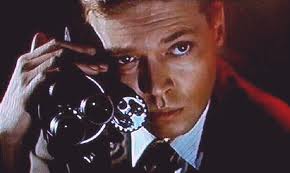 As with Blue Velvet more than twenty years later, this revelation of our role in Peeping Tom produces a reaction combining repulsion and mesmerism; we are shocked, or offended, we cannot look away. But rather than shock us cheaply by showing the murders in graphic detail, Powell leaves the real terror of what is occurring entirely in our minds. Towards the end of the film, Anna Massey discovers the footage of Mark's victims; she watches, being frightened and repulsed - but she keeps watching. The camera tracks her reactions in a long panning shot, which tell us all we need to know about what is happening.
 But even taken outside of all its commentary, Peeping Tom is still terrifying as a pure, full-on horror movie. Carl Boehm's performance is extraordinary, helping to create an immensely compelling character who feels more three-dimensional than Norman Bates. The psychological trauma which Mark suffers could be lazy shorthand, but instead he comes across as a lonely, fractured young man who struggles with himself, something reinforced by the distant, broken quality of his slight Austrian accent.
 The film explores the relationship between love and fear, with Mark wavering between the two as he is caught between the need to complete his documentary and the affections bestowed on him by Helen. We feel so close to Mark that when his doom approaches, we are willing to ignore or forgive his gruesome actions if it would save or redeem him. This is the final savage trick of Peeping Tom which reinforces our position as voyeurs; not only are we drawn to gaze, we impose emotion on people's actions so that even the truly terrifying can seem tragic.
 Peeping Tom is a barnstorming masterpiece which ranks alongside The Red Shoes as Powell's finest achievement. Its psychological complexity and cerebral treatment of its themes are perfectly complimented by Powell's direction, and the whole project is enhanced by Otto Heller's luridly beautiful visuals. It is still as fresh, shocking and truly terrifying as it was over 50 years ago, and in its level of emotional engagement - say it quietly - it's a better film than Psycho. In short, it is compelling, chilling and nothing less than essential viewing.
Rating:
Verdict: A dark, creepy, chilling masterpiece
Saturday Night and Sunday Morning (UK, 1960)
Directed by Karel Reisz
Starring Albert Finney, Shirley Anne Field, Rachael Roberts, Hylda Baker
In the immediate post-war period, British cinema lost a lot of the sparkle and sense of adventure which it had previously embodied. With Alfred Hitchcock now permanently based in America and Powell and Pressburger past their prime, cinema became increasingly populated by American melodramas, jingoistic war films and ropey comedies. It would take something truly momentous to shake cinema out of this stupor: that something was the British New Wave. Beginning with John Osborne's Look Back in Anger, the New Wave sought to reinvigorate film and theatre, tackling controversial subjects head on and presenting a view of the working classes which was the very opposite of patronising or parochial. In time the genre, with its left-wing undercurrents and subtle emphasis on counter-culture, would come to be epitomised by Lindsay Anderson, the director of If.... and This Sporting Life. But well before the latter entered production, Anderson's colleague Karel Reisz was blazing the cinematic trail with Saturday Night and Sunday Morning.
 Based upon the novel by Alan Sillitoe, Saturday Night and Sunday Morning is a rich and respectful work which depicts the life of the working man in Nottingham in a completely uncompromising way. Reisz' background in documentary filmmaking makes him a naturally understated director. His camera is always an observer, sitting passively in the corner; it never flinches or mitigates, and it makes no apologies for what occurs on screen.
Not only does this approach make the action more realistic, but it helps to convey the message of the film. It allows the characters to speak for themselves, to create and form their own voices and identities, rather than having to conform either to the conventions of Hollywood or to social attitudes of what is considered 'proper'. The central line of the film comes towards the end from Albert Finney: "whatever people say I am, that's what I'm not", from which we get the title of The Arctic Monkeys' debut album. The visuals in Saturday Night reflect this desire for the characters rather than the director to do the talking. The film is shot by Freddie Francis, who also shot The Elephant Man and would work with Reisz again on The French Lieutenant's Woman. His choice of angles is simple but effective and he never attempts to play up the emotion of a scene by resorting to thriller tropes in the manner of Hitchcock or surreal, dreamlike shifts in the manner of Michael Powell. There are moments of visual exuberance - for instance, the blurring of the footage at the fairground to convey Arthur's disorientation - but these are only used as occasional devices.
Shooting in black-and-white, whether for artistic or budgetary reasons, always seems to give a film a sense of gravitas and ruggedness, something which was comparatively lacking in Technicolor efforts from the same time. Francis' cinematography and Reisz' direction show up unashamedly all the rough edges of working life, from the thundering monotony of the factories to the grimy back streets and beer-drenched pubs. There is an underlying respect for what they document, but they do not glamorise working life to the point of parody, in the manner of Sergei Eisenstein. This might help to explain why the film was awarded an 'X' certificate when first released (it has since been downgraded to a PG). This ruggedness and gravitas is never more noticeable than in the performance of Albert Finney. In only his second film role, he inhabits Arthur Seaton, creating a complex and contradictory character that we spend the entire film trying to figure out. He is anti-heroic, and largely amoral save when it comes to his own skin. In certain scenes he is borderline sociopathic, like when he takes pot shots at a nosey neighbour with an air rifle. But he remains compelling in his capability to love, to think beyond what we expect of him, and - on occasion - to do the right thing.
 The most interesting moments of the film, which lift it out of the clichés of what would become kitchen-sink, see Arthur and his colleagues passing the time at weekends fishing or drinking, and discussing what the point of their lives might be. Arthur makes passing comments about a life beyond this, saying that he doesn't want to get married until he feels ready. His angry voiceovers about the factory and wayward relationships with women reflect a restless attitude towards the limits of the world put before him. He knows what he doesn't want, but can't quite communicate anything beyond that.
This desire to communicate creates an emotional involvement with Arthur which makes the story gripping and engrossing. Like most kitchen-sink dramas the actual plot is quite slim, and has a number of similarities to A Place in the Sun - the central one being a male protagonist who is torn between two women, and who is threatened with ruin when one of them falls pregnant. But Saturday Night rejects the melodramatic tone of that film, just as Arthur remarks upon living the cinema that he always knew where the film was going. In A Place in the Sun, like so many melodramas, the characters are so clearly drawn that you knew where things were going after about fifteen minutes: Montgomery Clift is bound to fail and make the wrong choices, because that is the archetype into which he fits. In Saturday Night, there are no such guarantees and no stock ending to dampen the mood. Not only do the twists and turns feel more realistic, they carry a greater weight because the various parties do not have to respond in a manner predetermined by genre. Because Arthur is so conflicted, we don't know what choice he will make and therefore there is no assurance that he will emerge intact.
 The film deserves further plaudits for sticking to its guns in depicting the darker elements of urban life. It's one thing to go for realism when things are rosy for the protagonists; it's quite another to follow through with this and risk the censors' wrath in the process. The film is quite happy to linger on the scenes between Arthur and Doreen, but it is equally candid in the fight between Arthur and the squaddies which leaves the former near-dead. The ending itself is quite ambiguous, as Arthur surveys the housing developments and wonders whether he can change even as the landscape changes around him.
 If there is a flaw with Saturday Night, it is purely a question of scope. Apart from little details that have dated and any resounding prejudiced surrounding the now-ripe genre of kitchen-sink, the big problem with the film is that it is a little too self-contained. While it captures this particular part of Nottingham exceedingly well, it doesn't have quite the same general reach as Anderson's work - it doesn't reach out beyond its tight-knit community in the manner of This Sporting Life.
 In spite of this problem, which has prevented it from ageing quite so well, Saturday Night and Sunday Morning remains an important work in British cinema. In the long-term its realistic treatment of ordinary life and uncompromising storylines can be seen in everything from Ken Loach and Mike Leigh to the more recent work of Lynn Ramsey and Andrea Arnold. Reisz directs beautifully, bringing Sillitoe's novel and screenplay to life through a series of refreshing performances, resulting in a very fine piece of work.
Rating:
Verdict: A compelling and well-crafted drama


