


Reflections
-
It is weird to read my correspondences from the late August/early September
period, being the time of transition between my old function in life to my
new ...
14 years ago
This is a reprint of my review which was first published on Rotten Tomatoes about 2 years ago. It appears here to mirror a series of reviews I had done for RT entitled 'From Burton to Nolan'.
The Dark Knight (USA, 2008)
Directed by Christopher Nolan
Starring Christian Bale, Heath Ledger, Gary Oldman, Aaron Eckhart
The word 'masterpiece' is batted around far too often these days, and with The Dark Knight it's sadly inappropriate. Most of what makes Christopher Nolan a great modern filmmaker is up there on screen, and you cannot fault it for being a blockbuster which is attempting to address such relevant and complicated ideas. But while it is a general success, it is not as disciplined or focussed as Batman Begins and does not reward repeat viewing like The Prestige. It deserves to be celebrated and admired for its intelligence, but one must inevitably acknowledge that it isn't flawless. Having barely put a foot wrong in his previous films, The Dark Knight is the first glimpse of Christopher Nolan ever so slightly losing control. Like Batman Begins the film is a little too long, but it also feels slightly bloated, with much of the dialogue being rushed or mumbled in order to cram in all the ideas. It's almost as though there was enough plot and themes in here for two films, but rather than shoot back-to-back sequels, like The Matrix, Nolan decided to compress them down into one. Considering how mediocre The Matrix sequels were, this was not in itself a bad idea, but we still have to live with the fact that there are too many stories going on.
 Moreover, the film is edited and structured in a peculiar way. Where Batman Begins progressed in a defined direction, The Dark Knight feels more like a series of philosophical vignettes rather than something more progressive and incremental. The set-pieces are undeniably brilliant, but with the exception of the final sequence with the ships, you could put these set-pieces in almost any order and the film would feel the same. It's not terrible because of it, but it does mean that there is less cumulative tension than there could have been.
 This feeling of disorder is bolstered by the increased spectacle. Of course, being a blockbuster we don't expect things to be quiet, but there is a feeling watching all the explosions of Nolan pandering to the popcorn crowd just a little too much. In Batman Begins there were two hours of substance and character development, followed by 20 minutes of explosions to make up the trailer. In The Dark Knight, with its themes of escalation and chaos, it seems right that there should be more carnage, up to a point. But the carnage Nolan puts on screen eventually becomes repetitive, and his decision to film some of it in IMAX adds to the impression that he is overcompensating.
 These criticisms make it seem that Nolan's film is a failure, and when compared to the rest of his output, it is disappointing. But it remains head and shoulders above your average superhero blockbuster. The discipline of the first film has been compromised, but the film retains a desire to explore characters rather than just blow everything up. If nothing else, you have to admire Nolan for being able to take such an ideas-heavy film and sell it to such a wide audience.
 Thematically, this picks up the reins of the first film, dealing with the idea of understanding one's enemy as the means to defeating them. The difference is that the Joker is not a Nietzschean figure like Ra's al Ghul, someone who becomes evil by believing so strongly that he is doing good. In fighting him Batman still risks becoming like his enemies, but this lack of morality means that the cost to him will be greater. Killing the Joker seems necessary, but it would destroy Batman's moral code and undermine the belief that good can overcome evil in a non-Nietzschean way.
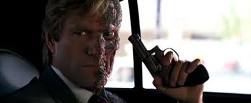
 The film is quite nihilistic in suggesting that even at its weakest, evil can triumph over good. The Joker's fate at the end remains uncertain, but the revelations surrounding Harvey Dent give a sense of him winning even though his direct influence is curtailed. The Joker's evil is allegorical to terrorism, in that his influence is fragmented and disparate. He does not take power by marching in with an army; he infiltrates, twisting, turning and double-crossing. Dent and Batman are the dove and the hawk trying to uphold rules in the face of chaos, and both are essentially destroyed in the process.
 The thing which marks out The Dark Knight from Nolan's previous work is that it is relatively conventional in its storytelling. It's ridiculous to call it 'dumbing down', but there is none of the jumping back and forth in time which made The Prestige so gripping. The themes are presented in a much more upfront way, both in the dialogue and the precise mechanics of the moral dilemmas. You could almost accuse Nolan of ramming ideas down the audience's throats, but thankfully the script and the characters are good enough to prevent this.
 The film has similar character development to Batman Returns, which was criticised for sidelining Batman in favour of the svillains. But that's always been the point. Since Batman is a superhero who uses cunning rather than powers, there has to be a section of the film in which he is the underdog; if nothing else it makes his eventual triumph more powerful and palatable. What makes The Dark Knight clever is that it does all this while withholding the Joker for a long time. Apart from the opening bank raid, the first act largely concerns itself with Lau and the Mob.
 As with all Nolan films, the performances are really great. Heath Ledger was generally a lightweight, but as the Joker he manages to channel Malcolm McDowell and make him truly terrifying. It's easily his best performance, although like the film it has become a victim of its own hype. Like the Scream killer, it has been so widely parodied that it isn't quite as scary anymore. Christian Bale remains convincing, and as before it is right that he should be a little sidelined so that the great evil is acknowledged.
 Michael Caine and Morgan Freeman are both warm and affable, and the script does allow for more humour this time round - for instance, when Rachel Dawes and Batman land on the car, she turns to him and says, "Let's not do that again". Interestingly enough, the film glosses over the most interesting character development: the individuals closest to Bruce Wayne finding out his identity. This was explored in Batman Returns in some detail, but here there are several conversations between Bruce and Rachel in which she knows he is Batman, which somewhat undercuts the drama.
 The Dark Knight contains many promising performances, along with stunning visuals from Wally Pfister who gives Gotham a grungy and decaying edge. In the end it struggles to completely control all the rogue elements, but at least Nolan doesn't fall into the same trap as Sam Raimi on Spiderman 3, namely throwing everything at the screen in the hope that some of it will work. If Batman Begins was Nolan's equivalent of Alien, then this is his Aliens: more action-packed and slightly less compelling, but still weighty, intelligent and interesting. One only hopes that Inception will not be his Alien 3.
Rating: 
Verdict: Bloated but containing brilliance
Batman and Robin (USA, 1997)
Directed by Joel Schumacher
Starring Arnold Schwarzenegger, George Clooney, Uma Thurman, Chris O'Donnell
Most of us grow up believing that Batman and Robin is the worst film of all time, a position reinforced by countless polls in magazines. It's only as our understanding of film grows that we come to realise that Joel Schumacher's Razzie-nominated magnum opus is not so much an abomination as a case of colossal misjudgement. Make no mistake, it's utter rubbish, but it's not the worst film ever made by quite some distance. As with its processor, the best way to understand Batman and Robin is through the extent of Tim Burton's involvement. With Batman Forever, Burton stayed on as a producer; he still held some sway over the end result, in least in terms of ensuring some form of continuity between his vision and that of his replacement. But with this instalment Burton and his sense of direction are completely absent. The hefty box office of Forever, which surpassed that of Batman Returns, gave Schumacher a free rein with full studio backing - and he made a total pig's ear of it.
 One of the arguments used to defend Batman and Robin is that the film was made too quickly. Warner Brothers wanted a rapid follow-up to Forever, hiring Schumacher in August 1996 and telling him to have the finished film ready to release in ten months. But Schumacher was used to shooting so quickly, averaging a film a year between 1993 and 1997. This is proved by his decision to film A Time to Kill instead of waiting on Warner Brothers, and by production on Batman and Robin wrapping two weeks early. Finally, though screenwriter Akiva Goldsman was officially hired in August, he and Schumacher had already worked out the story on the set of A Time to Kill.
 The script of Batman and Robin is not so much a script as a list of awful one-liners. Amidst his inexplicable Oscar win for A Beautiful Mind, Goldsman has scripted such utter disasters as Lost in Space and The Da Vinci Code. There is one good line in the whole screenplay: it occurs in the museum when the guards and gassed, and one of them is heard to shout "Oh my lungs!".
 The rest of the time the script is lazy, shoddy and devoid of any character development. The story itself is incredibly derivative, borrowing from action movie clichés as it sees fit. The final showdown involving satellites, lasers and sunlight is a straight lift from Diamonds are Forever or Goldeneye (sticking with the Bond theme, it could almost be called the inspiration for Die Another Day). The designs of Mr. Freeze's vehicles are a total rip-off of Mad Max, and there are passing nods to A Clockwork Orange and Blade Runner which will make every seasoned film buff's blood boil.
 Schumacher has always been a director concerned with style above everything else, often to the point that he has forgotten how to tell a story. John Glover, who plays the mad scientist, recalled that Schumacher would shout: "Remember, everyone, this is a cartoon" before every take, and Chris O'Donnell commented that the film resembled a toy commercial. If Batman Forever was like a dark nightclub that had been turned into a disco, Batman and Robin is like a night at Studio 54 populated by characters from The Care Bears or Barney the Dinosaur.
 The problem with Schumacher's approach is not a problem with being light or camp in itself. There are many great action films within the camp style which still hold up - Flash Gordon, Planet of the Apes, even Mad Max to some extent. The problem is that this approach is force-fed to the audience, with every scene and action being played so far over-the-top that there is no room left for the ideas to be presented intelligently. This is reflected in the film's homoeroticism, present in everything from the bat-nipples and rubber asses to Poison Ivy's lair being in a Turkish bath. The problem is not homoeroticism in and of itself - it's that we are so repeatedly told to believe that Batman is gay that we never have a chance to think about what else might be going on.
 The only times when Batman and Robin even slightly works are the conversations between Bruce and Alfred about the purpose of Batman. This is in itself an indictment of the film: the villains are so boring and obnoxious that the only character we care about is the butler. Michael Gough gamely trudges his way through lines about cancelling pizza and housekeeping, and actually manages, unlike the other actors, to have more than one facial expression. If nothing else, his efforts make for welcome if mawkish diversion from an unnecessary deluge of special effects.
 Throughout the Batman saga, the films have always been at their weakest whenever the effects were allowed to dominate - think of the opening set-piece of Forever, the spinning Batmobile from Returns, even the chase scenes from the first film. But all of these niggles pale in comparison with Batman and Robin, which is all about the effects. From its opening set-pieces to its final scenes involving satellites directing sunlight, there is a reliance on CGI and digital trickery to such an extent that the characters become completely secondary.
 This feeling of superfluity is reinforced by Schumacher's direction. It's all very well constructing ten-minute action scenes with a beginning, middle and end, but the editing has to complement the action to justify the length. Schumacher's editing is terrible - there is no sense or pacing, and his angles are constantly shifting so that you can't really see what's going on. Seeing Freeze and Batman surf down to Gotham might have worked had it been done in one take, but with a cut every few seconds it feels completely devoid of energy.
 As far as the acting goes, it makes the characters in Rocky Horror look understated. Uma Thurman is so bad that she makes William Shatner seems naturalistic, while the gormless Alicia Silverstone thoroughly deserved her Razzie nomination. The problem with casting such seemingly glamorous women is that we only believe in them when they put the spandex on. Before their real self becomes the cover story, there's no way we can believe that Thurman is a bookish scientist, or Silverstone is a schoolgirl.
 The male performers fare no better. Arnold Schwarzenegger may have been the king of one-liners in his day, but even his best lines are repetitive, cheesy and can be seen coming a mile off. Every possible pun involving ice, snow or cold is used, to the point where the character has become a parody of itself. George Clooney, who has since disowned the film, walks around with air of a man who things staring into middle distance will somehow maintain his dignity. And Chris O'Donnell remains. unconvincing and spends most of his lines whinging.
 When Sucker Punch was released, Mark Kermode observed that getting angry about the film's sexual politics was doing it a greater service than it deserved - the biggest reaction being sheer boredom above all else. In the case of Batman and Robin, there is so much to get angry about in terms of plot holes (why would Mr. Freeze hide in an ice-cream pub? Why would people not die from focussed sunlight? How come Bane can be defeated so easily? Etc.). But to get in a huff about these things, valid overlooks the most important and cynical aspect of the film.
 The reason Batman and Robin's story is so terribly weak is that the film exists mostly if not wholly to sell merchandise. There is no reason for Batman, Robin and Batgirl to change costumes: it is only in the film so that kids have to buy two action figures rather than one. The same goes for all of Freeze's gadgets, Poison Ivy's hairstyles, and the infamous Bat credit card, which takes jumping the shark to a whole new level.
 Batman and Robin is the point where bad movies end and terrible movies begin. It's easily the worst film of the Burton-Schumacher era, ignoring all that was right about Burton's efforts and extrapolating all that was wrong with Batman Forever. Its reputation as one of the worst films of all time is such that to kick it when it so far down feels almost cruel. But suffice to say, the franchise needed a good eight years to recover before the arrival of a dark knight in shining armour.
Rating: 
Verdict: Where bad movies end and terrible ones begin
Batman Forever (USA, 1995)
Directed by Joel Schumacher
Starring Val Kilmer, Tommy Lee Jones, Jim Carrey, Chris O'Donnell
Changing the director in the middle of a franchise can create seismic differences in the quality of the respective instalments. Sometimes this is for the better: Alfonso Cuaron lifted the Harry Potter series with Prisoner of Azkaban, bringing a real sense of magic and wonder where Chris Columbus had failed on both counts. On other occasions, such as this one, the franchise does not benefit, resulting in a film with none of the weight of Tim Burton's instalments and which is nothing more nor less than a little bit boring. The key to understanding Batman Forever lies in the relationship between Tim Burton and his replacement Joel Schumacher. Despite having left the director's chair after the mixed reception of Batman Returns, Burton stayed on to produce the third instalment at the behest of Warner Brothers. While this did not give him anything resembling creative control, it did give him a certain amount of power on the set, so that he could always step in if he felt that things were going too far off the rails.
 As a result of Burton's presence there is some degree of continuity between the universe of Returns and Forever. Despite its gaudier design and campier style, it doesn't feel entirely like you've switched over to the TV series right after watching the second film. Certain sections, such as the death of Bruce's parents, have been reshot so that they retain their existing composition but with the new colour scheme and editing style. By making the head of Arkham Asylum a goofy-haired man called Dr. Burton, the series tips its hat to his style and sensibility, acknowledging that without him we would never have got this far.
 But while we are ostensibly in the same Gotham City, the emphasis has been shifted away from expressionist architecture and dark anti-heroes, and onto something a lot more frivolous. Where Burton uses style as a means of expressing deeper themes or character traits, Schumacher is all about style for its own sake, and never mind the story. This reflects their respective beginnings as filmmakers: Burton cut his teeth in animation, creating drawings which had to speak a thousand words, while Schumacher started out designing costumes for Woody Allen's Sleeper.
 What we end up with is a film which is lit to within an inch of its life, but scripted to a bare minimum. Like the TV series, there is a central plot which is relatively thin and largely implausible, around which action set-pieces can be positioned and stretched out for as long as is necessary. There are big references to Schumacher's back catalogue throughout - the street gang with fluorescent make-up are a re-tuning of the vampires from The Lost Boys, while the scenes with Nicole Kidman's psychiatrist tread very close to the dialogue in Flatliners.
 Batman Forever is often cited as the point when the Batman series shifted from being about the comics to being about the merchandise. Many fans have cited Val Kilmer's opening lines about "getting drive-through" as the moment at which the franchise jumped the shark. There is a large amount of truth in this: the shift towards brighter colours, sillier villains and the increased hardware available to Batman points towards a desire to sell action figures and lunchboxes rather than something more grown-up.
But while there is a market-driven edge to this Batman instalment, it is not as crass or as cynical as it could have been. The plot is at best ironic and at worst duplicitous - creating an evil weapon which warps people's minds through television, when whole sections of the film resemble a commercial, at least in the way that they are lit. But it doesn't force the merchandise down the viewer's throat like Batman and Robin did, and compared to the work of Michael Bay it's totally harmless. For its first 45 minutes, the predominant reaction to Batman Forever is not betrayal or disgust but boredom. The opening set-piece, involving Two Face's elaborate heist and a safe full of acid, feels dragged out and is played for laughs way too obviously. The stunts become increasingly preposterous and the supporting characters have less personality than in the Burton films.
Whereas in Batman Returns there was a sense of all the villains and some of the bystanders having minds of their own, the security guard in the bank is confined to whining "Oh no!" with increasing desperation. There is less of a role for Pat Hingle as Commissioner Gordon, and Michael Gough is increasingly sidelined. During the set-pieces Schumacher's love of aesthetics becomes frequently overbearing. In the sequence on the rocks near the Riddler's lair, there is so much green on the screen that you can't see what's going on. It's like watching Flash Gordon without the wit or directorial vision. The performances reflect this sense frustration. Val Kilmer is a plank as Bruce Wayne, and has an off-putting, haughty quality which conveys that Kilmer thought he was above the role. When he's in the bat-suit, he unwittingly pouts in almost every scene, as though he saw wearing the mask as an excuse to stop acting, at least with his face. Jim Carrey does an awful lot of gurning as Edward Nigma, and he only stops being annoying when he's being reined in by Tommy Lee Jones, who genuinely gets the character and seems to be having fun.
 Nicole Kidman, whose character was written specifically for the film, spends an awful lot of her screen time doing nothing but wandering around in a little black dress. Like Kim Basinger in the first film, whatever attempt is made to build her character up as intelligent is eventually undone; she ends up as a damsel in distress, accompanied by a gratuitous upskirt shot as she falls out of the tube. And Chris O'Donnell never entirely convinces either as Dick Grayson or as Robin. When he pretends to be Batman while facing the street gang, we're laughing at him as much as with him.
 However, after we have cantered through the Riddler's backstory and drunk our fill of pouting, whinging, gurning and flirting, Batman Forever finally kicks into gear and starts to have a plot which feels like it has something to say. It stops being an overgrown kid playing with toys and becomes a film about repression of childhood memories.
 Where the previous two films dealt with Batman as an outsider, who may be no better than the villains he is fighting, Batman Forever asks the question of whether Bruce Wayne can ever live with himself, as Batman and as a fractured human being. There is continuity from Batman Returns in the role of women; Chase makes a passing reference to Catwoman on the rooftop, and she proves instrumental in helping Bruce come to terms with himself.
 The point seems to be that the central dilemma of Batman is always the same - where does the man end and the bat begin, both in terms of personality and in terms of authorit. The various villains or sideshows which Batman encounters are just different ways of asking the same questions, whether through violence (Two-Face), riddles (The Riddler) or seduction (Chase). Considering what happened with the sequel, one could argue that this is just a ploy to have infinite new villains turn up in infinite new films, but at least the film has the guts to raise one of the central issues of the comics, even if it handles it with kid gloves.
 Batman Forever is a noisy, incoherent and often dull third instalment of a franchise which was already showing signs of fatigue. For all its good intentions and attempts to grapple with several ideas, it never follows through enough with any of them to cut the mustard, resorting to special effects to disguise Schumacher's shortcomings as a storyteller. But despite this, it's passingly entertaining, with Tommy Lee Jones and Jim Carrey eventually coming through with the goods as a double act. It's a consistent and inoffensive disappointment; if only the same could be said for the sequel.
Rating:
Verdict: An inoffensive disappointment
Batman Returns (USA, 1992)
Directed by Tim Burton
Starring Michael Keaton, Danny DeVito, Michelle Pfeiffer, Christopher Walken
The huge box office success of Batman allowed Tim Burton to pursue a more personal project in the shape of Edward Scissorhands. Mixing gothic fairy tale with social satire and nods to classic horror movies, it was Burton's first truly great work and began his artistic relationship with Johnny Depp. With both critical and commercial success behind him, Burton was free to make Batman Returns much more of the film he wanted. As before, not everything works, but in certain key areas it is a marked improvement on the original. Whereas Batman felt like a film where Burton was one of many influences fighting for control, Batman Returns is a Tim Burton film first and a comic book adaptation second. Some of the overtly expressionist touches from the first film remain: apart from the continuity of Gotham's architecture, there is the contrast of black and white prams in the credits and the long pan up to the skyline in the final shot. But this film is much more of a gothic fairy tale, as though Scissorhands' close relatives had broken into the Bat-cave.
 This shift is most clearly present in the pre-title sequence. Burton's title sequences have always been elaborate, using evocative imagery to pull an audience into the world he is creating so that any initial preamble can be minimised. But the influence of Edward Scissorhands is clear from the outset, with falling snow and the child that nobody wanted - the only difference being that the Penguin is banished from the castle rather than being kept in it. This sequence has a poetic, bittersweet quality which slowly mutates into something creepier; the longer the camera follows the floating pram, the more we start thinking about Rosemary's Baby.
 Batman Returns sees Burton putting his stamp on Gotham and the characters in a far more distinctive way. He reworks the theme of outsiders from the first film and plays it out in the visuals to a far greater extent, rather than relying on the characters simply talking about it. The costumes emphasise the fractured nature of the characters, from the stitching on Catwoman's hand-made suit to the Penguin's rubber gloves which stand at odds to his waistcoat and walking stick.
 Whereas the first film saw Batman as the hero and ended on a triumphant note, Batman Returns is more nuanced and shows the characters at a more mature and established point in their history. The film expands on the "duel of the freaks" and taps into a central thread of the comics, namely that Batman is no better than the villains he is fighting. Batman, the Penguin and Catwoman are all vigilantes who do what they do because the law has in some way failed them; whatever individual acts of good they may perform, they are all potential enemies of the law, whose level of allegiance to the authorities changes several times over the course of the film.
 With this relativistic set-up, it becomes a question of whether the characters use their status, as outsiders and vigilantes, as a force for good or evil. Batman chooses the light, directing his moral compass on the people of Gotham, funded through his/ Bruce Wayne's immense wealth. The Penguin keeps changing his mind but eventually opts for darkness, choosing violence and revenge and over any possible form of redemption. Most interesting of all is Catwoman, who is trapped somewhere between the two extremes. At the end of the film she is still trying to pin down her raison d'etre, trying to reconcile both her personalities to Gotham, her past life and her costumed rivals.
 One of the complaints made about this film, and subsequently about The Dark Knight, is that Batman becomes marginalised in favour of the villains. While it is undoubtedly true that Burton finds the villains more intriguing, it makes sense both narratively and thematically for Batman to be on the back foot. Because he has no natural powers - he is not, as the Penguin puts it, "a genuine freak" - it takes time for him to respond to new threats and to defeat his enemies using wits rather than convenient gadgets. There's nothing more boring than seeing a hero brush villains aside with one punch, and the relationships which these three characters build during their various encounters give them a new depth.
 Like all the best comic book movies, Batman Returns is centrally focussed on the people trapped within the circumstances of their special powers. With Batman it is doubly interesting because there is no freak accident or supernatural force involved, so that it becomes a moral examination as much as a psychological one. But Catwoman and the Penguin also wrestle with their new identities, and the film is suitably ambiguous as to how far these people have come to terms with who they are.
 The best scenes in Batman Returns are those between Michael Keaton and Michelle Pfeiffer, in either of their incarnations, trying to decide how much of themselves they should reveal, second-guessing whether one knows who the other is, and weighing up whether to be lovers or enemies. In one scene they are kissing on the couch, trying to give in to their passions, but also trying to hide the injuries they sustained from fighting under their respective masks.
In a later scene, Pfeiffer is dancing with Keaton at Shreck's ball, having come her to kill the latter at Catwoman. As Keaton puts two and two together, Pfeiffer remarks "does this mean we have to start fighting now?", a line which perfectly conveys the conflict their characters are facing. Pfeiffer's face shifts dramatically in this scene, taking in panic, fear, angst and sadness as she desperately runs through all those questions in her mind. Does she really want to kill Shreck? Can she live with Bruce Wayne knowing that he is Batman? Can she in any circumstance live with herself? For those of us who are less interested in the psychology of the characters, there is still plenty in Batman Returns by way of popcorn entertainment. Burton may not be the most adept action director, but the set-pieces in Batman Returns are packed full of pyrotechnics and impressive stunts to keep younger viewers entertained. Some of the individual movements feel contrived, such as a gadget which rotates the Batmobile through 180 degrees just so a clown can be set on fire. But in the sheer variety and frequency of the set-pieces, there is something for pretty much anyone.
 The flaws with Batman Returns come less from Burton's vision than from the demands of a blockbuster sequel. The film is rather too long, and in complete contrast to its predecessor has too much plot rather than too little. Christopher Walken is underused for most of the running time, with his evil plots being quickly reduced to an expository sideshow. The film does fall into the Spiderman 3 trap of having too many villains, albeit not so catastrophically as Sam Raimi's effort.
 There are also elements of Batman Returns which seem out of a place for a 12 certificate films. Danny DeVito gets a number of unsavoury lines surrounding "filling the void" and "unlimited poon-tang", which come across as more disgusting than funny, even considering the grotesque nature of his character. And the Penguin's encounters with Catwoman tip over so often into sex talk that you begin to wonder whether this film was misjudged or simply given the wrong rating.
 Despite its flaws, Batman Returns is an improvement on the original and the best of the Burton-Schumacher canon. Its exploration of the characters is more complex and consistent than before, and Burton's evocation of Gotham is darkly distinctive. In hindsight it was probably for the best that Burton moved on to other projects, since he had taken the characters as far as his talent and interest would allow. One only wishes that Joel Schumacher had taken more care once Burton had handed over the keys.
Rating:
Verdict: A flawed but marked improvement


