


Reflections
-
It is weird to read my correspondences from the late August/early September
period, being the time of transition between my old function in life to my
new ...
14 years ago
Rogue Trader (UK, 1999)
Directed by James Dearden
Starring Ewan McGregor, Anna Friel, Tim McInnerny, Nigel Lindsay
In the current climate, where it's almost fashionable to bash the banker, it would be all too simple to go easy on films which paint a broadly negative picture of our financial system. But we must remember that such films have to weather the storm as much as the people they are portraying, and that they must remain relevant when the markets go back up (or down). Rogue Trader doesn't manage to do this, being occasionally arresting but mostly disappointing. There's no doubt that the story of Nick Leeson deserved to be put on screen. His story is indicative of two big trends in 1980s and 1990s commerce: new blood flowing into the City of London from outside of traditional circles, and intense levels of greed and materialism after Big Bang, which were (temporarily) curbed by the stock market crash of 1987.
 Our expectations are raised further by the talent on either side of the camera. Ewan McGregor had recently made his name in Trainspotting, Danny Boyle's first big transatlantic hit. The writer-director James Dearden had previously written the screenplay for Fatal Attraction, which captured another aspect of the 1980s zeitgeist, namely the AIDS epidemic. And the film is scored by Richard Hartley, who arranged the music for both The Rocky Horror Picture Show and its sequel Shock Treatment.
 The big problem with Rogue Trader is that it very quickly falls between two stalls. On the one hand, it wants to be a raucous, lads'-night-out comedy, in the manner of The Full Monty or, if you must, Lock, Stock and Two Smoking Barrels. The film contains numerous scenes of broad, bawdy comedy, such as Leeson and his colleagues mooning the girls in the bar. On the other hand, it wants to be a hard-hitting zeitgeist thriller about greed and how the stock market is based on lying - a sort of Wall Street for the late-1990s.
 The basic point which Rogue Trader makes is to draw an analogy between the stock market and gambling. The film contends that both are at heart based on luck and the ability to lie consistently enough to cover up one's mistakes; the only difference is the amount of money changing hands. It's hardly a ground-breaking analysis of global finance, and for much of the running time it is used to excuse or mitigate our increasing incredulity towards the central character. But at least the emphasis on luck makes us root for the central protagonist, even when we know in our hearts that his luck won't change.
 Rogue Trader's first flaw in terms of storytelling is that it fails to adequately explain the workings of the futures market. When Leeson is first coaching his team, he explains the basics of futures trading using salt, pepper and coffee cups, showing how they are betting on the future value of a commodity and aiming to make a profit by selling it at a higher price.
It's a welcome and reasonable explanation, but as the film barrels forward these layman's-term scenes are too few and far between. When it tries to explain what is going on, the film conveys it in an incoherent way: in one scene, Leeson talks to himself while hitting a punch bag, hitting it so hard and so often that we can only make out odd words. It is possible to explain something this complex without resorting entirely to exposition, but the film seems even less interested in the mechanics of trading than Leeson was. This problem is compounded by the early scenes, which have an obnoxious, geezer-y feel to them. During Leeson's early successes, we get numerous montages of him trawling around Singapore in a Porsche or entering drinking competitions. Even if Leeson's life really was like this, these scenes jar so prominently with the supposedly serious intentions of the film that it can feel like there are two different stories going on one - one about the stock market, the other about Club 18-30.
 One could argue that the film is intending to paint our protagonists as obnoxious, to reinforce the hollow basis of their lifestyle and the unenviable behaviour it produces. This works up to a point, but because the film is based on Leeson's memoirs, it has a sympathetic vie, if not of the system as a whole, then of his personality within it. The film may be more ambiguous about his personal financial decisions, and his choosing to lie to cover his tracks, but it is never brave enough to suggest any kind of link between Leeson's personality and the consequences of his actions.
 The film is also riddled with clichés, presenting a very hackneyed picture of both the trading floor and Barings Bank. Leeson is the archetypal fast-talking Cockney, whose catchphrase is something along the lines of "everything will be alright". When he first enters the bank to sort out the bonds, the cell bars slide back in front of his face - a shot that was already old when The Silence of the Lambs did it eight years earlier. His team wear horrible, tacky jackets on the trading floor, communicating with outlandish gestures, while his bosses are all stiff-upper-lipped, haughty, public school types. Add in an excitable Australian spouting business jargon and Anna Friel's oblivious wife, and you get a clear picture of a writer who isn't trying very hard.
 Rogue Trader also falls short on a technical level. Dearden's direction is workmanlike, but his editing is frequently slapdash. His frequent use of quick cuts on the trading floor make things feel more like a music video, and his choice of angles is occasionally silly. We don't need to see Leeson's panicked expression from the other side of a computer screen, any more than we need a close-up of '88888' being typed in, as if we didn't get the point. The film ends up relying on Hartley's score to tell us when things are turning bad, and while that may be fine in a melodrama it doesn't work wonders here.
 Having said all that, Rogue Trader does begin to pick up in its final act. After we have spent the best part of an hour trying to put up with clichés and platitudes, we start to get drawn in as we eventually appreciate just how bad things are. The turning point comes when Leeson stumbles into the toilets, checks that both cubicles are empty, and announced to his reflection that he has just lost £50m in one day.
From this point on there is a natural source of tension from the combination of the money involved and the time constraints, i.e. the bonuses and annual audit. The scene of Leeson having dinner with his bosses, knowing full well that he is draining their company dry, is very tensely orchestrated, and the dream sequence of Leeson owning up and the bankers choking works well. This is all slightly undercut by the airport scene, where Leeson imagines the photographers are his trading floor staff, and starts bidding in front of the press. But in general this kind of absurd interlude is the exception rather than the rule. In terms of the performances, the cast do their best with second-rate material. Ewan McGregor has a habit of being the best thing in a bad movie, and he does have a believable sense of conviction even if we are not sure how much we should like him. Anna Friel is dealt a duff hand, having to spend a lot of her time being blissfully ignorant in mini-skirts, but she somehow carries herself with good grace. Out of the rest, only Tim McInnerny makes any impression, and he gets far too little screen time.
 Rogue Trader is a sadly pedestrian telling of Nick Leeson's tragic tale. It has neither the comic spark of Trading Places nor the confidence of Wall Street or American Psycho, with regard to either the financial system or the pawns therein. The performances are likeable enough, and there is nothing offensively bad about the handling of the story. It needed to be told, but not in such a disappointing way.
Rating:
Verdict: Derivative and disappointingly dull
The Life and Death of Peter Sellers (UK/ USA, 2004)
Directed by Stephen Hopkins
Starring Geoffrey Rush, Charlize Theron, Emily Watson, John Lithgow
It was always going to be difficult to make a film about the life of Peter Sellers. The man was an immensely complicated personality who claimed to have no underlying self. His life was a Molotov cocktail of drug abuse, women and heart attacks, interspersed with some of the finest character acting ever to grace the silver screen.
The Life and Death of Peter Sellers is an admirable attempt to portray or depict Sellers, recreating key scenes from his film career alongside problems in his personal life. But despite the best efforts of director Stephen Hopkins and a fine performance by Geoffrey Rush, it never quite satisfies either emotionally or biographically. Whether due to the physical limits of the production or the inherent complexity of Sellers the enigma, in the end it does little more than scratch the surface. On the plus side, Peter Sellers (as it shall hence be called) does a very good job of replicating the various period settings. There are all the usual batch of camera tricks, such as using green-screen to recreate streets, and the colours of the film have been manipulated to give the appearance of degraded stock. But on top of the usual whistles and bells, the film captures a number of moments in Sellers' life with such accuracy that it could pass off as a documentary. This is particularly true of the opening section where The Goon Show is recreated on stage, with all the riotousness and anarchy of the original broadcasts.
 The film simply wouldn't work if we didn't believe in the performance of the lead actor, and in this respect Geoffrey Rush is ideal. Although he has the aid of an army of wigs and vast quantities of make-up, he never lets the artifice dominate his characterisation of Sellers or the various roles therein. Rush goes through the same physical transformations of Sellers, moving over the course of the film from podgy to fighting fit and finally ghostly and frail. Most of all, he mimics Sellers' vocal performances very accurately, going beyond impersonation in almost every instance.
 But rather than just have Sellers playing the various characters from his films, Hopkins and Rush contrive to have Sellers playing most of the people around him as well. At key moments, the camera will go 'back stage' and we watch the same characters as played by Sellers. This self-reflexive tactic is unnervingly effective, because it reaches the very core of Sellers' character: he was only happy or honest when he was being other people. Seeing Sellers as Stanley Kubrick in the taxi, we get a more open insight to Sellers than we would ever get from the horses' mouth, and seeing him re-dub the scene of his wife leaving him conveys his desperate need to be loved at any cost.
 The other performances manage to match Rush in terms of quality, even if they don't all get the screen time they deserve. Emily Watson is very good as Sellers' first wife Anne Hayes, who struggles with his cruel streak and his distance from their children. Watson resists the urge to overegg the emotional torment, so that we are convinced that she still loves him even when his behaviour is at its most outrageous. John Lithgow is having a ball as Blake Edwards; even if he is occasionally larger-than-life, he taps into Sellers' ability to produce hatred and admiration often simultaneously. And Miriam Margolyes is a good choice for Sellers' mother, who dominates his early life and instigates his early attempts to get into film.
 On top of this, the film has a number of fantasy moments which are particularly touching. The best of these is the dream sequence in Sellers' head as he is being revived from his near-fatal heart attack. We see the various characters from his film career up to that point - Clare Quilty, Dr. Strangelove, Fred Kite etc. - gathering round his hospital bed, before Sellers rises up on a huge bomb and hits a button on his heart blowing them all up. It's a moment of brief assertion from Sellers, showing his determination to be taken seriously and not be defined or controlled by the other versions of himself on screen.
 Unfortunately, the problems with Peter Sellers eventually outweigh all the aspects of it which are successful. First off, despite its solid production values and fantastical ambitions, it remains very televisual. Doubtless the involvement of HBO, both financially and creatively, came with the very best intentions, and had the film not been released theatrically than this would not have been a problem. But on the big screen, Peter Sellers feels too compact and limited to cut the mustard, and the backstage sequences only reinforce the feeling that the world we are seeing on screen doesn't extend very far beyond it.
Tied up with this televisual nature is the problem of content versus length. Even with two hours to play with, there is far too much in Sellers' eventful life to fit around the constraints of a feature film. But rather than opt to tell the story in small segments, as a TV miniseries or whole season of shows, Hopkins and his team are forced to cherry-pick what they deem to be the most well-known or important bits. While the film therefore serves as a good introduction to both Sellers and his body of work, those more familiar with either will get frustrated by just how much has been omitted, and by how quickly the film gallops through his life. Sellers claimed that his time on The Goon Show was the happiest time of his life, and yet we only get about five or ten minutes of it, including Spike Milligan and Harry Secombe turning up briefly in later scenes. The film never touches on his relationship with The Beatles, or much of his film work in between Dr. Strangelove and the later Pink Panthers. Most annoyingly, there is nothing in it about his last two marriages, or the precise attitude he had towards his children.
 Because the film moves at such a pace, we find it hard to connect with Sellers as a person. This could, of course, be argued as the intention of the film - that Sellers shifted between characters so quickly that you could never see the real him. But in order for the film to work even as an introduction, we have to have some means of connection beyond his display of talent - and there are only fleeting opportunities in which this is possible. As with Mr. Nice, Bernard Rose's biopic of Howard Marks, there is a sense of information being intentionally withheld to such an extent that our ability to empathise begins to wane.
 Had the film been reconfigured for a TV series, we would have got a far greater insight into both Sellers and the various characters which filtered in and out of his life. When we are introduced to Maurice Woodruff, the fraudulent fortune teller played by Stephen Fry, we expect him to get a lot of screen time because of the level of influence he quickly comes to hold. Instead he only gets three scenes and dies off-screen without a second's acknowledgement, so that we never get a proper sense of how greatly Sellers depended on him.
 The Life and Death of Peter Sellers is a film whose failure may not be entirely the fault of its creators. Certainly compared to Hopkins' previous offerings - Predator 2, A Nightmare on Elm Street 5 - it is an undeniable work of genius. The problem may be the real Peter Sellers was simply too complex a man to be convincingly summarised in two short hours. In which case, the film is proof of its own failure, functioning as a workable introduction but being found wanting everywhere else.
Rating:
Verdict: Would have worked better as a TV miniseries
The King's Speech (UK, 2011)
Directed by Tom Hooper
Starring Colin Firth, Geoffrey Rush, Helena Bonham Carter, Guy Pearce
It's hard being British during awards season. Seeing British films nominated is great; seeing people win just for playing monarchs is frankly quite depressing. But unlike The Queen or Shakespeare in Love, the acclaim for The King's Speech has a lot more to it than simply baiting the Oscars. Stripped of all its ploys and generic concessions, it remains an enjoyable, well-made film that will outlive most of its competitors. There was a time, not so long ago, when British period dramas about royalty (and by extension the aristocracy) were very tight-lipped affairs. Merchant Ivory and their derivatives handled their stories with an emphasis on repression, creating scenes where humour was seldom tolerated and private anguish emphasised almost to the point of tedium.
What makes The King's Speech such a breath of fresh air is the complete absence of this suffocating stiff-upper-lip. The film does more than its fair share of exploring British pleasantries and social graces, but it never takes itself too seriously in doing so. David Seidler's script is closer to the work of Alan Bennett in The Madness of King George, or to some extent Julian Fellowes in Gosford Park. There is a sense of playful mischief at the heart of it which prevents the film from becoming self-important. To this end, the moments of humour in The King's Speech are a balance between subtle one-liners for the costume crowd and more raucous elements that will pull in a mainstream audience. One cannot help but titter during George's arguments with Edward, involving the latter's attempts at "kinging" and letting Wallis Simpson sleep in their mother's suite (to which Edward remarks: "Mother's not still in the bed, is she?"). But the really laugh-out-loud moments come when George is made to swear therapeutically, delivering Anglo-Saxon vulgarisms with both reserve and abandon.
 The King's Speech is at heart a character piece, carried not by its storyline but by the talent and charm of its performers. And you couldn't have picked a better cast. Colin Firth is great in the lead role, delivering a performance almost on a par with his work in A Single Man. He shrinks into the role, slurring his 'r's and staggering his gait in a deeply empathetic manner, taking us right inside the strife of a man beset not just by a speech impediment but years of insecurity brought on by his brother and his father. Not only is he a reluctant king, he is naturally withdrawing, using even the most dated traditions for much-needed support.
 Geoffrey Rush is brilliant as Lionel Logue, nailing the character so early that he can be serious and well-meaning one moment and camp it up as Caliban the next. Helena Bonham Carter makes a successful return to her costume drama roots, carrying herself with just the right mixture of grace, pomposity and cheek. Elsewhere there are good supporting turns from Michael Gambon and Derek Jacobi, himself no stranger to stammers through his work on I, Claudius. But most surprising of all is Guy Pearce, who brings a real complexity to Edward VIII. The film makes no bones about his Nazi sympathies and skewed devotion to Wallis, but we really feel a lump in our throats when he is forced to decide between her and the throne.
 But although the performances dominate our memory of the film, The King's Speech is a great deal more than a gallery of famous British actors talking in rooms for two hours. All accusations about the film being televisual are complete and utter balderdash. Tom Hooper is a director who excels at putting personal conflict up on screen, even behind closed doors. Through meticulous sound design and an excellent choice of camera angles, he manages to make the drama both personal and expansive. We hear every hesitation in Firth's throat, and when he can get the words out the world he is addressing stretches far beyond the four corners of the screen.
 The film's ambiguous title hints at the three main issues tackled by the film beyond its conformance to generic conventions. Firstly, there is 'The King's Speech' as in 'King's English', the form of standard English against which all dialects are compared, contrasted, weighed in the balance and found wanting.
Although it doesn't touch on it in great detail, The King's Speech raises an interesting issue about how social hierarchy is ingrained even in language. The King is the head of both the imperial and the lingual family, and the hierarchy of accents below him is every bit as old-fashioned and restrictive as the insistence upon people's breeding. If the King cannot speak, then this entire system of hierarchy based on comparison threatens to collapse, putting the whole empire in jeopardy. Secondly, 'The King's Speech' refers to the actual stutter or stammer and the various stigmas attached to it. Aside from the stammer, George VI suffered from a number of other problems, some congenital (knock knees), others nurtured (being forced to write with his right hand, despite being naturally left-handed). In his big scene, Michael Gambon (playing George V) shouts at Firth every time he stammers, demanding that he get it out of his system. This was an age where stammering was seen as something which could be cured by parental discipline rather than caused by it, and in which fear was the natural basis of a father-son relationship.
 Thirdly, the title of The King's Speech refers to a momentous event, whether the state opening of Parliament, the Christmas address or in this case the declaration of war. After recording his Christmas address, Gambon complains that the invention of the wireless has reduced the monarchy to little more than actors, and later on Firth is wrestling with his exact role as King. Since he has no constitutional powers, he can only be an emblem - he speaks for the nation not as a legal representative, but as someone whose persona and moral values reflect the nation as a whole. His role as King is not just to hold ministers to account, but to feel his way through the ether for some common ground or position of national empathy.
 There are a couple of faults with The King's Speech. Being a film about the triumph of the human spirit, and based on a true story, it is massively predictable. This doesn't stop us rooting for the characters, but with all the interesting ideas running alongside we can't help wishing for something more adventurous as the story winds to a close. Even if we accept the various dramatic devices which Hooper puts in place, we still have to suspend disbelief quite some way to believe that the relationship between George and Logue was as informal as depicted. And there are small inconsistencies surrounding the passage of time: as in A Beautiful Mind, many years pass but the girls don't get any older.
 In the end, however, it is very easy to overlook such problems, because The King's Speech is a damn fine film. Taken purely as an actors' piece it is a delight, with a gallery of fine performances anchored by Firth who fully deserves his Oscar. Hooper's direction is intelligent and restrained, and the film never feels manipulative or melodramatic in the way that crippled Shine. While not a perfect film, it is a very fine piece of work which everyone should readily embrace.
Rating: 4/5
Verdict: A high-class heart-warmer
The Diving Bell and the Butterfly (France/ USA, 2007)
Directed by Julian Schnabel
Starring Mathieu Amalric, Emmanuelle Seigner, Marie-Josee Croze, Max von Sydow
Given that it is common practice to praise a filmmaker by describing them as an artist, one could assume that all artists would make great filmmakers. In fact this is very rarely the case, with many artists who dabble in the medium producing works which are closer to installations than actual films. Sometimes the works are so personal that they collapse into narcissism; other times, as with the work of Douglas Gordon, they display such overt contempt for the medium that no sane person would sit through them. In his first two films, Basquiat and Before Night Falls, Julian Schnabel fell into the first of these two traps. Both were billed as biographical tributes to artists whom Schnabel admired, but the former especially quickly morphed into a self-serving promotion of his own art and experiences, to the point at which the central character was completely marginalised. But with The Diving Bell and the Butterfly, Schnabel has overcome this considerable hurdle to produce an awe-inspiring film which truly makes us appreciate every living moment we have.
 Much film scholarship has been devoted to the director's relationship to the subject of their films, and to whether it is a good thing to put such a strongly personal or autobiographical stamp on one's work. Schnabel said that he was drawn to the project having cared for his elderly father in the last years of his life, drawing inspiration from the life of Jean-Dominique Bauby which resonated with his own circumstances. He has expressed this by making a vivid first-person account of what initially seems like a tragedy, but with the focus very much on the characters rather than the puppeteer pulling the strings.
 This is evident from the opening shot, where we see the outside world as if we are inside Jean-Do's head. Although this shooting approach has been used before (most notably in Being John Malkovich), this time the focus is less on what we see as how we see it. Schnabel and his cinematographer Janusz Kamiński used 'tilt-and-swing' lenses, in which only a small part of the frame is ever in focus and this part can be easily manoeuvred to match the movements of an eyeball. This simple creative decision goes some way in establishing both the disorientation of the central character and the immediate claustrophobia that comes from observing his condition.
For the first twenty minutes of The Diving Bell and the Butterfly, we feel like we are trapped inside someone else's body, like John Cusack at the end of Being John Malkovich. Before any of the fantasy sequences or the flashbacks to his life leading up to the stroke, we are forced to confront the bleak and depressing scenario of a man whose body has genuinely become a prison. When the doctors sew up his right eye to stop it becoming infected, we see everything so up close that we squirm and flinch, desperate to look away while knowing full well that he can't. Because the sense of claustrophobia created is so real and so intense, we begin to understand and share in the character's despair. Our limited perspective matches his own, so that we experience the same frustrations, from the trial-and-error of blinking out sentences to the feeling of blind panic as more information comes to light. When his speech therapist misunderstands Jean-Do, thinking he has said he wants to die and storming out of the room, we feel genuinely helpless. Schnabel puts us so close to the experience that we are forced to abandon all our misgivings and hope that there are better things in store.
 Thankfully, we do not spend the entire film as trapped observers. The title of the film summarises the contradiction between body and spirit which is central to Jean-Do's predicament. His body is a diving-bell (or in this case an old-fashioned diver's suit), which is cumbersome and through which one can only observe rather than influence the world around them. His spirit, on the other hand, is a butterfly, emerging from the grim exterior of the cocoon as something fragile yet beautiful, and most of all free.
As the film moves on, our perspective broadens out at the same rate as the central character. We begin to see flashbacks of Jean-Do's previous life, from his presence at a photo shoot for the cover of Elle to a sequence of him sharing oysters with a girlfriend. These scenes, coupled with the character's soul-searching internal monologues, depict a life which, while wealthy and affluent, was not rewarding or fulfilling in any way. Mathieu Amalric, best known as the villain in Quantum of Solace, gives a beautifully layered performance, walking through these scenes with a sense of existential frustration even when his life seems most exciting. The strength of the film's initial section means that when our vision broadens out, it doesn't simply collapse into yet another triumph-of-the-human-spirit-over-adversity story. For starters, we don't have to put up with our central character spouting off a lot of cheesy speeches about overcoming adversity. Then there is the personality of the characters and the extent of their physical transformation; you don't get the sense of people pretending to be ill so they can still look cool in the bar afterwards. Finally, there is the ending, which although it contains elements of triumph is also profoundly melancholic. We still leave on a hopeful note, but the film makes no attempt to sanitise or compromise its story for fear of undermining said optimism.
If the film has a message beyond its appraisal for life and love, it is to do with the difficulty of communication and the process of dealing with regret. One of the best scenes come when Jean-Do's father, played by the ever-reliable Max von Sydow, calls his son and breaks down over the phone, out of sorrow, frustration with his fading memory and anger that both are physically incapable of helping each other. Ronald Harwood's script is rich with these kinds of pathos-ridden exchanges which at their best are reminiscent of Samuel Beckett. The fantasy elements of The Diving Bell and the Butterfly represent both the film's greatest strength and its first of two problems. The images Schnabel conjures up are ravishingly beautiful, with scenes from Jean-Do's past intersecting and criss-crossing at the same breakneck speed as Joel's memories in Eternal Sunshine of the Spotless Mind. But there are occasions when we linger too long in the imagination, when what is really interesting is the day-to-day physical struggle of the central character.
Similarly, the film shifts rather uneasily from one central relationship to another. In the opening section we see Jean-Do's speech therapist (a great performance from Marie-Josée Croze) teaching him slowly and painfully how to communicate. We develop a great affection for her character, so that when the film moves to focus on Jean-Do's partner and children, we are frustrated and disappointed that we don't see more of her. Schnabel deliberately shot the film in the same hospital and ward in which the real life Jean-Do was treated, which makes it all the more unusual - if not slightly ungrateful - for the staff to become marginalised as things progress. In the end, however, these little problems are easily forgivable. For The Diving Bell and the Butterfly is that rarest of things - a film about the triumph of the human spirit which is genuinely uplifting and emotionally gripping. Unlike Rob Reiner's The Bucket List, it doesn't approach death or illness with stultifying schmaltz, and it really does make you value your life, health and well-being. While not quite a perfect film, it is by far and away Schnabel's best work, with enough vivid imagery and emotional heartache to stay with you for years.
Rating: 4/5
Verdict: A genuinely uplifting biopic
Shine (Australia, 1996)
Directed by Scott Hicks
Starring Geoffrey Rush, Armin Mueller-Stahl, Noah Taylor, John Gielgud
Few words fill a critic with such dread as "the triumph of the human spirit". There have been legions of films about individuals coming through against all odds, and for every time a director gets it right (The Elephant Man, Ed Wood, The Madness of King George), we get a gross of self-important, 'worthy' films, whose attempts at genuine emotional engagement fall desperately short of the mark. Shine is one of the better examples of this genre, containing a number of good performances and attempting to explore some interesting ideas. But it is not a complete success and fourteen years after its Oscar glory, its flaws are plain to see. For its first forty-five minutes, Shine is a well-made, technically accomplished biopic of piano prodigy David Helfgott which manages to get to grips with some of the issues which resulted from such an extraordinary amount of talent. We are given a father-son relationship which on the surface seems straightforward, but which is actually more nuanced than first appears. In the initial scenes between Noah Taylor and Armin Mueller-Stahl, it feels like a standard proud father or pushy parent relationship. But as the drama unfolds we begin to understand the father's own conflicts surrounding music and the pressures surrounding both characters.
Both father and son are essentially reacting to the extraordinary talent bequeathed to David. David's response is initially to obey his father, both by winning competitions and by practising to be as good as he can. The father's response is oppressive, at least to us, but it is motivated both by regret of his own missed opportunities and by a desire for David to be "a winner". On a couple of occasions he mentions how he saved up to buy a violin, only for his own father to smash it in front of him. Mueller-Stahl is conflicted by the desire to avoid that mistake, but at the same time a genetic desire to control his son. Hence he encourages him to play but refuses to pay for outside lessons or to allow David to go to America. Several reviews of Shine have pointed out the factual inaccuracies in this portrayal, claiming that Helfgott's upbringing was nowhere near as oppressive as the film depicts. While the film may be guilty of telling the 'Hollywood version' of events, it just about gets away with it at the start because the ideas it is exploring are both interesting dramatically and pertinent to the character. As in The Elephant Man and Ed Wood, it doesn't always matter that the facts aren't completely in order, so long as the events are cohesive with the artistic intentions of the writer and director.
 Shine explores the idea that music is all-pervasive: it surrounds and influences every human action, whether it is celebrated as high art or dismissed as base cacophony. It also manages to make highbrow classical music incredibly interesting, even to those of us who couldn't care less about Rachmaninoff. Sir John Gielgud's flowery speeches as he describes the conflicts in "the Rach Three" are indicative of a batch of characters who are utterly in love not just with individual pieces but the whole concept of music. This is echoed in Scott Hicks' direction; during Noah Taylor's performance, he shoots the piano and Taylor's hands from every conceivable angle, both to show the actor is actually playing the music and to get us caught up in the invisible battle between the notes.
Such decisions, however, are the beginning of a number of problems which eventually hobble the movie. Having gone to so much trouble to replicate the music on film (right down to Geoffrey Rush acting as his own hand double) Hicks spoils it all by resorting to clichéd slow motion during the pivotal performance. We end up being impressed by Taylor's recital and the level of physical exertion, but slowing down the film to show his hair being bathed in sweat is simply unnecessary. Such a device takes all the momentum out of the music, and after this sequence the film never really recovers.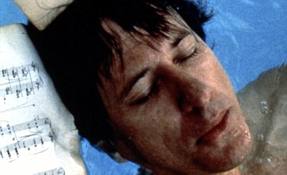 Melodrama in itself is not a bad thing, but Shine is guilty of a number of unnecessary concessions towards it, either in a plea for sympathy or as a means of moving the plot forward. There are a number of plot holes which are slightly troubling when trying to piece the film together. For instance, David Helfgott arrives at the Royal College of Music in London straight after walking out on his family: how did he get the money for the trip, or a passport for that matter?
In the second half of the film, after Taylor has disappeared from our screens, the plot begins to barrel along at a breakneck pace so that we miss out on a lot of potentially interesting scene. To some extent this is understandable, since Hicks' probably didn't have the money to cast a multitude of different actors to play Helfgott as he aged over a period of ten years. Nonetheless the film feels hurried and begins to lose sight of its thematic intentions. One could argue that Hicks is attempting to tell the story as Helfgott would: fast-talking, jabbering and unable to focus on anything for too long. But this theory doesn't hold much water when you consider the viewpoint of Hicks' camera, which only shows David's POV on a select few occasions. Even more problematic than this is the film's tendency in his second half to resort to biopic clichés, as if the filmmakers were deliberately positioning it for awards. Being a film about the triumph of the human spirit, we know that our protagonist is going to come to terms with their difficulties and everything will be happily resolved. But the pandering to convention extends further than just the plot outline. Geoffrey Rush, who is a talented actor, plays the adult Helfgott as essentially a holy fool, borrowing heavily from Dustin Hoffman's performance in Rain Man.
 The film is at heart an actors' romp, with only Taylor coming through with the goods and giving a genuinely brilliant performance. Rush is okay, but both he and Lynn Redgrave are tuned to a high setting, with arms and big emotions flying all over the place in an increasingly irritating manner. Mueller-Stahl mumbles his way through in a decent but unremarkable performance, and Gielgud is clearly enjoying himself as David's tutor, who can no longer play the piano because of a stroke. It's not a million miles from his performance in The Elephant Man, albeit with a little more pomp and a lot less gravitas.
 The only other real surprise with Shine is the amount of nudity. The film is a 12 certificate, and therefore we don't get anything that could be called 'full-frontal'. But several sequences involving nudity seem to come almost out of nowhere with little or no bearing on the plot. There are several shots of Helfgott, played by both Taylor and Rush, wearing nothing from the waist down, including a bizarre sequence of Rush bouncing on a trampoline in nothing but a pair of headphones and a tatty overcoat. Oddest of all is the scene where two rebellious pupils take David to a club, at which point the camera cuts to near-naked dancers and Marc Warren as a drag queen. Scenes like this are not exploitative, but they aren't exactly central to the plot.
 In the grand scheme of films about the triumph of the human spirit, Shine does better than most but comes nowhere near the likes of Ed Wood or The Madness of King George. As an examination of mental illness it is neither as compelling nor as heartbreaking as A Beautiful Mind, and even when taken as a full-on melodrama, it is a lot less satisfying than Intermezzo, let alone The Red Shoes. It's worth seeing for the central performances and a number of visual touches which prevent it from slipping into the realm of TV movies. But it has precious little else to stand on, and is further proof that the Academy should not always, if ever, be taken at its word.
Rating: 2.5/5
Verdict: Moments of genius but not much more


