

Reflections
-
It is weird to read my correspondences from the late August/early September
period, being the time of transition between my old function in life to my
new ...
14 years ago
Battle of Britain (UK, 1969)
Directed by Guy Hamilton
Starring Laurence Olivier, Trevor Howard, Michael Caine, Ralph Richardson
The war film is a most contentious genre. For decades theorists have locked horns to dispute its role or purpose in popular culture. Some have argued that war films are an essential part of a nation's identity, and when done properly can be as much of a mark of respect as many more traditional memorials. Others have likened the whole genre to propaganda: by bringing people up in a culture where war is primarily portrayed through entertainment, they come to believe that war is an essential part of human life, and are therefore more willing to give their lives in what might seem a futile cause. Battle of Britain is an interesting talking point in this debate, coming between the initial jingoistic wave of British post-war filmmaking and the resulting revisionism and anti-war efforts of the later-20th century. While patriotic in both intention and execution, it is not as troubling as The Bridge on the River Kwai in its glamorised depiction of the British stiff upper lip. But unlike David Lean's film it is found dramatically wanting, being well-meaning but disappointingly dull.
 It's difficult to judge war films in terms of historical accuracy because they are in the end dramatic constructions. While especially true of Lean's film, this even applies to documentaries like The World at War: the individual choices of what footage to include, and in what order, have a big influence on the nature and stance of the finished product. Certain older films could be written off because we now know a lot more about given conflicts through declassified secrets - an argument Peter Jackson has made towards remaking The Dambusters. But more information does not necessarily equal better drama: Saving Private Ryan may have the most accurate depiction of D-Day, but that is not enough to stop it slipping into melodrama.
 Battle of Britain earns initial brownie points because of its unprecedented access to war-era equipment and personnel. The production employed a large number of decorated airmen to serve as historical consultants, and worked closely with the RAF to track down surviving Spitfires and Hurricanes to assemble a squadron for filming. It took 3 years for producer Harry Saltzman to round up 100 aircraft, of which only 31 were airworthy, to make up what was nicknamed "the world's 35th largest air force".
 The flying sequences are thereby enhanced by the knowledge that we are watching real planes jockeying for position, rather than models on a rolling backdrop. But even without that knowledge, these scenes are spectacular. Guy Hamilton, who previously directed Goldfinger, structures the key moments like the showdowns in the Bond series, cutting between elaborate wide shots and intense close-ups of the pilots. Even if the blood on screen is a little day-glo, the deaths are sudden and surprising, just as they should be.
 In a further plus point, the German characters in the film are not only played by German actors but speak in German all through the film, something which was unprecedented in this genre. Not only do the filmmakers want things to be accurate, but they have the confidence and conviction to get the audience to read subtitles for sizeable parts of the action. There is a level of respect for both the audience and the historical figures which you wouldn't get from English actors delivering their lines in a pantomime German accent - or doing what Alec Guinness did in The Bunker and simply dressing like a Nazi without changing anything else.
 This level of respect for the antagonists belies another quality of Battle of Britain. Although it sticks very closely to the orthodox view of history, it is not as jingoistic as it could have been: it doesn't spend its running time constantly shouting about how Blighty beat Gerry single-handedly with men to spare. One of the film's big selling points is its acknowledgement of the role that foreign pilots played in ending the battle. The film concludes with Sir Winston Churchill's famous quote - "never in the field of human conflict was so much owed by so many to so few" - followed by a comprehensive breakdown of the casualties by nationality.
 In its production values and treatment of the subject matter, Battle of Britain is a very noble piece of filmmaking. But all of this is in vain because it lacks the one ingredient which is desperately needed: drama. For all the meticulous preparation and research, and all the respect shown to both sides in the conflict, the film quickly gets bogged down because we can't connect with the characters emotionally, and simply admiring their courage isn't enough.
 One of the film's biggest problems is its all-star cast. There is an extraordinary breadth of talent on offer, from relative newcomers like Michael Caine and Edward Fox to more established talents like Trevor Howard, Ralph Richardson and Laurence Olivier. But once the novelty of seeing these talents together has worn off, we realise that there is very little in the way of character focus or development: unlike Saving Private Ryan, there is no strong central performance on which to hang the story.
 The film paints such a broad and episodic picture of the battle that we are given no real indication of whom we should be following. To some extent this is fair play: no-one can choose when their friends get killed. But because there are so many plot points going on at any one time, when people do meet a sticky end it comes more as an annoying diversion than a nasty shock. Even during the bombing of RAF Duxford (when a working hangar was accidentally destroyed by the film crew), you spend more time admiring the pyrotechnics than worrying about the people underneath them.
 Because there is no central character among "the few" on whom we can focus, Battle of Britain ends up squandering most of its talented cast. Robert Shaw, one of the most intense and charismatic actors of his day, has surprisingly little to do besides barking orders to his men and telling the mechanics to hurry up. Caine turns up about 20 minutes in, acts a little stroppy, and the next thing we know he's been shot down. Even Olivier is on autopilot, as if he had been told in advance that The World at War was being made, and was using this film as an elaborate form of practice.
 In order for this kind of film to be compelling, we have to believe that the characters are genuinely in danger, not only on a national scale but in terms of their relationships with each other. But beyond the occasional scene of men arguing with their wives, there is nothing in Battle of Britain which creates this level of tension. It often feels like hanging out with a bunch of actors in the bar after a day's shooting, with them having a jolly good time reminiscing while we sit there looking confused.
 Because of its shortcomings in character and storytelling, Battle of Britain becomes less of a film than a re-enactment of newsreel footage with the (perceived) benefit of colour. Some sections of the film are so silly that they feel like propaganda - the worst being Edward Fox bailing out, crash-landing on someone's greenhouse, and being promptly offered a cigarette by the young boy standing nearby. Ron Goodwin's soundtrack is very stirring, but the film often relies on it so greatly that it becomes ridiculous. Without his stirring strings or bombastic brass, whole sections would consist of nothing more than cars driving very slowly, or people walking nowhere in particular.
 Battle of Britain is an admirable but ultimately insipid effort to put the Battle of Britain on the big screen. It was made with all the best intentions and immense technical skill, but it lacks directorial and narrative vision. It pales in comparison with Lean's work in The Bridge on the River Kwai, and for all its similar faults A Bridge Too Far is a much better film. It's completely inoffensive and thoroughly watchable, but also total tosh and very bland.
Rating: 
Verdict: Well-meaning but ultimately dull
The Man Who Knew Too Much (UK, 1934)
Directed by Alfred Hitchcock
Starring Leslie Banks, Edna Best, Peter Lorre, Nova Pilbeam
Where some directors reach a creative peak from which further innovation becomes impossible, Alfred Hitchcock was constantly developing as a filmmaker, pushing the limits of what he could achieve on screen. But while this has given us some of the most superbly crafted films ever made, it has the downside of making his early work rather uneven. The Man Who Knew Too Much, like Murder! before it, finds the master still finding himself, and for all its qualities it cannot be considered a classic. There is some natural interest in The Man Who Knew Too Much as the only film which Hitchcock ever remade. Our first thought would be that 'Hitch' was somehow dissatisfied with the results the first time around; he was, after all, working with very little money at the height of the studio system where producers held sway. But such levels of dissatisfaction with his other movies in this period never prompted him to remake any of them. For years he would express regret for the bomb going off in Sabotage, but he never contemplated building a new one to have another go.
Instead, the reason for the remake lies in Hitchcock's career-long emphasis on technique over content. The remake starring Jimmy Stewart and Doris Day differs greatly from the original, not because Hitch didn't like the original, but because he saw great potential in telling the same story with more money in a slightly different way. Just as the Indiana Jones series re-imagined the classic serials of the 1930s as they would have been had they actually had budgets, so the remake is Hitchcock paying tribute to the bits of the original that work and updating those that don't. In terms of its story, The Man Who Knew Too Much is a decent thriller about ordinary people being caught up in espionage. It is perhaps the first of Hitchcock's films to have the 'ordinary people' trope - a recurring theme of seemly unremarkable characters getting involved in matters beyond their prior knowledge or control. The opening section at the ski resort is shot in such a pleasant and charming manner that it doesn't feel like a contrived way of putting our protagonists in danger.
 There are a couple of memorable scenes in the 'detective' section of the film, with the characters snooping around for clues as to when the assassins are planning to strike or where they have hidden the girl. The first comes in the backstreet dentist's, where Leslie Banks confronts a dentist who works for the mob, anaesthetises him and then switches clothes so he can listen in on Peter Lorre's conversations. The other comes shortly afterwards in the church, where Banks and his companion pose as sun worshippers in a bid to find out what is going on.
Both of these examples are like warm-ups for The 39 Steps, and the two films also share a common theme of loyalty to one's country being in opposition with personal loyalties and the need to save one's own skin. When Banks' daughter is kidnapped, he is informed that if he says anything to the authorities he will never see her again. He and his wife are so distraught at the prospect of her being killed that they refuse to say anything to the man from the Foreign Office. When he retorts that "not caring about unknown men" effectively led to WWI, they simply ask him to leave. From a technical perspective, The Man Who Knew Too Much is a pretty solid effort. It doesn't have the stagey quality that Murder! did for much of its running time, and the production values are a lot higher. The wide shots are especially accomplished, particularly the clay-pigeon shooting at the beginning and the tense sequence in the Royal Albert Hall when the assassination is due to take place. The attempted assassination at the opera during The Godfather Part III closely resembles this scene, although in that case the assassin fails to make an attempt, rather than making an attempt that fails.
 In other areas, however, the film is not so technically sound. Whether due to poor technology at the time or the age of the print, the sound quality is quite bad, and this becomes particularly noticeable in the scenes at the Royal Albert Hall. Some of Hitch's editing choices are quite unusual, with characters' conversations being cut off before they seemed to have been properly resolved. And the cinematography is nothing remarkable: Curt Courrant would later shoot Jean Renoir's La Bete Humaine, but here he seems to be phoning it in with fairly standard contrasts and compositions.
 The film fares much better in its performances. At the time of filming Peter Lorre could barely speak English: he learned all his lines phonetically, picking up bits and pieces from the crew between takes. Despite the language barrier his characterisation is great, creating a villain who has a childlike, almost babyish quality while also being ruthless, intolerant and deaf to any form of mercy. Drawing on his earlier performance in Fritz Lang's M, he creates a villainous archetype which can be seen in everything from Richard Attenborough's Pinkie Brown in Brighton Rock to Ron Lacey's sadistic Gestapo in Raiders of the Lost Ark.
 The performances around Lorre are also pretty solid. Nova Pilbeam was only 15 when filming began but she does very well with so little screen time. Her career crossed paths with Hitchcock twice more, as she was considered first for Margaret Lockwood's role in The Lady Vanishes and later for Joan Fontaine's part in Rebecca. Leslie Banks and Edna Best make a convincing couple, balancing fear and trepidation with some level of resourcefulness, whether it's spying or using a gun. And George Curzon makes the best he can of the sidekick Gibson, with his role being the bumbling Watson to Banks' Sherlock Holmes.
 The big problem of The Man Who Knew Too Much lies, ironically enough, in its suspense. Because it reveals its hand so early on, there is far less in the way of intrigue or tension than there might have been or could have been from such a story. The film is one of Hitchcock's shortest features at only 75 minutes long, and if it were being made today its plot would barely stretch to an hour-long episode of Poirot.
The source of this problem is in the lack of another Hitchcockian trope, the McGuffin. Once it is clear that Abbott is plotting an assassination, there is nothing for the action to hide behind: it becomes more or less a case of watching all the pieces fit together and letting the set-pieces do the rest. There's still the pleasure of seeing the story being resolved without any plot holes or ridiculous twists, but it doesn't have the climactic thrill we have come to expect from Hitchcock. In The 39 Steps, the final confrontation between Richard Hannay and the spies was built up successfully through increasingly elaborate set-pieces, so that by the time we reached the final scene it carried some form of emotional significance rather than just bringing the story to a close. But on this occasion, the big climax - a shootout between assassins and police - feels tacked-on and somewhat shapeless. Rather than building bit by bit, it goes on for a certain amount of time until Hitch sees fit for some of the bullets to hit their targets, and Lorre dies in a way which seems underwhelming for such a memorable character.
 The Man Who Knew Too Much is a solid, jobbing effort from Hitchcock on a par with his earlier work in Murder!. It's nothing to write home about in terms of its story or execution, and like much of Hitch's earlier films it has not stood the test of time all that well. But there is just about enough in the quality of the performances and aspects of its technical execution to pass muster for a decent, if forgettable, evening's entertainment.
Rating:
Verdict: Solid but slightly forgettable
The Lovely Bones (USA/ New Zealand, 2009)
Directed by Peter Jackson
Starring Saoirse Ronan, Mark Wahlberg, Rachel Weisz, Stanley Tucci
When I reviewed The Imaginarium of Doctor Parnassus, I commented on how it was possible to admire the intentions of a director while acknowledging that their film simply doesn't work. Gilliam's good intentions and body of work maintain his status as a trusted filmmaker, even if his last three films have completely missed the mark. It is much the same story with The Lovely Bones, Peter Jackson's adaptation of Alice Sebold's novel which depicts a family in crisis from the viewpoint of a murdered girl. Jackson is a great filmmaker who has tackled this area before in Heavenly Creatures. He has demonstrated that he can film the un-filmable (The Lord of the Rings) and do justice to a much-loved and revered original (King Kong). And everything since The Frighteners has proved that he is skilled with CG effects, giving his films a consistent and believable physicality even in the most elaborate of circumstances.
Unfortunately, all of this goodwill towards both project and director make the reality of The Lovely Bones all the more infuriating. It is a huge misstep for Jackson, serving as ample ammunition for his critics who claimed the success of The Lord of the Rings had gone to his head and damaged his craft. In the end, like Gilliam's recent work, the film is an admirable failure, made with all the right intentions but so heavily flawed that the wound it leaves takes time to heal. On the plus side, there are two very strong performances which effectively carry the film. Saoirse Ronan is terrific as Susie Salmon, giving a really nuanced performance which progresses through a series of challenging emotional developments with complete naturalism. Ronan was 14 when filming began, and yet she delivers lines and holds her face like someone who has been acting for 20 years. Her only real rival here is Stanley Tucci, whose serial-killer-next-door is skin-crawlingly creepy. His performance combines the eeriness of Richard Attenborough in 10 Rillington Place with the intriguing distance that he honed playing Stanley Kubrick in The Life and Death of Peter Sellers.
 The first also has a number of scary scenes which are initially well-handled and effective at shocking an audience. The best of these is the nightmarish sequence where Susie walks around the bathroom with her killer lying in the bath and blood stained on the sink. The walls are the same shimmering, intrusive white as in Kubrick's A Clockwork Orange, and the stillness of that scene goes some way in suggesting what kind of brutal acts have been committed. As Tucci slowly rises from the bath and takes the flannel off his face, there's not much you can do to stop gripping your seat in a desperate bid not to scream.
But the effectiveness of this sequence hints at the first big problem with The Lovely Bones. There are huge, unmanageable lurches in tone between the tough, melancholic scenes surrounding Susie's death and the attempts at cheery sentimentality in between. Like so many of Steven Spielberg's 'serious' films, what starts off as dark, interesting and downbeat is quickly compromised by various decisions which undermine or eliminate the film's emotional impact. Susan Sarandon's character of the cantankerous alcoholic grandmother is a totally unnecessary attempt to bring quirkiness and eccentricity to the situation. What we want to see in the scenes not set in the afterlife are of a family struggling to stay together in the midst of total despair - kind of like Ordinary People, only good. But instead Jackson opts for goofiness over hard work, giving us a montage of Grandma playing in foam and setting things on fire, and thereby losing sight of the emotional thread.
A bigger problem lies in Jackson's decision about depicting heaven or the afterlife. Some films only hint at the afterlife, letting the imaginative power of the audience do the leg-work. Think of the ending of Faraway, So Close!, Laura's angel in Twin Peaks: Fire Walk With Me, or the Grey Havens in Jackson's The Return of the King. Other efforts depict heaven as somewhere universally recognisable but with a subtle twist, such as the busy black-and-white offices in A Matter of Life and Death, or the hospital-cum-railway station in The Exorcist III. In these films the familiarity of heaven is immediately comforting, but it feels different enough for it to not just be a different part of Earth. Instead, Jackson opts for a computer-generated 'in-between', coating Susie's entire world in bucket-loads of digital animation which owe a great debt to Vincent Ward's What Dreams May Come. Jackson knows how to make special effects work, and in The Lord of the Rings every CG effect feels seamless and physical, or at least bound by the same physical rules. But the difficulty in depicting the afterlife is that such a place does not have to play by the same rules - we can have landscapes which defy gravity or roses flowering under frozen lakes. The result of this difference is that no matter how seamless or well-rendered the visuals are, it does feel like Jackson is making it up as he goes along, until eventually his whole rendering of 'heaven' looks and feels like a Day-Glo video game.
 This wouldn't be so bad if the film established a convincing link between what happens in the real world and what happens in the 'in-between'. But Susie's world always feels disconnected from what happens to her family, and the film keeps changing its mind about where and when reality intervenes. When Mark Wahlberg smashes all his ships-in-bottles, that is carried over, but when the gazebo collapses there's no clear reason for it. Because Susie cannot influence her 'heaven' in any consistent or significant way, the version of 'heaven' on screen stops being her own perfect world and becomes neither more nor less than lazy symbolic shorthand.
 Even more troubling than the visuals is the film's emotional heart. Films surrounding death and family disintegration are among the most manipulative when done badly, and The Lovely Bones continues this trend, serving up a brace of very uncomfortable moral messages which play out in a deeply insensitive manner.
Its first message is that death, or being murdered, can actually make a person happier. Although Susie is initially and understandably horrified by what has happened to her, she seems to get over it surprisingly quickly and only returns to the pain of her family towards the end. There have been a number of film which have handled the passage from life to death or explored death as a means to escape pain - think of Shadowlands or the ending of Return of the King. The Lovely Bones takes a potentially interesting concept and is so heavy-handed and preachy that it makes Ward's work look subtle. The other, arguably worse message surrounds vengeance from beyond the grave. This is a staple of ghost and horror stories, and so you would again expect Jackson to do a half-decent job. But whether by bad judgement or the content of the book, what should be a story about forgiveness and catharsis becomes a film about revenge, hatred and judgement from on high. The prospect of Susie's family healing and moving on is only hinted at in the epilogue, while most of the film strives to make us wish death upon Tucci's character. His eventual comeuppance, involving the recurring image of an icicle, smacks of the kind of moral duplicity which long seemed to have died out with Cecil B. De Mille.
 In spite of its massive failings, The Lovely Bones remains an admirable effort for Jackson. It may well be that the book is genuinely un-filmable, and that in years to come this effort will be held up as proof. As it is, the film doesn't work on any level, as a spiritual paean, a family drama or a straightforward whodunit, and it is easily Jackson's weakest film since Meet the Feebles. But in the midst of disaster, there are individual moments and performances which suggest that this is merely a very obvious false note, rather than the death knell of an entire career.
Rating: 1.5/5
Verdict: An admirable but blatant failure
The Secret Garden (UK, 1993)
Directed by Agnieszka Holland
Starring Kate Maberly, Andrew Knott, Heydon Prowse, Maggie Smith
There is a long tradition in British cinema of great films being made as a collaboration between British and foreign talent. Many films which are considered classics are distinctive because of this marriage of different national and cultural outlooks: Michael Powell had Emeric Pressburger, and James Ivory had Ishmael Merchant.
It therefore makes absolute sense for The Secret Garden, a quintessentially English story by Frances Hodgson Burnett, to be scripted by a Briton but directed by a Pole. Like her contemporary Krzysztof Kieslowski, Agnieszka Holland is a director who knows how to bring out the delicate humanity of any given scene. Her sensitive approach to the material and knack for working with child actors combine beautifully, to create a masterful adaptation on a par with Shadowlands and Three Colours - Blue. The Kieslowski comparison is not a frivolous one, since Holland collaborated with him on the screenplay for Three Colours - Blue. And while her body of work is nowhere near as powerful or consistent, she shares Kieslowski's humanist sensibility and an understanding of the subtleties of human emotion. She has the same knack for expressing complex themes through the most subtle and innocent of interactions, conveyed through visuals which are effortlessly beautiful. There is also an incidental link in the casting: Irene Jacob, who appears briefly as Mary's mother, played the central role in Three Colours - Red.
The Secret Garden is a beautiful film from whichever angle you approach it. It was shot by Roger Deakins, who would later win a BAFTA for his work on No Country for Old Men. Deakins contrasts the early, drained-out footage of the gardens, filled with pale greens and faded browns, with later lush images of what seems like the whole world in bloom. The film also includes some beautiful time-lapse footage of the garden changing from winter to spring, with flowers blooming and butterflies emerging from cocoons. The film has a genuine sense of wonder which is tragically absent from many more contemporary children's films. This point can be illustrated perfectly by comparing The Secret Garden with the family films of Chris Columbus. Regardless of Columbus' other shortcomings as a director (of which there are many), his attempts at 'wonder' or 'fantasy' feel incredibly manufactured. The first two Harry Potter films feel like they have been test-screened to within an inch of their lives, and all the imagination has been sucked out in a bid to not offend the fans.
 The Secret Garden, on the other hand, manages to be faithful to its source material without taking off any of its dark or slightly rough edges. Like all great children's films, there is a balance between joy and tragedy, and the film doesn't shy away from letting the audience share in the characters' misery. Just like James and the Giant Peach, the story starts with the parents of the central character being tragically killed (in the book it is cholera, in the film it's an earthquake). We follow Mary through the lonely aftermath as she struggles to fit into the forbidding new world that is laid before her, and as with James it takes something quite magical to bring her round.
But despite its references to Indian religion and the rather uncomfortable scene of the children 'summoning' Colin's father, the film's 'magic' is rooted firmly in Christianity. Burnett was a prominent exponent of Christian Science, a doctrine of Christianity rooted in the belief that all of God's creation (that is, all nature) is made in His image and therefore inherently good. While this proposal might seem hard to stomach, The Secret Garden does have a very prominent Christian thread running through it, which is no more threatening or disagreeable than the fiction of C. S. Lewis (hence the Shadowlands comparison). Viewed through a Biblical prism, the garden at Misslethwaite Manor starts out as essentially Eden, with Colin's parents more or less as stand-ins for Adam and Eve. The tragic death of Colin's mother (a literal Fall, if you like) causes 'man' in the form of his father to leave the garden and barricade it up. He is shutting out all that is good because of his own guilt and shame, choosing the darkness as penance for what he believes he has done.
When Mary enters the garden, finding it overgrown and in desperate need of care, she is like Lucy when she first wanders through the wardrobe: the world is special and has signs of life, but the overall mood is one of sorrow and neglect. She rediscovers the joy of nature through her innocence and curiosity, and in discovering the 'magic' she learns to live with herself and to appreciate the good in others, rather than spurning them or treating them as servants. From a slightly different angle, the scenes involving Colin reuniting with his father could be compared with Jesus' time in the Garden of Gethsemane - perhaps what the garden had to go through to regain its former glory. These scenes are of a father rediscovering his son having turned his face away for so long, returning to a place that once embodied death and not only finding life but being welcomed. The final conversation between Mary and Lord Craven is like the encounter between Jesus and Mary Magdalene outside the tomb: the line about Mary "bringing them back to life" may be corny, but it does convey the idea of redemption through acceptance.
But there is more to The Secret Garden than just good old-fashioned morals. The film is thoroughly entertaining, thanks to the elegant dialogue in Caroline Thompson's screenplay. The three child actors are all highly enjoyable and convincing, with Kate Maberly and Heydon Prowse showing wisdom and grace beyond their years. Maberly may spend the first half-hour constantly in a strop, but she has a Puck-like quality which keeps her character interesting. The adult performers are also entertaining, with Maggie Smith turning in a typically domineering performance as Mrs. Medlock and John Lynch holding his own as Lord Craven (even if his long hair and moustache make him unduly resemble Colin Farrell). There are a couple of small faults with The Secret Garden. Although it does generally succeed in being charming under its own steam, it does drift into Disney convention as more animals appear. There's only so many times you can show cuddly deer before we start to feel manipulated. The ending is sentimental and a little cloying, and highlights once again the presence of unnecessary narration. It may be a children's film, but that doesn't mean you have to state the bleeding obvious at any given moment.
 The Secret Garden is a very fine children's film which recalls the best work of Richard Attenborough and Lionel Jeffries. Its Christian morals are presented in a very subtle way for such a prominently allegorical work, and it is every bit as fresh and entertaining now as when first released. As a spiritual film about or involving children it is on a par with Shadowlands, and as a children's film in general it is an amiable companion to The Railway Children. The film is touching, charming and captivating in equal measure, and despite its little faults it is essential viewing.
Rating: 4/5
Verdict: An evergreen family favourite
Shadowlands (UK, 1993)
Directed by Richard Attenborough
Starring Anthony Hopkins, Debra Winger, Edward Hardwicke, Joseph Mazzello
If Alfred Hitchcock is the archetypal auteur, and Robert Altman is the ultimate actors' director, then Richard Attenborough is the consummate luvvie. Attenborough's career is that of someone so impassioned by acting and filmmaking that it leaches into every aspect of his craft, both in front of and behind the camera. Sometimes, as with Chaplin or moments in A Bridge Too Far, this passion becomes overbearing and compromises the integrity of what we are seeing. But sometimes, as with Shadowlands, it may be the thing which makes all the difference. Taken at face value, Shadowlands could almost have been a Woody Allen film: its central relationship is a late-blooming romance between an elderly, shy, somewhat neurotic man and an inquisitive, playful younger woman. It is also a textbook weepy, being a story which is rooted in tragedy and which will have you in tears by the end. But while it doesn't deviate massively from either mould, there is much about Shadowlands which is intriguing and stimulating.
For all the times when he has over-egged things, Attenborough does know how to assemble a top-notch cast, who sit in their parts like they were the only people who could possibly play them. Anthony Hopkins has a head start in this due to his experiences with Merchant Ivory, but even so he inhabits C. S. Lewis like no-one before or since. His accent may still be a Port Talbot brogue rather than a clipped Cambridge twang, and there are moments in which he is rather theatrical. But he remains utterly convincing and completely endearing to an audience.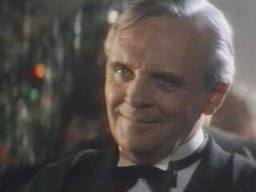 The theatrical moments of the film are not especially problematic either, for two reasons. Firstly, and perhaps obviously, it is adapted by William Nicholson from his original play. Because it is a direct adaptation by the same author, you can readily understand that the tone would be broadly similar, so that all the little flourishes which would occur on stage are captured and compressed on screen. But secondly, this is not problematic because the film does not feel stagey. Unlike Plenty, which tried to disguise its theatrical roots through clunky camera tricks, Shadowlands feels broadly cinematic and therefore when the moments of theatricality come, they do not disrupt proceedings too greatly.
Be that as it may, the film is guilty of one cardinal sin of stage-to-screen adaptations - namely that there are too many locations. There is a lot of travelogue footage in Shadowlands with the camera following our characters as tiny dots on a variety of landscapes, whether it's the hills of Herefordshire or the resplendent halls of Cambridge University. The film jumps from location to location a good deal more than it needs to, in an attempt to seem more epic, ambitious and by contrived extension cinematic. It doesn't quite fall into the trap of assuming that bigger scale equals better story, but on a number of occasions it comes perilously close.
The comparison between Shadowlands and Plenty goes beyond the technical accomplishments of the former. Both films approach the issues of routine and domesticity, and both feature women who don't fit into the very orderly, male-dominated world which is put before them. But what makes Shadowlands the more compelling is the dynamic of the central relationship, which in both films determines our ultimate response to the story. In Plenty, Meryl Streep's character is essentially passive-aggressive: she wants to change the world but not at the expense of moaning about how difficult her life is. This makes it more difficult for us to identify with her consistently, and we end up feeling sorry for Charles Dance having to put up with her. In the world of Susan Traherne, domesticity is a menace from which nothing productive or meaningful can emerge, and once a person has entered it their life is effectively worthless. Shadowlands is a lot more subtle and welcoming, with the settled nature of its characters serving as a springboard from which pure emotion can emerge. The need for Lewis and Joy Gresham to challenge each other, both personally and intellectually, gives us both a compelling drama and hope that we have not yet past our respective sell-by dates.
The great success of Shadowlands is its balance of the personal and the intellectual. The film raises a great number of fascinating theological questions to do with pain, suffering and the loss of childlike innocence, but it does not approach such questions with all the esoteric dryness of a Bible commentary. There is a rich vein of substance in the film which can be absorbed and will result in deep discussions afterwards. But the film can also be enjoyed purely as a romance, because its ideas are conveyed through characters we can relate to and conversations we can recognise. Much of the film is a debate about the role of suffering in human life - "the purpose of pain", as Lewis would put it. The film isn't afraid to confront this old chestnut of Christianity head-on, questioning the role of God in the events which transpire, both good and bad. Lewis is not immune from theological doubt, and is troubled so deeply by the loss of Joy that he erupts uncharacteristically when his academic friends try to comfort him. The early part of the film sees Lewis 'talking the talk' about pain and suffering, delivering lectures with an expression of sanguine satisfaction. But as the action moves on it becomes a film about 'walking the walk', putting Lewis' theories into practice and showing to what extent they bring comfort.
What makes Shadowlands so compelling as a religious or theological film is that there are no easy answers to any of the questions it raises. Joy criticises Lewis for his style of inquiry, quipping that "every time you ask a question, you know the answer already". The film is quite the opposite, neither giving a watertight theological explanation nor settling for a sentimental cop-out. We have to come to our own conclusions about where (if anywhere) morality lies, and whether Lewis was right to believe that God could still be at work in the midst of such tragedy. His passing words, that the pain of losing Joy is part of the deal of having a full life, leaves us hanging in the best possible way as we question our own attitude towards the Almighty. If anything, though, the central theme of Shadowlands is not whether pain is a justifiable part of life. It is mainly a film about openness, about baring one's soul and constantly questioning one's opinion of how the universe operates. The Narnia books are all about discovering and exploring fantastical new worlds, and yet Lewis himself a reluctant adventurer. His lecture on pain and suffering, which characterises God as a sculptor with a chisel, is repeated several times to show how he is set in his ways, whether by choice or unconsciously. The arrival of Joy is the beginning of a long period of questioning, which results both in deep sorrow and in levels of joy which he had never experienced before. As he says to Joy as she lies dying, "you've made me so happy... I didn't know I could be so happy."
 Shadowlands is a very moving film and may be Attenborough's best work, being tauter than Gandhi and more disciplined than Chaplin. Hopkins and Debra Winger anchor the film with convincing, understated performances, supported ably by Edward Hardwicke as Warney and Joseph Mazzello as Douglas. It isn't without its little problems, and it is too conventional in places, but as a piece it holds together and you find yourself getting swept up in the story. More than anything, this is a film made by someone with general affection for both the story and the characters, and it is made so well that a great deal of that affection is reflected back.
Rating: 4/5
Verdict: A top-notch thinking-man's tear-jerker


