
Reflections
-
It is weird to read my correspondences from the late August/early September
period, being the time of transition between my old function in life to my
new ...
14 years ago
Alice in Wonderland (USA, 2010)
Directed by Tim Burton
Starring Mia Wasikowska, Johnny Depp, Helena Bonham Carter, Crispin Glover
There's been a lot of nonsense written about Tim Burton in the past few months. Way in advance of Alice in Wonderland's release, detractors from all sides were bemoaning his supposed decline, accusing him of everything from selling out to never being any good in the first place.
In the face of this huge backlash, most of it unwarranted and much of it stupid, I wanted to be the one to stand up for Tim Burton. After all, his last three films - Big Fish, Charlie and the Chocolate Factory and Sweeney Todd - have all been great, and the latter is on a par with his masterpiece Ed Wood. But all good things must come to an end, and in the case of Alice in Wonderland the end is quite a bitter one.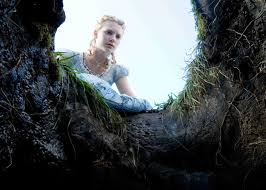 What makes Alice in Wonderland so depressing is that there is so much potential within both the story and Burton's approach to it. Both the original novels are about the role of childhood fantasies in preparing one for the traumas of adult life. The heroine is an outsider who doesn't fit into the world being designed for her - she is a classic Burton protagonist in the manner of Winona Ryder in Edward Scissorhands. And considering his knack for creating dark and exuberant visual worlds, Burton would seem the ideal choice for the drug-induced majesty of Lewis Carroll.
But in spite of all the good omens, the finished product is as banal and directionless as Terry Gilliam's The Brothers Grimm. Both films appear on the surface to be the directors' dream project, considering Gilliam's fascination with fairy tales which stretches back to Jabberwocky. But both Grimm and Alice are clear examples of an artistic, distinctive and often mad director having their visions suppressed or suffocated in favour of a bloated and anodyne mainstream blockbuster. For starters, the script for Alice in Wonderland is little short of pathetic. Its relationship to Carroll's works is at best stand-offish and at worst completely patronising - it borrows famous lines (like the Mad Hatter's riddle) and then rephrases them in such a way that sucks all the fun and insanity out. This becomes all the more shocking when we discover it's written by Linda Woolverton, who wrote Beauty and the Beast and co-wrote The Lion King. How could someone who made her name retuning fairy tales for family audiences have got this one so damn wrong?
 The biggest crime of the script, however, is not its contempt for Carroll's language. The biggest crime is that all the central ideas of both the novels and Burton's work are swiftly trampled underfoot, in favour of something a lot more generic and predictable. All the ideas about Alice being independent are quickly overruled by the central plot involving the compendium: one cannot be independent if your destiny is predetermined. In the face of this revelation, Alice as a character descends into the very thing that Burton sought to avoid: despite the best efforts of Mia Wasikowska, she comes across as little more than a sniffy, spoilt brat.
 The central plot of this 'reimagining' of Alice is also massively derivative. The idea of a plot built around the poem 'Jabberwocky' was handled, albeit unevenly, in the Gilliam film, while having Alice re-enter the fantasy world of her youth is a blatant rip-off of The Chronicles of Narnia. Then there is the design of the White Queen's castle, which looks like a cross between Lothlorien and Minas Tirith, and various elements lifted from the Harry Potter saga - the final battle on the chess board recalls The Philosopher's Stone, while the design and defeat of the bandersnatch owes something to the basilisk in Chamber of Secrets.
 The problem with all these derivative details is that the twisted, quirky and often creepy darkness of Burton's work can't get a word in edgeways. Despite occasional design elements which are quintessential Burton, this has none of the strange whimsy of the original Disney version, nor the haunting and absurdist quality of Jonathan Miller's take. There are also very few attempts to address how Wonderland (or Under-land) has changed since Alice left: we get a flashback sequence with a village being burned, but not much else. Even when the characters become fractured, like the Mad Hatter changing accents, it's played as a gimmick instead of a lead-in to something more substantial.
What we end up with is a film with all the structure and balance of a rollercoaster. The script keeps hurling us in four different directions, and we can't stop for more than two minutes without something exploding or being hurled at the screen. The film never quietens down for long enough to let the story work on its own terms, and with the exception of The Cheshire Cat (voiced by Stephen Fry), the characters rarely resemble anything more than one-trick ponies. This is the legacy of Pirates of the Caribbean, producing a film which even at 108 minutes feels bloated, baggy and boring. Then there is the 3D to consider. Many individual shots in Alice in Wonderland seem to have been designed solely for the 3D version - something that is obvious even when watching in 2D. The extended sequence of Alice falling down the rabbit hole, or the Mad Hatter's flying drapes, or even the floating Cheshire Cat, add nothing to the story and feel bolted on, much like the 3D itself: the film was shot against green-screen and then retro-fitted in post-production. The experience of shooting so much in green-screen actually made several of the actors nauseous, and there are endless examples in the finished film of mismatched eye-lines and bad continuity, of the kind that you thought only George Lucas was capable of doing.
 The role of CGI in the composition of special effects hints at the major deficiency in Burton's visual approach. When he was making his early films with entirely mechanical effects, there was always a feeling in the back of one's mind that the limitations of animatronics and make-up meant that only so much of his unique vision was finding its way out of his head and onto the screen. As the role of CGI has grown in harmony with organic effects, more and more of Burton's designs have been physical realised in a way which was both elaborate and believable. But Alice in Wonderland relies so heavily on CGI that it comes to resemble the heaven sequences in The Lovely Bones: there is the same sense of a world of many mismatched parts, whose logic and composition are being made up as its director goes along.
 On top of all that, we have a number of plot holes to digest. We readily accept that Alice can change size by eating cakes and drinking from bottles, but why don't her clothes change size with her, for decency's sake if nothing else? Why does the Bandersnatch change sides so readily having previously given Alice a nasty wound? Why does the Mad Hatter speak in a Scottish accent at carefully selected moments? And why, if Crispin Glover's knave had his eye on the throne all along, did he wait until he was being banished to try and kill the Queen?
 Alice in Wonderland is Burton's biggest failure since Mars Attacks!. The debate is not so much whether the film is any good, as to how much of the end product is his fault. In spite of everything there are moments in which his true colours shine through: certain scenes with the Red Queen or Cheshire Cat spring to mind. Burton has been known to bounce back quickly, having followed Mars Attacks! with Sleepy Hollow and Planet of the Apes with Big Fish. But he will have to work twice as hard to prevent this obvious blip from becoming the start of his epitaph.
Rating: 1/5
Verdict: A soul-crushing experience
The Muppet Christmas Carol (USA, 1992)
Directed by Brian Henson
Starring Michael Caine, Dave Goelz, Steve Whitmire, Jerry Nelson
There are so many versions of A Christmas Carol out there that it soon becomes tiresome arguing about their individual merits. The only faintly reliable indicator of an adaptation's success is in its lifespan over subsequent Christmases, specifically how often it will turn up in the double editions of the Radio Times. The Muppet Christmas Carol is not the finest version of this story, but neither is it by any means the worst, and there are many elements which have cemented its status as a festive family favourite. Purely as a matter of principle, The Muppet Christmas Carol is among the more faithful adaptations. A number of small changes have been made - there is no mention of skating penguins or rubber chicken factories in the original. But otherwise the film follows the arc of Dickens' story very closely, and the dialogue doesn't feel like it is being lazily paraphrased to prevent a modern audience from thinking.
What is often forgotten is that the original story was a pot-boiler, a shorter, more incidental work designed to keep the money coming in (presumably so Dickens could afford his Christmas shopping). Its subsequent status as one of the most fondly familiar of English texts was by no means intended, a factor which makes the film's fortunes all the more apt. It has slowly grown from breaking even at the box office to be embraced as a stalwart of Christmas television. The Muppet Christmas Carol is also the film to which Michael Caine ultimately owes his recent career revival. Aside from a BAFTA win for Dirty Rotten Scoundrels, the late-1980s had not been kind to him and he continued to make bad career choices. He famously could not collect his Oscar for Hannah and Her Sisters because he was on location in the Bahamas making Jaws: The Revenge. But the eventual goodwill caused by this performance, along with a revived interest in his 1960s work, would eventually lead to richer roles and a second Oscar for The Cider House Rules.
Actors who have played Ebenezer Scrooge have emphasised different aspects of the character - George C. Scott's version plays on his aggressive grumpiness, Bill Murray's version his worldly-worn weariness, and Alastair Sim's version his grim fastidiousness. Caine cherry-picks the best aspects from past portrayals and makes it his own, showing his range and placing himself in the top five all-time Scrooges. He sings well, looks great in period costume, and there are a number of brilliantly memorable moments. The scene of him shouting "UNEMPLOYED!" in a tight close-up at the book-keepers is hugely entertaining and wins over an audience immediately. Although it is primarily a children's film, The Muppet Christmas Carol is not afraid to tackle the darker aspects of the story. Because it's the Muppets you're not going to see anything questionable, and even to talk about it in terms of 'fantasy violence' is to dress things up a bit too much. But there is an appropriately creepy Gothic side to the film, and it handles the darker aspects of the story much more ably than the recent Robert Zemeckis version. Death is only hinted at, but those hints are enough, and the film is on its surest footing with the Ghost of Christmas Yet To Come.
 The design of The Muppet Christmas Carol is the key to understanding its successes and failures, and as with Zemeckis' version the film rises and falls on its portrayal of the ghosts. The Ghosts of Christmas Past and Future are very well-designed, the former as a childlike spirit recalling the paintings of L. S. Lowry. The latter is especially good, resembling a Ringwraith and being surrounded by Gothic churchyards and plenty of fog. There is something inherently creepy or eerie about a faceless ghost, and the film handles this very well.
But then we come to the Ghost of Christmas Present, and to the first problem with the film. Where the other two ghosts felt bespoke and purpose-made for the story, Christmas Present is a lot less memorable and a lot more annoying. Because the character has to age on screen, we are forced to confront the shortcomings of both puppetry and visual effects. The Ghost's disappearance is well-handled, but his sudden greyness after the flashback looks like someone dumped a vat of flour on him. The present-day section of the story is the hardest to get right because it contains the moment where Scrooge has his change of heart; the final Ghost's actions are little more than a confirmation of his volte-face when faced with his own death. Despite the presence of Animal in a brief cameo, this section of the film is saggy and sentimental in a way which sits awkwardly with the attempts to send up Dickens' tale. In an age where Shrek has sent up so many of Disney's conventions, seeing the Tiny Tim sequence played straight is little short of toe-curling.
The songs in The Muppet Christmas Carol are a little hit-and-miss. When they work, they work well: 'Thankful Heart' has a good, hummable melody which captures the upbeat tone without overcooking the feel-good factor. 'One More Sleep 'Til Christmas' and 'There Goes Mr. Humbug' are fine, having their moments but being more sustained by visual gags than a compelling set of lyrics. But 'Bless Us All' feels forced and cloying, as if the writers were trying too hard to be charming, and as a result it comes across as quite the opposite. Like the subsequent Muppet films, the film relies on the characters we know and love slotting into their allotted roles in the story. While in later films whole sequences had to be invented just to get Miss Piggy on the screen, in The Muppet Christmas Carol the characters fit like a glove. Gonzo treats Dickens' narrator with the tongue-in-cheek approach it deserves, and the double act he has with Rizzo works well. Kermit fits snugly into Bob Crackett, playing him as a well-meaning coward, and seeing him and Miss Piggy finally married on screen is something many fans had been waiting for years to see. As with Shrek, it works so long as you don't think too much about the children.
 The film is also notable as a passing of the torch from Henson's personal involvement to the characters living on without him. Steve Whitmire, who took over the voice of Kermit, told a story of how Henson appeared to him in a dream and gave his blessing. The film is directed by Henson's son Brian, who would also direct Muppet Treasure Island, and of all the post-Henson films it is the best, being made with both charm and affection tied up in a tribute to the great man.
 The Muppet Christmas Carol may not be the finest version of Dickens' story by any stretch of the imagination. Its weaknesses are obvious and older viewers may struggle to sit through its concessions to sentimentality. But as a means of introducing young children to the story, it is very good indeed. Michael Caine holds the film together with a fine performance and there is enough charm and well-meaning embedded in the film to tempt even the biggest miser to purchase a copy. Essential viewing.
Rating: 3.5/5
Verdict: A flawed but fun family classic


