

Reflections
-
It is weird to read my correspondences from the late August/early September
period, being the time of transition between my old function in life to my
new ...
14 years ago
The Proposition (Australia, 2005)
Directed by John Hillcoat
Starring Guy Pearce, Ray Winstone, Richard Wilson, John Hurt
In any kind of ideas-driven film, there has to be a balance between the ideas being addressed and the characters through whom such ideas are conveyed. And in any genre film it's easy to get the balance wrong because of the availability of stock plots and characters - something which is especially true with westerns.
At one end of the spectrum, we have There Will Be Blood - a film with substance pouring from its every orifice, but only one convincing character through which this can be channelled. Because no-one else can rival Daniel Day-Lewis, none of the ideas about imperialism, economics and religion create anything like the emotional impact they should. At the other end, we have The Proposition, a western with many rich performances from a very well-chosen cast, but which is ultimately a little too straightforward in its execution. On the good side, The Proposition does a very good job of demonstrating just how hardy the western genre is, showing how its conventions can be applied to any environment with the same effect. Until we first hear Guy Pearce's Irish lilt or Ray Winstone's throaty London growl, we could have sworn that we were back in the Wild West. In throwing us off so cleanly in its opening section, the film amply demonstrates how the familiar trademarks of westerns are not restricted or confined by geography, any more than the ideas which such films attempt to address.
 This hardiness is cemented by the central performances, which take the various stock characters and adapt them to their new surroundings to create a number of memorable turns. Ray Winstone's troubled Captain Stanley is the outback's equivalent of the battle-worn sheriff, someone who has seen one too many gunfights and longs for peace while despairingly mindful that it is impossible. On top of his usual gruff posturing and natural aggression, Winstone brings a vulnerable quality to the part which makes him more compelling.
 The other performers are equally impressive. Emily Watson continues to be the go-to actress for delicate, sensitive female characters. She succeeds where Meryl Streep has so often failed, namely being emotionally wrought and highly strung without being showy or attention-seeking. David Wenham casts off the mantle of Faramir as the uptight, lip-curling Eden Fletcher, who seeks order and justice without really understanding what is needed to achieve either. And Guy Pearce remains one of the most underrated actors of his generation: very few people could go from the grimy, scuzzy Charlie Burns to Andy Warhol in under 12 months.
 With this rich cast in place, we begin to appreciate the various ideas which The Proposition is trying to raise. The setting of 1880s Australia instinctively raises the issue of imperialism, and that is confirmed by the early section of the film. Stanley constantly talks about his desire to "civilise this land" by whatever means. His clashes with Fletcher are not simply a difference in personality, but a reflection of differing attitudes to justice and 'the colonials'.
 Fletcher is the new boy in town and wants to do things by the book: he insists on having Mickey Burns flogged to death since the 'proposition' was not binding in law. Stanley, meanwhile, has been out there long enough to know you sometimes have to compromise, letting a small evil slip through the net so you can deal with the big evil. But he has not become entirely lost to the landscape, retaining his military dress and insisting upon turkey at Christmas.
 Although there is imperial politics hanging over the events in The Proposition, the focus is much more on the personal than the political. To a certain extent the film argues that the actual working nature of the British Empire was determined more by individual desire than anything more noble or idealistic (insofar as empire-building could be either of those things). Neither Stanley nor Fletcher ever mention 'the old country' or appeal to high ideals to justify their actions. It could even be argued that Stanley's motivations behind his deal with Charlie Burns was motivated out of nothing more than wanting peace with his wife (which makes his final scene all the more ironic).
 Coming from a script by Nick Cave, The Proposition has its fair share of grim Biblical imagery. The brutal dilemmas faced by the characters mirror various stories in the Old Testament about individuals being called upon to commit murder in the name of justice and righteousness. Charlie's act is both a betrayal of his own kin and an attempt to save it, mirroring Cain's conflicted nature when he murdered Abel in Genesis. And the level of violent retribution is worthy of anything in the book of Judges; the raping of Stanley's wife is no less repulsive than Ehud's murder of the fat king Eglon, or Jael driving a tent peg through her master's temples as he slept.
 Like Winter's Bone a few years later, The Proposition also has atmosphere to spare. John Hillcoat shoots the scenes of Charlie Burns' quest with a completely unfussy eye, letting the landscape speak for itself. While he does become more intrusive, he shoots conversation in close-up so that we can almost taste the sweat and feel the flies on the characters' faces. Music plays its role as well: in addition to the original score by Nick Cave and fellow Bad Seed Warren Ellis, the opening shootout is carefully choreographed so that the bullets hitting the brothel become a form of percussion.
 However, The Proposition also has the same basic flaw as Winter's Bone - namely that the story is far too thin even for its short running time. Atmosphere and score can only do so much in pulling us in, before the actual narrative and themes have to step in and take over. Sadly, once all Cave's music and sense of dread is stripped away, the remaining story is deceptively and disappointing simple, and nothing is resolved in a satisfying manner.
The sequences in the outback have great potential within them in terms of generating tension. The fearful comments of the Aborigines hint towards Apocalypse Now, with Charlie going deeper into the wilderness in search of his own personal Kurtz. But as with Hillcoat's subsequent film The Road, neither the script nor the direction allow a genuine sense of horror to build, and it becomes more about the journey itself than the meaning behind it. The scenery-chewing performances by John Hurt and Danny Huston may be good fun, but they undercut the sense of dread, making us feel like we are going round in circles. This increasing lack of dread means that the existential implications of the story are also stifled. In No Country for Old Men, the relatively simple progression of the story was married to a deep-rooted examination of the nature of evil and the motivation behind it. You therefore felt that even when something happened which was abrupt or overly straightforward, there was a reason for it. The Proposition simply doesn't have that sense of weight which makes a good western into a great one, and that makes the violence in the last twenty minutes feel all the more gratuitous.
 The Proposition is a promisingly decent debut for Hillcoat, who on the basis of The Road seems to be improving as a filmmaker. All the ingredients for a well-executed western are to be found in it, and in its acting and aesthetics it is well-crafted. But like Mad Max 3 before it, the film never lives up to the promise of the ideas that it raises, resulting in a film which is enjoyable but only memorable in passing.
Rating:
Verdict: Great characters, shame about the story
True Grit (USA, 2011)
Directed by Joel & Ethan Coen
Starring Jeff Bridges, Hailee Steinfeld, Matt Damon, Josh Brolin
Having built their reputation on a series of strange, quirky and often dark films, True Grit is the Coen brothers' first pure genre exercise. In adapting Charles Portis' novel for the big screen, they have created an elegantly crafted western with a number of good performances and a rousing soundtrack. But although this adaptation is more faithful to the source, its semi-skimmed relationship with the Coens' signature style means it can't be regarded as a complete success.
There are two clear reasons why True Grit would have appealed to the Coens. All of their films are in some way about money, whether it's Paul Newman trying to bankrupt the company in The Hudsucker Proxy or the conflict between commercial success and creative purity at the heart of Barton Fink. Though True Grit is a revenge story, there are financial elements to both the crime and the attempt to bring Tom Chaney to justice. Money crops up everywhere, from the amount Chaney stole and Mattie Ross' bartering over the ponies, to the $50 she offers Rooster Cogburn and the bounty waiting in Texas for LaBeouf. Secondly, True Grit shares the central theme of No Country for Old Men, namely someone thinking they have got away with the perfect crime and justice or vengeance eventually catching up with them. Josh Brolin plays the impulsive criminal in both films, although the nature of his perfect crime is different. Whereas as in No Country, he just happened to be there and got away with it because there were no witnesses, in True Grit his escape is guaranteed by a reluctance of bystanders to do the right thing.
 Running through True Grit is an attitude which is steeped as much in Biblical ideas of wrath and revenge as in the famous quote from Edmund Burke: "all that is necessary for the triumph of evil is that good men do nothing." When Mattie Ross arrives in the town to collect her father's body, she is met with hostility, suspicion, nonchalance or apathy - and in the case of the saddler, all four at once. In these moments the Coens' knack for quirky characterisation comes through, particularly in the droll and deadpan undertaker. When Mattie asks if she can sleep at the funeral parlour, he replies: "if you wanted to sleep in a coffin... it would be alright."
 The irony of True Grit is that in a part of America which is increasingly civilised and lawful (there are actually fair trials rather than kangaroo courts and lynching), the one force that can deliver real justice is a cantankerous old drunk who frequently borders on incompetence. Jeff Bridges departs heavily from John Wayne's interpretation, playing Rooster Cogburn as the embodiment of the Old West, reluctantly girding its loins to dole out justice in a way which, while effective, is frowned upon by modern-day lawyers.
Mattie Ross, played with grace and dignity by Hailee Steinfeld, represents God's judgement channelled through the determination and innocence of a child. She is the meeting point between the God portrayed in the Old Testament and Jesus in the New Testament: both are intolerant of sin and wrongdoing, but instead of fire and brimstone this is conveyed through innocence, purity and natural curiosity. This performance is again in contrast to the 1969 version, in which Mattie is 21 years old and already a wizened schoolmistress. The darkest and most interesting section of True Grit is its last 20 minutes, when we see the consequences of Mattie's vengeance (or search for justice - take your pick) catching up with her. Having pursued Chaney and achieved her goal, she falls into a dark pit and is bitten by a rattlesnake, an action which leads to her left arm being amputated. The Coens take the comeuppance of the revenge thriller's protagonist and use it to turn the whole idea of Biblical revenge on its head. Mattie may achieve the desired outcome, but that does not make her actions wholly right, and the act is not achieved without unforeseen sacrifice and undesired cost.
 The film is also beautifully shot by Roger Deakins, who won a BAFTA for his work. As on No Country, Deakins proves himself to have a great eye when it comes to westerns. He paints and captures the landscapes as arid and barren as you could possibly get, and the night shoots of Matt Damon being ambushed are particularly coherent considering both the wide angles and the limited natural light. The Coens are able to capture a whole range of elements in perfect detail, from the dry dusty ground kicked up by the horses trample to the glistening snow that surrounds our heroes as they track Chaney through the woods.
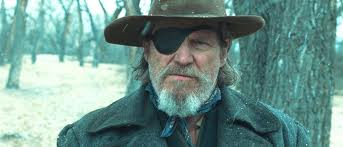 But for all its visual and thematic coherence, this version of True Grit is not without its problems. As on No Country, there is the simple problem of unintelligible dialogue. Jeff Bridges is a great actor, but Rooster Cogburn's accent and beard are so thick that you simply can't make out everything he says, at least not the first time around.
The film seems to assume some pre-knowledge of the dialect and that the viewer can paraphrase their way through conversations to get a general understanding of what is going on. But even though Bridges' delivery doesn't throw us off completely, it's still irritating when we consider how many potential zingers are hidden in this character. Furthermore, if we assume the dialogue is only supposed to be a guide, then surely that invalidates the Coens' desire for a more faithful adaptation: why attempt to be faithful to the source if you're not going to let all the words from the book be heard? Then there is the relationship which the Coens take towards their work. In their previous films, they have put their unique stamp on what are superficially straightforward stories, immersing themselves in the genre and characters and coming up with something genuinely quirky. Sometimes this makes their films distinctive, other times extremely grating, but even in their slip-ups there is a conscious decision-making which flows throughout every shot and line.
 The problem with True Grit is that the Coens' approach is much more stand-offish, in a way which detriments the film. There are big moments of full-on quirkiness which aren't in the novel, the biggest being the man riding through the woods wearing a bear costume, with a beard like that of the young wizard in Howl's Moving Castle. But these moments of full-fat Coens characterisation come few and far between, and they are so noticeable that all the stuff in-between starts to feel a little bit too ordinary. As much humour as there is in the conflicts between Mattie, Rooster and LeBeouf, the film never feels like it is pushing the genre envelope in the way that No Country or Blood Simple did.
 In the end True Grit is an interesting but incidental work from the Coen brothers. It doesn't have the full-blown original stamp of their other films, for better or worse, and is perhaps testament to the fact that filmmakers shouldn't always treat their source material with kid gloves. But as a piece of filmmaking outside, it is more stylish and better made than the original and the performances are all of a high calibre. If nothing else, it's a much better attempt at a remake than their botched look at The Ladykillers.
Rating: 3.5/5
Verdict: Enjoyable but hardly a full hand
The Secret Garden (UK, 1993)
Directed by Agnieszka Holland
Starring Kate Maberly, Andrew Knott, Heydon Prowse, Maggie Smith
There is a long tradition in British cinema of great films being made as a collaboration between British and foreign talent. Many films which are considered classics are distinctive because of this marriage of different national and cultural outlooks: Michael Powell had Emeric Pressburger, and James Ivory had Ishmael Merchant.
It therefore makes absolute sense for The Secret Garden, a quintessentially English story by Frances Hodgson Burnett, to be scripted by a Briton but directed by a Pole. Like her contemporary Krzysztof Kieslowski, Agnieszka Holland is a director who knows how to bring out the delicate humanity of any given scene. Her sensitive approach to the material and knack for working with child actors combine beautifully, to create a masterful adaptation on a par with Shadowlands and Three Colours - Blue. The Kieslowski comparison is not a frivolous one, since Holland collaborated with him on the screenplay for Three Colours - Blue. And while her body of work is nowhere near as powerful or consistent, she shares Kieslowski's humanist sensibility and an understanding of the subtleties of human emotion. She has the same knack for expressing complex themes through the most subtle and innocent of interactions, conveyed through visuals which are effortlessly beautiful. There is also an incidental link in the casting: Irene Jacob, who appears briefly as Mary's mother, played the central role in Three Colours - Red.
The Secret Garden is a beautiful film from whichever angle you approach it. It was shot by Roger Deakins, who would later win a BAFTA for his work on No Country for Old Men. Deakins contrasts the early, drained-out footage of the gardens, filled with pale greens and faded browns, with later lush images of what seems like the whole world in bloom. The film also includes some beautiful time-lapse footage of the garden changing from winter to spring, with flowers blooming and butterflies emerging from cocoons. The film has a genuine sense of wonder which is tragically absent from many more contemporary children's films. This point can be illustrated perfectly by comparing The Secret Garden with the family films of Chris Columbus. Regardless of Columbus' other shortcomings as a director (of which there are many), his attempts at 'wonder' or 'fantasy' feel incredibly manufactured. The first two Harry Potter films feel like they have been test-screened to within an inch of their lives, and all the imagination has been sucked out in a bid to not offend the fans.
 The Secret Garden, on the other hand, manages to be faithful to its source material without taking off any of its dark or slightly rough edges. Like all great children's films, there is a balance between joy and tragedy, and the film doesn't shy away from letting the audience share in the characters' misery. Just like James and the Giant Peach, the story starts with the parents of the central character being tragically killed (in the book it is cholera, in the film it's an earthquake). We follow Mary through the lonely aftermath as she struggles to fit into the forbidding new world that is laid before her, and as with James it takes something quite magical to bring her round.
But despite its references to Indian religion and the rather uncomfortable scene of the children 'summoning' Colin's father, the film's 'magic' is rooted firmly in Christianity. Burnett was a prominent exponent of Christian Science, a doctrine of Christianity rooted in the belief that all of God's creation (that is, all nature) is made in His image and therefore inherently good. While this proposal might seem hard to stomach, The Secret Garden does have a very prominent Christian thread running through it, which is no more threatening or disagreeable than the fiction of C. S. Lewis (hence the Shadowlands comparison). Viewed through a Biblical prism, the garden at Misslethwaite Manor starts out as essentially Eden, with Colin's parents more or less as stand-ins for Adam and Eve. The tragic death of Colin's mother (a literal Fall, if you like) causes 'man' in the form of his father to leave the garden and barricade it up. He is shutting out all that is good because of his own guilt and shame, choosing the darkness as penance for what he believes he has done.
When Mary enters the garden, finding it overgrown and in desperate need of care, she is like Lucy when she first wanders through the wardrobe: the world is special and has signs of life, but the overall mood is one of sorrow and neglect. She rediscovers the joy of nature through her innocence and curiosity, and in discovering the 'magic' she learns to live with herself and to appreciate the good in others, rather than spurning them or treating them as servants. From a slightly different angle, the scenes involving Colin reuniting with his father could be compared with Jesus' time in the Garden of Gethsemane - perhaps what the garden had to go through to regain its former glory. These scenes are of a father rediscovering his son having turned his face away for so long, returning to a place that once embodied death and not only finding life but being welcomed. The final conversation between Mary and Lord Craven is like the encounter between Jesus and Mary Magdalene outside the tomb: the line about Mary "bringing them back to life" may be corny, but it does convey the idea of redemption through acceptance.
But there is more to The Secret Garden than just good old-fashioned morals. The film is thoroughly entertaining, thanks to the elegant dialogue in Caroline Thompson's screenplay. The three child actors are all highly enjoyable and convincing, with Kate Maberly and Heydon Prowse showing wisdom and grace beyond their years. Maberly may spend the first half-hour constantly in a strop, but she has a Puck-like quality which keeps her character interesting. The adult performers are also entertaining, with Maggie Smith turning in a typically domineering performance as Mrs. Medlock and John Lynch holding his own as Lord Craven (even if his long hair and moustache make him unduly resemble Colin Farrell). There are a couple of small faults with The Secret Garden. Although it does generally succeed in being charming under its own steam, it does drift into Disney convention as more animals appear. There's only so many times you can show cuddly deer before we start to feel manipulated. The ending is sentimental and a little cloying, and highlights once again the presence of unnecessary narration. It may be a children's film, but that doesn't mean you have to state the bleeding obvious at any given moment.
 The Secret Garden is a very fine children's film which recalls the best work of Richard Attenborough and Lionel Jeffries. Its Christian morals are presented in a very subtle way for such a prominently allegorical work, and it is every bit as fresh and entertaining now as when first released. As a spiritual film about or involving children it is on a par with Shadowlands, and as a children's film in general it is an amiable companion to The Railway Children. The film is touching, charming and captivating in equal measure, and despite its little faults it is essential viewing.
Rating: 4/5
Verdict: An evergreen family favourite
No Country for Old Men (USA, 2007)
Directed by Joel & Ethan Coen
Starring Josh Brolin, Javier Bardem, Tommy Lee Jones, Kelly MacDonald
Having squandered their talents on both Intolerable Cruelty and The Ladykillers, the Coen Brothers mark a real return to form with No Country for Old Men. This faithful adaptation of Cormac McCarthy's novel takes the existential darkness at the centre of his work and blends it with everything we love about the Coens: distinctive characters, surprising plot developments, black humour and striking visuals. It is easily their best film since Fargo, and an important piece of modern filmmaking.
As a Coen Brothers film, No Country for Old Men succeeds for two key reasons. The first is that disposes of all the overbearing quirkiness and kookiness which have lumbered their films (or at least their comedies) since The Big Lebowski. Watching The Ladykillers in particular, you get the impression that the Coens are more concerned with stuffing the screen full of irritatingly zany characters with outrageous personality traits than they are in constructing something more coherent and insightful. Make no mistake, the characters in No Country are interesting and unique, but they are also a million miles from quirky. Listening to the dialogue, you never get the sense of the Coens being too clever to amuse themselves. The characters are distinctive, with their own voices and verbal tics, but save for a few fleeting moments you are never irritated by them. And unlike There Will Be Blood, where all the other characters were dwarfed by the almighty Daniel Day-Lewis, here there is balance to the cast, with all three leads firing on all cylinders.
The second key reason for the film's success is that it represents a return to the stripped-down form of Blood Simple. Like their debut, No Country takes a relatively simple event (the theft of a bag of money) and uses it as a springboard towards darker events and deeper analysis. The Coens have always been fascinated by individuals' relationships with money, and most of their films centre around some sort of financial motivation: think of Paul Newman wanting control the company in The Hudsucker Proxy, or William H. Macy trying to use ransom money to pay off his debts in Fargo. The drug money in No Country is a similar device, although its existential implications are perhaps more complicated than in some of their other films. The central theme of both the novel and the film is that the world has changed; there is a new kind of evil which has emerged seemingly out of nowhere, and none of the conventional methods of dealing with crime seem to have any effect on it. The fact that there is almost no soundtrack hints at the film's existential nature -- the events which occur are very real, but hardwired into their reality are deep questions about meaning, purpose and reason.
The film is similar to The Dark Knight in the lack of any real back-story surrounding its villain; what we do know about them is conflicted, whether it's the Joker's multiple stories surrounding the origin of his scars or the confused police reports surrounding Anton Chigurh. But whereas the Joker actually takes gleeful pleasure in the chaos he causes, and hence has some kind of twisted reason for doing what he does, Chigurh has no such reaction. He has the mechanical air of the Terminator in his pursuit of Llewellyn Moss, coupled with the sepulchral omnipresence of Death in The Seventh Seal and the other-worldliness of David Bowie in The Man Who Fell to Earth. He is cold and steadfast in his goal and methods, but is also willing to acknowledge the role of gamesmanship and chance. Chance plays a huge part in No Country, and is bound up with the existential or nihilistic morality of the piece. The central conceit of the story is that the great horrors which unfold are not happening for any kind of reason; they aren't a punishment from God, the foreshadowing of any kind of apocalypse or a result of social decay. Everything surrounding the chase, the murders and the attempted escape to Mexico all occurs because Moss just happened to be in a certain place in a certain time. The Coens are showing us that great evil is all around us, all the time. There is no way to truly escape it: you just have to pray you made the right choice.
The now-famous coin toss scene is a great illustration of this. When Chigurh asks the dopey attendant to call the toss of a coin, he speaks about him standing to win everything. We know from previous scenes what Chigurh is capable of, and hence we know that the attendant stands to lose everything as well. Much of the scene's dialogue is Chigurh playing with the attendant: the first half of the scene is a classic Coens trope of unpicking unnecessary small talk in order to question people's motivations. The comments about it being "just a coin", and the coin having made a journey over 22 years to be to this point, are partially facetious, but the latter also hints at the element of chance. Both the coin and Chigurh just happened to have turned up here, and both are now the balance in which his life hangs. For all our comparisons with The Dark Knight and other Coen works, the film which No County most closely resembles is The Hitcher. Javier Bardem is clearly drawing on Rutger Hauer's performance in that film, especially in the interior scenes where he emerges from the shadows with murder on his mind. There is the same sense of great horror lurking in the landscape, that sense of unending pursuit by a force we cannot hope to rationalise. And like The Hitcher, No Country has a lot of scenes in motels, those most temporary oases which quickly become anything but calm. The scene where Moss and Chigurh are on opposite sides of the same wall, trying to claw at the bag of money in the air vents, is one of the biggest nerve-shredders in recent memory.
One sad consequence of this chance-based thesis is that the film has less character development than we might expect. The fact that Tommy Lee Jones' character is always one step behind the violent events means that he gets a little marginalised, and hence some of his comments about lawlessness and evil remain sadly unelaborated. Unlike a lot of Coens features, there isn't much to laugh at either: there is some black humour throughout, amid irritating bits of goofiness with Moss' mother-in-law, but most of the time you find yourself wincing rather than laughing in the presence of all that blood. On the other hand, the fact that there is so little reason for these events give the film a cyclical feel, which somehow seems to make more sense. The fact that Chigurh is involved in a car accident soon after killing Moss is both ironic and a continuation of chance; it didn't happen because he deserved it, it happened because he was there at the wrong time. Likewise Sheriff Bell's speech about "carrying the fire" - a phrase also uttered in The Road - reflects the sense of perpetual despair in this world. Bell's dream centres around the hope that the world will become a better place through dedication to what is right. The fact that he awakes soon after, and can barely remember the first dream involving money, shows that he is both despairing of reality and reluctant to admit his own failings.
 Both as a standalone piece and as an adaptation, there can be little doubt that No Country for Old Men is a fine piece of work. It is a better film all round than There Will Be Blood, both in its characters and in the way its substance is channelled through them, and it is a more satisfying adaptation than The Road. There are several small problems with the finished product: some of the dialogue is difficult to understand, and there are little sections in which the sense of dread is compromised by concessions to obvious humour. But as a Western, and as a thesis on the nature of chance and evil, it deserves to be widely admired.
Rating: 4/5
Verdict: A very fine return to form


