

Reflections
-
It is weird to read my correspondences from the late August/early September
period, being the time of transition between my old function in life to my
new ...
14 years ago
The Adventures of Tintin: The Secret of the Unicorn (USA, 2011)
Directed by Steven Spielberg
Starring Jamie Bell, Andy Serkis, Daniel Craig, Simon Pegg
Because of the high regard in which Tintin is held around the world, it's fair to assume that any film adaptation would fall short of the mark in some way, shape or form. For all the charm and appeal of past adaptations, in film, TV and on the stage, none of them have truly captured the magic and intrigue of Hergé's iconic hero. With this in mind, Steven Spielberg and Peter Jackson have delivered a film of real brio and excitement which, while by no means definitive, is definitely worth your time. While the marriage between Spielberg directing and Jackson producing seems like a match made in heaven, both have been guilty recently of falling short of the mark - Spielberg with the unremarkable Indy 4, and Jackson with his misjudged take on The Lovely Bones. Likewise, it is not safe to assume that their combined affection for the source material will translate into a brilliant adaptation. Tim Burton has long professed his love for Alice in Wonderland, but when he finally got the chance to express said love, he came a cropper.
 Fittingly enough, the film begins with some Burton-esque opening credits, in which we are gradually introduced to the Tintin universe while the various names fly past. The opening animation gleefully replicates the feel of the comics, drawing on the plot of The Seven Crystal Balls and capturing every detail, right down to the drawn-on gasps. It has the same playful feel as the Pink Panther opening credits, and goes some way to both setting the scene and reassuring the fans that they are in safe hands.
 It is also a relief that Spielberg and Jackson's big creative decision quickly pays off (and no, I don't mean the 3D). The Adventures of Tintin was shot entirely in motion capture, with post-production taking nearly a year to accurately re-create the comics. The technology as employed here is the best it's ever been at capturing people: it is incredibly photorealistic but lacks the eerie, dead-eyed quality of Robert Zemeckis' efforts. As a side point, digital animation has a habit of making characters seem ballooned and bloated, which suits Haddock and the two detectives rather well.
 When War of the Worlds was released in 2005, Terry Gilliam remarked that Spielberg was a man who "makes brilliant scenes but can't make a movie anymore." Regardless of one's views on War of the Worlds (it's better than the original), it is undoubtedly true that the highlights of Tintin are the set-pieces. Of course, set-pieces in and of themselves do not make for a gripping piece of narrative. But to dismiss Spielberg and Jackson's expertise in this area is to do both of them a great disservice.
 The set-pieces in The Adventures of Tintin are consistently inventive and exciting. The pirate battle, which is told by Haddock in flashback, finds two ships getting locked by their masts at right angles during a storm; people are running up and down the various riggings with fire, water and gunfire all around them. It kicks all four Pirates of the Caribbean films into a cocked three-cornered hat, and reminds you of the classic pirate and swashbuckling films of old-school Hollywood.
 Equally spectacular is the city chase, in which the three scrolls containing the location of the treasure change hands on multiple occasions. During this ten-minute sequence, Tintin and Haddock chase the bad guys in a jeep, one of whom has a hawk carrying the scrolls. At one point Tintin's bike breaks in half and he uses the front-wheel as a zipwire to slide down a telegraph line and capture the scrolls. In another moment, he is literally hanging onto the hawk as it fights to stay in the air. While all this is going on, a tank careers into a hotel and starts rolling down a street with the hotel attached. It finally comes to a halt right on the sea front, and the owner comes out and adds another star to its rating - a witty pay-off that could only have come from the man who gave us Indiana Jones.
 Set-pieces like this are thrillingly executed, and leave the ten-year-old boy in me screaming "Wow!". But there is a side-effect to all the comparisons with Indy. The more the similarities keep stacking up, the more you wish that Spielberg could have gone back and simply filmed them for real. Most of the stunts I have listed would have looked amazing in real life and could be achieved without much in the way of CGI. Seeing it animated, especially in motion capture, deprives us of that raw physical thrill that we got from Indy, so that while the film as a whole is more exciting than Indy 4, it's a lot less endearing than the original trilogy.
 And it's not just Indy that Spielberg is tipping his fedora to in this film. There are multiple big references to Jaws: the first comes in the shark falling from the ceiling on board the ship, and the second with Tintin's quiff bobbing above water like a shark's fin as he sneaks up on the plane he downed with a pistol. References like this produce knowing laughs and are in a sense reassuring: we are definitely getting Spielberg in proper popcorn mode, whether by choice or through Jackson's gentle persuasion.
 More problematic than the Indy resemblances is the story itself. The film combines the narratives of three of the books - The Secret of the Unicorn, Red Rackham's Treasure and The Crab with the Golden Claws. There is some reasoning behind this, since many of the Tintin stories are quite short and self-contained. This is one reason why the series worked up to a point on TV and especially well on radio (regardless of Andy Serkis' best efforts, Leo McKern remains the definitive Haddock).
 Despite the assured writing talents of Edgar Wright and Steven Moffatt, The Adventures of Tintin's story is decidedly stodgy. It takes a good twenty minutes for the film to get into gear, not from adjusting to the visuals but from getting used to the massively expository tone. Combining three stories together means that plot points are merged and mashed together awkwardly, causing us to miss out on great moments and characters. There is no room for Professor Calculus, Max Bird or the sunken submarine. Leaving out the latter makes us question why it wasn't enough to do Unicorn and Rackham together, turning a two-part story into 90 minutes.
 The supporting characters in the film are enjoyable but all a little slim. Thomson and Thompson (Nick Frost and Simon Pegg) are quite funny in all their little scenes, but their limited role in the search for treasure leaves us wondering why they keep turning up at all. Bianca Castafiore, the opera singer whom Haddock despises, only turns up very briefly, and the film almost misses the big gag that she can't actually sing. Worst of all is Snowy: while physically expressive, he doesn't get to 'talk' or impart much of his inner thoughts to the audience. In the absence of a 'talking' Snowy, you need a stronger third character, like Professor Calculus, to complete the triangle.
 There seems to be a trend in modern screenwriting to take a sideways view at stories which are good and hardy enough to be told straight. Even if Disney had been constantly sanitising his vision, Burton's Alice in Wonderland would have been a much better film if it had told the story as it has always been enjoyed. While there is no such possible contempt shown for Hergé, it is something that should be borne in mind for when Jackson comes to direct the sequel.
 The Adventures of Tintin: The Secret of the Unicorn is a decent and enjoyable romp, at least when viewed in 2D. Neither Spielberg or Jackson are firing on all cylinders - though the latter's involvement with The Hobbit is as good an excuse as you need. But that said it is more enjoyable than Indy 4, and perhaps the closest that Spielberg has come to matching the spirit of Indy in the last ten years of his career. In the end it's flawed but good fun, and it will be interesting to see where things go from here.
Rating:
Verdict: Spectacular but narratively stodgy
The Eagle (UK/ USA, 2011)
Directed by Kevin Macdonald
Starring Channing Tatum, Jamie Bell, Donald Sutherland, Mark Strong
When Gladiator reinvigorated the swords-and-sandals epic, it was quickly followed by a host of films which sought to replicate its success by imitating part or all of its formula. But whatever the qualities of Troy, Alexander or even 300, there was always a niggling sense that we were getting something inherently inferior. Adding to this list of disappointments is The Eagle, the first big hiccup in Kevin Macdonald's career.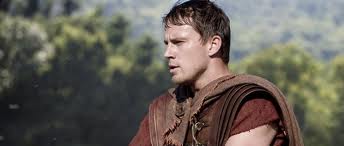 The Eagle's relationship to Gladiator is uncomfortably close right from the start. In the opening act, before Channing Tatum journeys over Hadrian's Wall, the film invokes or restages several key images from Ridley Scott's masterpiece, such as Marcus praying to the gods through smoke or laying out little figurines of his family. The first battle sequence is like the opening battle in Gladiator, only shot on a smaller scale and without a tripod. Last but not least, the central character is a soldier haunted by what has happened to his family, in this case the shame surrounding his father.
 There are other prominent references in the film which become all too apparent as the action plays out. The ending, where Marcus and Esca are pursued across the Scottish landscape by the Seal People, is very close to The Fellowship of the Ring. They are two small, vulnerable people being pursued by the 2nd-century equivalent of the uruk-hai, and Justine Wright's editing is very similar to those sequences. Even the sound design treads close to The Lord of the Rings, with the death throes of Marcus' horse sounding awfully similar to those of the cave troll.
 The crucial problem with The Eagle is that it fails to do what Gladiator did so well - namely balancing the macho and the metaphysical. Scott's film began and ended in the Elysian fields: its intense and often brutal battle scenes (including the fist-fight between Maximus and Commodus) were anchored around an exploration of politics, religion, gender and mortality. The Eagle doesn't have any such weight to carry around and its presentation is much more erratic: it amounts to lots of walking, then a battle, repeated a few times, with the odd little twist or idea thrown in along the way.
 A further comparison, this time with Scott's most recent effort, will help to shed further light on Macdonald's shortcomings. The central problem with Robin Hood was that it didn't know exactly what it wanted to be - a Batman Begins-like origin story, a political drama about working-class emancipation, or a bombastic action movie with pantomime villains. But even in the midst of making up its mind, Robin Hood did at least manage to tackle the political side of its story, albeit superficially.
 The Eagle has the opposite problem. It knows exactly what it wants to be, which is a very old-fashioned romp (and I use the term loosely) with characters which are all too clearly drawn and a fairly predictable storyline. Rosemary Sutcliff's novel, which had previously been adapted for Children's Hour in the 1950s, draws the battle lines between good and evil all too broadly, placing honour and valour over common sense and character development. Even when it's trying to subvert the central relationship between master and slave during the encounter with the Seal People, it still feels blinkered and obstinate as to where your loyalties should lie and to what extent.
 Whereas the novel was originally intended for children (more specifically young boys), there are numerous sequences in The Eagle which are unsuitable for younger audiences. For a 12 certificate film, it is pretty gruesome, with more than one instance of beheading and a fair amount of blood on screen. That said, you don't have to sit through all the really troubling stuff, like people's throats being slit (including a child's throat in one scene towards the end). And most of the time the battle scenes are so frenetic and rapidly edited that you can't exactly tell where people are getting hit, or with what - or, for that matter, why.
 The film is shot by Anthony Dod Mantle, whose credits include the Oscar-winning Slumdog Millionaire and Lars von Trier's controversial Antichrist. Dod Mantle is a pioneer of handheld digital photography, and he does add a number of notable visual touches which make The Eagle a little more distinctive. The opening shot on the river is like one of the woodland scenes in Antichrist: there is a similar sense of mystery in the wild surroundings of nature, albeit with less demonic threat. And some of his compositions are clever, such as showing characters' faces through water which is already reflecting the sky.
 But despite Dod Mantle's knowledge and expertise, the use of hand-held camera is inconsistent and ends up being detrimental. Notwithstanding the shortcomings of the battle scenes, the quieter sections find Macdonald's camera juddering and bouncing when the scene would be better served with a dolly or crane. Like the opening of The Bourne Supremacy, it takes a while for us to adjust to the aesthetic, and for the action to catch up with the frenetic camerawork. But whereas Paul Greengrass' film eventually got into its stride, The Eagle remains dodgy throughout, with Dod Mantle's camerawork hampering Macdonald's already lacklustre direction.
 What makes The Eagle so lacklustre is the lack of strong, charismatic performances. This is surprising considering Macdonald's back catalogue, which includes Forest Whittaker's terrifying performance as Idi Amin in The Last King of Scotland. Jamie Bell remains a decent actor with a certain amount of screen presence, and Mark Strong makes the most of a small supporting role. But all their best efforts are in vain due to Channing Tatum, who has the charisma and acting ability of a lump of granite.
 Because the film has no strong, charismatic protagonist, we aren't drawn into the story enough to make the substance feel intriguing. There is a couple of interesting ideas explored in The Eagle which are both interesting from a genre point of view and pertinent to 21st-century politics. One of these is the inherent instability of a conquering power, and the imperial force having to isolate an enemy rather than face it down and exterminate it. The very existence of Hadrian's Wall, as an imposed, artificial barrier between 'savage' and 'civilised', indicates that the occupying force is based upon fear, both in its methods of conquering and its view of other civilisations.
 When Marcus encounters the Seal People, he is confronted with a culture which operates along the same tribal lines as his own. There is a clear distinction made between Roman and Briton, observed in everything from speech patterns to physical features: there is a running comment about Roman soldiers being recognised by a helmet scar under their chin. Having spent all his life as part of the 'superior race', Marcus is forced into silence and submission as the master-slave relationship is reversed. Esca, meanwhile, is torn between his desire for vengeance against Rome and his professed loyalty to Marcus for sparing his life at the games.
 These are interesting ideas in and of themselves, but the film's structure never allows them to be explored in a satisfying amount of detail. More often than not The Eagle relies earnestly on genre expectations to sustain its appeal, giving us spectacle and plot devices but not much in the way of emotional engagement. The search for the missing roman standard, the eagle of the title, becomes almost secondary to the characters' endless wanderings, and the epilogue of them returning it to the senators is silly and clichéd.
 The Eagle is a big disappointment from Macdonald, failing as both a romp and a means of exploring interesting ideas within a genre. It's not without substance or individual scenes which are visually arresting: it's a better story than 300 and the battle scenes will just about satisfy teenage boys. But for those of us who want to think a little harder, it falls short of most of the marks set for it, never threatening Gladiator's mantle as the great historical epic of our time.
Rating:
Verdict: Macdonald's first real disappointment
Gojira (Japan, 1954)
Directed by Ishiro Honda
Starring Akira Takarada, Momoka Kochi, Akihiko Hirata, Takashi Shimura
Action movies are often criticised for being stupid. They are looked down upon by critics and blamed by social commentators for causing the perceived anti-intellectualism of today's youth. While there are many examples of this genre, or indeed any genre that would fit the bill, action movies are capable of being just as intelligent or insightful as their more artistic counterparts. Gojira is a classic case in point, retaining its relative intelligence in spite of its dramatic creakiness. The cultural influence that Gojira exerts is undeniable. Apart from generating a legion of sequels, crossover films and one god-awful American remake, it has become one of the most iconic Japanese artistic creations. But aside from its cemented status as a symbol of Western perceptions of Japan, its influence on cinema worldwide is just as marked. As well as directly inspiring works like Cloverfield and The Host, its imagery has influenced everyone from Matt Groening to Steven Spielberg, who dubbed the monster's death scream onto the end of Duel.
 For better or worse, Gojira either created or cemented many of the conventions of the modern monster movie. The groundwork may have been laid by King Kong and The Creature from the Black Lagoon, but the conventions founded in Gojira are now so endemic that they deserve recognition. We have the central romance between two people who are destined to be together, set against the backdrop of their home being destroyed or, as with Jurassic Park, other people they care about being put in mortal danger. While most of the characters want to destroy the monster, one person wants to keep it alive to see what they can learn for it (a variation of King Kong, in which one character wants to make money from it). And there is a distant or geeky scientist who doesn't want to help, but ends up possessing the only thing that can stop the monster.
 Like many classic foreign-language films, Gojira had a rough time with the American distributors. Just as Metropolis was heavily butchered to reduce its running time, so Gojira was taken apart and restructured in such a way that the American version looked like a totally different film. This version, called Godzilla, King of the Monsters!, was dubbed into English with new footage of Raymond Burr playing a reporter called Steve Martin - which leaves everybody free to remark that the American version is a complete joke. The disrespect which Terry Morse showed for the original is plain to see: even with the reams of new footage, the new version was 10 minutes shorter than the original.
 Ironically, one of the big problems with Gojira is something which is characteristic of American action movies, particularly with more contemporary offerings. Like many recent CG-heavy action films, Gojira does end up being dominated by its special effects. Some of the set-pieces are incredible even now, such as the central 10-minute sequence of the monster breathing fire and laying waste to Tokyo. But like the American remake, the extent to which the set-pieces are emphasised prompts questions about the workings of the monster - chief amongst them being, why would it help a lizard to be fire-breathing if it lived underwater?
 This dominance of effects is solidified by Gojira's melodramatic plot. It's wrong to attack one of the definitive monster movies for falling into the clichés it created, just as it's wrong to criticise The Cabinet of Dr. Caligari for having a twist ending. But you can still see all the plot points coming a mile off, and the characters are so clearly drawn from a visual point of view that you don't really have to second-guess. The moment you see the character with a scar and an eye-patch, you know there is something shifty about him.
 There is some dispute in critical circles over how good or original Gojira's effects are. Roger Ebert, who called it "a bad film, but with an undeniable urgency", argued that the effects in King Kong were much more state-of-the-art, describing Godzilla the monster as "awkward" and "crude". It's an argument that has never been properly settled, not even when the two monsters went head to head in King Kong vs. Godzilla eight years after this.
 In the end, the only way to judge the validity of Gojira's effects is whether or not they succeed in giving the monster character. This is not simply a case of whether or not he/ she/ it looks like a man in a beanbag wandering around on a set; it is whether the physical form taken by Godzilla/Gojira conveys or achieves the desired emotional response. The short answer to this is yes, because we do believe that the monster has intelligence and a personality. We aren't necessarily in floods of tears when the oxygen destroyer kills him, but there is still the feeling that something physical and tangible has departed, something in which we invested and believed.
 Where Gojira differs from, and perhaps improves on King Kong is its political subtext. The film is an engrossing allegory for Japan's reaction to the events of Hiroshima and Nagasaki, and to the on-going US nuclear tests occurring in the Pacific. This was something which was not widely reported in the American press at the time, which coupled with political pressure might explain why the US version cut out most of the subtext.
 The parallels Gojira draws between real-life events and those of the characters would have been strikingly clear at the time, and are arguably more so to us nearly 60 years later. The underwater explosions which are reported when the first ships sink are an echo of the after-effects of Bikini Atoll: the Americans exploded a device two-and-a-half times larger than expected, leaving hundreds of people within the supposed safety zone with acute radiation poisoning. The harrowing shots showing the aftermath of Gojira's destruction of Tokyo could be lifted straight from The World at War. Considering that Japan was still recovering from the long-term effects of the war, including these kinds of scenes was decidedly brave.
 There is also a direct parallel between the real-life and fictitious characters. Dr. Daisuke Serizawa, played by Akihiko Hirata, is a convincing reflection of Professor Robert Oppenheimer, one of the chief scientists at the Manhattan Project which created the first bombs. When we are taken inside his lab, there is a mention of his "German friends", a sly nod to the fact that German and Austrian scientists pioneered many of the components of the atomic bomb. Serizawa refuses to use the device because he knows how devastating it can be on a small scale, a possible nod to Oppenheimer's mixed feelings following the Trinity test. While Oppenheimer remarked that he had "become death, a destroyer of worlds", Serizawa dies alongside his invention, lest it ever be used again.
 Gojira, like King Kong before it, uses the monster to physicalize a deep-rooted or pertinent fear within humanity. It explores the fears surrounding nuclear war, or more general fears about a seemingly unbeatable weapon. Gojira is characterised as an ancient monster, somewhere between Jules Verne and H. P. Lovecraft, rudely awakened from its long slumber by the nuclear tests. It is simultaneously a symbol of nuclear war itself, the unforeseen consequences or fallout (in both senses), and a physicalisation of the dark, self-preserving aggression at the heart of every human being.
 It is rare that you get a monster movie, then or now, with such thoroughly intelligent subtext. But the film does have a couple of dramatic shortcomings which hamper its ability to convey these ideas. Because the film is constructed like a melodrama, complete with screaming heroines and muscular heroes, there isn't much in the way of tension in the scenes between Gojira's attacks. Whereas The War of the Worlds had moments of real threat, where it seemed like the aliens would win, Gojira always has a feeling of certainty about its outcome which is only partially mitigated by the old man's warnings at the end. Character development is in rather short supply, something which even Akira Ifukube's great soundtrack can't make up for.
 Considering its budget and the development of special effects, Gojira holds up surprisingly well. It is more thought-provoking and emotionally involving than The War of the Worlds, if nothing else because it holds its nerve and gets the ending right. Its dramatic shortcomings are more or less made up for by the emotional impact of the more harrowing scenes, and the monster itself is pretty convincing. As a film in and of itself it's flawed and ropey in places, and while it can't hold a candle to King Kong (in either version), it is essential viewing.
Rating:
Verdict: A flawed but memorable monster movie
This is a reprint of my review which was first published on Rotten Tomatoes about 2 years ago. It appears here to mirror a series of reviews I had done for RT entitled 'From Burton to Nolan'.
The Dark Knight (USA, 2008)
Directed by Christopher Nolan
Starring Christian Bale, Heath Ledger, Gary Oldman, Aaron Eckhart
The word 'masterpiece' is batted around far too often these days, and with The Dark Knight it's sadly inappropriate. Most of what makes Christopher Nolan a great modern filmmaker is up there on screen, and you cannot fault it for being a blockbuster which is attempting to address such relevant and complicated ideas. But while it is a general success, it is not as disciplined or focussed as Batman Begins and does not reward repeat viewing like The Prestige. It deserves to be celebrated and admired for its intelligence, but one must inevitably acknowledge that it isn't flawless. Having barely put a foot wrong in his previous films, The Dark Knight is the first glimpse of Christopher Nolan ever so slightly losing control. Like Batman Begins the film is a little too long, but it also feels slightly bloated, with much of the dialogue being rushed or mumbled in order to cram in all the ideas. It's almost as though there was enough plot and themes in here for two films, but rather than shoot back-to-back sequels, like The Matrix, Nolan decided to compress them down into one. Considering how mediocre The Matrix sequels were, this was not in itself a bad idea, but we still have to live with the fact that there are too many stories going on.
 Moreover, the film is edited and structured in a peculiar way. Where Batman Begins progressed in a defined direction, The Dark Knight feels more like a series of philosophical vignettes rather than something more progressive and incremental. The set-pieces are undeniably brilliant, but with the exception of the final sequence with the ships, you could put these set-pieces in almost any order and the film would feel the same. It's not terrible because of it, but it does mean that there is less cumulative tension than there could have been.
 This feeling of disorder is bolstered by the increased spectacle. Of course, being a blockbuster we don't expect things to be quiet, but there is a feeling watching all the explosions of Nolan pandering to the popcorn crowd just a little too much. In Batman Begins there were two hours of substance and character development, followed by 20 minutes of explosions to make up the trailer. In The Dark Knight, with its themes of escalation and chaos, it seems right that there should be more carnage, up to a point. But the carnage Nolan puts on screen eventually becomes repetitive, and his decision to film some of it in IMAX adds to the impression that he is overcompensating.
 These criticisms make it seem that Nolan's film is a failure, and when compared to the rest of his output, it is disappointing. But it remains head and shoulders above your average superhero blockbuster. The discipline of the first film has been compromised, but the film retains a desire to explore characters rather than just blow everything up. If nothing else, you have to admire Nolan for being able to take such an ideas-heavy film and sell it to such a wide audience.
 Thematically, this picks up the reins of the first film, dealing with the idea of understanding one's enemy as the means to defeating them. The difference is that the Joker is not a Nietzschean figure like Ra's al Ghul, someone who becomes evil by believing so strongly that he is doing good. In fighting him Batman still risks becoming like his enemies, but this lack of morality means that the cost to him will be greater. Killing the Joker seems necessary, but it would destroy Batman's moral code and undermine the belief that good can overcome evil in a non-Nietzschean way.
 The film is quite nihilistic in suggesting that even at its weakest, evil can triumph over good. The Joker's fate at the end remains uncertain, but the revelations surrounding Harvey Dent give a sense of him winning even though his direct influence is curtailed. The Joker's evil is allegorical to terrorism, in that his influence is fragmented and disparate. He does not take power by marching in with an army; he infiltrates, twisting, turning and double-crossing. Dent and Batman are the dove and the hawk trying to uphold rules in the face of chaos, and both are essentially destroyed in the process.
 The thing which marks out The Dark Knight from Nolan's previous work is that it is relatively conventional in its storytelling. It's ridiculous to call it 'dumbing down', but there is none of the jumping back and forth in time which made The Prestige so gripping. The themes are presented in a much more upfront way, both in the dialogue and the precise mechanics of the moral dilemmas. You could almost accuse Nolan of ramming ideas down the audience's throats, but thankfully the script and the characters are good enough to prevent this.
 The film has similar character development to Batman Returns, which was criticised for sidelining Batman in favour of the svillains. But that's always been the point. Since Batman is a superhero who uses cunning rather than powers, there has to be a section of the film in which he is the underdog; if nothing else it makes his eventual triumph more powerful and palatable. What makes The Dark Knight clever is that it does all this while withholding the Joker for a long time. Apart from the opening bank raid, the first act largely concerns itself with Lau and the Mob.
 As with all Nolan films, the performances are really great. Heath Ledger was generally a lightweight, but as the Joker he manages to channel Malcolm McDowell and make him truly terrifying. It's easily his best performance, although like the film it has become a victim of its own hype. Like the Scream killer, it has been so widely parodied that it isn't quite as scary anymore. Christian Bale remains convincing, and as before it is right that he should be a little sidelined so that the great evil is acknowledged.
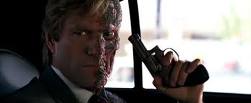 Michael Caine and Morgan Freeman are both warm and affable, and the script does allow for more humour this time round - for instance, when Rachel Dawes and Batman land on the car, she turns to him and says, "Let's not do that again". Interestingly enough, the film glosses over the most interesting character development: the individuals closest to Bruce Wayne finding out his identity. This was explored in Batman Returns in some detail, but here there are several conversations between Bruce and Rachel in which she knows he is Batman, which somewhat undercuts the drama.
 The Dark Knight contains many promising performances, along with stunning visuals from Wally Pfister who gives Gotham a grungy and decaying edge. In the end it struggles to completely control all the rogue elements, but at least Nolan doesn't fall into the same trap as Sam Raimi on Spiderman 3, namely throwing everything at the screen in the hope that some of it will work. If Batman Begins was Nolan's equivalent of Alien, then this is his Aliens: more action-packed and slightly less compelling, but still weighty, intelligent and interesting. One only hopes that Inception will not be his Alien 3.
Rating: 
Verdict: Bloated but containing brilliance


