

Reflections
-
It is weird to read my correspondences from the late August/early September
period, being the time of transition between my old function in life to my
new ...
14 years ago
The Adventures of Tintin: The Secret of the Unicorn (USA, 2011)
Directed by Steven Spielberg
Starring Jamie Bell, Andy Serkis, Daniel Craig, Simon Pegg
Because of the high regard in which Tintin is held around the world, it's fair to assume that any film adaptation would fall short of the mark in some way, shape or form. For all the charm and appeal of past adaptations, in film, TV and on the stage, none of them have truly captured the magic and intrigue of Hergé's iconic hero. With this in mind, Steven Spielberg and Peter Jackson have delivered a film of real brio and excitement which, while by no means definitive, is definitely worth your time. While the marriage between Spielberg directing and Jackson producing seems like a match made in heaven, both have been guilty recently of falling short of the mark - Spielberg with the unremarkable Indy 4, and Jackson with his misjudged take on The Lovely Bones. Likewise, it is not safe to assume that their combined affection for the source material will translate into a brilliant adaptation. Tim Burton has long professed his love for Alice in Wonderland, but when he finally got the chance to express said love, he came a cropper.
 Fittingly enough, the film begins with some Burton-esque opening credits, in which we are gradually introduced to the Tintin universe while the various names fly past. The opening animation gleefully replicates the feel of the comics, drawing on the plot of The Seven Crystal Balls and capturing every detail, right down to the drawn-on gasps. It has the same playful feel as the Pink Panther opening credits, and goes some way to both setting the scene and reassuring the fans that they are in safe hands.
 It is also a relief that Spielberg and Jackson's big creative decision quickly pays off (and no, I don't mean the 3D). The Adventures of Tintin was shot entirely in motion capture, with post-production taking nearly a year to accurately re-create the comics. The technology as employed here is the best it's ever been at capturing people: it is incredibly photorealistic but lacks the eerie, dead-eyed quality of Robert Zemeckis' efforts. As a side point, digital animation has a habit of making characters seem ballooned and bloated, which suits Haddock and the two detectives rather well.
 When War of the Worlds was released in 2005, Terry Gilliam remarked that Spielberg was a man who "makes brilliant scenes but can't make a movie anymore." Regardless of one's views on War of the Worlds (it's better than the original), it is undoubtedly true that the highlights of Tintin are the set-pieces. Of course, set-pieces in and of themselves do not make for a gripping piece of narrative. But to dismiss Spielberg and Jackson's expertise in this area is to do both of them a great disservice.
 The set-pieces in The Adventures of Tintin are consistently inventive and exciting. The pirate battle, which is told by Haddock in flashback, finds two ships getting locked by their masts at right angles during a storm; people are running up and down the various riggings with fire, water and gunfire all around them. It kicks all four Pirates of the Caribbean films into a cocked three-cornered hat, and reminds you of the classic pirate and swashbuckling films of old-school Hollywood.
 Equally spectacular is the city chase, in which the three scrolls containing the location of the treasure change hands on multiple occasions. During this ten-minute sequence, Tintin and Haddock chase the bad guys in a jeep, one of whom has a hawk carrying the scrolls. At one point Tintin's bike breaks in half and he uses the front-wheel as a zipwire to slide down a telegraph line and capture the scrolls. In another moment, he is literally hanging onto the hawk as it fights to stay in the air. While all this is going on, a tank careers into a hotel and starts rolling down a street with the hotel attached. It finally comes to a halt right on the sea front, and the owner comes out and adds another star to its rating - a witty pay-off that could only have come from the man who gave us Indiana Jones.
 Set-pieces like this are thrillingly executed, and leave the ten-year-old boy in me screaming "Wow!". But there is a side-effect to all the comparisons with Indy. The more the similarities keep stacking up, the more you wish that Spielberg could have gone back and simply filmed them for real. Most of the stunts I have listed would have looked amazing in real life and could be achieved without much in the way of CGI. Seeing it animated, especially in motion capture, deprives us of that raw physical thrill that we got from Indy, so that while the film as a whole is more exciting than Indy 4, it's a lot less endearing than the original trilogy.
 And it's not just Indy that Spielberg is tipping his fedora to in this film. There are multiple big references to Jaws: the first comes in the shark falling from the ceiling on board the ship, and the second with Tintin's quiff bobbing above water like a shark's fin as he sneaks up on the plane he downed with a pistol. References like this produce knowing laughs and are in a sense reassuring: we are definitely getting Spielberg in proper popcorn mode, whether by choice or through Jackson's gentle persuasion.
 More problematic than the Indy resemblances is the story itself. The film combines the narratives of three of the books - The Secret of the Unicorn, Red Rackham's Treasure and The Crab with the Golden Claws. There is some reasoning behind this, since many of the Tintin stories are quite short and self-contained. This is one reason why the series worked up to a point on TV and especially well on radio (regardless of Andy Serkis' best efforts, Leo McKern remains the definitive Haddock).
 Despite the assured writing talents of Edgar Wright and Steven Moffatt, The Adventures of Tintin's story is decidedly stodgy. It takes a good twenty minutes for the film to get into gear, not from adjusting to the visuals but from getting used to the massively expository tone. Combining three stories together means that plot points are merged and mashed together awkwardly, causing us to miss out on great moments and characters. There is no room for Professor Calculus, Max Bird or the sunken submarine. Leaving out the latter makes us question why it wasn't enough to do Unicorn and Rackham together, turning a two-part story into 90 minutes.
 The supporting characters in the film are enjoyable but all a little slim. Thomson and Thompson (Nick Frost and Simon Pegg) are quite funny in all their little scenes, but their limited role in the search for treasure leaves us wondering why they keep turning up at all. Bianca Castafiore, the opera singer whom Haddock despises, only turns up very briefly, and the film almost misses the big gag that she can't actually sing. Worst of all is Snowy: while physically expressive, he doesn't get to 'talk' or impart much of his inner thoughts to the audience. In the absence of a 'talking' Snowy, you need a stronger third character, like Professor Calculus, to complete the triangle.
 There seems to be a trend in modern screenwriting to take a sideways view at stories which are good and hardy enough to be told straight. Even if Disney had been constantly sanitising his vision, Burton's Alice in Wonderland would have been a much better film if it had told the story as it has always been enjoyed. While there is no such possible contempt shown for Hergé, it is something that should be borne in mind for when Jackson comes to direct the sequel.
 The Adventures of Tintin: The Secret of the Unicorn is a decent and enjoyable romp, at least when viewed in 2D. Neither Spielberg or Jackson are firing on all cylinders - though the latter's involvement with The Hobbit is as good an excuse as you need. But that said it is more enjoyable than Indy 4, and perhaps the closest that Spielberg has come to matching the spirit of Indy in the last ten years of his career. In the end it's flawed but good fun, and it will be interesting to see where things go from here.
Rating:
Verdict: Spectacular but narratively stodgy
The Ninth Gate (France/ Spain/ USA, 1999)
Directed by Roman Polanski
Starring Johnny Depp, Lena Olin , Frank Langella, Emmanuelle Seigner
With the notable exception of Se7en, numerical horror-thrillers are utter rubbish. With their ridiculous twists, over-the-top acting and an overreliance on special effects, they epitomise all that is banal and disappointing about these two genres. You would think that Roman Polanski, the man who gave us Repulsion and Rosemary's Baby, would be able to handle such well-worn material in at least a workable manner. But instead we end up with a ripe old stinker every bit as disappointing as Prince of Darkness. Polanski has always been a fan of absurdist, quirky comedy, being greatly influenced by France's crown prince of absurdity, Eugene Ionesco. While absurdity in and of itself is no bad thing, Polanski has always been at his best when this aspect of his sensibility has been minimised, or at least properly accommodated. You have to admire him for being able to switch between bleak, serious works like Tess and The Pianist, and something more fun and frothy like Frantic. But his out-and-out exercises in comedy have dated very badly, with What? being the worst example.
 Further doubts are raised by Polanski's attitude towards the source material. When interviewed in 1999 he said that he didn't believe in the supernatural - something you would never have guessed from Rosemary's Baby. He was drawn to the novel El Club Dumas by Arturo Pérez-Reverte because it was an opportunity to play with the clichés of a genre that he enjoyed. The consequence is that we aren't sure how seriously Polanski is taking things, and therefore how seriously we should be taking him.
 The Ninth Gate starts off quite atmospherically, with good pacing, dusty books and nice gothic colours. Film noir touches are evident throughout, from the archetype of the downbeat detective (or "book detective" in this case) to the enigmatic women in his life. Like so many noirs or Hitchcock films, the blond is enigmatic but for the most part on the hero's side, while the brunette is seductive and passionate to the point of being pure evil.
 Having set things up quite nicely in the first ten minutes, The Ninth Gate starts to crumble as more and more ridiculous elements encroach. We might swallow the story about the three copies of The Nine Gates, if only because Frank Langella sounds authoritative as he wades through exposition. But subsequent developments are so clouded or convoluted that we quickly give up trying to figure it all out, insofar as there is anything to figure out. It feels like the sort of thing that Polanski could have done in his sleep - and for much of the film, he might as well have done.
 All the big plot points in The Ninth Gate can be anticipated because they borrow all too heavily from better genre efforts. Having Dean Corso commissioned to search for The Nine Gates is exactly the same set-up as Angel Heart, but with a book instead of a jazz musician. His infiltration of a secret ceremony is lifted from The Wicker Man, and the mansion scenes strongly resemble Eyes Wide Shut, although this may be coincidental. There are also very standard references to The Omen in the use of 666, for instance, The NINE Gates being published in 1666. There is even a nod to An American Werewolf in London, as Corso arrives at the castle in a truck full of sheep.
 Having given up on taking The Ninth Gate seriously, the next logical step is to try and enjoy it as a comedy, perhaps as an unintentional one. But the comedic elements are so completely at odds with Polanski's execution of the twists that they feel like they have escaped from a different film. The twin brothers, who are played by the same actor via split screen, bumble their way through their lines like a cross between Thomson and Thompson from Tintin and Alf Garnett in Till Death Us Do Part.
 The silliness of the supporting characters increases as the film moves on. Baroness Kessler, played by Barbara Jefford, is introduced as a formidable character of real threat to Dean Corso - who then slips almost immediately into pantomime villain mode when we discover that she only has one hand. Corso later finds her slumped in her motorised wheelchair having been strangled: he turns the wheelchair around, only for her to go careering through the double doors, like Mason Verger's death in Hannibal two years later.
 Like many numerical thrillers, The Ninth Gate suffers from dodgy special effects. It's hardly a dull car crash like End of Days, in which Gabriel Byrne demonstrates his demonic power by blowing everything up, and Arnold Schwarzenegger try to stop him with a grenade launcher. But alongside bad continuity and an unconvincingly burnt book, there are at least two examples of dodgy wire work, in which Emmanuelle Seigner floats down into a scene, without any prior clue that she could fly.
 The Ninth Gate is littered with irritating plot holes which leaving us scratching our heads even in the moments when generic convention could fill in the gaps. There is no explanation of the serpent tattoo on the brunette's back, nor of Boris Balkan's ability to know exactly where Corso is at any one time - which is, conveniently, always within reach of a phone. But more annoying than either of these is Polanski's contempt for the subject matter. It's hard to believe that either Corso or Balkan know or care so much about rare tomes when they treat them so carelessly. They don't bother to handle them with gloves, flip through ancient pages like they were airport paperbacks and carry them around in scruffy bags which get flung everywhere.
 This care-free attitude spills over into the performances. Johnny Depp had wanted to work with Polanski for some time, but Polanski didn't tell him that he wasn't giving the performance that he wanted - in other words, he was almost completely undirected in the role. To be fair to Depp, he gets the physical stuff right, modelling himself on Raymond Chandler and being more convincing than he is in Secret Window. But otherwise it's pretty phoned-in, with Polanski being unable or unwilling to tease out the greatness that Tim Burton or Terry Gilliam had managed.
 Frank Langella is no stranger to trashy villains, having played Skeletor in the awful He-Man movie, Masters of the Universe. He does the best with a surprisingly underwritten role, looking a little bit like Michael Redgrave in The Dambusters. Lena Orin has far too little to do beyond flashing her stocking tops in the first half-hour and then dressing up like the actress from Scottish Widows for the satanic ceremony. As for Seigner, she does a good demon stare, but otherwise she's too airy-fairy, wafting through the scenery as if she doesn't really care who she's playing or what she's doing. In any case, it's essentially the same character she plays in Frantic - the quirky outsider who helps the male protagonist, only this time she's the devil as well.
 The final nail in The Ninth Gate's coffin comes with its ending, which is hopelessly dragged out and completely incoherent. We get to see Langella self-immolate and fail to pass through the Ninth Gate - but that's not the end. Seigner makes love to Depp against the flames with her demon eyes, the camera zooms in on Depp as if he realises who she is all along, and he seems about to scream - but that's not the end. After the two drive back, and Seigner remarks "is that it?" (to which the answer is "no"), Depp goes back to the bookshop and finds the missing page - but that's not the end. Depp then goes back to the castle and the screen fades to white, in one of the most shambolic and unsatisfying endings in 1990s cinema.
 The Ninth Gate is an example of what happens when a great director indulges themself to the extent that they no longer feel the need to try. As an exercise in supernatural horror it is every bit as rubbish as Prince of Darkness: Polanski's film looks better, but Carpenter's was shorter. In attempting to put his stamp on overly familiar elements, Polanski fails to deliver chills, thrills or knowing laughs. Thank God that he redeemed himself beyond all recognition just three short years later.
Rating:
Verdict: One of Polanski's few bad films
This is a reprint of my review which was first published on Rotten Tomatoes about 2 years ago. It appears here to mirror a series of reviews I had done for RT entitled 'From Burton to Nolan'.
The Dark Knight (USA, 2008)
Directed by Christopher Nolan
Starring Christian Bale, Heath Ledger, Gary Oldman, Aaron Eckhart
The word 'masterpiece' is batted around far too often these days, and with The Dark Knight it's sadly inappropriate. Most of what makes Christopher Nolan a great modern filmmaker is up there on screen, and you cannot fault it for being a blockbuster which is attempting to address such relevant and complicated ideas. But while it is a general success, it is not as disciplined or focussed as Batman Begins and does not reward repeat viewing like The Prestige. It deserves to be celebrated and admired for its intelligence, but one must inevitably acknowledge that it isn't flawless. Having barely put a foot wrong in his previous films, The Dark Knight is the first glimpse of Christopher Nolan ever so slightly losing control. Like Batman Begins the film is a little too long, but it also feels slightly bloated, with much of the dialogue being rushed or mumbled in order to cram in all the ideas. It's almost as though there was enough plot and themes in here for two films, but rather than shoot back-to-back sequels, like The Matrix, Nolan decided to compress them down into one. Considering how mediocre The Matrix sequels were, this was not in itself a bad idea, but we still have to live with the fact that there are too many stories going on.
 Moreover, the film is edited and structured in a peculiar way. Where Batman Begins progressed in a defined direction, The Dark Knight feels more like a series of philosophical vignettes rather than something more progressive and incremental. The set-pieces are undeniably brilliant, but with the exception of the final sequence with the ships, you could put these set-pieces in almost any order and the film would feel the same. It's not terrible because of it, but it does mean that there is less cumulative tension than there could have been.
 This feeling of disorder is bolstered by the increased spectacle. Of course, being a blockbuster we don't expect things to be quiet, but there is a feeling watching all the explosions of Nolan pandering to the popcorn crowd just a little too much. In Batman Begins there were two hours of substance and character development, followed by 20 minutes of explosions to make up the trailer. In The Dark Knight, with its themes of escalation and chaos, it seems right that there should be more carnage, up to a point. But the carnage Nolan puts on screen eventually becomes repetitive, and his decision to film some of it in IMAX adds to the impression that he is overcompensating.
 These criticisms make it seem that Nolan's film is a failure, and when compared to the rest of his output, it is disappointing. But it remains head and shoulders above your average superhero blockbuster. The discipline of the first film has been compromised, but the film retains a desire to explore characters rather than just blow everything up. If nothing else, you have to admire Nolan for being able to take such an ideas-heavy film and sell it to such a wide audience.
 Thematically, this picks up the reins of the first film, dealing with the idea of understanding one's enemy as the means to defeating them. The difference is that the Joker is not a Nietzschean figure like Ra's al Ghul, someone who becomes evil by believing so strongly that he is doing good. In fighting him Batman still risks becoming like his enemies, but this lack of morality means that the cost to him will be greater. Killing the Joker seems necessary, but it would destroy Batman's moral code and undermine the belief that good can overcome evil in a non-Nietzschean way.
 The film is quite nihilistic in suggesting that even at its weakest, evil can triumph over good. The Joker's fate at the end remains uncertain, but the revelations surrounding Harvey Dent give a sense of him winning even though his direct influence is curtailed. The Joker's evil is allegorical to terrorism, in that his influence is fragmented and disparate. He does not take power by marching in with an army; he infiltrates, twisting, turning and double-crossing. Dent and Batman are the dove and the hawk trying to uphold rules in the face of chaos, and both are essentially destroyed in the process.
 The thing which marks out The Dark Knight from Nolan's previous work is that it is relatively conventional in its storytelling. It's ridiculous to call it 'dumbing down', but there is none of the jumping back and forth in time which made The Prestige so gripping. The themes are presented in a much more upfront way, both in the dialogue and the precise mechanics of the moral dilemmas. You could almost accuse Nolan of ramming ideas down the audience's throats, but thankfully the script and the characters are good enough to prevent this.
 The film has similar character development to Batman Returns, which was criticised for sidelining Batman in favour of the svillains. But that's always been the point. Since Batman is a superhero who uses cunning rather than powers, there has to be a section of the film in which he is the underdog; if nothing else it makes his eventual triumph more powerful and palatable. What makes The Dark Knight clever is that it does all this while withholding the Joker for a long time. Apart from the opening bank raid, the first act largely concerns itself with Lau and the Mob.
 As with all Nolan films, the performances are really great. Heath Ledger was generally a lightweight, but as the Joker he manages to channel Malcolm McDowell and make him truly terrifying. It's easily his best performance, although like the film it has become a victim of its own hype. Like the Scream killer, it has been so widely parodied that it isn't quite as scary anymore. Christian Bale remains convincing, and as before it is right that he should be a little sidelined so that the great evil is acknowledged.
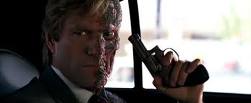 Michael Caine and Morgan Freeman are both warm and affable, and the script does allow for more humour this time round - for instance, when Rachel Dawes and Batman land on the car, she turns to him and says, "Let's not do that again". Interestingly enough, the film glosses over the most interesting character development: the individuals closest to Bruce Wayne finding out his identity. This was explored in Batman Returns in some detail, but here there are several conversations between Bruce and Rachel in which she knows he is Batman, which somewhat undercuts the drama.
 The Dark Knight contains many promising performances, along with stunning visuals from Wally Pfister who gives Gotham a grungy and decaying edge. In the end it struggles to completely control all the rogue elements, but at least Nolan doesn't fall into the same trap as Sam Raimi on Spiderman 3, namely throwing everything at the screen in the hope that some of it will work. If Batman Begins was Nolan's equivalent of Alien, then this is his Aliens: more action-packed and slightly less compelling, but still weighty, intelligent and interesting. One only hopes that Inception will not be his Alien 3.
Rating: 
Verdict: Bloated but containing brilliance
This is a reprint of my review which was first published on Rotten Tomatoes about 2 years ago, with a couple of minor revisions. It appears here to mirror a series of reviews I had done for RT entitled 'From Burton to Nolan'.
Batman Begins (USA, 2005)
Directed by Christopher Nolan
Starring Christian Bale, Michael Caine, Liam Neeson, Katie Holmes
The words 'substance' and 'blockbuster' are rarely found in the same sentence. Nor indeed are the words 'auteur' and 'commercially reliable'. But Christopher Nolan is living, breathing proof that the two can come together and make astonishing work. Having won over mainstream audiences with Memento and Insomnia, Nolan uses his particular blend of non-linear storylines and visual hyper-realism to breathe new life into a long-dead franchise. With all the acclaim being accorded to The Dark Knight (most of which it deserves), it is easy to forget just how good or how strong Batman Begins is. It's not just good by Batman standards, or by prequel standards; it has its own, stand-alone identity, a headstrong independence which defies and ignores all that has gone before it. Gone are the Gothic spires of Tim Burton's Gotham City, or the day-glo camp of Joel Schumacher's costumes. This is a new whole new world, in all its meticulous and frightening glory.
 All of Nolan's films are stunning to behold, but Batman Begins takes his craft to new heights. He is famous for not using a second unit, allowing him to supervise and construct every shot just the way he wants it. This means there is no jarring difference between the film's dramatic scenes and the external effects designed to show us the city. Even in the most effects-heavy parts of the film, we never question who is behind the camera, guiding these scenes and determining their significance.
 Nolan has the same gift for visual verisimilitude as Ridley Scott, whose masterpiece Blade Runner was a major influence on the young filmmaker. Both directors are able to construct seamless, immersive worlds on screen which are simultaneously strange and familiar. They have a beauty which both comforts and surprises us, allowing the filmmaker to play with the clichés and always come up with something new. But while several of Scott's films are truly style over substance (Legend, Someone to Watch Over Me), Nolan has yet to make a film which forsakes narrative substance for the sake of visual splendour.
 What makes Batman Begins so rewarding, so gripping, and arguably so radical, is that there is a constant and unrelenting focus on the story. No matter how much we jump back and forth in time, or how many bad guys get hit, we never doubt that the movie is in control of itself and is yearning to move on to the next important piece of character development. The fact that we have to wait an hour before Christian Bale even dons the bat-suit is a clear sign that the filmmakers want to do this properly. They have avoided falling into the trap of either the original films, which often put the narrative on pause for a kid-friendly set-piece, or the Star Wars prequels, which waded through years of turgid back-story for a few minutes of vaguely dark action.
 Mark Kermode once described this film as "a little independent, weird, art movie, trapped within the body of a $140m blockbuster." And he wasn't far off. Batman Begins is much less a superhero film per se than it is a detailed philosophical examination of the nature of fear and morality in a chaotic world. Both our protagonists and his many enemies have fear and intimidation as their source of power -- the former by their bribes and weapons, the latter by stealth and an incorruptible desire to do good. But rather than keep it as a straight fight between good guys and baddies, the film questions the motivations of our hero on a frequent basis. The supporting cast, particularly his old flame, push him on his motivation for doing what he does, in the way he does, regardless of how little they actually know.
 This is a film in which the desire to do good can so easily be blurred into the desire for power; in which the lines between justice and vengeance are frequently re-drawn; and in which the triumph of good over evil is neither complete nor reassuring. In the film's closing scenes, Gary Oldman warns Batman that he is potentially doing more harm than good; this enemy may have been extinguished, but a darker menace lurks on the horizon which will be harder to defeat.
 At the centre of all this is the idea that to defeat evil, one must understand it and even adopt part of its methods if the ends justify the means. The League of Shadows, headed up by Ra's al Ghul, are a symbolic forewarning to Bruce Wayne of what he could become should he fully embrace his fear. Liam Neeson's character is a Nietzschean figure, who has channelled his desire for justice so purely that it has consumed all his remaining humanity. Bruce Wayne should if anything be more brutal, since he wishes to atone for the death of his parents. But when he is asked to slay the farmer, his humanity intervenes and he refuses. This pivotal scene confirms Wayne's incorruptible nature; he may become feared, but he will never let the fear become him.
 One criticism of this film from some quarters is that this new emphasis on darkness and philosophical soul-searching has taken all the fun out of the character. In fact one of the pleasant surprises about Batman Begins is the extent to which humour still resides. Not only do we get impressive popcorn-worthy action sequences, but we also have a script which grows more sarcastic and playful as all the battle lines are drawn. There aren't any laugh-out-loud moments, but that's not why the film exists.
 The film is inhabited by one of the best all-star casts outside a Robert Altman film. Christian Bale is brilliant as Batman, drawing on his great work in American Psycho to make Bruce Wayne totally three-dimensional. He plays Wayne with a tortured intensity which makes his pain all the more palpable. The supporting cast is completely solid, with the best performances coming from Cillian Murphy as the chillingly creepy Dr. Krane and Michael Caine as the affable father figure Alfred. Special mention should also go to Gary Oldman as Gordon and to Liam Neeson, who gives one of his best performances in years.
 The only real flaws with Batman Begins come when it attempts the widest possible appeal. The last twenty minutes, is completely over-the-top and rather cavalier on the part of the director. It's not so much a punch in the face as a flick on the nose; not especially painful, but you still feel annoyed that it happened. Moreover the opening scenes, before Bale reaches the monastery, are very jumpily edited so that only the most devoted will be pulled in.
 Nonetheless, Batman Begins is a really great film which does not deserve to be neglected in the wake of The Dark Knight's success. It is a stunning combination of style and substance which avoids all the pitfalls of its counterparts and predecessors. Together with The Dark Knight, it has become the gold standard against which all subsequent superhero films have been measured, and more often than not come up short. It may not be Nolan's best film - that remains Inception - but it is a fantastic demonstration of how art and money are not so easy to separate.
Rating: 
Verdict: The best Batman film


