


Reflections
-
It is weird to read my correspondences from the late August/early September
period, being the time of transition between my old function in life to my
new ...
14 years ago
The Eagle (UK/ USA, 2011)
Directed by Kevin Macdonald
Starring Channing Tatum, Jamie Bell, Donald Sutherland, Mark Strong
When Gladiator reinvigorated the swords-and-sandals epic, it was quickly followed by a host of films which sought to replicate its success by imitating part or all of its formula. But whatever the qualities of Troy, Alexander or even 300, there was always a niggling sense that we were getting something inherently inferior. Adding to this list of disappointments is The Eagle, the first big hiccup in Kevin Macdonald's career.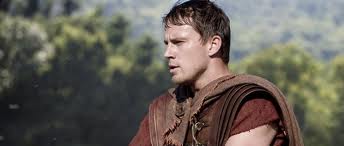 The Eagle's relationship to Gladiator is uncomfortably close right from the start. In the opening act, before Channing Tatum journeys over Hadrian's Wall, the film invokes or restages several key images from Ridley Scott's masterpiece, such as Marcus praying to the gods through smoke or laying out little figurines of his family. The first battle sequence is like the opening battle in Gladiator, only shot on a smaller scale and without a tripod. Last but not least, the central character is a soldier haunted by what has happened to his family, in this case the shame surrounding his father.
 There are other prominent references in the film which become all too apparent as the action plays out. The ending, where Marcus and Esca are pursued across the Scottish landscape by the Seal People, is very close to The Fellowship of the Ring. They are two small, vulnerable people being pursued by the 2nd-century equivalent of the uruk-hai, and Justine Wright's editing is very similar to those sequences. Even the sound design treads close to The Lord of the Rings, with the death throes of Marcus' horse sounding awfully similar to those of the cave troll.
 The crucial problem with The Eagle is that it fails to do what Gladiator did so well - namely balancing the macho and the metaphysical. Scott's film began and ended in the Elysian fields: its intense and often brutal battle scenes (including the fist-fight between Maximus and Commodus) were anchored around an exploration of politics, religion, gender and mortality. The Eagle doesn't have any such weight to carry around and its presentation is much more erratic: it amounts to lots of walking, then a battle, repeated a few times, with the odd little twist or idea thrown in along the way.
 A further comparison, this time with Scott's most recent effort, will help to shed further light on Macdonald's shortcomings. The central problem with Robin Hood was that it didn't know exactly what it wanted to be - a Batman Begins-like origin story, a political drama about working-class emancipation, or a bombastic action movie with pantomime villains. But even in the midst of making up its mind, Robin Hood did at least manage to tackle the political side of its story, albeit superficially.
 The Eagle has the opposite problem. It knows exactly what it wants to be, which is a very old-fashioned romp (and I use the term loosely) with characters which are all too clearly drawn and a fairly predictable storyline. Rosemary Sutcliff's novel, which had previously been adapted for Children's Hour in the 1950s, draws the battle lines between good and evil all too broadly, placing honour and valour over common sense and character development. Even when it's trying to subvert the central relationship between master and slave during the encounter with the Seal People, it still feels blinkered and obstinate as to where your loyalties should lie and to what extent.
 Whereas the novel was originally intended for children (more specifically young boys), there are numerous sequences in The Eagle which are unsuitable for younger audiences. For a 12 certificate film, it is pretty gruesome, with more than one instance of beheading and a fair amount of blood on screen. That said, you don't have to sit through all the really troubling stuff, like people's throats being slit (including a child's throat in one scene towards the end). And most of the time the battle scenes are so frenetic and rapidly edited that you can't exactly tell where people are getting hit, or with what - or, for that matter, why.
 The film is shot by Anthony Dod Mantle, whose credits include the Oscar-winning Slumdog Millionaire and Lars von Trier's controversial Antichrist. Dod Mantle is a pioneer of handheld digital photography, and he does add a number of notable visual touches which make The Eagle a little more distinctive. The opening shot on the river is like one of the woodland scenes in Antichrist: there is a similar sense of mystery in the wild surroundings of nature, albeit with less demonic threat. And some of his compositions are clever, such as showing characters' faces through water which is already reflecting the sky.
 But despite Dod Mantle's knowledge and expertise, the use of hand-held camera is inconsistent and ends up being detrimental. Notwithstanding the shortcomings of the battle scenes, the quieter sections find Macdonald's camera juddering and bouncing when the scene would be better served with a dolly or crane. Like the opening of The Bourne Supremacy, it takes a while for us to adjust to the aesthetic, and for the action to catch up with the frenetic camerawork. But whereas Paul Greengrass' film eventually got into its stride, The Eagle remains dodgy throughout, with Dod Mantle's camerawork hampering Macdonald's already lacklustre direction.
 What makes The Eagle so lacklustre is the lack of strong, charismatic performances. This is surprising considering Macdonald's back catalogue, which includes Forest Whittaker's terrifying performance as Idi Amin in The Last King of Scotland. Jamie Bell remains a decent actor with a certain amount of screen presence, and Mark Strong makes the most of a small supporting role. But all their best efforts are in vain due to Channing Tatum, who has the charisma and acting ability of a lump of granite.
 Because the film has no strong, charismatic protagonist, we aren't drawn into the story enough to make the substance feel intriguing. There is a couple of interesting ideas explored in The Eagle which are both interesting from a genre point of view and pertinent to 21st-century politics. One of these is the inherent instability of a conquering power, and the imperial force having to isolate an enemy rather than face it down and exterminate it. The very existence of Hadrian's Wall, as an imposed, artificial barrier between 'savage' and 'civilised', indicates that the occupying force is based upon fear, both in its methods of conquering and its view of other civilisations.
 When Marcus encounters the Seal People, he is confronted with a culture which operates along the same tribal lines as his own. There is a clear distinction made between Roman and Briton, observed in everything from speech patterns to physical features: there is a running comment about Roman soldiers being recognised by a helmet scar under their chin. Having spent all his life as part of the 'superior race', Marcus is forced into silence and submission as the master-slave relationship is reversed. Esca, meanwhile, is torn between his desire for vengeance against Rome and his professed loyalty to Marcus for sparing his life at the games.
 These are interesting ideas in and of themselves, but the film's structure never allows them to be explored in a satisfying amount of detail. More often than not The Eagle relies earnestly on genre expectations to sustain its appeal, giving us spectacle and plot devices but not much in the way of emotional engagement. The search for the missing roman standard, the eagle of the title, becomes almost secondary to the characters' endless wanderings, and the epilogue of them returning it to the senators is silly and clichéd.
 The Eagle is a big disappointment from Macdonald, failing as both a romp and a means of exploring interesting ideas within a genre. It's not without substance or individual scenes which are visually arresting: it's a better story than 300 and the battle scenes will just about satisfy teenage boys. But for those of us who want to think a little harder, it falls short of most of the marks set for it, never threatening Gladiator's mantle as the great historical epic of our time.
Rating:
Verdict: Macdonald's first real disappointment
Senna (France/ UK/ USA, 2011)
Directed by Asif Kapadia
Starring Ayrton Senna, Alain Prost, Frank Williams, Ron Dennis
Innovation and artistic value are not properties which disappear when a genre enters the mainstream, and nowhere is there more evident than in documentaries. There are copious examples of recent efforts which have found a relatively wide audience while pushing the genre envelope, from Kevin Macdonald's nail-biting Touching the Void to more introspective works like The Arbor and Of Time and the City. Continuing this trend is Senna, a really great documentary which could be one of the year's best films. Senna is a documentary about the late Formula 1 racing driver Ayrton Senna, which is constructed entirely from archive footage of him. This incorporates TV race coverage, press interviews, TV appearances in Brazil, behind-the-scenes footage and family home video. Although other voices appear over the footage, there is no consistent narration to impose a particular version of events over what we see. Senna is allowed to tell his own story, like he is reading from pages of a diary which switches between the first and third person.
 One of the instant advantages of this approach is that Senna avoids the cliché of the talking head. These are individuals connected with the subject or more contemporary commentators, whose often platitudinous insights can drag even the best documentary into tedium and mediocrity. But just as Julien Temple's rock documentaries have sought to capture the feel of a band rather than just what people have said about them, so Asif Kapadia makes us instantly immersed in the character of Senna as he saw himself, rather than just the reputations he accrued.
 Another coup of Kapadia's film is that it makes the televisual cinematic. Normally when TV footage is put on the big screen, it looks out of place because of a difference in aspect ratio or frame rate which breaks the flow. But Kapadia does not let this happen, blowing up the footage very carefully and reframing key scenes so that we zoom in on the characters' faces and emotions. The pace of the film, both as a thrill ride and a piece of storytelling, keep any technical quibbles out of our minds, so that even when the footage is grainy or incomplete, we don't complain.
 Senna explores a number of themes related to racing driving and the personality and attitudes of the drivers therein. There is a repeated mention of "real driving", the pure sensation of driving for its own sake, in which the goal is not simply winning but winning through pure talent and passion alone. It is this pure devotion to what he loves that made Senna stand out from the other drivers, and which led him to become a national hero in his home country of Brazil.
 Senna's complaints about racing technology mirror concerns in the sport as a whole, and comment on how the nature of Formula 1 has changed since he started racing in the 1980s. The tipping point comes in 1992 when Williams introduce new suspension technology on their car; at this point Senna's form begins to decline because he cannot adjust his pure style of driving to technology designed to make the driver do less work.
Within this there is a comment on how technology determines not only the style of racing but also the personality of the driver. In the middle of the film there is a conversation between Senna and Jackie Stewart, in which they talk about the changes in technology and how that has affected the flair of different drivers. The implication is the less there is for a driver to do in a race, the less there is for the driver to be, with said individuals hiding behind endorsements and statistics in the absence of real, passionate charisma. This difference in approach is further communicated in Senna's bitter rivalry with Alain Prost. Senna races with a pure spirit and an often reckless urge to win at any cost - he is not content to play the political games and he never does it for the money. But Prost, who is nicknamed the Professor, is content to play those games and drive according to mathematical calculations - if he can win a championship by staying in fifth, he will stay in fifth.
 Much has been written about how Prost comes out as the villain of the film, and it is undeniably true that at the height of their respective careers both men hated each other. But in fact, their relationship is far more complicated than simple rivalry. Beneath the public scrapes involving crashes and back-chatting, there is some form of mutual underlying respect which these men retained throughout their careers. In spite of completely different styles and attitudes, both men were willing to acknowledge the other's talent, which might explain why Prost currently serves as a trustee for Senna's charity.
 If we wish to paint the documentary purely in terms of heroes and villains, then the true antagonists are the Formula 1 regulators. The film examines the conflicted and clouded politics of professional racing and how the rules designed to make racing fair and exciting often go against the very things the drivers (or at least Senna) want. In one sequence, the FIA President Jean-Michel Balestre emphasises a particular regulation, only for the majority of drivers to vote against upholding it. In another, there is a heated disagreement about racing lines on the starting grid which leads to a spectacular crash involving Senna at the start of a race.
 But although Senna focuses on the physical effort and talent involved in racing, an equal amount of its focus is on the spiritual aspect of the sport. Senna was a devout Roman Catholic who prayed to God before each race, and who believed that God had called him to drive this fast and in this way. The way Senna talks about God often drifts in Chariots of Fire territory, so that you almost expect him to say: "when I drive, I feel his pleasure". But the documentary also shows that this relationship was not straightforward; the first time Senna feels God's presence, he crashes at Monaco, throwing away a huge lead and losing the race.
 Because the outcome of the subject is widely known, certain moments in Senna take on an eerie quality so that they become harbingers of his tragic death. When he goes on Brazilian TV after becoming world champion, a girl kisses him and wishes him a happy new year for every year up until 1993, the year before he died. In 1991 he talks about having many years ahead of him and still so much to achieve. Like Amazing Journey, the film touches on the possibility that certain individuals are so prodigiously talented that they were not put on this Earth to make old bones. And like Keith Moon, Senna's death was both a tragic accident and something to be expected by the way he lived his life.
 Even if you're not a fan of Formula 1, or particularly interested in the spiritual side of sport, there is more than enough in Senna to get your heart racing. Some of the racing footage is genuinely scary, as cars pass within inches of each other through corners and the on-board cameras give you a sense of speed with wider shots would not. Senna's driving throughout is extraordinary, and in appreciating this we follow his emotional journey. We feel his intense anger at being disqualified from the Japanese Grand Prix in 1989, and both his joy and immense pain after having won in Brazil in 1990 despite having to drive the last few laps in a single gear.
 There are aspects of Senna's life which remain absent from the documentary, such as his relationships with women and his influence on popular motoring, such as working with Honda on the NSX. But all in all this is a great documentary which is gripping, insightful and highly emotional. It does justice both to the man and to the ideals for which he stood, while leaving plenty of things open to interpretation. Like Senna himself, it is accomplished, thrilling and ultimately heart-breaking.
Rating:
Verdict: One of the year's best films
Touching the Void (UK, 2003)
Directed by Kevin Macdonald
Starring Joe Simpson, Simon Yates, Brendan Mackey, Nicholas Aaron
Docudramas, like biopics, are difficult things to pull off. They have to be close enough to the truth to be credible in the eyes of those involved, but they must also be engrossing and entertaining enough to pull in audiences which are not so well-versed. Touching the Void is a first-class balancing act between the two, and after eight years it remains both Kevin Macdonald's best film and a high point of the genre. Touching the Void recreates the extraordinary story of Joe Simpson and Simon Yates, two British mountaineers who attempted to be the first to climb the southern face of the Siula Grande in the Peruvian Andes in 1985. Having successfully reached the summit, tragedy struck on their descent when Simpson fell and broke his leg. Yates attempted to lower his friend down the mountain, but bad weather and increasingly desperate circumstances led him to cut the rope holding his friend. After surviving a fall into a deep crevasse, Simpson was able to climb and crawl his way down to the base camp despite having a badly broken leg and not eating for several days.
 Under normal circumstances, you would now have every right to have a go at me for spoiling the plot. But what makes Touching the Void so interesting, and remarkable as a piece of filmmaking, is that it is able to keep you in nerve-shredding suspense about the predicament of these two men even though the outcome is already known. The film makes this very clear by having both men appear in person in the opening shots (although in separate interviews, for reasons that will become clear from watching).
Unlike most films, where too much prior knowledge can cause prejudicial judgement, Touching the Void is not affected by whatever background research you would care to undertake. You could know the story and the book on which it is based inside out, and you still wouldn't be able to stop yourself sitting open-mouthed, wondering how the hell both of these brave men are still alive. In terms of its themes and ideas, the film is on its most general level about the ability of people - or at least certain kinds of people - to do the seemingly impossible under an appalling set of conditions with all the odds staked against them. Every time you think the characters have reached their limit, and that they cannot possibly even hope of surviving, they quickly go beyond said limits without a second's hesitation. Rather than begging them to just stop and let death take its course, we are in awe that they even had the idea to try, let alone by the reality that both survived.
 Like many extraordinary figures in whatever discipline, the relationships we build with Simon and Joe are a mix of distant admiration at what they did and endearment at how easily they can describe or relate their experiences. The more time we spend in their company, the more convinced we become that, under the same circumstances, we could not have done a tenth what they managed to do. This sense of distance, which is present in a lot of war documentaries, almost makes us feel inadequate and unworthy to be in their company.
 Fortunately enough, both Joe Simpson and Simon Yates turn out to be fascinating and approachable characters, who take a very straightforward, down-to-earth approach to both the incident and life in general. Simon is the more animated of the two, at least in terms of his facial expressions: his soft Yorkshire accent and darting eyes make him resemble a younger, more athletic Nick Park. Joe, on the other hand, is very considered, with very little movement in his upper body and a more lackadaisical way of talking. Macdonald shoots their interviews in fixed close-ups, so that every facial tic and change in vocal pitch becomes magnified, helping our insight to grow.
 Accompanying the interviews we have reconstructions of both the climb and Joe's miraculous descent down the mountain. In many TV documentaries, this is normally the point where things get silly, as an assortment of actors with varying degrees of hair and make-up sit around explaining the plot in funny accents. But Touching the Void is deeply cinematic, and the actors involved in these reconstructions make the experience very real. The pain and anguish is so believable that you can't help but wonder what Macdonald must have put them through on the set (if it can be called a set) to get them to that point of intense emotion.
 These reconstructions have a second role, namely in demonstrating how well-directed the film is. Macdonald contrasts the undeniable beauty of the mountain ranges and Andean lakes with the cold, dark, nightmarish reality of the crevasse into which Joe falls. His choice of camera angles is superb, ranging from wide helicopter shots of the actors on the summit to extreme, shaky-camera close-ups in the snowstorm.
This sense of professionalism makes the harsher moments of Touching the Void all the more wince-inducing. The scenes of Joe hopping his way down a glacier, screaming in pain every time his bad leg brushes against a rock, cause you to crumple up and almost watch through your hands. But even the non-physical elements of the film make it almost unbearable (in a good way). Because your proximity to the actors is so close, you are forced to ask yourself the very same questions. Would I have cut the rope? Would I have waited longer at the base camp? Would I have even tried to make it out of the crevasse? There is a natural comparison between Touching the Void and 127 Hours, since both films deal with characters in extremis who are forced to make potentially life-threatening decisions. And in terms of our relationship with the characters, there is a part of us which continues to believe all through the film that both the climbers and Aron Ralston are completely reckless in what they are doing. But whether because of the presence of the real-life men on screen or the performances of the actors retracing their steps, it is much easier to forgive this trait in Simon and Joe, making them more readily likeable.
 The one real weakness of Touching the Void, however, is something which is closely tied to the work of Danny Boyle. There is an interesting counterpoint in the film between the human and the spiritual; Joe may be a declared atheist, but he still speaks of "malignant forces" on the mountain - another reading of 'void' in the title. But when the film attempts to depict his spiritual frame of mind, it gets a little bogged down. Macdonald is not as adept as Boyle in interweaving the fantastical or supernatural into the grim and realistic, and the use of timelapse on the glacier looks like a lazy riff on the boulders sequence in Sorcerer, William Friedkin's much-maligned remake of The Wages of Fear.
 In spite of this minor shortcoming, however, Touching the Void is a riveting docudrama and a very fine filmmaking achievement. From a narrative point of view it achieves the rare feat of creating genuine tension and suspense when the outcome is clearly known to the audience. The fact that it shows its hand so early in this respect is a sign of great confidence in both the story and its emotional impact. It is a gripping work from every conceivable angle, and while not the most relaxing experience, it deserves to be seen.
Rating:
Verdict: Really frightening and frighteningly real


