


Reflections
-
It is weird to read my correspondences from the late August/early September
period, being the time of transition between my old function in life to my
new ...
14 years ago
Dances with Wolves (USA, 1990)
Directed by Kevin Costner
Starring Kevin Costner, Mary McDonnell, Graham Greene, Rodney A. Grant
It may be a clichéd complaint, but more often than not the Academy has got the Best Picture Oscar dead wrong. Sometimes, as with Crash, their mistake is obvious and the outcry is instant; on other occasions, as with Citizen Kane, both the Academy and the public have taken time to see the error of their ways. And then we have Dances with Wolves, which beat Goodfellas to the big gong to deny Martin Scorsese his Oscar for a third time. While not as crass a mistake as the others, time has not been kind to Kevin Costner's debut, which now seems long on principle but short on actual story. The obvious way to prey on Dances with Wolves would be to attack Costner's subsequent career. His later efforts behind the camera have left a lot to be desired, with Waterworld running hugely over budget and The Postman being the dictionary definition of tedious. His acting style and drawling delivery suggest a man who takes himself far too seriously, rivalling only Nicolas Cage for stony-faced absurdity. But a quick glance at his back catalogue reveals a slightly more complicated picture. Lest we forget, Costner was once an admired and popular actor, who acquitted himself perfectly well in No Way Out, The Untouchables and Field of Dreams. And for all the gaping flaws in his directorial efforts, you could never accuse him of going in with anything but the very best intentions.
 The most obvious quality of Dances with Wolves is that it is very even-handed towards its subject matter. It approaches the relationship between Native Americans and American soldiers with the same restraint and intelligence that Clint Eastwood applied to the subject of revenge in Unforgiven. There has clearly been a lot of effort expended by Costner and the writer Michael Blake to get away from the clichéd depiction of Native Americans as a backward, violent people, who deserved everything they got from the brave, civilised white men driving them off the land in the name of God and Progress.
 You also have to applaud Costner's ambition as a director. There are few actors, let alone big stars, who would have taken on such a big project first time out. Costner was shooting in mostly external locations for four months, including several elaborate sequences with hundreds of real horses and buffalo. His commitment was such that he nearly broke his back from doing his own stunts, and stumped up over $3m of his own money to cover the costs incurred by bad weather. Costner was prepared to take risks with Dances with Wolves, and that deserves praise regardless of whether the film works or not.
 A further point of admiration comes in Costner's decision to have much of the dialogue spoken in the Lakota language. The fact that the film grossed more than $400m worldwide, and $184m domestically, is a massive raspberry to the notion that Western audiences won't pay to watch films that aren't in the English language. But it also proves that the respect for the different cultures within the film is genuine, not just a device for boosting Costner's artistic standing. This remains the case even after Russell Means pointed out the flawed translations, which left all the men in the film speaking in the female Sioux dialect.
 In terms of the admiration it generates, Dances with Wolves is in the same league as Battle of Britain in terms of pure good will. But like Battle of Britain, this admiration does not guarantee good drama, and little by little Costner's film begins to look earnest to the point of being dul. It ends up stuck halfway between Unforgiven and Heaven's Gate, being neither as gripping nor elegiac as the former, nor as wretchedly pretentious as the latter. It never becomes as well-meaningly dull as Battle of Britain, but its flaws in terms of pacing and emotion cannot help but prey on our minds.
 The first 45 minutes of Dances with Wolves are very slow and very portentous. Costner is clearly pulling out all the stops to make us admire and believe in the character of John Dunbar, but he ends up both trying too hard and not enough. The opening battle sequence features Costner attempting suicide by riding straight at the Confederate front line with his arms held out in a messianic pose - a decision which results in sniggers or sneers rather than feelings of empathy. In the various scenes that follow, where Dunbar is sent out to the frontier, too much effort is expended trying to express his bravery and not enough made on showing him as a rounded human being.
 When I reviewed (500) Days of Summer, I argued that the presence of a narrator in any kind of film creates an element of certainty which can sometimes work against dramatic tension. In the case of Dances with Wolves, one could argue it is necessary since the diary is integral to the later stages of the plot. But while it is partially justified on a narrative level, Costner's delivery of it is frankly third-rate. His readings feel rushed and increasingly desperate, as he tries to convey the gravity of the situation without much success.
 The narration aside, there is precious little about Dances with Wolves which is rushed. At just over 3 hours long (4 hours in its Director's Cut), comparisons with Heaven's Gate are unavoidable; the project was even nicknamed 'Kevin's Gate' after the production delays were leaked to the press. Costner's film is nowhere near as baggy as Heaven's Gate, let alone as self-serving, but it is every bit as drawn out, especially in its final act. Had Kevin gone through with a pair of scissors and lost even 30 seconds from every scene, it would have made a world of difference.
 The biggest problem with Dances with Wolves is that it constantly tells us how important the events are without doing enough to show us why this is the case. There are many beautiful or poignant images throughout, from the hundreds of dead buffalo lying on the plains to the couple's departure from the winter camp. But these images don't carry the weight that they should because we haven't invested enough in the characters to make them any more than pretty compositions.
 The film is so respectful towards the Sioux that it is almost hesitant to scratch the surface and ask the difficult questions about how their society works, such as the relationship between fathers and sons, and the position of women. This is understandable up to a point, considering the negative depiction of Native Americans in Hollywood throughout the 20th century - a fact which, if you believe Marlon Brando, led him to turn down his second Oscar. But you would think that if Costner were brave enough to embark on something of such scale and ambition, the last thing he would be worried about was mildly offending people.
 Fortunately, the film does pick up after the first 45 minutes and has moments where the action and characters do take flight. Many of these scenes find Costner willing to let his hair down, whether it's dancing with Two Socks around the camp fire or giving audiences a clear view of his naked bottom. It is hard not to get swept up in the chases scene across the plains, diligently matched by John Barry's stirring score. And some of the lighter moments within the camp help us to relax as well; when Dunbar interrupts Kicking Bird's nearby lovemaking, Graham Greene's facial expression says it all.
 The romantic aspect of Dances with Wolves is well-played for an epic, if only because the central relationship develops at a reasonable rate. We don't get that agonising sensation as in Out of Africa, where we know the characters are meant to kiss and are begging them to get on with it. The scenes of Stands with a Fist interpreting between Dunbar and Kicking Bird are well-played, serving their purpose while conveying the sexual tension between the characters. Their relationship conveys the conflicted identity of the central characters and the possibility of future harmony between the nations.
 Dances with Wolves is ultimately a very middling film. It's too long to adequately serve its story, but not so long that we lose all patience with it. Its respect for its characters undercuts the drama, but not to the extent that we sit there drifting into a coma. And its direction is uninvolving, but not in an artsy, egotistical way. Calling it an average or ordinary film is to belie Costner's ambition, but any higher praise is impossible in light of its flaws. It remains significant but not stirring, admirable but not engaging, important but not profound.
Rating:
Verdict: Admirable but not always engaging
The Guard (Ireland, 2011)
Directed by John Michael McDonagh
Starring Brendan Gleeson, Don Cheadle, Liam Cunningham, Mark Strong
Film reviewers like me frequently get accused of being unable to appreciate films designed purely to entertain. But while we may spend a lot of our time directing people towards films in which entertainment may not be top priority, we are as capable as the next punter of having a good time. The Guard is the latest film to prove this, being the most purely entertaining film since Scott Pilgrim vs. the World. From a cineaste's point of view, The Guard contains a great number of familiar genre elements. It has described as a cross between Lethal Weapon and Father Ted, and there are strong hints of both throughout. The pairing of Brendan Gleeson and Don Cheadle is in the buddy cop style, with one being by-the-book to the point of being inept, and the other being a loose cannon who is unprofessional but gets the job done. The shots of the landscape in and around Connemara resemble the opening credits of Father Ted, and there are occasions when Gleeson's facial expressions copy those of Father Dougal.
 The film is also deeply rooted in the conventions of westerns. Gleeson's performance has been specifically compared to Gary Cooper's in High Noon (high praise indeed), but more generally the film corresponds to the stock western plot of the irascible, antiheroic sheriff defending his town from simple-minded crooks. From a more European perspective, one could compare The Guard to the 1930s comedies of Will Hay: there are hints of Ask a Policeman in the role of smugglers, and Oh Mr. Porter! in the Connemara settling and the seeming simple-mindedness of the characters.
 The Guard is the debut film from writer-director John Michael McDonagh, whose brother Martin McDonagh previously worked with Gleeson on In Bruges. As with his brother's debut, the stock plots and familiar conventions of The Guard are a springboard to create interesting characters and carve out a distinctive niche through strong language and violence. But The Guard emerges as the superior film, for two clear reasons.
 Firstly, the film benefits from a low-budget aesthetic. Because In Bruges looked relatively glossy and was flashily directed, it led you to expect something very polished and balanced, so that whenever the more constrictive elements of the plot encroached, you felt somewhat underwhelmed. The Guard doesn't have the luxury of looking like an expensive film, with understated camerawork and a more washed-out colour palette. But this has the side effect of allowing the script to breathe, so that we are less conscious of the clichés when they do come to the surface.
 Secondly, The Guard benefits from a relative lack of archness in its characters. Both filming are incredibly knowing in their construction of dialogue, from the police officers discussing Fellini's 8 1/2 to the lad with the camera commenting that the events that transpired would make a really great book one day. But where In Bruges occasionally felt like it was showing off, being arch for its own sake, The Guard puts the brakes on all that very quickly. The characters feel more genuine and more immediately likeable, even in their most questionable or archetypal moments.
 One of the best examples of this latter trend comes in the performance of Mark Strong. He plays a British gangster hired by the Irish mob to oversee the cocaine smuggling operation, and is as much a fish out of water as Don Cheadle's character. In one of the best scenes in the film, he delivers a bribe to two corrupt police officers, who offer up clichéd lines like "It's all there?". Strong's response is sarcastic but smart, pointing out not only the inherent stupidity of their question within the confines of the film, but also the silliness of a particular generic convention. His character embodies the part of our brain that says "well that wouldn't happen", and seeing that urge physicalized is a real delight.
 There is a similar intelligence with regard to the distinctly un-PC humour of Sergeant Gerry Boyle. The script for The Guard is fantastically bad taste and walks the tightrope between laughter and pain with perfect balance. You'll quickly lose count of the number of times you'll laugh yourself stupid, squirm in your seat, or do both at once whenever Boyle opens his mouth. One particularly funny faux pas occurs when Boyle and Everett are having breakfast, and the conversation moves on to skiing. Boyle remarks: "I thought black guys couldn't ski?". Awkward pause. "Or is that swimming?".
 Such scenes recall the Father Ted episode 'Are You Right There, Father Ted?', in which Ted is accused of being a racist and attempts unsuccessfully to put things right. Both are attacking racists and racism by showing how utterly absurd and pitiful such statements or attitudes are. Boyle has the same misplaced innocence as Father Dougal and does not understand that what he is saying is wrong or insensitive: when berated for his remarks at the FBI briefing, he remarks that racism is part of his culture. We may find Boyle likeable as a character, but the film doesn't use ignorance as an excuse to condone any of his vices, whether racism, drinking, or using two hookers on his day off. We laugh at the statements and the characters, rather than with them.
 But in the midst of this knowing use of racial epithets and black humour, there is a more melancholy side to the film. Boyle may be unconventional, but he is not entirely a happy-go-lucky buffoon who has everything he needs and couldn't care less. There are several scenes where he visits his dying mother, scenes which make us laugh by showing where he got his spirit from. But these moments, and those featuring the young children, are reminiscent of Being There, contrasting the well-meaning, almost clownish central character with the dark world around him.
 In Being There, the gag was that whenever Chance spoke his mind, people read into his words and behaviour as if he were a guru, rather than just the sheltered child whose only life experience was in tending gardens. Boyle may not be sheltered, but there is a through-line in the characters' growing acceptance of his value as a member of the force and an ultimately upstanding human being. As Everett remarks early on, "I can't tell if you're really motherfucking dumb, or really motherfucking smart", though by the end he has clearly made up his mind.
 The Guard hangs on the brilliant central performance of Brendan Gleeson. He is clearly enjoying himself, taking McDonagh's script and breathing life into the character though naturalistic mannerisms and great comic timing. He improves on his performance in In Bruges and is as commanding a screen presence as he has ever been. Don Cheadle compliments him perfectly, proving his comedic worth by playing everything poker straight. The montage of him attempting to interview the locals, including a horse, is a particular highlight.
 Taken as a piece of pure, undiluted entertainment, The Guard is one of the best films of the year. It is deeply generic and occasionally its low-budget aesthetic works against it, with the sound design rendering some of the thicker accents inaudible. But those are little niggles which fail to tarnish a hilarious and beautifully constructed black comedy. Brendan Gleeson has given interviews suggesting that the McDonagh brothers have a friendly rivalry. On the basis of this, it's one-nil to John.
Rating:
Verdict: This year's Scott Pilgrim
The Proposition (Australia, 2005)
Directed by John Hillcoat
Starring Guy Pearce, Ray Winstone, Richard Wilson, John Hurt
In any kind of ideas-driven film, there has to be a balance between the ideas being addressed and the characters through whom such ideas are conveyed. And in any genre film it's easy to get the balance wrong because of the availability of stock plots and characters - something which is especially true with westerns.
At one end of the spectrum, we have There Will Be Blood - a film with substance pouring from its every orifice, but only one convincing character through which this can be channelled. Because no-one else can rival Daniel Day-Lewis, none of the ideas about imperialism, economics and religion create anything like the emotional impact they should. At the other end, we have The Proposition, a western with many rich performances from a very well-chosen cast, but which is ultimately a little too straightforward in its execution. On the good side, The Proposition does a very good job of demonstrating just how hardy the western genre is, showing how its conventions can be applied to any environment with the same effect. Until we first hear Guy Pearce's Irish lilt or Ray Winstone's throaty London growl, we could have sworn that we were back in the Wild West. In throwing us off so cleanly in its opening section, the film amply demonstrates how the familiar trademarks of westerns are not restricted or confined by geography, any more than the ideas which such films attempt to address.
 This hardiness is cemented by the central performances, which take the various stock characters and adapt them to their new surroundings to create a number of memorable turns. Ray Winstone's troubled Captain Stanley is the outback's equivalent of the battle-worn sheriff, someone who has seen one too many gunfights and longs for peace while despairingly mindful that it is impossible. On top of his usual gruff posturing and natural aggression, Winstone brings a vulnerable quality to the part which makes him more compelling.
 The other performers are equally impressive. Emily Watson continues to be the go-to actress for delicate, sensitive female characters. She succeeds where Meryl Streep has so often failed, namely being emotionally wrought and highly strung without being showy or attention-seeking. David Wenham casts off the mantle of Faramir as the uptight, lip-curling Eden Fletcher, who seeks order and justice without really understanding what is needed to achieve either. And Guy Pearce remains one of the most underrated actors of his generation: very few people could go from the grimy, scuzzy Charlie Burns to Andy Warhol in under 12 months.
 With this rich cast in place, we begin to appreciate the various ideas which The Proposition is trying to raise. The setting of 1880s Australia instinctively raises the issue of imperialism, and that is confirmed by the early section of the film. Stanley constantly talks about his desire to "civilise this land" by whatever means. His clashes with Fletcher are not simply a difference in personality, but a reflection of differing attitudes to justice and 'the colonials'.
 Fletcher is the new boy in town and wants to do things by the book: he insists on having Mickey Burns flogged to death since the 'proposition' was not binding in law. Stanley, meanwhile, has been out there long enough to know you sometimes have to compromise, letting a small evil slip through the net so you can deal with the big evil. But he has not become entirely lost to the landscape, retaining his military dress and insisting upon turkey at Christmas.
 Although there is imperial politics hanging over the events in The Proposition, the focus is much more on the personal than the political. To a certain extent the film argues that the actual working nature of the British Empire was determined more by individual desire than anything more noble or idealistic (insofar as empire-building could be either of those things). Neither Stanley nor Fletcher ever mention 'the old country' or appeal to high ideals to justify their actions. It could even be argued that Stanley's motivations behind his deal with Charlie Burns was motivated out of nothing more than wanting peace with his wife (which makes his final scene all the more ironic).
 Coming from a script by Nick Cave, The Proposition has its fair share of grim Biblical imagery. The brutal dilemmas faced by the characters mirror various stories in the Old Testament about individuals being called upon to commit murder in the name of justice and righteousness. Charlie's act is both a betrayal of his own kin and an attempt to save it, mirroring Cain's conflicted nature when he murdered Abel in Genesis. And the level of violent retribution is worthy of anything in the book of Judges; the raping of Stanley's wife is no less repulsive than Ehud's murder of the fat king Eglon, or Jael driving a tent peg through her master's temples as he slept.
 Like Winter's Bone a few years later, The Proposition also has atmosphere to spare. John Hillcoat shoots the scenes of Charlie Burns' quest with a completely unfussy eye, letting the landscape speak for itself. While he does become more intrusive, he shoots conversation in close-up so that we can almost taste the sweat and feel the flies on the characters' faces. Music plays its role as well: in addition to the original score by Nick Cave and fellow Bad Seed Warren Ellis, the opening shootout is carefully choreographed so that the bullets hitting the brothel become a form of percussion.
 However, The Proposition also has the same basic flaw as Winter's Bone - namely that the story is far too thin even for its short running time. Atmosphere and score can only do so much in pulling us in, before the actual narrative and themes have to step in and take over. Sadly, once all Cave's music and sense of dread is stripped away, the remaining story is deceptively and disappointing simple, and nothing is resolved in a satisfying manner.
The sequences in the outback have great potential within them in terms of generating tension. The fearful comments of the Aborigines hint towards Apocalypse Now, with Charlie going deeper into the wilderness in search of his own personal Kurtz. But as with Hillcoat's subsequent film The Road, neither the script nor the direction allow a genuine sense of horror to build, and it becomes more about the journey itself than the meaning behind it. The scenery-chewing performances by John Hurt and Danny Huston may be good fun, but they undercut the sense of dread, making us feel like we are going round in circles. This increasing lack of dread means that the existential implications of the story are also stifled. In No Country for Old Men, the relatively simple progression of the story was married to a deep-rooted examination of the nature of evil and the motivation behind it. You therefore felt that even when something happened which was abrupt or overly straightforward, there was a reason for it. The Proposition simply doesn't have that sense of weight which makes a good western into a great one, and that makes the violence in the last twenty minutes feel all the more gratuitous.
 The Proposition is a promisingly decent debut for Hillcoat, who on the basis of The Road seems to be improving as a filmmaker. All the ingredients for a well-executed western are to be found in it, and in its acting and aesthetics it is well-crafted. But like Mad Max 3 before it, the film never lives up to the promise of the ideas that it raises, resulting in a film which is enjoyable but only memorable in passing.
Rating:
Verdict: Great characters, shame about the story
Westworld (USA, 1973)
Directed by Michael Crichton
Starring Yul Brynner, Richard Benjamin, James Brolin, Alan Oppenheimer
People always complain about film adaptations of books never living up to the source material, and yet when novelists turn to filmmaking the results are hardly extraordinary. The problem is often that novelists are so attentive to verbal content that they neglect the visual characteristics of great cinema. Stephen King's adaptation of The Shining may follow the original story more closely, but it isn't half as scary or discomforting as the Stanley Kubrick version. With Westworld, the task is made doubly difficult by the sheer number of genres involved. Michael Crichton's first film contains elements of pretty much every genre apart from rom-com, musical and gothic horror. It's an odd little number, shifting rapidly from western and action-adventure elements into conspiracy thriller territory, borrowing from horror as it goes along. While it never quite comes through with the goods in the way that we would like, it remains an interesting debut effort and a decent 1970s cult film.
The first thing in Westworld's favour is its achievements on a technical level. It was famously the first film to utilise pixelated graphics, showing certain short sections of the action from the androids' point of view. Original footage shot on celluloid was scanned into a computer and processed digitally, creating a blurred and distorted image which makes Yul Brynner's killings seem all the more merciless. The old-fashioned effects are pretty good as well. To create the effect of acid being thrown into Brynner's face, the production team mixed ground-up indigestion tablets into his make-up; when water was thrown at it, it would fizz to give the impression of skin being dissolved. The make-up and prop-making in general is impressive, particularly when it comes to the robots themselves. Brynner's face mask is very life-like, and seeing his charred body stagger into close-up without a face is quite creepy.
 Westworld's chief significance, however, is in its influence on subsequent thrillers. Crichton would rework the central premise of an elaborate amusement park gone wrong for Jurassic Park, one of Steven Spielberg's biggest and best blockbusters. Yul Brynner's Gunslinger was the Terminator of its day, with the same jerky, mechanical posture and relentless desire to kill. And there is some discussion about robots being indistinguishable from humans and being used as "sex models", subjects which would later be tackled in Blade Runner.
The various worlds of the Delos complex allow Westworld to dip in and out of various genres, picking and choosing as it sees fit. It only becomes a conspiracy thriller in its third act, with the duel between Yul Brynner and Richard Benjamin becoming the driving force of the plot against a background of total chaos. In fact, one of the weaknesses of Westworld is that it dabbles a little too much. It gets so distracted by the various sub-plots - for instance, the knights duelling in Mediaeval World - that when all hell breaks loose, you don't feel quite so threatened by it. The film attempts to address a number of ideas which have become archetypal of low-budget 1970s cinema. Most obviously, it deals with the idea of a perfect machine going wrong, and by extension how mankind's increasing dependence upon technology will eventually come back to haunt them. But whereas Kubrick approached this idea from a conceptual or philosophical platform in both Dr. Strangelove and 2001, Crichton is more interested in the mechanics of such a rebellion. It is not so much a case of discussing morality as predicting the course of destruction that would occur, with Crichton steering closer to the work of Arthur C. Clarke in his matter-of-fact treatment of technology.
The Delos complex functions like the robots which populate it. On the surface it may appear incredibly sophisticated and refined, but it is ultimately a very fragile creature, reliant on constant input and highly sensitive to changes in its surroundings. Long sections of the film focus on the scientists surrounded by computer banks, endlessly checking temperatures and humidity levels, tweaking the system to respond to individual needs and weeding out any renegades. The repair sessions which take place at night resemble the A&E ward of a hospital, with doctors working against the clock just to maintain the status quo. Westworld also tackles the idea of mankind's nostalgia for the past. Like Deliverance a year earlier, its characters make the trip to experience an alternative to their carefully ordered, incredibly dull lives. There is the same desire to 'be at one with nature' or live in the past, while at the same time romanticising it. If, as Alfred Hitchcock said, drama is reality with all the dull bits cut out, then Westworld contains all that is fun and jolly about the American West without any of the drawbacks - disease, death, boredom or hard work.
 Within this there is also a comment about the compartmentalisation of violence, and the difference between the simulated world and the reality. Part of what attracts our heroes to Westworld is the ability to get away with murder on a daily basis. They can go around firing off guns without fear of getting killed or being thrown out; when Richard Benjamin is thrown in jail, it is merely the set-up for the jokey stunt that gets him out. Yet when things turn nasty and reality intervenes, Benjamin runs instead of confronting Brynner; even though the latter is still a robot, our hero cannot bring himself to practice what he has preached up until that point.
While all of these ideas are enticing, they are somewhat undercut by the film's execution. Crichton, for all his skill as a writer, is not a brilliant director, at least when it comes to sustaining and building tension. Because the film was shot using anamorphic lenses on MGM's sound stages, it looks a lot more professional than something equally ideas-driven like The Clonus Horror. But the tone remains uneven, so that even when it works really well you can't help wishing the whole film had been as good. This is exemplified by Fred Karlin's erratic soundtrack, which dithers between subtle underplay and energetic bursts in the manner of Bernard Hermann. The performances in Westworld vary from the intensely memorable to the completely forgettable. Brynner is great, sending up his role in The Magnificent Seven right down to wearing the same costume. He exudes menace and tenacity, and his delivery manages to sound stilted without tipping over into comedy. His co-stars, however, fare less well. James Brolin - father of Josh - is decent but has little in the way of character development, and Peter Morgan is not charismatic enough to carry the final section on his own. Without the Gunslinger constantly hunting him, the film would fall completely flat.
 Westworld is an entertaining and insightful film hamstrung only by its uneven execution. Its campy visual style may have dated, and it isn't constructed half as consistently as many would have liked. But when it does pull itself together, it meets all the requirements of a decent 90-minute thriller, giving us enough in the way of both ideas and suspense to sustain our attention. A decent start to Crichton's career in film, which would culminate twenty years later.
Rating:
Verdict: Uneven but influential
True Grit (USA, 2011)
Directed by Joel & Ethan Coen
Starring Jeff Bridges, Hailee Steinfeld, Matt Damon, Josh Brolin
Having built their reputation on a series of strange, quirky and often dark films, True Grit is the Coen brothers' first pure genre exercise. In adapting Charles Portis' novel for the big screen, they have created an elegantly crafted western with a number of good performances and a rousing soundtrack. But although this adaptation is more faithful to the source, its semi-skimmed relationship with the Coens' signature style means it can't be regarded as a complete success.
There are two clear reasons why True Grit would have appealed to the Coens. All of their films are in some way about money, whether it's Paul Newman trying to bankrupt the company in The Hudsucker Proxy or the conflict between commercial success and creative purity at the heart of Barton Fink. Though True Grit is a revenge story, there are financial elements to both the crime and the attempt to bring Tom Chaney to justice. Money crops up everywhere, from the amount Chaney stole and Mattie Ross' bartering over the ponies, to the $50 she offers Rooster Cogburn and the bounty waiting in Texas for LaBeouf. Secondly, True Grit shares the central theme of No Country for Old Men, namely someone thinking they have got away with the perfect crime and justice or vengeance eventually catching up with them. Josh Brolin plays the impulsive criminal in both films, although the nature of his perfect crime is different. Whereas as in No Country, he just happened to be there and got away with it because there were no witnesses, in True Grit his escape is guaranteed by a reluctance of bystanders to do the right thing.
 Running through True Grit is an attitude which is steeped as much in Biblical ideas of wrath and revenge as in the famous quote from Edmund Burke: "all that is necessary for the triumph of evil is that good men do nothing." When Mattie Ross arrives in the town to collect her father's body, she is met with hostility, suspicion, nonchalance or apathy - and in the case of the saddler, all four at once. In these moments the Coens' knack for quirky characterisation comes through, particularly in the droll and deadpan undertaker. When Mattie asks if she can sleep at the funeral parlour, he replies: "if you wanted to sleep in a coffin... it would be alright."
 The irony of True Grit is that in a part of America which is increasingly civilised and lawful (there are actually fair trials rather than kangaroo courts and lynching), the one force that can deliver real justice is a cantankerous old drunk who frequently borders on incompetence. Jeff Bridges departs heavily from John Wayne's interpretation, playing Rooster Cogburn as the embodiment of the Old West, reluctantly girding its loins to dole out justice in a way which, while effective, is frowned upon by modern-day lawyers.
Mattie Ross, played with grace and dignity by Hailee Steinfeld, represents God's judgement channelled through the determination and innocence of a child. She is the meeting point between the God portrayed in the Old Testament and Jesus in the New Testament: both are intolerant of sin and wrongdoing, but instead of fire and brimstone this is conveyed through innocence, purity and natural curiosity. This performance is again in contrast to the 1969 version, in which Mattie is 21 years old and already a wizened schoolmistress. The darkest and most interesting section of True Grit is its last 20 minutes, when we see the consequences of Mattie's vengeance (or search for justice - take your pick) catching up with her. Having pursued Chaney and achieved her goal, she falls into a dark pit and is bitten by a rattlesnake, an action which leads to her left arm being amputated. The Coens take the comeuppance of the revenge thriller's protagonist and use it to turn the whole idea of Biblical revenge on its head. Mattie may achieve the desired outcome, but that does not make her actions wholly right, and the act is not achieved without unforeseen sacrifice and undesired cost.
 The film is also beautifully shot by Roger Deakins, who won a BAFTA for his work. As on No Country, Deakins proves himself to have a great eye when it comes to westerns. He paints and captures the landscapes as arid and barren as you could possibly get, and the night shoots of Matt Damon being ambushed are particularly coherent considering both the wide angles and the limited natural light. The Coens are able to capture a whole range of elements in perfect detail, from the dry dusty ground kicked up by the horses trample to the glistening snow that surrounds our heroes as they track Chaney through the woods.
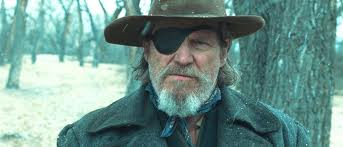 But for all its visual and thematic coherence, this version of True Grit is not without its problems. As on No Country, there is the simple problem of unintelligible dialogue. Jeff Bridges is a great actor, but Rooster Cogburn's accent and beard are so thick that you simply can't make out everything he says, at least not the first time around.
The film seems to assume some pre-knowledge of the dialect and that the viewer can paraphrase their way through conversations to get a general understanding of what is going on. But even though Bridges' delivery doesn't throw us off completely, it's still irritating when we consider how many potential zingers are hidden in this character. Furthermore, if we assume the dialogue is only supposed to be a guide, then surely that invalidates the Coens' desire for a more faithful adaptation: why attempt to be faithful to the source if you're not going to let all the words from the book be heard? Then there is the relationship which the Coens take towards their work. In their previous films, they have put their unique stamp on what are superficially straightforward stories, immersing themselves in the genre and characters and coming up with something genuinely quirky. Sometimes this makes their films distinctive, other times extremely grating, but even in their slip-ups there is a conscious decision-making which flows throughout every shot and line.
 The problem with True Grit is that the Coens' approach is much more stand-offish, in a way which detriments the film. There are big moments of full-on quirkiness which aren't in the novel, the biggest being the man riding through the woods wearing a bear costume, with a beard like that of the young wizard in Howl's Moving Castle. But these moments of full-fat Coens characterisation come few and far between, and they are so noticeable that all the stuff in-between starts to feel a little bit too ordinary. As much humour as there is in the conflicts between Mattie, Rooster and LeBeouf, the film never feels like it is pushing the genre envelope in the way that No Country or Blood Simple did.
 In the end True Grit is an interesting but incidental work from the Coen brothers. It doesn't have the full-blown original stamp of their other films, for better or worse, and is perhaps testament to the fact that filmmakers shouldn't always treat their source material with kid gloves. But as a piece of filmmaking outside, it is more stylish and better made than the original and the performances are all of a high calibre. If nothing else, it's a much better attempt at a remake than their botched look at The Ladykillers.
Rating: 3.5/5
Verdict: Enjoyable but hardly a full hand


