


Reflections
-
It is weird to read my correspondences from the late August/early September
period, being the time of transition between my old function in life to my
new ...
14 years ago
Fire in Babylon (UK, 2011)
Directed by Stevan Riley
Starring Clive Lloyd, Viv Richards, Michael Holding, Andy Roberts
More than any other form of documentary, sports films are often guilty of preaching to the converted. Through a combination of eccentric jargon, cliquey culture, off-putting aggression and economy with the truth, the majority of factual films about sport have no way in for the casual viewer. Fire in Babylon is an exception to this general rule, being a ramshackle but entertaining introduction to the West Indies cricket team of the 1970s and 1980s. The first success of Fire in Babylon is that it explains the appeal of cricket for West Indians, in a way which draws non-fans slowly but surely into the culture surrounding the game. Early on Michael Holding talks about cricket as the only activity which unites this small group of very different countries. He evokes scenes of young boys playing cricket on Caribbean beaches from the minute school ends until the sun goes down, painting an enticing if overly romantic picture of a sport too often associated with boring middle-aged Englishmen.
 But this is not a teary-eyed, rose-tinted documentary, extolling the spirit of cricket like characters from P. G. Wodehouse. Holding's comments about the beauty of cricket are immediately contrasted with the harsh political realities in the West Indies and the wider world. Holding and his counterparts were playing at a time when many Caribbean states were ruled by brutal dictators, not to mention the continued existence of apartheid in South Africa and the race-related violence in British cities.
 The film establishes a clear affinity between the West Indies' position as sporting underdogs and the accompanying racial struggle for independence and equality. It explores the persistence of imperialistic attitudes in culture, so that even after formal political independence, people from the Caribbean were still regarded as racially inferior. Where English players were revered as gentlemen, and Australians feared as long as they bowled quickly, West Indians were called "calypso cricketers", clowns who would entertain but always lose. They were the cricketing equivalent of The Black and White Minstrel Show, existing for the snooty pleasure of white men while bringing shame on their own culture.
 Nowhere does this prejudice come more to the fore than with Tony Greig's awful faux pas in the lead-up to the 1976 tour of England. Facing questions about the West Indies following their 5-1 win against Australia the year before, the England captain remarked: "If they're down, they grovel, and I intend with the help of [Brian Close] and a few others to make them grovel." The association of 'grovel' with the slave trade, the persistence of apartheid and the fact that Greig was a white South African turned a simple test series into a battle between historical masters and slaves, with the latter coming out firmly on top.
 Both as a political force for uniting black people and a sporting force in its own right, the West Indies challenged the imperial yoke by giving it a taste of its own medicine. The teams they faced were resoundingly beaten because the Windies were not expected to bowl so fast and so ruthlessly to what were considered the best sides in the world. As when Australia won the inaugural Ashes series in 1882, the West Indies shook cricket at its foundations, upsetting the natural order and asking big questions about the running of the game.
 Fire in Babylon credits the West Indies with helping to modernise the game, particularly in their involvement in World Series Cricket. This private three-way tournament, created by Aussie entrepreneur Kerry Packer, recruited cricketers from all over the world to play for big prize money with extensive sponsorship and media coverage. As well as introducing coloured kits and improved protection for batsmen, World Series turned cricket from a sport of "pot-bellied amateurs" into something which could be a full-time profession with proper training and an emphasis on fitness. The series, and the West Indies' approach within it, cut through all the old school, elitist customs that threatened to keep the game stuck in wartime, doing away with such pitiful traditions as a bowler applauding a batsman after being hit for six.
 From Stevan Riley's abundance of talking heads, a series of fascinating and entertaining characters emerge. Andy Roberts comes across as a man of immense passion, who is quick to defend their playing style from accusations of disrepute or unnecessary aggression. He talks about needing to not show weakness in front of the opposition, choosing to "take my aggression out on five-and-a-half ounces" rather than give in to pointless violence.
 Other characters within the side are equally gripping. Colin Croft comes across an ebullient, gleeful man who loved to represent his country and take revenge on big-headed batsmen. Watching Michael Holding play is beautiful and his dedication to the sport comes through in everything he says. Whenever South Africa is mentioned, it is as though a dark cloak has been drawn over proceedings, and he is quick to criticise players like Croft who signed up to lucrative rebel tours, where they were treated as "honorary whites"(!). Best of all is the enigmatic Viv Richards, who talks dolorously of staring down Dennis Lillee and treating his bat like a sword.
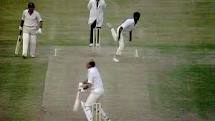 Fire in Babylon doesn't shy away from the pain involved in cricket, containing any number of wince-inducing moments. This was an age where cricket was played without proper protection in the way of arm and thigh pads; most players, Viv Richards included, faced down some of the world's fastest bowlers without a helmet. Riley includes a number of choice morsels, including Andy Roberts breaking David Hookes' jaw, David Lloyd copping one in the knackers from Jeff Thomson, and Michael Holding's lethal bouncers against Brian Close in 1976. Sadly we don't get to enjoy his extraordinary over against Geoffrey Boycott on the same tour.
 This leads to on to a major problem with Fire in Babylon, namely the lack of playing footage. While sourcing archive material for documentaries can be expensive, there must be more archive footage available, and a lot of it is old enough to be in the public domain. It's all well and good having loads of still photographs of the ball in flight, with little clips potted here and there, but when you have someone as graceful and threatening as Michael Holding, you want to see him in full motion, not being constantly interrupted by newspaper cuttings. The shortcomings of this film points to the greatness of Senna, a film which was not only mopre thoroughly researched but better stitched together.
 Fire in Babylon is also guilty of overegging its political pudding. While it does make very good points about racial attitudes and challenging stereotypes through dignity and humour, it is said so often that it becomes didactic. Sometimes it can feel like we are being lectured, with the same points being repeated so much that the film threatens to tip over into Malcolm X territory. The presence of Bunny Wailer, of Bob Marley & The Wailers, becomes especially tiresome: we become extremely annoyed with him even as we're agreeing with everything he says.
 The final huge problem is that the film has too many voiceovers or narrators. Having a lot of talking heads is fine, but the director has to step in and marshal them, either to construct a direct narrative or to present them in such a way that the audience can create their own. Riley falls simultaneously into two completely different traps: it's too inconsistent and jumpy to be narratively compelling, but it's also too broad and schematic to be believable. In the end he just about gets away with it, but the shortcomings remain in plain sight.
 Fire in Babylon is a flawed but important document of a sporting era whose repercussions are still being felt in contemporary cricket. Stevan Riley has better-structured, more comprehensive documentaries in him, and the problems with the film become all too obvious as the action moves forward. But this is still a pretty decent first stab at an important subject matter which will bring in the casual viewer. In cricketing terms, it's a solid half-century, and while its best shots are hampered by poor footwork, all signs point to a better second innings.
Rating:
Verdict: A decent first knock
Super Size Me (USA, 2004)
Directed by Morgan Spurlock
Starring Morgan Spurlock, Alexandra Jamieson
Cinema is full of food-related scenes which are guaranteed to turn one's stomach. We have La Grande Bouffe, in which rich people eat themselves to death; Peter Greenaway turning cannibalism into an art form with The Cook, The Thief, His Wife and Her Lover; and the famously gross Mr. Creosote sequence from Monty Python's The Meaning of Life. And now we have Super Size Me, Morgan Spurlock's appropriately queasy documentary which is up there with Touching the Void as one of the decade's best films.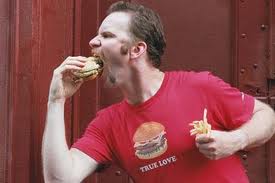 Super Size Me follows Spurlock as he attempts to survive on nothing but McDonalds for an entire month. The rules are simple: he must eat three meals a day, he can only eat what is offered at McDonalds, he must try everything on the menu at least once, and he must answer yes if offered a super-size meal. In between tackling his alarming diet, Spurlock is closely monitored by a small army of doctors, and the only exercise he undertakes is walking the same daily distance as an average American.
 Although it's an intensely personal, first-person documentary, the film has none of the self-obsession or navel-gazing which has dogged Michael Moore or later Nick Broomfield. For starters, Spurlock is a lot more likeable than either of these: we don't just enjoy his company, we get the impression that the film crew did as well. He is populist, rational and refreshingly self-effacing, in complete contrast to Moore who, in the words of Mark Kermode, seems mainly concerned with inflating his own ego.
 Furthermore, Spurlock is pursuing a subject matter of great importance but getting under the surface with a bigger intention than scoring political points. Where Fahrenheit 9/11 frequently went off the boil for the sake of making Moore look good, Super Size Me keeps its eyes on the prize, being thorough and comprehensive in its investigations. In one of its best moments, Spurlock gets under the skin of a spokesman from the Grocery Manufacturers Association, getting him to admit that the lobbyists he represents are part of the growing problem of State-side obesity.
 Like the films listed in the opening paragraph, there are a number of scenes in Super Size Me which make you want to throw up. On Day 2 of the challenge, Spurlock orders a Big Mac and throws up in the car park. The camera looks away as he does it, but then shows the horrid yellow mess left on the tarmac. Equally disgusting are the close-ups of the food before it enters his stomach; suffice to say, it's nothing like the pictures. Worst of all, about half way through we get to witness keyhole surgery on a gastric band operation, set to the main theme from The Blue Danube.
 Critics of Super Size Me have pointed to these scenes as evidence of the film's partisan approach. Their argument goes that since Spurlock didn't test other restaurants or brands of fast food, he has a particular grudge against McDonalds and is using the film as a form of propaganda. The camera's lingering on Spurlock's discomfort, or his claims about his sex life suffering, are means of manipulating people into boycotting one company rather than exposing deeper truths about the industry as a whole.
 While the documentary may paint a far-from-rosy picture of McDonalds, such criticisms are unduly harsh. Spurlock makes clear from the start that this is not a clinical trial or a hard scientific experiment. He chose McDonalds for the reason that it has the most outlets across America, with the largest number of customers, and therefore would provide a more representative sample than a study of any other single chain. The evidence produced by Spurlock is conclusive but not medically binding, which makes it all the more extraordinary when we discover in the epilogue that McDonalds has withdrawn its Super Size options.
 The documentary is very even-handed in a number of points that it makes. At one of the schools examined in the film, the students are given a presentation by Jared Fogle, who lost a large amount of weight by eating Subway sandwiches. The crew then interview a teenage girl who admires what Fogle has done, but who cannot afford to eat Subway three times a day. The positive goals which celebrities like Fogle are setting are as unhealthily unrealistic as the impossibly airbrushed bodies of girls in magazines. In terms of self-esteem among teenagers, role models of any kind are portrayed as doing more harm than good.
 Super Size Me identifies three areas in which there has been neglect, ignorance or cynical foul play with regard to the consumption of fast food. The first, unsurprisingly, is with McDonalds itself. Spurlock sheds light on the immense amount of money spent on advertising, which far exceeds the national budget for promoting healthy eating. The prevalence of TV advertising means that no parent, no matter how responsible, can guarantee their child isn't being poorly influenced, and individual McDonalds chains (at the time of making the film) are not displaying adequate levels of information about the nutrition content of their meals.
 The second area which has fallen short is the government. More recent documentaries such as Waiting for Superman have detailed the years of neglect and underfunding in the American state school system in a more thorough and comprehensive way. But Super Size Me does show how the use of outside food contractors to provide school meals has led to a race to the bottom, in terms of price and in terms of quality. So much of the food served in schools requires no preparation other than reheating, and because the choices are limited children are brought up to accept nothing better, let alone healthier.
 But thirdly, Super Size Me has the balls to point the finger at the individuals who consume McDonalds so frequently. Having made a very solid case against fast food companies and lobbyists, and spoken about the frightening extent of fast food advertising, the film concludes by saying that it's as much down to us not making the effort as it is the society in which we are constantly exposed to such food. This might seem like a cop out, considering how much righteous anger the film generates through its arguments against the industry. But it is refreshing that a documentary has the balls to 'blame' the public without guilt-tripping them in the process.
 On top of everything else, Super Size Me is a very entertaining piece of work. As well as making you feel angry or sick, there are at least as many moments in the film which will provoke laughter - and genuine laughter at that. Hearing Spurlock's girlfriend talk about their disappointing sex life is hilarious; she comments, for instance, about how she always has to be on top since he started his diet. On the day that we see him throw up, Spurlock cracks jokes about the side effects of fast food on his system, muttering about "Mc-twitches" in his arm and other such complaints. Such scenes are pleasant interludes which make the experience more bearable and counteract any negative feelings we may have, e.g. shouting at Spurlock to stop it, lest he should kill himself.
 Super Size Me is a great example of populist documentary filmmaking which is a near-perfect balance of entertainment and information. Its impact will be greater the less one knows about fast food in general or McDonalds in particular, and many may be bothered that it doesn't go into enough detail when it needs to. But as an introduction to a subject which many have barely considered, it is both admirable and successful. One hopes that Spurlock's latest film can emulate both of these qualities.
Rating:
Verdict: En-gross-ing
Senna (France/ UK/ USA, 2011)
Directed by Asif Kapadia
Starring Ayrton Senna, Alain Prost, Frank Williams, Ron Dennis
Innovation and artistic value are not properties which disappear when a genre enters the mainstream, and nowhere is there more evident than in documentaries. There are copious examples of recent efforts which have found a relatively wide audience while pushing the genre envelope, from Kevin Macdonald's nail-biting Touching the Void to more introspective works like The Arbor and Of Time and the City. Continuing this trend is Senna, a really great documentary which could be one of the year's best films. Senna is a documentary about the late Formula 1 racing driver Ayrton Senna, which is constructed entirely from archive footage of him. This incorporates TV race coverage, press interviews, TV appearances in Brazil, behind-the-scenes footage and family home video. Although other voices appear over the footage, there is no consistent narration to impose a particular version of events over what we see. Senna is allowed to tell his own story, like he is reading from pages of a diary which switches between the first and third person.
 One of the instant advantages of this approach is that Senna avoids the cliché of the talking head. These are individuals connected with the subject or more contemporary commentators, whose often platitudinous insights can drag even the best documentary into tedium and mediocrity. But just as Julien Temple's rock documentaries have sought to capture the feel of a band rather than just what people have said about them, so Asif Kapadia makes us instantly immersed in the character of Senna as he saw himself, rather than just the reputations he accrued.
 Another coup of Kapadia's film is that it makes the televisual cinematic. Normally when TV footage is put on the big screen, it looks out of place because of a difference in aspect ratio or frame rate which breaks the flow. But Kapadia does not let this happen, blowing up the footage very carefully and reframing key scenes so that we zoom in on the characters' faces and emotions. The pace of the film, both as a thrill ride and a piece of storytelling, keep any technical quibbles out of our minds, so that even when the footage is grainy or incomplete, we don't complain.
 Senna explores a number of themes related to racing driving and the personality and attitudes of the drivers therein. There is a repeated mention of "real driving", the pure sensation of driving for its own sake, in which the goal is not simply winning but winning through pure talent and passion alone. It is this pure devotion to what he loves that made Senna stand out from the other drivers, and which led him to become a national hero in his home country of Brazil.
 Senna's complaints about racing technology mirror concerns in the sport as a whole, and comment on how the nature of Formula 1 has changed since he started racing in the 1980s. The tipping point comes in 1992 when Williams introduce new suspension technology on their car; at this point Senna's form begins to decline because he cannot adjust his pure style of driving to technology designed to make the driver do less work.
Within this there is a comment on how technology determines not only the style of racing but also the personality of the driver. In the middle of the film there is a conversation between Senna and Jackie Stewart, in which they talk about the changes in technology and how that has affected the flair of different drivers. The implication is the less there is for a driver to do in a race, the less there is for the driver to be, with said individuals hiding behind endorsements and statistics in the absence of real, passionate charisma. This difference in approach is further communicated in Senna's bitter rivalry with Alain Prost. Senna races with a pure spirit and an often reckless urge to win at any cost - he is not content to play the political games and he never does it for the money. But Prost, who is nicknamed the Professor, is content to play those games and drive according to mathematical calculations - if he can win a championship by staying in fifth, he will stay in fifth.
 Much has been written about how Prost comes out as the villain of the film, and it is undeniably true that at the height of their respective careers both men hated each other. But in fact, their relationship is far more complicated than simple rivalry. Beneath the public scrapes involving crashes and back-chatting, there is some form of mutual underlying respect which these men retained throughout their careers. In spite of completely different styles and attitudes, both men were willing to acknowledge the other's talent, which might explain why Prost currently serves as a trustee for Senna's charity.
 If we wish to paint the documentary purely in terms of heroes and villains, then the true antagonists are the Formula 1 regulators. The film examines the conflicted and clouded politics of professional racing and how the rules designed to make racing fair and exciting often go against the very things the drivers (or at least Senna) want. In one sequence, the FIA President Jean-Michel Balestre emphasises a particular regulation, only for the majority of drivers to vote against upholding it. In another, there is a heated disagreement about racing lines on the starting grid which leads to a spectacular crash involving Senna at the start of a race.
 But although Senna focuses on the physical effort and talent involved in racing, an equal amount of its focus is on the spiritual aspect of the sport. Senna was a devout Roman Catholic who prayed to God before each race, and who believed that God had called him to drive this fast and in this way. The way Senna talks about God often drifts in Chariots of Fire territory, so that you almost expect him to say: "when I drive, I feel his pleasure". But the documentary also shows that this relationship was not straightforward; the first time Senna feels God's presence, he crashes at Monaco, throwing away a huge lead and losing the race.
 Because the outcome of the subject is widely known, certain moments in Senna take on an eerie quality so that they become harbingers of his tragic death. When he goes on Brazilian TV after becoming world champion, a girl kisses him and wishes him a happy new year for every year up until 1993, the year before he died. In 1991 he talks about having many years ahead of him and still so much to achieve. Like Amazing Journey, the film touches on the possibility that certain individuals are so prodigiously talented that they were not put on this Earth to make old bones. And like Keith Moon, Senna's death was both a tragic accident and something to be expected by the way he lived his life.
 Even if you're not a fan of Formula 1, or particularly interested in the spiritual side of sport, there is more than enough in Senna to get your heart racing. Some of the racing footage is genuinely scary, as cars pass within inches of each other through corners and the on-board cameras give you a sense of speed with wider shots would not. Senna's driving throughout is extraordinary, and in appreciating this we follow his emotional journey. We feel his intense anger at being disqualified from the Japanese Grand Prix in 1989, and both his joy and immense pain after having won in Brazil in 1990 despite having to drive the last few laps in a single gear.
 There are aspects of Senna's life which remain absent from the documentary, such as his relationships with women and his influence on popular motoring, such as working with Honda on the NSX. But all in all this is a great documentary which is gripping, insightful and highly emotional. It does justice both to the man and to the ideals for which he stood, while leaving plenty of things open to interpretation. Like Senna himself, it is accomplished, thrilling and ultimately heart-breaking.
Rating:
Verdict: One of the year's best films
Amazing Journey: The Story of The Who (UK, 2007)
Directed by Murray Lerner & Paul Crowder
Starring Roger Daltrey, Pete Townshend, John Entwistle, Keith Moon
Like any kind of biographical project, rock documentaries have the potential to be nothing more than exercises in ego inflation. When The Who's first film, The Kids Are Alright was released, Roger Daltrey sold it on the basis that it made the band look like "complete idiots", commenting that The Song Remains The Same was made "for the sole purpose of making Robert Plant's dick look big."
Amazing Journey is a natural companion to The Kids Are Alright, covering much of the same ground in a more detailed and serene manner, as well as providing some much-needed coverage of the band's activity after the death of Keith Moon. It is the weaker and less engaging of the two films, but newcomers to the band will find much that is engrossing or entertaining, while existing fans can revel in all the new footage on offer. When making a documentary about a famous band, it would be very easy to just regurgitate all the most famous anecdotes, intercut with their greatest hits. And considering all the things Keith Moon did in his life, you could have filled up the two hours with an exhaustive list of every last prank. But Amazing Journey rarely falls into this trap, and when it does approach stories of cars being driven into swimming pools or drum kits being blown up, it makes some effort to clarify the facts rather than just revelling in the myth.
 The film is very well-researched, drawing on a variety of sources to tell the story of The Who. Alongside a series of interviews with surviving members Roger Daltrey and Pete Townshend, there is footage of the band's TV appearances, live performances at Charlton and Kilburn (which featured in The Kids Are Alright), and various clips from their promotional videos and forays into filmmaking. In certain sections animation is employed - for instance, the cover art of A Quick One is animated while Townshend's mini-opera is discussed.
 The most interesting section of the film, for both fans and newcomers, is the opening section up until the arrival of Keith Moon in early-1964. This section explores the genesis of The Who's unique sound, describing the musical landscape of 1950s Britain and the young musicians' relationship with London skiffle and American blues. It may be a cliché to describe life in 1950s Britain as being in black-and-white, and to set the scene by showing footage of bombed buildings. But through this section you come to understand the band's initial fire and fury, and how much of their music was a reaction against 1950s culture, both musically and socially.
 One of the coups of the film is the 8 minutes of footage of the band, then called The High Numbers, performing at the Railway Hotel in London in 1964. This footage is interesting both for its rarity and for capturing the band on the brink of finding their own sound and thereafter success. Daltrey is still singing blues covers in a style somewhere between Lonnie Donnegan and John Lee Hooker, but all the other ingredients are beginning to come through: Moon's exuberant drumming, Townshend's jagged power chords and John Entwistle's complex, jazzy bass lines.
 Amazing Journey is far from a po-faced affair, with plenty of laugh-out-loud moments to keep us entertained. It's hard not to chuckle when John Entwistle likens their label-mate Jimmy Hendrix, or Pete Townshend impersonates the Beach Boys with equal amounts of playfulness and vitriol. And then there is the montage of Moon's various incarnations, ranging from a pirate to an SS officer and a Dickensian money-keeper.
There is also a lot of self-deprecation on the part of Townshend and Daltrey. While the former occasionally covers himself in glory, describing himself as "on the edge of things" and calling Quadrophenia "magnificent" (which it is), Daltrey is much more understated and welcoming. His posture throughout interviews is downbeat, frequently holding his hands near his face and at points being close to tears. He's not asking for sympathy, but nor is he reigning himself in to play to his stereotype of being the band's hard man. This sense of self-deprecation helps to partially mitigate one of the problems of Amazing Journey, namely the chumminess of its outside contributors. The film features contributions from The Edge, Noel Gallagher, Eddie Vedder and Sting, all of whom makes no bones about their adulation of the band and its influence on their own music. Some of them have direct connections with the band - Sting played the Ace Face in Quadrophenia and Gallagher performed with them in 2000. But for all The Edge's knowledge of 1960s music, he doesn't have a lot to contribute, and Vedder frequently resorts to platitude to praise his heroes.
 There are other problems too. Firstly, there is the question of whether or not it is cinematic; the film had a very short theatrical release before being released as a 2-disc DVD set. It may be a consequence of seeing the same clips being endlessly repeated in TV documentaries, but portions of Amazing Journey do feel like they are more at home on the small screen. The directors use an interesting device to get around this, namely structuring the film like a double album; the film stops to turn the record over, and the footage occasionally skips and distorts like sound on a scratched LP. But about halfway through this device is phased out and the niggling feeling remains in your mind.
From a fan's point of view, the film does begin to canter through the history after 1975. It treats the later works and the gaps between reunions rather more brusquely, when in fact there is some interest in exploring the various behaviours of the band outside The Who. We get a mention of Moon's drunken exploits in 1974, but it completely glosses over his fledging film career and the band's various solo efforts. You can understand the filmmakers wanting to keep the running time down, and the need for the film to play to a mainstream audience, but long-time fans of the band will still feel like this was a missed opportunity. The overarching problem with Amazing Journey, however, is that it is a little too civilised for its own good. It doesn't have the raw, shambolic energy of The Kids Are Alright, so that even in the bits which are laugh-out-loud funny, or which feature Townshend being outrageous, it feels a little too reigned in to properly capture the atmosphere of the band. There is an argument for shooting in a more serene style, since some of the band's energy has waned and both surviving members are a lot older and wiser. But the recent footage of the band touring Endless Wire throws the former claim into question, so that while the film is engrossing it is also frustrating.
 Amazing Journey: The Story of The Who is a well-made and informative attempt to catalogue the highs and lows of one of the world's greatest rock bands. The sheer amount of archive material gives it a comprehensive feel, and as an introduction to the band it is very accessible and entertaining. But long-time fans of the band may be disappointed in places, both in the lack of coverage post-1982 and in the calmer style of presentation. It's good but not great, and definitely not The Kids Are Alright.
Rating: 3.5/5
Verdict: A good introduction to a great band
Stop Making Sense (USA, 1984)
Directed by Jonathan Demme
Starring David Byrne, Tina Weymouth, Jerry Harrison, Chris Frantz
There's a line in School of Rock where Jack Black talks about rock-and-roll being killed by "a little thing called MTV". The aesthetic sensibility of MTV (rapid cuts, flashy close-ups and rampant product placement) was at odds with the more elaborate, experimental end of rock which reached its peak in the 1970s. How ironic, then, that as said channel reached its peak, a concert film should come along which completely rejected the pop video aesthetic and redefined an entire genre. Where Gimme Shelter and The Last Waltz captured the ends of their respective eras, Stop Making Sense is a showcase for Talking Heads at their artistic and musical peak. It is also the film which put Jonathan Demme on the map; seven years later, he would win five Oscars (including Best Director) for The Silence of the Lambs. But looking at the film twenty-six years on, there is something faintly elegiac about it. It contains none of the vapid self-promotion which has dogged more recent concert movies, from Shine a Light to Rattle and Hum.
For a film about looking at a group of musicians for ninety minutes, Stop Making Sense is surprisingly cine-literate. The opening credits, with its elongated blank-and-white font, is an obvious reference to Dr. Strangelove (fittingly, since they were designed by the same man). David Byrne's 'machine gun stagger' across the stage during 'Psycho Killer' is a nod to the death scene at the end of A Bout de Souffle. More than that, though, the film is genuinely cinematic in a way that concert films very often aren't. Demme has always been an unfussy, understated director, and his camera is always keeping up with the players rather than the other way around. He possesses great technical know-how, knowing what to put the camera and how to shoot a performance so that the actors (or musicians) can just do their thing. Despite the level of meticulous planning that went into the tour, you get a real sense of kinetic energy existing on stage, something that a fussier director would quickly undermine.
Stop Making Sense is a showcase of Talking Heads at their very best, shortly after the release of Speaking In Tongues had brought them screaming into the mainstream. Their song-writing and musicianship is superb, producing a series of really catchy, rhythmical songs with ample room for improvisation. While later albums were dominated by David Byrne, here it feels like all four members are on the same page, working towards the same ends. But you don't have to be a fan of Talking Heads to understand just what makes this moment in their career so special. For one thing, the film demonstrates a rare level of confidence and exuberance which is absent in so much of modern music (read closely, Lady Gaga: 'confidence' and 'shock value' are not the same thing). Normally it is considered anathema for stage crew and roadies to share the stage with performers, unless there was an urgent technical problem that needed attention. But in Stop Making Sense, the stage crew are on for much of the first half, moving around equipment in the middle of songs; the band play on regardless, and even bring them all on at the end as a thank-you gesture.
 And then there is David Byrne, who in this film is confidence personified. Byrne has always been a charismatic front-man, but here he is positively hypnotic right from the opening. His jerky head moments, powerful voice and frenzied eyes lead you to focus only on him; during 'Psycho Killer', he holds the whole Pantages audience right in the palm of his hand. When he dances, his body moves like it's made out of plasticene, capable of being bent in all directions in perfect time to the music. His energetic repertoire ranges from doing laps of the stage being chased by a searchlight ('Life During Wartime') to cradling a lamp in his arms ('Naïve Melody (This Must Be The Place)'). And then there is 'the big suit', inspired by Japanese noh theatre, which is quite simply too cool for words.
 The film contains a number of interesting creative decisions which both add to the impact of the concert and make the film more cinematic. Stage crew notwithstanding, the band come on one at a time, only reaching full strength during 'Burning Down The House'. This is a great decision because it highlights the individual talent of the musicians, and creates some form of narrative thread without resorting to pretentious prog rock narration.
Byrne was very keen that there be as few distractions on stage as possible, to focus both the performers and the audience. To this end there are no water bottles, which could reflect the light, and all the amplifiers and musical branding have been painted over in matte black. There is also no coloured lighting, with Demme and cinematographer Jordan Cronenweth using several interesting means to get around this. During 'Once In A Lifetime', Byrne is lit up while the rest of the band are in darkness, and in 'Girlfriend Is Better', a technician walks around with a portable light, steadily moving turning instrument (and the big suit) into a series of creepy shadows. But the biggest innovation of Stop Making Sense comes in the relationship it strikes up between performers and audience. There are very few shots of the Pantages' crowd until the very last song of the show, and the recordings of their applause is turned down and pushed to the bottom of the mix. This makes the whole film feel incredibly intimate, like it's just you and the band having a long chat.
In something like U2-3D, the audience are put in the middle of a cheering crowd; their vision is obscured by waving hands and bobbing heads, and the experience is deeply claustrophobic. A show like this resembles an elaborate worship ceremony, with the band 'playing God' and inciting frenzied belief among those who have entered the temple. In Stop Making Sense, you still get the atmosphere, but everything is more settled and understated. While U2 fight to the last man for appreciation, Talking Heads know how good they are: they have nothing to prove, which means everyone can relax and just enjoy the music. There are a couple of false notes which undermine the film's status as "the Citizen Kane of the concert movies". The first is the very common mistake of mismatched film and audio. Because the film was shot over three nights, there are a number of amusing continuity errors - for instance, Tina Weymouth's bass keeps changing colour. More troublingly, Chris Frantz will sometimes hit a cymbal, or a guitarist strike a chord, and no sound will come out. This is partly understandable given the arrangement of microphones, but for purists it can very be annoying.
The other issue is perhaps more petty, and that is the appearance of The Tom Tom Club, the spin-off band of Tina Weymouth and Chris Frantz. Midway through the second half, they come on to perform 'Genius Of Love' while Byrne goes off to put on the suit. You can understand this decision logistically, but the song itself is quite weak. Tina Weymouth's natural range and calm delivery is at odds with the prominent funk percussion and Frantz' powerful backbeats; it's like the singer from The Party trying to compete with a Brazilian samba orchestra.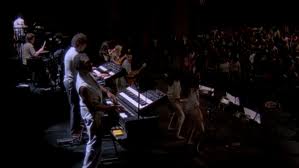 Despite these niggles, Stop Making Sense remains a remarkable piece of work, both for Demme and for Talking Heads. The fact that the band never toured again after this cements its status, and confirms its importance as a document of just how good they were. All of Demme's subsequent concert films, including the excellent Prairee Wind, owe a debt to this film, and it raised the bar for all concert movies to follow. Most of all, it proves the value of the music even to people indifferent towards the band, and for that feat alone it deserves the highest praise.
Rating: 4/5
Verdict: Intimate and innovative


