

Reflections
-
It is weird to read my correspondences from the late August/early September
period, being the time of transition between my old function in life to my
new ...
14 years ago
Cronos (Mexico, 1993)
Directed by Guillermo del Toro
Starring Federico Luppi, Ron Perlman, Claudio Brook, Tamara Shanath
Well before the 'abstinence porn' of Twilight began to hit our screens, a whole wave of vampire films in the 1990s returned to the deep well of sex which had become the lifeblood of vampire fiction. We had Anne Rice's AIDS allegory Interview with a Vampire, John Landis' uneven crime drama Innocent Blood, and of course Francis Ford Coppola's bonkers version of Dracula.
But in the midst of these hypersexual offerings, a small Mexican film from a first-time director was helping to radically reshape the genre. Cronos, the debut by Guillermo Del Toro, demonstrated that vampire fiction could explore themes far more varied than sex, such as the fear of death, the loneliness of old age and the relationship between Mexico and the USA. A hugely influential work of horror cinema, it is every bit as striking and significant as Let The Right One In. When I reviewed The Usual Suspects, I remarked that one test of a good filmmaker is being able to take a hackneyed series of conventions, and create something which is both memorable and mindful of its genre origins. On this level alone Cronos is a triumph, since it is able to fulfil all the requirements of being a bona fide vampire film which approaching all the key plot points and characters arcs from distinctively unusual angles.
 Cronos may have a backstory about the origins of the vampire, followed by the introduction of our protagonists to said bloodsucker which results in quite a lot of gore. But Del Toro manages to achieve this while removing from the story all connotations of sex or lust. In place of Hammer's heaving bosoms and phallic fangs, he gives us skin peeling like wallpaper and the intricate clockwork of the Cronos device. The closest the film comes to anything sexual is a scene of Federico Luppi licking a nosebleed off a bathroom floor, which is shot with such clinical precision that there can be no room for erotic thoughts.
By refocusing the story around ageing and the fear of death, Cronos hits on the central dilemma in vampire fiction: would you rather live forever but lose your soul, or stay pure and human but live in constant fear of death? Both the elderly characters in the film choose the former, albeit for different motives and by entirely different means. Dieter, the dying businessman, makes a conscious decision to pursue the device: he owns the manual needed to operate it and believes it is the only thing that can keep him and his empire alive (and out of his nephew's hands). Jesus, on the other hand, is 'bitten' accidentally, and only comes to use the device frequently through observing its physical benefits. His desire, in the form of addiction to blood, is every bit as strong as Dieter's desire to possess the device himself, but it is not motivated by selfishness or a desire for power. Like Dracula, Jesus becomes weary of eternal life: he is worn down not by an army of brides, but by the constant torment of those who are jealous of his powers. In the end his remaining sense of self triumphs over the vampire he has become, and he sacrifices himself to protect his beloved granddaughter.
The theme of ageing is also conveyed in the visuals of Cronos. Guillermo Navarro's cinematography is very washed-out, with dark woods and fading reds to indicate how everything around the characters is very slowly dying or decaying. Even the brightest scenes in the film, like the New Year's party, are filled with pale colours and make use of shadows wherever possible. Beyond its direct connections with the vampire genre, Cronos is connected to other key figures in horror. The design of the Cronos device itself, with its peculiar blend of biology and mechanics, resembles the work of Clive Barker: its design as is intricate as the puzzle box in Hellraiser and there is the same suggestion of great evil being contained in or brought forth from something of great beauty.
 There are also connections with John Carpenter in the film's elaborate and highly convincing make-up. Del Toro's training under make-up artist Dick Smith shines through in his pursuit of organic, physical terror, and the work of his make-up artist M. Carrajal rivals anything which Rob Bottin achieved on The Thing. There is a further connection with Carpenter contained in a line where the device is dismissed as "just a toy". Like Carpenter in Hallowe'en, Del Toro is taking an aspect of horror which had become institutionalised and accepted, and proving that it could still scare you to death.
 Cronos is a deeply religious film, in its use of iconography and its exploration of the meanings to both life and death. Again, this is drawing on a classic trait in vampire fiction, namely that the act of being or becoming a vampire is a rebellion against the laws of nature (including death), which it was believed were set in stone by God. Though there is no scene of Jesus declaring war on heaven, as happens in the Coppola version, his faith is counterpointed by his growing dependence on the device, as demonstrated by him reciting the Lord's Prayer while allowing it to stab him a second time.
 There are other indications of these religious themes as well. The Cronos device was created by an alchemist, someone who brought the material and spiritual worlds together, using what became the scientific method to find the divine substance which could cure all disease and prolong life. The images of cockroaches bursting out of angels, or the device being hidden in said statues, hints at the threat which such a device poses to Christianity. By removing the certainty of death, it undermines the corresponding fear of death and damnation, and therefore makes it less necessary either to repent or to live a moral life.
 To add to its theological wrangling, Cronos also has political connotations. The film is a rich allegory for US-Mexican relations, in which America is the bloodsucker which takes without asking and refuses to yield. Dieter, the American, is determined not to let the Mexicans (in the shape of Jesus) get one over on them - the second they come up with something useful, the Americans want it for themselves and won't take no for an answer. There is a contrast between Federico Luppi's sympathetic, caring grandfather and Ron Perlman's aggressive and ambitious nephew. Perlman may slip in and out of Luppi's language, but he is only interested in himself - it is not communication, only giving orders in a language he thinks they can understand.
 The performances in Cronos are mostly of a high quality. Luppi is a great screen presence, seeming frail and vulnerable while coming across as a strong and determined character. Perlman, in his first of several collaborations with Del Toro, is a very fine match for him. His versatility with language is matched only by his desire to throw himself physically into the role. The only weak link is the young girl, played by Tamara Shanath. It isn't so much her performance as the limited extent of her character's development; we don't feel as strongly connected to her as we do with her counterparts in The Devil's Backbone or Pan's Labyrinth.
 Cronos is a great debut feature from one of horror's greatest directors. While not as perfectly formed as Pan's Labyrinth, it contains all the hallmarks of Del Toro's genius, from its powerfully unique visuals to its constant invention and intelligence even in the most trivial of moments. It's a top-notch chiller and a welcome shot in the arm for vampire fiction, proving that the genre is still able to stimulate as well as scare. It's not Let The Right One In, but it should be welcomed into anyone's collection.
Rating:
Verdict: Creepy, chilling and very clever
Memento (USA, 2000)
Directed by Christopher Nolan
Starring Guy Pearce, Carrie-Anne Moss, Joe Pantoliano, Stephen Tobolowsky
Long before his reinvention of the superhero genre with Batman Begins; long before he conjured The Prestige onto our screens; long before Inception even existed in a dream, Christopher Nolan was proving his worth as a director. Having garnered critical attention for his debut feature Following, Nolan sets its sights on his brother Jonathan's short story, Memento Mori. Eleven years on, it remains one of the most audacious thrillers in recent memory. Nolan's films have often been criticised for being cold or clinical, being too focussed on ideas or concepts to be interested in the characters. While this has been emphatically disproven with regard to his subsequent films, the opening 20 minutes of Memento are a little too mechanical. Some critics complained about the film's reverse chronology being little more than a gimmick, and certainly if all the colour sections had played literally in reverse, the film would have quickly become annoying. While such accusations are misplaced, this section of the film does seem more concerned with establishing a structure than with introducing a story.
But once we are in the zone and understand how the film is going to work, Memento is never short of fascinating. Like many films associated with time travel or disparate memories, the big reveal happens in the middle (or so we think). But the film's deceptive chronology keeps pulling us in, forcing us to think if we want to keep up and rewarding our detective work. As in The Prestige, Nolan allows us to revisit scenes and places which we thought had run their course, and shows us that little bit more that makes all the difference. Telling the story of Memento in reverse is not simply a gimmick, designed to cover a deceptively simple story of revenge. Instead it challenges one of the deepest foundations of the thriller, namely the linear progression of suspense. In one sequence, when his wife is in bed re-reading a book, Leonard says: "I thought the real pleasure was in wanting to know what happens next." Memento completely inverts this idea, making us want to find out what happened before and allowing us to share in Leonard's disorientated state.
 On top of this emotional inversion, Memento twists the age-old principle of Chekhov's Gun. Chekhov's Gun states that no prop or device shall be introduced unless it is going to be used at some point: if there is a gun on stage in a play, it must be fired at some point, otherwise there is no point in it being there. In Memento, however, the question is not so much what each prop is for as to how it got on stage in the first place. If there is a Polaroid of someone or a name scribbled out, we want to find out how, when and why it got there. We (mostly) know what these props are for, but how they came about could make all the difference.
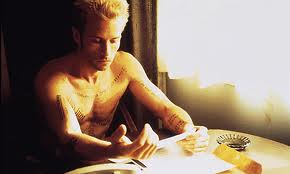 Memento is often cited by film theorists as a demonstration of the difference between plot and story. The distinction, put simply, is that the plot is a logical progression of events from A to B, while the story is what these events are ultimately about. In this case, the plot involves Leonard waking up in a motel, meeting various characters, and shooting Teddy. But it is the story of Memento, namely its exploration of memory and revenge, which is the thing which keeps us glued to the screen.
In approaching the subject of memory, Memento begins by making a distinction between factual and emotional memory. Leonard talks about learning by routine, relying on facts to determine his actions and tattooing them onto his body. Emotional memory, the memory of how an event or moment felt, takes a back seat to cold rationality. But as the film moves on it becomes clear that this distinction is at best ill-defined and at worst completely redundant. Leonard talks about memory being essentially impressionistic - the memory we have of an object or event is not an actual picture of it, but something we have created, changing anything from the colour of a car to the whole time and place when it happened. Even the photos on which Leonard relies are subject to manipulation and can be burned should his desires lead him to believe they are unessential. This, combined with the climactic twist and his recurring mention of 'instinct', raises the question of whether we really know or experience anything real.
 In terms of its character content, Memento could be called the acorn from which the mighty oak of Inception grew. Apart from their aesthetic similarities (both being expertly shot by Wally Pfister), both films have a central character whose actions are driven or dominated by the memories of his dead wife. Although Leonard's wife is a much gentler creature than Mal and has much less screen time, there is the same idea of creating new worlds from memories as a way of dealing with or attempting to escape reality (whatever that is). While Inception is more successful and adventurous in conveying this concept, all the groundwork for Cobb's dreamscapes is to be found in Leonard's decision-making.
 Memento is also further proof of the hardiness of film noir, showing just well how its techniques and archetypes have persisted and retained their relevance. Where previous neo-noir efforts like Blade Runner borrowed most from the genre's visual poetry, Nolan takes the convention of the unreliable narrator to its most extreme conclusion. Just as Deckard is increasingly unsure who may or may not be a replicant (or indeed, whether that really matters), so we find ourselves unravelling with the story until, in Teddy's words, "you can only remember the things you want to be true".
 This brings us on to the final scene in which the timelines merge and we are left utterly baffled by what we have seen. Teddy's line is the pivotal phrase in the film, capturing as it does both the film's message about memory and the motivations of the various characters. In Teddy's case, it is an indication of corruption, a desire to solve cases and create something certain even if the outcome isn't true: as he says, "there's plenty of 'John G's for us to find."
For Leonard, however, the line reveals something darker. Having believed all along that Leonard was in the right, we are faced with the possibility that our tragic hero may in fact be a monster. Either his version of events is true, in which case his wife was murdered and Teddy gets what he deserves - or Leonard killed her, and is now wandering the earth killing people to fit with his twisted version of events. Most chillingly, Nolan leaves it to us to choose, handling his material with more subtly than American Psycho and leaving us genuinely unnerved. Memento is a truly great film with a twist and subtle touch which makes The Usual Suspects look like total child's play. Its intense examination of memory, morality and revenge is counterpointed by slick visuals and great performances, including a career-best turn from the eternally underrated Guy Pearce. It isn't quite a masterpiece, being neither as multi-stranded as Inception nor as mesmerising as Mulholland Drive. But whichever version of events you choose to believe, its greatness cannot be disputed.
Rating:
Verdict: Memorably marvellous
The Usual Suspects (USA, 1995)
Directed by Bryan Singer
Starring Kevin Spacey, Gabriel Byrne, Stephen Baldwin, Benicio Del Toro
All Bryan Singer films are deeply unsure of themselves: they attempt to marry several conflicting elements while never quite deciding what they want to be. Superman Returns can't decide whether it wants to be dark and moody like Batman Begins or a nostalgic throwback to the earlier films. Valkyrie flits between a romping B-movie about Tom Cruise blowing up Hitler and an intense character study about what it means to betray your country. And then there is The Usual Suspects, which claims to be the heist movie with the ultimate twist, but ends up as the ultimate disappointment. When making a genre film or any kind of homage, there is a very fine line between playing with conventions and coming across as completely unoriginal. The ingredients of a heist film are among the most familiar and formulaic in cinema: the assembly of a team, typically for one last job, the heist being planned and executed, and then something going horribly wrong. One of the tests of a good filmmaker is being able to take a very cliché-ridden subject and do something interesting and memorable while being fully mindful of generic constraints.
 There are two main ways to make a good heist film in the modern day. The first is to take a particular convention and break it. In The Ladykillers, the heist is barely planned and takes place off screen, with the majority of the film being focussed on the gang unravelling at the hands of Mrs. Wilberforce. The second is to use audience familiarity with conventions to one's advantage, using the heist as a springboard to explore something else. Inception may have a heist structure, but the actual crime which Cobb commits is only as important as the ideas surrounding it - the nature of dreaming, the fracturing of identity, the consequences of addiction and the pain of losing one's love.
From a purely mechanical point of view, The Usual Suspects is a very well-made heist film. All the pieces of the plot fit together very well: there are no gaping holes in either Kevin Spacey's account or the various encounters which persuade Gabriel Byrne to come on board for the big job. And taken in abstract, the final twist is fairly impressive. It's not a million miles away from the silly ending of Shattered, but it's carried with suitable grace and doesn't feel like an unnecessary contrivance, crowbarred in to bring the film to a speedy conclusion. But here, already, we have the central problem with the film. The Usual Suspects may be mechanically sound, but it is so obsessed with being mechanically sound that it never allows you to bond with what is going on in the meantime. Singer spends so much time and effort ensuring that we go through the motions in the slickest way possible, that the actual characters become increasingly superfluous.
By keeping the characters at arms' length from the plot, a barrier between the story and the audience is created. Whenever the screenplay attempts to invoke ideas about the nature of evil, or fear, or the power of will, these ideas are quickly passed over or shot down as the film demands to keep pressing forward. Potentially fascinating explorations of the nature of underground crime are suppressed in favour of the next irrelevant plot point, making The Usual Suspects a decidedly hollow experience. If we compare Singer's efforts to that of Quentin Tarantino in Reservoir Dogs, the significance of this problem becomes apparent. Like The Usual Suspects, Reservoir Dogs is a straightforward heist film whose distinctions are structural rather than aesthetic. But unlike Singer, Tarantino's work not only knew its place within a genre: it knew that the audience knew its place as well. By giving the audience a degree of certainty, Tarantino could get away with his outlandish dialogue and shuffled timeframes which would otherwise have thrown the audience a bigger curveball.
 To use the analogy of a circus, Reservoir Dogs is like a show at the big top in which everything happens as expected, but always with a flourish. Instead of just a trapeze act, we get a trapeze artist doing triple somersaults - and instead of gangsters simply talking about the heist, we get them to dissect the meaning of Madonna's 'Like A Virgin'. The Usual Suspects is like a circus show in which the ringmaster is so keen to hurry the acts along that we have no time to admire them, and all that is memorable is the huge poles holding up the tent.
 You only have to look at the characters to realise how much talent has been squandered here. The five 'usual suspects' are all quirkily drawn, whether in their dress sense, their accents or the way they conduct themselves within the group. Christopher McQuarrie's screenplay contains a number of potentially great scenes, laden with distinctively macho dialogue and criminal posturing. But the more time we spend in their company, the more you come to realise that they are quirky for its own sake: there is no narrative reason for Benicio Del Toro to speak like that. They are little more than archetypes in new suits, and like later Tarantino works, you are never convinced that any of them could really exist.
Without properly three-dimensional or believable characters, or much direction beyond rigidly following a formula, the one thing that could have saved The Usual Suspects would have been some kind of moral clout. Both this film and Se7en are thrillers in which the villain is prominent, or at least has a prominent presence which hangs over everything that unfolds. But what made Se7en work, aside from David Fincher's distinctive visuals, was its ability to make subtle contemporary moral points while honouring an old-fashioned hardboiled storyline. The Usual Suspects has the potential - that word again - to have this exact kind of moral clout. The character of Keyser Soze, a criminal who operates underground through oblivious associates, is an intriguing creation which carries meaning about the way that evil infiltrates society. Kevin Spacey's long monologues contain references to the Devil and vengeance on a genuinely Biblical scale, painting Soze as a man that would make even Hannibal Lector flinch. But again, the film never allows these ideas to come out beyond brief suggestions - suggestions which are barely elaborated upon by either the story or the characters.
 In the midst of all this, The Usual Suspects deserves some credit for its execution. Singer is not a terrible director, at least not from a constructional point of view: his camerawork is solid and the heist scenes especially are well-shot by his long-time cinematographer, Newton Thomas Sigel. As far as the performances go, Kevin Spacey gives his all in the meatiest of roles; his performance of a man with cerebral palsy is Oscar-baiting but convincing. Gabriel Byrne remains an enjoyable screen presence, even if his choice of films is somewhat less enjoyable, and it remains the best thing that Stephen Baldwin has ever done.
 But in all, The Usual Suspects is a densely plotted disappointment. Singer can never make up his mind what issues he wishes to explore within the confines of the story, and the result is a film which claims a lot but delivers on very little. Through the best efforts of the performers and the decent visuals, you find yourself wanting to like it more, and you start looking for something or someone with whom you can engage. But for all your best efforts the film never lets you in, making The Usual Suspects little more than a well-made waste of time.
Rating: 2/5
Verdict: Well-made but ultimately hollow


