

Reflections
-
It is weird to read my correspondences from the late August/early September
period, being the time of transition between my old function in life to my
new ...
14 years ago
The Go-Between (UK, 1971)
Directed by Joseph Losey
Starring Julie Christie, Alan Bates, Dominic Guard, Margaret Leighton
When I reviewed The King's Speech many months ago, I commented that "Merchant Ivory and their derivatives handled their stories with an emphasis on repression, creating scenes where humour was seldom tolerated and private anguish emphasised almost to the point of tedium." While particularly true of the Merchant Ivory stable, this criticism could easily be applied to The Go-Between, a film whose initial promise is ultimately strangled by poor storytelling and irritating characterisation. There's no denying that The Go-Between is good-looking. The film is shot by Gerry Fisher, who would later shoot William Peter Blatty's The Ninth Configuration and Aces High, a WWI drama starring Malcolm McDowell whose aerial scenes were reused in the final series of Blackadder. It is replete with painterly shots of huge fields, wide lakes and manicured lawns, which recall the landscapes of John Constable. The colour palette is quite bright for a period drama, and the summer setting invites us in.
 However, there is only so much of this visual poetry we can take before we start hankering for something resembling a plot. It is possible to make a slow, painterly film which also has narrative and thematic legs - Barry Lyndon being the best and most obvious example. Stanley Kubrick's 18th-century epic about ambition, materialism, war and honour manages to capture the pace of the past without boring us to tears in the process, something which The Go-Between struggles to do.
 It may be that the story of The Go-Between is more nuanced and involving as a piece of literature. A great deal many books rely so greatly on the subtleties of language that they are not naturally suited to visual media, whether film or television. Adaptations of Dickens or Bronte have generally got around this because the language is descriptive enough to create a ravishing visual world, and because there is an expectation with period drama that it once took an entire sentence to convey what we now say in a word.
 With The Go-Between, however, this approach doesn't entirely hold water. Harold Pinter's screenplay is largely faithful to L. P. Hartley's novel; considering Pinter's talent as a screenwriter, this would suggest that the story itself may be at fault. We spend an awfully long time waiting for anything to happen, and at 111 minutes the film is far too long for what is in essence quite a simple story. It attempts to compensate for this by inserting short snippets of Leo as an adult, talking to the now-elderly Marian. But there is not enough time devoted to these scenes in the main section of the film: they don't gain any meaning until the very end, in which case the sensible thing would have been to unite them as a separate epilogue.
 The Go-Between is essentially a coming-of-age story about forbidden or unrequited love. Leo's attraction towards Marian, played by Julie Christie, is echoed in Marian's relationship with Ted Burgess (Alan Bates), insofar as neither relationship can ever really come to fruition. Marian is deeply fond of Leo, and trusts him to deliver her messages to Ted, but in the end she is using him, stringing him along with little tasks which he thinks are winning her favour.
 As Leo grows to understand his role as "postman", he supposedly passes from a childlike adoration of women to a deeper understanding of the fairer sex. He becomes curious about how people express their love, pressing Ted Burgess to explain to him what "spooning" is. But unlike a more modern coming-of-age story, in which the male hero emerges wiser and more rounded in his view of women, Leo's experiences put him off women altogether; when he meets Marian again, he has become a shy, withered old man who never married. One could almost argue that The Go-Between is misogynist in its characterisation of Marian, whose so-called love is as poisonous as the deadly nightshade growing in her garden.
 Marian points to another problem with The Go-Between, namely the irritable nature of several characters. This is particularly the case with Julie Christie, who is a million miles from her more intriguing performance in Don't Look Now two years later. Here she is spoilt, stuck up and constantly preening, taking a repulsive pleasure in quietly belittling those around her. When Leo refuses to take her message, she throws a hissy fit, calling him ungrateful and treating him no better than the mud on her shoes. Whatever the intentions of Hartley or Pinter, we quickly lose patience with her, to the point where we almost stop caring about her relationship with Burgess.
 The other characters fare somewhat better, if only because they are so innocuous that we can't be bothered getting cross at them. Michael Gough looks the part as the father of the house, but his role and dialogue are very repetitive; his part becomes reduced to asking Leo if he is enjoying himself, while examining his barometer in the garden. Edward Fox is once again playing himself, letting the huge scar on his face do most of the acting, while Michael Redgrave gets far too little screen time. The only cast members who make any resounding impression are Alan Bates, who has charisma coming out of his ears, and the BAFTA-winning Margaret Leighton, who eventually comes into her own after spending most of the film just idly scowling.
 Like many period dramas, The Go-Between is also problematic in its rose-tinted view of the upper classes and its suspect attitude towards privilege. The central question in any character drama is this: why should we care about these people? It takes a long time to find any kind of satisfying answer, considering that the characters consider a croquet match to be arduous and constantly moan about the rain. In one early scene Leo remarks that he was born under Mercury, and Edward Fox tells him about Mercury being the messenger to the gods - a snooty comment which underscores their treatment of Leo is little more than an impressionable plaything.
 There are also a number of moments in The Go-Between which are unintentionally funny. The oddities of Edwardian English are played so unknowingly straight, and repeated so often, that the film's portrayal of the upper classes becomes a borderline parody. It's hard not to snigger at the near-constant mentions of bathing suits or the repeated comments of "What cheek!" when Burgess is found swimming in the river. At least with Chariots of Fire there was something meaty to chew on beneath all the "I say!"s and "What-ho!"s.
 Despite all these problems, The Go-Between just manages to scrape through once we stop thinking of it as anything more than tosh. Once we accept that the landscape and the rendering of rural England are the most that the film has to offer, we start to relax into it a little more and enjoy it almost in spite of its flaws. The cricket match is long and slow but quite pleasantly assembled, and although Dominic Guard's singing is toe-curling, the scene with Bates and Christie on the piano is perfectly passable.
 In the midst of all this gaiety, the film almost totally redeems itself with one of its final scenes. The confrontation in the haystack, where Marian's mother catches her with Bates, finds Pinter firing on all cylinders. The conversations between her and Leo beforehand contain much of his famously menacing wordplay, and Joseph Losey's camerawork is a lot more adept. The intense feeling of betrayal summed up in the silent exchange of glance is handled very well, undone only by a lazy cut to the present day.
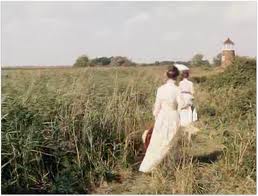 The Go-Between is a disappointing period drama which squanders a potentially interesting premise. Its myriad flaws with characterisation, storytelling and direction would normally produce a feeling of anger to match the disappointment. But ultimately it is too innocuous and escapist to be worth getting frustrated about. In the end the film is a beautiful series of landscapes with unlikeable, uninteresting people scattered therein. It's pretty, but it's also pretty dull.
Rating:
Verdict: Pretty, dull
The King's Speech (UK, 2011)
Directed by Tom Hooper
Starring Colin Firth, Geoffrey Rush, Helena Bonham Carter, Guy Pearce
It's hard being British during awards season. Seeing British films nominated is great; seeing people win just for playing monarchs is frankly quite depressing. But unlike The Queen or Shakespeare in Love, the acclaim for The King's Speech has a lot more to it than simply baiting the Oscars. Stripped of all its ploys and generic concessions, it remains an enjoyable, well-made film that will outlive most of its competitors. There was a time, not so long ago, when British period dramas about royalty (and by extension the aristocracy) were very tight-lipped affairs. Merchant Ivory and their derivatives handled their stories with an emphasis on repression, creating scenes where humour was seldom tolerated and private anguish emphasised almost to the point of tedium.
What makes The King's Speech such a breath of fresh air is the complete absence of this suffocating stiff-upper-lip. The film does more than its fair share of exploring British pleasantries and social graces, but it never takes itself too seriously in doing so. David Seidler's script is closer to the work of Alan Bennett in The Madness of King George, or to some extent Julian Fellowes in Gosford Park. There is a sense of playful mischief at the heart of it which prevents the film from becoming self-important. To this end, the moments of humour in The King's Speech are a balance between subtle one-liners for the costume crowd and more raucous elements that will pull in a mainstream audience. One cannot help but titter during George's arguments with Edward, involving the latter's attempts at "kinging" and letting Wallis Simpson sleep in their mother's suite (to which Edward remarks: "Mother's not still in the bed, is she?"). But the really laugh-out-loud moments come when George is made to swear therapeutically, delivering Anglo-Saxon vulgarisms with both reserve and abandon.
 The King's Speech is at heart a character piece, carried not by its storyline but by the talent and charm of its performers. And you couldn't have picked a better cast. Colin Firth is great in the lead role, delivering a performance almost on a par with his work in A Single Man. He shrinks into the role, slurring his 'r's and staggering his gait in a deeply empathetic manner, taking us right inside the strife of a man beset not just by a speech impediment but years of insecurity brought on by his brother and his father. Not only is he a reluctant king, he is naturally withdrawing, using even the most dated traditions for much-needed support.
 Geoffrey Rush is brilliant as Lionel Logue, nailing the character so early that he can be serious and well-meaning one moment and camp it up as Caliban the next. Helena Bonham Carter makes a successful return to her costume drama roots, carrying herself with just the right mixture of grace, pomposity and cheek. Elsewhere there are good supporting turns from Michael Gambon and Derek Jacobi, himself no stranger to stammers through his work on I, Claudius. But most surprising of all is Guy Pearce, who brings a real complexity to Edward VIII. The film makes no bones about his Nazi sympathies and skewed devotion to Wallis, but we really feel a lump in our throats when he is forced to decide between her and the throne.
 But although the performances dominate our memory of the film, The King's Speech is a great deal more than a gallery of famous British actors talking in rooms for two hours. All accusations about the film being televisual are complete and utter balderdash. Tom Hooper is a director who excels at putting personal conflict up on screen, even behind closed doors. Through meticulous sound design and an excellent choice of camera angles, he manages to make the drama both personal and expansive. We hear every hesitation in Firth's throat, and when he can get the words out the world he is addressing stretches far beyond the four corners of the screen.
 The film's ambiguous title hints at the three main issues tackled by the film beyond its conformance to generic conventions. Firstly, there is 'The King's Speech' as in 'King's English', the form of standard English against which all dialects are compared, contrasted, weighed in the balance and found wanting.
Although it doesn't touch on it in great detail, The King's Speech raises an interesting issue about how social hierarchy is ingrained even in language. The King is the head of both the imperial and the lingual family, and the hierarchy of accents below him is every bit as old-fashioned and restrictive as the insistence upon people's breeding. If the King cannot speak, then this entire system of hierarchy based on comparison threatens to collapse, putting the whole empire in jeopardy. Secondly, 'The King's Speech' refers to the actual stutter or stammer and the various stigmas attached to it. Aside from the stammer, George VI suffered from a number of other problems, some congenital (knock knees), others nurtured (being forced to write with his right hand, despite being naturally left-handed). In his big scene, Michael Gambon (playing George V) shouts at Firth every time he stammers, demanding that he get it out of his system. This was an age where stammering was seen as something which could be cured by parental discipline rather than caused by it, and in which fear was the natural basis of a father-son relationship.
 Thirdly, the title of The King's Speech refers to a momentous event, whether the state opening of Parliament, the Christmas address or in this case the declaration of war. After recording his Christmas address, Gambon complains that the invention of the wireless has reduced the monarchy to little more than actors, and later on Firth is wrestling with his exact role as King. Since he has no constitutional powers, he can only be an emblem - he speaks for the nation not as a legal representative, but as someone whose persona and moral values reflect the nation as a whole. His role as King is not just to hold ministers to account, but to feel his way through the ether for some common ground or position of national empathy.
 There are a couple of faults with The King's Speech. Being a film about the triumph of the human spirit, and based on a true story, it is massively predictable. This doesn't stop us rooting for the characters, but with all the interesting ideas running alongside we can't help wishing for something more adventurous as the story winds to a close. Even if we accept the various dramatic devices which Hooper puts in place, we still have to suspend disbelief quite some way to believe that the relationship between George and Logue was as informal as depicted. And there are small inconsistencies surrounding the passage of time: as in A Beautiful Mind, many years pass but the girls don't get any older.
 In the end, however, it is very easy to overlook such problems, because The King's Speech is a damn fine film. Taken purely as an actors' piece it is a delight, with a gallery of fine performances anchored by Firth who fully deserves his Oscar. Hooper's direction is intelligent and restrained, and the film never feels manipulative or melodramatic in the way that crippled Shine. While not a perfect film, it is a very fine piece of work which everyone should readily embrace.
Rating: 4/5
Verdict: A high-class heart-warmer


