
Reflections
-
It is weird to read my correspondences from the late August/early September
period, being the time of transition between my old function in life to my
new ...
14 years ago
The King's Speech (UK, 2011)
Directed by Tom Hooper
Starring Colin Firth, Geoffrey Rush, Helena Bonham Carter, Guy Pearce
It's hard being British during awards season. Seeing British films nominated is great; seeing people win just for playing monarchs is frankly quite depressing. But unlike The Queen or Shakespeare in Love, the acclaim for The King's Speech has a lot more to it than simply baiting the Oscars. Stripped of all its ploys and generic concessions, it remains an enjoyable, well-made film that will outlive most of its competitors. There was a time, not so long ago, when British period dramas about royalty (and by extension the aristocracy) were very tight-lipped affairs. Merchant Ivory and their derivatives handled their stories with an emphasis on repression, creating scenes where humour was seldom tolerated and private anguish emphasised almost to the point of tedium.
What makes The King's Speech such a breath of fresh air is the complete absence of this suffocating stiff-upper-lip. The film does more than its fair share of exploring British pleasantries and social graces, but it never takes itself too seriously in doing so. David Seidler's script is closer to the work of Alan Bennett in The Madness of King George, or to some extent Julian Fellowes in Gosford Park. There is a sense of playful mischief at the heart of it which prevents the film from becoming self-important. To this end, the moments of humour in The King's Speech are a balance between subtle one-liners for the costume crowd and more raucous elements that will pull in a mainstream audience. One cannot help but titter during George's arguments with Edward, involving the latter's attempts at "kinging" and letting Wallis Simpson sleep in their mother's suite (to which Edward remarks: "Mother's not still in the bed, is she?"). But the really laugh-out-loud moments come when George is made to swear therapeutically, delivering Anglo-Saxon vulgarisms with both reserve and abandon.
 The King's Speech is at heart a character piece, carried not by its storyline but by the talent and charm of its performers. And you couldn't have picked a better cast. Colin Firth is great in the lead role, delivering a performance almost on a par with his work in A Single Man. He shrinks into the role, slurring his 'r's and staggering his gait in a deeply empathetic manner, taking us right inside the strife of a man beset not just by a speech impediment but years of insecurity brought on by his brother and his father. Not only is he a reluctant king, he is naturally withdrawing, using even the most dated traditions for much-needed support.
 Geoffrey Rush is brilliant as Lionel Logue, nailing the character so early that he can be serious and well-meaning one moment and camp it up as Caliban the next. Helena Bonham Carter makes a successful return to her costume drama roots, carrying herself with just the right mixture of grace, pomposity and cheek. Elsewhere there are good supporting turns from Michael Gambon and Derek Jacobi, himself no stranger to stammers through his work on I, Claudius. But most surprising of all is Guy Pearce, who brings a real complexity to Edward VIII. The film makes no bones about his Nazi sympathies and skewed devotion to Wallis, but we really feel a lump in our throats when he is forced to decide between her and the throne.
 But although the performances dominate our memory of the film, The King's Speech is a great deal more than a gallery of famous British actors talking in rooms for two hours. All accusations about the film being televisual are complete and utter balderdash. Tom Hooper is a director who excels at putting personal conflict up on screen, even behind closed doors. Through meticulous sound design and an excellent choice of camera angles, he manages to make the drama both personal and expansive. We hear every hesitation in Firth's throat, and when he can get the words out the world he is addressing stretches far beyond the four corners of the screen.
 The film's ambiguous title hints at the three main issues tackled by the film beyond its conformance to generic conventions. Firstly, there is 'The King's Speech' as in 'King's English', the form of standard English against which all dialects are compared, contrasted, weighed in the balance and found wanting.
Although it doesn't touch on it in great detail, The King's Speech raises an interesting issue about how social hierarchy is ingrained even in language. The King is the head of both the imperial and the lingual family, and the hierarchy of accents below him is every bit as old-fashioned and restrictive as the insistence upon people's breeding. If the King cannot speak, then this entire system of hierarchy based on comparison threatens to collapse, putting the whole empire in jeopardy. Secondly, 'The King's Speech' refers to the actual stutter or stammer and the various stigmas attached to it. Aside from the stammer, George VI suffered from a number of other problems, some congenital (knock knees), others nurtured (being forced to write with his right hand, despite being naturally left-handed). In his big scene, Michael Gambon (playing George V) shouts at Firth every time he stammers, demanding that he get it out of his system. This was an age where stammering was seen as something which could be cured by parental discipline rather than caused by it, and in which fear was the natural basis of a father-son relationship.
 Thirdly, the title of The King's Speech refers to a momentous event, whether the state opening of Parliament, the Christmas address or in this case the declaration of war. After recording his Christmas address, Gambon complains that the invention of the wireless has reduced the monarchy to little more than actors, and later on Firth is wrestling with his exact role as King. Since he has no constitutional powers, he can only be an emblem - he speaks for the nation not as a legal representative, but as someone whose persona and moral values reflect the nation as a whole. His role as King is not just to hold ministers to account, but to feel his way through the ether for some common ground or position of national empathy.
 There are a couple of faults with The King's Speech. Being a film about the triumph of the human spirit, and based on a true story, it is massively predictable. This doesn't stop us rooting for the characters, but with all the interesting ideas running alongside we can't help wishing for something more adventurous as the story winds to a close. Even if we accept the various dramatic devices which Hooper puts in place, we still have to suspend disbelief quite some way to believe that the relationship between George and Logue was as informal as depicted. And there are small inconsistencies surrounding the passage of time: as in A Beautiful Mind, many years pass but the girls don't get any older.
 In the end, however, it is very easy to overlook such problems, because The King's Speech is a damn fine film. Taken purely as an actors' piece it is a delight, with a gallery of fine performances anchored by Firth who fully deserves his Oscar. Hooper's direction is intelligent and restrained, and the film never feels manipulative or melodramatic in the way that crippled Shine. While not a perfect film, it is a very fine piece of work which everyone should readily embrace.
Rating: 4/5
Verdict: A high-class heart-warmer
Shine (Australia, 1996)
Directed by Scott Hicks
Starring Geoffrey Rush, Armin Mueller-Stahl, Noah Taylor, John Gielgud
Few words fill a critic with such dread as "the triumph of the human spirit". There have been legions of films about individuals coming through against all odds, and for every time a director gets it right (The Elephant Man, Ed Wood, The Madness of King George), we get a gross of self-important, 'worthy' films, whose attempts at genuine emotional engagement fall desperately short of the mark. Shine is one of the better examples of this genre, containing a number of good performances and attempting to explore some interesting ideas. But it is not a complete success and fourteen years after its Oscar glory, its flaws are plain to see. For its first forty-five minutes, Shine is a well-made, technically accomplished biopic of piano prodigy David Helfgott which manages to get to grips with some of the issues which resulted from such an extraordinary amount of talent. We are given a father-son relationship which on the surface seems straightforward, but which is actually more nuanced than first appears. In the initial scenes between Noah Taylor and Armin Mueller-Stahl, it feels like a standard proud father or pushy parent relationship. But as the drama unfolds we begin to understand the father's own conflicts surrounding music and the pressures surrounding both characters.
Both father and son are essentially reacting to the extraordinary talent bequeathed to David. David's response is initially to obey his father, both by winning competitions and by practising to be as good as he can. The father's response is oppressive, at least to us, but it is motivated both by regret of his own missed opportunities and by a desire for David to be "a winner". On a couple of occasions he mentions how he saved up to buy a violin, only for his own father to smash it in front of him. Mueller-Stahl is conflicted by the desire to avoid that mistake, but at the same time a genetic desire to control his son. Hence he encourages him to play but refuses to pay for outside lessons or to allow David to go to America. Several reviews of Shine have pointed out the factual inaccuracies in this portrayal, claiming that Helfgott's upbringing was nowhere near as oppressive as the film depicts. While the film may be guilty of telling the 'Hollywood version' of events, it just about gets away with it at the start because the ideas it is exploring are both interesting dramatically and pertinent to the character. As in The Elephant Man and Ed Wood, it doesn't always matter that the facts aren't completely in order, so long as the events are cohesive with the artistic intentions of the writer and director.
 Shine explores the idea that music is all-pervasive: it surrounds and influences every human action, whether it is celebrated as high art or dismissed as base cacophony. It also manages to make highbrow classical music incredibly interesting, even to those of us who couldn't care less about Rachmaninoff. Sir John Gielgud's flowery speeches as he describes the conflicts in "the Rach Three" are indicative of a batch of characters who are utterly in love not just with individual pieces but the whole concept of music. This is echoed in Scott Hicks' direction; during Noah Taylor's performance, he shoots the piano and Taylor's hands from every conceivable angle, both to show the actor is actually playing the music and to get us caught up in the invisible battle between the notes.
Such decisions, however, are the beginning of a number of problems which eventually hobble the movie. Having gone to so much trouble to replicate the music on film (right down to Geoffrey Rush acting as his own hand double) Hicks spoils it all by resorting to clichéd slow motion during the pivotal performance. We end up being impressed by Taylor's recital and the level of physical exertion, but slowing down the film to show his hair being bathed in sweat is simply unnecessary. Such a device takes all the momentum out of the music, and after this sequence the film never really recovers.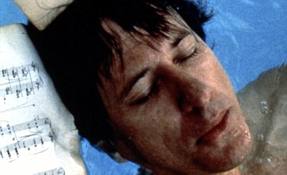 Melodrama in itself is not a bad thing, but Shine is guilty of a number of unnecessary concessions towards it, either in a plea for sympathy or as a means of moving the plot forward. There are a number of plot holes which are slightly troubling when trying to piece the film together. For instance, David Helfgott arrives at the Royal College of Music in London straight after walking out on his family: how did he get the money for the trip, or a passport for that matter?
In the second half of the film, after Taylor has disappeared from our screens, the plot begins to barrel along at a breakneck pace so that we miss out on a lot of potentially interesting scene. To some extent this is understandable, since Hicks' probably didn't have the money to cast a multitude of different actors to play Helfgott as he aged over a period of ten years. Nonetheless the film feels hurried and begins to lose sight of its thematic intentions. One could argue that Hicks is attempting to tell the story as Helfgott would: fast-talking, jabbering and unable to focus on anything for too long. But this theory doesn't hold much water when you consider the viewpoint of Hicks' camera, which only shows David's POV on a select few occasions. Even more problematic than this is the film's tendency in his second half to resort to biopic clichés, as if the filmmakers were deliberately positioning it for awards. Being a film about the triumph of the human spirit, we know that our protagonist is going to come to terms with their difficulties and everything will be happily resolved. But the pandering to convention extends further than just the plot outline. Geoffrey Rush, who is a talented actor, plays the adult Helfgott as essentially a holy fool, borrowing heavily from Dustin Hoffman's performance in Rain Man.
 The film is at heart an actors' romp, with only Taylor coming through with the goods and giving a genuinely brilliant performance. Rush is okay, but both he and Lynn Redgrave are tuned to a high setting, with arms and big emotions flying all over the place in an increasingly irritating manner. Mueller-Stahl mumbles his way through in a decent but unremarkable performance, and Gielgud is clearly enjoying himself as David's tutor, who can no longer play the piano because of a stroke. It's not a million miles from his performance in The Elephant Man, albeit with a little more pomp and a lot less gravitas.
 The only other real surprise with Shine is the amount of nudity. The film is a 12 certificate, and therefore we don't get anything that could be called 'full-frontal'. But several sequences involving nudity seem to come almost out of nowhere with little or no bearing on the plot. There are several shots of Helfgott, played by both Taylor and Rush, wearing nothing from the waist down, including a bizarre sequence of Rush bouncing on a trampoline in nothing but a pair of headphones and a tatty overcoat. Oddest of all is the scene where two rebellious pupils take David to a club, at which point the camera cuts to near-naked dancers and Marc Warren as a drag queen. Scenes like this are not exploitative, but they aren't exactly central to the plot.
 In the grand scheme of films about the triumph of the human spirit, Shine does better than most but comes nowhere near the likes of Ed Wood or The Madness of King George. As an examination of mental illness it is neither as compelling nor as heartbreaking as A Beautiful Mind, and even when taken as a full-on melodrama, it is a lot less satisfying than Intermezzo, let alone The Red Shoes. It's worth seeing for the central performances and a number of visual touches which prevent it from slipping into the realm of TV movies. But it has precious little else to stand on, and is further proof that the Academy should not always, if ever, be taken at its word.
Rating: 2.5/5
Verdict: Moments of genius but not much more


