
Reflections
-
It is weird to read my correspondences from the late August/early September
period, being the time of transition between my old function in life to my
new ...
14 years ago
This is a reprint of my review which was first published on Rotten Tomatoes about 2 years ago. It appears here to mirror a series of reviews I had done for RT entitled 'From Burton to Nolan'.
The Dark Knight (USA, 2008)
Directed by Christopher Nolan
Starring Christian Bale, Heath Ledger, Gary Oldman, Aaron Eckhart
The word 'masterpiece' is batted around far too often these days, and with The Dark Knight it's sadly inappropriate. Most of what makes Christopher Nolan a great modern filmmaker is up there on screen, and you cannot fault it for being a blockbuster which is attempting to address such relevant and complicated ideas. But while it is a general success, it is not as disciplined or focussed as Batman Begins and does not reward repeat viewing like The Prestige. It deserves to be celebrated and admired for its intelligence, but one must inevitably acknowledge that it isn't flawless. Having barely put a foot wrong in his previous films, The Dark Knight is the first glimpse of Christopher Nolan ever so slightly losing control. Like Batman Begins the film is a little too long, but it also feels slightly bloated, with much of the dialogue being rushed or mumbled in order to cram in all the ideas. It's almost as though there was enough plot and themes in here for two films, but rather than shoot back-to-back sequels, like The Matrix, Nolan decided to compress them down into one. Considering how mediocre The Matrix sequels were, this was not in itself a bad idea, but we still have to live with the fact that there are too many stories going on.
 Moreover, the film is edited and structured in a peculiar way. Where Batman Begins progressed in a defined direction, The Dark Knight feels more like a series of philosophical vignettes rather than something more progressive and incremental. The set-pieces are undeniably brilliant, but with the exception of the final sequence with the ships, you could put these set-pieces in almost any order and the film would feel the same. It's not terrible because of it, but it does mean that there is less cumulative tension than there could have been.
 This feeling of disorder is bolstered by the increased spectacle. Of course, being a blockbuster we don't expect things to be quiet, but there is a feeling watching all the explosions of Nolan pandering to the popcorn crowd just a little too much. In Batman Begins there were two hours of substance and character development, followed by 20 minutes of explosions to make up the trailer. In The Dark Knight, with its themes of escalation and chaos, it seems right that there should be more carnage, up to a point. But the carnage Nolan puts on screen eventually becomes repetitive, and his decision to film some of it in IMAX adds to the impression that he is overcompensating.
 These criticisms make it seem that Nolan's film is a failure, and when compared to the rest of his output, it is disappointing. But it remains head and shoulders above your average superhero blockbuster. The discipline of the first film has been compromised, but the film retains a desire to explore characters rather than just blow everything up. If nothing else, you have to admire Nolan for being able to take such an ideas-heavy film and sell it to such a wide audience.
 Thematically, this picks up the reins of the first film, dealing with the idea of understanding one's enemy as the means to defeating them. The difference is that the Joker is not a Nietzschean figure like Ra's al Ghul, someone who becomes evil by believing so strongly that he is doing good. In fighting him Batman still risks becoming like his enemies, but this lack of morality means that the cost to him will be greater. Killing the Joker seems necessary, but it would destroy Batman's moral code and undermine the belief that good can overcome evil in a non-Nietzschean way.
 The film is quite nihilistic in suggesting that even at its weakest, evil can triumph over good. The Joker's fate at the end remains uncertain, but the revelations surrounding Harvey Dent give a sense of him winning even though his direct influence is curtailed. The Joker's evil is allegorical to terrorism, in that his influence is fragmented and disparate. He does not take power by marching in with an army; he infiltrates, twisting, turning and double-crossing. Dent and Batman are the dove and the hawk trying to uphold rules in the face of chaos, and both are essentially destroyed in the process.
 The thing which marks out The Dark Knight from Nolan's previous work is that it is relatively conventional in its storytelling. It's ridiculous to call it 'dumbing down', but there is none of the jumping back and forth in time which made The Prestige so gripping. The themes are presented in a much more upfront way, both in the dialogue and the precise mechanics of the moral dilemmas. You could almost accuse Nolan of ramming ideas down the audience's throats, but thankfully the script and the characters are good enough to prevent this.
 The film has similar character development to Batman Returns, which was criticised for sidelining Batman in favour of the svillains. But that's always been the point. Since Batman is a superhero who uses cunning rather than powers, there has to be a section of the film in which he is the underdog; if nothing else it makes his eventual triumph more powerful and palatable. What makes The Dark Knight clever is that it does all this while withholding the Joker for a long time. Apart from the opening bank raid, the first act largely concerns itself with Lau and the Mob.
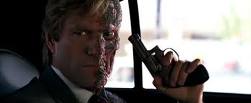
 As with all Nolan films, the performances are really great. Heath Ledger was generally a lightweight, but as the Joker he manages to channel Malcolm McDowell and make him truly terrifying. It's easily his best performance, although like the film it has become a victim of its own hype. Like the Scream killer, it has been so widely parodied that it isn't quite as scary anymore. Christian Bale remains convincing, and as before it is right that he should be a little sidelined so that the great evil is acknowledged.
 Michael Caine and Morgan Freeman are both warm and affable, and the script does allow for more humour this time round - for instance, when Rachel Dawes and Batman land on the car, she turns to him and says, "Let's not do that again". Interestingly enough, the film glosses over the most interesting character development: the individuals closest to Bruce Wayne finding out his identity. This was explored in Batman Returns in some detail, but here there are several conversations between Bruce and Rachel in which she knows he is Batman, which somewhat undercuts the drama.
 The Dark Knight contains many promising performances, along with stunning visuals from Wally Pfister who gives Gotham a grungy and decaying edge. In the end it struggles to completely control all the rogue elements, but at least Nolan doesn't fall into the same trap as Sam Raimi on Spiderman 3, namely throwing everything at the screen in the hope that some of it will work. If Batman Begins was Nolan's equivalent of Alien, then this is his Aliens: more action-packed and slightly less compelling, but still weighty, intelligent and interesting. One only hopes that Inception will not be his Alien 3.
Rating: 
Verdict: Bloated but containing brilliance
This is a reprint of my review which was first published on Rotten Tomatoes about 2 years ago, with a couple of minor revisions. It appears here to mirror a series of reviews I had done for RT entitled 'From Burton to Nolan'.
Batman Begins (USA, 2005)
Directed by Christopher Nolan
Starring Christian Bale, Michael Caine, Liam Neeson, Katie Holmes
The words 'substance' and 'blockbuster' are rarely found in the same sentence. Nor indeed are the words 'auteur' and 'commercially reliable'. But Christopher Nolan is living, breathing proof that the two can come together and make astonishing work. Having won over mainstream audiences with Memento and Insomnia, Nolan uses his particular blend of non-linear storylines and visual hyper-realism to breathe new life into a long-dead franchise. With all the acclaim being accorded to The Dark Knight (most of which it deserves), it is easy to forget just how good or how strong Batman Begins is. It's not just good by Batman standards, or by prequel standards; it has its own, stand-alone identity, a headstrong independence which defies and ignores all that has gone before it. Gone are the Gothic spires of Tim Burton's Gotham City, or the day-glo camp of Joel Schumacher's costumes. This is a new whole new world, in all its meticulous and frightening glory.
 All of Nolan's films are stunning to behold, but Batman Begins takes his craft to new heights. He is famous for not using a second unit, allowing him to supervise and construct every shot just the way he wants it. This means there is no jarring difference between the film's dramatic scenes and the external effects designed to show us the city. Even in the most effects-heavy parts of the film, we never question who is behind the camera, guiding these scenes and determining their significance.
 Nolan has the same gift for visual verisimilitude as Ridley Scott, whose masterpiece Blade Runner was a major influence on the young filmmaker. Both directors are able to construct seamless, immersive worlds on screen which are simultaneously strange and familiar. They have a beauty which both comforts and surprises us, allowing the filmmaker to play with the clichés and always come up with something new. But while several of Scott's films are truly style over substance (Legend, Someone to Watch Over Me), Nolan has yet to make a film which forsakes narrative substance for the sake of visual splendour.
 What makes Batman Begins so rewarding, so gripping, and arguably so radical, is that there is a constant and unrelenting focus on the story. No matter how much we jump back and forth in time, or how many bad guys get hit, we never doubt that the movie is in control of itself and is yearning to move on to the next important piece of character development. The fact that we have to wait an hour before Christian Bale even dons the bat-suit is a clear sign that the filmmakers want to do this properly. They have avoided falling into the trap of either the original films, which often put the narrative on pause for a kid-friendly set-piece, or the Star Wars prequels, which waded through years of turgid back-story for a few minutes of vaguely dark action.
 Mark Kermode once described this film as "a little independent, weird, art movie, trapped within the body of a $140m blockbuster." And he wasn't far off. Batman Begins is much less a superhero film per se than it is a detailed philosophical examination of the nature of fear and morality in a chaotic world. Both our protagonists and his many enemies have fear and intimidation as their source of power -- the former by their bribes and weapons, the latter by stealth and an incorruptible desire to do good. But rather than keep it as a straight fight between good guys and baddies, the film questions the motivations of our hero on a frequent basis. The supporting cast, particularly his old flame, push him on his motivation for doing what he does, in the way he does, regardless of how little they actually know.
 This is a film in which the desire to do good can so easily be blurred into the desire for power; in which the lines between justice and vengeance are frequently re-drawn; and in which the triumph of good over evil is neither complete nor reassuring. In the film's closing scenes, Gary Oldman warns Batman that he is potentially doing more harm than good; this enemy may have been extinguished, but a darker menace lurks on the horizon which will be harder to defeat.
 At the centre of all this is the idea that to defeat evil, one must understand it and even adopt part of its methods if the ends justify the means. The League of Shadows, headed up by Ra's al Ghul, are a symbolic forewarning to Bruce Wayne of what he could become should he fully embrace his fear. Liam Neeson's character is a Nietzschean figure, who has channelled his desire for justice so purely that it has consumed all his remaining humanity. Bruce Wayne should if anything be more brutal, since he wishes to atone for the death of his parents. But when he is asked to slay the farmer, his humanity intervenes and he refuses. This pivotal scene confirms Wayne's incorruptible nature; he may become feared, but he will never let the fear become him.
 One criticism of this film from some quarters is that this new emphasis on darkness and philosophical soul-searching has taken all the fun out of the character. In fact one of the pleasant surprises about Batman Begins is the extent to which humour still resides. Not only do we get impressive popcorn-worthy action sequences, but we also have a script which grows more sarcastic and playful as all the battle lines are drawn. There aren't any laugh-out-loud moments, but that's not why the film exists.
 The film is inhabited by one of the best all-star casts outside a Robert Altman film. Christian Bale is brilliant as Batman, drawing on his great work in American Psycho to make Bruce Wayne totally three-dimensional. He plays Wayne with a tortured intensity which makes his pain all the more palpable. The supporting cast is completely solid, with the best performances coming from Cillian Murphy as the chillingly creepy Dr. Krane and Michael Caine as the affable father figure Alfred. Special mention should also go to Gary Oldman as Gordon and to Liam Neeson, who gives one of his best performances in years.
 The only real flaws with Batman Begins come when it attempts the widest possible appeal. The last twenty minutes, is completely over-the-top and rather cavalier on the part of the director. It's not so much a punch in the face as a flick on the nose; not especially painful, but you still feel annoyed that it happened. Moreover the opening scenes, before Bale reaches the monastery, are very jumpily edited so that only the most devoted will be pulled in.
 Nonetheless, Batman Begins is a really great film which does not deserve to be neglected in the wake of The Dark Knight's success. It is a stunning combination of style and substance which avoids all the pitfalls of its counterparts and predecessors. Together with The Dark Knight, it has become the gold standard against which all subsequent superhero films have been measured, and more often than not come up short. It may not be Nolan's best film - that remains Inception - but it is a fantastic demonstration of how art and money are not so easy to separate.
Rating: 
Verdict: The best Batman film
This is a revised and rewritten version of my Inception review first published August 19th 2010. The original review can be found here: http://threemenonablog.blogspot.com/2010/08/film-review-inception-2010.html
Inception (USA, 2010)
Directed by Christopher Nolan
Starring Leonardo DiCaprio, Joseph Gordon-Levitt, Ken Watanabe, Cillian Murphy
Most of us have at least one film which we can watch over and over without necessarily getting anything new out of it. But there is a small number of truly magnificent films which keep rewarding us, intellectually and viscerally, even when there is no need for the gift to keep on giving. Inception is a worthy member of this club, sharing pride of place with A Clockwork Orange, Mulholland Drive and - dare I say it - Blade Runner. Every new viewing opens up new theories and interpretations, while confirming its status as the best film of 2010 and of Christopher Nolan's career. A lot has been written about the reputation of Inception as a 'smart blockbuster' which proves that audiences aren't stupid and lays down the gauntlet for the rest of the film industry. While all of this is completely true, it has been said so often that people have been led to doubt whether the film has anything of offer beyond what it represents: in other words, is it meant to be admired rather than enjoyed. Make no mistake: Inception is a smart blockbuster, but in order to appreciate it we have to look beyond its possible implications for the industry, at least for the moment.
 Inception is the culmination of Nolan's career, at least up to now. It shares a number of qualities with his previous efforts while having its own identity, like a series of jewels that have been waiting ten years for a crown. There is the deceptive chronology of Memento and The Prestige, used to make you question everything you have seen and distrust the editing over where stories begin and end. There is the nail-biting action of the Batman films, with real characters exploring ideas and experiencing pain in the midst of outstanding special effects. And there is the genre integrity of Following and Insomnia, creating in this case a film which follows heist film conventions without being in any way limited by them.
 All of these elements are woven together by Nolan's constant pursuit of verisimilitude, the art of finding reality and believability in the most fantastical of stories and concepts. Rather than go down the surrealistic route, filling the heist with scenes from Eraserhead or Un Chien Andalou, Nolan creates a hyper-stylised world which is so akin to our own that his artistic flourishes feel all the more surprising. His use of organic, physical effects wherever possible confirms his desire to keep us rooted in reality even as the world around us becomes extraordinary. The story introduces the mechanics of dreaming incrementally, so the film never grinds to a halt for plot exposition or loses its way by twisting too much at once.
 At its most superficial (if such a word is appropriate), Inception is about the nature of dreams and dreaming. In previous films which have explored dreaming, particularly as part of a thriller storyline, the boundary between dreams and reality has been all too obvious. Think, for instance, of Alfred Hitchcock's Spellbound, whose dream sequence directed by Salvador Dali is in stark contrast to the rest of the film.
 Inception corrects this, blurring the lines so seamlessly that we quickly understand the danger the characters are facing - both in failing their mission and in losing themselves to their own sub-consciences. During her training, Cobb warns Ariadne not to base a dream's architecture on real life, because that is the easiest way to lose your bearings and perhaps even end up like Mal. The feeling of getting lost is reflected in our experience as an audience: the film is constantly asking us to keep up, and there are only so many points where we can rely on totems or editing to tell us where we are. But as with Mulholland Drive, feeling lost is not only fun, it enhances the experience, making the dream-state all the more believable, threatening and fascinating.
 Like all great heist films, Inception is not really about the job itself. Nor, indeed, is it entirely or primarily about the nature of dreaming. The mechanics of dreaming, involving inception and extraction, heavy sedations and multiple dreams-within-dreams, are there to serve the plot by putting an enticing twist on the conventions of the heist film. But they also provide an introduction to a host of other interesting themes and ideas, each as enticing and multi-layered as the dreams in which they appear.
 One of Inception's biggest themes is identity, namely the ability in the dream world to be whoever you want, potentially forever. Like Mulholland Drive before it, it examines the idea of characters creating whole worlds or lives for themselves within a dream or fantasy. In this case the dreams can be designed and engineered to such a degree that reality becomes unnecessary: characters spend so long in dreams that reality seems like a pale imitation of the world which offers them everything they need.
 The one factor connecting all the members of Cobb's team is that their abilities and worth are enhanced by being in the dream. In reality, Eames is flippant, soft-headed and can't hold onto his money; in the dream he is brilliant, impersonating people and garnering information with ease. Arthur begins as a "stick in the mud" with no imagination, but in the dream he gains the imagination needed to bring the team home. Cobb is the exception to this rule: haunted by guilt, any potential enhancement in the dream in cancelled out or undermined by his troubled, unrestrained psyche.
 There is a counterpoint in the characters between Mal and Ariadne, played with superb skill by Marion Cotillard and Ellen Page. Both are to some extent experiments of Cobb: he trials inception on Mal, in a move which produces the impossible (inception) at the cost of creating the unbearable (her death). Ariadne represents Cobb trying to avoid his past mistakes, revisiting the impossible for the sake of catharsis. His relationship with Ariadne is sensitive because she sees through him, providing his salvation from the dream while giving him the chance to atone for Mal's death.
 When Darren Aronofsky made Requiem for a Dream, he commented that it was not so much a film about drugs as about addictive impulses - what constitutes or defines a drug, and therefore what makes a drug addict. So much of Inception is about addiction, with the characters being sedated to experience dreaming and their dreams being a pursuit of the high that is unlimited creativity.
 As with Aronofsky's work, Inception contrasts the limitless possibilities of the characters' fantasies with the threatened or actual destruction of their lives, minds and memories. Cobb was drawn to extraction by the ability to design whole new cities which could never exist, and when Ariadne runs away he remarks that "reality won't be enough for her anymore". But these optimistic sections are given perspective by the revelation that Cobb can no longer dream of his own accord. The chilling scene in the Mombasa basement hints at what he threatens to become if he does not restore his grip on reality and work for something more than the selfish high of extraction or inception.
 The performances in Inception are magnificent across the board. Leonardo DiCaprio has been working hard to cast off the pretty boy image of his early career, and in this case he manages it, turning in his most layered and accomplished performance to date. Cillian Murphy has an intriguing fractured quality to his performance which brings subtlety to his relationships with the other characters. And Tom Hardy is outstanding as Eames, providing much of the light relief as the world falls apart around him.
 Inception is a mesmerising masterpiece which improves with every viewing. Its mind-blowing, hyper-tense action sequences are perfectly complimented by its multi-layered examination of dreaming, addiction, catharsis and identity. It is visually superb thanks to Wally Pfister's outstanding cinematography, and Hans Zimmer's unusual score is nothing short of breathtaking. But at the centre of everything is Christopher Nolan, possibly Britain's greatest living director, who has delivered a film which is not only smart, but utterly flawless.
Rating: 
Verdict: The best film of 2010
NOTE: This is a reprinting of the original review published on Rotten Tomatoes on January 30th 2010, with minor alterations to correct dates.
Monty Python and the Holy Grail (UK, 1975)
Directed by Terry Gilliam and Terry Jones
Starring Graham Chapman, John Cleese, Terry Gilliam, Eric Idle, Terry Jones, Michael Palin
Monty Python and the Holy Grail is one of the few comedy films which continue to live up to and deserve its hype. Now thirty-six years old, it remains incessantly hilarious, fantastically silly, magically absurd and brilliantly surreal, right down to the last detail. It is the perfect balance of intelligence and madcap anarchy, drawn together by razor-sharp, career-best writing and superb comic timing from every performer. It is low-budget filmmaking at its absolute best, and one of the best films of the 1970s. The first and biggest hurdle that Holy Grail has to overcome is the transition from the small screen to something more cinematic. Many comedy series have faltered here, but the very essence and structure of Python gives them a leg-up. The TV shows were always conceived as streams of consciousness, in which ideas bled into one another and minds wandered. Scenes ended not with a punch line, but when things stopped being funny, and nobody either inside or outside the joke questioned it. This means there is far greater scope to construct an over-arching narrative over the course of ninety minutes, as opposed to creating an anthology of episodes similar to And Now For Something Completely Different.
 The second hurdle, arising from this, is preventing the film from becoming baggy or having long sections of no laughs in between set-pieces. Thankfully this problem is swiftly overcome by two means, one intentional, the other not so. On the one hand, Holy Grail was very tightly scripted from the beginning, under the same rules and restrictions of the TV series - if it ain't funny, it goes. This led at one point to half the script being binned because it didn't gel with the rest of the story. On the other hand, the very, very low budget (less than £250,000) meant that there was simply no room to shoot any scene or sequence for longer than was deemed necessary.
 The result of this careful preparation, and even more careful execution, is a film which is not only efficient but incessantly funny. From the famous opening credits to the Castle Aargh and everything in-between, the film is packed full of jokes in a way which, Airplane! aside, has never been emulated. Every conversation builds as a routine to a hilarious climax, and barely a line goes by without something quotable coming along. The script is the perfect balance between the verbal and the visual, high-brow and low-brow, making it a comedy film that is genuinely for everyone.
 There is not enough room to praise or point out all the great sequences, not without giving a scene-by-scene commentary of the whole film. There are, however, a number of categories of jokes which can be easily recognised. Although the film as a whole is a spoof of the Arthurian legends and the epics of Cecil B. DeMille, very little of the humour is derived from directly poking fun at these things, in the manner of Blazing Saddles or Young Frankenstein. Instead we have numerous examples of surreal absurdity (the Knights Who Say Ni ordering Arthur to cut down a tree with a herring); repetition (the Bridge of Death, Swamp Castle); existential role-reversal (Dennis the peasant arguing about anarcho-syndicalism); and running gags (swallows with coconuts, the cat being beaten, and the constant appearance of rabbits).
 One question which has bothered both Python fans and film fans alike is whether or not this is better than Life of Brian. John Cleese opines that Brian is a "more mature" work, noting sardonically how Americans tend to prefer Holy Grail while Brits opt for Brian. And he does have something of a point. It is more mature and professional from a technical point of view, and it is more substantial in either its subject matter or its use of it. But Life of Brian has its problems, most of which relate ironically to its abundance of substance. Although the film is still very funny, it has a more obvious axe to grind than Holy Grail, and there are moments where it loses sight of what is truly funny in favour of focussing on what is simply uncomfortable. In Life of Brian, you're focussed on the story so intently, so aware of the intelligence and the controversy, that many of the little distractions - like the aliens sequence - get lost. In Holy Grail, you still follow the story with some intent, and everything is efficiently told, but the jokes speak for themselves and ultimately triumph over ever other aspect.
Every member of the Python team is at the top of their game in Holy Grail - even Graham Chapman, who was still a rampant alcoholic and struggled to remember his lines. Like all the Python films, this is an ensemble piece; no one member is allowed to dominate and be the star, no matter how many roles Michael Palin plays. Terry Gilliam's animations are as beautifully mad as ever, helping at very least to get around the budgetary limits and humorously divert us while time passes. Each of the six gets at least one scene in which they excel, although Cleese is particularly brilliant in both the fight with the Black Knight and the one-man assault on Swamp Castle. Like all the best low-budget films, you're so swept along by the story and laughter that you aren't constantly trying to spot the body doubles or continuity errors. After a while you don't even notice it's the same six guys playing all the characters (well, almost). The influence of Holy Grail remains writ large in comedy and in filmmaking. To some extent, this is unsurprising because of Gilliam's subsequent success. His first post-Python films, Jabberwocky and Time Bandits, have Holy Grail hovering somewhere in the background either in the story or the aesthetics. Likewise much of Handmade Films' output owes something to the ropey, creaky (but still fantastic) look of this film.
 The film's most curious legacy, however, lies in the realm of horror comedy. Python's relationship with gore started in the TV series - think of the sketch about Sam Peckinpah's 'Salad Days', with blood oozing from every limb and every prop serving as a murder weapon. In the film we have the Black Knight, Swamp Castle, the Killer Rabbit and the Bridge of Death, all of which are simultaneously gross-out horrific and laugh-out-loud hilarious. You only have to look at Sam Raimi's The Evil Dead or Peter Jackson's Brain Dead to see reflections of Python's undying genius.
 Monty Python and the Holy Grail is the film to turn to whenever you lose faith in the power and lifespan of comedy. It is brilliantly written, brilliantly acted, and contains more moments of hysterical laughter than almost any other film. It still has the charm and vibrancy which it had at the point of its conception, and its reputation and influence will only grow as time goes by. For all the subsequent efforts of Python, both as a troupe and individually, this remains their finest achievement and the benchmark against which all their other work should be measured. It's a masterpiece, a classic, a joy and a thrill - quite simply, the greatest comedy of all time.
Rating: 5/5
Verdict: The greatest comedy ever made


