

Reflections
-
It is weird to read my correspondences from the late August/early September
period, being the time of transition between my old function in life to my
new ...
14 years ago
Silent Running (USA, 1972)
Directed by Doug Trumball
Starring Bruce Dern, Cliff Potts, Ron Rifkin, Jesse Vint
It's long been fashionable for film reviewers to slag off films for being sentimental. The problem is not so much the notion of sentimentality in and of itself, as the context and manner in which it is applied. Criticising Steven Spielberg for being sentimental is simultaneously apt and foolish - apt when it meddles with or cheapens a dark subject matter, as with Schindler's List, but foolish when it is complimentary and integral, as with E.T. or Close Encounters. Silent Running's reputation has suffered from a similar stigma, namely that a grown-up science fiction film with serious thematic intentions cannot bow to something as feeble as human emotion. The clichéd view of 1970s science fiction, created by 2001 and cemented by Solaris, is one of a cold, clinical, existential world where any concession to audience emotion is strictly verboten. But while such an approach worked wonders for Stanley Kubrick and Andrei Tarkovsky, Silent Running is still a damn fine film which proves that substance and sentimentality can go together.
 Doug Trumball made Silent Running in direct response to the perceived coldness and clinical precision of 2001. Having created many of the special effects on Kubrick's film, including the iconic star-gate sequence, he sought to make a film about the future of humanity in which computers and apes were not the most human characters. Where Kubrick's films focussed on Mankind, Trumball wishes to look at people as individuals. And where Kubrick balanced Humanity's physical insignificance with its God-like potential, Trumball praises Man's capacity for compassion even in the face of insignificance, disinterest or despair.
 If one was feel as cold and calculating as HAL, one could easily dismiss Silent Running as nothing more than 'hippies in space'. Being a product of the early-1970s, when America was experiencing the death throes of hippie culture, such connotations are to some extent inevitable. It is undoubtedly true that Bruce Dern's character conforms to popular, if cynical, stereotypes of hippies, from his loose-fitting clothing and drawling delivery to his obsession with nature which many (the crew included) would consider unhealthy.
 One of the problems with Silent Running from this point of view is its questionable attitude towards mankind in the pursuit of pro-nature or 'hippie' ideals. The position towards technology is ambivalent; Dern yearns for a monastic existence where Man eats the fruits of His own labours, but it is ultimately the machines which sustain the forest. More problematic is the implication that preserving nature is more important than human life, to the point where murdering his crewmates appears to be justified. The film could be making the point that one has to go the hard yards in the name of one's principles, but it remains questionable whether in its content or its presentation.
 But if we put this immediate concern to the back of our minds, Silent Running's ecological theme emerges as more than a simple choice between Nature and Man, or Man and Machine. It is more prominently a film about harmony, about how the march of progress has made humans overly dependent on technology. Technological progress, including the development of space travel, has increased the standard of living of the astronauts to such an extent that they take their resources for granted.
 Dern's colleagues no longer care about the forest or the food they eat because they have been living in a world where their every want is met. They behave almost like spoilt children, spending their time racing around the cargo bay and joking around. Dern's position is similar to that of the 19th-century Arcadians like John Ruskin and Henry David Thoreau, writers who warned against the increasing luxury and apathy brought on by mechanical progress. Dern is the Arcadian among the lackadaisical industrialists, still able to enjoy himself but ever watchful of the consequences of progress, and mindful of the alternative which could soon cease to exist.
 When WALL-E was released three years ago, numerous critics compared the opening section to Silent Running. There is an obvious parallel in the role of robots tending to the Earth (or what is left of it), and in the loneliness of this occupation both practically and philosophically. Like WALL-E, Dern and his droids are going against the grain to do what they believe is right, and both have developed eccentricities through isolation which has caused them to deviate from their original 'programming'. With WALL-E, it is his bizarre passion for Hello Dolly!; with Dern, it is his desire to teach droids how to play poker.
 Although WALL-E could not have existed without Silent Running, it remains the superior of the two films. Although one of the longer PIXAR efforts, it feels tightly structured and well-paced, while there are long sections of Silent Running which feel superfluous or needlessly slow. This may be down to the involvement of Michael Cimino at a script level; his first writing credit in Hollywood contains the same flaws in pace and emphasis which would scupper him as a director. The poker scene, for instance, feels like it shouldn't be there, or at least like it should be a lot shorter.
 Parts of Silent Running have also dated quite badly. Peter Schickele's soundtrack has stood the test of time rather well, but Joan Baez' warblings are a distinctly Marmite experience. Some of the dialogue is preachy, with Dern going over many of the same arguments to the point of exhaustion. But to be fair, it is very difficult to sustain a story with a limited number of locations and characters without the luxury of extended dream sequences (Solaris) or multiple versions of the characters (Moon). Trumball may be no Kubrick, but all in all he has done a reasonable job.
 One aspect which hasn't dated, however, is the special effects. When Trumball was interviewed recently for the Blu-Ray release, he commented that organic, miniature or optical effects date better than CG visuals because they are more "photo-realistically impressive", i.e. have weight and tactility. The external shots of the Valley Forge are shot from the correct perspective so that we aren't conscious of them being model shots, and the explosions look and feel both realistic and custom-built.
 The most illuminating special effect, however, is the three drones which Dern uses to tend to the forests after commandeering the Valley Forge. The drones, inspired by characters in Tod Browning's Freaks, were created by double amputees walking on their hands. This and the facial structures of the drones create a human-like movement which we can recognise and use as a starting point for empathy.
 What makes Silent Running remarkable, and ultimately successful, is the strength of its emotional pull. The tactility of the special effects, the honesty of the script and the tender nature of the final act has the same effect that the ending of E. T. does; you feel as though you have earned the right to blub your eyes out because of how well the characters have been formed and how much you have enjoyed their company. Much like The Man Who Fell To Earth, the emotional weight of the characters allows us to overlook or forgive any narrative shortcomings and enjoy having our hearts broken.
 Silent Running remains an underrated and underappreciated science fiction film. It's not without its flaws, whether narrative or otherwise, and it has to take a back seat to 2001 both in ambition and in execution. But what it lacks in awe and spectacle it makes up for in heartache, coupled with a good-natured and welcome intelligence. WALL-E may have since surpassed it, but it remains compelling viewing.
Rating:
Verdict: An underrated sci-fi heartbreaker
The Cat Returns (Japan, 2002)
Directed by Hiroyuki Morita
Starring Chizuru Ikewaki, Yoshihiko Hakamada, Tetsu Watanabe, Yosuke Saito
The critical and commercial rapture surrounding Spirited Away introduced a new wave of audiences to the work of Studio Ghibli. This in turn led to a whirlwind of re-releases and the creation of English language dubs of Hayao Miyazaki's back catalogue (some of which were supervised by Pixar's John Lasseter). But even as all this was occurring, films like The Cat Returns were demonstrating that quality animation could still be produced even without the master at the wheel. The Cat Returns is a really great children's animation which, though lighter in both tone and scope than Miyazaki's work, is still gripping, magical and laugh-out-loud funny. In a marketplace dominated by fare which is often depressingly anodyne, it is the equivalent of a stiff breeze that blows through a room after someone has slammed a door. Even in its weaker moments there is more than enough for both children and adults to revel in, and the viewing experience is intensely memorable.
 If one takes a cursory look at contemporary Japanese and Western animation, it doesn't take long to spot the major factor which divides them. The majority of mainstream Western animation is geared against both childhood and childlikeness. The work of Dreamworks in particular seeks to appeal to adults on a different or higher level, patronising the children watching and asking them to grow up quicker so they can appreciate in-jokes about The Godfather. The progression of the Shrek series from edgy Disney satire to cynical cash cow is ample demonstration of this.
 Japanese animation, on the other hand, tends to revel in the wonders and magic associated with childhood. It doesn't by and large infantilise its audience, by claiming that everything about childhood is perfect or infinitely more desirable than being an adult. But the characterisation of children, particularly as they undergo some kind of development, feels so much more honest and genuine. Hiroyuki Morita and his affiliates know how to nail that sense of childlike curiosity and fearlessness which is so difficult to find in a live-action performance.
 The Cat Returns has several clear similarities to Miyazaki in terms of its storyline and its relationship to various works of Western literature. Both this and Spirited Away are to some extent reinterpretations of Alice in Wonderland and The Wizard of Oz, in that they focus on the magical and often surreal adventures of a young girl who gets lost in a world that she does not understand. The anthropomorphism of Alice carries over strongly into The Cat Returns, giving us not only talking cats but talking ravens too.
 If anything, however, the Oz references are even stronger. The scene of Haru lying in the fields of catkin, slowly drifting off and not wanting to leave, recalls the scene in both the book and the film of Dorothy wilting in the field of deadly poppies. The plot revolves around a deranged and maniacal king with sinister intentions whose physical presence is both intimidating and ridiculous. And as things reach a climax, there are darker and edgier scenes involving decapitation (although, being a U certificate, there is no real violence shown on screen).
But although The Cat Returns is by no means the most original story ever told, it does tell its story remarkably well with a very strong moral thread. At the centre of an increasingly bizarre turn of events is a desire of individuals and particularly young girls to define their own path in life, to embrace their own identity and not to base their every decision on the desires or attitudes of others. In the midst of so many films, from Sex and the City to Bratz: The Movie, which promote vapid and soulless views of modern womanhood, here is a film which genuinely embraces female independence without falling into the trap of lecturing its target audience. Quite apart from anything else, the characters in The Cat Returns do not feel like the mouthpieces of a disillusioned feminist champing at the bit. When we are first introduced to Haru, she is a lonely young girl who is subject to bullying at school, has few friends and lives slightly in the shadow of her mother. Her life appears to have little in the way of purpose or direction, save for a fruitless crush on the local jock. Most of us can relate to her predicament - at the very least we have all had a short phase of shyness around others we are trying to impress, romantically or otherwise.
As in Spirited Away, the central device of The Cat Returns is a subliminal or dreamlike experience causing or having an impact on the real-world development of the young protagonist. As with so much of Miyazaki's work, if you wrote out the plot of this film and attempted to assess it with a straight face, you won't get very far. The film operates on the same logic that Alice does: everything works, but to explain and rationalise it is to suck out all that is fun and enticing. The journey that Haru undergoes contains a number of bizarre or elaborate developments which threaten to pull the film head-first into outright silliness. If we accept the existence of a cat bureau that deals with all things cat-related and is run by a cat called the Baron, who wears a suit and has a German name, we still have to contend with a secret kingdom hidden through a portal under a lake with its own skewed hierarchy and customs. But for all the moments in The Cat Returns that are absurd or inexplicable, there is an undying focus on Haru's personal struggle which keeps us grounded and allows us to embrace even the strangest goings-on.
 Having presented us with a relatively complex parallel world, the film could so easily fall into the trap of A Kid in King Arthur's Court, namely pointing out all the differences between the worlds for the sake of a brief gag. But again, Morita holds his nerve, keeping Haru in our frame of mind even during the most outlandish set-pieces. The maze sequence, which contains nods to Jim Henson's Labyrinth, could easily descend into padding to buy the animators time. But instead it becomes an effective way of demonstrating Haru's intelligence and resilience which, combined with self-belief, are the qualities that eventually redeem her.
 On top of all this, The Cat Returns is genuinely charming and sweet. Morita's designs are warm and inviting without ever becoming overbearing. The colour schemes are full and the smiles wide so that every character seems inviting even if their motives are suspect. There is not a single cat which feels like it was lifted from a stock drawing and plonked idly in the background to make up the numbers, and the final sequence involving Haru walking on the backs of ravens is really something. This level of craft leads to a unified admiration of the film, so that even the bootlicker Natoru is completely adorable.
 While The Cat Returns is not the finest or most substantial offering to emerge from Studio Ghibli, it deserves undiluted praise for approaching its subject and storyline with such gusto, charm and conviction. It is beautifully animated, has a cast of genuine and believable characters, and a level of laugh-out-loud alacrity which allows us to forgive all but the most obvious moments of contrived sentimentality. In the end it is Miyazaki-lite and won't date as well as Spirited Away, but you would be hard-pushed to find a more entertaining 72 minutes in recent animation.
Rating: 4.5/5
Verdict: A genuinely charming children's animation
WALL-E (USA, 2008)
Directed by Andrew Stanton
Starring Ben Burtt, Elissa Knight, Jeff Garlin, Sigourney Weaver
Asking what is Pixar's best film is something of a loaded question. The studio's immense acclaim has meant on the one hand that arguing between Finding Nemo and Toy Story 2 amounts to little more than splitting hairs, and on the other hand that a certain vindictive breed of critics are waiting in eager anticipation for when the big flop arrives. But despite a couple of wobbles (The Incredibles is too long and Ratatouille too shiny), said group of critics is going to be kept waiting just that little bit longer.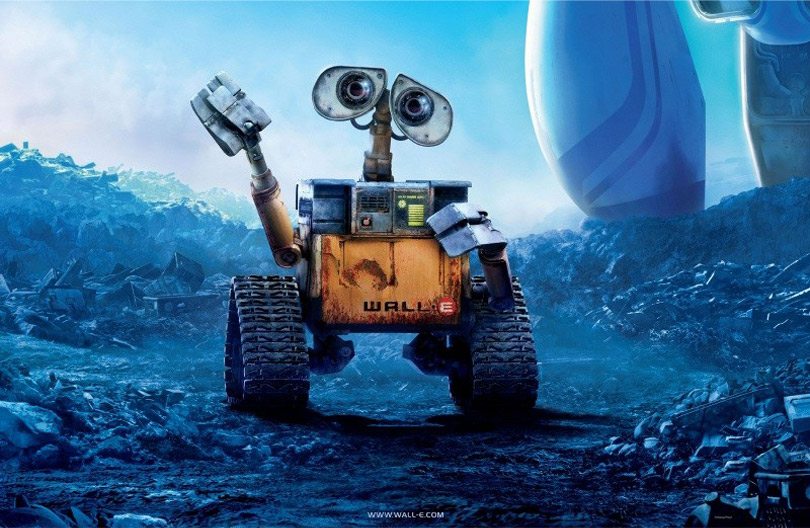 WALL-E is further proof not only of the genius of Pixar as both animators and storytellers, but of the ongoing relevance of both highbrow science fiction and the conventions of silent movies. It is also a continuing demonstration of the ability of so-called 'children's films' to be perfectly pitched towards everyone, whatever their age or inclination. On top of that, the film has a visual beauty and a striking sense of humanity which give even the likes of Toy Story a run for their money.
For the opening 20 minutes, WALL-E is effectively a silent movie. There is next to nothing approaching dialogue, and the actions of our central character are a mix of menial routines and knock-about, Laurel and Hardy slapstick. The latter aspect is brought out by Thomas Newman's score: its prominent use of oboes and clarinets reflect the classical grandeur of 2001: A Space Odyssey, but the individual riffs are playful and are timed to coincide with the jokes. Add in the great sound editing, by Ben Burtt and Matthew Wood, and you have an opening act of both humour and poignancy. We've all seen various attempts to parody silent films; Richard Attenborough's Chaplin managed to stage the filming of one which made us simultaneously laugh with and at what was going on. But despite all the advances in technology, watching WALL-E reminds you just how much of the manner of silent cinema remains, and of how useful it is. Sure, the 'actors' may no longer wear black-and-white make-up, and we don't find the need to use inter-titles any more. But so much of WALL-E relies on the prominent use of physical gesture to convey subtle emotions - WALL-E's eyes are always prominently shot so that the smallest movement is amplified and the character becomes more recognisable.
WALL-E owes a large debt to a number of science fiction films. 2001 looms over it, not just in the score but in the grand scale of human civilisation in space, and of course in the villain. The Autopilot looks exactly like HAL, the only difference being his voice; in 2001 HAL is the most human-sounding character, while Auto's voice was created by a Macbook. There are also references to E.T. and Short Circuit both in the design of WALL-E and the film's prominent sentimentality. Fortunately it never feels as mawkish or manipulative as either of these, and so you forgive it even when the highly predictable ending comes along. But by far the biggest influence on WALL-E is Silent Running. The first 20 minutes are literally Silent Running, both in the plot resemblance and in the lack of sound (boom boom). Both films begin with the premise of humans having to abandon the Earth due to the high levels of waste and pollution that have devastated natural life. The humans that remain in space have grown lazy and apathetic; they don't understand about how plants grow or how important it is to care about natural life, because everything they need can be delivered through a straw. Even their clothes can be digitally altered as fashions change (though Doug Trumball could have only dreamed of such an effect).
Where WALL-E differs from Silent Running, along with most other environmental films, is that it is not in the least bit preachy towards its subject matter. Silent Running, for all its virtues, quickly gets bogged down with Bruce Dern giving sanctimonious speeches about the need to take care of the Earth. Like An Inconvenient Truth, such speeches contain much that can be agreed upon, but they are delivered in such a way that you grew to dislike the character giving them and thereby disregard his words of wisdom. Because so much in WALL-E is subtle and underplayed, even when it is being very sentimental, we never feel alienated from its generally positive message. WALL-E's strength from a thematic point of view is that it manages to convey ideas about the environment and human emotion without either patronising the audience or giving them a negative lecture. The sight of humans being unable to walk because their bones have withered in zero gravity is more than enough to get children up and exercising; such images are so well-constructed that there is no need for the human characters to stand up and start wagging their fingers at the screen. The environmental lessons which the film focuses on revolve around positive action (i.e. take care of the Earth, do more exercise etc.) rather than simply berating the audience for all the damage they have done.
The visuals of the film are an aid to this. It's very easy to complain that all CGI looks the same, but actually much of the designs of WALL-E are above and beyond what we have come to expect. Although the entire film is digitally animated, it has a feeling of intimacy to it. This is not just intimacy in the relationship we have with the central character, but with the world in which he finds himself. The film has a beautiful cinematography, capturing a multitude of hues and tones among even the most sterile of surfaces: the inside of the spaceships are shot so brightly, they look like fairgrounds. The film doesn't feel like just another corporate knock-off which is made for the sake of advertising software, as the more recent Shrek movies have seemed. On top of all the intelligence, substance, humanism and beautiful music, WALL-E is also a great children's movie because it's really good fun. It never gets bogged down in the complexities of its subject matter, or hampered by the sense of smugness which seems to occur when Brad Bird is at the helm. Andrew Stanton, who co-directed Finding Nemo, understands not only for the need to balance light and shade, but that the two can be intertwined - bringing us right back to the pathos-ridden comedy of Charlie Chaplin. Some of the darkest moments in WALL-E are lifted by little sparks of comedy, like the little robot with a brush trying to clean WALL-E just after he has been badly damaged.
 WALL-E is a really intelligent children's film, which like all proper children's films is able to be fully enjoyed and appreciated by adults. Although its central relationship isn't as adventurous as one might like (i.e. the boy-robot and girl-robot end up together), there is very little else about the film which one could object to without being accused of sour grapes. The film is charming, humorous, sensitive and smart; you feel completely involved in the world of the characters and are left wanting more at the end. A real must-see.
Rating: 4.5/5
Verdict: A children's film with brains (and heart)


