

Reflections
-
It is weird to read my correspondences from the late August/early September
period, being the time of transition between my old function in life to my
new ...
14 years ago
Big Trouble in Little China (USA, 1986)
Directed by John Carpenter
Starring Kurt Russell, Dennis Dun, Kim Cattrall, Victor Wong
One of the ironies of being in the film business is that when you finally get the chance to make your dream project, it often ends up being your worst film. In 1985 John Carpenter was on a roll, enjoying both the commercial success of Christine and the Oscar buzz for Starman. Having long dreamed of making a martial arts movie, he leapt at the chance to direct Big Trouble in Little China - a decision which ended his relationship with Hollywood, and ultimately resulted in one of his weakest films.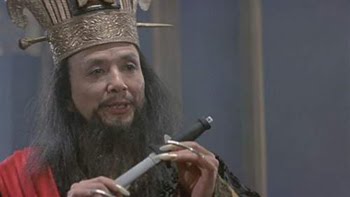 As with Prince of Darkness, Carpenter's subsequent failure, there is something inherently interesting in the central concept of this film. It aims to do for martial arts movies what Indiana Jones did for matinee idols: take all the clichés and conventions of those films, restage them with the budgets they deserved, and pay tribute to the aspects that worked while sending up those that didn't. The twist with Big Trouble is that this story does not have a period setting, with Carpenter attempting to marry ancient Chinese mythology to the technology and social attitudes of the 1980s.
 Carpenter may not have Steven Spielberg's track record when it comes to blockbusters, but he had shown his knack for directing action movies on Assault on Precinct 13 and, to a lesser extent, Escape from New York. And to give credit where it's due, the design elements of Big Trouble are pretty good. Dean Cundey, Carpenter's long-time cinematographer, gives the film a grainy B-movie look while utilising anamorphic lenses (another Carpenter trademark) to make the action feel very modern. The stunt choreography by James Lew is balletic but playful, creating stunts which are cartoonish without prompting us to look where all the wires or trampolines are hidden.
Unfortunately all the good work of Carpenter and his colleagues comes to nothing. After a pretty decent opening, Big Trouble in Little China slowly descends into the very formulas it was trying to send up, resulting in a film which is repetitive, uninvolving and lacking in narrative direction. The central problem lies in a further comparison to Indiana Jones, namely in the business of being tongue-in-cheek. Although Raiders of the Lost Ark was clearly motivated by a desire to send up its subject matter, Spielberg understood that it wasn't enough to simply stand around making fun of old film clichés. In order to sell the film to an audience, it had to be entertaining in its own right, with enough in the way of pace and punchy action to wow an audience who hadn't grown up on John Ford or Howard Hawks.
 One of the great successes of Raiders - in fact, of all the original trilogy - was its combination of pace and narrative; the story was pulpy enough to be gripping when married to the action, but even if you weren't that interested in what was going on, you could just sit back and enjoy the spectacle in blissful ignorance. Big Trouble in Little China doesn't have this perfect pacing: it barrels along so quickly that the story keeps getting lost, with characters having to stop and explain the plot to each other in an increasingly incoherent manner.
 Because the film keeps losing its narrative thread (what there is of it), its ability to work as an affectionate pastiche or parody begins to gradually desert it. Certain elements remain faintly subversive, such as Dennis Dun's character, whose resourcefulness and intelligence sends up Indy and Short Round in Temple of Doom. But elsewhere the film bears an uncanny resemblance to The Fiendish Plot of Dr. Fu Manchu, Peter Sellers' final film which attempted (unsuccessfully) to send up similar stereotypes. The film forgets about its desire to be ironic as soon as it becomes convenient, settling for spectacle where we expect to see so much more.
 Even if we attempt to enjoy Big Trouble as empty-headed entertainment, we still don't get very far. One of the pleasures of classic martial arts films was the scale of the fights and the seamless way in which they were filmed. Bruce Lee's fight scenes would be filmed like Gene Kelly's dancing, in long continuous shots which created a natural sense of scale and continuity. A lot of both Lee and Kelly's film work was somewhat lacking narratively, but again it didn't matter because of the inherent physicality and tactility of their fighting and dancing respectively.
 Big Trouble, on the other hand, has precious little in the way of physicality. The fight sequences may be inventively choreographed, but they are shot from such odd angles and edited so rapidly that you can't tell what's going on or who is fighting whom. Then there are the cheesy special effects, which include beams of light coming out of people's mouths or characters conjuring up lightning like Emperor Palpatine. These effects were created by Boss Films, who did the effects for Ghostbusters, and as with that film the characters become lost in a lot of uninvolving visual trickery.
 In most cases, the special effects in Big Trouble are there to pad out the action rather than contribute to the story. The laser beam fight between Victor Wong and James Hong, in which imaginary warriors are conjured from rings and battle it out, is like watching a boring video game and breaks up the more interesting duel involving Dennis Dun. Even the old-fashioned monsters are no good, with neither the wookie-like creature nor the floating head with many eyes getting anything like the screen time they need to set them up as sustained and believable threats to the characters.
 On top of all that, the film is populated by a cast of characters which are poorly drawn and unlikeable. Kurt Russell, who has never topped his performance in The Thing, spends most of his time mugging at the camera. While his Clint Eastwood impression in Escape from New York had a certain amount of appeal, his John Wayne impression in this film is off-putting and obnoxious. Kim Cattrall is equally annoying and largely wooden, and the film only seems properly interested in her when she's been dolled up in buckets of rouge. Dennis Dun's character is underdeveloped beyond his one-liners with Jack, and Victor Wong is as criminally underused here as he was in Prince of Darkness.
 One factor that might mitigate Big Trouble's poor execution is the conditions under which it was made. The film went into production around the same time as the Eddie Murphy vehicle The Golden Child; Carpenter was hired because he could work fast, enabling the studio to get their film out first. Certainly one cannot accuse Carpenter of bottling it in the presence of more money; as his 1990s output shows, he was capable of making bad films regardless of how much they cost. But even with the rushed production schedule, you would have expected someone of his mettle and genre experience to come through with the goods.
 Big Trouble in Little China resembles a dumb mix of Indiana Jones and Year of the Dragon, albeit without the overt racism of the latter. It disappoints as empty action and as an attempted subversion of martial arts clichés. It still has pockets of humour, whether intentional or otherwise, which keep it from being either depressing or Carpenter's worst film. But it simply doesn't cut the mustard either as a Carpenter film or on its own terms - it's no fun, and nothing but trouble.
Rating:
Verdict: Incoherent, irritating and uninvolving
Escape from New York (USA, 1981)
Directed by John Carpenter
Starring Kurt Russell, Lee van Cleef, Donald Pleasance, Isaac Hayes
After the production problems on The Fog, John Carpenter sought to re-assert himself as a creative force with Escape from New York. Based upon a script he had written around the time of Dark Star, it promised to be a post-apocalyptic action movie with all the subversive subtext of his earlier work. But whether by flaws in its execution or by the passage of the time, the film doesn't hold up as anything more than an efficient and enjoyable disappointment. Almost by definition, post-apocalypse films don't date very well. Those that do still hold up - Mad Max, The Road, even The Bed-Sitting Room - succeed by being 'universal' in the ideas they examine but crucially vague about when or even how we got to this point in time. Most films about the end of the world are actually about the problems in present society, which can make even the best-made films dated in a matter of years. It doesn't take long to realise for instance that, if the Daleks did invade in 2150, we wouldn't still be driving Bedford vans and eating Sugar Puffs.
 Carpenter's original script was written at the time of the Watergate scandal, when the idea of a criminal rescuing a president would have carried a great deal of satirical bite. Had he got the money to make it when Nixon resigned, he could have had a hit on his hands which packed as big a political punch as All The President's Men. Telling that story during the Reagan years may still work on some level; turning Manhattan Island into a prison seems every bit as outlandish as the Star Wars programme. But whatever else the original script had simply doesn't gel, turning the film into something far more straightforwardly heroic, if not overtly patriotic.
 Like They Live a few years after it, Escape from New York is an action movie with large overtones of the western genre. Both John Nada and Snake Plissken are Carpenter's own takes on The Man with No Name, and Kurt Russell's performance is on one level a pretty good impression of Clint Eastwood. The film is built around the classic 'one last job' scenario, in which Plissken is offered his freedom to do the one thing he really doesn't want to do. There is great potential in this character, as a classic anti-hero who eschews authority and is only convinced to obey when threatened with a slow and painful death.
 Even considering its low budget (around $6m), Escape from New York does look like a film that was made in a hurry. To film some of the key scenes, including the aftermath of the plane crash, the crew had to sneak onto empty streets without permits at 3am, in some cases dumping truckloads of junk onto the roads to create the feeling of chaos. Even from the start the story is being hurried along, with the first 15 minutes doing whatever is necessary to get Snake into the city, and from thereon in the film wastes no time in getting him out. This is not a Chinatown-like mystery, with brooding detectives slowly uncovering a hideous truth; it is a simple, straightforward story and a race against time, and as a piece of efficient filmmaking, it delivers.
 This rapid approach to shooting does create some obvious continuity errors: in one scene, it's sunrise on one side of the island while still midnight on the other. But the first problem with the film is that it's so quick-fire and so efficient that you begin to wonder whether there's anything actually going on in the pauses. Although it's lost the Watergate backdrop, there is still the potential to explore a number of interesting ideas, if not enough to fill a whole series of films.
The set-up of the film, with a whole city being walled off and turned into a prison, hints at the tendency of civilised societies to isolate and shun its criminals rather than deal with them upfront and try to understand them, something which Carpenter tackled previously in Assault on Precinct 13. The unveiling of a criminal society, presided over by the Duke of New York, puts forward the notion of criminals being every bit as civilised and cunning as either their captors or the protagonist, something reflected throughout the work of Michael Mann. And the conflicts over power, with Harry Dean Stanton's character controlling the city's only source of oil, taps into the very same territory as the first Mad Max film. But as things evolve, it becomes clear that the film isn't really interested in any of these ideas. The film is like a land speed record attempt in which the driver is wearing blinkers; the object is to get from A to B as quickly as possible, and there is no chance to look around or think about anything else. Whenever Carpenter does attempt to tackle deeper issues, it's done in a half-hearted manner using imagery which is surprisingly unoriginal.
Huge sections of the film owe a big debt to Mad Max in a way which really demonstrates all that was spot on about George Miller's debut effort. The criminal gang in Escape from New York don't get enough time to establish themselves, and for all Isaac Hayes' best efforts, he's not as intimidating as the Toe-Cutter. The various street gangs (which reference George A. Romero by calling themselves 'The Crazies') dress every bit as extremely as the bikers, right down to Isaac Hayes' right hand man who looks unnervingly like Keith Flint from The Prodigy. And then there is the fight scene, in which Kurt Russell takes on a wrestler with a huge beard. It may predate the Thunderdome fight in Mad Max 3 by about four years, but there is a tonal similarity to the series in the combination of camp humour and realistic violence. This brings us on to problems with the characters. Escape from New York has more than its fair share of them, from Snake himself to Ernest Borgnine's chirpy Cabby, and from the Duke of New York to the odd couple of Maggie and Brain. But Carpenter sets up so many of these potentially interesting and quirky characters that he can't quite decide who to focus on and ends up having to kill them off in quick succession so that just Snake and the President survive. In the bridge sequence, where Cabby's taxi gets destroyed by several mines, he is incredibly cavalier about who cops it and when.
 This jumpy approach carries over into the performances themselves. Harry Dean Stanton is an enjoyable screen presence, and he plays Brain very well - so well that you wish he had more screen time. Adrienne Barbeau, on the other hand, seems to spend most of her time either firing a gun or walking into wide shots that show off her cleavage. Ernest Borgnine is annoyingly over-the-top, as if he were trying to cut in on every shot, and Lee van Cleef is reduced to largely scowling behind a desk. Only Kurt Russell gets the screen time he deserves, filling the empty streets of New York with his one-eyed swagger and growling whispers.
 There are a number of enjoyable moments in Escape from New York which make it at least partially memorable. The set-pieces involving the cars, both on the bridge and breaking through the barricade, are well-choreographed and have good sound design, so that every explosion and crunch of metal is appropriately amplified. Isaac Hayes' entrance will raise a chuckle, as he drives through the wreckage of New York in a limo with chandeliers mounted on the bonnet (eat your heart out, Pimp My Ride!). Some of the humorous exchanges do work well, such as Hayes taunting Donald Pleasance with a gun and then the latter getting his revenge at the end. And the final scene, where the crucial tape has been replaced, is quite funny.
 But in all, Escape from New York is little more than an enjoyable disappointment. It's a perfectly functional, efficiently made sci-fi actioner, but is nothing like as witty or subversive or thrilling as you would expect from John Carpenter. Like Mad Max 3 a few years later, there are individual scenes that work well but these are counterpointed by longer, more underwhelming sections. Carpenter completists will enjoy it, but everyone else should probably look elsewhere.
Rating: 2.5/5
Verdict: An enjoyable disappointment


