

Reflections
-
It is weird to read my correspondences from the late August/early September
period, being the time of transition between my old function in life to my
new ...
14 years ago
Saturday Night and Sunday Morning (UK, 1960)
Directed by Karel Reisz
Starring Albert Finney, Shirley Anne Field, Rachael Roberts, Hylda Baker
In the immediate post-war period, British cinema lost a lot of the sparkle and sense of adventure which it had previously embodied. With Alfred Hitchcock now permanently based in America and Powell and Pressburger past their prime, cinema became increasingly populated by American melodramas, jingoistic war films and ropey comedies. It would take something truly momentous to shake cinema out of this stupor: that something was the British New Wave. Beginning with John Osborne's Look Back in Anger, the New Wave sought to reinvigorate film and theatre, tackling controversial subjects head on and presenting a view of the working classes which was the very opposite of patronising or parochial. In time the genre, with its left-wing undercurrents and subtle emphasis on counter-culture, would come to be epitomised by Lindsay Anderson, the director of If.... and This Sporting Life. But well before the latter entered production, Anderson's colleague Karel Reisz was blazing the cinematic trail with Saturday Night and Sunday Morning.
 Based upon the novel by Alan Sillitoe, Saturday Night and Sunday Morning is a rich and respectful work which depicts the life of the working man in Nottingham in a completely uncompromising way. Reisz' background in documentary filmmaking makes him a naturally understated director. His camera is always an observer, sitting passively in the corner; it never flinches or mitigates, and it makes no apologies for what occurs on screen.
Not only does this approach make the action more realistic, but it helps to convey the message of the film. It allows the characters to speak for themselves, to create and form their own voices and identities, rather than having to conform either to the conventions of Hollywood or to social attitudes of what is considered 'proper'. The central line of the film comes towards the end from Albert Finney: "whatever people say I am, that's what I'm not", from which we get the title of The Arctic Monkeys' debut album. The visuals in Saturday Night reflect this desire for the characters rather than the director to do the talking. The film is shot by Freddie Francis, who also shot The Elephant Man and would work with Reisz again on The French Lieutenant's Woman. His choice of angles is simple but effective and he never attempts to play up the emotion of a scene by resorting to thriller tropes in the manner of Hitchcock or surreal, dreamlike shifts in the manner of Michael Powell. There are moments of visual exuberance - for instance, the blurring of the footage at the fairground to convey Arthur's disorientation - but these are only used as occasional devices.
Shooting in black-and-white, whether for artistic or budgetary reasons, always seems to give a film a sense of gravitas and ruggedness, something which was comparatively lacking in Technicolor efforts from the same time. Francis' cinematography and Reisz' direction show up unashamedly all the rough edges of working life, from the thundering monotony of the factories to the grimy back streets and beer-drenched pubs. There is an underlying respect for what they document, but they do not glamorise working life to the point of parody, in the manner of Sergei Eisenstein. This might help to explain why the film was awarded an 'X' certificate when first released (it has since been downgraded to a PG). This ruggedness and gravitas is never more noticeable than in the performance of Albert Finney. In only his second film role, he inhabits Arthur Seaton, creating a complex and contradictory character that we spend the entire film trying to figure out. He is anti-heroic, and largely amoral save when it comes to his own skin. In certain scenes he is borderline sociopathic, like when he takes pot shots at a nosey neighbour with an air rifle. But he remains compelling in his capability to love, to think beyond what we expect of him, and - on occasion - to do the right thing.
 The most interesting moments of the film, which lift it out of the clichés of what would become kitchen-sink, see Arthur and his colleagues passing the time at weekends fishing or drinking, and discussing what the point of their lives might be. Arthur makes passing comments about a life beyond this, saying that he doesn't want to get married until he feels ready. His angry voiceovers about the factory and wayward relationships with women reflect a restless attitude towards the limits of the world put before him. He knows what he doesn't want, but can't quite communicate anything beyond that.
This desire to communicate creates an emotional involvement with Arthur which makes the story gripping and engrossing. Like most kitchen-sink dramas the actual plot is quite slim, and has a number of similarities to A Place in the Sun - the central one being a male protagonist who is torn between two women, and who is threatened with ruin when one of them falls pregnant. But Saturday Night rejects the melodramatic tone of that film, just as Arthur remarks upon living the cinema that he always knew where the film was going. In A Place in the Sun, like so many melodramas, the characters are so clearly drawn that you knew where things were going after about fifteen minutes: Montgomery Clift is bound to fail and make the wrong choices, because that is the archetype into which he fits. In Saturday Night, there are no such guarantees and no stock ending to dampen the mood. Not only do the twists and turns feel more realistic, they carry a greater weight because the various parties do not have to respond in a manner predetermined by genre. Because Arthur is so conflicted, we don't know what choice he will make and therefore there is no assurance that he will emerge intact.
 The film deserves further plaudits for sticking to its guns in depicting the darker elements of urban life. It's one thing to go for realism when things are rosy for the protagonists; it's quite another to follow through with this and risk the censors' wrath in the process. The film is quite happy to linger on the scenes between Arthur and Doreen, but it is equally candid in the fight between Arthur and the squaddies which leaves the former near-dead. The ending itself is quite ambiguous, as Arthur surveys the housing developments and wonders whether he can change even as the landscape changes around him.
 If there is a flaw with Saturday Night, it is purely a question of scope. Apart from little details that have dated and any resounding prejudiced surrounding the now-ripe genre of kitchen-sink, the big problem with the film is that it is a little too self-contained. While it captures this particular part of Nottingham exceedingly well, it doesn't have quite the same general reach as Anderson's work - it doesn't reach out beyond its tight-knit community in the manner of This Sporting Life.
 In spite of this problem, which has prevented it from ageing quite so well, Saturday Night and Sunday Morning remains an important work in British cinema. In the long-term its realistic treatment of ordinary life and uncompromising storylines can be seen in everything from Ken Loach and Mike Leigh to the more recent work of Lynn Ramsey and Andrea Arnold. Reisz directs beautifully, bringing Sillitoe's novel and screenplay to life through a series of refreshing performances, resulting in a very fine piece of work.
Rating:
Verdict: A compelling and well-crafted drama
I Know Where I'm Going! (UK, 1945)
Directed by Michael Powell and Emeric Pressburger
Starring Wendy Hiller, Roger Lively, Pamela Brown, Finlay Currie
Romantic drama is a hard genre to get right, both on paper and on screen. Some are so light and frothy that they leave no lasting impression; others, like The Snows of Kilimanjaro, are overblown, overwrought and in most cases over-long. I Know Where I'm Going! is a textbook example of how to do this sort of film properly, taking a relatively simple story and making it memorable through a series of strong performances, a great script and remarkable direction. One of the common criticisms laid against romantic films, whether dramatic or comedic, is that they lack substance, relying on the charm of the performers to take an audience's mind off a highly clichéd or conventional premise. But while that criticism may carry a certain weight with regard to more recent rom-coms, it can't be fairly levelled against I Know Where I'm Going!. This is not because of the film's age, or its positioning in the golden age of melodramas. It is instead because the film is subtly inventive, adding precious moments of surprise in its every twist and turn.
I Know Where I'm Going! begins with a woman setting off to marry the man of her dreams, who is rich, powerful, influential and lives in the magical land of Scotland. These early scenes, with Wendy Hiller in full-on daddy's-little-girl mode, explore the age-old desire of young girls to be princesses and ride off into the sunset with a handsome prince. The twist, however, is that Joan Webster is not your average girly princess: she is a driven, ambitious woman who has known what she has wanted all her life. The opening credits explore her childhood in the manner of a BBC newsreel, showing a series of clear turning points underscored by Home Service narration. If the character of Joan Webster were to turn up in a film today, she would most likely be characterised as having OCD or some form of neurosis. Perhaps she would have been a suitable soul-mate for Jack Nicholson at the start of As Good As It Gets. She has her entire life planned out meticulously, knowing exactly what and who she wants and how she intends to get it. Her constant desire to get to the island comes as much from her compulsive urge to be punctual as the desire to meet the man she is marrying.
For the first ten minutes the film confronts this idea in a very broad, head-on way. We see Wendy Hiller in the railway carriage pouring over her routine, behaving in a very controlled and restrained manner. But for the rest of the film Emeric Pressburger's script explores her character and surroundings much more subtly. Superficially, the story of I Know Where I'm Going! seems very predictable - put simply, there's not that many men on the island. But the film plays out economically and keeps its emotions and dialogue in check, giving us a number of pleasant surprises along the way. The film is very good at planting seeds of doubt in Webster's mind, and demonstrating her infuriation at seeing her planned perfection disrupted. These disruptions start off very small, with her oversleeping and having to carry her clothes off the train in a heap. As the weather delays her trip to Kiloran, she slowly but surely begins to adjust to the landscape, even if she doesn't find herself warming to the place until the final reel. When she finally hears her fiancée on the radio, she assumes there is something wrong with his voice and asks him if he has a cold. These little moments don't seem like much when they first play out, but as the plot unfolds their significance becomes clear.
 Like many of their other films, I Know Where I'm Going! sees Powell and Pressburger dabbling in fantasy and applying magic to an otherwise realistic setting. These dabbles begin on the train to Glasgow, when Webster is sleeping with her wedding dress hanging in a see-through case above her. Suddenly the dress disappears and we move into her fantasy of being married - albeit jokingly, since she is being married to her fiancée's company, thanks to her father's confusion. Later in the same scene we see the train passing through tunnels made of tartan while the narrator whispers the chorus to 'The Bonnie Banks o'Loch Lomond'.
The film draws on a number of mythical elements which give depth and credibility to the situation. These range from the Laird's story about the Viking ship which anchored in the whirlpool Corryvreckan, to the practice of counting the beams and making a wish on the first night spent in a new room. To some extent these follow in the tradition started by Sir Walter Scott and carried on in Brigadoon, since they paint a fanciful portrait of the Highlands and Outer Hebrides. But the film is not entirely a tourists'-eye-view, and is populated with enough believable supporting characters to stop things drifting too far into fantasy. Although it seems an odd comparison, the story of I Know Where I'm Going! is not all that far removed from that of The Wicker Man nearly 30 years later. Both films centre on an individual who comes to a remote Scottish community driven by a singular urge to find someone. Both Joan Webster and Sergeant Howie are outsiders in this community and cannot comprehend its way of life - although the former doesn't have to put up with pagan worship or naked dancing. The central similarity, however, is that the goal of their respective characters is essentially a McGuffin. Just as the girl in The Wicker Man never really went missing, so we never meet Lord Beringer, or get to count his money. He might as well not exist, for his only function is to bring her to the island, and the weather does the rest in managing to keep her there.
 The mythical elements of the film are ultimately what lift it out of being predictable fare. The stories which Torquil regales to his guests include a tale about a rope being made of virginal hair which would never break, since true love is stronger than anything. The sub-plot surrounding the curse gives his character a sense of mystery, so that we enjoy their relationship while picking our brain as to what this curse could be. One of the best scenes in the film sees Torquil and Webster arguing on the stairs about the local customs and the latter's decision to go out in a gale to get to the island. When our leads do finally get together, their entanglement with the curse makes it seem a whole lot less contrived, while raising the question of whether their love was chance intervening on fate or fate playing out in a different way than they had intended.
 I Know Where I'm Going! has impressive production values for a film of its time and budget. The storm scenes, where the boat flounders and drifts into a whirlpool, are impressively executed. You do feel like you are in the boat with the characters, with the spray soaking your face and the boat lurching one way and then the other. Capturing the whirlpool and the boat involved a lot of complicated editing, with multiple location long-shots being spliced together with model shots and studio shoots in which the cast were doused in buckets of icy water. All Powell's efforts pay off, creating a storm sequence which is gripping and inventive.
The performances are also of a high calibre. Wendy Hiller is on great form as Joan Webster, nailing the character in the very first scene and displaying the same formidable femininity that would serve her well in The Elephant Man. Roger Livesey is a great match for her, combining humour, humility and a deep-seated integrity (plus he looks good in a kilt). Among the supporting cast, real-life Captain C. W. R. Wright is a well-chosen Colonel Barnstaple, and Valentine Dyall turns up in a rare non-villainous performance as Mr. Robinson. I Know Where I'm Going! is a top-notch romantic drama which is understated but ambitious and whose ideas remain fresh and engaging even after 65 years. The performances are charming and convincing, and really bring Pressburger's myth-injected script to life. It isn't quite the masterpiece that Martin Scorsese had claimed it to be, since its quirkier sections are occasionally overbearing (tea with the Robinsons, for example). But it marks a definite improvement on A Canterbury Tale and the start of the prime years of Powell and Pressburger's careers.
Rating: 4.5/5
Verdict: A properly magical love story
Shine (Australia, 1996)
Directed by Scott Hicks
Starring Geoffrey Rush, Armin Mueller-Stahl, Noah Taylor, John Gielgud
Few words fill a critic with such dread as "the triumph of the human spirit". There have been legions of films about individuals coming through against all odds, and for every time a director gets it right (The Elephant Man, Ed Wood, The Madness of King George), we get a gross of self-important, 'worthy' films, whose attempts at genuine emotional engagement fall desperately short of the mark. Shine is one of the better examples of this genre, containing a number of good performances and attempting to explore some interesting ideas. But it is not a complete success and fourteen years after its Oscar glory, its flaws are plain to see. For its first forty-five minutes, Shine is a well-made, technically accomplished biopic of piano prodigy David Helfgott which manages to get to grips with some of the issues which resulted from such an extraordinary amount of talent. We are given a father-son relationship which on the surface seems straightforward, but which is actually more nuanced than first appears. In the initial scenes between Noah Taylor and Armin Mueller-Stahl, it feels like a standard proud father or pushy parent relationship. But as the drama unfolds we begin to understand the father's own conflicts surrounding music and the pressures surrounding both characters.
Both father and son are essentially reacting to the extraordinary talent bequeathed to David. David's response is initially to obey his father, both by winning competitions and by practising to be as good as he can. The father's response is oppressive, at least to us, but it is motivated both by regret of his own missed opportunities and by a desire for David to be "a winner". On a couple of occasions he mentions how he saved up to buy a violin, only for his own father to smash it in front of him. Mueller-Stahl is conflicted by the desire to avoid that mistake, but at the same time a genetic desire to control his son. Hence he encourages him to play but refuses to pay for outside lessons or to allow David to go to America. Several reviews of Shine have pointed out the factual inaccuracies in this portrayal, claiming that Helfgott's upbringing was nowhere near as oppressive as the film depicts. While the film may be guilty of telling the 'Hollywood version' of events, it just about gets away with it at the start because the ideas it is exploring are both interesting dramatically and pertinent to the character. As in The Elephant Man and Ed Wood, it doesn't always matter that the facts aren't completely in order, so long as the events are cohesive with the artistic intentions of the writer and director.
 Shine explores the idea that music is all-pervasive: it surrounds and influences every human action, whether it is celebrated as high art or dismissed as base cacophony. It also manages to make highbrow classical music incredibly interesting, even to those of us who couldn't care less about Rachmaninoff. Sir John Gielgud's flowery speeches as he describes the conflicts in "the Rach Three" are indicative of a batch of characters who are utterly in love not just with individual pieces but the whole concept of music. This is echoed in Scott Hicks' direction; during Noah Taylor's performance, he shoots the piano and Taylor's hands from every conceivable angle, both to show the actor is actually playing the music and to get us caught up in the invisible battle between the notes.
Such decisions, however, are the beginning of a number of problems which eventually hobble the movie. Having gone to so much trouble to replicate the music on film (right down to Geoffrey Rush acting as his own hand double) Hicks spoils it all by resorting to clichéd slow motion during the pivotal performance. We end up being impressed by Taylor's recital and the level of physical exertion, but slowing down the film to show his hair being bathed in sweat is simply unnecessary. Such a device takes all the momentum out of the music, and after this sequence the film never really recovers.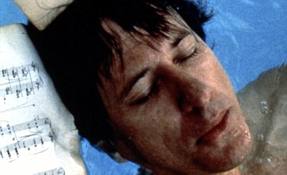 Melodrama in itself is not a bad thing, but Shine is guilty of a number of unnecessary concessions towards it, either in a plea for sympathy or as a means of moving the plot forward. There are a number of plot holes which are slightly troubling when trying to piece the film together. For instance, David Helfgott arrives at the Royal College of Music in London straight after walking out on his family: how did he get the money for the trip, or a passport for that matter?
In the second half of the film, after Taylor has disappeared from our screens, the plot begins to barrel along at a breakneck pace so that we miss out on a lot of potentially interesting scene. To some extent this is understandable, since Hicks' probably didn't have the money to cast a multitude of different actors to play Helfgott as he aged over a period of ten years. Nonetheless the film feels hurried and begins to lose sight of its thematic intentions. One could argue that Hicks is attempting to tell the story as Helfgott would: fast-talking, jabbering and unable to focus on anything for too long. But this theory doesn't hold much water when you consider the viewpoint of Hicks' camera, which only shows David's POV on a select few occasions. Even more problematic than this is the film's tendency in his second half to resort to biopic clichés, as if the filmmakers were deliberately positioning it for awards. Being a film about the triumph of the human spirit, we know that our protagonist is going to come to terms with their difficulties and everything will be happily resolved. But the pandering to convention extends further than just the plot outline. Geoffrey Rush, who is a talented actor, plays the adult Helfgott as essentially a holy fool, borrowing heavily from Dustin Hoffman's performance in Rain Man.
 The film is at heart an actors' romp, with only Taylor coming through with the goods and giving a genuinely brilliant performance. Rush is okay, but both he and Lynn Redgrave are tuned to a high setting, with arms and big emotions flying all over the place in an increasingly irritating manner. Mueller-Stahl mumbles his way through in a decent but unremarkable performance, and Gielgud is clearly enjoying himself as David's tutor, who can no longer play the piano because of a stroke. It's not a million miles from his performance in The Elephant Man, albeit with a little more pomp and a lot less gravitas.
 The only other real surprise with Shine is the amount of nudity. The film is a 12 certificate, and therefore we don't get anything that could be called 'full-frontal'. But several sequences involving nudity seem to come almost out of nowhere with little or no bearing on the plot. There are several shots of Helfgott, played by both Taylor and Rush, wearing nothing from the waist down, including a bizarre sequence of Rush bouncing on a trampoline in nothing but a pair of headphones and a tatty overcoat. Oddest of all is the scene where two rebellious pupils take David to a club, at which point the camera cuts to near-naked dancers and Marc Warren as a drag queen. Scenes like this are not exploitative, but they aren't exactly central to the plot.
 In the grand scheme of films about the triumph of the human spirit, Shine does better than most but comes nowhere near the likes of Ed Wood or The Madness of King George. As an examination of mental illness it is neither as compelling nor as heartbreaking as A Beautiful Mind, and even when taken as a full-on melodrama, it is a lot less satisfying than Intermezzo, let alone The Red Shoes. It's worth seeing for the central performances and a number of visual touches which prevent it from slipping into the realm of TV movies. But it has precious little else to stand on, and is further proof that the Academy should not always, if ever, be taken at its word.
Rating: 2.5/5
Verdict: Moments of genius but not much more
The Elephant Man (USA, 1980)
Directed by David Lynch
Starring Anthony Hopkins, John Hurt, Anne Bancroft, John Gielgud
One of the most common (and flippant) charges laid against acclaimed filmmakers is that they are too interested in ideas and concepts to leave room for human emotions. Directors from Stanley Kubrick to Christopher Nolan have had their films criticised for being heartless or clinical, or have been backhandedly complimented for producing works of distance and icy cool. Surrealist filmmakers are deemed to be especially guilty, with their obsession with dreams and psychosexual imagery forcing characters and empathy to play second fiddle. The Elephant Man is proof positive that such criticisms are total nonsense. And it is also proof that it is possible to make a film about ‘the triumph of the human spirit’ without descending to the very depths of saccharine schmaltz. While not a flawless work, The Elephant Man is a compelling exercise in biographical filmmaking, both as a character study and in its examination of social attitudes.
As I mentioned in my review of Ed Wood (1994), in any biopic there is a natural tension between the supposedly objective, historical record of events and the subjective sensibility of the filmmaker. A good biopic is not simply one which gets all the facts right, especially at the expense of the drama. In order for any biopic to work, there have to be clear signals from the director right from the start about their attitude to the material and the extent to which their creativity is going to intervene.
The comparison between Ed Wood and The Elephant Man is very apt, since both films depart from the accepted version of events to make deeper points about themes and social attitudes. In real life, Ed Wood never met Orson Welles in a bar, and Bela Lugosi did not curse like a sailor. It doesn’t matter. Tim Burton makes it clear that he is being affectionate towards Wood, using such creative decisions to turn an ordinary story about a struggling filmmaker into an extraordinary film about a battle between deluded creativity and an equally deluded studio system. Likewise, it doesn’t matter that Joseph/ John Merrick wasn’t ritually flogged, or that he went to Belgium before meeting Dr. Treves rather than after. The film is not so much about the life and death of Merrick as it is about the society which shuns him. The Elephant Man is one of the most moving and honest examinations of the truism that a society mocks, denies or hides from that which it cannot understand. Merrick’s deformity may be biologically unique, but it is also an exaggerated means of expressing his difference, and by extension the small-minded, fickle nature of the people who come into contact with him.
This small-mindedness runs throughout the social structure of Victorian society. Regardless of their proximity to him, most of the characters mistreat or spurn Merrick, despite (or perhaps even because of) claiming to understand him. Bytes calls him an “imbecile” and treats him like a possession, though he is strangely moved when he comes to Treves demanding to take him back. Treves starts by seeing Merrick is little more than a career opportunity, and Mr. Carr Gohm is equally aloof. It is only when Merrick demonstrates his intelligence (by reciting the whole of Psalm 23) that their attitudes and perceptions begin to change. In a lesser director’s hands, this kind of character arc could have been completely overplayed, and the remainder of the film would have been one long exercise in trying to make us cry. But what is impressive about The Elephant Man, and about Lynch’s direction, is that it manages to feel raw and emotional without ever looking like it is trying to be either.
The visuals betray both the success and failure of The Elephant Man, containing many images and motifs which we now associate with Lynch. He has always been fond of the grotesque side of human existence; the freak shows and dark streets are played slower, forcing us to linger on their twisted and strange quality. But in general, the visual style is very restrained, respectful and fastidious, recalling the work of David Lean. The film is like a surrealist Great Expectations, and is beautifully lit by Freddie Francis. The film is incredibly respectful towards its subject from a visual point of view. The cloak and hood was only intended to be used for a couple of scenes; its presence was increased because Christopher Tucker struggled to complete the make-up in time. When Merrick is first revealed, it is not played for shock value, neither is it designed to make the audience deeply uneasy in the manner of Eraserhead. Moments in the film, like the opening scene of Merrick’s mother and the dream sequence involving machinery, resemble Eraserhead very closely, and it can feel like the edgier side of Lynch is trying to escape. This experience is nowhere near as jarring as it is in Dune, but it remains somewhat frustrating.
Because of this fastidious quality of the visuals, and the conventions of the period, there is really very little room for mawkishness. But there is plenty of room for emotional involvement with the characters, even in scenes which seem overtly sentimental. Covering actors in lots of make-up is a risky business: the audience can spend so long glued to the prosthetics that the performance becomes little more than pantomime, as in Legend or Return of the Jedi. But John Hurt’s performance as Merrick is terrific: it feels utterly genuine from the first to last frame, and it is hard not to cry at his every triumph and tragedy. The film’s supporting cast are also very solid. Anthony Hopkins complained in later life that he found Treves a dull character to play, but there is nothing dull about his performance. Treves begins as an opportunistic doctor looking to impress his London Hospital friends, but the experience of treating and caring for Merrick brings about a profound if gradual change in his worldview. In a key scene, he wrestles with himself as to whether keeping Merrick at the hospital has made him a circus act all over again. Much like Tom Hanks’ character in The Green Mile, Hopkins is wrestling with the idea of doing good which is simultaneously harming someone he cares about.
 The role of women in The Elephant Man is peripheral, with neither Treves’ wife nor Anne Bancroft’s actress being given much screen time. But this is compensated for by the recurring images of Merrick’s mother, who appears in flashbacks and in the photograph which Merrick carries. The photograph is not just a symbol of Merrick’s devotion to his mother, but an expression of his desire to be loved and accepted. This makes the final scene, in which he finishes his model and lays down to die, all the more cathartic and beautiful.
 The Elephant Man may not be Lynch’s finest work, being neither as artistically pure as Eraserhead nor as shockingly beautiful as Blue Velvet. But it sits close to the company of Ed Wood as a yardstick of inspirational biopics, and as a milestone of black-and-white cinema. Being one of Lynch’s most accessible films, it is also a good starting point for anyone interested in his career, and taken purely as a drama it delivers a genuine emotional punch. An all-round excellent effort from one of cinema’s greatest directors.
Rating: 4.5/5
Verdict: Fascinating but not entirely flawless


