


Reflections
-
It is weird to read my correspondences from the late August/early September
period, being the time of transition between my old function in life to my
new ...
14 years ago
Witness (USA, 1985)
Directed by Peter Weir
Starring Harrison Ford, Kelly McGillis, Lukas Haas, Danny Glover
In recent years the thriller genre has become so closely hybridised with action that we expect almost every thriller to be high-octane, ass-kicking entertainment. Whether it's the ultra-macho shootout in Michael Mann's Heat or the second unit work on the Bourne series, when we heard the word 'thriller' we expect everything to be turned up to 11, and if it doesn't feel ridiculous then we haven't got our money's worth.
But the thriller genre is a malleable beast, and there is potential even in the most aggressive and edgy storylines for understated character development and old-fashioned, slow-burning suspense. Witness is a film which demonstrates this with energy and intelligence to spare, and it remains one of Peter Weir's finest films. Over a career lasting over 35 years, Weir has earned himself a reputation as a meticulous craftsman of the cinema. Like Stanley Kubrick he has rarely, if ever, approached the same subject or period twice, and what unites all his works is the impeccable level of craft that goes into making them. You really get the sense watching Witness that this was a labour of love for the director, something he cared about very closely. Considering that he only came to make it after funding for The Mosquito Coast fell through, it is testament to his ability and determination that he didn't simply soft-peddle to get it over with.
 Witness is a film which showcases Weir's mastery as a storyteller. The thriller elements are introduced seamlessly and convincingly, but they never become so complicated that they overwhelm the human story at the centre. The narcotics plot point is brought in so that it makes sense for McFee to have done what he did, and the conspiracy elements involving police corruption are introduced in a matter-of-fact manner. The film never feels the need to get bogged down in procedure, because Weir knows that the real intrigue lies in the innocent people caught up in the web rather than the structure of the web itself.
 Weir directs the film in an unusually painterly way, with long wide takes which capture the slow pace of Amish life. Much like Barry Lyndon, we are forced to slow down and accept the often languorous pace at which events unfold, so that it doesn't feel like the lives of the characters are being crowbarred into a generic plot. This is story-telling rather than plot-handling, and like all good storytellers Weir both takes his time and knows when he has overstayed his welcome; despite the leisurely pace, it doesn't feel like a two-hour film.
 Further evidence of Weir putting characters and story before the demands of a genre are found in the treatment of the culture clash. It would be very easy for Witness to fall into the trap of A Connecticut Yankee in King Arthur's Court, by having Harrison Ford constantly commenting in the differences in cultures for ill-founded comic effect. Alternatively it could have gone down the route of A Stranger Among Us, Sidney Lumet's misguided thriller in which Melanie Griffith tracks down a murderer by pretending to be Jewish, adopting every conceivable stereotype in a bid to blend in.
 While its depiction of the Amish lifestyle may not be entirely accurate, it is respectful and very even-handed towards both sides. The film is not looking to portray them as sheltered fundamentalists who are entirely backward or too naïve to function as human beings. But neither does Witness shy away from pointing out the flaws with the Amish religion, or at least demonstrating the downsides to such a particular way of life. The society in which Rachel raises Samuel is very patriarchal, with a man's worth being judged by his capacity for hard work, and there is frequent talk in the latter parts of "shunning" and the dire consequences of this. The film utilises the Amish language (either High German or Pennsylvania Dutch) as an alienating device, much like Alfred Hitchcock did in The Lady Vanishes.
The title of Witness reflects the film's balance and contrast between the spiritual and the temporal, referring to both the act of bearing witness to God's work and testifying in a criminal court. Harrison Ford's character is called John Book - an inversion of the Book of John, also known as John's Gospel. In protecting Samuel from the police who wish to silence him, Book is bearing witness both by observing God's work through the Amish and by doing God's duty in protecting those who cannot protect themselves. Witness approaches spirituality in a mature and considered fashion which is unusually nuanced for Hollywood. You won't find any fire-and-brimstone preachers in this neck of the woods, let alone any of the hysterical wailing present in Carrie. Most of the religious scenes in the film revolve around quiet devotion and the silence of saying one's prayers, and even when things get rather Old Testament, the points aren't hammered home with un-Christian relish.
 This subtle examination of spirituality allows an accompanying theme to be approached with equal reserve and intelligence. For Witness is also about the limits of authority, whether the police or outsiders who think they can make the rules because they carry guns. Being the only man with a gun for many miles, you would think Book would quickly impose himself on the community - but instead he is forced to obey the rules and turn in his weapon. This is further reflected in the passive resistance of the Amish when they are threatened by Book's superior - a scene which shows that authority comes not merely from power, but respect and acceptance.
 The Biblical elements of Witness also emerge in the theme of forbidden fruit and the repression of Rachel's sexuality. Kelly McGillis has a recurring trait to her performance, giving a slight smile whenever she glances at Book. This slight smile reflects her inability to open up and acknowledge her womanhood at the cost of her faith. Her passionate kiss with Book in the field is counterpointed by an earlier scene where Book catches her bathing: minutes pass with the characters just looking at each other, both fearful of the consequences of giving in to temptation.
 Much of the film is about the loss of innocence, whether in Samuel witnessing the murder, Rachel's love for John, or the community being shaken by John's presence and his misguided attempts at delivering justice through violence. After he beats up a group of tourists who were mocking the Amish, one of the elderly locals tells Rachel to rein him in, saying he is "not good for the tourist trade!". The loss of innocence is further reflected in Book's colleagues, who have drifted into narcotics by spending too long on the beat. There are hints of The French Connection about Paul, who like Gene Hackman has become more impulsive and reckless in pursing what he wants.
 Witness also has a beautifully understated soundtrack. Maurice Jarre, who won a BAFTA for his work, creates a score with the epic sweep of his work with David Lean but with modern trappings courtesy of Vangelis-like synthesisers. There is a recurring theme of one ethereal note being sustained during moments of revelation, such as Samuel recognising McFee from the photo in the trophy cabinet. It's a very effective means of bringing together the old and the new in the story.
 Witness is a great film and a great piece of storytelling. Harrison Ford is terrific as John Book, bringing understatement and gravitas to a role which demonstrates his talent and range as an actor. McGillis is a great match as Rachel, and Danny Glover is as menacing here as he is in The Colour Purple. It isn't perfect, being a little too slow at times, and the final confrontation between John and Paul threatens to become silly. But it remains one of Peter Weir's finest achievements and proof that thrills don't always have to come from shouting and rapid editing.
Rating: 
Verdict: Smart, slow-burning and spiritually insightful
The Man Who Knew Too Much (UK, 1934)
Directed by Alfred Hitchcock
Starring Leslie Banks, Edna Best, Peter Lorre, Nova Pilbeam
Where some directors reach a creative peak from which further innovation becomes impossible, Alfred Hitchcock was constantly developing as a filmmaker, pushing the limits of what he could achieve on screen. But while this has given us some of the most superbly crafted films ever made, it has the downside of making his early work rather uneven. The Man Who Knew Too Much, like Murder! before it, finds the master still finding himself, and for all its qualities it cannot be considered a classic. There is some natural interest in The Man Who Knew Too Much as the only film which Hitchcock ever remade. Our first thought would be that 'Hitch' was somehow dissatisfied with the results the first time around; he was, after all, working with very little money at the height of the studio system where producers held sway. But such levels of dissatisfaction with his other movies in this period never prompted him to remake any of them. For years he would express regret for the bomb going off in Sabotage, but he never contemplated building a new one to have another go.
Instead, the reason for the remake lies in Hitchcock's career-long emphasis on technique over content. The remake starring Jimmy Stewart and Doris Day differs greatly from the original, not because Hitch didn't like the original, but because he saw great potential in telling the same story with more money in a slightly different way. Just as the Indiana Jones series re-imagined the classic serials of the 1930s as they would have been had they actually had budgets, so the remake is Hitchcock paying tribute to the bits of the original that work and updating those that don't. In terms of its story, The Man Who Knew Too Much is a decent thriller about ordinary people being caught up in espionage. It is perhaps the first of Hitchcock's films to have the 'ordinary people' trope - a recurring theme of seemly unremarkable characters getting involved in matters beyond their prior knowledge or control. The opening section at the ski resort is shot in such a pleasant and charming manner that it doesn't feel like a contrived way of putting our protagonists in danger.
 There are a couple of memorable scenes in the 'detective' section of the film, with the characters snooping around for clues as to when the assassins are planning to strike or where they have hidden the girl. The first comes in the backstreet dentist's, where Leslie Banks confronts a dentist who works for the mob, anaesthetises him and then switches clothes so he can listen in on Peter Lorre's conversations. The other comes shortly afterwards in the church, where Banks and his companion pose as sun worshippers in a bid to find out what is going on.
Both of these examples are like warm-ups for The 39 Steps, and the two films also share a common theme of loyalty to one's country being in opposition with personal loyalties and the need to save one's own skin. When Banks' daughter is kidnapped, he is informed that if he says anything to the authorities he will never see her again. He and his wife are so distraught at the prospect of her being killed that they refuse to say anything to the man from the Foreign Office. When he retorts that "not caring about unknown men" effectively led to WWI, they simply ask him to leave. From a technical perspective, The Man Who Knew Too Much is a pretty solid effort. It doesn't have the stagey quality that Murder! did for much of its running time, and the production values are a lot higher. The wide shots are especially accomplished, particularly the clay-pigeon shooting at the beginning and the tense sequence in the Royal Albert Hall when the assassination is due to take place. The attempted assassination at the opera during The Godfather Part III closely resembles this scene, although in that case the assassin fails to make an attempt, rather than making an attempt that fails.
 In other areas, however, the film is not so technically sound. Whether due to poor technology at the time or the age of the print, the sound quality is quite bad, and this becomes particularly noticeable in the scenes at the Royal Albert Hall. Some of Hitch's editing choices are quite unusual, with characters' conversations being cut off before they seemed to have been properly resolved. And the cinematography is nothing remarkable: Curt Courrant would later shoot Jean Renoir's La Bete Humaine, but here he seems to be phoning it in with fairly standard contrasts and compositions.
 The film fares much better in its performances. At the time of filming Peter Lorre could barely speak English: he learned all his lines phonetically, picking up bits and pieces from the crew between takes. Despite the language barrier his characterisation is great, creating a villain who has a childlike, almost babyish quality while also being ruthless, intolerant and deaf to any form of mercy. Drawing on his earlier performance in Fritz Lang's M, he creates a villainous archetype which can be seen in everything from Richard Attenborough's Pinkie Brown in Brighton Rock to Ron Lacey's sadistic Gestapo in Raiders of the Lost Ark.
 The performances around Lorre are also pretty solid. Nova Pilbeam was only 15 when filming began but she does very well with so little screen time. Her career crossed paths with Hitchcock twice more, as she was considered first for Margaret Lockwood's role in The Lady Vanishes and later for Joan Fontaine's part in Rebecca. Leslie Banks and Edna Best make a convincing couple, balancing fear and trepidation with some level of resourcefulness, whether it's spying or using a gun. And George Curzon makes the best he can of the sidekick Gibson, with his role being the bumbling Watson to Banks' Sherlock Holmes.
 The big problem of The Man Who Knew Too Much lies, ironically enough, in its suspense. Because it reveals its hand so early on, there is far less in the way of intrigue or tension than there might have been or could have been from such a story. The film is one of Hitchcock's shortest features at only 75 minutes long, and if it were being made today its plot would barely stretch to an hour-long episode of Poirot.
The source of this problem is in the lack of another Hitchcockian trope, the McGuffin. Once it is clear that Abbott is plotting an assassination, there is nothing for the action to hide behind: it becomes more or less a case of watching all the pieces fit together and letting the set-pieces do the rest. There's still the pleasure of seeing the story being resolved without any plot holes or ridiculous twists, but it doesn't have the climactic thrill we have come to expect from Hitchcock. In The 39 Steps, the final confrontation between Richard Hannay and the spies was built up successfully through increasingly elaborate set-pieces, so that by the time we reached the final scene it carried some form of emotional significance rather than just bringing the story to a close. But on this occasion, the big climax - a shootout between assassins and police - feels tacked-on and somewhat shapeless. Rather than building bit by bit, it goes on for a certain amount of time until Hitch sees fit for some of the bullets to hit their targets, and Lorre dies in a way which seems underwhelming for such a memorable character.
 The Man Who Knew Too Much is a solid, jobbing effort from Hitchcock on a par with his earlier work in Murder!. It's nothing to write home about in terms of its story or execution, and like much of Hitch's earlier films it has not stood the test of time all that well. But there is just about enough in the quality of the performances and aspects of its technical execution to pass muster for a decent, if forgettable, evening's entertainment.
Rating:
Verdict: Solid but slightly forgettable
Unknown (USA/ Germany, 2011)
Directed by Jaume Collet-Serra
Starring Liam Neeson, Diane Kruger, January Jones, Bruno Ganz
It's not uncommon for actors to have a second, very different career after their initial period of stardom has been and gone. Malcolm McDowell went from the symbol of anarchic youth in If.... and A Clockwork Orange to the man who killed Captain Kirk in Star Trek: Generations. Leslie Nielsen began as a middling melodrama actor and ended up as a comedy icon through the Naked Gun series. And Richard Attenborough started out as Pinkie Brown and ended up as Chris Cringle.
Unknown begins where Taken left off in confirming Liam Neeson's new-found status as the king of the upmarket B-movie. With an interesting central conceit and a flashy visual style, it has the potential to be a rip-roaring, nuts-and-bolts action thriller. But despite Neeson's solid central performance and a couple of decent scenes, the film is undone by its derivative nature and ends up being nothing more than a bit dull. At the centre of Unknown there is a reasonably intriguing idea which has been a staple of thrillers and science fiction for many years. Feeling like the whole world is conspiring against you, and that you are the only sane person left alive, can be found in everything from Philip K. Dick to Eugene Ionesco. It's an appealing idea in cinema because it allows an audience to connect with the central protagonist early on, and creates an air of intrigue which pulls us into the central story.
 In particular, Unknown owes a big debt to two entries in this loose conspiracy mould. The first is The Lady Vanishes, one of Alfred Hitchcock's last films made in England. In it a young woman boards a train with an elderly lady and goes to sleep, only to find that said lady has disappeared and none of the other passengers remember anyone of her description being on the train.
 The other close comparison is Frantic, one of Roman Polanski's lighter and frothier efforts in which Harrison Ford's wife disappears in the centre of Paris and the authorities are unwilling to help him find her. In both cases the stories revolve around ordinary people discovering hidden dealings with spies which place them into some kind of mortal danger. And in the case of Frantic, there are direct crossovers in the plot points involving mysterious women and misplaced briefcases.
 Like both of these films, Unknown hinges on whether or not the central performance is commanding and entertaining enough to keep us interested. And on this level at least, it works. Liam Neeson may be no Harrison Ford, but he has sufficient screen presence to hold an audience's gaze and the emotional range to convey the turmoil of the central character. Much of our attention in the early section of the film is focussed on him adjusting to his status as a man in limbo; not only are his circumstances believable, but his reactions are as well.
 These early sections find Dr. Martin Harris wondering whether it is possible that every aspect of his life as he perceives it may not actually exist. Because the character does not remember much that happened before the accident, we are left uncertain as to when the illusion of his life would have been created (if indeed it has been created). It is fruitless to speculate as to what happens before his plane lands, since all we have are his conflicted memories and the events which play out before us.
 As the film rolls on it has to make a number of decisions about which version of reality is true and the reasoning behind it. And it is here that Unknown begins to come apart as its plot and execution become increasingly derivative. In a scene in a multi-story car park, the script dithers over the exact nature of a big twist, borrowing heavily from The Manchurian Candidate and especially the Bourne series. The 'revelation' of Martin Harris' identity is so akin to that in The Bourne Ultimatum that the scripts virtually match up: you almost expect Frank Langella to lean in like Albert Finney and say: "Will you commit to this programme?".
 Then there are the plot holes to consider. At the beginning of the film we are led to believe that Martin Harris is an ordinary guy in a good marriage - who, as it turns out, also has knowledge of martial arts, explosives and semi-automatic weapons. The question is always how much the character really remembers, and even early on there are questions as to whether someone so seemingly normal could fight or use weapons that well. But after the car park scene all hell breaks loose, with the clunky twist serving as the excuse to turn his character into an all-out invincible action hero.
 There are other plot holes too. In at least two scenes Liam Neeson gives someone all the money he has in exchange for their help - and yet he always has enough left to make a phone call or to offer to somebody else. The police are conspicuously absent as he leaves an increasing trail of destruction behind him, with long lulls in the film in-between the various attacks by assassins or hired goons. Everything about the Bourne series which solved these problems are lacking in Unknown, and the more often they occur the less plausible it becomes.
The central problem with Unknown is that in the end, it is a little too ordinary. In every aspect of its execution, it is just about passable or almost good enough, but it lacks the sparkle or slight panache to make it memorable. Even in its most frenetic moments, with Neeson punching or killing everyone in sight or several floors of a hotel being blown up, you sit there just a bit bored and increasingly less bothered about what happened beforehand.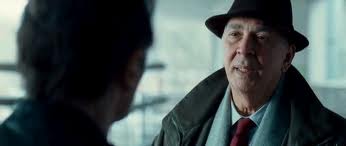 Like a lot of thrillers, the film ends up relying on a Basil Exposition character to wander in from time to time and nudge the plot along. In this case we have Bruno Ganz, who fills the Michael Redgrave role from The Lady Vanishes, as the man of ill-repute who trusts our hero as much out of curiosity as personal gain. Ganz does the best he can and his scenes are among the most likeable in the film. But after Frank Langella arrives the two are in competition for the role; when they meet it is as much a fight to explain what will happen next as it is about serving their characters.
 Unknown might have had more chance of being memorable had the action sequences been well-executed. But sadly this is not to be, with even the biggest set-pieces falling short. The film is shot by Flavio Labiano, who also shot the compelling thriller Timecrimes, but the glossy visuals are rendered useless by the bad use of shaky-cam and the hackery of Jaume Collet-Serra. The same stunts involving cars spinning and people being hit by crowbars are repeated almost literally ad nauseum.
 In terms of the performances around Neeson and Ganz, they are a complete mixed bag. Diane Kruger, fresh from Inglourious Basterds, does a pretty good job as Gina; her character feels savvy and quite rounded, and we enjoy her relationship with Harris as the film develops. But Sebastian Koch, who was great in Paul Verhoeven's Black Book, gets precious little to work with, and neither does 'the other Martin Harris' played by Aidan Quinn. As for January Jones, her role consists of little more than turning around mysteriously, glancing into middle distance or demonstrating that she looks good in a backless dress.
 Unknown is a disappointingly dull and derivative thriller made memorable only by the performance of Liam Neeson. It has neither the light-hearted, playful thrills of Frantic nor the proficient construction of The Lady Vanishes. It scores over Taken in its depiction of foreigners as something other than blatant stereotypes, and there are individual moments which may raise an eyebrow or a giggle. But otherwise there's very little in Unknown which is surprising, enticing or worth remembering.
Rating:
Verdict: Initially promising but ultimately pedestrian
The Lady Vanishes (UK, 1938)
 The Lady Vanishes is a very loose adaptation of The Wheel Spins by Ethel Lina White - so loose, in fact, that almost everything in the film is different. The setting and some of the character names are unchanged, but the rest has been markedly altered - judging by this, for the better. Such decisions tie in with Hitchcock's underlying interest in technique over content: his concern was never with what the story is about, as with how was the best way to tell it.
 The first plus point of the film is that it takes a relatively simple premise and not only runs with it, but explores it from every conceivable angle in the space of 90 minutes. Even when there's a big shoot-out in the last ten minutes, the film has the strength of its convictions and never feels like the director is giving up on the material. Whereas Flightplan wanted to be taken seriously and ended up hoisted by its own petard, The Lady Vanishes follows through with its premise until Hitchcock is satisfied that the audience's needs have been met.
 The film contains a number of aspects which foreshadow Hitchcock's better-known work. He would return to dreams and hallucinations a few years later in Spellbound, and both films are rooted in unreliable narrators searching for an identity which may or may not be their own. When Miss Froy is first introduced to Iris, the latter mishears it as Freud, further confirmation of Hitchcock's continued interest in sex, dreams and psychology.
 Like The 39 Steps before it and Notorious after it, The Lady Vanishes is a classic story of ordinary people caught up in the world of spying by a single chance encounter. And there is a tenuous link with The Birds in a scene halfway through, where Margaret Lockwood and Michael Redgrave are beset upon by pigeons. But the film is also a refinement of existing techniques. The use of shadows in the strangling scene is a development of the gallows sequence in Murder!, while the use of kaleidoscopic vision to depict hallucinations is taken from Fritz Lang's Metropolis.
 The claustrophobic setting of The Lady Vanishes means that there is much less opportunity for the performers to descend into melodrama. While there is no doubt that their characters are whimsical, they feel genuine and understated, and there are only occasional moments in which our heroine has to be hysterical on cue.
 This sense of whimsy is complimented by Hitchcock's use of language as a means of alienation. Many different languages are spoken on screen as a means of making our heroine more isolated. There are no subtitles, and only so many characters can interpret, which is one of the reasons why Iris and Gilbert become friends. This device is a huge influence on the level of trust we have for both our heroine and the other passengers: are people simply misunderstanding her, or do they have something to hide and are using language as a protective barrier?
 Hitchcock always made a clear distinction between mystery and suspense, with the former being wholly intellectual and the latter emotional. Superficially, The Lady Vanishes could be classed as a mystery, since its plot is based around a search for a missing person, just like a detective searching for the murderer. The story has vague similarities with Murder on the Orient Express: the action takes places on a train with many strangers from different countries, their various stories do not corroborate and in one solution everyone is in on it. But Hitchcock doesn't just settle for a sense of mystery, and as things move forward it is our emotional response which becomes key.
 The suspense he generates comes from a number of sources. Some of it is down to set-pieces, the most dramatic being Michael Redgrave having out of the train window in the manner of The 39 Steps. Some of it comes from the time restrictions involved - the train moves to various stations, and characters constantly mutter about crossing the border and needing to make connections. And some of it comes from physical constraints - short of jumping out the window, there's no way off a speeding train. But all of these examples work because of the emotional attachment we have to the characters, both in the reluctant romance and the development of Iris' character as she moves from pity and despair to being more determined and resourceful.
 Like so many of Hitchcock's thrillers, The Lady Vanishes is brilliant at throwing us off the scent, with little touches here and there which appear more significant than eventually transpires. Through a series of cleverly timed edits, we come to believe that the two Englishmen we meet at the start are the ones we should be watching. After Iris and Gilbert pass along a corridor, we see them coming out of a hidden cubicle, as if they were trying to avoid her. Later we see them talking about the pressing need to get back home: these scenes are shot from a more intrusive angle, so that all their talk of 'cricket' could easily be nothing of the sort.
 Then we come to the twist. It's hardly the most impressive or shocking in cinema, but for a film anchored by an unreliable narrator it handles it very assuredly. Some thrillers, like Shutter Island or Heartless, eventually have to come down on one side or the other and say what was real or true in a often disappointing manner. With The Lady Vanishes, no such moment is necessary because only one version of events can be true. Because we see Miss Froy around other characters before she boards the train, she has to have genuinely disappeared. Had the entire film been set on the train, with no preamble, only then would the other option been remotely viable.
 The Lady Vanishes is a great thriller from a director on the cusp of greatness. It takes a simple, modest premise and rings out the maximum amount of both thrills and tension. The performances are believable, the plot is twisty and compelling, and Hitchcock's direction is assured and professional. Later works would be more experimental, but this remains a highlight of his pre-Hollywood career.


