

Reflections
-
It is weird to read my correspondences from the late August/early September
period, being the time of transition between my old function in life to my
new ...
14 years ago
We Need To Talk About Kevin (UK/ USA, 2011)
Directed by Lynne Ramsay
Starring Tilda Swinton, John C. Reilly, Ezra Miller, Jasper Newell
Fate has a funny way of producing amazing success out of apparent failure. For the best part of two years, director Lynne Ramsay struggled to bring The Lovely Bones to the silver screen. She relinquished the project in 2004 and contemplated giving up filmmaking, while The Lovely Bones eventually emerged in a heavily flawed version helmed by Peter Jackson. But without being unfair to either director, this failure was almost certainly a good thing. Otherwise, we wouldn't need to talk about Kevin. We Need To Talk About Kevin is Ramsay's first film in nearly nine years, and is without any conceivable doubt the best film of the year. It's an astonishing, bold and haunting work which is both evocative and emotionally draining, combining a fragmented, nightmarish narrative with expressionistic visuals to create an intoxicating experience. Its unique and frightening vision of the world will chill you to the bone and remain with you for a very, very long time.
 Regardless of its other merits (and there are many), the film is a flawless adaptation of Lionel Shriver's novel. Ramsay doesn't fall into the trap of many bestseller adaptations, which simply arrange the pages in a literalistic order, shoot what they contain and hope that the performances will somehow hold it together. Instead she takes the book's fragmented confessional structure and transforms it, allowing the story to move between events fifteen years apart without any feeling of directorial imposition or incoherence.
 We Need To Talk About Kevin finds Eva Khatchadourian (Tilda Swinton at her terrifying best) looking back over her relationship with her first-born son, struggling to understand how and why he ended up massacring his classmates with a bow and arrow. Their story is told expressionistically, with imagery, colours and sounds being employed to connect Eva's memories. We are never spoon-fed any easy answers about where blame or cause may lie, or whether Eva's intense guilt is justified. The experience is draining in the best possible sense: we follow every glance and sound intensely, feverishly looking for some kind of meaning in all the horror we encounter.
 Purely on a narrative level, We Need to Talk About Kevin is an extraordinary representation of how memory works. It is on a par with Memento in its refusal to allow plot to get in the way of story, or mechanics to override emotions. The internal logic of Kevin is present in its powerful colour palette: the film begins with Eva being drenched in tomatoes at La Tomatina in Spain, which foreshadows the gruesome massacre that Kevin will wreak upon his innocent and unsuspecting classmates. But like Christopher Nolan's later works, like Inception and The Prestige, feeling lost or deeply confused is as thrilling as having it all worked out.
 Outside of Nolan's mental and narrative acrobatics, the film to which Kevin sits closest is Inland Empire, David Lynch's most recent and perhaps most esoteric work. Both films feature female protagonists who are dragged deeper and deeper into a dark world from which there is seemingly no escape, and in which the power of their imaginations are as great an enemy as whatever physical evil may be waiting for them. Eva's guilt, shame, negligence and suppressed despair are a powerful cocktail which produce moments of both earth-shattering horror and painful beauty.
 The other comparison between Ramsay and Lynch is in the disorientating use of sound. The soundtrack to Kevin is by Johnny Greenwood, who previously scored There Will Be Blood, and here he continues his fascination with the intrusive quality of music. Where There Will Be Blood featured burbling eruptions and groaning ironwork (akin to Alan Splet's work on Eraserhead), Kevin is populated with background noises being amplified in a way which is fantastically unsettling.
 The film's exploration of memory and trauma is not confined to the evocative nature of colour and composition. Ramsay's sound design is magnificent, turning ordinary background noise into a source of threat and menace. Kevin's constant screaming as a young child leaves Eva and us with a heightened sense of the world around us. We hear a lawnmower, or a sanding tool, or even rain falling, as if there were a woodpecker hammering away in each ear.
 In one memorable moment, Eva parks Kevin's pram by a pneumatic drill in the road, going to desperate lengths to drown out her child's complaining. We are on constant alert throughout the film, and every sound, especially from Kevin, feels like a vicious attack. But as well as being aware of such attacks, Eva appears to have grown numb because of them: it's difficult to say whether she simply no longer cares about what Kevin does, or whether she is too tired to fight. Perhaps she invites in the noise of the world around her to help her forget the problem she has borne.
 The film is an intelligent, nuanced and multi-layered approach to the nature of evil, asking many questions to which there are no satisfying answers. It's redundant to single any one out as the 'issue' of the film, because they are all interconnected and there is no sugary pay-off that you would find in more Oscar-baiting work. The film is almost structured as a thriller, in which we are charged with gathering all the evidence and offering our verdict as to what happened and why. But the evidence is so conflicted, ambiguous and speculative that it will take many viewings and much discussion to settle on even a workable version of events and motives.
 One of the questions which Kevin raises is whether evil is something which is innate, or whether it is a product of one's upbringing. Eva is far from a natural mother, seemingly incapable of dealing with Kevin and harbouring bitterness at him for ruining her life and career. But both of the actors who play Kevin (Jasper Newell and Ezra Miller) have a disturbing charisma and intelligence: they are smarter than Eva and Franklin, seeing through their every word and deed, and having no time for emotions unless they serve their interests.
 From this arises the question of who is to blame for everything. Is Kevin guilty because he is inherently evil, a sociopath who exists to provide entertainment for the empty-headed morons that are called his equals? Is it Eva, for not standing up to him? Is it Franklin for ignoring Eva's warnings, laughing off her perhaps irrational ravings with comments like "that's just what boys do"? Or perhaps it is a wider social problem: Kevin speaks about the voyeuristic nature of modern society, in which people on TV are filmed watching TV, and in which what is left of entertainment comes from acts of shocking, shattering horror like those that he will perpetrate.
 Finally, there is the role of emotions to consider. It is possible to accept, up to a point, that Eva never really loved Kevin: that she held him responsible for ruining her chances of happiness, and soon got tired of playing mother, knowing full well that there was no point. But equally there is evidence of Kevin's emotional side underneath his dark veneer. We might accept that he is a sociopath, someone who cannot process human emotion and revels in causing pain to others. But in the final scene in the prison, he is openly afraid, a sign that he is still a child who craves affection. This is a significant if pyrrhic victory for Eva in a story of shame and sorrow, and the ending with her walking into piercing white light would seem to leave things on a balance between optimism and stark pathos.
 We Need To Talk About Kevin is the film of the year and Lynne Ramsay's best work to date. It is a shocking, haunting, deeply unnerving masterpiece with a bold artistic vision, every bit as striking and earth-shattering as the best works of David Lynch. If we get another film as good as this in the decade, let alone the year, all the dross which passes in between can easily be forgiven. It is a staggering achievement on all fronts, and nothing short of essential viewing.
Rating:
Verdict: Film of the year
This is a reprint of my review which was first published on Rotten Tomatoes about 2 years ago. It appears here to mirror a series of reviews I had done for RT entitled 'From Burton to Nolan'.
The Dark Knight (USA, 2008)
Directed by Christopher Nolan
Starring Christian Bale, Heath Ledger, Gary Oldman, Aaron Eckhart
The word 'masterpiece' is batted around far too often these days, and with The Dark Knight it's sadly inappropriate. Most of what makes Christopher Nolan a great modern filmmaker is up there on screen, and you cannot fault it for being a blockbuster which is attempting to address such relevant and complicated ideas. But while it is a general success, it is not as disciplined or focussed as Batman Begins and does not reward repeat viewing like The Prestige. It deserves to be celebrated and admired for its intelligence, but one must inevitably acknowledge that it isn't flawless. Having barely put a foot wrong in his previous films, The Dark Knight is the first glimpse of Christopher Nolan ever so slightly losing control. Like Batman Begins the film is a little too long, but it also feels slightly bloated, with much of the dialogue being rushed or mumbled in order to cram in all the ideas. It's almost as though there was enough plot and themes in here for two films, but rather than shoot back-to-back sequels, like The Matrix, Nolan decided to compress them down into one. Considering how mediocre The Matrix sequels were, this was not in itself a bad idea, but we still have to live with the fact that there are too many stories going on.
 Moreover, the film is edited and structured in a peculiar way. Where Batman Begins progressed in a defined direction, The Dark Knight feels more like a series of philosophical vignettes rather than something more progressive and incremental. The set-pieces are undeniably brilliant, but with the exception of the final sequence with the ships, you could put these set-pieces in almost any order and the film would feel the same. It's not terrible because of it, but it does mean that there is less cumulative tension than there could have been.
 This feeling of disorder is bolstered by the increased spectacle. Of course, being a blockbuster we don't expect things to be quiet, but there is a feeling watching all the explosions of Nolan pandering to the popcorn crowd just a little too much. In Batman Begins there were two hours of substance and character development, followed by 20 minutes of explosions to make up the trailer. In The Dark Knight, with its themes of escalation and chaos, it seems right that there should be more carnage, up to a point. But the carnage Nolan puts on screen eventually becomes repetitive, and his decision to film some of it in IMAX adds to the impression that he is overcompensating.
 These criticisms make it seem that Nolan's film is a failure, and when compared to the rest of his output, it is disappointing. But it remains head and shoulders above your average superhero blockbuster. The discipline of the first film has been compromised, but the film retains a desire to explore characters rather than just blow everything up. If nothing else, you have to admire Nolan for being able to take such an ideas-heavy film and sell it to such a wide audience.
 Thematically, this picks up the reins of the first film, dealing with the idea of understanding one's enemy as the means to defeating them. The difference is that the Joker is not a Nietzschean figure like Ra's al Ghul, someone who becomes evil by believing so strongly that he is doing good. In fighting him Batman still risks becoming like his enemies, but this lack of morality means that the cost to him will be greater. Killing the Joker seems necessary, but it would destroy Batman's moral code and undermine the belief that good can overcome evil in a non-Nietzschean way.
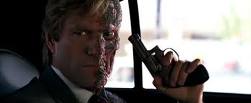
 The film is quite nihilistic in suggesting that even at its weakest, evil can triumph over good. The Joker's fate at the end remains uncertain, but the revelations surrounding Harvey Dent give a sense of him winning even though his direct influence is curtailed. The Joker's evil is allegorical to terrorism, in that his influence is fragmented and disparate. He does not take power by marching in with an army; he infiltrates, twisting, turning and double-crossing. Dent and Batman are the dove and the hawk trying to uphold rules in the face of chaos, and both are essentially destroyed in the process.
 The thing which marks out The Dark Knight from Nolan's previous work is that it is relatively conventional in its storytelling. It's ridiculous to call it 'dumbing down', but there is none of the jumping back and forth in time which made The Prestige so gripping. The themes are presented in a much more upfront way, both in the dialogue and the precise mechanics of the moral dilemmas. You could almost accuse Nolan of ramming ideas down the audience's throats, but thankfully the script and the characters are good enough to prevent this.
 The film has similar character development to Batman Returns, which was criticised for sidelining Batman in favour of the svillains. But that's always been the point. Since Batman is a superhero who uses cunning rather than powers, there has to be a section of the film in which he is the underdog; if nothing else it makes his eventual triumph more powerful and palatable. What makes The Dark Knight clever is that it does all this while withholding the Joker for a long time. Apart from the opening bank raid, the first act largely concerns itself with Lau and the Mob.
 As with all Nolan films, the performances are really great. Heath Ledger was generally a lightweight, but as the Joker he manages to channel Malcolm McDowell and make him truly terrifying. It's easily his best performance, although like the film it has become a victim of its own hype. Like the Scream killer, it has been so widely parodied that it isn't quite as scary anymore. Christian Bale remains convincing, and as before it is right that he should be a little sidelined so that the great evil is acknowledged.
 Michael Caine and Morgan Freeman are both warm and affable, and the script does allow for more humour this time round - for instance, when Rachel Dawes and Batman land on the car, she turns to him and says, "Let's not do that again". Interestingly enough, the film glosses over the most interesting character development: the individuals closest to Bruce Wayne finding out his identity. This was explored in Batman Returns in some detail, but here there are several conversations between Bruce and Rachel in which she knows he is Batman, which somewhat undercuts the drama.
 The Dark Knight contains many promising performances, along with stunning visuals from Wally Pfister who gives Gotham a grungy and decaying edge. In the end it struggles to completely control all the rogue elements, but at least Nolan doesn't fall into the same trap as Sam Raimi on Spiderman 3, namely throwing everything at the screen in the hope that some of it will work. If Batman Begins was Nolan's equivalent of Alien, then this is his Aliens: more action-packed and slightly less compelling, but still weighty, intelligent and interesting. One only hopes that Inception will not be his Alien 3.
Rating: 
Verdict: Bloated but containing brilliance
This is a reprint of my review which was first published on Rotten Tomatoes about 2 years ago, with a couple of minor revisions. It appears here to mirror a series of reviews I had done for RT entitled 'From Burton to Nolan'.
Batman Begins (USA, 2005)
Directed by Christopher Nolan
Starring Christian Bale, Michael Caine, Liam Neeson, Katie Holmes
The words 'substance' and 'blockbuster' are rarely found in the same sentence. Nor indeed are the words 'auteur' and 'commercially reliable'. But Christopher Nolan is living, breathing proof that the two can come together and make astonishing work. Having won over mainstream audiences with Memento and Insomnia, Nolan uses his particular blend of non-linear storylines and visual hyper-realism to breathe new life into a long-dead franchise. With all the acclaim being accorded to The Dark Knight (most of which it deserves), it is easy to forget just how good or how strong Batman Begins is. It's not just good by Batman standards, or by prequel standards; it has its own, stand-alone identity, a headstrong independence which defies and ignores all that has gone before it. Gone are the Gothic spires of Tim Burton's Gotham City, or the day-glo camp of Joel Schumacher's costumes. This is a new whole new world, in all its meticulous and frightening glory.
 All of Nolan's films are stunning to behold, but Batman Begins takes his craft to new heights. He is famous for not using a second unit, allowing him to supervise and construct every shot just the way he wants it. This means there is no jarring difference between the film's dramatic scenes and the external effects designed to show us the city. Even in the most effects-heavy parts of the film, we never question who is behind the camera, guiding these scenes and determining their significance.
 Nolan has the same gift for visual verisimilitude as Ridley Scott, whose masterpiece Blade Runner was a major influence on the young filmmaker. Both directors are able to construct seamless, immersive worlds on screen which are simultaneously strange and familiar. They have a beauty which both comforts and surprises us, allowing the filmmaker to play with the clichés and always come up with something new. But while several of Scott's films are truly style over substance (Legend, Someone to Watch Over Me), Nolan has yet to make a film which forsakes narrative substance for the sake of visual splendour.
 What makes Batman Begins so rewarding, so gripping, and arguably so radical, is that there is a constant and unrelenting focus on the story. No matter how much we jump back and forth in time, or how many bad guys get hit, we never doubt that the movie is in control of itself and is yearning to move on to the next important piece of character development. The fact that we have to wait an hour before Christian Bale even dons the bat-suit is a clear sign that the filmmakers want to do this properly. They have avoided falling into the trap of either the original films, which often put the narrative on pause for a kid-friendly set-piece, or the Star Wars prequels, which waded through years of turgid back-story for a few minutes of vaguely dark action.
 Mark Kermode once described this film as "a little independent, weird, art movie, trapped within the body of a $140m blockbuster." And he wasn't far off. Batman Begins is much less a superhero film per se than it is a detailed philosophical examination of the nature of fear and morality in a chaotic world. Both our protagonists and his many enemies have fear and intimidation as their source of power -- the former by their bribes and weapons, the latter by stealth and an incorruptible desire to do good. But rather than keep it as a straight fight between good guys and baddies, the film questions the motivations of our hero on a frequent basis. The supporting cast, particularly his old flame, push him on his motivation for doing what he does, in the way he does, regardless of how little they actually know.
 This is a film in which the desire to do good can so easily be blurred into the desire for power; in which the lines between justice and vengeance are frequently re-drawn; and in which the triumph of good over evil is neither complete nor reassuring. In the film's closing scenes, Gary Oldman warns Batman that he is potentially doing more harm than good; this enemy may have been extinguished, but a darker menace lurks on the horizon which will be harder to defeat.
 At the centre of all this is the idea that to defeat evil, one must understand it and even adopt part of its methods if the ends justify the means. The League of Shadows, headed up by Ra's al Ghul, are a symbolic forewarning to Bruce Wayne of what he could become should he fully embrace his fear. Liam Neeson's character is a Nietzschean figure, who has channelled his desire for justice so purely that it has consumed all his remaining humanity. Bruce Wayne should if anything be more brutal, since he wishes to atone for the death of his parents. But when he is asked to slay the farmer, his humanity intervenes and he refuses. This pivotal scene confirms Wayne's incorruptible nature; he may become feared, but he will never let the fear become him.
 One criticism of this film from some quarters is that this new emphasis on darkness and philosophical soul-searching has taken all the fun out of the character. In fact one of the pleasant surprises about Batman Begins is the extent to which humour still resides. Not only do we get impressive popcorn-worthy action sequences, but we also have a script which grows more sarcastic and playful as all the battle lines are drawn. There aren't any laugh-out-loud moments, but that's not why the film exists.
 The film is inhabited by one of the best all-star casts outside a Robert Altman film. Christian Bale is brilliant as Batman, drawing on his great work in American Psycho to make Bruce Wayne totally three-dimensional. He plays Wayne with a tortured intensity which makes his pain all the more palpable. The supporting cast is completely solid, with the best performances coming from Cillian Murphy as the chillingly creepy Dr. Krane and Michael Caine as the affable father figure Alfred. Special mention should also go to Gary Oldman as Gordon and to Liam Neeson, who gives one of his best performances in years.
 The only real flaws with Batman Begins come when it attempts the widest possible appeal. The last twenty minutes, is completely over-the-top and rather cavalier on the part of the director. It's not so much a punch in the face as a flick on the nose; not especially painful, but you still feel annoyed that it happened. Moreover the opening scenes, before Bale reaches the monastery, are very jumpily edited so that only the most devoted will be pulled in.
 Nonetheless, Batman Begins is a really great film which does not deserve to be neglected in the wake of The Dark Knight's success. It is a stunning combination of style and substance which avoids all the pitfalls of its counterparts and predecessors. Together with The Dark Knight, it has become the gold standard against which all subsequent superhero films have been measured, and more often than not come up short. It may not be Nolan's best film - that remains Inception - but it is a fantastic demonstration of how art and money are not so easy to separate.
Rating: 
Verdict: The best Batman film
Watchmen (USA, 2009)
Directed by Zack Snyder
Starring Jackie Earle Haley, Patrick Wilson, Malin Akerman, Matthew Goode
Big-screen adaptations of Alan Moore's work have been a decidedly mixed bag, from the enjoyable V for Vendetta to the flawed From Hell and the excremental The League of Extraordinary Gentlemen. In bringing what is considered Moore's finest work to the big screen, Zack Snyder has made every effort to do justice to the graphic novel and satisfy the fans. But the finished project is found severely wanting in crucial areas, resulting in either a big, long folly or a missed opportunity.
 Of all the Alan Moore adaptations, Watchmen has the longest and most troubled production history. The film was first mooted in the early-1990s when Terry Gilliam was approached by Sam Hamm, who had recently achieved success writing Tim Burton's Batman. Despite being initially interested, Gilliam concluded that the novel could only work as a TV mini-series; he left the project and Hamm's script was indefinitely shelved.
 The project re-emerged in 2001 with a new script by David Hayter, which lay around for three years before Darren Aronofsky was attached to direct. He subsequently dropped out to make pet project The Fountain, and his replacement Paul Greengrass did the same a few months later, in order to make United 93. Snyder was first offered the project in late-2005, shortly after his success with the remake of Dawn of the Dead. The project was formally green-lit in 2007 after shooting wrapped on 300.
 There is no doubt that Snyder and everyone involved in Watchmen wanted this to be the best possible adaptation of the novel. This is in spite of the fact that Alan Moore has disowned it, along with all other adaptations of his work (and looking at The League of Extraordinary Gentlemen, it's not hard to see why). Various stories have circulated about the cast having copies of the novel on set, so that it could be referred to directly whenever there were questions over plot or characters. The film was clearly made for the fans and not for the money: with an 18 certificate and a budget of $130m, no expense or effort has been spared to replicate the comics as closely as possible.
 But in spite of this obvious affection, there are a number of big problems with Watchmen which render it at least a partial failure. The first and biggest problem is that Snyder is a fanboy. He loves the comic to such an obsessive degree that either he can't explain it to the rest of us, or he isn't willing to explain it.
 As a result the story of Watchmen is largely impenetrable to anyone who didn't spend their teenage years immersed in comic books. Snyder is focussed so much on meeting fans' expectations that the backstories or reasoning of the characters gets buried or lost, not to mention the mechanics of the alternative universe they inhabit. This is particularly the case with Doctor Manhattan, whose origins are only touched upon about halfway through the film.
 The second, deeper problem is with Snyder as a director. He is not the "visionary" that he is made out to be, being visually stylish but a very poor storyteller. While the novel is purported to have substance coming out of its ears, the film gives the impression that it is all surface and no depth, amounting to little more than people in latex hitting each other. One could say on these grounds that Snyder is the new Joel Schumacher - and for all its disinterest in the comics, Batman Forever is a better film.
 On top of his irritating use of slow-motion, most of Snyder's visual decisions smack of impatience, incompetence or showing off. His impatience is seen in the constant cutting between multiple, similar angles in scenes which would flow much better with longer, simpler takes. His incompetence is found in beginner's-level mistakes: he shoots several scenes through windows, resulting in lens flare or distracting reflections. And his showing-off is evident in Veidt's interview being reflected through a lens of another camera, or a sex scene being captured through the glasses on the table. In each example the visual decisions are an unnecessary indulgence which contribute little, and in many cases detract from and undermine the story.
 Regardless of how complex or multi-layered the story of Watchmen is, it does not require two-and-a-half-hours to be told. On the one hand, it feels like the film always wants more time to develop the characters, and Gilliam was probably right that it would have worked better as a miniseries. On the other hand, if Snyder was determined to make a manageable film, he would have accepted the necessary compressions and moved the character development forward. But he doesn't do this, at least not as much or as well as he should. We have to wait nearly two hours for things to come together with the twist involving Ozymandias and Doctor Manhattan, by which time most of us will have given up.
 So much of Watchmen is window-dressing, confirming Snyder's pursuit of style over everything else. Rorschach's film noir narration might work in the comics, but it serves little to no purpose here: the end point involving the discovery of his journal is silly, and it does nothing to move the plot forward other than stating the obvious. Snyder's choice of pop songs on the soundtrack is lazy, particularly in the opening montage: he settles for Bob Dylan's 'The Times They Are A-Changin' where Quentin Tarantino would have put on something more entertainingly esoteric.
 This feeling of superficiality, coupled with the unrelenting pursuit of style, causes all of the arresting themes of Watchmen to get buried. In fact, the story raises a number of interesting issues about the ethics of nuclear war and peace, the workings of mutually assured destruction, and in particular the role of "costumed heroes" and how they could be controlled or policed. The slogan "Who Watches the Watchmen?" recurs as graffiti throughout the film but is barely addressed in a constructive way.
 The tone of Watchmen keeps flipping between flippant and portentous, with Snyder being unable to balance the dark or forbidding elements with the inherent silliness of a naked floating blue man. This is perfectly demonstrated by a scene halfway through on Night Owl's ship: Silk Spectre II makes a comment about impending nuclear war, which then cuts to her and Night Owl making love in their costumes. Such lurches in tone are akin to erotic fan fiction and threaten to drag the whole film into parody.
 Because the flippant aspects of Watchmen are so prominent, scenes which are meant to be more thought-provoking lose much of their impact. During the scenes involving Richard Nixon, what sticks in your mind is not the threat of global destruction but his comedy rubber nose, which makes the war room scenes feel less like Dr. Strangelove than Spitting Image. More problematically, when the film has a near-rape sequence, or a child abduction, or any number of brutally gruesome deaths, Snyder can't pull himself together: he can't deliver the emotion punch that such scenes require to prevent them from seeming inexcusably adolescent.
 Watchmen is a deeply flawed, over-long and often boring attempt to bring Alan Moore's vision to the big screen. Whatever the merits of the graphic novel, and regardless of his good intentions, Snyder was the wrong director and this adaptation will put many newcomers off the source material. It pales in comparison to both V for Vendetta and Christopher Nolan's Batman films, both as a comic adaptation and an attempt to explore serious political issues. Fanboys will leap to its defence, but everyone else will be bored, annoyed or confused.
Rating: 
Verdict: A deeply frustrating failure


