

Reflections
-
It is weird to read my correspondences from the late August/early September
period, being the time of transition between my old function in life to my
new ...
14 years ago
Ladyhawke (USA, 1985)
Directed by Richard Donner
Starring Matthew Broderick, Rutger Hauer, Michelle Pfeiffer, Leo McKern
When it comes to 1980s fantasy, there are three broad categories into which films can fall. There are those like Flesh & Blood, which get the balance between substance and silliness spot on, marrying Machiavellian mercenaries to grin-inducing battle scenes. There are those like Excalibur, which take themselves so seriously that they're fatally dull. And there are those that are totally, utterly, and enjoyably silly - and into that category goes Ladyhawke. Ladyhawke is of historical interest due to its place in Richard Donner's career. The fiasco surrounding Superman II, on which he was replaced mid-shoot by Richard Lester, had thrown Donner's career off-course: he had to watch Superman II and III take huge amounts of money while he delivered flops like Inside Movies and The Toy. But either side of this film, he found himself very much in mainstream favour again, first with The Goonies and later with Lethal Weapon. It is interesting that a director whose place in history has been defined by blockbusters (including, of course, The Omen) should be capable of making something so delightfully odd in the midst of two more rounded and confident efforts.
 Like many 1980s fantasies, there are aspects of Ladyhawke to which time has not been kind. The most obvious of these is Andrew Powell's soundtrack, which was nominated for a Saturn award in 1985 but has since become regarded in some quarters as one of the worst ever composed. After Toto's contributions to Dune, it became more common for pop groups or composers to score films, due to the selling potential of the groups and the relatively cheap cost of synthesised music. But Powell's efforts go just too far even to be enjoyed ironically, with its overproduction and bouncy pop timbre frequently jarring with the quieter moments.
 The score is one aspect of Ladyhawke which confirms its inherent silliness, even before we get to the meat of the story. Another such aspect is its visuals, which manage to look lavish and professional while still feeling ropey and cheap. The film is shot by Vittorio Storaro, who famously shot Apocalypse Now - something which is evident in the multitude of blood-red, beautiful sunsets which are central to the plot. But in amongst the terrific scenes of frozen lakes, dark forests and crisp skylines, there are numerous scenes which look like they were filmed in a hurry, treading unintentionally close to Monty Python and the Holy Grail.
 This feeling of cutting corners is reinforced by the paucity of special effects. For a film in which people metamorphose into animals on a daily basis, the special effects of Ladyhawke are coy to say the least. Apart from a few shots where Michelle Pfeiffer's eyes change shape in close-up, all the big transitions happen off-screen; on several occasions Matthew Broderick leaves the room just beforehand, as though the actors had to go off-stage to change costumes. While Donner wouldn't have had access to the CG wizardry we take for granted, there was plenty of scope in the physical effects of the time to achieve something a little more palpable. Only four years earlier Rick Baker produced the definitive werewolf transformation for John Landis, in a film with half of Ladyhawke's total budget.
 Added to this shortcoming we have a number of plot holes which either confuse or produce unwanted tittering. First there is the problem of clothes: Rutger Hauer and Michelle Pfeiffer keep the same outfits throughout, but there's not much effort to keep the clothes together when one of the pair is in animal form. Then there is the question of memory. The film borrows the horror device of the person having no memory of what they did as a beast - so how come the hawk remembers to stay with her master, or the wolf not to eat his mistress? Finally, there are several blatant continuity errors. We are told that Pfeiffer appears as an eagle whenever it is daylight, and yet there are at least two scenes where it's daylight and yet she is still there. At least when Shrek half-inched the plot, it was consistent throughout.
 But in spite of these problems, Ladyhawke is a consistently entertaining little romp. Like Logan's Run nine years earlier, it's only when you stop trying to take it seriously that its ideas and emotional impact bubble to the surface. And like Logan's Run, this transition is cemented via a dominant performance by a great actor - not Peter Ustinov, but Leo McKern.
 Most famous for playing Horace Rumpole in the long-running TV series Rumpole of the Bailey, McKern had courted cult status at various points in his career: as veteran reporter Bill McGuire in The Day The Earth Caught Fire, as a recurring Number 2 in The Prisoner, and in his previous outing with Donner as a mad archaeologist in The Omen. But whereas that last appearance was a silly cameo in an otherwise seriously creepy film, here McKern brings weight and gumption to an otherwise facile concoction. Like Ustinov before him, he puts a brake on excessive silliness, if only for a moment, in order to steer the viewer towards the emotional heart of the film.
 Not only is McKern's delivery well-suited to disguising exposition, but he illuminates some cracking lines in the script. Most of the wisecracks go to Broderick, who is on very fine form; his soliloquys with God about telling the truth and resisting temptation are guaranteed to raise a smile. But McKern's timing is note-perfect, as he waits for a knight to fall right through the drawbridge before quipping: "Always walk on the left side!". Best of all comes when Broderick brings him the hawk after it has been wounded by an arrow. Having been told that he can't eat it, McKern bellows: "What? Is it Lent again already?!"
 While McKern's performance is the icing on the cake, the other major players are also firing on all cylinders. Rutger Hauer seems naturally suited to the historical romp, whether as a heroic figure here or as an antihero in Flesh & Blood. His typically brilliant screen presence, being equally charming and threatening, suits the personality of Navarre as a knight tormented by the woman he loves but cannot have. And while Michelle Pfeiffer's hair may be straight out of a pop video, she too fits her character very nicely. Her beauty conveys both the innate sense of mystery about Isabeau and the vulnerability of her predicament. She's so convincing, in fact, that you keep recognising her facial features in those of the hawk.
 Having these two charismatic performances goes some way in making the romance at the heart of the film feel believable. Somehow the grandiosity of the setting gives the relationship more weight, making it feel like there is more at stake than with similarly inseparable lovers in more mainstream rom-coms. The story is an interesting variation on the age-old tale of two people destined to be together but cursed to be apart, and for all the ridiculous elements within the central conceit it does end up pulling you in.
 This emotional pull is most evident in two scenes towards the end. The first occurs when Philippe finds Navarre lying next to Isabeau as a wolf. The sun begins to rise, Isabeau begins to change, and for a split second both see each other with human eyes. Navarre reaches out to touch Isabeau, only for her to change and fly away, leaving him beating the earth in frustrated rage. The other comes during the solar eclipse where the two are reunited and the curse is broken. The slow pacing and distance between them prior to their first real contact reinforces the strength of the bond between them.
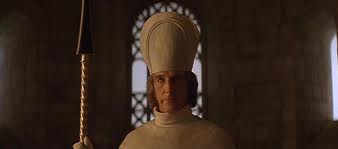 Ladyhawke also has its fair share of good action. Considering Donner's bad feelings towards Richard Lester (who can blame him?), it is ironic that his action sequences, in this film at least, take after Lester's finest work in The Three and Four Musketeers. The fight scenes have some pretty inventive slapstick and Broderick doing all manner of acrobatics, while Hauer gets to swashbuckle and head-butt to his heart's content. The highlight comes in the climactic fight in the church, ending with Hauer throwing his huge sword over several yards right into the heart of John Wood's scenery-chewing Bishop.
 Ladyhawke may not have aged as well as Flesh & Blood or Legend, but it remains a definite guilty pleasure and a bona fide cult film. Its flaws are all in plain sight - the soundtrack, the silly plot, the special effects - and yet none of them can completely eclipse the sheer enjoyment that it brings. If anything these flaws serve to make it more endearing, and more fun than mainstream fare like Robin Hood: Prince of Thieves. Donner would make more consistent features after this, but for pure and simple fun it takes some beating.
Rating:
Verdict: Silly but sublimely entertaining
Deliverance (USA, 1972)
Directed by John Boorman
Starring Jon Voight, Burt Reynolds, Ned Beatty, Ronny Cox
Every so often a film's image in popular culture is defined by a moment completely out of character with the film as a whole. One could argue that this is true for the ending of The Wicker Man, or the lengthy fight sequence in They Live. But there can be no better example of this than Deliverance, whose five minutes of light-hearted duelling banjos masks a gruelling, harrowing and edgy thriller that will haunt you for days on end. In another director's hands, James Dickey's novel about four wannabe "city boy" adventurers could have ended up as a very simple, nuts-and-bolts exploitation film: a clash of civilised and savages, townies versus hicks, and the last man standing wins. But in what remains his best film, John Boorman manages to take this limited narrative and turn it into both a frightening voyage of discovery and one of the best environmental films ever made.
Deliverance draws on a recurring theme in Boorman's work of man versus nature, or more precisely the unquantifiable power of the natural world compared to the humans who attempt to dominate it. In his later career, Boorman would make these kinds of points a lot more heavy-handedly: the sheer quantity of tree-hugging in The Emerald Forest makes Terrence Malick look like a gun-toting industrialist. Here, however, there is a very good balance between the film's political message and the drama of the characters through which such a message is communicated. As the film begins, we are introduced to our four modern men - modern in the sense that they live over and above the landscape and are imposing their authority on it even by the act of going on the river. The local hicks warn the men that what they are doing is stupid, but they dismiss such comments as superstitious crazy talk and stick rigidly to their plans. The car journey to the river is intercut with scenes of bulldozers ferrying rock from a quarry and huge cliff walls being dynamited, as if every action of Man against his habitat is one of exploitation or destruction. They even invoke the great explorers of old having just safely barrelled through the rapids.
But although these men come from the same stock, we are slowly but surely introduced to little fissures in the group. Burt Reynolds' character seems to be more 'at one with nature' than the others, and feels genuinely sorry that the river will be flooded while the others are just there for the fun. Dru, played by Ronny Cox, is the most naïve and childlike of the four, bringing his guitar everywhere and spending the opening act riding through rapids with no life jacket and a beaming grin. Ned Beatty is overly cautious, being the most out of shape and reluctant to be ordered around, and Jon Voight has some pretentions towards being like Reynolds but is ultimately out of his depth; he carries a bow, but gets the shakes whenever he tries to use it. Aside from a direct warning against exploiting one's surroundings, there is a more subtle thread in Deliverance about the character of modern Man and how He is more or less incapable of returning to 'the old way of life'. All four men, even Reynolds, are at heart white-collar workers, who feel at home in their busy offices with paper and coffee, or in their large homes with loving wives. Their affection for nature is entirely playful, since none of them would choose to give up what they have to live like a hunter-gatherer. They enjoy pretending to be wild when in fact they are nothing of the sort, and as long as their journey is filled with beauty and adrenaline, their experience of 'nature' fits in with their worldview.
 But, as the darker, less merciful side of nature begins to rear its ugly head, these men quickly become overwhelmed by their surroundings, and we understand just how little they really know. If Reynolds et al are an expression of Man's desire for dominance of nature, mitigated by a faux fondness of its beauty, then the hicks or in-breds are a manifestation of nature itself: uncompromising, ruthless, set in its ways and not so much of a pushover. The crucial mistake of the gang is not being among nature of itself: their mistake is assuming that they are in control.
 The famous rape scene, in which Ned Beatty is made to "squeal like a pig", is an ironic role reversal based upon one of the film's opening lines. Over some long aerial shots of the river, Reynolds remarks that in building the dam, people are "raping" the river and the surrounding countryside - and here we have nature raping man, not in self-defence or out of vindictiveness, but because that's the way it has always been. Boorman shoots these sequences very sensitively; his camera does not revel in Beatty's humiliation, with a clever combination of wide shots and close-ups on his face doing more than enough to terrify us.
 Had Boorman not set up the themes of the story, and brought them out of the woodwork so accessibly (no pun intended), scenes like this would appear gratuitous or exploitative. But just like the ending of The Wicker Man, the brutality of Deliverance is justified because it vividly conveys the themes and ideas of the film. Scenes like this demonstrate that, under the right circumstances, visceral, gut-wrenching horror can say as much about a subject as a dozen boring conversations. As with The Wicker Man or Alien after it, the violence in Deliverance instinctively shocks but remains with you until its symbolic significance becomes clear.
 Those who are unconvinced by this need only look at a scene just before the rape sequence, in which Jon Voight is crouched behind a tree trying to shoot a deer. There is nothing tense or threatening about his situation, save for the small matter of finding breakfast. But even so, he hesitates, his hand shudders and the arrow flies off into the trees causing the deer to flee. The set-up is the same as before: Man assumes he is in control, attempts to enact that control, and finds that he can't.
 Deliverance is also a very well-directed piece of work and a lesson in great low-budget filmmaking. Although the film looks rough and ready in places, it also has a great drained-out beauty to it. This is achieved through Vilmos Zsigmund's trademark use of 'pre-fogging', in which the celluloid is partially exposed before shooting to create a muted colour palette. Because the budget was so low (around $2m), all the stunts are real, right down to Ronny Cox tumbling head-first into the rapids. Boorman's camerawork is inventive and precise, following the men above and below the water as they struggle to the surface and fight for breath.
Deliverance is also notable for its limited use of music. Aside from its duelling banjos at the start, there isn't really any soundtrack to speak of. The film is comparable with Get Carter, which introduces its jazzy theme in the opening minutes and then fleetingly revisits it at key moments to add tension or terror. The little banjo touches as the survivors float around the river are few and far between, and every time they pop up our eyes dart frantically to the trees, searching for further enemies who might spring out at any moment. Like any great Western, Deliverance knows how to use the stillness of the landscape to create tension, and its use of background noise like water rushing or birdsong will shred your nerves to breaking point. Deliverance is a great film with exceptional performances from its cast: Voight is every bit as good as he was in Midnight Cowboy, and Reynolds has never better, carrying himself in several scenes like a young Marlon Brando. It also remains Boorman's best film, being more substantial than Point Blank or Hell in the Pacific but also much less indulgent than his later works. Like Get Carter it isn't quite flawless, as things take a while to get going and still feels rough around the edges. But that's a small price to pay for a top-notch thriller which is intensely terrifying and terrifyingly intense.
Rating: 4.5/5
Verdict: An endlessly tense environmental thriller


