
Reflections
-
It is weird to read my correspondences from the late August/early September
period, being the time of transition between my old function in life to my
new ...
14 years ago
Kind Hearts and Coronets (UK, 1949)
Directed by Robert Hamer
Starring Dennis Price, Alec Guinness, Valerie Hobson, Joan Greenwood
Since the brand was revived several years ago, Ealing Studios have developed a reputation for quaintness. With the exception of John Landis' underrated Burke and Hare, the majority of the new Ealing's output has been frothy, often retrograde films designed solely for the export market. How easily we forget that the self-same studio once produced some of the darkest, edgiest and blackest comedies the world had ever seen. And there is no better example of this than Kind Hearts and Coronets, which takes pride of place with The Red Shoes as one of the finest British films of the 1940s. Describing any old film as 'edgy' comes with problems. Changes in social attitudes since the 1940s means that, on one level, filmmakers are now able to show a wider range of subjects to a greater extent than ever before. Under this line of argument, what was once considered edgy, radical or insightful now looks timid and tame. But even if we accept this as a general rule, Kind Hearts and Coronets still stands as a proud and intriguing exception. Like Peeping Tom eleven years later, it has retained its emotional impact even after its aesthetic achievements have been surpassed.
 Kind Hearts and Coronets is a comedy about a serial killer, at a time when the vast majority of films involving murder sought to completely demonise the assailant in question. More than that, it is about a serial killer who vengefully targets the aristocracy, who while waning in power still held a great deal of influence in government and high society. The film is a vitriolic attack on the British class system, thinly disguised as an erudite comedy of manners. To paraphrase Macbeth, it may look like the innocent flower, but it is most definitely the serpent under it, and its venom is ruthless and bitter.
 In a further comparison to Peeping Tom, the film had a rocky ride with the censors when first released. Sir Michael Balcon, then-head of Ealing, sought to distance himself from the film, believing that the public could not handle its ironic treatment of the subject matter. In line with the restrictive Hays Code, the American distributors requested that Robert Hamer added a ten-second epilogue, to show Louis Mazzini getting his comeuppance in a way while the original ending only implied. While Alec Guinness went on to win an Oscar for The Bridge on the River Kwai, neither Dennis Price nor Robert Hamer would ever reach this level of success again. Film critic David Thompson described the latter's fortunes as "the most serious miscarriage of talent in post-war British cinema".
 Many of the classic Ealing comedies used present events to satirise the past and vice versa. Passport to Pimlico satirised both the Berlin airlift and the exile of the Dutch monarchy to Canada, while some commentators have argued that The Ladykillers is a send-up of the post-war Labour government. Kind Hearts and Coronets was made in the year of the Second Parliament Act, which further curbed the power of the House of Lords and with it the aristocracy. The real-life political attack on landed wealth is contrasted with the lethal attacks of Louis Mazzini, with the aristocracy being 'killed off' in both cases.
 Kind Hearts and Coronets has a very poisonous view of the British class system, and in particular of the aristocracy's attempts to justify its position. While marrying out of love may have brought Mazzini's mother poverty, marrying for wealth and "good breeding stock" brings nothing but misery. Whatever diversions the D'Ascoynes may pursue (the navy, photography, the church, hunting) there are a universally inward-looking bunch, with little time for anyone whose interests or backgrounds are not identical to their own.
 Although Mazzini is of noble blood, his training as a draper, shop assistant and bank clerk gives him a middle-class status, something which simultaneously repulses and pleases him because it serves as the perfect cover for his crimes. The closer he comes to his goal of becoming Duke of Chalfont, the more he takes on the characteristics of a D'Ascoyne, shunning his childhood sweetheart Sibella (Joan Greenwood) and refusing to help Lionel in his hour of need. The film brutally depicts the entrenched arrogance of the British elites, something which has persisted longer after the D'Ascoynes of this world have withered away.
 Dennis Price, who had previously found fame in Powell and Pressburger's A Canterbury Tale, is absolutely extraordinary in the lead role. Having been aptly described as "sourly handsome", he presents Louis Mazzini as a man of immense class and sophistication, but who is also capable of being cold, dismissive, callous and sociopathic. Price was always self-deprecating about his acting abilities, describing himself as "second-rate" and "lacking the essential spark." But whatever else happened in his career, this performance is enough to dismiss all such deprecation.
 What makes his performance so interesting is that, for a lot of the time, Price doesn't speak. The prolific use of voiceover gives his performance a silent movie quality - not because his movements are exaggerated, but because his facial expressions and posture play a bigger part in his characterisation. Normally this amount of voiceover could quickly become tedious, but here it works brilliantly, taking us behind Mazzini's mask of dignity. It makes his deadpan expression all the more funny, as the most unspeakable things are uttered without the merest twitch of his lips. It is as though we were inside the mind of a killer, hearing his darkest deeds completely uncensored and without any license on the part of the screenwriter.
 Kind Hearts and Coronets' themes of love and class are also expressed in Mazzini's relationships with women. For most of the film he is taken with Sibella, who marries Lionel but confides in Louis due to their friendship as children, and increasingly out of desperation as just how boring her husband is. Louis strings Sibella along, playing with her heart strings and being glad to kiss her while knowing he can never bring himself to be with her. This is a further example of Louis' corruption as he grows closer to his goal, becoming as cold and as haughty as the people who caused him to swear revenge.
 If Sibella is the proud plaything who is ultimately beneath his stature, Edith (Valerie Hobson) provides the security of wealth and the moral backbone Louis needs. Their initial meeting, while her husband is still alive, indicates that such a marriage would not be any fun: her strong religious conviction forbids drinking, leading her husband to keep gin and whisky in his dark room. Much of the film plays out like a bedroom farce as Louis tries to keep the two women from ever meeting. In the final scene, he has to choose between dull security and loving disgrace, quoting from The Beggar's Opera as he struggles to make up his mind.
 The humour in Kind Hearts and Coronets is as black as can be, with multiple jokes about hanging and all the murders having a comedic quality. These range from the general being blown up as he opens the caviar, to the admiral mistaking port for starboard and sinking his ship, and finally Mazzini's employer dying of shock after inheriting the title. There are dozens of laugh-out-loud moments, such as Mazzini's comments after shooting down Lady Agatha D'Ascoyne: "I shot an arrow through the air; she fell to earth in Berkeley Square." But a lot of the time the film is so edgy and so forthright that you're almost afraid to laugh: the barb is so strong that to laugh is almost too easy a response.
 The film is most popularly remembered for Alec Guinness, who plays all eight members of the D'Ascoyne family. He was originally only offered four roles, but pressed Hamer to cast him in all eight after reading the script. Suffice to say, he's magnificent, with each family member having clearly developed character traits and quirks, and each looking hilariously pompous in all that make-up. The split-screen shooting used to put all eight characters on screen is utterly seamless, and Hamer's direction is totally first-rate.
 Kind Hearts and Coronets is a perfect black comedy, which is as funny as Monty Python and the Holy Grail and as artistically accomplished as the best work of Powell and Pressburger. The performances are all superb, particularly from Guinness and Price, and Robert Hamer's direction gives the film a note-perfect pace so that all the jokes hit the spot. Over 60 years since it took the world by storm, it remains the darkest, edgiest and funniest of the classic Ealing comedies, and will be reducing generations to fits of laughter for years to come.
Rating:
Verdict: A perfect black comedy
Peeping Tom (UK, 1960)
Directed by Michael Powell
Starring Carl Boehm, Moira Shearer, Anna Massey, Maxine Audley
When looking back on his long career in an interview with The Onion, Robert Altman said that "you tend to love your least successful children the most", saying that he felt more affection for Popeye than for anything critics and audiences embraced, such as Short Cuts or Nashville. One wonders whether Michael Powell would have taken the same view of Peeping Tom, the film which all but destroyed him as a filmmaker. But unlike Popeye, which produces reactions ranging from 'utter rubbish' to 'guilty pleasure', there can be no doubt that Peeping Tom is a blistering masterpiece. You will struggle to find a more audacious, bold, striking and shocking piece of British cinema, at least until the rulebook was re-written by A Clockwork Orange. Coming at the beginning of a decade which would be defined by rebellion against any and every convention, Peeping Tom blazed the trail, stepping into the darkness with a red-hot torch at the cost of setting its own coat-tails on fire.
 Considering that Peeping Tom and Psycho were released within months of each other, you would expect audiences to have flocked to both releases, and for both to become regarded by critics as among the best works of 1960. Aside from their similarities in terms of story and characters, there was very little to separate the prestige of Alfred Hitchcock from that of Michael Powell. While the former was more recognisable in public and was in his commercial prime, the latter had captured audience imaginations during the war years through his work with Emeric Pressburger.
 Sadly for Powell, who was a close friend of Hitchcock's, joint adulation was not to be. While Psycho enjoyed huge box-office success and garnered four Oscar nominations, Peeping Tom was greeted with outright hatred in the British press and quickly disappeared from screens. For the next twenty years the film was seen as an untouchable bête noire, a half-whispered rumour of a once-great man gone mad. It was not until 1979, when Martin Scorsese was asked to remake it, that Peeping Tom began its long rise from the critical sewers to take its place among the all-time greats.
 It would be tempting to blame Peeping Tom's demise on the perceived small-mindedness of 1960s audiences, something seemingly reinforced by the ridiculous reviews which branded it as "evil", "vulgar" and "repellent". But watching the film even 50 years later, you can understand why even the most open-minded people in any age would be shocked by it. On this occasion it is not so much a case of finger-pointing at audiences, as applauding the dangerous (and self-deprecating) vision of a director.
Peeping Tom was made at a time when cinema was still very much focussed around the life and trials of the rich and famous: a time when films were star vehicles with often shamefully predictable plots, consisting of little more than talking, smoking, dancing and kissing (though not always in that order). When Hollywood attempted to tackle difficult subjects, or to interpose itself among the less fortunate, it did so in a way which was often deeply patronising (in the case of My Fair Lady) or which smoothed over any rough edges in a way which made the finished product seem dishonest. The problem wasn't simply that the subject of Peeping Tom was a million miles from the ballet of The Red Shoes or the pilots of A Matter of Life and Death. It was more the way in which prostitutes, sleazy models and above all a serial killer were presented in a way which was not only realistic, but empathetic. The film eschews melodramatic convention, contrasting the showy, frothy acting of the film star (played by Shirley Anne Field) with the considered, naturalistic and more believable performance of Carl Boehm. Proof of this is to be found in the murder of Moira Shearer's character; Powell allows her to perform a flamboyant dance routine, as happens in The Red Shoes, before her dancing days are cut short with a tripod leg and a piercing scream.
 As Scorsese observed, Peeping Tom is like the darker, shiftier cousin of 8 1/2. Both are self-reflexive films about filmmaking and the role of the director, and both feature said director coming in front of the camera (Powell appears in the black-and-white sections as Mark's manipulative father). For Federico Fellini, cinema was inherently a force for good, a place of magic in which the director was a creative genius with noble intentions. But for Powell, in an act of brutal self-deprecation, cinema was a dangerous weapon in the hands of an insane voyeur, who would exploit, manipulate and even kill, just to get the perfect shot.
 In complete contrast to the fairy tale quality of his earlier work, there is very little in Peeping Tom in the way of childlike magic. Film is presented as a medium characterised by darkness and strange noises; Mark's dark room is like a haunted house or Frankenstein's lab, only instead of slamming doors and creaking floorboards, we have the flicking of metal switches and the drip-drip-drip of silver nitrate. Camera and projector hum and whirr like some sinister insect, waiting for the right moment to pounce and claim its victim.
 Having likened filmmaking to murder, Powell then turns the camera on us to show that we are as much a part of this as the director. The film is a breath-taking examination of voyeurism, arguing that the very act of watching a film is voyeuristic. When we pay good money to sit in the dark for two hours, we are devoting our time to watching others who are oblivious to our presence and have no means of defence. We see their lives play out in such detail that we become unwittingly obsessed by them; our psychological relationship is of the same morbid fascination which prompts Mark to make his documentary.
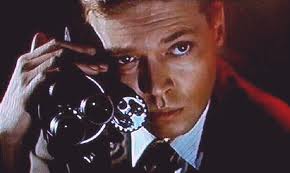 As with Blue Velvet more than twenty years later, this revelation of our role in Peeping Tom produces a reaction combining repulsion and mesmerism; we are shocked, or offended, we cannot look away. But rather than shock us cheaply by showing the murders in graphic detail, Powell leaves the real terror of what is occurring entirely in our minds. Towards the end of the film, Anna Massey discovers the footage of Mark's victims; she watches, being frightened and repulsed - but she keeps watching. The camera tracks her reactions in a long panning shot, which tell us all we need to know about what is happening.
 But even taken outside of all its commentary, Peeping Tom is still terrifying as a pure, full-on horror movie. Carl Boehm's performance is extraordinary, helping to create an immensely compelling character who feels more three-dimensional than Norman Bates. The psychological trauma which Mark suffers could be lazy shorthand, but instead he comes across as a lonely, fractured young man who struggles with himself, something reinforced by the distant, broken quality of his slight Austrian accent.
 The film explores the relationship between love and fear, with Mark wavering between the two as he is caught between the need to complete his documentary and the affections bestowed on him by Helen. We feel so close to Mark that when his doom approaches, we are willing to ignore or forgive his gruesome actions if it would save or redeem him. This is the final savage trick of Peeping Tom which reinforces our position as voyeurs; not only are we drawn to gaze, we impose emotion on people's actions so that even the truly terrifying can seem tragic.
 Peeping Tom is a barnstorming masterpiece which ranks alongside The Red Shoes as Powell's finest achievement. Its psychological complexity and cerebral treatment of its themes are perfectly complimented by Powell's direction, and the whole project is enhanced by Otto Heller's luridly beautiful visuals. It is still as fresh, shocking and truly terrifying as it was over 50 years ago, and in its level of emotional engagement - say it quietly - it's a better film than Psycho. In short, it is compelling, chilling and nothing less than essential viewing.
Rating:
Verdict: A dark, creepy, chilling masterpiece
Black Swan (USA, 2011)
Directed by Darren Aronofsky
Starring Natalie Portman, Vincent Cassel, Mila Kunis, Barbara Hershey
What is it about ballet and madness that continues to entrance filmmakers? In the 1940s we had The Red Shoes, Powell and Pressburger's masterful look at art, love, jealousy and fantasy set against the backdrop of a ballet company. In the 1970s we had Suspiria, Dario Argento's brutal masterpiece about the fate of a young ballerina modelled on Snow White. And now we have Black Swan from Darren Aronofsky, one of the maddest and most unrelenting films you will see all year. Aronofsky has always been an uncompromising director, having put his audiences through the mill with Requiem for a Dream and tested their patience with The Fountain (think Terrence Malick in space, only not as good). Black Swan continues this trend, beginning at a point of nerve-shredding intensity and never letting you relax until our heroine lies bleeding at the end. In the hands of a less confident director, the film's shrieking intensity and over-cranked visual style would have made the finished project nothing short of ridiculous. But for all the elements which don't quite work, it somehow holds together, for good or bad, as something genuinely jaw-dropping.
 As so often happens, the release of Black Swan has prompted a discussion about the nature of its subject matter, specifically over how realistic is its depiction of ballet, both physically and psychologically. On the first point, the film is one of the best in recent memory at putting dancing up on screen. Natalie Portman and Mila Kunis went through six months of intense training for the roles, so that they physical resemble ballerinas as well as being able to do most of their own dancing. Aronofsky does not rely overly on editing to show the best possible version of a given routine, giving us a sense of scale which Rob Marshall's works do not.
 Ultimately, however, to focus on whether or not Black Swan accurately depicts the world of ballet is to somewhat miss the point. The film is much more of a study of a character in disintegration, about the physical and emotional consequences that come from devotion to one's art, and how such devotion can quickly tip over into obsession and delusion. The film's status as a full-on visual experience is mitigated only by the deep emotional attachment we have for the central character, who appears in every frame and is the only thing we have approaching a reliable narrator.
In both its subject matter and execution, Black Swan is a deeply cine-literate film which references a whole host of other works. It is at heart a genre piece, combining elements of psychological and expressionist horror with the character study elements of an introspective thriller. This does not denigrate or compromise the boldness of Aronofsky's vision, but it is worth being aware of these references as a means of explaining and responding to the film. The film owes a large debt to the works of Powell and Pressburger, particularly The Red Shoes and Black Narcissus. Like the former, it is not so much a film about ballet as a film about personal trauma which just happens to have ballet in it. It is every bit as melodramatic (in the best possible way) and similar themes are explored, such as the jealousy of the various dancers and the way in which the pursuit of perfection leads to hallucination or fantasy.
Both films are striking in their use of colour, from the strobe-red lighting in the nightclub to the beaming white stage lamps during the actual performance. But where Powell goes for wide-eyed, almost childlike fantasy, Aronofsky is much more lurid in approach, playing up the sexual currents in the story rather more. After a fundraising evening, Vincent Cassel tells Natalie Portman to lighten up by going home and touching herself, and earlier on he dismisses her attempts at dancing the Black Swan as un-seductive, adding that her male colleagues wouldn't look at her twice. Stripped of all its trappings, Black Swan is a relatively simple story about the conflict between light and darkness and the need to be in touch with the latter. Nina's physical conflict is plain to see; aside from all the shots of her skeletal body, the film devotes many painful frames to splitting toenails, cracking feet and disguising the strange rashes on her shoulder blades. But like Black Narcissus, Aronofsky's main means of expressing the difference between dark and light is through an exploration of sexuality.
 The relationship between Nina and Lily is to a large extent a restaging of the clash in Black Narcissus between Sisters Clodagh and Ruth. In their confrontation towards the end of the film, these two are offered up to us as two opposing sides of womanhood, with the latter being driven almost to madness by her overt sexualisation and the former being stymied by her desire for purity. Nina's purity is not only physical (she is a virgin) but technical, which in the end prevents her from being a great dancer as opposed to a very good one. Lily meanwhile has all the wild spirit and seduction needed to be great, but she turns up late, picks up strangers and parties all night long.
 While this dichotomy works well, it is ironically in its most lurid aspects that the film begins to come apart. Even if we accept the hysterical tone of the film, certain moments still feel out of place or overdone. The scene of the dirty old man eyeing up Nina on the train is very uncomfortable and far too literal-minded in a film which is trying to be symbolic. And then there is the hallucinatory lesbian sex between Nina and Lily, which represents the same act of symbolic self-love of Betty and Rita in Mulholland Drive. But whereas in David Lynch's film that scene felt relatively substantial, in Black Swan it doesn't feel quite so essential, and its ability to titillate certain audience members threatens to drag the whole story into route-one exploitation.
 Fortunately, the film redeems itself by not letting these wobbles undercut the general narrative. It drifts between fantasy and reality so seamlessly that the barriers between them eventually crumble, so that by the last 20 minutes, you no longer have the luxury of knowing what is real and what is not. This forces you to trust Nina, so that whatever happens on screen becomes reality in that moment and cannot be solidly questioned. No other film could string together the body-horror metamorphosis of David Cronenberg's The Fly and the blood-drenched giallo of Suspiria, two traditions which on paper are miles apart.
 This portion of Black Swan highlights the biggest debt of the film, which is to the work of Dario Argento; Mark Kermode famously described the ending of Black Swan as "Dario Argento on crack". Suspiria runs throughout these scenes, with the bitchy chorus line standing in for the coven of witches plotting our heroine's downfall, and Lily's alternate taking the place of the mother witch whom she must defeat. The colour palette is stretched to the outer limits, with the blood and Black Narcissus eyes being the same Day Glo red as the blood as Argento's work. For all the well-executed mirror tricks and CGI doppelgangers, this is the moment in which the film fully takes flight.
 Black Swan is an utterly mad film which manages somehow to hang together in the face of many striking and rivalling elements. Its closest comparison from a structural viewpoint is The Man Who Fell to Earth: many scenes are indulgent, or uncomfortable, or downright unnecessary, but the overall effect is quite profound. Natalie Portman gives her best performance in a decade, banishing the memories of the Star Wars prequels and hinting at a possible new maturity in her line of work. It's not perfect, or entirely satisfying, but it remains a truly frightening experience.
Rating: 4/5
Verdict: Breathtakingly bonkers
Shutter Island (USA, 2010)
Directed by Martin Scorsese
Starring Leonardo DiCaprio, Mark Ruffalo, Ben Kingsley, Max von Sydow
It's very common for directors to indulge themselves after winning awards, using the heft of their new-found acclaim to splash out on a pet project. And considering how long Martin Scorsese had to wait for his Oscar, no-one could complain about him letting his hair down and doing something a little less cerebral. While it never reaches the heights of his earlier work, Shutter Island is a fun and engaging thriller which more or less holds together, and which is made with the same affection for its genre as Peter Jackson's remake of King Kong. The comparison with King Kong extends further than just two great directors kicking back a little. Both Jackson's remake and Shutter Island are upmarket re-workings of rich B-movie traditions, namely the monster movie and the asylum-based thriller. Both take films or genres which are well-worn or familiar, and re-imagine their stories as they would have been told had the technology or the money been available the first time around.
The core ideas in Shutter Island are easily recognisable to film fans, and even casual Scorsese-ites will be able to spot the master returning to old themes. The idea of a mental institute in which the lines between patients and doctors are blurred is a big lift from Shock Corridor, or its slightly more upmarket cousin The Ninth Configuration. The idea of foul play involving Nazi or ex-Nazi scientists is taken from The Boys from Brazil, which itself was rather ripe. And the device of an island or isolated location being cut off by the elements is as old as the trees; Stanley Kubrick was pastiching it when he made The Shining. This revamped B-movie aesthetic is reinforced by Shutter Island's pulpy, glossy visuals. The film is often art directed to within an inch of its life, as Scorsese seeks to wring out every inch of suspense and terror from the claustrophobic setting. Like The Killer Inside Me shortly after it, Shutter Island's visuals are rooted in 1950s noir, not just in costumes and lighting decisions but in the measured and deceptive staging of certain sequences. Scorsese utilises every possible camera angle to tell the story, from tough dolly shots when the German soldiers are executed, to tight zooms on the spiral staircase which recall the ending of The Red Shoes.
As if you needed any more convincing that this is not a 'serious' work, you only have to listen to the dialogue in the first 30 minutes. The running of the island is explained in such a way that you know which elements will come into play later on. And there are a number of deliberate continuity errors which are common in low-budget films, such as glasses disappearing and re-appearing. The film is edited by Thelma Schoonmaker, widow of Michael Powell, and both she and Scorsese are too talented to let such things slip by unnoticed. The central idea or twist of Shutter Island is that of people pretending to be other people, and living out their lives as highly complicated fantasies or repetitions of past lives. Again, we are on familiar ground, not just with The Shining but with Roman Polanski's The Tenant. Both of these films succeed by completely disorientating their audiences: the goalposts are constantly shifting and what seemed a watertight explanation ten minutes ago is no longer anything of the sort. On a slightly lesser note, the actual revelation involving Teddy Daniels' name is a clouded reference to Robert De Niro's character in Angel Heart.
 All that has been said so far makes Shutter Island out to be a failure, a film packed with enough references to satisfy fanboys but nothing for the uninitiated. Considering that so much of the film is well-worn to the point of being ridiculous, and that is knowingly well-worn at that, the film must then succeed or fail on whether or not it is entertaining and thrilling in its own right. And broadly speaking, it's is, albeit not completely.
The most illuminating comparison is with The Ghost Writer, another Polanski film which is also at heart an old-fashioned thriller. Both Polanski and Scorsese are fantastic visual artists, who know how to use colour and music both thematically and symbolically, and who can achieve a real sense of thrill whatever the subject or situation. But The Ghost Writer is the superior film because it is much more certain of its own purpose and identity, not just in terms of its politics but as a piece of genre filmmaking. The Ghost Writer is so constantly aware of what it wants to be, and of the manner in which it wants to achieve that, that even when aspects like the final twist don't quite work, it still feels reasonably sure-footed. Shutter Island, for all its knowing ripeness and unapologetic B-movie trappings, can't quite make up its mind how serious it wants to take itself. For its first half hour, where the dialogue is expository to the point of being parody, you are expecting a kind of knowingly cheesy film in the manner of High Anxiety. But as the various plot twists start to unfold, including some very graphic dream sequences involving murdered children and the Holocaust, we begin to feel like the film is wanting to carry more weight that its setup seems to allow.
To its credit, most of Shutter Island does hold together rather well. The dream sequences involving Teddy Daniels' wife and children are beautifully done; seeing his wife turn slowly to ashes as the house burns is very striking. And taken purely as a thriller, it is an exciting romp with a series of plot points which fit together while throwing us off. The scenes of Leonardo DiCaprio wandering along dark corridors by match-light are like the action sequences in The Time Machine married to the haunted house traditions of The Haunting or Alien. On the other hand, as many reviews have pointed out, the final reveal involving Teddy's true identity is somewhat disappointing. It's not that the twist comes out of nowhere and makes no sense, nor conversely that we could see bits of it coming a mile off. The disappointment comes from the fact that we have to definitively settle for one version of events over another; once we leave the lighthouse, the sense of threat has largely gone. It would have been braver and more effective to have left the audience hanging, to decide for themselves whether Teddy was real or not. There is not the same level of ambiguity as in The Shining, or Inception, or indeed Mulholland Drive. But it would have satisfied both the conventions of the genre and created enough debate for a couple of water-cooler moments.
 The performances in Shutter Island are as ripe and enjoyable as the material. DiCaprio may have assumed Robert DeNiro's mantle as Scorsese's actor of choice, but his performances have been much more larger-than-life than his predecessor. While his Howard Hughes in The Aviator occasionally drifted into pastiche, here he is in full-on scenery-chewing mode, playing up every emotion and being constantly on edge. Ben Kingsley and Max von Sydow are clearly enjoying themselves, revelling in the chance to play with the material and send up their earlier, 'serious' selves. And Mark Ruffalo is also solid, even if his role does become more of a cipher as things play out.
 Shutter Island is ultimately a good fun thriller which is a great deal more stimulating than Quentin Tarantino's efforts at B-movie homage. It's not a 'serious' or 'proper' Scorsese work both by design and execution, but it is slightly hamstrung by its occasional desire to take itself a bit too seriously for the circumstances. In all it's an enjoyable, atmospheric work crammed with enough suspense for thriller fans, enough references for film geeks, and just about enough entertainment for the rest of us.
Rating: 3.5/5
Verdict: Cheesy, romping and ultimately good fun
Black Narcissus (UK, 1947)
Directed by Michael Powell & Emeric Pressburger
Starring Deborah Kerr, Roger Farrar, Kathleen Byron, Sabu
The two worst devices in film criticism are nostalgia and the arrogance of youth. On the one hand it is foolish to assume that all films from the past have a natural superiority over those made today, just as it is foolish to say that a hand-written letter is entirely superior to e-mail. On the other hand, in an age where almost anything can be said or done legally on screen, it is stupid to assume that a film like Black Narcissus doesn't still hold up. At first glance, Black Narcissus would seem like a lot of other melodramas released around the Second World War: emotionally shallow, overly simple, badly constructed and ultimately dull. But after its off-putting theatrical opening, the film quickly begins to defy our expectations and serves up a lot more in the way of both style and substance. What starts off shakily ends up as a brilliantly gripping, intense psychological thriller with great performance and stunning expressionist visuals.
 To give credit to the cynics, the opening ten minutes are a little uneven. Their style is much more quirky and offbeat than we would expect from Powell and Pressburger, even considering the level of quaintness in A Canterbury Tale. May Hallatt's role as the elderly caretaker is very off-balance in both her performance and its surroundings. The opening is also laden with exposition, and as the camera lingers on the luxurious décor of this former seraglio, we struggle to engage with our surroundings for more than a few moments.
Once the nuns arrive, however, the film takes off and you forgive all its subsequent quirks of fate. The film is a visual delight, with Jack Cardiff's Oscar-winning cinematography bringing real character to both the costumes and the architecture. Most Technicolor films are praised for how bright their primary colours are, but in Black Narcissus what sticks with you is the white on screen, from the shimmering robes of the nuns to the pale walls of the convent and the flickering candles in between. The production design is so effective that you soon forget that all of this was shoot at Pinewood Studios, and all the vistas of the Himalayas are either murals or matte paintings. Black Narcissus is an intriguing exploration of sexual repression, made intriguing by its relative subtlety and understatement. Some of this is down to the context in which the film was made; even though Powell considered it "his most erotic movie", there is no open consummation of love or lust, and if such scenes had been attempted they would never have got passed the censors. But most of it is down to Powell's brilliant camerawork and Pressburger's slow-burning script. The camera is fixed on the nuns' faces to reveal every little twitch or slight smile that reveal more than words ever could.
 The film explores sexual repression through a number of interesting opposites. The most obvious of these is the relationship between Sister Clodagh (Deborah Kerr) and Mr. Dean (Roger Farrar). The camera treats these two characters very differently: when Clodagh is in shot, the camera focuses on her face and she is never seen out of her habit, to show her purity and resilience. With Mr. Dean, on the other hand, we get to see a whole lot more: there are many wide shots of him stomping around in short shorts, and at least one close-up on his hairy chest. Farrar is the antithesis of everything Clodagh stand for - wild at heart, uncouth, unkempt, and massively attractive.
 Under these circumstances, the easy thing would be to focus solely on the rivalry between these two characters and end up with Sister Clodagh resigning from the order to be with him. But Pressburger is too clever to let that happen, and instead the story plays out like a duel of principles with the prize being right rather than being in love. Both Dean and Clodagh are established as intelligent, determined and resourceful characters whose conflict comes primarily from a conflict of opinion rather than a botched desire to suppress Freudian urges.
As the plot develops and Sister Ruth becomes a more prominent character, we begin to understand the intelligence behind this decision. For most of the film in which Sister Ruth plays no massive part, we are led to believe that Dean is an obstacle to the nuns' success, someone whose disregard for their religion and way of life threatens both the success of the convent and the purity of their order. But once we discover Ruth's fate, we realise that the source of evil or temptation was not so much Dean as the nuns' perception of him. In the eyes of the film, temptation is not something that comes from 'out there', beyond the safety of Christian walls. It is inside of all of us, and more often than not we drive ourselves to give into it. If we think of Black Narcissus as a version of Adam and Eve, that helps to illuminate its spiritual and psychological theses. At the beginning we believe that the convent is like Eden, a safe, perfect place surrounded by a strange land, and with Dean as the serpent who enters the Garden bringing temptation with him. But after we see what has happened to Ruth, the story departs from this in one of two ways. Either we are still seeing a Christian myth play out, but with more emphasis on perception and delusion than on physical evil. Or what we are seeing is something more humanist, where the evil is simply the torment of opposites coming together under one roof.
The key scene in Black Narcissus comes when Sister Clodagh stumbles into a room and finds Sister Ruth wearing a dress and red lipstick, looking immensely proud and increasingly wanton. Here we have opposing depictions of womanhood: one is intensely sexual to the point of madness, the other pure and virginal but also naïve. Both Clodagh and Ruth are driven by a kind of faith - Clodagh by her belief in God and her need to prove herself, and Ruth by her belief that Dean loves her and that no-one must stand in her way. When Dean spurns her, shouting "I don't love anyone!", it is as much a loss of faith as Clodagh's departure, if not moreso. Fantasy plays a prominent part in Black Narcissus. Throughout the story we see flashback to Clodagh's youth in Ireland, and slowly realise her motivation behind becoming a nun. She remembers the man she loved through objects; the emeralds worn by the general's son remind her of those given to her for her wedding day which never took place. These scenes were banned when the film was first released, presumably because of its insinuation that nuns were simply failed lovers, women who didn't measure up to the men of this world. And then we have the ending, which takes us straight to the heart of expressionist horror. The way in which the screen turns red as Sister Ruth faints, or the terrifying close-ups of her eyes, foreshadow the great work of Dario Argento in Suspiria.
 The film also has a strong but subtle political elements. The film was released around the time of India's independence from Britain, and its final scenes have been interpreted as Britain trying to make a dignified exit from a land it could neither control nor understand. The culture clash between different religions (in this case Christianity and Hinduism) is played out very subtly, and foreshadows the more frightening and hysterical clashes in The Devils and The Wicker Man. Crucially, the film doesn't fall into the imperialist trap of portraying the British as wholly rational and the 'natives' as overtly savage. As the nuns start to disintegrate and more intelligent Indian characters come forward, such accusations become redundant.
 Black Narcissus is a great effort from Powell and Pressburger which is almost up there with The Red Shoes. The performances are superb, with Deborah Kerr managing to seem composed and conflicted simultaneously and Kathleen Byron scaring us to death as Sister Ruth. The film remains visually astounding, the script is subtle even in its maddest moments, and there is enough tension and brains bubbling beneath the surface to keep anyone enthralled. A hugely compelling piece and a must-see for thriller fans.
Rating: 4.5/5
Verdict: Smart, sexy and scintillating


