
Reflections
-
It is weird to read my correspondences from the late August/early September
period, being the time of transition between my old function in life to my
new ...
14 years ago
La Haine (France, 1995)
Directed by Mathieu Kassovitz
Starring Vincent Kassel, Hubert Kounde, Said Taghmoudi, Abdul Ahmed Ghili
Whenever French cinema comes up in conversation, it's very easy to be dismissive. Quite apart from their artistic legacy within the medium, Jean-Luc Godard and others within the nouvelle vague have created a stereotype of French cinema - namely as something slow, pompous, and with little bearing on reality. Even if these attributes are not remotely accurate, they persist to such an extent that we treat any exception to them with great surprise. And there is no greater exception than La Haine, a positively incendiary film which proves that there is more to French cinema than staring soulfully into middle distance. La Haine is the debut feature from Mathieu Kassovitz, whose subsequent career has left a lot to be desired. While he has been pretty consistent in front of the camera, with supporting roles in Amelie and The Fifth Element, his directorial work has been at best erratic. After seeing this film, you would never have predicted that such a talented observer of human behaviour would end up helming something as deeply derivative as Gothika. But putting that aside, his debut is remarkable both in its socio-political analysis and as a very visceral piece of filmmaking.
 Realist cinema has always had an ability to shock audiences, either by pushing the envelope of what can be shown on screen, or by tackling subjects which were deemed 'unsuitable' or 'inappropriate' but which form integral parts of our social fabric, for good or ill. When Saturday Night and Sunday Morning was first released in 1960, it was given an X certificate; when reclassified it in 2002, it got a PG. This was not because the film has become tame with the passage of time, or conversely because society has gone rapidly downhill. It is because the film was such a radical departure from the expectations of the public and in particular the censors; not knowing how to react, they made sure that relatively few people saw Karel Reisz' film the first time round.
 There is a close comparison with Saturday Night and Sunday Morning in the structure of La Haine and in its depiction of the misery of urban life. Both films are set around the actions of a close-knit group of characters over a short period of time, in this case a single day. The world of La Haine is much more angular and masculine, with the characters having very little time for women socially, and the humour is quite a lot darker. But the films do share a central theme of characters being trapped in the underclass, and being deeply unsure of their place in society in spite of all their posturing.
 Vinz, Said and Hubert go about their business with a conflicted sense of ambivalence about the world around them. On the one hand, they are desperate to get out of the banlieues by whatever means: Hubert wants to move away, while Vinz talks about killing policemen, as if being sent down for life is better than living there for another day. On the other hand, the close affinity between the characters, the confidence they exude, and the sheer number of contacts they have, give the impression of people being embedded within a culture or community, with a fear of outsiders which is as strong as the fear people have towards them.
 La Haine has a very convincing verité style which embeds us in the world of the characters. The opening credits contain documentary footage of Paris rioting between 1986 and 1996; the film was made during the tail end of these riots, and is dedicated to all those who perished in them while it was being made. The dramatic sections are shot in the same hue of black-and-white as the opening footage, creating a smooth transition from the general picture into this specific story.
 This approach works so well that we find ourselves asking exactly the kind of questions we should with this kind of film. How much of what we are saying is real? Where does reality end and the acting begin? Where, if anywhere, does the director's creative license enter the fray? When we actually sit down and think about it, in terms of the camera always being in an ideal position at the exact time of the action, such questions do become a little redundant. But the fact that we ask them at all, and for so long, is a validation of the film's approach.
 Not only is La Haine very realistic, it is also deeply cine-literate. Some of the references are upfront, such as Vincent Cassel recreating a scene from Taxi Driver in front of a mirror, and the film's meticulous approach to realism and use of non-professional actors looks back to The Battle of Algiers. But others are more thinly-veiled, or at least open to degrees of interpretation. The scene where a rap DJ plays music out of his window, and the camera pans over the open spaces between the buildings, is like an ironic rendering of the scene in The Shawshank Redemption where Andy DuFresne treats his fellow inmates to an opera record.
 La Haine explores hatred between individuals and groups of people in a variety of interesting ways. On one level it is a film about racism, depicting a society dominated by white, 'respectable' people who have little or no idea about what goes on the poorer areas of town. The make-up of the central trio - one Black, one Jewish, one Arabic - reflects three groups which have traditionally been the subject of discrimination and exploitation in France (the latter being a further connection with The Battle of Algiers). Because the police force and media are dominated by white people, our three main characters are alienated and made to feel like scapegoats for the country's problems.
 On another level, the film explores class hatred and the general fear of outsiders. In the later stages of the film, the three men wangle their way into an art gallery, where free drink is being given out at the launch of a new exhibition. Said attempts to hit on a couple of women there, telling them that his friends are sensitive and write poetry, but the women see right through them and are quick to dismiss their half-arsed attempts to be 'cultural'. The men respond by smashing up the artwork and swearing profusely as they leave, alienated by the stuck-up attitudes of their fellow countrymen and -women.
 La Haine also explores the possible ethics of violence, and how characters' attitudes change when threatened by or possessing a gun. Early on Vinz reveals that he has found a gun which went missing from a policeman on the night of the riots. Carrying it around in the back of his trousers, he becomes as sociopathic as Travis Bickle, feeling he can take on the world and is willing to die if he takes a few policemen with him. But in the few instances where he gets the chance to use it, he hesitates, being as much of a coward as he claims the police to be. In the end he who lives by the sword dies by the sword, as the film concludes with Vinz being shot in the head at point-blank range.
 The thrust of these three analyses is that in an advanced capitalist society such as France, society is constantly on the brink of descending into civil war. The widening gap between rich and poor, coupled with continuing racial discrimination, has led to rising crime, drug use and anger at the powers-that-be, who talk about help and fair treatment but continue to look down on the banlieues. The film begins and ends with Hubert's story of a man falling from a 50-storey building, repeating the phrase "So far, so good" until he lands. The fall is not important; what is important is what happens when he lands, and how hard he lands.
 There are a couple of problems with La Haine. Although the characters remain engaging throughout the 90 minutes, it can sometimes feel like we are going round in circles; in its weaker sections the film can feel like talking followed by shouting, repeated ad nauseum. Equally problematic is the bizarre scene of the old man who finds the young men in the toilet. He tells a story of him and a friend travelling through Siberia on a train, stopping to defecate off the back of the train and his friend freezing to death. It's a very odd bit of absurdist humour which jars with everything around it.
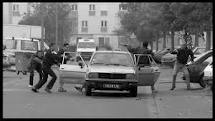 In spite of these small distractions, La Haine is still a very powerful film. Its political and social arguments are still fresh and relevant after 16 years, and Kassovitz' direction is by and large exceptional. It is a shame that, out of the main players, only Vincent Cassel has continued to garner the attention he deserves. But as both a document of a troubled past and a stark warning for the present, La Haine remains essential viewing.
Rating: 
Verdict: A remarkably realistic debut
Saturday Night and Sunday Morning (UK, 1960)
Directed by Karel Reisz
Starring Albert Finney, Shirley Anne Field, Rachael Roberts, Hylda Baker
In the immediate post-war period, British cinema lost a lot of the sparkle and sense of adventure which it had previously embodied. With Alfred Hitchcock now permanently based in America and Powell and Pressburger past their prime, cinema became increasingly populated by American melodramas, jingoistic war films and ropey comedies. It would take something truly momentous to shake cinema out of this stupor: that something was the British New Wave. Beginning with John Osborne's Look Back in Anger, the New Wave sought to reinvigorate film and theatre, tackling controversial subjects head on and presenting a view of the working classes which was the very opposite of patronising or parochial. In time the genre, with its left-wing undercurrents and subtle emphasis on counter-culture, would come to be epitomised by Lindsay Anderson, the director of If.... and This Sporting Life. But well before the latter entered production, Anderson's colleague Karel Reisz was blazing the cinematic trail with Saturday Night and Sunday Morning.
 Based upon the novel by Alan Sillitoe, Saturday Night and Sunday Morning is a rich and respectful work which depicts the life of the working man in Nottingham in a completely uncompromising way. Reisz' background in documentary filmmaking makes him a naturally understated director. His camera is always an observer, sitting passively in the corner; it never flinches or mitigates, and it makes no apologies for what occurs on screen.
Not only does this approach make the action more realistic, but it helps to convey the message of the film. It allows the characters to speak for themselves, to create and form their own voices and identities, rather than having to conform either to the conventions of Hollywood or to social attitudes of what is considered 'proper'. The central line of the film comes towards the end from Albert Finney: "whatever people say I am, that's what I'm not", from which we get the title of The Arctic Monkeys' debut album. The visuals in Saturday Night reflect this desire for the characters rather than the director to do the talking. The film is shot by Freddie Francis, who also shot The Elephant Man and would work with Reisz again on The French Lieutenant's Woman. His choice of angles is simple but effective and he never attempts to play up the emotion of a scene by resorting to thriller tropes in the manner of Hitchcock or surreal, dreamlike shifts in the manner of Michael Powell. There are moments of visual exuberance - for instance, the blurring of the footage at the fairground to convey Arthur's disorientation - but these are only used as occasional devices.
Shooting in black-and-white, whether for artistic or budgetary reasons, always seems to give a film a sense of gravitas and ruggedness, something which was comparatively lacking in Technicolor efforts from the same time. Francis' cinematography and Reisz' direction show up unashamedly all the rough edges of working life, from the thundering monotony of the factories to the grimy back streets and beer-drenched pubs. There is an underlying respect for what they document, but they do not glamorise working life to the point of parody, in the manner of Sergei Eisenstein. This might help to explain why the film was awarded an 'X' certificate when first released (it has since been downgraded to a PG). This ruggedness and gravitas is never more noticeable than in the performance of Albert Finney. In only his second film role, he inhabits Arthur Seaton, creating a complex and contradictory character that we spend the entire film trying to figure out. He is anti-heroic, and largely amoral save when it comes to his own skin. In certain scenes he is borderline sociopathic, like when he takes pot shots at a nosey neighbour with an air rifle. But he remains compelling in his capability to love, to think beyond what we expect of him, and - on occasion - to do the right thing.
 The most interesting moments of the film, which lift it out of the clichés of what would become kitchen-sink, see Arthur and his colleagues passing the time at weekends fishing or drinking, and discussing what the point of their lives might be. Arthur makes passing comments about a life beyond this, saying that he doesn't want to get married until he feels ready. His angry voiceovers about the factory and wayward relationships with women reflect a restless attitude towards the limits of the world put before him. He knows what he doesn't want, but can't quite communicate anything beyond that.
This desire to communicate creates an emotional involvement with Arthur which makes the story gripping and engrossing. Like most kitchen-sink dramas the actual plot is quite slim, and has a number of similarities to A Place in the Sun - the central one being a male protagonist who is torn between two women, and who is threatened with ruin when one of them falls pregnant. But Saturday Night rejects the melodramatic tone of that film, just as Arthur remarks upon living the cinema that he always knew where the film was going. In A Place in the Sun, like so many melodramas, the characters are so clearly drawn that you knew where things were going after about fifteen minutes: Montgomery Clift is bound to fail and make the wrong choices, because that is the archetype into which he fits. In Saturday Night, there are no such guarantees and no stock ending to dampen the mood. Not only do the twists and turns feel more realistic, they carry a greater weight because the various parties do not have to respond in a manner predetermined by genre. Because Arthur is so conflicted, we don't know what choice he will make and therefore there is no assurance that he will emerge intact.
 The film deserves further plaudits for sticking to its guns in depicting the darker elements of urban life. It's one thing to go for realism when things are rosy for the protagonists; it's quite another to follow through with this and risk the censors' wrath in the process. The film is quite happy to linger on the scenes between Arthur and Doreen, but it is equally candid in the fight between Arthur and the squaddies which leaves the former near-dead. The ending itself is quite ambiguous, as Arthur surveys the housing developments and wonders whether he can change even as the landscape changes around him.
 If there is a flaw with Saturday Night, it is purely a question of scope. Apart from little details that have dated and any resounding prejudiced surrounding the now-ripe genre of kitchen-sink, the big problem with the film is that it is a little too self-contained. While it captures this particular part of Nottingham exceedingly well, it doesn't have quite the same general reach as Anderson's work - it doesn't reach out beyond its tight-knit community in the manner of This Sporting Life.
 In spite of this problem, which has prevented it from ageing quite so well, Saturday Night and Sunday Morning remains an important work in British cinema. In the long-term its realistic treatment of ordinary life and uncompromising storylines can be seen in everything from Ken Loach and Mike Leigh to the more recent work of Lynn Ramsey and Andrea Arnold. Reisz directs beautifully, bringing Sillitoe's novel and screenplay to life through a series of refreshing performances, resulting in a very fine piece of work.
Rating:
Verdict: A compelling and well-crafted drama


