
Reflections
-
It is weird to read my correspondences from the late August/early September
period, being the time of transition between my old function in life to my
new ...
14 years ago
Four Lions (UK, 2010)
Directed by Chris Morris
Starring Riz Ahmed, Kayvan Novak, Nigel Lindsay, Adeel Akhtar
Throughout his career on radio and TV, Chris Morris has proved his calibre not merely as a comedy writer and performer, but as a bristling and savagely intelligent commentator on current affairs. Like Peter Cook at his very best, he combines an urbane demeanour with a ruthlessly acerbic eye, delivering comedy of extraordinary craft and attention to detail. Four Lions, his first venture into feature filmmaking, continues his fantastic run of form, being one of the year's best films and one of the best black comedies of the last two decades. The comparison between Morris and Cook is not mere hyperbole. For all their reputations as rebels, and occasionally uncouth ones, there is a sparkling intelligence running throughout their work, so that even at their weakest they always feel on a different plane to everybody else. From the "good AIDS/ bad AIDS" conversations in Brass Eye to the darker moments of The Day Today, Morris has continually caught audiences between wincing and laughing hysterically, between revelling in the absurdity of life and being openly shaken by reality.
 But despite this rich pedigree, there is no sense in Four Lions of Morris re-treading old ground, in the tradition of TV performers who translate to the big screen. The only vague character similarity comes in Omar's security guard friend; his opening monologue about marathons and running distances is a distant cousin of Steve Coogan's pool attendant in The Day Today, who insists after an accident that, year after year, "no-one died". Neither is it the case that Four Lions feels televisual; Morris' comedy has never felt constricted by the limits of a given medium, and he makes the transition to cinema pretty effortlessly.
 Being a British comedy, there are moments in Four Lions which feature or heavily rely on big, broad sight gags. These are the kinds of laughs which populate the trailers, since they are perceived by marketers as bringing in a mainstream audience who do not follow either politics or Morris' career so closely. That's not to say that Morris put them in specifically to sell the film; while they don't reach the heights of the satirical and verbal comedy, they are executed in the best possible way. There is quite a bit of pleasure to be had from watching someone firing a grenade launcher the wrong way, or blowing up crows, or running awkwardly with hydrogen peroxide stashed under their arms.
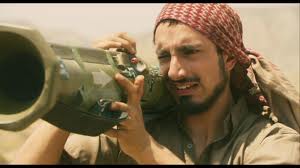 Had the use of such gags been more prolific, you could easily accuse Four Lions of exploiting its subject matter, barely scratching the surface in search of a cheap, mean-spirited laugh. But as the film moves on, all suggestions or hints of Carry on Bombing go out the window, as we grow in our relationship with the characters and view their actions in a more serious or pathos-ridden light.
 A key indicator of this is the sight of one of the bombers running towards the house with the explosives - he successfully mounts a wall, only to trip over a sheep and explodes before our very eyes. Whereas in previous scenes this would have induced a belly laugh, instead we sit there in shock, not quite believing what we have just seen. Morris has the confidence to keep the boundary between comedy and tragedy completely blurred; he doesn't feel the need to constantly get a laugh if a laugh is not what is needed at a given moment.
 Four Lions is an unusual comedy insofar as laughter or hilarity is not always the natural reaction which it produces. It sits in the company of Kind Hearts and Coronets or Dr. Strangelove, in which the overwhelming desire to laugh at the absurd or outrageous situations is balanced by an extraordinary sense of sadness or fear towards the characters. The final act of Four Lions, in which the four men decide to bomb the London Marathon, is up there with Charlie Chaplin's work in The Kid, or Buster Keaton at his most melancholic. Rather than lurch between laughing and lecturing, Morris invites us to recognise the sad and pitiful absurdity of what these four men are doing. While the four are all in some way stupid, disorganised and conflicted men, the film does not belittle them; it humanises them, allowing us to weep for their fate while laughing scornfully at the ideas which drove them to said fate.
 This marriage of tragedy and comedy is indicative of Morris' intentions as a comedian. Despite his uncanny ability to make people laugh, Morris has always had some form of serious intention behind his work, whether it's questioning stereotypes or approaching a controversial subject in a manner which cuts through all the hysteria and hyperbole of modern media. With Four Lions he has created a comedy which generates huge laughs in places while also raising all the difficult questions about the origins of terrorism in Britain, and if and how it can be combatted.
 The film is particularly strong at showing the impact of jihadist beliefs on the families of those engaged in terrorism. It cuts through all the nonsense of terrorists being portrayed as psychopathic loners, showing Omar (Riz Ahmed) as a family man attempting to reconcile his religious beliefs with his responsibilities as a husband and father. In one poignant moment, he tells his young son a bedtime story, explaining the principles of Islamic jihad in relation to The Lion King. In another equally sad scene, he poses as a hospital porter to get past police and say goodbye to his wife during her shift on reception. He says that he'll "be going now" and she glances back at him, tearful yet loyal to the last.
 Four Lions also shows the flawed, or at least unsympathetic, position of moderate Muslims, arguing that they are as potentially damaging to the public image of Islam as the suicide bombers. One of Omar's friends adheres very strictly to the teachings of the Qu'ran, to the point where he comes across as distant, arrogant and pious. While Omar does everything with his wife and doesn't force her to cover up, his friend refuses to stand in the same room as a woman; when questioning about keeping women in a cupboard during prayer meetings, he replies: "it was not a cupboard, it was a small room." At this point Omar and his wife respond by chasing him out of their house with water pistols, with Omar's wife declaring sarcastically that she is "out of control". It's a smart and funny way of showing the nuances of Islamic attitudes to women, which have all too often been reduced to simple-minded caricature.
 This scene leads onto one of the great set-piece gags in Four Lions (although gag is perhaps not the best way to describe it). At one point the four bombers meet at the house and discuss bombing the London Marathon. The camera keeps cutting between their conversations and the police pulling up outside a house, shot in night vision. This editing leads us to think that the bombers are going to be ambushed - only for the police to break into the 'study group' of the moderates, arresting the men and taking the women out of the 'cupboard'. Morris throws us a totally welcome curveball, and offers a memorable pay-off involving a freight container doubling for Egyptian soil and Weetabix being used as a bargaining chip.
 What makes Four Lions work as a study or satire of fundamentalism is that it doesn't claim to have all the answers for exactly why young people are doing this. Morris spent the best part of six years researching the film, and clearly understands that there isn't a one-size-fits-all answer to any aspect of this phenomenon. The film is concerned as much with exposing the hypocrisy of radical Islam as it is deflating the helpless, squirming responses of MPs and other authority figures. In putting every party, political or otherwise, under the spotlight, Morris is exposing and shaming the tendency to oversimplify the issues for the sake of sound-bites, or the cowardly approach taken by groups and politicians to avoid the issue altogether.
 Four Lions is a great black comedy which indicates that Chris Morris can be as good a film director as he is when working in TV or radio. It isn't quite perfect, relying a little too often on broad comedy in its first act, and there is the outside possibility that audiences will come away feeling that, in terms of pure laughs, they didn't get their money's worth. Make no mistake, Four Lions is an often hilarious film, but it is more than funny - it hits the rich seam of awkward or edgy comedy which leaves one feeling shaken as well as stirred. In short, it is an all-round triumph from one of Britain's greatest comedy talents.
Rating: 
Verdict: One of the decade's best
The Guard (Ireland, 2011)
Directed by John Michael McDonagh
Starring Brendan Gleeson, Don Cheadle, Liam Cunningham, Mark Strong
Film reviewers like me frequently get accused of being unable to appreciate films designed purely to entertain. But while we may spend a lot of our time directing people towards films in which entertainment may not be top priority, we are as capable as the next punter of having a good time. The Guard is the latest film to prove this, being the most purely entertaining film since Scott Pilgrim vs. the World. From a cineaste's point of view, The Guard contains a great number of familiar genre elements. It has described as a cross between Lethal Weapon and Father Ted, and there are strong hints of both throughout. The pairing of Brendan Gleeson and Don Cheadle is in the buddy cop style, with one being by-the-book to the point of being inept, and the other being a loose cannon who is unprofessional but gets the job done. The shots of the landscape in and around Connemara resemble the opening credits of Father Ted, and there are occasions when Gleeson's facial expressions copy those of Father Dougal.
 The film is also deeply rooted in the conventions of westerns. Gleeson's performance has been specifically compared to Gary Cooper's in High Noon (high praise indeed), but more generally the film corresponds to the stock western plot of the irascible, antiheroic sheriff defending his town from simple-minded crooks. From a more European perspective, one could compare The Guard to the 1930s comedies of Will Hay: there are hints of Ask a Policeman in the role of smugglers, and Oh Mr. Porter! in the Connemara settling and the seeming simple-mindedness of the characters.
 The Guard is the debut film from writer-director John Michael McDonagh, whose brother Martin McDonagh previously worked with Gleeson on In Bruges. As with his brother's debut, the stock plots and familiar conventions of The Guard are a springboard to create interesting characters and carve out a distinctive niche through strong language and violence. But The Guard emerges as the superior film, for two clear reasons.
 Firstly, the film benefits from a low-budget aesthetic. Because In Bruges looked relatively glossy and was flashily directed, it led you to expect something very polished and balanced, so that whenever the more constrictive elements of the plot encroached, you felt somewhat underwhelmed. The Guard doesn't have the luxury of looking like an expensive film, with understated camerawork and a more washed-out colour palette. But this has the side effect of allowing the script to breathe, so that we are less conscious of the clichés when they do come to the surface.
 Secondly, The Guard benefits from a relative lack of archness in its characters. Both filming are incredibly knowing in their construction of dialogue, from the police officers discussing Fellini's 8 1/2 to the lad with the camera commenting that the events that transpired would make a really great book one day. But where In Bruges occasionally felt like it was showing off, being arch for its own sake, The Guard puts the brakes on all that very quickly. The characters feel more genuine and more immediately likeable, even in their most questionable or archetypal moments.
 One of the best examples of this latter trend comes in the performance of Mark Strong. He plays a British gangster hired by the Irish mob to oversee the cocaine smuggling operation, and is as much a fish out of water as Don Cheadle's character. In one of the best scenes in the film, he delivers a bribe to two corrupt police officers, who offer up clichéd lines like "It's all there?". Strong's response is sarcastic but smart, pointing out not only the inherent stupidity of their question within the confines of the film, but also the silliness of a particular generic convention. His character embodies the part of our brain that says "well that wouldn't happen", and seeing that urge physicalized is a real delight.
 There is a similar intelligence with regard to the distinctly un-PC humour of Sergeant Gerry Boyle. The script for The Guard is fantastically bad taste and walks the tightrope between laughter and pain with perfect balance. You'll quickly lose count of the number of times you'll laugh yourself stupid, squirm in your seat, or do both at once whenever Boyle opens his mouth. One particularly funny faux pas occurs when Boyle and Everett are having breakfast, and the conversation moves on to skiing. Boyle remarks: "I thought black guys couldn't ski?". Awkward pause. "Or is that swimming?".
 Such scenes recall the Father Ted episode 'Are You Right There, Father Ted?', in which Ted is accused of being a racist and attempts unsuccessfully to put things right. Both are attacking racists and racism by showing how utterly absurd and pitiful such statements or attitudes are. Boyle has the same misplaced innocence as Father Dougal and does not understand that what he is saying is wrong or insensitive: when berated for his remarks at the FBI briefing, he remarks that racism is part of his culture. We may find Boyle likeable as a character, but the film doesn't use ignorance as an excuse to condone any of his vices, whether racism, drinking, or using two hookers on his day off. We laugh at the statements and the characters, rather than with them.
 But in the midst of this knowing use of racial epithets and black humour, there is a more melancholy side to the film. Boyle may be unconventional, but he is not entirely a happy-go-lucky buffoon who has everything he needs and couldn't care less. There are several scenes where he visits his dying mother, scenes which make us laugh by showing where he got his spirit from. But these moments, and those featuring the young children, are reminiscent of Being There, contrasting the well-meaning, almost clownish central character with the dark world around him.
 In Being There, the gag was that whenever Chance spoke his mind, people read into his words and behaviour as if he were a guru, rather than just the sheltered child whose only life experience was in tending gardens. Boyle may not be sheltered, but there is a through-line in the characters' growing acceptance of his value as a member of the force and an ultimately upstanding human being. As Everett remarks early on, "I can't tell if you're really motherfucking dumb, or really motherfucking smart", though by the end he has clearly made up his mind.
 The Guard hangs on the brilliant central performance of Brendan Gleeson. He is clearly enjoying himself, taking McDonagh's script and breathing life into the character though naturalistic mannerisms and great comic timing. He improves on his performance in In Bruges and is as commanding a screen presence as he has ever been. Don Cheadle compliments him perfectly, proving his comedic worth by playing everything poker straight. The montage of him attempting to interview the locals, including a horse, is a particular highlight.
 Taken as a piece of pure, undiluted entertainment, The Guard is one of the best films of the year. It is deeply generic and occasionally its low-budget aesthetic works against it, with the sound design rendering some of the thicker accents inaudible. But those are little niggles which fail to tarnish a hilarious and beautifully constructed black comedy. Brendan Gleeson has given interviews suggesting that the McDonagh brothers have a friendly rivalry. On the basis of this, it's one-nil to John.
Rating:
Verdict: This year's Scott Pilgrim
Kind Hearts and Coronets (UK, 1949)
Directed by Robert Hamer
Starring Dennis Price, Alec Guinness, Valerie Hobson, Joan Greenwood
Since the brand was revived several years ago, Ealing Studios have developed a reputation for quaintness. With the exception of John Landis' underrated Burke and Hare, the majority of the new Ealing's output has been frothy, often retrograde films designed solely for the export market. How easily we forget that the self-same studio once produced some of the darkest, edgiest and blackest comedies the world had ever seen. And there is no better example of this than Kind Hearts and Coronets, which takes pride of place with The Red Shoes as one of the finest British films of the 1940s. Describing any old film as 'edgy' comes with problems. Changes in social attitudes since the 1940s means that, on one level, filmmakers are now able to show a wider range of subjects to a greater extent than ever before. Under this line of argument, what was once considered edgy, radical or insightful now looks timid and tame. But even if we accept this as a general rule, Kind Hearts and Coronets still stands as a proud and intriguing exception. Like Peeping Tom eleven years later, it has retained its emotional impact even after its aesthetic achievements have been surpassed.
 Kind Hearts and Coronets is a comedy about a serial killer, at a time when the vast majority of films involving murder sought to completely demonise the assailant in question. More than that, it is about a serial killer who vengefully targets the aristocracy, who while waning in power still held a great deal of influence in government and high society. The film is a vitriolic attack on the British class system, thinly disguised as an erudite comedy of manners. To paraphrase Macbeth, it may look like the innocent flower, but it is most definitely the serpent under it, and its venom is ruthless and bitter.
 In a further comparison to Peeping Tom, the film had a rocky ride with the censors when first released. Sir Michael Balcon, then-head of Ealing, sought to distance himself from the film, believing that the public could not handle its ironic treatment of the subject matter. In line with the restrictive Hays Code, the American distributors requested that Robert Hamer added a ten-second epilogue, to show Louis Mazzini getting his comeuppance in a way while the original ending only implied. While Alec Guinness went on to win an Oscar for The Bridge on the River Kwai, neither Dennis Price nor Robert Hamer would ever reach this level of success again. Film critic David Thompson described the latter's fortunes as "the most serious miscarriage of talent in post-war British cinema".
 Many of the classic Ealing comedies used present events to satirise the past and vice versa. Passport to Pimlico satirised both the Berlin airlift and the exile of the Dutch monarchy to Canada, while some commentators have argued that The Ladykillers is a send-up of the post-war Labour government. Kind Hearts and Coronets was made in the year of the Second Parliament Act, which further curbed the power of the House of Lords and with it the aristocracy. The real-life political attack on landed wealth is contrasted with the lethal attacks of Louis Mazzini, with the aristocracy being 'killed off' in both cases.
 Kind Hearts and Coronets has a very poisonous view of the British class system, and in particular of the aristocracy's attempts to justify its position. While marrying out of love may have brought Mazzini's mother poverty, marrying for wealth and "good breeding stock" brings nothing but misery. Whatever diversions the D'Ascoynes may pursue (the navy, photography, the church, hunting) there are a universally inward-looking bunch, with little time for anyone whose interests or backgrounds are not identical to their own.
 Although Mazzini is of noble blood, his training as a draper, shop assistant and bank clerk gives him a middle-class status, something which simultaneously repulses and pleases him because it serves as the perfect cover for his crimes. The closer he comes to his goal of becoming Duke of Chalfont, the more he takes on the characteristics of a D'Ascoyne, shunning his childhood sweetheart Sibella (Joan Greenwood) and refusing to help Lionel in his hour of need. The film brutally depicts the entrenched arrogance of the British elites, something which has persisted longer after the D'Ascoynes of this world have withered away.
 Dennis Price, who had previously found fame in Powell and Pressburger's A Canterbury Tale, is absolutely extraordinary in the lead role. Having been aptly described as "sourly handsome", he presents Louis Mazzini as a man of immense class and sophistication, but who is also capable of being cold, dismissive, callous and sociopathic. Price was always self-deprecating about his acting abilities, describing himself as "second-rate" and "lacking the essential spark." But whatever else happened in his career, this performance is enough to dismiss all such deprecation.
 What makes his performance so interesting is that, for a lot of the time, Price doesn't speak. The prolific use of voiceover gives his performance a silent movie quality - not because his movements are exaggerated, but because his facial expressions and posture play a bigger part in his characterisation. Normally this amount of voiceover could quickly become tedious, but here it works brilliantly, taking us behind Mazzini's mask of dignity. It makes his deadpan expression all the more funny, as the most unspeakable things are uttered without the merest twitch of his lips. It is as though we were inside the mind of a killer, hearing his darkest deeds completely uncensored and without any license on the part of the screenwriter.
 Kind Hearts and Coronets' themes of love and class are also expressed in Mazzini's relationships with women. For most of the film he is taken with Sibella, who marries Lionel but confides in Louis due to their friendship as children, and increasingly out of desperation as just how boring her husband is. Louis strings Sibella along, playing with her heart strings and being glad to kiss her while knowing he can never bring himself to be with her. This is a further example of Louis' corruption as he grows closer to his goal, becoming as cold and as haughty as the people who caused him to swear revenge.
 If Sibella is the proud plaything who is ultimately beneath his stature, Edith (Valerie Hobson) provides the security of wealth and the moral backbone Louis needs. Their initial meeting, while her husband is still alive, indicates that such a marriage would not be any fun: her strong religious conviction forbids drinking, leading her husband to keep gin and whisky in his dark room. Much of the film plays out like a bedroom farce as Louis tries to keep the two women from ever meeting. In the final scene, he has to choose between dull security and loving disgrace, quoting from The Beggar's Opera as he struggles to make up his mind.
 The humour in Kind Hearts and Coronets is as black as can be, with multiple jokes about hanging and all the murders having a comedic quality. These range from the general being blown up as he opens the caviar, to the admiral mistaking port for starboard and sinking his ship, and finally Mazzini's employer dying of shock after inheriting the title. There are dozens of laugh-out-loud moments, such as Mazzini's comments after shooting down Lady Agatha D'Ascoyne: "I shot an arrow through the air; she fell to earth in Berkeley Square." But a lot of the time the film is so edgy and so forthright that you're almost afraid to laugh: the barb is so strong that to laugh is almost too easy a response.
 The film is most popularly remembered for Alec Guinness, who plays all eight members of the D'Ascoyne family. He was originally only offered four roles, but pressed Hamer to cast him in all eight after reading the script. Suffice to say, he's magnificent, with each family member having clearly developed character traits and quirks, and each looking hilariously pompous in all that make-up. The split-screen shooting used to put all eight characters on screen is utterly seamless, and Hamer's direction is totally first-rate.
 Kind Hearts and Coronets is a perfect black comedy, which is as funny as Monty Python and the Holy Grail and as artistically accomplished as the best work of Powell and Pressburger. The performances are all superb, particularly from Guinness and Price, and Robert Hamer's direction gives the film a note-perfect pace so that all the jokes hit the spot. Over 60 years since it took the world by storm, it remains the darkest, edgiest and funniest of the classic Ealing comedies, and will be reducing generations to fits of laughter for years to come.
Rating:
Verdict: A perfect black comedy
Britannia Hospital (UK, 1982)
Directed by Lindsay Anderson
Starring Leonard Rossiter, Graham Crowden, Joan Plowright, Malcolm McDowell
In the 1950s and 1960s Lindsay Anderson was hailed as a visionary, with If.... receiving the Palme d'Or and widespread critical acclaim. In the 1970s, he was regarded as intelligent but indulgent, with O Lucky Man! dividing critical opinion upon its release. By the 1980s, he was branded obsolete, with Britannia Hospital receiving the worst notices and lowest box office of his career. In hindsight that is a crying shame, since the film is both a return to form from O Lucky Man! and one of the most underrated films of the early-1980s. Britannia Hospital is the third and final instalment of the Mick Travis trilogy, coming nearly nine years after O Lucky Man!. Having been the centrepiece of the last two films, Travis (played by Malcolm McDowell) takes only a peripheral role here - he has risen from schoolboy revolutionary to coffee salesman and filmstar, only to wind up as a muckraking reporter with two stoned technicians. We can see through the trilogy a shift in semi-autobiographical emphasis from Anderson (If....) to McDowell (O Lucky Man!) and finally the nation as a whole.
 The film's biggest improvement on O Lucky Man! is the quality and integrity of its narrative. O Lucky Man! had so much to do, and so many stories to tell, that it ended up spreading itself too thin to achieve a knockout blow: it resembled pouring a pint of stout onto a very wide saucer. By confining itself to the events of a single day, in a single location, Britannia Hospital is more readily focussed. Even though it looks at many different groups of people, it succeeds as a microcosm of Britain in the same way that If.... did, and manages to be more universal even when it drifts into outright horror or fantasy.
 Britannia Hospital is also a very unusual and interesting mix of genres. It is on one level a farce, albeit one with a great deal more sophistication and ambition than the Carry On series or the work of Blake Edwards. On another level, it is a political drama, in which the organised and politicised working classes take on both the middle-class managers and the upper class establishment embodied by the private patients and 'HRH'. On a further level, it is a full-blooded horror movie which draws on the traditions of Hammer and grand guignol. Leonard Rossiter's snarling and repressed manager is in stark contrast to Graham Crowden's Rotwang-like mad scientist, in a performance reminiscent of Vincent Price in Theatre of Blood.
 Britannia Hospital is primarily a lament or requiem of modern Britain. By comparing the state of the nation to that of a hospital constantly facing a crisis, Anderson is lambasting both the old guard and the post-war governments which attempted to brush them aside. Where O Lucky Man! skirted around the notion of champagne socialists and the corruption of politicians and lawmakers, Britannia Hospital launches a vitriolic attack on all sides from all fronts, showing how much the post-war dream has been eroded by self-interest and misjudgement on the part of everyone.
 In light of Anderson's life-long association with the British Left, you would expect such a thesis to treat the treat union movement with a certain amount of sympathy. But Anderson is merciless, almost to the point of bitterness, in pointing out the duplicity of the union movement with regard to the aims of the people it claims to defend. The film begins with an absurdist vignette of an old man with hypothermia. The ambulance drivers barter their way past the picket line, only for the manto be left on a stretcher in the corridor because both the nurses and porters have clocked off for the night. As Rossiter's name appears he breaths his last; through little more than pedantry and selfishness, the health service is prevented from doing the one thing it was set up to do.
 Britannia Hospital finds the public and the private co-existing uneasily in the new welfare state. The plight of ordinary patients, for whom the NHS is a matter of life or death, is contrasted with the attitudes of the VIP patients in the private ward, who demand to be treated like royalty. Their number includes a child-eating dictator (a further nod to O Lucky Man!) who has taken up residence in his own private ward. When the catering staff go on strike, matron is forced to offer the private patients oranges for breakfast; her efforts are met with anger, disgust and racial epithets, with one general remarking: "I didn't spend forty years in India to end up with a lot of wogs!".
 The Britain depicted in Britannia Hospital is a country which is deeply fractured, being torn apart by violence, injustice, inequality and the threat of revolution. But again, Anderson doesn't just fall into the trap of making propaganda, turning out his own private Battleship Potemkin. He characterises Britain as a nation about to turn its back not merely on socialism and the achievements of the welfare state, but on idealism and intelligence as a whole in favour of the simplicity of brute force and tribal warfare. The riot scenes are kinetic and frightening, but they also have a heart-breaking quality, summed up by an image of a protester offering a riot policeman a flower, only to get her head smashed in with his baton.
 The film also has very little time for the media, with both sets of film crews coming in for a lot of stick. Mick's technicians (one of whom is played by Mark Hamill) are portrayed as sensationalist and lazy: while Mick is crawling around the hospital sticking his neck out to get the footage, they get stoned and laugh themselves stupid watching documentaries about battery hens. The BBC fare no better, coming over as sycophants who fabricate events around Dr. Millar to inflate his ego and make him feel more like a God.
 Despite Anderson's depression about this state of affairs, the film manages to tackle these pertinent and vital political issues without ever slipping into self-pity. Anderson's sense of righteous anger at what is unfolding is matched by fear on his part for the future of the country his loves, and by a feeling of pathos on the part of the characters. The humour is satirically vainglorious - for instance on the soundtrack, where Alan Price plays 'Rule Britannia' very slowly for maximum irony.
 There is a comparison between Britannia Hospital and the work of Pink Floyd around the same period, namely The Wall, the subsequent film helmed by Alan Parker, and The Final Cut which was accompanied by a 20-minute short. Britannia Hospital itself shares certain features with The Fletcher Memorial Home: it is a bastion for a bygone age based upon privilege and order, which has since been eroded and rendered all-but-obsolete. Running through all these projects is a theme of missed chances and regret, which will echo through the plight of future generations.
 Britannia Hospital is also an attack on positivism, showing the march of scientific progress continuing at the expense of mankind. One of the core themes of modernist art is Man feeling lost in a world which is constantly evolving, and which He at best struggles and at worst fails to control. In this case we have Dr. Millar, up to his old tricks again, as the maverick private pioneer being sponsored by (but not controlled by) the state.
 Where O Lucky Man! felt in places like The Island of Dr. Moreau, the horror elements of Britannia Hospital are a retuning of Frankenstein. It takes a story about humans trying to live forever, leaves in Mary Shelley's warnings about the dangers of progress, and adds disturbing allegories for social engineering. What begins with Travis finding foetuses in jars or freezers full of limbs culminates in a terrifying sequence where his head is grafted onto Millar's monster - it comes to life, only to attack its creator and disintegrate. The gore in these scenes is worthy of anything in Sweeney Todd or Lucio Fulci, coming virtually out of nowhere and being terrifying gruesome.
 But by far the highlight of Britannia Hospital is its final scene. With a cross-section of society gathered, from royalty to revolutionaries, Millar gives a passionate speech about humanity's need to reinvent itself and the inherent injustices of the status quo. He concludes by revealing 'Genesis', a giant brain which begins to recite from Hamlet before repeating the line 'How like a God'. It's a wonderfully judged paean complimented by creepy special effects and Crowden as his absolute best.
 There are flaws with Britannia Hospital. Some of the broader, more farcical comedy doesn't work, such as the clichéd sequence of Travis crawling out of the mass of people. And its sexual politics have not dated all that well: the random sex scene with the nurse feels jarring and unnecessary. But as both a plea for intelligence in a time of crisis and a savage social satire, it still holds up both on its own and as a fine conclusion to the trilogy. It's a twisted tale of compassion and caustic humour, and remains a hidden gem of British cinema.
Rating: 
Verdict: A twisted triumph


