
Reflections
-
It is weird to read my correspondences from the late August/early September
period, being the time of transition between my old function in life to my
new ...
14 years ago
Fire in Babylon (UK, 2011)
Directed by Stevan Riley
Starring Clive Lloyd, Viv Richards, Michael Holding, Andy Roberts
More than any other form of documentary, sports films are often guilty of preaching to the converted. Through a combination of eccentric jargon, cliquey culture, off-putting aggression and economy with the truth, the majority of factual films about sport have no way in for the casual viewer. Fire in Babylon is an exception to this general rule, being a ramshackle but entertaining introduction to the West Indies cricket team of the 1970s and 1980s. The first success of Fire in Babylon is that it explains the appeal of cricket for West Indians, in a way which draws non-fans slowly but surely into the culture surrounding the game. Early on Michael Holding talks about cricket as the only activity which unites this small group of very different countries. He evokes scenes of young boys playing cricket on Caribbean beaches from the minute school ends until the sun goes down, painting an enticing if overly romantic picture of a sport too often associated with boring middle-aged Englishmen.
 But this is not a teary-eyed, rose-tinted documentary, extolling the spirit of cricket like characters from P. G. Wodehouse. Holding's comments about the beauty of cricket are immediately contrasted with the harsh political realities in the West Indies and the wider world. Holding and his counterparts were playing at a time when many Caribbean states were ruled by brutal dictators, not to mention the continued existence of apartheid in South Africa and the race-related violence in British cities.
 The film establishes a clear affinity between the West Indies' position as sporting underdogs and the accompanying racial struggle for independence and equality. It explores the persistence of imperialistic attitudes in culture, so that even after formal political independence, people from the Caribbean were still regarded as racially inferior. Where English players were revered as gentlemen, and Australians feared as long as they bowled quickly, West Indians were called "calypso cricketers", clowns who would entertain but always lose. They were the cricketing equivalent of The Black and White Minstrel Show, existing for the snooty pleasure of white men while bringing shame on their own culture.
 Nowhere does this prejudice come more to the fore than with Tony Greig's awful faux pas in the lead-up to the 1976 tour of England. Facing questions about the West Indies following their 5-1 win against Australia the year before, the England captain remarked: "If they're down, they grovel, and I intend with the help of [Brian Close] and a few others to make them grovel." The association of 'grovel' with the slave trade, the persistence of apartheid and the fact that Greig was a white South African turned a simple test series into a battle between historical masters and slaves, with the latter coming out firmly on top.
 Both as a political force for uniting black people and a sporting force in its own right, the West Indies challenged the imperial yoke by giving it a taste of its own medicine. The teams they faced were resoundingly beaten because the Windies were not expected to bowl so fast and so ruthlessly to what were considered the best sides in the world. As when Australia won the inaugural Ashes series in 1882, the West Indies shook cricket at its foundations, upsetting the natural order and asking big questions about the running of the game.
 Fire in Babylon credits the West Indies with helping to modernise the game, particularly in their involvement in World Series Cricket. This private three-way tournament, created by Aussie entrepreneur Kerry Packer, recruited cricketers from all over the world to play for big prize money with extensive sponsorship and media coverage. As well as introducing coloured kits and improved protection for batsmen, World Series turned cricket from a sport of "pot-bellied amateurs" into something which could be a full-time profession with proper training and an emphasis on fitness. The series, and the West Indies' approach within it, cut through all the old school, elitist customs that threatened to keep the game stuck in wartime, doing away with such pitiful traditions as a bowler applauding a batsman after being hit for six.
 From Stevan Riley's abundance of talking heads, a series of fascinating and entertaining characters emerge. Andy Roberts comes across as a man of immense passion, who is quick to defend their playing style from accusations of disrepute or unnecessary aggression. He talks about needing to not show weakness in front of the opposition, choosing to "take my aggression out on five-and-a-half ounces" rather than give in to pointless violence.
 Other characters within the side are equally gripping. Colin Croft comes across an ebullient, gleeful man who loved to represent his country and take revenge on big-headed batsmen. Watching Michael Holding play is beautiful and his dedication to the sport comes through in everything he says. Whenever South Africa is mentioned, it is as though a dark cloak has been drawn over proceedings, and he is quick to criticise players like Croft who signed up to lucrative rebel tours, where they were treated as "honorary whites"(!). Best of all is the enigmatic Viv Richards, who talks dolorously of staring down Dennis Lillee and treating his bat like a sword.
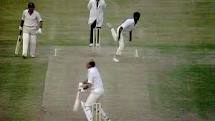 Fire in Babylon doesn't shy away from the pain involved in cricket, containing any number of wince-inducing moments. This was an age where cricket was played without proper protection in the way of arm and thigh pads; most players, Viv Richards included, faced down some of the world's fastest bowlers without a helmet. Riley includes a number of choice morsels, including Andy Roberts breaking David Hookes' jaw, David Lloyd copping one in the knackers from Jeff Thomson, and Michael Holding's lethal bouncers against Brian Close in 1976. Sadly we don't get to enjoy his extraordinary over against Geoffrey Boycott on the same tour.
 This leads to on to a major problem with Fire in Babylon, namely the lack of playing footage. While sourcing archive material for documentaries can be expensive, there must be more archive footage available, and a lot of it is old enough to be in the public domain. It's all well and good having loads of still photographs of the ball in flight, with little clips potted here and there, but when you have someone as graceful and threatening as Michael Holding, you want to see him in full motion, not being constantly interrupted by newspaper cuttings. The shortcomings of this film points to the greatness of Senna, a film which was not only mopre thoroughly researched but better stitched together.
 Fire in Babylon is also guilty of overegging its political pudding. While it does make very good points about racial attitudes and challenging stereotypes through dignity and humour, it is said so often that it becomes didactic. Sometimes it can feel like we are being lectured, with the same points being repeated so much that the film threatens to tip over into Malcolm X territory. The presence of Bunny Wailer, of Bob Marley & The Wailers, becomes especially tiresome: we become extremely annoyed with him even as we're agreeing with everything he says.
 The final huge problem is that the film has too many voiceovers or narrators. Having a lot of talking heads is fine, but the director has to step in and marshal them, either to construct a direct narrative or to present them in such a way that the audience can create their own. Riley falls simultaneously into two completely different traps: it's too inconsistent and jumpy to be narratively compelling, but it's also too broad and schematic to be believable. In the end he just about gets away with it, but the shortcomings remain in plain sight.
 Fire in Babylon is a flawed but important document of a sporting era whose repercussions are still being felt in contemporary cricket. Stevan Riley has better-structured, more comprehensive documentaries in him, and the problems with the film become all too obvious as the action moves forward. But this is still a pretty decent first stab at an important subject matter which will bring in the casual viewer. In cricketing terms, it's a solid half-century, and while its best shots are hampered by poor footwork, all signs point to a better second innings.
Rating: 
Verdict: A decent first knock
Senna (France/ UK/ USA, 2011)
Directed by Asif Kapadia
Starring Ayrton Senna, Alain Prost, Frank Williams, Ron Dennis
Innovation and artistic value are not properties which disappear when a genre enters the mainstream, and nowhere is there more evident than in documentaries. There are copious examples of recent efforts which have found a relatively wide audience while pushing the genre envelope, from Kevin Macdonald's nail-biting Touching the Void to more introspective works like The Arbor and Of Time and the City. Continuing this trend is Senna, a really great documentary which could be one of the year's best films. Senna is a documentary about the late Formula 1 racing driver Ayrton Senna, which is constructed entirely from archive footage of him. This incorporates TV race coverage, press interviews, TV appearances in Brazil, behind-the-scenes footage and family home video. Although other voices appear over the footage, there is no consistent narration to impose a particular version of events over what we see. Senna is allowed to tell his own story, like he is reading from pages of a diary which switches between the first and third person.
 One of the instant advantages of this approach is that Senna avoids the cliché of the talking head. These are individuals connected with the subject or more contemporary commentators, whose often platitudinous insights can drag even the best documentary into tedium and mediocrity. But just as Julien Temple's rock documentaries have sought to capture the feel of a band rather than just what people have said about them, so Asif Kapadia makes us instantly immersed in the character of Senna as he saw himself, rather than just the reputations he accrued.
 Another coup of Kapadia's film is that it makes the televisual cinematic. Normally when TV footage is put on the big screen, it looks out of place because of a difference in aspect ratio or frame rate which breaks the flow. But Kapadia does not let this happen, blowing up the footage very carefully and reframing key scenes so that we zoom in on the characters' faces and emotions. The pace of the film, both as a thrill ride and a piece of storytelling, keep any technical quibbles out of our minds, so that even when the footage is grainy or incomplete, we don't complain.
 Senna explores a number of themes related to racing driving and the personality and attitudes of the drivers therein. There is a repeated mention of "real driving", the pure sensation of driving for its own sake, in which the goal is not simply winning but winning through pure talent and passion alone. It is this pure devotion to what he loves that made Senna stand out from the other drivers, and which led him to become a national hero in his home country of Brazil.
 Senna's complaints about racing technology mirror concerns in the sport as a whole, and comment on how the nature of Formula 1 has changed since he started racing in the 1980s. The tipping point comes in 1992 when Williams introduce new suspension technology on their car; at this point Senna's form begins to decline because he cannot adjust his pure style of driving to technology designed to make the driver do less work.
Within this there is a comment on how technology determines not only the style of racing but also the personality of the driver. In the middle of the film there is a conversation between Senna and Jackie Stewart, in which they talk about the changes in technology and how that has affected the flair of different drivers. The implication is the less there is for a driver to do in a race, the less there is for the driver to be, with said individuals hiding behind endorsements and statistics in the absence of real, passionate charisma. This difference in approach is further communicated in Senna's bitter rivalry with Alain Prost. Senna races with a pure spirit and an often reckless urge to win at any cost - he is not content to play the political games and he never does it for the money. But Prost, who is nicknamed the Professor, is content to play those games and drive according to mathematical calculations - if he can win a championship by staying in fifth, he will stay in fifth.
 Much has been written about how Prost comes out as the villain of the film, and it is undeniably true that at the height of their respective careers both men hated each other. But in fact, their relationship is far more complicated than simple rivalry. Beneath the public scrapes involving crashes and back-chatting, there is some form of mutual underlying respect which these men retained throughout their careers. In spite of completely different styles and attitudes, both men were willing to acknowledge the other's talent, which might explain why Prost currently serves as a trustee for Senna's charity.
 If we wish to paint the documentary purely in terms of heroes and villains, then the true antagonists are the Formula 1 regulators. The film examines the conflicted and clouded politics of professional racing and how the rules designed to make racing fair and exciting often go against the very things the drivers (or at least Senna) want. In one sequence, the FIA President Jean-Michel Balestre emphasises a particular regulation, only for the majority of drivers to vote against upholding it. In another, there is a heated disagreement about racing lines on the starting grid which leads to a spectacular crash involving Senna at the start of a race.
 But although Senna focuses on the physical effort and talent involved in racing, an equal amount of its focus is on the spiritual aspect of the sport. Senna was a devout Roman Catholic who prayed to God before each race, and who believed that God had called him to drive this fast and in this way. The way Senna talks about God often drifts in Chariots of Fire territory, so that you almost expect him to say: "when I drive, I feel his pleasure". But the documentary also shows that this relationship was not straightforward; the first time Senna feels God's presence, he crashes at Monaco, throwing away a huge lead and losing the race.
 Because the outcome of the subject is widely known, certain moments in Senna take on an eerie quality so that they become harbingers of his tragic death. When he goes on Brazilian TV after becoming world champion, a girl kisses him and wishes him a happy new year for every year up until 1993, the year before he died. In 1991 he talks about having many years ahead of him and still so much to achieve. Like Amazing Journey, the film touches on the possibility that certain individuals are so prodigiously talented that they were not put on this Earth to make old bones. And like Keith Moon, Senna's death was both a tragic accident and something to be expected by the way he lived his life.
 Even if you're not a fan of Formula 1, or particularly interested in the spiritual side of sport, there is more than enough in Senna to get your heart racing. Some of the racing footage is genuinely scary, as cars pass within inches of each other through corners and the on-board cameras give you a sense of speed with wider shots would not. Senna's driving throughout is extraordinary, and in appreciating this we follow his emotional journey. We feel his intense anger at being disqualified from the Japanese Grand Prix in 1989, and both his joy and immense pain after having won in Brazil in 1990 despite having to drive the last few laps in a single gear.
 There are aspects of Senna's life which remain absent from the documentary, such as his relationships with women and his influence on popular motoring, such as working with Honda on the NSX. But all in all this is a great documentary which is gripping, insightful and highly emotional. It does justice both to the man and to the ideals for which he stood, while leaving plenty of things open to interpretation. Like Senna himself, it is accomplished, thrilling and ultimately heart-breaking.
Rating:
Verdict: One of the year's best films


