
Reflections
-
It is weird to read my correspondences from the late August/early September
period, being the time of transition between my old function in life to my
new ...
14 years ago
Sir Henry at Rawlinson End (UK, 1980)
Directed by Steve Roberts
Starring Trevor Howard, Patrick McGee, Sheila Reid, Denise Coffey
In my review of Westworld, I argued that novelists who become filmmakers often lack the visual creativity to balance out the verbal richness of a given work. While certainly true of Michael Crichton's debut, this can also be applied to literary adaptations in general; the often-prolific use of voiceover and frequency of long speeches belie an unhelpfully literal approach to adaptation. Sir Henry at Rawlinson End proves the same can be true for spoken word albums. Vivian Stanshall's 1978 LP, culled from his stints on Radio 1 covering for John Peel, remains an irresistible slice of whimsical absurdity with wordplay which is utterly to die for. But in the hands of first-time director Steve Roberts, most of the charm and quality of Stanshall's work is eroded or withered away, resulting in a crushing disappointment.
 Sir Henry at Rawlinson End has been called everything from "the cinematic equivalent of cheese before bedtime" (The Big Issue) to "the missing link between Monty Python and Withnail & I" (Time Out). Set in and around the fictional English country manor of Rawlinson End, it follows a day in the life of Sir Henry Rawlinson (Trevor Howard), Great Aunt Florie (Sheila Reid) and various other eccentrics who inhabit or visit the estate. The film version extends the plot of the album, adding both the activities of a morose priest Slodden (Patrick Magee) and Sir Henry's attempts to exorcise the ghost of his brother, accidentally killed during a drunken fishing trip.
 The best way to understand the film is found in the words of Peter Sellers. When interviewed in 1972 just before a one-off Goon Show to mark 50 years of the BBC, he made the comparison between The Goons and Monty Python in terms of visual imagination on the part of the audience. Watching Monty Python's Flying Circus, you had a starting point for what the various characters could look like: in Sellers' words, "John Cleese always looks like John Cleese". Listening to the Goons, on the other hand, you had to create pictures of what the various characters looked like without much visual assistance, even from Spike Milligan's own drawings.
The great joy of Sir Henry as a record was Stanshall's skill with voices, accents and verbal acrobatics. Every sinew of the storyline was crammed full with wit and wordplay, with Stanshall's metaphors and imagery being up there with the best bits of Under Milk Wood. Dylan Thomas would have smiled favourably on corkers such as this: "A pale sun poked impudent marmalade fingers through the grizzled lattice glass, and sent the shadows scurrying, like convent girls menaced by a tramp." Like Under Milk Wood, the story of Sir Henry at Rawlinson End is secondary to the characters inhabiting it, whose every tic and foible is captured in superb detail by the rich language. With Thomas, it is the grotesquery of Mr. and Mrs. Pew, the melancholy of Polly Garter or the grief of the blind sea captain. With Stanshall, it is the absurdity and sheer lunacy of English aristocrats, from Sir Henry's simpleton son Hubert, "in his mid-40s, and still unusual", to walking encyclopaedia Reg Smeeton, who obsesses over the fact that there is no proper name for the back of the knees.
As delightfully hilarious as all of this sounds, it was always going to be difficult to capture the innate anarchy of Stanshall's unique mind. The very effect of adding a visual dimension takes away from the imagination of the record, offering a standardised version of events which, much like the Tele-Goons, will inevitably fall short of one's expectations. One could blame this on the director's inexperience or lack of talent: Roberts would later carve a niche for himself penning TV series based on successful Disney films. But Stanshall's close involvement, both at a script level and in a supporting role, leads one to conclude that it was simply a bad idea for anyone to attempt it. In adapting the album for the big screen, there has been a certain amount of plot-shuffling - understandable enough, and just about excusable considering the consistent quality of the material. But some of the best bits of the album are inexplicably missing. At only 73 minutes long, it is unlikely that they were cut for time, and more unlikely still that they were lost for lack of making sense. Most tragic is the omission of Sir Henry's monologue about Professor Molebottom, who in his mind "put the bounce in the bouncing bomb".
 The new additions to the story are poorly integrated, giving the distinct impression that the film would have been fine without them. Patrick Magee is a burning screen presence, as evidenced by his work with Stanley Kubrick in A Clockwork Orange and Barry Lyndon. But for all his charisma his character seems curiously pointless; his priest plots and glowers on the side-lines, but nothing ever comes of him being there. Harry Fowler's winkle-pickered Cockney is an obvious bum note, a pale imitation of Walker from Dad's Army. And the ghost exorcism plot is badly handled, arriving with some hokey special effects and being palmed off pretty quickly.
There have been a number of strange British cult films which have passed muster in spite of their shambolic narratives. Think of Richard Lester's The Bed-Sitting Room, co-written by Spike Milligan, or The Magic Christian starring Peter Sellers. But what saw these films through their short running times and perplexing turns of plot was a constant feeling that they were about something, even if they weren't going anywhere. Sir Henry at Rawlinson End, on the other hand, feels totally and indulgently aimless. It feels like the cast and crew were given a big house to play around in for a week - they shot everything they could, making it up as they went along and then tried to stitch it all together in the editing room. While the album may not have finished in an entirely satisfying way, it at least had the common decency to quiet while it was ahead. This hangs around for at least 20 minutes too long, ending with someone bungee-jumping off the battlements for no good reason.
 In amongst its disastrous execution, there are individual moments in the film which at the very least make it memorable. There is some pleasure in seeing Trevor Howard sending himself up so mercilessly; one can almost picture this is what his character in Battle of Britain might have become had he been given a peerage. He gets a number of pretty juicy lines which showcase his insanity - the best being, "I never met a man I didn't mutilate" - and his prisoner-of-war camp banter is quite fun.
Some of the visual decisions are also notable. Where The Bed-Sitting Room found Lester manipulating colour like his contemporary Nicolas Roeg, Sir Henry at Rawlinson End is shot entirely in sepia monochrome, reinforcing its amateurish, parochial feel. If one was feeling generous, one could call this a descendent of the early surrealist films, taking its place in the canon as a late-blooming English take on Luis Bunuel. In the end, however, there is precious little about Sir Henry at Rawlinson End that makes one feel anything like as charitable. It is a crushing disappointment for fans of the spoken word album, whose bizarrely annoying tone leaves no way in either for fans of English whimsy or for the casual viewer. The pockets of familiar bliss or tongue-twisting delight are padded out by incoherence, indulgence and irritation. In short, it proves that audience imagination is key to making these kinds of stories work, and that as a result, some things are best left unseen.
Rating: 
Verdict: A crushing disappointment
Ladyhawke (USA, 1985)
Directed by Richard Donner
Starring Matthew Broderick, Rutger Hauer, Michelle Pfeiffer, Leo McKern
When it comes to 1980s fantasy, there are three broad categories into which films can fall. There are those like Flesh & Blood, which get the balance between substance and silliness spot on, marrying Machiavellian mercenaries to grin-inducing battle scenes. There are those like Excalibur, which take themselves so seriously that they're fatally dull. And there are those that are totally, utterly, and enjoyably silly - and into that category goes Ladyhawke. Ladyhawke is of historical interest due to its place in Richard Donner's career. The fiasco surrounding Superman II, on which he was replaced mid-shoot by Richard Lester, had thrown Donner's career off-course: he had to watch Superman II and III take huge amounts of money while he delivered flops like Inside Movies and The Toy. But either side of this film, he found himself very much in mainstream favour again, first with The Goonies and later with Lethal Weapon. It is interesting that a director whose place in history has been defined by blockbusters (including, of course, The Omen) should be capable of making something so delightfully odd in the midst of two more rounded and confident efforts.
 Like many 1980s fantasies, there are aspects of Ladyhawke to which time has not been kind. The most obvious of these is Andrew Powell's soundtrack, which was nominated for a Saturn award in 1985 but has since become regarded in some quarters as one of the worst ever composed. After Toto's contributions to Dune, it became more common for pop groups or composers to score films, due to the selling potential of the groups and the relatively cheap cost of synthesised music. But Powell's efforts go just too far even to be enjoyed ironically, with its overproduction and bouncy pop timbre frequently jarring with the quieter moments.
 The score is one aspect of Ladyhawke which confirms its inherent silliness, even before we get to the meat of the story. Another such aspect is its visuals, which manage to look lavish and professional while still feeling ropey and cheap. The film is shot by Vittorio Storaro, who famously shot Apocalypse Now - something which is evident in the multitude of blood-red, beautiful sunsets which are central to the plot. But in amongst the terrific scenes of frozen lakes, dark forests and crisp skylines, there are numerous scenes which look like they were filmed in a hurry, treading unintentionally close to Monty Python and the Holy Grail.
 This feeling of cutting corners is reinforced by the paucity of special effects. For a film in which people metamorphose into animals on a daily basis, the special effects of Ladyhawke are coy to say the least. Apart from a few shots where Michelle Pfeiffer's eyes change shape in close-up, all the big transitions happen off-screen; on several occasions Matthew Broderick leaves the room just beforehand, as though the actors had to go off-stage to change costumes. While Donner wouldn't have had access to the CG wizardry we take for granted, there was plenty of scope in the physical effects of the time to achieve something a little more palpable. Only four years earlier Rick Baker produced the definitive werewolf transformation for John Landis, in a film with half of Ladyhawke's total budget.
 Added to this shortcoming we have a number of plot holes which either confuse or produce unwanted tittering. First there is the problem of clothes: Rutger Hauer and Michelle Pfeiffer keep the same outfits throughout, but there's not much effort to keep the clothes together when one of the pair is in animal form. Then there is the question of memory. The film borrows the horror device of the person having no memory of what they did as a beast - so how come the hawk remembers to stay with her master, or the wolf not to eat his mistress? Finally, there are several blatant continuity errors. We are told that Pfeiffer appears as an eagle whenever it is daylight, and yet there are at least two scenes where it's daylight and yet she is still there. At least when Shrek half-inched the plot, it was consistent throughout.
 But in spite of these problems, Ladyhawke is a consistently entertaining little romp. Like Logan's Run nine years earlier, it's only when you stop trying to take it seriously that its ideas and emotional impact bubble to the surface. And like Logan's Run, this transition is cemented via a dominant performance by a great actor - not Peter Ustinov, but Leo McKern.
 Most famous for playing Horace Rumpole in the long-running TV series Rumpole of the Bailey, McKern had courted cult status at various points in his career: as veteran reporter Bill McGuire in The Day The Earth Caught Fire, as a recurring Number 2 in The Prisoner, and in his previous outing with Donner as a mad archaeologist in The Omen. But whereas that last appearance was a silly cameo in an otherwise seriously creepy film, here McKern brings weight and gumption to an otherwise facile concoction. Like Ustinov before him, he puts a brake on excessive silliness, if only for a moment, in order to steer the viewer towards the emotional heart of the film.
 Not only is McKern's delivery well-suited to disguising exposition, but he illuminates some cracking lines in the script. Most of the wisecracks go to Broderick, who is on very fine form; his soliloquys with God about telling the truth and resisting temptation are guaranteed to raise a smile. But McKern's timing is note-perfect, as he waits for a knight to fall right through the drawbridge before quipping: "Always walk on the left side!". Best of all comes when Broderick brings him the hawk after it has been wounded by an arrow. Having been told that he can't eat it, McKern bellows: "What? Is it Lent again already?!"
 While McKern's performance is the icing on the cake, the other major players are also firing on all cylinders. Rutger Hauer seems naturally suited to the historical romp, whether as a heroic figure here or as an antihero in Flesh & Blood. His typically brilliant screen presence, being equally charming and threatening, suits the personality of Navarre as a knight tormented by the woman he loves but cannot have. And while Michelle Pfeiffer's hair may be straight out of a pop video, she too fits her character very nicely. Her beauty conveys both the innate sense of mystery about Isabeau and the vulnerability of her predicament. She's so convincing, in fact, that you keep recognising her facial features in those of the hawk.
 Having these two charismatic performances goes some way in making the romance at the heart of the film feel believable. Somehow the grandiosity of the setting gives the relationship more weight, making it feel like there is more at stake than with similarly inseparable lovers in more mainstream rom-coms. The story is an interesting variation on the age-old tale of two people destined to be together but cursed to be apart, and for all the ridiculous elements within the central conceit it does end up pulling you in.
 This emotional pull is most evident in two scenes towards the end. The first occurs when Philippe finds Navarre lying next to Isabeau as a wolf. The sun begins to rise, Isabeau begins to change, and for a split second both see each other with human eyes. Navarre reaches out to touch Isabeau, only for her to change and fly away, leaving him beating the earth in frustrated rage. The other comes during the solar eclipse where the two are reunited and the curse is broken. The slow pacing and distance between them prior to their first real contact reinforces the strength of the bond between them.
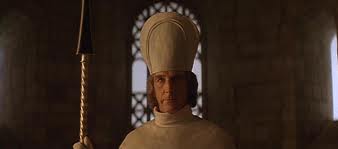 Ladyhawke also has its fair share of good action. Considering Donner's bad feelings towards Richard Lester (who can blame him?), it is ironic that his action sequences, in this film at least, take after Lester's finest work in The Three and Four Musketeers. The fight scenes have some pretty inventive slapstick and Broderick doing all manner of acrobatics, while Hauer gets to swashbuckle and head-butt to his heart's content. The highlight comes in the climactic fight in the church, ending with Hauer throwing his huge sword over several yards right into the heart of John Wood's scenery-chewing Bishop.
 Ladyhawke may not have aged as well as Flesh & Blood or Legend, but it remains a definite guilty pleasure and a bona fide cult film. Its flaws are all in plain sight - the soundtrack, the silly plot, the special effects - and yet none of them can completely eclipse the sheer enjoyment that it brings. If anything these flaws serve to make it more endearing, and more fun than mainstream fare like Robin Hood: Prince of Thieves. Donner would make more consistent features after this, but for pure and simple fun it takes some beating.
Rating: 
Verdict: Silly but sublimely entertaining
The Magic Christian (UK, 1969)
Directed by Joseph McGrath
Starring Peter Sellers, Ringo Starr, John Cleese, Spike Milligan
If there was a category of films called 'WTF?!', then The Magic Christian would be the definitive example. Joseph McGrath's late-1960s satire assaults your senses and your intelligence over a disorientating and unrelenting 92 minutes. The result is both a colossal train-wreck and a memorable commentary on human greed, which if nothing else will make you laugh and freak you out. There are a number of reasons to get excited about The Magic Christian. It is based on the 1959 novel by Terry Southern, who co-wrote the screenplay for Dr. Strangelove. Stanley Kubrick hired Southern after Peter Sellers gave him a copy of the novel; Kubrick loved it and promptly re-worked Dr. Strangelove from a straight drama into a black comedy. The screenplay for The Magic Christian was co-written by Graham Chapman and John Cleese, just before they hit the big time with Monty Python's Flying Circus.
 The other huge draw of The Magic Christian is its cast, which reads like a who's-who of British comedy actors. Alongside Chapman and Cleese, who appear respectively as the Oxford boat race captain and Mr. Dugdale, the director of the auction, Spike Milligan turns up as a traffic warden whom Sellers bribes to eat his parking ticket. John Le Mesurier, who was in The Italian Job the same year, turns up as Sir John during the boat race, and Hattie Jacques cameos as Ginger Horton. There are also brief cameos by Christopher Lee as 'The Ship's Vampire', Raquel Welch as Priestess of the Whip (don't ask), Roman Polanski as a lonely drunk and an unrecognisable Yul Brynner as a drag queen singing Noel Coward's 'Mad About The Boy'.
 That last sentence should give you some idea of the sheer level of weirdness we are dealing with here. Like its contemporary The Bed-Sitting Room, the film has a very particular brand and style of humour, and once it has gotten into its stride it makes no effort to tone down or alter said style to achieve greater audience appeal. With this in mind, it is no surprise that the film was almost universally panned when first released, although both it and The Bed-Sitting Room have since been rehabilitated.
 On the one hand, there are many, many things wrong with The Magic Christian. Like a lot of 1960s comedies it is shambolically constructed with an episodic storyline, so that it ends up as less of a story than a series of sequences of famous people enjoying each other's company at our expense. McGrath had previously directed Casino Royale, the equally shambolic James Bond spoof which Sellers had left mid-shoot. Even at its best his direction is aimless and very sub-Richard Lester (who isn't that good in the first place).
 The story of The Magic Christian makes very little sense. After eccentric billionaire Sir Guy Grand (Sellers) decides on a whim to adopt a homeless orphan (Ringo Starr), they embark on a series of pranks designed (and I use that word advisedly) to prove that everyone had their price and will do anything, no matter how degrading, if enough money is offered. Grand supposedly gets this idea when buying a hot dog from a train: having no change he offers the man first a fiver and then a tenner, and the man crashes his hot dog stand off the end of the platform in excitement.
 What follows is a series of increasingly elaborate pranks which target the unsuspecting public (often played by famous people) in increasingly mean-spirited ways. Things begin fairly harmlessly with the parking ticket scene, or Guy going to a high-quality restaurant and behaving like a pig, eating caviar with his hands and throwing his food at the guests. But soon the tone of the pranks become more savage, with the boat race being sabotaged and ending with civil servants swimming for money in a vat of faecal matter from the local slaughterhouse.
 With scenes like this, you would imagine that The Magic Christian would come across as a hard-hitting if heavy-handed satire, in which the seemingly moral and upright citizens of the world are humiliated in such a way that we are forced to reflect upon our own selfish desires. Sometimes the film does manage this, but for all the moments in which it does there are at least as many moments where it loses sight of this message and settles for the weirdness of the scenes in and of itself.
 This is particularly evident in the centrepiece involving The Magic Christian itself, billed as the most advanced passenger cruiser ever made. Once the guests embark, all manner of things go wrong, starting with them being shown a film of a black man's head being transplanted onto a white men's body (questionable doesn't cover it). The ship's captain becomes steadily more drunk and is promptly kidnapped by a gorilla. Christopher Lee turns up and starts biting the passengers who flee to the hold, only to discover the engine room is filled with hundreds of topless rowers commanded by a whip-cracking Raquel Welch. They run off the ship, only to find that the whole thing was a simulator inside a London warehouse, with Sellers and Starr looking on completely deadpan.
 Other set-pieces are equally inexplicable. Whilst at a performance of Hamlet, the actor playing the title role (Lawrence Harvey) delivers the whole 'to be or not to be' speech as a striptease, for no apparent reason. On the train later on, Guy Grand holds a board meeting for designing a new car; the scene then cuts to an illustrative animation which is somewhere between Terry Gilliam's Python work and Yellow Submarine. Finally, on the same train, a series of Oriental gentleman rotate through hidden doors to sit next to a seemingly racist businessman, who is then dragged through the door, laughed at by divers in strobe light, and carted off the train by the Gestapo. The only natural response to such scenes is to sit open-mouthed, head in hands, going: "What the hell?!".
 On the surface, then, there is an awful lot wrong with this film. It's shambolically directed, the story is all over the place, and the main theme often gets lots amongst the cameos. And yet - somehow - it works. For starters, it is an achievement in and of itself that someone could make a comedy this spiteful and mean-spirited at a time when most mainstream comedies were light and frothy. Whereas The Party a year earlier was a playful throwback to the traditions of silent cinema, The Magic Christian points the way forward to darker, blacker comedies like Withnail & I and Heathers.
 The ultimate test of a comedy, past or present, is whether or not it makes you laugh. And The Magic Christian passes this test, even if, as in Dr. Strangelove, much of the laughter is awkward laughter. The art gallery sequence where Sellers cuts up a priceless Rembrandt is funny, and the following scene with Sellers bidding with klaxon horns and flashing lights showcases his brilliant comic timing. Sellers' characterisation is great, drawing on his work as Grytpype-Thynne in The Goon Show, and Ringo Starr is very sporting and convincing as a more deadpan Moriarty.
 The Magic Christian contains all that is good and bad about 1960s comedy. It is ramshackle in its construction, but no moreso than The Party, and it is very excessive and indulgent, but not to the point of utter frustration. Indeed, despite its myriad flaws it has aged considerably better than some of Sellers' other work from the same period. The film makes for enjoyably confusing viewing, and would make a good double bill with The Bed-Sitting Room. You'll laugh, you'll be confused, you might be offended - but somehow you can't bring yourself to hate it.
Rating: 
Verdict: An enjoyably confusing shambles
The Bed-Sitting Room (UK, 1969)
Directed by Richard Lester
Starring Ralph Richardson, Arthur Lowe, Peter Cook, Dudley Moore
Nobody makes cult films like the British. From the chilling horror of The Wicker Man to the high-camp lunacy of The Rocky Horror Picture Show, Britain has produced more than its fair share of cinematic oddities which were just too much for the mainstream. And no film is more emblematic of this particular brand of oddness than The Bed-Sitting Room, a film which makes even The Man Who Fell to Earth feel disciplined and coherent. The Bed-Sitting Room began as a one-act play by Spike Milligan and John Antrobus, who had collaborated in the later years of The Goon Show. After a successful run at the Marlowe Theatre in Canterbury, it was extended into a full-length play and ran in London to critical acclaim throughout 1963. After a successful revival four years later, Richard Lester entered into discussions about making a film version.
Although Lester became successful through his work with The Beatles, his career had been kick-started by Milligan; their eleven-minute short, The Running, Jumping and Standing Still Film, was Oscar-nominated in 1960. As the decade wore on, Lester's output became more blackly comic in tone, particularly with the 'anti-anti-war' satire How I Won the War. Under these circumstances, The Bed-Sitting Room seemed the ideal project for the budding director. The presence of Milligan, both as a co-writer and in a supporting role, does lend comparisons to The Goon Show. Aside from its surreal, absurdist humour and madcap cast of characters, the plot is similar to an episode called 'The Nadger Plague', in which Eccles and Neddie Seagoon end up being turned into a gas stove and clock respectively. But in fact, the film is closer to Milligan's later work on the Q series, being every bit as visually outrageous and every bit as inconsistent.
This inconsistency derives mainly from the fact that there is no 'restraining device' on Milligan's humour - there is nothing to stop him or the plot wandering off on some stream of manic energy. In The Goon Show, having an audience meant that there was a cut-off point for the humour, either by laughter or by the 30-minute time limit. Even though The Bed-Sitting Room barely makes it to 90 minutes, bits of it feel much longer because there is no natural brake on proceedings. The lines come so quickly and the jokes from so far out of left-field, that we are given far too little time to stop, laugh and take it all in. On top of this, Lester is not the most accomplished director when it comes to narrative. Like Nicholas Roeg after him, his films often contain very odd experiments with colour; there is one whole section in which the screen is bathed in a mixture of red and green light, for no apparent reason. And like The Man Who Fell to Earth, the film gives very little clue as to the passage of time. In place of pace, we have long, lingering shots of the devastation of London, which in some way foreshadow the junkyard scenes in Superman III. The film has so many characters and stories running around and it really struggles to bring them altogether, even for a couple of scenes.
 Just as The Goon Show often poked fun at the army, health service and labour exchange, so The Bed-Sitting Room is a comedy about various British institutions. The film takes place after a "nuclear misunderstanding" which led to the shortest war in history - "two minutes, 28 seconds, including the signing of the peace treaty." All the institutions that made up mass society (the army, the postal service, the NHS and the church) are now being run by lone survivors. The film begins with a BBC newsreader moving from one abode to another, reading the last recorded bulletin before the bombs fell.
When questioned about the film's meaning, Milligan said it was a story of how, after the dust had settled, man would simply rebuild society and carry on as if nothing happened. Though it's a cliché, the film embodies the British spirit of 'keep calm and carry on'. One of the characters actually offers "we're British" as an explanation when asked why the survivors are carrying on, trying to live their lives as if nothing happened. Nobody ever talks about the bomb specifically, and the main advice of the police is just to "keep moving", never mind where to. By having characters carrying on as if nothing had changed, The Bed-Sitting Room is making two very different points. Firstly, it demonstrates how impersonal most social institutions are: without masses of people working as cogs in the machine, they are little more than empty shells. It makes no sense to have the whole National Grid being powered by a man on a bicycle. Neither is it common sense to crown the Queen's tea lady as ruler of the British Empire. The Bed-Sitting Room is absurdist both in premise and in purpose: it is absurd to cling on to the past and the familiar when the world has so irrevocably changed.
But if the film attacks institutions, it is a lot kinder to the characters that inhabit them. Out of the myriad plot threads and episodic bouts of nonsense, there emerges a central story about a pregnant woman and her lover; in the manner of Children of Men, she is effectively carrying the future of humanity. The second message of the film is that even in the midst of all this chaos and clinging futilely to the past, there is some kind of hope for the future. The film ends with a parody of the second coming, as Roy Kinnear warns people to repent and Peter Cook descends from the sky and tells the survivors that everything will be alright. Although The Bed-Sitting Room is designed to be a comedy, you won't spend an awful lot of time laughing. The film is not a failure because of that, since there are a great many comedies which don't provoke outright hilarity. You'd be hard-pressed, for instance, to find anyone who laughed during the montage of atomic explosions at the end of Dr. Strangelove. A number of moments will raise a chuckle, like Harold Wilson agreeing the rent of 10 Downing St. with Mao Zedong, or the scenes of Marty Feldman's mad nurse screaming down a zip wire and crashing into a tree. But the primary response to the film will be a mixture of sadness and bewilderment.
 There is a huge vein of Beckett-esque pathos surrounding these characters - the play was once described as "Waiting for Godot with better jokes". Two characters in the film end up mutating into inanimate objects; Lord Fortnum becomes the bed-sitting room, and Mother becomes a wardrobe. A third character, played by Arthur Lowe, ends up as a parrot which is eaten for dinner. When these characters 'speak' in echoed sentences, it is like hearing the ghosts of the past - the people who inhabited this world and these rooms, both of which are now seemingly useless.
There is, equally, a copious amount of scenes which cause you to stare at the screen in total bafflement. Take Harry Secombe's character, who lives underground, staring at old film stock and ranting about 'Haig the butcher'. In one very odd scene, he asks Mother to be his wife, because a cut-out on the wall cannot satisfy him. Instead of a bawdy sex scene, she then starts throwing crockery at Secombe, who tries to explain that he wasn't having an affair. Such oddness is textbook Milligan, but it comes so far out of nowhere that we fail to understand its relevance, either in that moment or in the story as a whole. The Bed-Sitting Room is a really ramshackle concoction and a bona fide cult film. It is absolutely a product of its time, and a classic example of a film which simply cannot be re-made. It's not as consistently funny as either The Goon Show or Monty Python's Flying Circus, and it does require an awful lot of patience. But there is some joy to be had both from its message and from watching an all-star cast of British eccentrics clearly having a ball. Recommend viewing for all who seek to be baffled.
Rating: 3/5
Verdict: Very British and very baffling


