
Reflections
-
It is weird to read my correspondences from the late August/early September
period, being the time of transition between my old function in life to my
new ...
14 years ago
Dances with Wolves (USA, 1990)
Directed by Kevin Costner
Starring Kevin Costner, Mary McDonnell, Graham Greene, Rodney A. Grant
It may be a clichéd complaint, but more often than not the Academy has got the Best Picture Oscar dead wrong. Sometimes, as with Crash, their mistake is obvious and the outcry is instant; on other occasions, as with Citizen Kane, both the Academy and the public have taken time to see the error of their ways. And then we have Dances with Wolves, which beat Goodfellas to the big gong to deny Martin Scorsese his Oscar for a third time. While not as crass a mistake as the others, time has not been kind to Kevin Costner's debut, which now seems long on principle but short on actual story. The obvious way to prey on Dances with Wolves would be to attack Costner's subsequent career. His later efforts behind the camera have left a lot to be desired, with Waterworld running hugely over budget and The Postman being the dictionary definition of tedious. His acting style and drawling delivery suggest a man who takes himself far too seriously, rivalling only Nicolas Cage for stony-faced absurdity. But a quick glance at his back catalogue reveals a slightly more complicated picture. Lest we forget, Costner was once an admired and popular actor, who acquitted himself perfectly well in No Way Out, The Untouchables and Field of Dreams. And for all the gaping flaws in his directorial efforts, you could never accuse him of going in with anything but the very best intentions.
 The most obvious quality of Dances with Wolves is that it is very even-handed towards its subject matter. It approaches the relationship between Native Americans and American soldiers with the same restraint and intelligence that Clint Eastwood applied to the subject of revenge in Unforgiven. There has clearly been a lot of effort expended by Costner and the writer Michael Blake to get away from the clichéd depiction of Native Americans as a backward, violent people, who deserved everything they got from the brave, civilised white men driving them off the land in the name of God and Progress.
 You also have to applaud Costner's ambition as a director. There are few actors, let alone big stars, who would have taken on such a big project first time out. Costner was shooting in mostly external locations for four months, including several elaborate sequences with hundreds of real horses and buffalo. His commitment was such that he nearly broke his back from doing his own stunts, and stumped up over $3m of his own money to cover the costs incurred by bad weather. Costner was prepared to take risks with Dances with Wolves, and that deserves praise regardless of whether the film works or not.
 A further point of admiration comes in Costner's decision to have much of the dialogue spoken in the Lakota language. The fact that the film grossed more than $400m worldwide, and $184m domestically, is a massive raspberry to the notion that Western audiences won't pay to watch films that aren't in the English language. But it also proves that the respect for the different cultures within the film is genuine, not just a device for boosting Costner's artistic standing. This remains the case even after Russell Means pointed out the flawed translations, which left all the men in the film speaking in the female Sioux dialect.
 In terms of the admiration it generates, Dances with Wolves is in the same league as Battle of Britain in terms of pure good will. But like Battle of Britain, this admiration does not guarantee good drama, and little by little Costner's film begins to look earnest to the point of being dul. It ends up stuck halfway between Unforgiven and Heaven's Gate, being neither as gripping nor elegiac as the former, nor as wretchedly pretentious as the latter. It never becomes as well-meaningly dull as Battle of Britain, but its flaws in terms of pacing and emotion cannot help but prey on our minds.
 The first 45 minutes of Dances with Wolves are very slow and very portentous. Costner is clearly pulling out all the stops to make us admire and believe in the character of John Dunbar, but he ends up both trying too hard and not enough. The opening battle sequence features Costner attempting suicide by riding straight at the Confederate front line with his arms held out in a messianic pose - a decision which results in sniggers or sneers rather than feelings of empathy. In the various scenes that follow, where Dunbar is sent out to the frontier, too much effort is expended trying to express his bravery and not enough made on showing him as a rounded human being.
 When I reviewed (500) Days of Summer, I argued that the presence of a narrator in any kind of film creates an element of certainty which can sometimes work against dramatic tension. In the case of Dances with Wolves, one could argue it is necessary since the diary is integral to the later stages of the plot. But while it is partially justified on a narrative level, Costner's delivery of it is frankly third-rate. His readings feel rushed and increasingly desperate, as he tries to convey the gravity of the situation without much success.
 The narration aside, there is precious little about Dances with Wolves which is rushed. At just over 3 hours long (4 hours in its Director's Cut), comparisons with Heaven's Gate are unavoidable; the project was even nicknamed 'Kevin's Gate' after the production delays were leaked to the press. Costner's film is nowhere near as baggy as Heaven's Gate, let alone as self-serving, but it is every bit as drawn out, especially in its final act. Had Kevin gone through with a pair of scissors and lost even 30 seconds from every scene, it would have made a world of difference.
 The biggest problem with Dances with Wolves is that it constantly tells us how important the events are without doing enough to show us why this is the case. There are many beautiful or poignant images throughout, from the hundreds of dead buffalo lying on the plains to the couple's departure from the winter camp. But these images don't carry the weight that they should because we haven't invested enough in the characters to make them any more than pretty compositions.
 The film is so respectful towards the Sioux that it is almost hesitant to scratch the surface and ask the difficult questions about how their society works, such as the relationship between fathers and sons, and the position of women. This is understandable up to a point, considering the negative depiction of Native Americans in Hollywood throughout the 20th century - a fact which, if you believe Marlon Brando, led him to turn down his second Oscar. But you would think that if Costner were brave enough to embark on something of such scale and ambition, the last thing he would be worried about was mildly offending people.
 Fortunately, the film does pick up after the first 45 minutes and has moments where the action and characters do take flight. Many of these scenes find Costner willing to let his hair down, whether it's dancing with Two Socks around the camp fire or giving audiences a clear view of his naked bottom. It is hard not to get swept up in the chases scene across the plains, diligently matched by John Barry's stirring score. And some of the lighter moments within the camp help us to relax as well; when Dunbar interrupts Kicking Bird's nearby lovemaking, Graham Greene's facial expression says it all.
 The romantic aspect of Dances with Wolves is well-played for an epic, if only because the central relationship develops at a reasonable rate. We don't get that agonising sensation as in Out of Africa, where we know the characters are meant to kiss and are begging them to get on with it. The scenes of Stands with a Fist interpreting between Dunbar and Kicking Bird are well-played, serving their purpose while conveying the sexual tension between the characters. Their relationship conveys the conflicted identity of the central characters and the possibility of future harmony between the nations.
 Dances with Wolves is ultimately a very middling film. It's too long to adequately serve its story, but not so long that we lose all patience with it. Its respect for its characters undercuts the drama, but not to the extent that we sit there drifting into a coma. And its direction is uninvolving, but not in an artsy, egotistical way. Calling it an average or ordinary film is to belie Costner's ambition, but any higher praise is impossible in light of its flaws. It remains significant but not stirring, admirable but not engaging, important but not profound.
Rating: 
Verdict: Admirable but not always engaging
Gone With The Wind (USA, 1939)
Directed by George Cukor, Victor Fleming & Sam Wood
Starring Vivien Leigh, Clark Gable, Leslie Howard, Olivia de Havilland
There's no getting away from Gone with the Wind, either as a darling of the Academy or as one of the most commercially successful films of all time. Nor is there any escaping its influence on filmmaking, from its direct impact on the golden age of Hollywood, through to less desirable legacies in the shape of Out of Africa and Heaven's Gate. With a reputation exceeding that of almost any other film, it is something that everyone should see once - but probably only once. Apart from anything else, you have to admire the sheer ambition of Gone with the Wind from a production point of view. The scale of filming is immense, taking in huge barren plains, long warm sunsets, sprawling towns and every kind of weather other than snow. At a budget of $3.9m in 1939, it was already the third most expensive film ever made, behind only Hell's Angels and the 1925 version of Ben-Hur. There is nothing about the production which feels cheap or half-hearted, with impeccable craftsmanship in every set and shot.
 This is more remarkable when you consider the film's complex and convoluted production history. David O. Selznick purchased the rights to Margaret Mitchell's Pulitzer Prize-winning novel for a record $50,000 in 1936. What followed was two years of bartering and in-fighting where Selznick and the executives at MGM and Warner Bros. grappled over matters of budgeting and distribution rights.
Gone with the Wind took nearly two years to cast, with Vivian Leigh only being installed as Scarlett a week before shooting started. Filming began in January 1939 and last for five months, during which time Selznick fired both the cinematographer Lee Garmes and original director George Cukor. His replacement, The Wizard of Oz director Victor Fleming, expressed dissatisfaction with the script, so Selznick and screenwriter Ben Hecht re-wrote the entire film in five days. In May, Fleming briefly left the production due to exhaustion, with Sam Wood being drafted in to cover. This version of events would seem to paint the production as one of ego gone mad - Selznick's, namely - and would set the film up to be a total catastrophe. But it's worth remembering just how radical aspects of Gone with the Wind were when it was first released, and how it courted controversy with the censors. This was the age of the MPAA's Production Code, in which there were clear lines between what could and could not be said or shown in a film. Clarke Gable's famous final line, "Frankly, my dear, I don't give a damn" sent shockwaves through the Code's administrators, and Selznick only avoided a hefty fine by an amendment passed by the MPAA board, which permitted the use of "damn" or "hell" within an appropriate historical context.
 For a film that went through three directors, two cinematographers and one of the most hands-on producers in the history of Hollywood, it is remarkable that Gone with the Wind still looks and feels like a single film. The visuals in places are exceptionally beautiful, particularly the bright pink sunsets and the composition of the battle scenes. One of the best sequences comes during the Civil War part of the story, which finds Vivien Leigh wandering through acres of injured men, lying and dying all around her.
 In terms of its themes, Gone with the Wind explores the concepts of chivalry and honour. It is nostalgic about the age of chivalry, in which masters and their companions went through life side by side, doing what is honourable and helpful to others even at the cost of one's own life or happiness. Scarlett's multiple unhappy marriages reflect this theme, as she repeatedly makes herself unhappy out of silent respect for the marriage between Ashley and Melanie. In turn Melanie thanks Scarlett for her loyalty, delivering the film's central lines as she lies dying: "Look after Ashley, Scarlett... but... don't ever let him know."
 Much of this review so far has focussed on the reputation of Gone with the Wind. The positive comments made therein would seem to confirm its status as the greatest American movie of all time. Sadly, this is not the case. For when stripped of its acclaim and its trophy cabinet full of Oscars, Gone with the Wind is riddled with myriad flaws which, while not totally scuppering it, severely tarnish its image.
 The first, and most obvious flaw, is that the film is way, way, WAY too long. Even if we take out the intermission and the title cards, it still overstays its welcome by at least an hour, insofar as the story could have been handled in a shorter time through a simple act of compression. There is an argument that today's audience are more impatient, and would not watch a four-hour film no matter how good it was - an argument supported by the initial screenings, in which the punters begged MGM not to cut a single frame. But there are whole sections of Gone with the Wind which are so baggy and repetitive that even devotes of The Deer Hunter would struggle to resist looking at their watches.
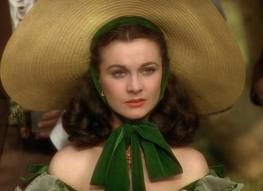 The first hour in particular is very difficult to get into, being populated by a huge number of characters who are all in some way unlikeable. The barbecue at Twelve Oaks consists essentially of spoilt rich people bitching about each other, with Vivien Leigh coming across as a childish brat who moans and screams and cries whenever she doesn't get her way. Leigh is a good actress who is undeniably beautiful, and very good at demonstrating the ambivalence of the character in her attitude to others. But we end up as ambivalent to her as she does to Ashley, and it take a lot of patience to stay with her character.
 Because the film is attempting to be so big in every single department, it ends up as the dictionary definition of sprawling. Although it just about manages to keep us focussed on the central characters (anchored by the great performance of Clarke Gable), the supporting cast is way too big, with potentially enthralling individuals endlessly drifting in and out. When characters do come back, they re-appear in the most contrived way imaginable; Sam, for instance, just happened to be sitting around the campfire when Scarlett was being attacked on the bridge.
 This brings us on the racial aspect of the film. The arguments here are the same as those surrounding The Birth of a Nation: do we accept the racial attitudes as a product of an historical period, or do we criticise such a revered film for being so deeply questionable? If we take the latter view, then the film is totally reprehensible, with almost every black character being reduced to pantomime; they never question their duty and seem incapable of functioning without being ordered around by impeccably dressed white nobles. If we accept the former, then the film is slightly more enjoyable, but the characterisation of Prissy as a screaming, incapable slave girl is still nothing short of toe-curling.
 In the last half hour, the film's poor storytelling is exposed and things get completely silly. In further testimony to it rambling, aimless style, most of the main characters are quickly killed off so that we arrive, very clumsily, at the union of Scarlett and Rhett. Every plot point in this section is prompted by an unfortunate death - Bonny falls from her horse like Scarlett's father, and Melanie falls mysteriously ill again, just so Scarlett can realise that Ashley never loved her. The plot drags laughably as we yearn to get to the staircase and Rhett's final line (which, of course, is not the end of the film).
 Gone with the Wind remains that most difficult of films: something which is so heavily flawed and hugely overrated, but also essential viewing for anyone who loves cinema. It is better than subsequent epic romances like Out of Africa because even at its weakest, baggiest moments it still feels like it is going somewhere. But its greatness is ultimately tarnished by its dated attitudes, poor storytelling and ramshackle structure. In short, it contains both the best and the worst that Hollywood has ever offered; it's massively, massively flawed, but also strangely irresistible.
Rating:
Verdict: Overrated but still essential
The Paradine Case (USA, 1947)
Directed by Alfred Hitchcock
Starring Gregory Peck, Ann Todd, Alida Valli, Charles Laughton
With all the horror stories that come out of Hollywood about studio interference and troubled productions, it is easy to assume that these phenomena are relatively new. Ever since the firestorm surrounding Heaven's Gate, it has been common practice to let producers walk over directors where necessary, even if the finished product suffers artistically. But a quick glance at something like The Paradine Case reveals that this had been going on for much longer, and with the same underwhelming results. The Paradine Case is the final collaboration between Alfred Hitchcock and David O. Selznick, which had begun with the Oscar-winning Rebecca and recently resulted in Notorious, considered by many to be Hitch's finest film. What had started as a good albeit sparky marriage slowly began to disintegrate as both parties' priorities changed. While Selznick wanted more direct control over the films he financed, playing it safe to assure box-office appeal, Hitchcock wanted to experiment, doing 10-minute takes and shooting simultaneously with multiple cameras.
 This disharmony behind the camera was present throughout production. Hitchcock and his wife had produced a script adapted from the original novel, which had then been polished by the Scottish playwright James Bridie. But Selznick was deeply unsatisfied with their efforts, so much so that after viewing the rushes each day, he would send re-writes to the set and order Hitchcock to reshoot yesterday's scenes. The film went vastly over-budget as Selznick attempted to assert his authority, right down to him taking over the editing behind Hitchcock's back.
As a result of these shenanigans, The Paradine Case feels like a deliberate duff note, like the bad album that a band releases to fulfil their contact before going off to do something more interesting. Faced with constant interference and with no control over the final cut, it's fair to assume that Hitchcock simply gave up. The film is still technically interesting, and has flashes of both suspense and directorial genius. But these sections of brilliance are counterpointed by long swathes of inconsistent mediocrity, some of it irritating, some it is ridiculous and all of it disappointing. The story of The Paradine Case is very simple: a barrister is asked to defend a woman accused of murdering her husband, and in the process of defending her he falls in love with her. It's the sort of silly, predictable plot which, had the film been made in the 1980s or 1990s, would have formed the basis of a sleazy, straight-to-video erotic thriller. In fact, in its bid to be upmarket and serious despite its cheesy origins, the film could be seen as the long-term influence on Jagged Edge or Basic Instinct.
 Sidney Lumet once said that "in a well-written drama, the story comes out of the characters. The characters in a well-written melodrama come out of the story." The Paradine Case is a melodrama because our involvement comes less from what the characters do as to the way in which they are drawn. The most obvious example of this is Mrs Paradine herself: we know quite clearly from the start whether or not she did it, but we don't exactly know why she did it (if she did). As the film moves on, her status as a femme fatale or possible black widow becomes clearer, and it is not certain whether the same fate will befall Andre Latour if and when she tires of him.
The Paradine Case does deserve plaudits for its technical execution. Hitchcock, ever looking to push the boundaries of what was possible, captured the majority of footage in long takes, only calling cut when there was no film left in the camera. Because Selznick took charge of editing, there's no way of telling how he would have assembled this mountain of footage, and therefore how similar it would have been to his other such experiments on Rope and Under Capricorn. But the use of long takes, married to some very fine crane shots, give the film a sense of slow-burning flow and poise that it might otherwise have lacked. The other major technical point of interest is in the capturing of the courtroom, which replicated the Old Bailey to the last detail on the strict instructions of Selznick. Unlike a lot of internal sets, the courtroom was built with a ceiling to allow for very low angles, giving the barristers a greater air of authority. These scenes were also unusual for being filmed simultaneously on at least four cameras, which allowed Hitchcock to pick the angles he wanted for every revelation which keeping the energy up on the long takes.
 But ultimately, all this technical wizardry is in vain, for a number of reasons. Firstly, with the exception of one or two short scenes, there is no real suspense in the story at all. Whether through Selznick's hackery or Hitchcock's disinterest, we can see all the major plot points coming a mile off and there is very little in the characters that pulls us through and keeps us hooked. At 114 minutes, the film is way too long for such a simple story, and it keeps filibustering in a bid to convince us that there is more going on that we realise.
 In the absence of either a meaty story or genuinely gripping characters, The Paradine Case becomes just another procedural drama. Hitchcock had very little time for mystery as an intellectual process, believing that unless it was married to emotional engagement with an audience, there would be no reason to care. In the courtroom scenes he is a victim of his own argument: even when the characters are at their most histrionic, the drama falls flat because we haven't formed enough of an emotional bond to feel any tension about their predicament.
In Murder!, his only previous courtroom drama of sorts, Hitchcock wasted very little time on the facts of the case: he used the deliberating jury solely to set up the character of Sir John as an emotionally involving protagonist. After that, he could lead the audience through the various twists by putting this character in danger or under time constraints, giving us all the same information but with an emotional attachment to boot. Watching The Paradine Case is like reading a dry case history: all the facts are there in plain order, but we have no psychological connection to it. This lack of engagement we have with the characters is rooted as much in the direction as the central performances. Gregory Peck is good, but nowhere near as good as he was in Spellbound two years earlier; the last in a long line of actors to play the role, he was probably too young for the part. The other male performers are either caricatures (Charles Laughton's judge) or, in the case of Louis Jourdan, have their character traits so clearly displayed that there is nowhere for them to go.
 The women get dealt an equally duff hand. Ann Todd gives her all but her character is weak, drifting into melodrama way too often and making contradicting statements about her attitude to the case. Joan Tetzel, who plays the precocious daughter of Peck's colleague, gets far too little screen time to demonstrate her intelligence. And then there is Alida Valli (credited solely as 'Valli'), who remains one of the most grating and irritating screen presences of her age. Her typically haughty and preening demeanour may be more at home here than it is in The Third Man, but in either case she comes across as so utterly horrible that you give up caring long before the end.
 The Paradine Case is a plodding, pedestrian Hitchcock effort which does not deserve to be glowingly remembered. Whether as a cautionary tale of producers' involvement in filmmaking or an example of a bored director, it serves little purpose other than as a stopgap between the commercial success of Notorious and Hitchcock's more experimental works later on. Beyond its technical innovations and occasional moments of brilliance, there is precious little in it that one would care to defend.
Rating: 2/5
Verdict: Occasional brilliance amid a sea of mediocrity
The Lord of the Rings: The Fellowship of the Ring (New Zealand, 2001)
Directed by Peter Jackson
Starring Elijah Wood, Ian McKellen, Viggo Mortensen, Christopher Lee
When New Line Cinema first offered a relatively unknown director a budget of $285m, to make a trilogy of films from a source that was deemed un-filmable, you could have been forgiven for assuming we would have another Heaven's Gate on our hands. Likewise, as more and more big-screen imitations have turned up and fallen short, it is easy to be cynical about The Lord of the Rings because of the legacy it has left. But as is so often the way with these things, it only takes a quick revisit of the trilogy for all fears to be laid to rest and for all the magic to once again take hold. Even if the other instalments of this trilogy had never seen the light of day, The Fellowship of the Ring remains a masterpiece in its own right, an epic with substance and emotional power which rewrites the rulebook for fantasy filmmaking. Considering the enormity of the project and the ambitious scope of J. R.R. Tolkien's novel, it is something of a miracle that it was even made at all. But what is a bigger miracle is that a film this long, with this many characters and this much introduction, should be so flawlessly executed that it holds up even after 20 or 30 viewings.
Part of what makes the film so magical is the sheer level of craftsmanship and attention to detail, both in the visual representation of Middle Earth and the deeply affectionate treatment of Tolkien's story. Before even the prologue has finished you are utterly convinced not only that Peter Jackson was the right choice to direct but that every effort has been expended to do justice to the material. There are no dodgy special effects, no props which have been built down to a price, and no locations which feel like the real world is being frantically kept off screen. When designing the film, Jackson and WETA's Richard Taylor sought to create a world and series of cultures which would expand beyond the four corners of the screen. Everything about the film, from the hair on the hobbits' feet to the grandest building, feels completely bespoke, and in being so detailed the smallest object like a belt or a sword can come to embody and define an entire culture. Because of this level of detail, you never have that awful experience of recognising a prop or set piece. You won't find the tankards in The Prancing Pony hiding in the back of your cupboards, and the woodland communities are not simply jumped-up versions of Endor in Return of the Jedi.
 But although the world of Middle Earth is rich with its own cultures, this is balanced out by a desire to be realistic in the film's depiction of characters and situations. The battle scenes may be fantasy violence, but the violence is structured realistically. You don't always need to show blood to understand that people are getting hurt, and unlike the Star Wars prequels we don't end up with fights which defy the laws of physics because of an over-indulgence in CGI. Tolkien wrote The Lord of the Rings as a mythic pre-history, as something that could have existed in a forgotten dark age. And that same spirit has been replicated here: we believe enough in the mechanics of this world to accept it, but there is also plenty of magic in which to lose oneself.
Fellowship is the gentlest film in the trilogy, with more focus in its first hour on Hobbiton and setting up the idyll of the Shire. On the surface this would seem like the easy part of the whole project, since it doesn't involves epic battles with a cast of thousands or scenes of enduring physical pain. In fact, this is the part of the trilogy that Jackson simply had to get right. These scenes have to demonstrate not just the idyllic and sheltered lives of hobbits, but the pure and harmonious way of life which Frodo undertakes his quest in order to preserve. And they succeed wholeheartedly, making us feel part of this community, at home with its customs and laid-back means of existence. Hence when the first elements of darkness creep in with the arrival of the Ringwraiths, we are every bit as terrified as the hobbits or inhabitants of Bree. Even though it is the gentlest in the trilogy, the film has real darkness and builds the creeping sense of horror really well. In the first encounter with the Ringwraith, we see insects crawling away from the tree in which the hobbits are hiding, like the whole of creation is repulsed or terrified by the very presence of this fallen king. The scenes in Moria are deeply claustrophobic; even before the orcs and goblins turn up you feel like you are walking through the bowels of hell, on a thin path of light between two immerse darknesses. The Balrog and the Uruk-hai are terrifying, the former especially since its presence is subtly suggested through the evocative use of red light, and when revealed it is every bit as monstrous as one would have hoped.
 What is really striking about The Lord of the Rings, and Fellowship especially, is how this progression of increasing darkness is counterpointed by humour. Though this aspect is less prominent in the books, it makes sense for there to be some form of comic relief amidst the gathering gloom and destruction of human souls. Jackson comes from a background in horror comedy, having made his name in the 'splatstick' horror of Bad Taste and Brain Dead. There are clear hints of this macabre humour in the battle scenes, and the comic interplay between Merry and Pippin as is much comic relief as a naïve, absurdist reaction to the strange, dark worlds ahead of them.
 Tolkien likened the ring to a machine: something which is cold, clinical, calculating and by its very nature heartless. Tolkien was not a Luddite, but he was aware of the way in which technology could be used to eradicate human will. One of the delicious ironies of the story is that the enemy is both a distant concept (like 'technology') and something which must be carried with them (like a sword). Characters are seduced by the concept or potential of the ring - Boromir, believes it will help his people and save his country. But what is designed to bring victory can just as swiftly bring defeat, and just as men die upon their own swords, so the ring will destroy those who carry it.
 Much of Fellowship examines the rise of industry and man's relationship with nature. The elves, who have a harmonious relationship with nature, are in the autumn of their years and are beginning to leave Middle Earth. The orcs and Uruk-hai, meanwhile, represent the march of progress, technology and modernity, exploiting and trampling on nature in the name of power. Sauron's decision to tear down his trees and replace them with machinery is a symbol of civilisation advancing at the expense of nature, a development which creates competition for resources and causes humanity to turn on itself. While Sauron creates a pure, almost Aryan race in the Uruk-hai, mankind stands on a knife-edge, unsure of which direction in which they should proceed.
 The film also has a breathtaking soundtrack, which contains some of Howard Shore's very best work. Because The Lord of the Rings is a deeply emotional story about worlds colliding and civilisations collapsing, it is necessary for the score to be prominent and for it to embody and encapsulate the different cultures. In this case, it fits so perfectly that you can't believe that the actors weren't mapping out their movements to it. From the tender scene between Aragorn and Arwen to the drums matching the Uruk-hai's tempo through the woods, the music never misses a beat and succeeds where so many melodramas fail, matching emotion to music without compromising the performances.
 The Fellowship of the Ring is a barnstorming masterpiece, which balances its multiple stories effortlessly. Although it has an easier job than its brothers in this respect, you never feel as though characters are being ignored or getting left behind, and every performance in the ensemble has depth and conviction. The film is visually spectacular, from the ethereal beauty of Lothlorien to the gloomy depths of Moria. Its set-pieces are as intimate and thrilling as its romantic scenes, and Jackson's direction is flawless. It is the perfect start to a perfect trilogy.
Rating: 5/5
Verdict: A perfect start to a perfect trilogy
The Red Shoes (UK, 1948)
Directed by Michael Powell & Emeric Pressburger
Starring Moira Shearer, Anton Walbrook, Marius Goring
In 1948 Michael Powell and Emeric Pressburger were in their prime. The combined success of A Matter of Life and Death, I Know Where I'm Going! and Black Narcissus had cemented their status among the most inspiring and innovative filmmakers of their day. When J. Arthur Rank heard their next project was going to be a film about ballet, his heart sank and his financiers panicked. They needn't have worried, for the result is a total masterpiece, both among their work and in its own right. The Red Shoes is a breathtaking film, a perfect marriage of spectacular visuals and a slow-burning, heartbreaking story. It blends the original fairy tale by Hans Christian Andersen with powerful undercurrents about art, obsession, jealousy and devotion. The whole thing is held together by Powell and Pressburger's trademark direction, which blends fantasy and reality effortlessly, taking the audience on a highly imaginative journey. The first time out you will be so overwhelmed you won't know what to think, save that the film is something very, very special.
Dance has always been a popular subject on film; even Metropolis has several minutes of it, as Maria's robotic double seduces her audience of impressionable voyeurs. But notwithstanding the other problems of most mainstream efforts (Grease, Flashdance, Step-Up etc.), there are many examples of dancing being used to either needlessly pad out a film or to disguise narrative shortcomings. On the one hand, we have the twenty minutes of roller skate dancing in Heaven's Gate (which is about twenty minutes too long). On the other hand we have the ending of The Millionairess, with Peter Sellers and Sophia Loren waltzing on the balcony with nothing but contempt for their viewing public. The Red Shoes' first big strength is that it falls into neither of these traps. The dance sequences in it are not only beautiful, but they are filmed with the same sense of discipline and restraint exercised by the ballet teachers when drilling the dancers. Although the film is over two hours long it never feels baggy, because the dancing is kept to a minimum and only used to initiate a plot point or important piece of character development.
This is particularly true in the centre of the film, when the whole of 'The Red Shoes' ballet (written specifically for the film) is performed on screen. Like many older films, the dance sequences are filmed in long takes with straightforward editing, to give a sense of scale and the level of physical preparation which went into choreographing the dance. But more than that, this 20-minute sequence is filled with enough visual brilliance and imagination to rival anything in Moulin Rouge! or Spirited Away.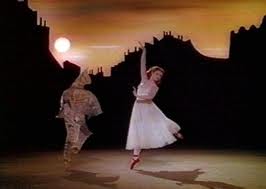 The Red Shoes is a classic Powell and Pressburger film because of the unique way in which it blends fantasy and reality. During the eponymous ballet, we drift between the realistic portrayal of the dance, as something being performed on a physical stage, and the more fantastical view of the world which is coming entirely from the mind of the central character. In one magical moment the red shoes magically appear on Vicky Page's feet, and as she dances with the shoemaker she sees in his face the faces of the different men dominating her life. These touches come so quickly and so seamlessly that it is a challenge to say where we are at any given moment. But there is enough beauty and passion in these scenes to prevent us from getting lost or confused.
 The Red Shoes is often cited as one of the most visually extraordinary films ever made - a moniker which it thoroughly deserves. Of all the films made in the golden age of Technicolor, this is probably the best (pipe down, Wizard of Oz purists: it's not that good). It's not just that the colours are so perfectly rendered on screen, but they are used symbolically and sparingly to convey the deeper themes of the picture. Take the scene where Maurice Lermontov is picking out the exact pair of red shoes that Vicky will wear for the ballet. What could have been a simple showcase for Jack Cardiff's cinematography becomes a multi-layered and intriguing scene which hints at the nature and motives of certain characters.
 As you might have guessed by now, The Red Shoes is not centrally a film about ballet. You certainly don't have to be a fan of ballet to enjoy it. The original fairy tale is about a singular passion which comes to dominate a person's life. That passion for dancing is made physical in the magical shoes. which force the wearer to dance forever, until - in the original version - she cuts off her own feet and dies. And while there may be nothing quite so graphic in this version, the ending is every bit as earth-shattering.
 Vicky Page, played brilliantly by Moira Shearer, is a young woman who desires nothing more than to dance. In one of the film's key scenes, Lermontov questions her about why she wants to dance. She asks him, "why do you want to live?"; he replies, "I don't know exactly why, but I must" and she repeats his answer. Page's talent is something that she does not fully understand, and Lermontov gives her a chance based solely on her technical abilities. But as the film moves on, his tutelage develops into something a lot more personal, and Vicky is forced to question her raison d'etre still further.
 The Red Shoes is a brilliant examination of jealousy and obsession, centred around the conflict between art and love. Both inspire great levels of devotion, whether to ideals (the art of dancing or the dream of love) or to practical gains (money or marriage). But unlike many modern films, The Red Shoes keeps a lid on this jealousy until the very last scenes. There are several moments throughout of Lermontov and Julian Craster essentially fighting for control of Vicky, both as a person to be loved and as a object to be marketed. But these conflicts are never directly over the girl, with most of their conversations surrounding individual sections of music, interlaced with tart remarks about standards and ambitions.
 Vicky is caught in the middle of a powerful love triangle consisting of love, art, and the gifted individual. On the one hand, she is drawn to Lermontov, who offers her success and nurtures her talent but cannot allow her to love anyone. He despairs at his prima ballerina who leaves the company to get married, remarking: "a dancer who relies upon the doubtful comforts of human love will never be a great dancer. Never.". On the other hand, there is Craster, a talented composer who is devoted to Vicky whilst wanting to further his own career via the opera. He is the only one who can offer her love, but the sting in the tale is that her talents must come second to his ambitions.
In the climactic final scene, we see these two forces come to blows as Vicky breaks down and does not know what to do. After Craster leaves, Lermontov consoles her and she prepares to perform. But suddenly, clad in the red shoes, she dances out of the theatre, all the way to the railway station and to her tragic end. Many might questions this small inconsistency (why is she wearing the red shoes at the start of the ballet?), but as Powell pointed out it makes sense when we examine what motivates her to leave the theatre. Did she choose to go of her own free will and love for Julian, or did the shoes make her go against her will? The Red Shoes is a magnificent achievement, with fantastic central performances, breathtaking visuals and a wonderful soundtrack. Its influence can be seen in most of the great Hollywood musicals of the 1950s and 1960s, and there has never been a film about dance (or ballet) which has captured the art in such a fascinating manner. It is hard, however, to call it Powell and Pressburger's best film, because of their extraordinary body of work. One thing is for sure - Darren Aronofsky's Black Swan has a very hard act to follow.
Rating: 5/5
Verdict: A red-blooded masterpiece


