
Reflections
-
It is weird to read my correspondences from the late August/early September
period, being the time of transition between my old function in life to my
new ...
14 years ago
The Eagle (UK/ USA, 2011)
Directed by Kevin Macdonald
Starring Channing Tatum, Jamie Bell, Donald Sutherland, Mark Strong
When Gladiator reinvigorated the swords-and-sandals epic, it was quickly followed by a host of films which sought to replicate its success by imitating part or all of its formula. But whatever the qualities of Troy, Alexander or even 300, there was always a niggling sense that we were getting something inherently inferior. Adding to this list of disappointments is The Eagle, the first big hiccup in Kevin Macdonald's career.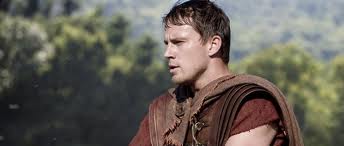 The Eagle's relationship to Gladiator is uncomfortably close right from the start. In the opening act, before Channing Tatum journeys over Hadrian's Wall, the film invokes or restages several key images from Ridley Scott's masterpiece, such as Marcus praying to the gods through smoke or laying out little figurines of his family. The first battle sequence is like the opening battle in Gladiator, only shot on a smaller scale and without a tripod. Last but not least, the central character is a soldier haunted by what has happened to his family, in this case the shame surrounding his father.
 There are other prominent references in the film which become all too apparent as the action plays out. The ending, where Marcus and Esca are pursued across the Scottish landscape by the Seal People, is very close to The Fellowship of the Ring. They are two small, vulnerable people being pursued by the 2nd-century equivalent of the uruk-hai, and Justine Wright's editing is very similar to those sequences. Even the sound design treads close to The Lord of the Rings, with the death throes of Marcus' horse sounding awfully similar to those of the cave troll.
 The crucial problem with The Eagle is that it fails to do what Gladiator did so well - namely balancing the macho and the metaphysical. Scott's film began and ended in the Elysian fields: its intense and often brutal battle scenes (including the fist-fight between Maximus and Commodus) were anchored around an exploration of politics, religion, gender and mortality. The Eagle doesn't have any such weight to carry around and its presentation is much more erratic: it amounts to lots of walking, then a battle, repeated a few times, with the odd little twist or idea thrown in along the way.
 A further comparison, this time with Scott's most recent effort, will help to shed further light on Macdonald's shortcomings. The central problem with Robin Hood was that it didn't know exactly what it wanted to be - a Batman Begins-like origin story, a political drama about working-class emancipation, or a bombastic action movie with pantomime villains. But even in the midst of making up its mind, Robin Hood did at least manage to tackle the political side of its story, albeit superficially.
 The Eagle has the opposite problem. It knows exactly what it wants to be, which is a very old-fashioned romp (and I use the term loosely) with characters which are all too clearly drawn and a fairly predictable storyline. Rosemary Sutcliff's novel, which had previously been adapted for Children's Hour in the 1950s, draws the battle lines between good and evil all too broadly, placing honour and valour over common sense and character development. Even when it's trying to subvert the central relationship between master and slave during the encounter with the Seal People, it still feels blinkered and obstinate as to where your loyalties should lie and to what extent.
 Whereas the novel was originally intended for children (more specifically young boys), there are numerous sequences in The Eagle which are unsuitable for younger audiences. For a 12 certificate film, it is pretty gruesome, with more than one instance of beheading and a fair amount of blood on screen. That said, you don't have to sit through all the really troubling stuff, like people's throats being slit (including a child's throat in one scene towards the end). And most of the time the battle scenes are so frenetic and rapidly edited that you can't exactly tell where people are getting hit, or with what - or, for that matter, why.
 The film is shot by Anthony Dod Mantle, whose credits include the Oscar-winning Slumdog Millionaire and Lars von Trier's controversial Antichrist. Dod Mantle is a pioneer of handheld digital photography, and he does add a number of notable visual touches which make The Eagle a little more distinctive. The opening shot on the river is like one of the woodland scenes in Antichrist: there is a similar sense of mystery in the wild surroundings of nature, albeit with less demonic threat. And some of his compositions are clever, such as showing characters' faces through water which is already reflecting the sky.
 But despite Dod Mantle's knowledge and expertise, the use of hand-held camera is inconsistent and ends up being detrimental. Notwithstanding the shortcomings of the battle scenes, the quieter sections find Macdonald's camera juddering and bouncing when the scene would be better served with a dolly or crane. Like the opening of The Bourne Supremacy, it takes a while for us to adjust to the aesthetic, and for the action to catch up with the frenetic camerawork. But whereas Paul Greengrass' film eventually got into its stride, The Eagle remains dodgy throughout, with Dod Mantle's camerawork hampering Macdonald's already lacklustre direction.
 What makes The Eagle so lacklustre is the lack of strong, charismatic performances. This is surprising considering Macdonald's back catalogue, which includes Forest Whittaker's terrifying performance as Idi Amin in The Last King of Scotland. Jamie Bell remains a decent actor with a certain amount of screen presence, and Mark Strong makes the most of a small supporting role. But all their best efforts are in vain due to Channing Tatum, who has the charisma and acting ability of a lump of granite.
 Because the film has no strong, charismatic protagonist, we aren't drawn into the story enough to make the substance feel intriguing. There is a couple of interesting ideas explored in The Eagle which are both interesting from a genre point of view and pertinent to 21st-century politics. One of these is the inherent instability of a conquering power, and the imperial force having to isolate an enemy rather than face it down and exterminate it. The very existence of Hadrian's Wall, as an imposed, artificial barrier between 'savage' and 'civilised', indicates that the occupying force is based upon fear, both in its methods of conquering and its view of other civilisations.
 When Marcus encounters the Seal People, he is confronted with a culture which operates along the same tribal lines as his own. There is a clear distinction made between Roman and Briton, observed in everything from speech patterns to physical features: there is a running comment about Roman soldiers being recognised by a helmet scar under their chin. Having spent all his life as part of the 'superior race', Marcus is forced into silence and submission as the master-slave relationship is reversed. Esca, meanwhile, is torn between his desire for vengeance against Rome and his professed loyalty to Marcus for sparing his life at the games.
 These are interesting ideas in and of themselves, but the film's structure never allows them to be explored in a satisfying amount of detail. More often than not The Eagle relies earnestly on genre expectations to sustain its appeal, giving us spectacle and plot devices but not much in the way of emotional engagement. The search for the missing roman standard, the eagle of the title, becomes almost secondary to the characters' endless wanderings, and the epilogue of them returning it to the senators is silly and clichéd.
 The Eagle is a big disappointment from Macdonald, failing as both a romp and a means of exploring interesting ideas within a genre. It's not without substance or individual scenes which are visually arresting: it's a better story than 300 and the battle scenes will just about satisfy teenage boys. But for those of us who want to think a little harder, it falls short of most of the marks set for it, never threatening Gladiator's mantle as the great historical epic of our time.
Rating: 
Verdict: Macdonald's first real disappointment
The Adjustment Bureau (USA, 2011)
Directed by George Nolfi
Starring Matt Damon, Emily Blunt, Anthony Mackie, John Slattery
When Ridley Scott showed him the rough cut of Blade Runner just months before he died, Philip K. Dick is said to have remarked: "it is as though you looked inside my head." But not all adaptations of Dick's work have been quite so ecstatically received. For all the ones that have worked (Total Recall, Minority Report, A Scanner Darkly), there have been at least as many that ditched the more thoughtful aspects of Dick's work in favour of chasing and explosions. Adding to Paycheck and Next, we now have The Adjustment Bureau, which could be the biggest let-down of the year. It's not as though The Adjustment Bureau doesn't have talent behind it. Emily Blunt has demonstrated her dramatic chops in My Summer of Love and The Young Victoria, while Matt Damon is fast becoming one of the most reliable screen actors of our time. George Nolfi, who wrote and directed the film, worked as a co-writer on The Bourne Ultimatum, which remains Paul Greengrass' best work. And it is shot by John Toll, who won back-to-back Oscars for his work on Legends of the Fall and Braveheart.
 With these credentials it would be tempting to brand The Adjustment Bureau as 'Bourne-lite' - or maybe 'Inception-lite' due to its science fiction trappings. But to do this would be a great disservice to both films, since The Adjustment Bureau has neither the intellectual rigour nor the heart-stopping, emotional action of these films. In fact, it is everything that those films weren't: flimsily constructed, loosely written, glossy-looking for its own sake and with underdeveloped ideas.
 What made the later Bourne films so fantastic was the ability of Paul Greengrass to marry the aggressive, hand-held action sequences to believable character drama. The Bourne Ultimatum balanced this perfectly, with none of Jason Bourne's personal quandaries getting lost in or watered down by the spectacular action. Looking at Nolfi's film from a writing point of view, you'd swear that he had written the chase scenes and let Greengrass do the rest. He does not have the skill to marry action and ideas together, creating a film which is at best silly and at worst completely shallow.
 The Adjustment Bureau is essentially a perfectly decent, if unremarkable, romantic comedy surrounded by increasingly preposterous elements of science fiction. The central relationship between David and Elise does have a genuine spark about it: the romantic dialogue in Nolfi's screenplay is too witty to have been written by a committee, and both characters feel like rounded human beings with believable jobs and lifestyles. We enjoy the company of Damon and Blunt because their emotional responses seem believable, increasingly a rarity in Hollywood rom-coms.
 Normally, this kind of frothy concoction would do absolutely fine. But the science fiction elements, which provide the backdrop and keep breaking into the plot, cause the more contrived moments in the relationship to become magnified. Having David give up on Elise, only to have him realise he loves her and run across a city to find her, would work perfectly well on its own. But when you have David running across the city through secret doors, which he can only pass through while wearing a trilby, it very quickly becomes ludicrous, like a bad mash-up of The Graduate and Tron.
 The Adjustment Bureau does attempt to raise a number of interesting questions about fate, chance and free will, subjects which are staples not only of science fiction but of Dick's work in particular. At the centre of the film is a discussion about whether human beings are free to choose how they live their lives, or whether we are simply actors reading lines off a script which has already been written (and re-written). The film strikes an interesting balance between the two, saying that while humanity's behaviour is constantly 'adjusted', it is not possible for the Bureau to be everywhere at once or stop every bad thing from happening. They even go so far as to admit that certain things are entirely down to chance, although it isn't specified where exactly the lines are drawn.
 The film does a pretty good job of demonstrating the cost of free will - or, from the Bureau's point of view, the advantages of intervention. Terence Stamp's character delivers a speech similar to Al Pacino's in The Devil's Advocate, about how Mankind has taken itself to the brink whenever 'the Chairman' has taken a hands-off approach (for instance, the Dark Ages and the Cold War). The film retunes Dick's paranoia surrounding big corporations (and Hollywood) to a more abstract moral dilemma, in which the Chairman is God and his hatted assistants are interceding angels, keeping Humanity on the straight and narrow at the cost of there being no genuine free will.
 The Adjustment Bureau attempts to retune this concept further to look at the course of true love. The central relationship, between a congressman and a ballerina, follows the trajectory of most American rom-coms: all sorts of obstacles are created to push them apart, but we always know that they will somehow end up together. The Adjustment Bureau doesn't deviate from this mould, but what it does do is offer a twist on why such obstacles occur. Rather than being the result of personal attitudes or quirkiness, the obstacles faced by Damon and Blunt are created by the powers-that-be, whether God or - to go all Pirandello for a second - the writers themselves.
 Unfortunately, there are two gigantic problems with the manner in which The Adjustment Bureau tackles these ideas. The first is that it is very literal-minded, and fails to bring out the moral dilemmas without resorting to blatant plot exposition. Terrence Stamp's character is effectively Basil Exposition in a sharp suit, as though Nolfi thought Stamp was too old to be running around Chicago, telling him to stay in the warehouse and talk to his heart's content.
 Alfred Hitchcock once said that exposition is a pill which must be sugar-coated if the audience is to remain in suspense. If North by Northwest is the epitome of sugar-coating, then The Adjustment Bureau is like a series of big and bitter pills. Whereas Inception introduced the mechanics of the dream-state incrementally, this handles its mechanics like someone repeatedly dropping a sledgehammer. It never has the confidence or foresight to outline exactly how much of what we see is adjusted, and the conversations about the plans are shoved down the audience's throats.
 The second big problem with the films is that it dodges all the big moral questions that follow from its intriguing set-up. Not only does it gloss over where the battle lines are drawn, but its payoff feels far too easy. The lengthy chase sequences in the final act are an excuse to canter through the character development when it really matters, and the rooftop scene finds the script skimming over the philosophical implications of the plan 'being changed'. In its naked pursuit of a happy, feel-good ending, The Adjustment Bureau produces the exact opposite emotional response.
 The visuals of The Adjustment Bureau are also guilty of being shallow. John Toll may be a great cinematographer, but under Nolfi's instructions everything is far too glossy: the overabundance of shiny blues and metallic greys make everything look like a shaving advert, or one of George Clooney's coffee commercials. The chase sequences are a blatant excuse to get the ol' green screen out, making the action seem even less physical or believable. At every possible turn there is a pursuit of style over content, and speed over intelligence.
 The Adjustment Bureau is a deeply disappointing film which lacks the depth, nuance or subtlety of the best Philip K. Dick adaptations. In Nolfi's hands what could be a potentially interesting sci-fi romance becomes something flimsy, frothy and ultimately too ridiculous. I would be lying if I said I didn't laugh, either mockingly at the film or out of charm at the central couple. But laughter isn't enough to do justice, either to Dick's material or to the central relationship, resulting in a case of squandered potential that could have been so much more.
Rating: 
Verdict: Flimsy, frothy and far too ridiculous
Tinker Tailor Soldier Spy (UK/ France, 2011)
Directed by Tomas Alfredson
Starring Gary Oldman, Colin Firth, Tom Hardy, John Hurt
You could be forgiven for approaching Tinker, Tailor, Soldier, Spy with some degree of trepidation. So many European filmmakers, who rocked the world with their first few features, went the way of the dodo after they started working in the English language. And considering just how good Let The Right One In was, you find yourself almost begging that Tomas Alfredson hasn't gone the way of Wolfgang Petersen. O, we of little faith. Within minutes of his second film beginning, Alfredson has laid all such fears to rest, allowing us to enjoy one of the very best films of 2011. His adaptation of John Le Carré's highly regarded novel is as distinctive and artistic as his debut, packing in a gallery of superb performances within a perfectly rendered period setting. While it never entirely hits the heights of Let The Right One In, it is a more-than-worthy follow-up from a director who seemingly can do no wrong.
 For starters, Tinker, Tailor, Soldier, Spy is truly beautiful to behold. Alfredson reunites with cinematographer Hoyte van Hoytema to create a highly evocative portrait of 1970s London. The screen is awash with faded greens and blues, and many scenes are shot partially or wholly in shadow to underscore the murky dealings that are afoot in the Circus. There is a perfect balance between artistic license and authenticity, creating a world which is both unique and instantly recognisable.
 Not only is Alfredson's vision of London so visually outstanding, it is also culturally nuanced. He identifies three separate cultures uneasily co-existing, evoking and demonstrating them through intelligent choices of music. We have the recent past, embodied by Tom Hardy's character, which is like a paler rendition of Life on Mars, complete with Mudd and David Bowie. We have the recent past, namely the 1960s, which is reflected in the Breathless-like scenes between Hardy and the girl in the convertible. And we have the Circus itself, which seems completely unchanged from the 1940s, or possibly earlier than that, as typified by the inclusion of a George Formby record when one of MI5's agents makes a call from a music shop.
 In Alfredson's hands, Tinker, Tailor, Soldier, Spy becomes a film about malaise and ennui. It depicts a Britain which is past its glory, not only as an imperial power but as an intelligence force: not only can it no longer conquer countries, but it is increasingly incapable of holding on to their secrets. The Circus increasingly positions itself as a buffer zone, refusing to admit reliance upon its American "cousins" and contenting itself with gathering intelligence about Soviet activity in Europe.
 The Circus is depicted as the very definition of old-fashioned. If there wasn't a close-up on the ticker-tape showing it was 1973, you would swear that this was the War Office and we were still fighting the Germans. All of the furniture, from the wooden chairs to the Bakelite phones, seems left over from the war, and in the libraries you can almost smell the dust on the shelves. It feels like an organisation built upon self-denial - a collection of people who continue existing without any real reason for doing so. Without any 'proper' wars left to fight, everything Britain stands for has become redundant, and no-one, not even Smiley, is willing to admit it.
 In the best possible way, the film is very slow-paced for a thriller. It would be totally inappropriate to tell Le Carré's story through Bourne-style shaky-cam and rapid editing, because the material and the technology surrounding it is does not have a 2011 sensibility. This is still an analogue world, in which conversations are transcribed off reel-to-reel tape recorders, bugs are hidden in lampshades, and people signal through flashlights and banging on walls.
The film is also old-fashioned (in a good way) by its methodical patience. With the exception of Control's outburst or Jim Prideaux beign shot, the conversations in Tinker, Tailor are quiet and considered, containing nothing that could be classed as histrionic. Smiley doesn't speak for the first fifteen minutes, and even when he is interrogating the Magic Circle he never shouts: he takes time to phrase his questions, refusing to give anything away and ensuring that he need not repeat himself. You could argue that this understatement and emphasis on method over movement is another period detail; because modern espionage is built around the internet, it makes sense for the camera to move faster and for things to be more action-packed. But it's also a reflection of Le Carré's sensibility. Where his contemporary Ian Fleming was drawn to the glamour of spying, Le Carré sought to dismantle all such illusions, emphasising the loneliness of spying and the moral ambiguity of the protagonists.
 If a James Bond film is like a shooting gallery intercut with car chases, Tinker, Tailor is like a tricky game of chess. It is a film about characters who are in the endgame: they see the doom of their organisation approaching, and it is a question of when and not if they will be dragged down with it. After Control and Smiley are forced out (with the former dying soon after), it becomes a scramble for power with Percy Alleline emerging as the leader. We follow Smiley as he navigates through the mind-games to uncover the mole - to find the king whom he will trap in an elaborate mate.
 The inward-looking nature of the Circus is reflected in the understated performances of an extraordinary ensemble cast. In many ensemble films, the cast often compete for attention by out-acting each other, but Alfredson is too smart to put up with any such nonsense. This is a film in which the tiniest little gesture can say everything about a character, whether it's the raise of an eyebrow, the twitch of a lip, or the slightly forced way that Colin Firth smiles at the ghastly Christmas party.
 Because the TV adaptation of Tinker, Tailor is so well-regarded, any new adaptation in any medium will have to be compared to it. And for all the brilliance and quality of Alfredson's work, there are a couple of areas in which the TV series has the edge. There is not much between them in terms of cast - Gary Oldman can hold his own against Sir Alec Guinness, and in Colin Firth's current form he is more than a match for Ian Richardson. But in compressing the novel or the series into just over two hours, there are two small flaws with this adaptation.
 Because the cast is so strong, and charismatic, you find yourself wishing to see more of them, something you do get with the TV series. When you've got someone as radiant as Tom Hardy, or as enigmatic as Benedict Cumberbatch, it doesn't seem fair to give them so little screen time. More to the point, a lot of the rich language of Le Carré's novel has been reduced. Bill Haydon's explanation of why he defected is reduced to a few teary sentences, and Smiley seems to centre in on Hayden relatively quickly. These shortcomings aren't enough to throw the whole film off course, but it does put you in the unusual position of wanting it to be half an hour longer.
 To be fair on Alfredson, he does make up for these tiny shortcomings by bringing out new aspects of the story, particularly the sexual nature of the characters. There are strong indications that Haydon and Prideaux were lovers, from the loaded glances at the Christmas party to the photograph of them together, which Haydon keeps when he raids Prideaux's flat. Haydon is ultimately killed by Prideaux by being shot under the eye: a tear flows from Colin Firth's eye, mingling with blood over the bullet wound, and the camera cuts to Mark Strong, also in tears.
 Tinker, Tailor, Soldier, Spy is an almost perfect film. Its flaws are so miniscule and yet so clear that they will drive you to the point of frustration. But no amount of lingering on them can detract from its status as one of the year's very best films. The performances are superb, the visuals are extraordinary, and Alfredson directs with a reserve and intelligence which is all too rare in modern filmmaking. A true gem.
Rating: 
Verdict: Almost perfect
Watchmen (USA, 2009)
Directed by Zack Snyder
Starring Jackie Earle Haley, Patrick Wilson, Malin Akerman, Matthew Goode
Big-screen adaptations of Alan Moore's work have been a decidedly mixed bag, from the enjoyable V for Vendetta to the flawed From Hell and the excremental The League of Extraordinary Gentlemen. In bringing what is considered Moore's finest work to the big screen, Zack Snyder has made every effort to do justice to the graphic novel and satisfy the fans. But the finished project is found severely wanting in crucial areas, resulting in either a big, long folly or a missed opportunity.
 Of all the Alan Moore adaptations, Watchmen has the longest and most troubled production history. The film was first mooted in the early-1990s when Terry Gilliam was approached by Sam Hamm, who had recently achieved success writing Tim Burton's Batman. Despite being initially interested, Gilliam concluded that the novel could only work as a TV mini-series; he left the project and Hamm's script was indefinitely shelved.
 The project re-emerged in 2001 with a new script by David Hayter, which lay around for three years before Darren Aronofsky was attached to direct. He subsequently dropped out to make pet project The Fountain, and his replacement Paul Greengrass did the same a few months later, in order to make United 93. Snyder was first offered the project in late-2005, shortly after his success with the remake of Dawn of the Dead. The project was formally green-lit in 2007 after shooting wrapped on 300.
 There is no doubt that Snyder and everyone involved in Watchmen wanted this to be the best possible adaptation of the novel. This is in spite of the fact that Alan Moore has disowned it, along with all other adaptations of his work (and looking at The League of Extraordinary Gentlemen, it's not hard to see why). Various stories have circulated about the cast having copies of the novel on set, so that it could be referred to directly whenever there were questions over plot or characters. The film was clearly made for the fans and not for the money: with an 18 certificate and a budget of $130m, no expense or effort has been spared to replicate the comics as closely as possible.
 But in spite of this obvious affection, there are a number of big problems with Watchmen which render it at least a partial failure. The first and biggest problem is that Snyder is a fanboy. He loves the comic to such an obsessive degree that either he can't explain it to the rest of us, or he isn't willing to explain it.
 As a result the story of Watchmen is largely impenetrable to anyone who didn't spend their teenage years immersed in comic books. Snyder is focussed so much on meeting fans' expectations that the backstories or reasoning of the characters gets buried or lost, not to mention the mechanics of the alternative universe they inhabit. This is particularly the case with Doctor Manhattan, whose origins are only touched upon about halfway through the film.
 The second, deeper problem is with Snyder as a director. He is not the "visionary" that he is made out to be, being visually stylish but a very poor storyteller. While the novel is purported to have substance coming out of its ears, the film gives the impression that it is all surface and no depth, amounting to little more than people in latex hitting each other. One could say on these grounds that Snyder is the new Joel Schumacher - and for all its disinterest in the comics, Batman Forever is a better film.
 On top of his irritating use of slow-motion, most of Snyder's visual decisions smack of impatience, incompetence or showing off. His impatience is seen in the constant cutting between multiple, similar angles in scenes which would flow much better with longer, simpler takes. His incompetence is found in beginner's-level mistakes: he shoots several scenes through windows, resulting in lens flare or distracting reflections. And his showing-off is evident in Veidt's interview being reflected through a lens of another camera, or a sex scene being captured through the glasses on the table. In each example the visual decisions are an unnecessary indulgence which contribute little, and in many cases detract from and undermine the story.
 Regardless of how complex or multi-layered the story of Watchmen is, it does not require two-and-a-half-hours to be told. On the one hand, it feels like the film always wants more time to develop the characters, and Gilliam was probably right that it would have worked better as a miniseries. On the other hand, if Snyder was determined to make a manageable film, he would have accepted the necessary compressions and moved the character development forward. But he doesn't do this, at least not as much or as well as he should. We have to wait nearly two hours for things to come together with the twist involving Ozymandias and Doctor Manhattan, by which time most of us will have given up.
 So much of Watchmen is window-dressing, confirming Snyder's pursuit of style over everything else. Rorschach's film noir narration might work in the comics, but it serves little to no purpose here: the end point involving the discovery of his journal is silly, and it does nothing to move the plot forward other than stating the obvious. Snyder's choice of pop songs on the soundtrack is lazy, particularly in the opening montage: he settles for Bob Dylan's 'The Times They Are A-Changin' where Quentin Tarantino would have put on something more entertainingly esoteric.
 This feeling of superficiality, coupled with the unrelenting pursuit of style, causes all of the arresting themes of Watchmen to get buried. In fact, the story raises a number of interesting issues about the ethics of nuclear war and peace, the workings of mutually assured destruction, and in particular the role of "costumed heroes" and how they could be controlled or policed. The slogan "Who Watches the Watchmen?" recurs as graffiti throughout the film but is barely addressed in a constructive way.
 The tone of Watchmen keeps flipping between flippant and portentous, with Snyder being unable to balance the dark or forbidding elements with the inherent silliness of a naked floating blue man. This is perfectly demonstrated by a scene halfway through on Night Owl's ship: Silk Spectre II makes a comment about impending nuclear war, which then cuts to her and Night Owl making love in their costumes. Such lurches in tone are akin to erotic fan fiction and threaten to drag the whole film into parody.
 Because the flippant aspects of Watchmen are so prominent, scenes which are meant to be more thought-provoking lose much of their impact. During the scenes involving Richard Nixon, what sticks in your mind is not the threat of global destruction but his comedy rubber nose, which makes the war room scenes feel less like Dr. Strangelove than Spitting Image. More problematically, when the film has a near-rape sequence, or a child abduction, or any number of brutally gruesome deaths, Snyder can't pull himself together: he can't deliver the emotion punch that such scenes require to prevent them from seeming inexcusably adolescent.
 Watchmen is a deeply flawed, over-long and often boring attempt to bring Alan Moore's vision to the big screen. Whatever the merits of the graphic novel, and regardless of his good intentions, Snyder was the wrong director and this adaptation will put many newcomers off the source material. It pales in comparison to both V for Vendetta and Christopher Nolan's Batman films, both as a comic adaptation and an attempt to explore serious political issues. Fanboys will leap to its defence, but everyone else will be bored, annoyed or confused.
Rating:
Verdict: A deeply frustrating failure


