
Reflections
-
It is weird to read my correspondences from the late August/early September
period, being the time of transition between my old function in life to my
new ...
14 years ago
Ladyhawke (USA, 1985)
Directed by Richard Donner
Starring Matthew Broderick, Rutger Hauer, Michelle Pfeiffer, Leo McKern
When it comes to 1980s fantasy, there are three broad categories into which films can fall. There are those like Flesh & Blood, which get the balance between substance and silliness spot on, marrying Machiavellian mercenaries to grin-inducing battle scenes. There are those like Excalibur, which take themselves so seriously that they're fatally dull. And there are those that are totally, utterly, and enjoyably silly - and into that category goes Ladyhawke. Ladyhawke is of historical interest due to its place in Richard Donner's career. The fiasco surrounding Superman II, on which he was replaced mid-shoot by Richard Lester, had thrown Donner's career off-course: he had to watch Superman II and III take huge amounts of money while he delivered flops like Inside Movies and The Toy. But either side of this film, he found himself very much in mainstream favour again, first with The Goonies and later with Lethal Weapon. It is interesting that a director whose place in history has been defined by blockbusters (including, of course, The Omen) should be capable of making something so delightfully odd in the midst of two more rounded and confident efforts.
 Like many 1980s fantasies, there are aspects of Ladyhawke to which time has not been kind. The most obvious of these is Andrew Powell's soundtrack, which was nominated for a Saturn award in 1985 but has since become regarded in some quarters as one of the worst ever composed. After Toto's contributions to Dune, it became more common for pop groups or composers to score films, due to the selling potential of the groups and the relatively cheap cost of synthesised music. But Powell's efforts go just too far even to be enjoyed ironically, with its overproduction and bouncy pop timbre frequently jarring with the quieter moments.
 The score is one aspect of Ladyhawke which confirms its inherent silliness, even before we get to the meat of the story. Another such aspect is its visuals, which manage to look lavish and professional while still feeling ropey and cheap. The film is shot by Vittorio Storaro, who famously shot Apocalypse Now - something which is evident in the multitude of blood-red, beautiful sunsets which are central to the plot. But in amongst the terrific scenes of frozen lakes, dark forests and crisp skylines, there are numerous scenes which look like they were filmed in a hurry, treading unintentionally close to Monty Python and the Holy Grail.
 This feeling of cutting corners is reinforced by the paucity of special effects. For a film in which people metamorphose into animals on a daily basis, the special effects of Ladyhawke are coy to say the least. Apart from a few shots where Michelle Pfeiffer's eyes change shape in close-up, all the big transitions happen off-screen; on several occasions Matthew Broderick leaves the room just beforehand, as though the actors had to go off-stage to change costumes. While Donner wouldn't have had access to the CG wizardry we take for granted, there was plenty of scope in the physical effects of the time to achieve something a little more palpable. Only four years earlier Rick Baker produced the definitive werewolf transformation for John Landis, in a film with half of Ladyhawke's total budget.
 Added to this shortcoming we have a number of plot holes which either confuse or produce unwanted tittering. First there is the problem of clothes: Rutger Hauer and Michelle Pfeiffer keep the same outfits throughout, but there's not much effort to keep the clothes together when one of the pair is in animal form. Then there is the question of memory. The film borrows the horror device of the person having no memory of what they did as a beast - so how come the hawk remembers to stay with her master, or the wolf not to eat his mistress? Finally, there are several blatant continuity errors. We are told that Pfeiffer appears as an eagle whenever it is daylight, and yet there are at least two scenes where it's daylight and yet she is still there. At least when Shrek half-inched the plot, it was consistent throughout.
 But in spite of these problems, Ladyhawke is a consistently entertaining little romp. Like Logan's Run nine years earlier, it's only when you stop trying to take it seriously that its ideas and emotional impact bubble to the surface. And like Logan's Run, this transition is cemented via a dominant performance by a great actor - not Peter Ustinov, but Leo McKern.
 Most famous for playing Horace Rumpole in the long-running TV series Rumpole of the Bailey, McKern had courted cult status at various points in his career: as veteran reporter Bill McGuire in The Day The Earth Caught Fire, as a recurring Number 2 in The Prisoner, and in his previous outing with Donner as a mad archaeologist in The Omen. But whereas that last appearance was a silly cameo in an otherwise seriously creepy film, here McKern brings weight and gumption to an otherwise facile concoction. Like Ustinov before him, he puts a brake on excessive silliness, if only for a moment, in order to steer the viewer towards the emotional heart of the film.
 Not only is McKern's delivery well-suited to disguising exposition, but he illuminates some cracking lines in the script. Most of the wisecracks go to Broderick, who is on very fine form; his soliloquys with God about telling the truth and resisting temptation are guaranteed to raise a smile. But McKern's timing is note-perfect, as he waits for a knight to fall right through the drawbridge before quipping: "Always walk on the left side!". Best of all comes when Broderick brings him the hawk after it has been wounded by an arrow. Having been told that he can't eat it, McKern bellows: "What? Is it Lent again already?!"
 While McKern's performance is the icing on the cake, the other major players are also firing on all cylinders. Rutger Hauer seems naturally suited to the historical romp, whether as a heroic figure here or as an antihero in Flesh & Blood. His typically brilliant screen presence, being equally charming and threatening, suits the personality of Navarre as a knight tormented by the woman he loves but cannot have. And while Michelle Pfeiffer's hair may be straight out of a pop video, she too fits her character very nicely. Her beauty conveys both the innate sense of mystery about Isabeau and the vulnerability of her predicament. She's so convincing, in fact, that you keep recognising her facial features in those of the hawk.
 Having these two charismatic performances goes some way in making the romance at the heart of the film feel believable. Somehow the grandiosity of the setting gives the relationship more weight, making it feel like there is more at stake than with similarly inseparable lovers in more mainstream rom-coms. The story is an interesting variation on the age-old tale of two people destined to be together but cursed to be apart, and for all the ridiculous elements within the central conceit it does end up pulling you in.
 This emotional pull is most evident in two scenes towards the end. The first occurs when Philippe finds Navarre lying next to Isabeau as a wolf. The sun begins to rise, Isabeau begins to change, and for a split second both see each other with human eyes. Navarre reaches out to touch Isabeau, only for her to change and fly away, leaving him beating the earth in frustrated rage. The other comes during the solar eclipse where the two are reunited and the curse is broken. The slow pacing and distance between them prior to their first real contact reinforces the strength of the bond between them.
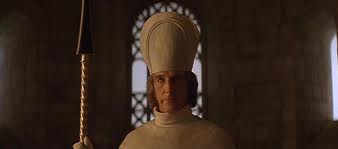 Ladyhawke also has its fair share of good action. Considering Donner's bad feelings towards Richard Lester (who can blame him?), it is ironic that his action sequences, in this film at least, take after Lester's finest work in The Three and Four Musketeers. The fight scenes have some pretty inventive slapstick and Broderick doing all manner of acrobatics, while Hauer gets to swashbuckle and head-butt to his heart's content. The highlight comes in the climactic fight in the church, ending with Hauer throwing his huge sword over several yards right into the heart of John Wood's scenery-chewing Bishop.
 Ladyhawke may not have aged as well as Flesh & Blood or Legend, but it remains a definite guilty pleasure and a bona fide cult film. Its flaws are all in plain sight - the soundtrack, the silly plot, the special effects - and yet none of them can completely eclipse the sheer enjoyment that it brings. If anything these flaws serve to make it more endearing, and more fun than mainstream fare like Robin Hood: Prince of Thieves. Donner would make more consistent features after this, but for pure and simple fun it takes some beating.
Rating: 
Verdict: Silly but sublimely entertaining
Wings of Desire (Germany, 1987)
Directed by Wim Wenders
Starring Bruno Ganz, Solveig Dommartin, Otto Sander, Curt Bois
In my review of The Lovely Bones, I wrote about the difficulties associated with depicting the afterlife on screen. The select group of films which manage to pull it off take one of two approaches: either they approach the subject in a manner which is fantastical but fleeting, or they characterise the next world as mundanely similar to the one we inhabit now. In Wings of Desire Wim Wenders gives us the best of both worlds, resulting on one of the most touching and moving films of the 1980s. Although he only began making documentaries late of his career, Wenders' approach to filmmaking is rooted in key aspects of the documentary tradition. He has the same attitude to people as Lindsay Anderson or Krzysztof Kieslowski: in depicting and recording their actions, he is completely understated and entirely respectful of people as they are. There is a further similarity to the British New Wave in his impressionistic use of voiceover. Not everything that is spoken is subtitled or attributed to a given individual, as in Anderson's short film Every Day Except Christmas, which looks at Covent Garden flower market.
As with the British New Wave, or more recently Terence Davies, Wings of Desire is a film which understands the level of gravitas which can be achieved through shooting in black-and-white. The film is shot by Henri Alekan, who also shot Jean Cocteau's La Belle et La Bête. There is none of the mystical manipulation of shadows from that film, but the film picks up on every wrinkle and slight smile on the actors' faces. The evocative and deeply elegiac visuals were achieved by rather unusual methods; Alekan draped an antique silk stocking over the camera to act as a peculiar filter. The central idea of Wings of Desire is that of angels wanting to be human. Damiel, played beautifully by Bruno Ganz, spends the film yearning to experience mortality - not as a path towards death, but as the physical sensation of being. He has long speeches in which he lists actions which seem trivial or odd to us as if they were the most valuable commodities in the universe. His love and affection for humanity is matched only by his desire to understand it, and becoming human is a way of manifesting or achieving both.
 In this intriguing premise, Wings of Desire takes a very interesting position on spirituality. In the first instance, it inverts or subverts people's impressions of heaven. The traditional worldview, upheld by much of Christianity, is that life is full of hardship and suffering, but when we get to heaven all such suffering will be allayed and we will understand what life was all about.
 But in the black-and-white world which they inhabit, it is the angels who are suffering or cursed, as they stand frustrated by their shadowy essence and perplexed as they attempt to unravel human existence. The people, meanwhile, while not permanently ecstatic or without worry, are more or less content within themselves. They have contentment even if they cannot explain or vocalise it - or if, in the case of the trapeze artist, contentment is to be found in loneliness.
 Following in the tradition of A Matter of Life and Death, Wenders shoots the scenes involving the angels in black-and-white while keeping the rest of the world in colour. In a subversion of 1 Corinthians, the angels' view of life is like a "poor reflection" of what life really is, and their striving towards reality is played out on one level like a detective story. Early on there is a scene of Damiel and Cassiel sitting in a car swapping notes like detectives on a stakeout. They invoke Philip Marlowe (Raymond Chandler's protagonist) and list random observations which seem completely unconnected, like clues in a case which seems impossible to solve.
 There is a further echo of this in the role of Nick Cave and the Bad Seeds. Near the beginning of the film the trapeze artist plays an LP of 'The Carny', which is followed by a performance in black-and-white by fictional band Crime and the City, whose singer writhes around like a young Nick Cave. Towards the end, the Bad Seeds themselves turn up in colour with Nick Cave singing in full voice. Guitarist Mick Harvey appears in both line-ups, reinforcing the theme of poor reflections. In an unusual blend of Christianity and humanism, we hear reality at the expense of seeing it, then we see the imitation as seen by the angels, and when Damiel is made human, we arrive at reality with all of our senses.
 A related aspect of the relationship between the earthly and the ethereal is found in Peter Falk's character, an actor playing an investigator in the film-within-a-film. Aside from his improvised conversations on the movie set, and his various 'private' thoughts about the part, Falk gets a couple of scenes at diners where Bruno Ganz is in attendance. On both occasions Falk uses the line, "I can't see you but I know you're there", and Ganz gives a slight, welcoming smile.
 There are three possible interpretations of these scenes. The first is that it is all coincidence; Falk is simply rehearsing a line and Ganz just happened to be there and think he was referring to him, as when someone remarks about seeing an angel at the circus. The second is that he really can see Ganz and is 'in on the joke', being a former angel himself: we don't know enough about him to rule this out, but there's not much evidence for this either. The third, and most poignant, is that Falk isn't sure whether or not someone is there - but he wants there to be; the possibility reassures him and brings a sense of peace.
 This last point hints to the second spiritual dimension of Wings of Desire, namely the role of angels and whether or not God actively intervenes in humanity. Instead of being active agents of God, the angels are there as observers to document humanity - hence why so much of their time is spend in libraries, soaking up the wisdom which Men have accumulated. They cannot stop death or heal the sick, and their actions do not always lead to positive outcomes. When Cassiel lays his hands on a man, the man's next action is to jump off a ledge, and both he and Damiel are tormented at being able to hear people's thoughts and do nothing to change them.
 But as with Falk's character, the people in Wings of Desire ultimately find solace in the knowledge that there are forces watching over them. There is a recurring image of the angels placing hands on people - not to heal or comfort, but just to acknowledge the person's presence and that they matter in the eyes of God. Even if the Almighty isn't constantly making Himself known, His presence is a force which sustains us - it makes us feel good to be alive, even if we cannot explain why.
The romance between Damiel and Marion is a beautiful counterpoint which ties all these elements together. There is the mutual irony of their predicaments: one is an angel who longs for earth, the other a performer whose profession sends her heavenward but for whom heaven is always out of reach. The scene where they meet in the bar and fall in love finds the two players meeting in the middle and sharing both worlds in a love that will last beyond the boundaries of this life. The dialogue, although rambling, has a real poetry to it which brings a sense of grandeur to what could be a very trite encounter. Wings of Desire is a beautiful, profound and deeply affecting film which remains one of the best films of the 1980s and a high point in Wenders' career. It is too long, with a very rambling structure, and the dialogue can sometimes be too artsy-fartsy for its own good. But those are miniscule flaws which are easily overlooked, in view of what remains an overwhelming experience.
Rating:
Verdict: A beautiful and deeply moving experience
Nausicaa of the Valley of the Wind (Japan, 1984)
Directed by Hayao Miyazaki
Starring Sumi Shimamoto, Goro Naya, Ichiro Nagai, Hisako Kyoda
No-one could ever accuse Hayao Miyazaki of aiming low. His second full-length feature, Nausicaa of the Valley of the Wind, is a hugely ambitious epic combining environmentalism, gender politics and the respective ethics of war and pacifism. And while like so many epics it is ultimately loose and sprawling, it contains all the classic ingredients which have made him the godfather of modern Japanese animation. The first and most obvious of these ingredients is the animation itself. Although it might not have the bright, glossy sheen of Miyazaki's more recent offerings, there can be no denying that Nausicaa looks fantastic. The detail in every frame is immaculate, accurately capturing every changing hue in the ohmu's eyes or every strand of the princess' billowing hair. The colour scheme blends pale pastel shades for the Valley of the Wind with the ethereal blues of the underground forest and the sharper, more metallic tones of the ohmu and aeroplanes.
 What makes Miyazaki's animation distinctive is his ability to make the beautiful seem creepy and vice versa without any real change in physical composition. What we initially view as being inherently malicious or horrid (like the charging ohmu) eventually reveal themselves as being good-natured, albeit easily led. Likewise when the Tolmekians arrive, their advanced technology and regal uniforms lead them to appear benevolent and civilised. But long before the Giant Warrior has been prematurely raised, we understand where their loyalties and intentions truly lie.
 There are a number of through-lines in Nausicaa to Miyazaki's later, better works. As in Princess Mononoke, the central protagonist is a woman who defies traditional gender roles, a pacifist who hates bloodshed but is willing to fight to the death to protect her people. Both films also feature a domineering matriarch seeking to use the power of ancient gods for world domination. And like Porco Rosso, the film sees Miyazaki playing out his obsession with flight, giving us amazing flying machines and jet-powered gliders whose designs are enough to take one's breath away.
 Like so much of Miyazaki's work, there are clear hints of Western film and literature in the story and characters of Nausicaa. But where later works would draw heavily on Alice in Wonderland or The Wizard of Oz, the biggest influence in this case is the original Star Wars trilogy. The opening section, with Nausicaa wandering through the murky forest in her strange mask, recalls the mynocks sequence in The Empire Strikes Back. The design of the Pejitan ship bears a striking resemblance to Jabba's cruise vessel during the sarlacc scenes in Return of the Jedi. And Lady Kushana, with her high neckbrace and bionic limbs, is a clear stand-in for Darth Vader.
 Despite these prominent overtones of space opera, Nausicaa is much less Star Wars than Silent Running when it comes to its themes and substance. The film is a brilliantly subtle look at environmental politics and the human impact on nature. Aside from making more general points about the need for humans and nature to live side by side and depend upon each other, it insightfully comments on Man's ability to misinterpret His surroundings in a way which is calamitous for both sides.
The thrust of Nausicaa is not so much that humans exploit their surroundings, but that they misunderstand them. The film makes no bones about humans being the cause of the Sea of Decay, but it doesn't simply condemn the existing foundations of civilisation and lay out an unrealistic alternative. On the one hand, we are shown that none of the races in this future are safe from the Sea of Decay: even the Valley of the Wind, with its seeming harmony and economy of nature, is rooted in the same toxic soil that covers the whole earth. On the other hand, there is the underground, non-toxic forest in the middle of the Sea of Decay. This symbolises the ability in nature and in humans for something good to come out of the most evil and toxic of places. The film argues that the means of judgement humans employ and the attitudes they take in doing so are every bit as important as the actual actions they take. The problem is not humans using or developing technology, whether windmills or weapons; it is the ends which they serve and the methods of thinking which such decisions cultivate. Lady Kushana's attempts to use the Giant Warrior to fight off the ohmu and the Sea of Decay may be motivated by moral reasons, at least initially. But her efforts are ultimately in vain because they become driven not only by selfish political gain but an ignorance of the true nature of the environment and the insects that inhabit it.
 Although the film is set in a post-apocalyptic future, the culture of Nausicaa is a blend of mediaeval and modern in terms of its design. The film counterpoints the sedentary lifestyle of the peasant communities in the Valley of the Wind with the WWI-like uniforms worn by the Tolmekian army. In addition to the universal environmental issues facing humanity, we have societies progressing through different stages of economic development, and their attitudes towards their surroundings change. Those in the Valley of the Wind utilise nature without manipulating it, while the Tolmekians use their planes and weapons to brush aside any aspect which opposes them.
In amongst all this cutting social and political analysis, we have a series of believable relationships which anchor the themes of the film. The 'romance' between Princess Nausicaa and Asbel never feels contrived and does not follow the predictable course of the male and female protagonists in other such films (Ferngully especially). Like all Miyazaki's works there is an inherent respect for both woman and the elderly, both of whom demonstrate their resilience and usefulness at key points in the storyline. The supporting cast are all believable, with even the smallest of characters feeling or at least appearing distinctive. There are, a couple of flaws with Nausicaa, one contextual and one general. The contextual flaw is the soundtrack, which comprises keyboard or synth-based dance pop that never gels with the main action sequences. Rather like Giorgio Moroder's restructuring of Metropolis, the addition of 1980s keyboard instrumentals to the flying sequences detracts from what we are seeing rather than enhance it, and this is is the one aspect of Nausicaa that hasn't dated well.
 The more general complaint is one of narrative structure. In the last half hour the film is cutting between so many different aspects of the final confrontation that the plot becomes a bit too much of a jumble. We can just about follow what is going on, but we have to balance so much that all the potentially impressive sequences sort of pass us by. The death of the Giant Warrior, which resembles Ctuhlu from the work of H. P. Lovecraft, is only on screen for a couple of minutes, and its death seems rather too hasty considering the huge amount of build-up.
 Nausicaa of the Valley of the Wind is a very good, brilliantly-made film which hints at the future greatness of Miyazaki as both a storyteller and animator. Despite its narrative shortcomings and dated soundtrack, it is every bit as visually ravishing as it was 27 years ago, and its thematic richness is plain for all to see. It's not Princess Mononoke, or Spirited Away, but it is an entertaining and enlightening introduction to a truly magical career.
Rating: 4/5
Verdict: Sprawling yet satisfying
Alice in Wonderland (USA, 2010)
Directed by Tim Burton
Starring Mia Wasikowska, Johnny Depp, Helena Bonham Carter, Crispin Glover
There's been a lot of nonsense written about Tim Burton in the past few months. Way in advance of Alice in Wonderland's release, detractors from all sides were bemoaning his supposed decline, accusing him of everything from selling out to never being any good in the first place.
In the face of this huge backlash, most of it unwarranted and much of it stupid, I wanted to be the one to stand up for Tim Burton. After all, his last three films - Big Fish, Charlie and the Chocolate Factory and Sweeney Todd - have all been great, and the latter is on a par with his masterpiece Ed Wood. But all good things must come to an end, and in the case of Alice in Wonderland the end is quite a bitter one.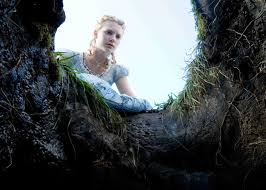 What makes Alice in Wonderland so depressing is that there is so much potential within both the story and Burton's approach to it. Both the original novels are about the role of childhood fantasies in preparing one for the traumas of adult life. The heroine is an outsider who doesn't fit into the world being designed for her - she is a classic Burton protagonist in the manner of Winona Ryder in Edward Scissorhands. And considering his knack for creating dark and exuberant visual worlds, Burton would seem the ideal choice for the drug-induced majesty of Lewis Carroll.
But in spite of all the good omens, the finished product is as banal and directionless as Terry Gilliam's The Brothers Grimm. Both films appear on the surface to be the directors' dream project, considering Gilliam's fascination with fairy tales which stretches back to Jabberwocky. But both Grimm and Alice are clear examples of an artistic, distinctive and often mad director having their visions suppressed or suffocated in favour of a bloated and anodyne mainstream blockbuster. For starters, the script for Alice in Wonderland is little short of pathetic. Its relationship to Carroll's works is at best stand-offish and at worst completely patronising - it borrows famous lines (like the Mad Hatter's riddle) and then rephrases them in such a way that sucks all the fun and insanity out. This becomes all the more shocking when we discover it's written by Linda Woolverton, who wrote Beauty and the Beast and co-wrote The Lion King. How could someone who made her name retuning fairy tales for family audiences have got this one so damn wrong?
 The biggest crime of the script, however, is not its contempt for Carroll's language. The biggest crime is that all the central ideas of both the novels and Burton's work are swiftly trampled underfoot, in favour of something a lot more generic and predictable. All the ideas about Alice being independent are quickly overruled by the central plot involving the compendium: one cannot be independent if your destiny is predetermined. In the face of this revelation, Alice as a character descends into the very thing that Burton sought to avoid: despite the best efforts of Mia Wasikowska, she comes across as little more than a sniffy, spoilt brat.
 The central plot of this 'reimagining' of Alice is also massively derivative. The idea of a plot built around the poem 'Jabberwocky' was handled, albeit unevenly, in the Gilliam film, while having Alice re-enter the fantasy world of her youth is a blatant rip-off of The Chronicles of Narnia. Then there is the design of the White Queen's castle, which looks like a cross between Lothlorien and Minas Tirith, and various elements lifted from the Harry Potter saga - the final battle on the chess board recalls The Philosopher's Stone, while the design and defeat of the bandersnatch owes something to the basilisk in Chamber of Secrets.
 The problem with all these derivative details is that the twisted, quirky and often creepy darkness of Burton's work can't get a word in edgeways. Despite occasional design elements which are quintessential Burton, this has none of the strange whimsy of the original Disney version, nor the haunting and absurdist quality of Jonathan Miller's take. There are also very few attempts to address how Wonderland (or Under-land) has changed since Alice left: we get a flashback sequence with a village being burned, but not much else. Even when the characters become fractured, like the Mad Hatter changing accents, it's played as a gimmick instead of a lead-in to something more substantial.
What we end up with is a film with all the structure and balance of a rollercoaster. The script keeps hurling us in four different directions, and we can't stop for more than two minutes without something exploding or being hurled at the screen. The film never quietens down for long enough to let the story work on its own terms, and with the exception of The Cheshire Cat (voiced by Stephen Fry), the characters rarely resemble anything more than one-trick ponies. This is the legacy of Pirates of the Caribbean, producing a film which even at 108 minutes feels bloated, baggy and boring. Then there is the 3D to consider. Many individual shots in Alice in Wonderland seem to have been designed solely for the 3D version - something that is obvious even when watching in 2D. The extended sequence of Alice falling down the rabbit hole, or the Mad Hatter's flying drapes, or even the floating Cheshire Cat, add nothing to the story and feel bolted on, much like the 3D itself: the film was shot against green-screen and then retro-fitted in post-production. The experience of shooting so much in green-screen actually made several of the actors nauseous, and there are endless examples in the finished film of mismatched eye-lines and bad continuity, of the kind that you thought only George Lucas was capable of doing.
 The role of CGI in the composition of special effects hints at the major deficiency in Burton's visual approach. When he was making his early films with entirely mechanical effects, there was always a feeling in the back of one's mind that the limitations of animatronics and make-up meant that only so much of his unique vision was finding its way out of his head and onto the screen. As the role of CGI has grown in harmony with organic effects, more and more of Burton's designs have been physical realised in a way which was both elaborate and believable. But Alice in Wonderland relies so heavily on CGI that it comes to resemble the heaven sequences in The Lovely Bones: there is the same sense of a world of many mismatched parts, whose logic and composition are being made up as its director goes along.
 On top of all that, we have a number of plot holes to digest. We readily accept that Alice can change size by eating cakes and drinking from bottles, but why don't her clothes change size with her, for decency's sake if nothing else? Why does the Bandersnatch change sides so readily having previously given Alice a nasty wound? Why does the Mad Hatter speak in a Scottish accent at carefully selected moments? And why, if Crispin Glover's knave had his eye on the throne all along, did he wait until he was being banished to try and kill the Queen?
 Alice in Wonderland is Burton's biggest failure since Mars Attacks!. The debate is not so much whether the film is any good, as to how much of the end product is his fault. In spite of everything there are moments in which his true colours shine through: certain scenes with the Red Queen or Cheshire Cat spring to mind. Burton has been known to bounce back quickly, having followed Mars Attacks! with Sleepy Hollow and Planet of the Apes with Big Fish. But he will have to work twice as hard to prevent this obvious blip from becoming the start of his epitaph.
Rating: 1/5
Verdict: A soul-crushing experience
Heartless (UK, 2010)
Directed by Philip Ridley
Starring Jim Sturgess, Noel Clarke, Clemence Poesy, Joseph Mawle
With the exception of John Landis, Stanley Kubrick and Terrence Malick, there are few directors who can go more than ten years between films and still deliver the magic. But now Philip Ridley can be added to that illustrious list with Heartless, which comes fifteen years after his mesmerising fairy tale, The Passion of Darkly Noon. It doesn't take long to realise that Heartless is something very special. Its visuals are superb, capturing the East End of London as something both gritty and fantastical - think Michael Powell meets Kidulthood by way of Guillermo Del Toro. The familiar shots of council estates, graffiti and street lamps are married to eerie backstreets, dark alleyways and a blood-red sunrise, as if the natural and the supernatural were intertwined in a dance of death. But it's not just the streets that ripple with the unreal: Papa B's flat in a disused tower block resembles the Pale Man's dining room in Pan's Labyrinth.
 Heartless is a film in which fantasy and reality violently collide, in which demons and the forces of evil are not just coexisting with real life, but infiltrating and manipulating it. The film owes a great debt to the story of Faustus, with Joseph Mawle's sepulchral Papa B standing in for the Devil and a dead-pan, no-nonsense Eddy Marsden channelling Mephistopheles as Weapons Man.
 But although it shares the central premise and morals of Faustus - you can do anything you like, but be careful what you wish for - the film departs from the legend in the precise relationship between the Devil and his eventual prey. Jamie, played brilliantly by Jim Sturgess, does not inherit or possess any of the palpable magic that Faustus does when he signs over his soul. In fact, he gets much more of a rum deal, becoming as much a victim as everyone around him. Rather than being able to channel demonic power to live his life the way he wants, his life is at the mercy of chaos, and through his life the Devil's aim of greater horror and panic becomes reality.
 Heartless is suffused with Ridley's trademark blend of religious allegory and fairy tales, a combination that is every bit as seamless as the visual marriage of magic and grittiness. As a genre piece, the film is an interesting pairing of the streetwise dialogue of Kidulthood (a fair comparison considering the presence of Noel Clarke) with the more poetic sensibilities of Guillermo Del Toro or Clive Barker. It begins unevenly as all these unlikely elements struggle to weave together, but it doesn't take long for the effect to become hypnotic.
Because of its links to horror artists and directors, Heartless references a number of individual horror films; Ridley takes the various touches which crop up and re-forges them into something new. The character of She, a heavily tattooed gangster with a claw for one hand, hints back to the killer in Candyman: as in both Clive Barker's story and the film by Bernard Rose, the character is either the physical vessel of some supernatural evil or one of the keys to determine where the characters' sanity lies. There are also strong references to A Nightmare on Elm Street, particularly the Freddie Krueger slashes across AJ's chest and the scenes of Jamie being hurled violently against the ceiling by an unseen evil. But by far the closest companion to Heartless is Ridley's previous film, The Passion of Darkly Noon. Both revolve around central characters with a deeply warped view of the world: Darkly Noon is a young man indoctrinated into a fundamentalist Christian cult, and Jamie is implied to have a history of mental illness. Christian imagery is prominent in both films: Jamie's house is full of icons belonging to his late mother, and in Papa B's flat the lampshades on the walls cast shadows resembling the shape of a cross.
Both Heartless and The Passion of Darkly Noon begin on relatively realistic ground and then pull us headlong into a terrifying world which is equal parts fairy tale, horror and fantasy. In the case of Darkly Noon (featuring a career-best performance by Brendan Fraser), what starts off as a story about indoctrination and a blinkered worldview that stunts development turns into a Grimm's fairy tale about sex, witchcraft and a climactic clash of ideals which is worthy of The Wicker Man. We begin believing that one side is deluded, then the other side, until eventually we don't know who to trust and have to just lose ourselves in it. While Heartless never quite reaches the levels of transcendent, euphoric terror which Ridley achieved there, Jamie doesn't exactly make it easy for us. There are any number of terrifying, earth-shattering moments which will make even the seasoned horror fun curl into the foetal position and pray for it to end.
The most terrifying of these comes where Jamie has to stab a male prostitute and cut out his heart while he is still alive. Having chosen his victim and brought him back to his flat, Jamie reluctantly wraps him in cling-film in what his victim perceives to be an elaborate homosexual ritual. When Jim Sturgess pulls out the knife and we hear the hooker's muffled screams, we are thrust right into the horror that character is experiencing; we tense up and start to panic, desperate to escape and yet knowing we can't look away. Scenes like this are cleverly counterpointed by imagery which occurs earlier in the film. The precise demands placed upon Jamie regarding the nature of the murder are a symbol of his own status: he must cut out the heart of another, for he no longer has a heart himself. While he is more than capable of physical or erotic love, his desire for friendship and platonic love is ebbing away. The cling-filming is counterpointed by the beautiful moment of Jamie emerging from the cocoon of his own burnt flesh, with his heart-shaped birthmark nowhere to be seen.
 One of the key images in Heartless is that of fire and immolation. Ridley shoots flame like another character, with its own personality and powers. Just as there is a double meaning to hearts in the film, so fire is the means of both our hero's transformation and destruction. When Papa B hands him the Molotov cocktail and Jamie sets himself alight, the fire is cleansing him of his old self, like a furnace removing impurities from metal. But in the final scene, fire becomes the means to briefly reunite with his dead father - only in destruction does Jamie realise what he truly wanted and whom he truly loved.
 The one real flaw with Heartless is its big final twist, in which we are shown what was real and what was not. On the one hand, it works brilliantly, with all the different parties corresponding to figures in the real world, and it does deliver a sucker punch as we realise what Jamie has actually done. But there's still something unsatisfying about it in the same way that Shutter Island was unsatisfying. Because of the way the film is played, it has to come down on one side or the other, when as with Scorsese's work the more radical and haunting choice would have been to leave us hanging.
 Despite this quibble, Heartless is a truly great film and a welcome return to the big screen for Philip Ridley. While it never quite lives up to The Passion of Darkly Noon, it is a really stunning piece of work with haunting visuals and brilliant performances. Jim Sturgess excels in the central role, amply supported by gripping turns from Noel Clarke and Joseph Mawle, whose scene together on the rooftop is really harrowing. One only hopes we don't have to wait another 15 years for Ridley to return to our screens.
Rating: 4.5/5
Verdict: Mesmerising, magical, macabre and memorable


