
Reflections
-
It is weird to read my correspondences from the late August/early September
period, being the time of transition between my old function in life to my
new ...
14 years ago
Dances with Wolves (USA, 1990)
Directed by Kevin Costner
Starring Kevin Costner, Mary McDonnell, Graham Greene, Rodney A. Grant
It may be a clichéd complaint, but more often than not the Academy has got the Best Picture Oscar dead wrong. Sometimes, as with Crash, their mistake is obvious and the outcry is instant; on other occasions, as with Citizen Kane, both the Academy and the public have taken time to see the error of their ways. And then we have Dances with Wolves, which beat Goodfellas to the big gong to deny Martin Scorsese his Oscar for a third time. While not as crass a mistake as the others, time has not been kind to Kevin Costner's debut, which now seems long on principle but short on actual story. The obvious way to prey on Dances with Wolves would be to attack Costner's subsequent career. His later efforts behind the camera have left a lot to be desired, with Waterworld running hugely over budget and The Postman being the dictionary definition of tedious. His acting style and drawling delivery suggest a man who takes himself far too seriously, rivalling only Nicolas Cage for stony-faced absurdity. But a quick glance at his back catalogue reveals a slightly more complicated picture. Lest we forget, Costner was once an admired and popular actor, who acquitted himself perfectly well in No Way Out, The Untouchables and Field of Dreams. And for all the gaping flaws in his directorial efforts, you could never accuse him of going in with anything but the very best intentions.
 The most obvious quality of Dances with Wolves is that it is very even-handed towards its subject matter. It approaches the relationship between Native Americans and American soldiers with the same restraint and intelligence that Clint Eastwood applied to the subject of revenge in Unforgiven. There has clearly been a lot of effort expended by Costner and the writer Michael Blake to get away from the clichéd depiction of Native Americans as a backward, violent people, who deserved everything they got from the brave, civilised white men driving them off the land in the name of God and Progress.
 You also have to applaud Costner's ambition as a director. There are few actors, let alone big stars, who would have taken on such a big project first time out. Costner was shooting in mostly external locations for four months, including several elaborate sequences with hundreds of real horses and buffalo. His commitment was such that he nearly broke his back from doing his own stunts, and stumped up over $3m of his own money to cover the costs incurred by bad weather. Costner was prepared to take risks with Dances with Wolves, and that deserves praise regardless of whether the film works or not.
 A further point of admiration comes in Costner's decision to have much of the dialogue spoken in the Lakota language. The fact that the film grossed more than $400m worldwide, and $184m domestically, is a massive raspberry to the notion that Western audiences won't pay to watch films that aren't in the English language. But it also proves that the respect for the different cultures within the film is genuine, not just a device for boosting Costner's artistic standing. This remains the case even after Russell Means pointed out the flawed translations, which left all the men in the film speaking in the female Sioux dialect.
 In terms of the admiration it generates, Dances with Wolves is in the same league as Battle of Britain in terms of pure good will. But like Battle of Britain, this admiration does not guarantee good drama, and little by little Costner's film begins to look earnest to the point of being dul. It ends up stuck halfway between Unforgiven and Heaven's Gate, being neither as gripping nor elegiac as the former, nor as wretchedly pretentious as the latter. It never becomes as well-meaningly dull as Battle of Britain, but its flaws in terms of pacing and emotion cannot help but prey on our minds.
 The first 45 minutes of Dances with Wolves are very slow and very portentous. Costner is clearly pulling out all the stops to make us admire and believe in the character of John Dunbar, but he ends up both trying too hard and not enough. The opening battle sequence features Costner attempting suicide by riding straight at the Confederate front line with his arms held out in a messianic pose - a decision which results in sniggers or sneers rather than feelings of empathy. In the various scenes that follow, where Dunbar is sent out to the frontier, too much effort is expended trying to express his bravery and not enough made on showing him as a rounded human being.
 When I reviewed (500) Days of Summer, I argued that the presence of a narrator in any kind of film creates an element of certainty which can sometimes work against dramatic tension. In the case of Dances with Wolves, one could argue it is necessary since the diary is integral to the later stages of the plot. But while it is partially justified on a narrative level, Costner's delivery of it is frankly third-rate. His readings feel rushed and increasingly desperate, as he tries to convey the gravity of the situation without much success.
 The narration aside, there is precious little about Dances with Wolves which is rushed. At just over 3 hours long (4 hours in its Director's Cut), comparisons with Heaven's Gate are unavoidable; the project was even nicknamed 'Kevin's Gate' after the production delays were leaked to the press. Costner's film is nowhere near as baggy as Heaven's Gate, let alone as self-serving, but it is every bit as drawn out, especially in its final act. Had Kevin gone through with a pair of scissors and lost even 30 seconds from every scene, it would have made a world of difference.
 The biggest problem with Dances with Wolves is that it constantly tells us how important the events are without doing enough to show us why this is the case. There are many beautiful or poignant images throughout, from the hundreds of dead buffalo lying on the plains to the couple's departure from the winter camp. But these images don't carry the weight that they should because we haven't invested enough in the characters to make them any more than pretty compositions.
 The film is so respectful towards the Sioux that it is almost hesitant to scratch the surface and ask the difficult questions about how their society works, such as the relationship between fathers and sons, and the position of women. This is understandable up to a point, considering the negative depiction of Native Americans in Hollywood throughout the 20th century - a fact which, if you believe Marlon Brando, led him to turn down his second Oscar. But you would think that if Costner were brave enough to embark on something of such scale and ambition, the last thing he would be worried about was mildly offending people.
 Fortunately, the film does pick up after the first 45 minutes and has moments where the action and characters do take flight. Many of these scenes find Costner willing to let his hair down, whether it's dancing with Two Socks around the camp fire or giving audiences a clear view of his naked bottom. It is hard not to get swept up in the chases scene across the plains, diligently matched by John Barry's stirring score. And some of the lighter moments within the camp help us to relax as well; when Dunbar interrupts Kicking Bird's nearby lovemaking, Graham Greene's facial expression says it all.
 The romantic aspect of Dances with Wolves is well-played for an epic, if only because the central relationship develops at a reasonable rate. We don't get that agonising sensation as in Out of Africa, where we know the characters are meant to kiss and are begging them to get on with it. The scenes of Stands with a Fist interpreting between Dunbar and Kicking Bird are well-played, serving their purpose while conveying the sexual tension between the characters. Their relationship conveys the conflicted identity of the central characters and the possibility of future harmony between the nations.
 Dances with Wolves is ultimately a very middling film. It's too long to adequately serve its story, but not so long that we lose all patience with it. Its respect for its characters undercuts the drama, but not to the extent that we sit there drifting into a coma. And its direction is uninvolving, but not in an artsy, egotistical way. Calling it an average or ordinary film is to belie Costner's ambition, but any higher praise is impossible in light of its flaws. It remains significant but not stirring, admirable but not engaging, important but not profound.
Rating: 
Verdict: Admirable but not always engaging
La Haine (France, 1995)
Directed by Mathieu Kassovitz
Starring Vincent Kassel, Hubert Kounde, Said Taghmoudi, Abdul Ahmed Ghili
Whenever French cinema comes up in conversation, it's very easy to be dismissive. Quite apart from their artistic legacy within the medium, Jean-Luc Godard and others within the nouvelle vague have created a stereotype of French cinema - namely as something slow, pompous, and with little bearing on reality. Even if these attributes are not remotely accurate, they persist to such an extent that we treat any exception to them with great surprise. And there is no greater exception than La Haine, a positively incendiary film which proves that there is more to French cinema than staring soulfully into middle distance. La Haine is the debut feature from Mathieu Kassovitz, whose subsequent career has left a lot to be desired. While he has been pretty consistent in front of the camera, with supporting roles in Amelie and The Fifth Element, his directorial work has been at best erratic. After seeing this film, you would never have predicted that such a talented observer of human behaviour would end up helming something as deeply derivative as Gothika. But putting that aside, his debut is remarkable both in its socio-political analysis and as a very visceral piece of filmmaking.
 Realist cinema has always had an ability to shock audiences, either by pushing the envelope of what can be shown on screen, or by tackling subjects which were deemed 'unsuitable' or 'inappropriate' but which form integral parts of our social fabric, for good or ill. When Saturday Night and Sunday Morning was first released in 1960, it was given an X certificate; when reclassified it in 2002, it got a PG. This was not because the film has become tame with the passage of time, or conversely because society has gone rapidly downhill. It is because the film was such a radical departure from the expectations of the public and in particular the censors; not knowing how to react, they made sure that relatively few people saw Karel Reisz' film the first time round.
 There is a close comparison with Saturday Night and Sunday Morning in the structure of La Haine and in its depiction of the misery of urban life. Both films are set around the actions of a close-knit group of characters over a short period of time, in this case a single day. The world of La Haine is much more angular and masculine, with the characters having very little time for women socially, and the humour is quite a lot darker. But the films do share a central theme of characters being trapped in the underclass, and being deeply unsure of their place in society in spite of all their posturing.
 Vinz, Said and Hubert go about their business with a conflicted sense of ambivalence about the world around them. On the one hand, they are desperate to get out of the banlieues by whatever means: Hubert wants to move away, while Vinz talks about killing policemen, as if being sent down for life is better than living there for another day. On the other hand, the close affinity between the characters, the confidence they exude, and the sheer number of contacts they have, give the impression of people being embedded within a culture or community, with a fear of outsiders which is as strong as the fear people have towards them.
 La Haine has a very convincing verité style which embeds us in the world of the characters. The opening credits contain documentary footage of Paris rioting between 1986 and 1996; the film was made during the tail end of these riots, and is dedicated to all those who perished in them while it was being made. The dramatic sections are shot in the same hue of black-and-white as the opening footage, creating a smooth transition from the general picture into this specific story.
 This approach works so well that we find ourselves asking exactly the kind of questions we should with this kind of film. How much of what we are saying is real? Where does reality end and the acting begin? Where, if anywhere, does the director's creative license enter the fray? When we actually sit down and think about it, in terms of the camera always being in an ideal position at the exact time of the action, such questions do become a little redundant. But the fact that we ask them at all, and for so long, is a validation of the film's approach.
 Not only is La Haine very realistic, it is also deeply cine-literate. Some of the references are upfront, such as Vincent Cassel recreating a scene from Taxi Driver in front of a mirror, and the film's meticulous approach to realism and use of non-professional actors looks back to The Battle of Algiers. But others are more thinly-veiled, or at least open to degrees of interpretation. The scene where a rap DJ plays music out of his window, and the camera pans over the open spaces between the buildings, is like an ironic rendering of the scene in The Shawshank Redemption where Andy DuFresne treats his fellow inmates to an opera record.
 La Haine explores hatred between individuals and groups of people in a variety of interesting ways. On one level it is a film about racism, depicting a society dominated by white, 'respectable' people who have little or no idea about what goes on the poorer areas of town. The make-up of the central trio - one Black, one Jewish, one Arabic - reflects three groups which have traditionally been the subject of discrimination and exploitation in France (the latter being a further connection with The Battle of Algiers). Because the police force and media are dominated by white people, our three main characters are alienated and made to feel like scapegoats for the country's problems.
 On another level, the film explores class hatred and the general fear of outsiders. In the later stages of the film, the three men wangle their way into an art gallery, where free drink is being given out at the launch of a new exhibition. Said attempts to hit on a couple of women there, telling them that his friends are sensitive and write poetry, but the women see right through them and are quick to dismiss their half-arsed attempts to be 'cultural'. The men respond by smashing up the artwork and swearing profusely as they leave, alienated by the stuck-up attitudes of their fellow countrymen and -women.
 La Haine also explores the possible ethics of violence, and how characters' attitudes change when threatened by or possessing a gun. Early on Vinz reveals that he has found a gun which went missing from a policeman on the night of the riots. Carrying it around in the back of his trousers, he becomes as sociopathic as Travis Bickle, feeling he can take on the world and is willing to die if he takes a few policemen with him. But in the few instances where he gets the chance to use it, he hesitates, being as much of a coward as he claims the police to be. In the end he who lives by the sword dies by the sword, as the film concludes with Vinz being shot in the head at point-blank range.
 The thrust of these three analyses is that in an advanced capitalist society such as France, society is constantly on the brink of descending into civil war. The widening gap between rich and poor, coupled with continuing racial discrimination, has led to rising crime, drug use and anger at the powers-that-be, who talk about help and fair treatment but continue to look down on the banlieues. The film begins and ends with Hubert's story of a man falling from a 50-storey building, repeating the phrase "So far, so good" until he lands. The fall is not important; what is important is what happens when he lands, and how hard he lands.
 There are a couple of problems with La Haine. Although the characters remain engaging throughout the 90 minutes, it can sometimes feel like we are going round in circles; in its weaker sections the film can feel like talking followed by shouting, repeated ad nauseum. Equally problematic is the bizarre scene of the old man who finds the young men in the toilet. He tells a story of him and a friend travelling through Siberia on a train, stopping to defecate off the back of the train and his friend freezing to death. It's a very odd bit of absurdist humour which jars with everything around it.
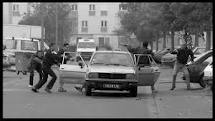 In spite of these small distractions, La Haine is still a very powerful film. Its political and social arguments are still fresh and relevant after 16 years, and Kassovitz' direction is by and large exceptional. It is a shame that, out of the main players, only Vincent Cassel has continued to garner the attention he deserves. But as both a document of a troubled past and a stark warning for the present, La Haine remains essential viewing.
Rating: 
Verdict: A remarkably realistic debut
Bad Lieutenant (USA, 1992)
Directed by Abel Ferrara
Starring Harvey Keitel, Victor Argo, Frankie Thorn, Paul Hipp
Since attracting the wrath of the BBFC with his debut feature Driller Killer, Abel Ferrara has carved out a niche as one of the most difficult and uncompromising filmmakers of our time. His forthright personality off-screen is matched only by the hard-talking, macho nature of his films, which range from the gruesome rape revenge thriller Ms. 45 to the poignant but swaggering China Girl. In Bad Lieutenant, arguably his most audacious work, he gives us a film about guilt, redemption and unbearable human suffering, constructed around one of the greatest performances of the 1990s. Bad Lieutenant is a slow-burning, often thoughtful character study scripted by Zoe Lund, a model-turned-actress who starred in Ms. 45. It follows the tortured lifestyle of an unnamed New York police lieutenant who is deeply in debt to the mob through bets made on a baseball series. On top of his gambling addiction he is also a cocaine and heroin addict, who steals drugs from crime scenes to sell on the street so he can fund his other habit, namely women. In the midst of all this, somehow being able to keep his job, he is assigned to track down two men who have brutally raped a young nun, played by Frankie Thorn.
 For this kind of character to be believable, you need an actor with weight, experience and a threatening screen presence - and no-one meets those criteria better than Harvey Keitel. After a relatively quiet 1980s, Keitel was experiencing a revival with critical plaudits for his work on Thelma and Louise and Bugsy, the latter of which brought him his first (and so far only) Oscar nomination. Around the same time he played Mr. White in Reservoir Dogs, a role popularly perceived as his comeback. But out of the two this is the more remarkable performance, which makes any talk of a 'comeback' seem like damning with faint praise.
 Keitel's performance in Bad Lieutenant is one of the best of his career, up there with his early work on Mean Streets or The Duellists. He truly and painfully inhabits the nameless Lieutenant, giving a performance of such raw, unmitigated honesty that we empathise with him even in his most unspeakable moments. We genuinely feel the torture of the lieutenant as he descends further and further into hell on the streets of New York, faced with both his growing personal problems and a case which is impossible to solve. It's a performance of blood, sweat, tears and God knows what else, and the result is both frightening and heartbreaking.
 In terms of Keitel's back catalogue, the film to which Bad Lieutenant is closest is Taxi Driver. Martin Scorsese has almost admitted this comparison, including Bad Lieutenant on his list of Greatest Films of the 1990s. Both Travis Bickle and the Bad Lieutenant are driven, obsessive loners, who inhabit a world which is drowning in corruption and sin, and whose motivation comes from a desire to fight against the all-engulfing tide. But where Travis is positioned as God's lonely man, the Lieutenant has one foot firmly in hell and only gains complete moral conviction in the final stages of the film.
 Bad Lieutenant is at heart a story of Catholic redemption. Keitel is haunted by the mistakes he has made in the past, and his regrets are tempered by an admittance that it is all his fault. His bets with the mob's bookie become increasingly absurd, so that during the scene in the club the broker advises Keitel that it would be cheaper and easier just to have him killed. The Lieutenant's many years on the streets have made him incapable of forgiving people or understand the grace or mercy of God. When his nieces receive their first communion, he watches from a distance, unable to connect with either the service or the beliefs it upholds.
 There are a number of deeply striking sequences in Bad Lieutenant which convey the seemingly impossible prospect of redemption in the midst of all the horror unfolding on screen. The best and most extraordinary of these comes in the church, where Keitel questions the nun over her refusal to identify the men who raped her. She refuses to identify her attackers on the grounds that her rape raises the prospect of God's grace being bestowed on the two men. After she leaves, Keitel breaks down and see a vision of Christ standing in the church. He crawls along the floor, weeping and wailing, wanting to grasp the mysteries of God and forgiveness but being unable to reconcile that with his own shallow nature. It's an extraordinary scene in which the temporal and spiritual collide in a moment of pure passion and emotion, leaving the character devastated and the audience astonished.
 After coming out of his vision, Keitel manages to track down the two men who raped the nun, but rather than turning them in, he gives them all the money he has and puts them on the first bus out of town. He does so against his better judgement, but even while he berates himself as the bus drives away, he knows in his heart that it was the right thing to do. In these scenes the Lieutenant realises in practice the true grace and compassion of Christ, with his decision mirroring that of the nun; like Thomas in the Gospels, he believes because he has seen. The film ends with the Lieutenant being murdered in his car: what seems like a cruel accident could equally be a blessed release, with the Lieutenant finally reaching heaven having performed God's works here on Earth.
 Because Abel Ferrara started out as a grindhouse director, the spiritual aspects of Bad Lieutenant are not handled in a sugar-coated, airy-fairy way. Instead they come as ecstatic interludes to really brutal scenes involving nudity, violence and copious amounts of swearing, which earned the film an 18 certificate in the UK and a rare NC-17 in the States.
 The film contains several very realistic depictions of drug-taking. Ferrara shoots long, uninterrupted takes in which Keitel meets with his stick-thin dealer, and warms heroin on a spoon with a lighter before injecting it into his arm. In one of the very first scenes, Keitel uses a coke spoon immediately after dropping his young nephews off to school. These scenes are shot in such clinical detail as to make drug-taking about as unglamorous as you can get: as in Requiem for a Dream, the high of taking the drug is cancelled out or overridden by the immediately painful consequences.
 This discipline on Ferrara's part is equally present in the rape scene. Having previously made Ms. 45, Ferrara was well aware of the way such scenes would be structured in a duplicitous way: we almost tolerate the horrible violence because we are on the moral side of the victim and are goading her on to take revenge. But Bad Lieutenant doesn't fall into the kind of hideous duplicity present in I Spit On Your Grave. The rape scene focusses on the emotion of the nun and is intentionally repulsive. To reinforce the Christian element of the story, it is intercut with Christ on the cross, screaming as the nun screams. It's a shocking and original way of conveying the idea of Christ feeling every single pain and sin of mankind as He hung there on Good Friday.
 Most controversial of all is a scene halfway through Bad Lieutenant, in which Keitel pulls over two girls, to find that they are stoned and driving without a license. Rather than turn them in, he asks one of them to strip and the other to mimic oral sex while he masturbates outside the car. James Ferman, then-Head Censor of the BBFC, was asked on several occasions why he didn't cut that scene; he responded that it was so repulsive that no sane person could possibly find it arousing. The scene is repulsive and goes on a little too long, but it does at least reinforce the distance and desperation of the Lieutenant, and arguably a graphic sex scene with girls half his age would be the greater of two evils.
 There are flaws with Bad Lieutenant which prevent it from being a masterpiece. Even as we invest so deeply in Keitel's performance, we can't help wondering why he has been able to stay on the force all this time. He makes next to no effort to cover up his behaviour, and it seems a little far-fetched that even his seasoned colleagues would turn such a blind eye. As the character study deepens, the crime plot becomes almost totally peripheral, and in its weaker moments it can feel like Ferrara is testing our mettle for its own sake, seeing how much nastiness we can take before bringing back the plot to give us relief.
 In the end, however, Bad Lieutenant rises above these flaws as a triumphant example of how exploitation cinema can explore serious ideas, in ways which are often more insightful and frequently more provocative than its mainstream equivalents. Keitel is outstanding in the title role, and Ferrara's direction is both merciless and mesmerising. It's a very tough watch for those not familiar with Ferrara or the traditions he has espoused throughout this career. But for those who can go the distance, it is a deeply moving piece of work.
Rating:
Verdict: Slow-burning, tough and profound
Peeping Tom (UK, 1960)
Directed by Michael Powell
Starring Carl Boehm, Moira Shearer, Anna Massey, Maxine Audley
When looking back on his long career in an interview with The Onion, Robert Altman said that "you tend to love your least successful children the most", saying that he felt more affection for Popeye than for anything critics and audiences embraced, such as Short Cuts or Nashville. One wonders whether Michael Powell would have taken the same view of Peeping Tom, the film which all but destroyed him as a filmmaker. But unlike Popeye, which produces reactions ranging from 'utter rubbish' to 'guilty pleasure', there can be no doubt that Peeping Tom is a blistering masterpiece. You will struggle to find a more audacious, bold, striking and shocking piece of British cinema, at least until the rulebook was re-written by A Clockwork Orange. Coming at the beginning of a decade which would be defined by rebellion against any and every convention, Peeping Tom blazed the trail, stepping into the darkness with a red-hot torch at the cost of setting its own coat-tails on fire.
 Considering that Peeping Tom and Psycho were released within months of each other, you would expect audiences to have flocked to both releases, and for both to become regarded by critics as among the best works of 1960. Aside from their similarities in terms of story and characters, there was very little to separate the prestige of Alfred Hitchcock from that of Michael Powell. While the former was more recognisable in public and was in his commercial prime, the latter had captured audience imaginations during the war years through his work with Emeric Pressburger.
 Sadly for Powell, who was a close friend of Hitchcock's, joint adulation was not to be. While Psycho enjoyed huge box-office success and garnered four Oscar nominations, Peeping Tom was greeted with outright hatred in the British press and quickly disappeared from screens. For the next twenty years the film was seen as an untouchable bête noire, a half-whispered rumour of a once-great man gone mad. It was not until 1979, when Martin Scorsese was asked to remake it, that Peeping Tom began its long rise from the critical sewers to take its place among the all-time greats.
 It would be tempting to blame Peeping Tom's demise on the perceived small-mindedness of 1960s audiences, something seemingly reinforced by the ridiculous reviews which branded it as "evil", "vulgar" and "repellent". But watching the film even 50 years later, you can understand why even the most open-minded people in any age would be shocked by it. On this occasion it is not so much a case of finger-pointing at audiences, as applauding the dangerous (and self-deprecating) vision of a director.
Peeping Tom was made at a time when cinema was still very much focussed around the life and trials of the rich and famous: a time when films were star vehicles with often shamefully predictable plots, consisting of little more than talking, smoking, dancing and kissing (though not always in that order). When Hollywood attempted to tackle difficult subjects, or to interpose itself among the less fortunate, it did so in a way which was often deeply patronising (in the case of My Fair Lady) or which smoothed over any rough edges in a way which made the finished product seem dishonest. The problem wasn't simply that the subject of Peeping Tom was a million miles from the ballet of The Red Shoes or the pilots of A Matter of Life and Death. It was more the way in which prostitutes, sleazy models and above all a serial killer were presented in a way which was not only realistic, but empathetic. The film eschews melodramatic convention, contrasting the showy, frothy acting of the film star (played by Shirley Anne Field) with the considered, naturalistic and more believable performance of Carl Boehm. Proof of this is to be found in the murder of Moira Shearer's character; Powell allows her to perform a flamboyant dance routine, as happens in The Red Shoes, before her dancing days are cut short with a tripod leg and a piercing scream.
 As Scorsese observed, Peeping Tom is like the darker, shiftier cousin of 8 1/2. Both are self-reflexive films about filmmaking and the role of the director, and both feature said director coming in front of the camera (Powell appears in the black-and-white sections as Mark's manipulative father). For Federico Fellini, cinema was inherently a force for good, a place of magic in which the director was a creative genius with noble intentions. But for Powell, in an act of brutal self-deprecation, cinema was a dangerous weapon in the hands of an insane voyeur, who would exploit, manipulate and even kill, just to get the perfect shot.
 In complete contrast to the fairy tale quality of his earlier work, there is very little in Peeping Tom in the way of childlike magic. Film is presented as a medium characterised by darkness and strange noises; Mark's dark room is like a haunted house or Frankenstein's lab, only instead of slamming doors and creaking floorboards, we have the flicking of metal switches and the drip-drip-drip of silver nitrate. Camera and projector hum and whirr like some sinister insect, waiting for the right moment to pounce and claim its victim.
 Having likened filmmaking to murder, Powell then turns the camera on us to show that we are as much a part of this as the director. The film is a breath-taking examination of voyeurism, arguing that the very act of watching a film is voyeuristic. When we pay good money to sit in the dark for two hours, we are devoting our time to watching others who are oblivious to our presence and have no means of defence. We see their lives play out in such detail that we become unwittingly obsessed by them; our psychological relationship is of the same morbid fascination which prompts Mark to make his documentary.
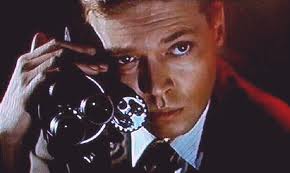 As with Blue Velvet more than twenty years later, this revelation of our role in Peeping Tom produces a reaction combining repulsion and mesmerism; we are shocked, or offended, we cannot look away. But rather than shock us cheaply by showing the murders in graphic detail, Powell leaves the real terror of what is occurring entirely in our minds. Towards the end of the film, Anna Massey discovers the footage of Mark's victims; she watches, being frightened and repulsed - but she keeps watching. The camera tracks her reactions in a long panning shot, which tell us all we need to know about what is happening.
 But even taken outside of all its commentary, Peeping Tom is still terrifying as a pure, full-on horror movie. Carl Boehm's performance is extraordinary, helping to create an immensely compelling character who feels more three-dimensional than Norman Bates. The psychological trauma which Mark suffers could be lazy shorthand, but instead he comes across as a lonely, fractured young man who struggles with himself, something reinforced by the distant, broken quality of his slight Austrian accent.
 The film explores the relationship between love and fear, with Mark wavering between the two as he is caught between the need to complete his documentary and the affections bestowed on him by Helen. We feel so close to Mark that when his doom approaches, we are willing to ignore or forgive his gruesome actions if it would save or redeem him. This is the final savage trick of Peeping Tom which reinforces our position as voyeurs; not only are we drawn to gaze, we impose emotion on people's actions so that even the truly terrifying can seem tragic.
 Peeping Tom is a barnstorming masterpiece which ranks alongside The Red Shoes as Powell's finest achievement. Its psychological complexity and cerebral treatment of its themes are perfectly complimented by Powell's direction, and the whole project is enhanced by Otto Heller's luridly beautiful visuals. It is still as fresh, shocking and truly terrifying as it was over 50 years ago, and in its level of emotional engagement - say it quietly - it's a better film than Psycho. In short, it is compelling, chilling and nothing less than essential viewing.
Rating:
Verdict: A dark, creepy, chilling masterpiece


