
Reflections
-
It is weird to read my correspondences from the late August/early September
period, being the time of transition between my old function in life to my
new ...
14 years ago
Spirited Away (Japan, 2001)
Directed by Hayao Miyazaki
Starring Rumi Hiiragi, Miyu Irino, Mari Natsuki, Bunta Sugawara
When I reviewed Mulholland Drive not so long ago, I commented that it was "one of a very rare breed of films which hold you in such a hypnotic state that your normal critical faculties become temporarily suspended." Films like Lynch's work contain so much of the magic and mystery of cinema that the experience becomes everything, and no matter where it goes, we follow. But this was not the only film from 2001 to achieve such a powerful effect upon its audience. Spirited Away is the culmination of Hayao Miyazaki's extraordinary career, only just edging out over its predecessor, Princess Mononoke. It is a stunningly animated, beautifully told story which reinvents Alice in Wonderland for the 21st century while offering profound insight into Japanese culture and the psychology of growing up. While Princess Mononoke has more ambition in terms of its story, Spirited Away wins out through the sheer power of its emotional appeal.
 On its simplest level, Spirited Away sees Miyazaki returning to the story and themes of Alice of Wonderland, whose influence can be seen throughout the work of Studio Ghibli. But whereas something like The Cat Returns bore only fleeting similarities, the early sections of Spirited Away are like a direct retuning of Lewis Carroll. Instead of sitting on the river bank being bored at her lesson, Chihiro is sullen in the back of the car, cross with her parents for moving house and taking away all her friends. And instead of falling down a rabbit hole, she wanders through a long tunnel which, in a further fairy tale connection, is found in the middle of a deep, dark wood.
As with Alice, Chihiro drifts into the company of many unusual characters, all of whom in some way misinterpret her purpose in this world (assuming of course that she has one). And many individual scenes or characters play out like Miyazaki's own wry take on Carroll's bizarre fantasy. The sequence of the baby being turned into a fat little mouse is like Alice shrinking after sipping the bottle marked 'Drink Me', while No-Face is a spookier version of The Cheshire Cat, and Yubaba and her twin sister Zeniba fill in for the red and white queens from Through The Looking-Glass. But there is so much more to Spirited Away than a join-the-dots parallel with Alice in Wonderland. For starters, Chihiro is not a conventional protagonist, either in her narrative arc or in the extent to which we empathise with her. Instead of immediately bonding with her, like we would with Nausicaa or Kiki, we initially find her an irritating brat; she is cowardly, prone to sulking and stamps her feet when she doesn't get her way.
 When her parents are turned into pigs by gorging themselves on the ghostly food, we bond with Chihiro since she is the only human character remaining in this ever-creepier world (at least, until Haku turns up some minutes later). Much like Pan's Labyrinth a few years later, we adopt the viewpoint of the central character so closely that when the fantasy elements are introduced we accept them with open arms and wide eyes. No matter how bizarre, surreal or downright strange Miyazaki's designs become over the next two hours, we remain totally absorbed in Chihiro as a character.
 Although her overall goal may be to save her parents, Chihiro's arc through Spirited Away is not to be a hero, but to survive. Lost in a world which she has no hope of understanding, she relies on her own judgment in choosing who to trust and when to trust them. She does not enter the world of the gods with the intention of destroying a great villain, with most of her major acts being accidental or having consequences which are unintentional. Sometimes this works out in her favour, in the case of the River God; other times, in the case of No-Face, it almost claims her life.
 Chihiro's search for her parents is both a literal and a metaphorical one, being bound up with the search for her own identity. When Yubaba allows her to work in the bathhouse, she steals Chihiro's name and begins calling her Sen; Haku warns Sen that unless she remembers her own name, she will be trapped here forever. Chihiro came into the ghost world at a crossroads of her own identity, having been forced to part from her old self with the move. The theft of her name represents the death of her childhood self; she must decide what must be erected in its place, and what role her parents must play in her life after she returns to reality.
 Just as in Princess Mononoke, the characters in Spirited Away walk a tightrope between good and evil in which our definitions of either do not carry much weight. This is a world in which loyalties are if not constantly shifting then very difficult to pin down; as before, we have to trust our heroine's judgment because her perspective is all we have to go on. The film tricks us beautifully into believing that the friendly can be threatening or vice versa, making something as simple as a paper man be really scary or an eight-armed, spidery mechanic be deeply endearing.
 This richness and ambiguity make Chihiro's process of self-realisation more compelling, as Miyazaki avoids the painting-by-numbers character development of recent Disney efforts. Her relationship with No-Face in particular is a learning curve in which she learns to adjust her impetuous naivety to something more mature, while retaining her belief in everyone's capacity to do good. Even when No-Face is chasing her while regurgitating black sludge, Sen is motivated less by out-and-out fear than a desire to help him overcome himself even at the cost of her own life. It is this form of sheer selflessness which endears her and which eventually saves her.
 Just as Mulholland Drive used its characters to examine the nature of filmmaking past and present, so the spirit world of Spirited Away reflects modern-day Japan, looking to its imperial past as it drifts ever more away from it. When Chihiro's parents find the town, they remark it must be an old theme park, saying that many were built before the economic downturn in the early-1990s. The gluttony of her parents reflects the consequences of this downturn and the difference between generations, while the scenes with the River God tap into issues of pollution previously explored in Nausicaa of the Valley of the Wind.
 The design of Spirited Away is staggeringly beautiful, incorporating elements of both hand-drawn animation and CG techniques to reinterpret themes from Miyazaki's previous works. There is the same use of rapid background movement in frames, so that whole cities seem to rush by while Chihiro and Haku rush through the streets in perfect clarity. The film is deeply dreamlike in places, particularly the scenes which take place in or around water and which are complimented by the beautiful score by Joe Hasaishi. But Miyazaki is not just a genius where light is concerned; his darker tones are extraordinary too, from the thick sludge spewed forth by No-Face to the fire that spews from Yubaba's mouth.
 On top of everything else, Spirited Away is a proper children's film in its accessible and intelligent treatment of themes and characters. Its blend of darkness and light is note-perfect, so although there are many scenes which are creepy or strange, there is more than enough in the way of humour to compensate. In fact, it's surprisingly laugh-out-loud, with the bouncing heads, the balls of soot or the baby-turned-mouse being so adorable that they threaten to steal the show.
 Spirited Away is a truly astonishing animation which marks the high point in a career of already dizzying heights. Its thematic richness and subtle storytelling are matched only by its impeccable level of craft, with Miyazaki at the top of his game in every respect. Even after a dozen viewings it never fails to work its magic, bringing out the childlike spirit in even the most cold-hearted viewer. It is the Pan's Labyrinth of animation, and nothing more needs to be said.
Rating:
Verdict: The Pan's Labyrinth of animation
The Cat Returns (Japan, 2002)
Directed by Hiroyuki Morita
Starring Chizuru Ikewaki, Yoshihiko Hakamada, Tetsu Watanabe, Yosuke Saito
The critical and commercial rapture surrounding Spirited Away introduced a new wave of audiences to the work of Studio Ghibli. This in turn led to a whirlwind of re-releases and the creation of English language dubs of Hayao Miyazaki's back catalogue (some of which were supervised by Pixar's John Lasseter). But even as all this was occurring, films like The Cat Returns were demonstrating that quality animation could still be produced even without the master at the wheel. The Cat Returns is a really great children's animation which, though lighter in both tone and scope than Miyazaki's work, is still gripping, magical and laugh-out-loud funny. In a marketplace dominated by fare which is often depressingly anodyne, it is the equivalent of a stiff breeze that blows through a room after someone has slammed a door. Even in its weaker moments there is more than enough for both children and adults to revel in, and the viewing experience is intensely memorable.
 If one takes a cursory look at contemporary Japanese and Western animation, it doesn't take long to spot the major factor which divides them. The majority of mainstream Western animation is geared against both childhood and childlikeness. The work of Dreamworks in particular seeks to appeal to adults on a different or higher level, patronising the children watching and asking them to grow up quicker so they can appreciate in-jokes about The Godfather. The progression of the Shrek series from edgy Disney satire to cynical cash cow is ample demonstration of this.
 Japanese animation, on the other hand, tends to revel in the wonders and magic associated with childhood. It doesn't by and large infantilise its audience, by claiming that everything about childhood is perfect or infinitely more desirable than being an adult. But the characterisation of children, particularly as they undergo some kind of development, feels so much more honest and genuine. Hiroyuki Morita and his affiliates know how to nail that sense of childlike curiosity and fearlessness which is so difficult to find in a live-action performance.
 The Cat Returns has several clear similarities to Miyazaki in terms of its storyline and its relationship to various works of Western literature. Both this and Spirited Away are to some extent reinterpretations of Alice in Wonderland and The Wizard of Oz, in that they focus on the magical and often surreal adventures of a young girl who gets lost in a world that she does not understand. The anthropomorphism of Alice carries over strongly into The Cat Returns, giving us not only talking cats but talking ravens too.
 If anything, however, the Oz references are even stronger. The scene of Haru lying in the fields of catkin, slowly drifting off and not wanting to leave, recalls the scene in both the book and the film of Dorothy wilting in the field of deadly poppies. The plot revolves around a deranged and maniacal king with sinister intentions whose physical presence is both intimidating and ridiculous. And as things reach a climax, there are darker and edgier scenes involving decapitation (although, being a U certificate, there is no real violence shown on screen).
But although The Cat Returns is by no means the most original story ever told, it does tell its story remarkably well with a very strong moral thread. At the centre of an increasingly bizarre turn of events is a desire of individuals and particularly young girls to define their own path in life, to embrace their own identity and not to base their every decision on the desires or attitudes of others. In the midst of so many films, from Sex and the City to Bratz: The Movie, which promote vapid and soulless views of modern womanhood, here is a film which genuinely embraces female independence without falling into the trap of lecturing its target audience. Quite apart from anything else, the characters in The Cat Returns do not feel like the mouthpieces of a disillusioned feminist champing at the bit. When we are first introduced to Haru, she is a lonely young girl who is subject to bullying at school, has few friends and lives slightly in the shadow of her mother. Her life appears to have little in the way of purpose or direction, save for a fruitless crush on the local jock. Most of us can relate to her predicament - at the very least we have all had a short phase of shyness around others we are trying to impress, romantically or otherwise.
As in Spirited Away, the central device of The Cat Returns is a subliminal or dreamlike experience causing or having an impact on the real-world development of the young protagonist. As with so much of Miyazaki's work, if you wrote out the plot of this film and attempted to assess it with a straight face, you won't get very far. The film operates on the same logic that Alice does: everything works, but to explain and rationalise it is to suck out all that is fun and enticing. The journey that Haru undergoes contains a number of bizarre or elaborate developments which threaten to pull the film head-first into outright silliness. If we accept the existence of a cat bureau that deals with all things cat-related and is run by a cat called the Baron, who wears a suit and has a German name, we still have to contend with a secret kingdom hidden through a portal under a lake with its own skewed hierarchy and customs. But for all the moments in The Cat Returns that are absurd or inexplicable, there is an undying focus on Haru's personal struggle which keeps us grounded and allows us to embrace even the strangest goings-on.
 Having presented us with a relatively complex parallel world, the film could so easily fall into the trap of A Kid in King Arthur's Court, namely pointing out all the differences between the worlds for the sake of a brief gag. But again, Morita holds his nerve, keeping Haru in our frame of mind even during the most outlandish set-pieces. The maze sequence, which contains nods to Jim Henson's Labyrinth, could easily descend into padding to buy the animators time. But instead it becomes an effective way of demonstrating Haru's intelligence and resilience which, combined with self-belief, are the qualities that eventually redeem her.
 On top of all this, The Cat Returns is genuinely charming and sweet. Morita's designs are warm and inviting without ever becoming overbearing. The colour schemes are full and the smiles wide so that every character seems inviting even if their motives are suspect. There is not a single cat which feels like it was lifted from a stock drawing and plonked idly in the background to make up the numbers, and the final sequence involving Haru walking on the backs of ravens is really something. This level of craft leads to a unified admiration of the film, so that even the bootlicker Natoru is completely adorable.
 While The Cat Returns is not the finest or most substantial offering to emerge from Studio Ghibli, it deserves undiluted praise for approaching its subject and storyline with such gusto, charm and conviction. It is beautifully animated, has a cast of genuine and believable characters, and a level of laugh-out-loud alacrity which allows us to forgive all but the most obvious moments of contrived sentimentality. In the end it is Miyazaki-lite and won't date as well as Spirited Away, but you would be hard-pushed to find a more entertaining 72 minutes in recent animation.
Rating: 4.5/5
Verdict: A genuinely charming children's animation
Alice in Wonderland (USA, 2010)
Directed by Tim Burton
Starring Mia Wasikowska, Johnny Depp, Helena Bonham Carter, Crispin Glover
There's been a lot of nonsense written about Tim Burton in the past few months. Way in advance of Alice in Wonderland's release, detractors from all sides were bemoaning his supposed decline, accusing him of everything from selling out to never being any good in the first place.
In the face of this huge backlash, most of it unwarranted and much of it stupid, I wanted to be the one to stand up for Tim Burton. After all, his last three films - Big Fish, Charlie and the Chocolate Factory and Sweeney Todd - have all been great, and the latter is on a par with his masterpiece Ed Wood. But all good things must come to an end, and in the case of Alice in Wonderland the end is quite a bitter one.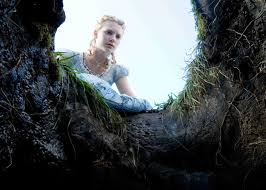 What makes Alice in Wonderland so depressing is that there is so much potential within both the story and Burton's approach to it. Both the original novels are about the role of childhood fantasies in preparing one for the traumas of adult life. The heroine is an outsider who doesn't fit into the world being designed for her - she is a classic Burton protagonist in the manner of Winona Ryder in Edward Scissorhands. And considering his knack for creating dark and exuberant visual worlds, Burton would seem the ideal choice for the drug-induced majesty of Lewis Carroll.
But in spite of all the good omens, the finished product is as banal and directionless as Terry Gilliam's The Brothers Grimm. Both films appear on the surface to be the directors' dream project, considering Gilliam's fascination with fairy tales which stretches back to Jabberwocky. But both Grimm and Alice are clear examples of an artistic, distinctive and often mad director having their visions suppressed or suffocated in favour of a bloated and anodyne mainstream blockbuster. For starters, the script for Alice in Wonderland is little short of pathetic. Its relationship to Carroll's works is at best stand-offish and at worst completely patronising - it borrows famous lines (like the Mad Hatter's riddle) and then rephrases them in such a way that sucks all the fun and insanity out. This becomes all the more shocking when we discover it's written by Linda Woolverton, who wrote Beauty and the Beast and co-wrote The Lion King. How could someone who made her name retuning fairy tales for family audiences have got this one so damn wrong?
 The biggest crime of the script, however, is not its contempt for Carroll's language. The biggest crime is that all the central ideas of both the novels and Burton's work are swiftly trampled underfoot, in favour of something a lot more generic and predictable. All the ideas about Alice being independent are quickly overruled by the central plot involving the compendium: one cannot be independent if your destiny is predetermined. In the face of this revelation, Alice as a character descends into the very thing that Burton sought to avoid: despite the best efforts of Mia Wasikowska, she comes across as little more than a sniffy, spoilt brat.
 The central plot of this 'reimagining' of Alice is also massively derivative. The idea of a plot built around the poem 'Jabberwocky' was handled, albeit unevenly, in the Gilliam film, while having Alice re-enter the fantasy world of her youth is a blatant rip-off of The Chronicles of Narnia. Then there is the design of the White Queen's castle, which looks like a cross between Lothlorien and Minas Tirith, and various elements lifted from the Harry Potter saga - the final battle on the chess board recalls The Philosopher's Stone, while the design and defeat of the bandersnatch owes something to the basilisk in Chamber of Secrets.
 The problem with all these derivative details is that the twisted, quirky and often creepy darkness of Burton's work can't get a word in edgeways. Despite occasional design elements which are quintessential Burton, this has none of the strange whimsy of the original Disney version, nor the haunting and absurdist quality of Jonathan Miller's take. There are also very few attempts to address how Wonderland (or Under-land) has changed since Alice left: we get a flashback sequence with a village being burned, but not much else. Even when the characters become fractured, like the Mad Hatter changing accents, it's played as a gimmick instead of a lead-in to something more substantial.
What we end up with is a film with all the structure and balance of a rollercoaster. The script keeps hurling us in four different directions, and we can't stop for more than two minutes without something exploding or being hurled at the screen. The film never quietens down for long enough to let the story work on its own terms, and with the exception of The Cheshire Cat (voiced by Stephen Fry), the characters rarely resemble anything more than one-trick ponies. This is the legacy of Pirates of the Caribbean, producing a film which even at 108 minutes feels bloated, baggy and boring. Then there is the 3D to consider. Many individual shots in Alice in Wonderland seem to have been designed solely for the 3D version - something that is obvious even when watching in 2D. The extended sequence of Alice falling down the rabbit hole, or the Mad Hatter's flying drapes, or even the floating Cheshire Cat, add nothing to the story and feel bolted on, much like the 3D itself: the film was shot against green-screen and then retro-fitted in post-production. The experience of shooting so much in green-screen actually made several of the actors nauseous, and there are endless examples in the finished film of mismatched eye-lines and bad continuity, of the kind that you thought only George Lucas was capable of doing.
 The role of CGI in the composition of special effects hints at the major deficiency in Burton's visual approach. When he was making his early films with entirely mechanical effects, there was always a feeling in the back of one's mind that the limitations of animatronics and make-up meant that only so much of his unique vision was finding its way out of his head and onto the screen. As the role of CGI has grown in harmony with organic effects, more and more of Burton's designs have been physical realised in a way which was both elaborate and believable. But Alice in Wonderland relies so heavily on CGI that it comes to resemble the heaven sequences in The Lovely Bones: there is the same sense of a world of many mismatched parts, whose logic and composition are being made up as its director goes along.
 On top of all that, we have a number of plot holes to digest. We readily accept that Alice can change size by eating cakes and drinking from bottles, but why don't her clothes change size with her, for decency's sake if nothing else? Why does the Bandersnatch change sides so readily having previously given Alice a nasty wound? Why does the Mad Hatter speak in a Scottish accent at carefully selected moments? And why, if Crispin Glover's knave had his eye on the throne all along, did he wait until he was being banished to try and kill the Queen?
 Alice in Wonderland is Burton's biggest failure since Mars Attacks!. The debate is not so much whether the film is any good, as to how much of the end product is his fault. In spite of everything there are moments in which his true colours shine through: certain scenes with the Red Queen or Cheshire Cat spring to mind. Burton has been known to bounce back quickly, having followed Mars Attacks! with Sleepy Hollow and Planet of the Apes with Big Fish. But he will have to work twice as hard to prevent this obvious blip from becoming the start of his epitaph.
Rating: 1/5
Verdict: A soul-crushing experience


