
Reflections
-
It is weird to read my correspondences from the late August/early September
period, being the time of transition between my old function in life to my
new ...
14 years ago
Ladyhawke (USA, 1985)
Directed by Richard Donner
Starring Matthew Broderick, Rutger Hauer, Michelle Pfeiffer, Leo McKern
When it comes to 1980s fantasy, there are three broad categories into which films can fall. There are those like Flesh & Blood, which get the balance between substance and silliness spot on, marrying Machiavellian mercenaries to grin-inducing battle scenes. There are those like Excalibur, which take themselves so seriously that they're fatally dull. And there are those that are totally, utterly, and enjoyably silly - and into that category goes Ladyhawke. Ladyhawke is of historical interest due to its place in Richard Donner's career. The fiasco surrounding Superman II, on which he was replaced mid-shoot by Richard Lester, had thrown Donner's career off-course: he had to watch Superman II and III take huge amounts of money while he delivered flops like Inside Movies and The Toy. But either side of this film, he found himself very much in mainstream favour again, first with The Goonies and later with Lethal Weapon. It is interesting that a director whose place in history has been defined by blockbusters (including, of course, The Omen) should be capable of making something so delightfully odd in the midst of two more rounded and confident efforts.
 Like many 1980s fantasies, there are aspects of Ladyhawke to which time has not been kind. The most obvious of these is Andrew Powell's soundtrack, which was nominated for a Saturn award in 1985 but has since become regarded in some quarters as one of the worst ever composed. After Toto's contributions to Dune, it became more common for pop groups or composers to score films, due to the selling potential of the groups and the relatively cheap cost of synthesised music. But Powell's efforts go just too far even to be enjoyed ironically, with its overproduction and bouncy pop timbre frequently jarring with the quieter moments.
 The score is one aspect of Ladyhawke which confirms its inherent silliness, even before we get to the meat of the story. Another such aspect is its visuals, which manage to look lavish and professional while still feeling ropey and cheap. The film is shot by Vittorio Storaro, who famously shot Apocalypse Now - something which is evident in the multitude of blood-red, beautiful sunsets which are central to the plot. But in amongst the terrific scenes of frozen lakes, dark forests and crisp skylines, there are numerous scenes which look like they were filmed in a hurry, treading unintentionally close to Monty Python and the Holy Grail.
 This feeling of cutting corners is reinforced by the paucity of special effects. For a film in which people metamorphose into animals on a daily basis, the special effects of Ladyhawke are coy to say the least. Apart from a few shots where Michelle Pfeiffer's eyes change shape in close-up, all the big transitions happen off-screen; on several occasions Matthew Broderick leaves the room just beforehand, as though the actors had to go off-stage to change costumes. While Donner wouldn't have had access to the CG wizardry we take for granted, there was plenty of scope in the physical effects of the time to achieve something a little more palpable. Only four years earlier Rick Baker produced the definitive werewolf transformation for John Landis, in a film with half of Ladyhawke's total budget.
 Added to this shortcoming we have a number of plot holes which either confuse or produce unwanted tittering. First there is the problem of clothes: Rutger Hauer and Michelle Pfeiffer keep the same outfits throughout, but there's not much effort to keep the clothes together when one of the pair is in animal form. Then there is the question of memory. The film borrows the horror device of the person having no memory of what they did as a beast - so how come the hawk remembers to stay with her master, or the wolf not to eat his mistress? Finally, there are several blatant continuity errors. We are told that Pfeiffer appears as an eagle whenever it is daylight, and yet there are at least two scenes where it's daylight and yet she is still there. At least when Shrek half-inched the plot, it was consistent throughout.
 But in spite of these problems, Ladyhawke is a consistently entertaining little romp. Like Logan's Run nine years earlier, it's only when you stop trying to take it seriously that its ideas and emotional impact bubble to the surface. And like Logan's Run, this transition is cemented via a dominant performance by a great actor - not Peter Ustinov, but Leo McKern.
 Most famous for playing Horace Rumpole in the long-running TV series Rumpole of the Bailey, McKern had courted cult status at various points in his career: as veteran reporter Bill McGuire in The Day The Earth Caught Fire, as a recurring Number 2 in The Prisoner, and in his previous outing with Donner as a mad archaeologist in The Omen. But whereas that last appearance was a silly cameo in an otherwise seriously creepy film, here McKern brings weight and gumption to an otherwise facile concoction. Like Ustinov before him, he puts a brake on excessive silliness, if only for a moment, in order to steer the viewer towards the emotional heart of the film.
 Not only is McKern's delivery well-suited to disguising exposition, but he illuminates some cracking lines in the script. Most of the wisecracks go to Broderick, who is on very fine form; his soliloquys with God about telling the truth and resisting temptation are guaranteed to raise a smile. But McKern's timing is note-perfect, as he waits for a knight to fall right through the drawbridge before quipping: "Always walk on the left side!". Best of all comes when Broderick brings him the hawk after it has been wounded by an arrow. Having been told that he can't eat it, McKern bellows: "What? Is it Lent again already?!"
 While McKern's performance is the icing on the cake, the other major players are also firing on all cylinders. Rutger Hauer seems naturally suited to the historical romp, whether as a heroic figure here or as an antihero in Flesh & Blood. His typically brilliant screen presence, being equally charming and threatening, suits the personality of Navarre as a knight tormented by the woman he loves but cannot have. And while Michelle Pfeiffer's hair may be straight out of a pop video, she too fits her character very nicely. Her beauty conveys both the innate sense of mystery about Isabeau and the vulnerability of her predicament. She's so convincing, in fact, that you keep recognising her facial features in those of the hawk.
 Having these two charismatic performances goes some way in making the romance at the heart of the film feel believable. Somehow the grandiosity of the setting gives the relationship more weight, making it feel like there is more at stake than with similarly inseparable lovers in more mainstream rom-coms. The story is an interesting variation on the age-old tale of two people destined to be together but cursed to be apart, and for all the ridiculous elements within the central conceit it does end up pulling you in.
 This emotional pull is most evident in two scenes towards the end. The first occurs when Philippe finds Navarre lying next to Isabeau as a wolf. The sun begins to rise, Isabeau begins to change, and for a split second both see each other with human eyes. Navarre reaches out to touch Isabeau, only for her to change and fly away, leaving him beating the earth in frustrated rage. The other comes during the solar eclipse where the two are reunited and the curse is broken. The slow pacing and distance between them prior to their first real contact reinforces the strength of the bond between them.
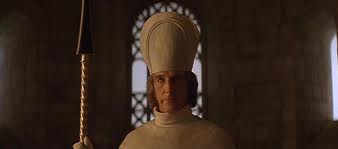 Ladyhawke also has its fair share of good action. Considering Donner's bad feelings towards Richard Lester (who can blame him?), it is ironic that his action sequences, in this film at least, take after Lester's finest work in The Three and Four Musketeers. The fight scenes have some pretty inventive slapstick and Broderick doing all manner of acrobatics, while Hauer gets to swashbuckle and head-butt to his heart's content. The highlight comes in the climactic fight in the church, ending with Hauer throwing his huge sword over several yards right into the heart of John Wood's scenery-chewing Bishop.
 Ladyhawke may not have aged as well as Flesh & Blood or Legend, but it remains a definite guilty pleasure and a bona fide cult film. Its flaws are all in plain sight - the soundtrack, the silly plot, the special effects - and yet none of them can completely eclipse the sheer enjoyment that it brings. If anything these flaws serve to make it more endearing, and more fun than mainstream fare like Robin Hood: Prince of Thieves. Donner would make more consistent features after this, but for pure and simple fun it takes some beating.
Rating: 
Verdict: Silly but sublimely entertaining
Logan's Run (USA, 1976)
Directed by Michael Anderson
Starring Michael York, Jenny Agutter, Richard Jordan, Peter Ustinov
Ever since Star Trek first arrived on our screens, it's been almost fashionable to dismiss science fiction as little more than enjoyable pantomime hogwash. Whatever interesting ideas the series tried to raise, more often than not the ideas would take a back seat to silly fighting, hammy acting and increasingly bizarre costumes. Coming a year before Star Wars rewrote the sci-fi rulebook, Logan's Run is a kindred spirit to the original Star Trek: campy, silly and utterly escapist, yet still passingly entertaining. One of the initial disappointments of Logan's Run is how little of the original novel survives in the screenplay. The novel, written by William F. Nolan and George Clayton Johnson, used the counter-culture and youth movements of the mid-1960s as a platform for a story about eugenics and social engineering, predicting a society where the power of youth was so great that ageing beyond 21 was forbidden. But in the screenplay for Logan's Run, written by Straw Dogs scribe David Zelag Goodman, this fascinating premise is compressed into an old-fashioned action-adventure story, with most of the political undercurrents being taken out.
Logan's Run still has an interesting premise in spite of this - people can only live to 30 before they are elaborately executed - but in both its execution and its place within the sci-fi canon, it is much more old-fashioned than its source material. The film is directed by Michael Anderson, who had reached his peak in the 1950s with The Dambusters and the Oscar-winning Around the World in Eighty Days. He approaches Logan's Run in the same way as his classic work: as a star vehicle with a lot of locations and fun-packed action, and not much room for the darker, more political aspects of science fiction. Logan's Run contains many references to other sci-fi works, some classic, some contemporary. The idea of a totalitarian society in which people live only for pleasure can be traced back to Brave New World, Aldous Huxley's extraordinary novel which predicted (amongst other things) anti-depressants, test tube babies, and interactive media with the 'feelies', where you could see, hear and touch what was happening on screen. The Carrousel scenes are like more elaborate versions of the funeral from Soylent Green, while the general camp tone nods towards Planet of the Apes and its sequels.
 In light of Anderson's track record, the film to which Logan's Run most closely aspires is The Time Machine, directed by The War of the Worlds producer George Pal. The whole of Logan's Run is comparable to the final act of The Time Machine, in which a docile, hedonistic and ignorant society are held captive by evil forces - respectively morlocks and time itself. But in its overly frequent use of model shots and strange collection of weapons, Logan's Run is much less George Pal than Gerry Anderson. The wide shots of the domed city are closely reminiscent of Thunderbirds or Stingray, while the costumes are akin to Anderson's contemporary venture, Space: 1999.
 Logan's Run is clearly a product of its time, particularly where sets and costumes are concerned. While the men get to wear full-length uniforms or jumpsuits, the women are paraded around in a series of dresses and skirts which leave absolutely nothing to the imagination. When we first meet Jenny Agutter, she doesn't appear to be wearing any underwear - something which is confirmed on no less than two separate occasions. Despite having a budget of $9m (around the same as Star Wars), the film looks like it was made on the cheap and in a hurry. Whole sections of the domed city look like the inside of a shopping mall (which it is), with seemingly little time being spent on set-dressing.
 For most of its running time, Logan's Run is a very silly film. We quickly forget that Logan 5 is infiltrating the runners with the intention of finding and destroying Sanctuary - we forget, in other words, that he is a government puppet whose lifeclock has been artificially accelerated. After Logan initially defeats Francis, the plot descends into a series of set-pieces in increasingly elaborate sets until Peter Ustinov turns up to help us get a grip.
 The tone of these set-pieces is generally light-hearted, with our heroes surviving seemingly implausible scenarios while managing to maintain their perfect hair and make-up. But in the midst of this frivolity there are little pockets of creepiness, such as their encounter with Box. He trundles into shot like a bargain basement Dalek and starts spouting off about plankton and sea greens, all of which seems completely harmless. But then he leads Logan and Jessica to a corridor of runners frozen in ice: Box implies that they are now being used for food, pulls out two guns and laughs wickedly. While still silly at heart, it's as though we had accidentally wandered into Soylent Green.
 The silly, campy tone of Logan's Run is consolidated by the acting. Michael York manages to keep his dignity for the most part: his unique voice gives him an air of authority while keeping his more sensitive moments believable. Jenny Agutter makes the very best of a duff role: she spends a lot of her opening scenes wandering around open-mouthed in next to nothing, but she eventually gets into her stride. But aside from the leads the acting is very wooden, and while no-one comes close to the 'quality' of Charlton Heston or William Shatner, it's difficult not to snigger at how straight-laced everything is. The film lacks the knowing deftness of Flash Gordon, with only a small fraction of the cast being in on the joke.
 But in spite of its copious flaws, Logan's Run eventually emerges as a passingly enjoyable slice of science fiction. The irony is that once we have given up trying to take it seriously, the film begins to get off the ground and say the things that it really wants to say. The later sections of the film, while still a little ridiculous, make up for the loose, baggy opening act and do raise a couple of interesting issues around the central theme.
 A big part of this transition is down to Peter Ustinov. Gene Siskel, who once called this the worst film he'd ever seen, wrote that Ustinov's cameo was unduly extended because he was the only decent thing in the whole film. While few would share Siskel's view, his performance is by far and away the best, and his character is the most interesting. He plays a seemingly senile old man who is found by Logan and Jessica wandering around the ruined House of Representatives. The film never states exactly why he is still alive; perhaps, like J. F. Sebastian in Blade Runner, he was too old to leave the old ways behind.
 Like Richard Burton, Peter Ustinov has immense screen presence. He is able to take the most ridiculous or stupid line, and deliver it in such a way that it gains great weight or feels deeply important. He might be rambling on about cats having three different names, but his mannerisms feel more developed than the other characters, and his dithering manner works as a means of reaction to Logan and Jessica, who have no concept of age or decay.
 In its later sections, Logan's Run also takes on a Biblical quality, with undertones emerging in the attitude and development of the characters. Logan and Jessica's escape from the domed city is akin to the banishment of Adam and Eve from the Garden of Eden - although, in line with the conspiracy element of the film, Eden is too good to be true in the first place. The ending of the film is also rooted in the Old Testament, with Ustinov emerging like a nervous Moses, ready (unexpectedly) to lead his people out of Egypt.
The film is also prophetic in predicting the increased social role for cosmetic surgery. In an age where breast implants, tummy tucks and facelifts have become both cheap and fashionable, it isn't too far-fetched to believe that, in the near-future, you could change your entire appearance through just a few quick flicks of a laser. The fight between Logan and the doctor (played by Michael Anderson Jr.) is one of the better action scenes, taking the laser sequence in Goldfinger to its natural conclusion. There is much about Logan's Run which would be good cause to dismiss it. Its production values have dated badly, the ideas are compromised by a generic adventure story, and both its plot and execution are preposterous. But it just about manages to pass muster in the end, being consistently entertaining and getting a grip on things in the final act. It succeeds where so many of the Star Trek movies failed, and while it never reaches the heights of Flash Gordon, it passes the time rather nicely.
Rating: 
Verdict: Preposterous but perfectly passable


