
Reflections
-
It is weird to read my correspondences from the late August/early September
period, being the time of transition between my old function in life to my
new ...
14 years ago
Sir Henry at Rawlinson End (UK, 1980)
Directed by Steve Roberts
Starring Trevor Howard, Patrick McGee, Sheila Reid, Denise Coffey
In my review of Westworld, I argued that novelists who become filmmakers often lack the visual creativity to balance out the verbal richness of a given work. While certainly true of Michael Crichton's debut, this can also be applied to literary adaptations in general; the often-prolific use of voiceover and frequency of long speeches belie an unhelpfully literal approach to adaptation. Sir Henry at Rawlinson End proves the same can be true for spoken word albums. Vivian Stanshall's 1978 LP, culled from his stints on Radio 1 covering for John Peel, remains an irresistible slice of whimsical absurdity with wordplay which is utterly to die for. But in the hands of first-time director Steve Roberts, most of the charm and quality of Stanshall's work is eroded or withered away, resulting in a crushing disappointment.
 Sir Henry at Rawlinson End has been called everything from "the cinematic equivalent of cheese before bedtime" (The Big Issue) to "the missing link between Monty Python and Withnail & I" (Time Out). Set in and around the fictional English country manor of Rawlinson End, it follows a day in the life of Sir Henry Rawlinson (Trevor Howard), Great Aunt Florie (Sheila Reid) and various other eccentrics who inhabit or visit the estate. The film version extends the plot of the album, adding both the activities of a morose priest Slodden (Patrick Magee) and Sir Henry's attempts to exorcise the ghost of his brother, accidentally killed during a drunken fishing trip.
 The best way to understand the film is found in the words of Peter Sellers. When interviewed in 1972 just before a one-off Goon Show to mark 50 years of the BBC, he made the comparison between The Goons and Monty Python in terms of visual imagination on the part of the audience. Watching Monty Python's Flying Circus, you had a starting point for what the various characters could look like: in Sellers' words, "John Cleese always looks like John Cleese". Listening to the Goons, on the other hand, you had to create pictures of what the various characters looked like without much visual assistance, even from Spike Milligan's own drawings.
The great joy of Sir Henry as a record was Stanshall's skill with voices, accents and verbal acrobatics. Every sinew of the storyline was crammed full with wit and wordplay, with Stanshall's metaphors and imagery being up there with the best bits of Under Milk Wood. Dylan Thomas would have smiled favourably on corkers such as this: "A pale sun poked impudent marmalade fingers through the grizzled lattice glass, and sent the shadows scurrying, like convent girls menaced by a tramp." Like Under Milk Wood, the story of Sir Henry at Rawlinson End is secondary to the characters inhabiting it, whose every tic and foible is captured in superb detail by the rich language. With Thomas, it is the grotesquery of Mr. and Mrs. Pew, the melancholy of Polly Garter or the grief of the blind sea captain. With Stanshall, it is the absurdity and sheer lunacy of English aristocrats, from Sir Henry's simpleton son Hubert, "in his mid-40s, and still unusual", to walking encyclopaedia Reg Smeeton, who obsesses over the fact that there is no proper name for the back of the knees.
As delightfully hilarious as all of this sounds, it was always going to be difficult to capture the innate anarchy of Stanshall's unique mind. The very effect of adding a visual dimension takes away from the imagination of the record, offering a standardised version of events which, much like the Tele-Goons, will inevitably fall short of one's expectations. One could blame this on the director's inexperience or lack of talent: Roberts would later carve a niche for himself penning TV series based on successful Disney films. But Stanshall's close involvement, both at a script level and in a supporting role, leads one to conclude that it was simply a bad idea for anyone to attempt it. In adapting the album for the big screen, there has been a certain amount of plot-shuffling - understandable enough, and just about excusable considering the consistent quality of the material. But some of the best bits of the album are inexplicably missing. At only 73 minutes long, it is unlikely that they were cut for time, and more unlikely still that they were lost for lack of making sense. Most tragic is the omission of Sir Henry's monologue about Professor Molebottom, who in his mind "put the bounce in the bouncing bomb".
 The new additions to the story are poorly integrated, giving the distinct impression that the film would have been fine without them. Patrick Magee is a burning screen presence, as evidenced by his work with Stanley Kubrick in A Clockwork Orange and Barry Lyndon. But for all his charisma his character seems curiously pointless; his priest plots and glowers on the side-lines, but nothing ever comes of him being there. Harry Fowler's winkle-pickered Cockney is an obvious bum note, a pale imitation of Walker from Dad's Army. And the ghost exorcism plot is badly handled, arriving with some hokey special effects and being palmed off pretty quickly.
There have been a number of strange British cult films which have passed muster in spite of their shambolic narratives. Think of Richard Lester's The Bed-Sitting Room, co-written by Spike Milligan, or The Magic Christian starring Peter Sellers. But what saw these films through their short running times and perplexing turns of plot was a constant feeling that they were about something, even if they weren't going anywhere. Sir Henry at Rawlinson End, on the other hand, feels totally and indulgently aimless. It feels like the cast and crew were given a big house to play around in for a week - they shot everything they could, making it up as they went along and then tried to stitch it all together in the editing room. While the album may not have finished in an entirely satisfying way, it at least had the common decency to quiet while it was ahead. This hangs around for at least 20 minutes too long, ending with someone bungee-jumping off the battlements for no good reason.
 In amongst its disastrous execution, there are individual moments in the film which at the very least make it memorable. There is some pleasure in seeing Trevor Howard sending himself up so mercilessly; one can almost picture this is what his character in Battle of Britain might have become had he been given a peerage. He gets a number of pretty juicy lines which showcase his insanity - the best being, "I never met a man I didn't mutilate" - and his prisoner-of-war camp banter is quite fun.
Some of the visual decisions are also notable. Where The Bed-Sitting Room found Lester manipulating colour like his contemporary Nicolas Roeg, Sir Henry at Rawlinson End is shot entirely in sepia monochrome, reinforcing its amateurish, parochial feel. If one was feeling generous, one could call this a descendent of the early surrealist films, taking its place in the canon as a late-blooming English take on Luis Bunuel. In the end, however, there is precious little about Sir Henry at Rawlinson End that makes one feel anything like as charitable. It is a crushing disappointment for fans of the spoken word album, whose bizarrely annoying tone leaves no way in either for fans of English whimsy or for the casual viewer. The pockets of familiar bliss or tongue-twisting delight are padded out by incoherence, indulgence and irritation. In short, it proves that audience imagination is key to making these kinds of stories work, and that as a result, some things are best left unseen.
Rating: 
Verdict: A crushing disappointment
Super Size Me (USA, 2004)
Directed by Morgan Spurlock
Starring Morgan Spurlock, Alexandra Jamieson
Cinema is full of food-related scenes which are guaranteed to turn one's stomach. We have La Grande Bouffe, in which rich people eat themselves to death; Peter Greenaway turning cannibalism into an art form with The Cook, The Thief, His Wife and Her Lover; and the famously gross Mr. Creosote sequence from Monty Python's The Meaning of Life. And now we have Super Size Me, Morgan Spurlock's appropriately queasy documentary which is up there with Touching the Void as one of the decade's best films.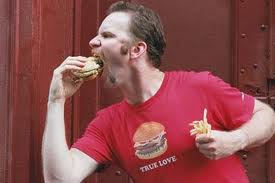 Super Size Me follows Spurlock as he attempts to survive on nothing but McDonalds for an entire month. The rules are simple: he must eat three meals a day, he can only eat what is offered at McDonalds, he must try everything on the menu at least once, and he must answer yes if offered a super-size meal. In between tackling his alarming diet, Spurlock is closely monitored by a small army of doctors, and the only exercise he undertakes is walking the same daily distance as an average American.
 Although it's an intensely personal, first-person documentary, the film has none of the self-obsession or navel-gazing which has dogged Michael Moore or later Nick Broomfield. For starters, Spurlock is a lot more likeable than either of these: we don't just enjoy his company, we get the impression that the film crew did as well. He is populist, rational and refreshingly self-effacing, in complete contrast to Moore who, in the words of Mark Kermode, seems mainly concerned with inflating his own ego.
 Furthermore, Spurlock is pursuing a subject matter of great importance but getting under the surface with a bigger intention than scoring political points. Where Fahrenheit 9/11 frequently went off the boil for the sake of making Moore look good, Super Size Me keeps its eyes on the prize, being thorough and comprehensive in its investigations. In one of its best moments, Spurlock gets under the skin of a spokesman from the Grocery Manufacturers Association, getting him to admit that the lobbyists he represents are part of the growing problem of State-side obesity.
 Like the films listed in the opening paragraph, there are a number of scenes in Super Size Me which make you want to throw up. On Day 2 of the challenge, Spurlock orders a Big Mac and throws up in the car park. The camera looks away as he does it, but then shows the horrid yellow mess left on the tarmac. Equally disgusting are the close-ups of the food before it enters his stomach; suffice to say, it's nothing like the pictures. Worst of all, about half way through we get to witness keyhole surgery on a gastric band operation, set to the main theme from The Blue Danube.
 Critics of Super Size Me have pointed to these scenes as evidence of the film's partisan approach. Their argument goes that since Spurlock didn't test other restaurants or brands of fast food, he has a particular grudge against McDonalds and is using the film as a form of propaganda. The camera's lingering on Spurlock's discomfort, or his claims about his sex life suffering, are means of manipulating people into boycotting one company rather than exposing deeper truths about the industry as a whole.
 While the documentary may paint a far-from-rosy picture of McDonalds, such criticisms are unduly harsh. Spurlock makes clear from the start that this is not a clinical trial or a hard scientific experiment. He chose McDonalds for the reason that it has the most outlets across America, with the largest number of customers, and therefore would provide a more representative sample than a study of any other single chain. The evidence produced by Spurlock is conclusive but not medically binding, which makes it all the more extraordinary when we discover in the epilogue that McDonalds has withdrawn its Super Size options.
 The documentary is very even-handed in a number of points that it makes. At one of the schools examined in the film, the students are given a presentation by Jared Fogle, who lost a large amount of weight by eating Subway sandwiches. The crew then interview a teenage girl who admires what Fogle has done, but who cannot afford to eat Subway three times a day. The positive goals which celebrities like Fogle are setting are as unhealthily unrealistic as the impossibly airbrushed bodies of girls in magazines. In terms of self-esteem among teenagers, role models of any kind are portrayed as doing more harm than good.
 Super Size Me identifies three areas in which there has been neglect, ignorance or cynical foul play with regard to the consumption of fast food. The first, unsurprisingly, is with McDonalds itself. Spurlock sheds light on the immense amount of money spent on advertising, which far exceeds the national budget for promoting healthy eating. The prevalence of TV advertising means that no parent, no matter how responsible, can guarantee their child isn't being poorly influenced, and individual McDonalds chains (at the time of making the film) are not displaying adequate levels of information about the nutrition content of their meals.
 The second area which has fallen short is the government. More recent documentaries such as Waiting for Superman have detailed the years of neglect and underfunding in the American state school system in a more thorough and comprehensive way. But Super Size Me does show how the use of outside food contractors to provide school meals has led to a race to the bottom, in terms of price and in terms of quality. So much of the food served in schools requires no preparation other than reheating, and because the choices are limited children are brought up to accept nothing better, let alone healthier.
 But thirdly, Super Size Me has the balls to point the finger at the individuals who consume McDonalds so frequently. Having made a very solid case against fast food companies and lobbyists, and spoken about the frightening extent of fast food advertising, the film concludes by saying that it's as much down to us not making the effort as it is the society in which we are constantly exposed to such food. This might seem like a cop out, considering how much righteous anger the film generates through its arguments against the industry. But it is refreshing that a documentary has the balls to 'blame' the public without guilt-tripping them in the process.
 On top of everything else, Super Size Me is a very entertaining piece of work. As well as making you feel angry or sick, there are at least as many moments in the film which will provoke laughter - and genuine laughter at that. Hearing Spurlock's girlfriend talk about their disappointing sex life is hilarious; she comments, for instance, about how she always has to be on top since he started his diet. On the day that we see him throw up, Spurlock cracks jokes about the side effects of fast food on his system, muttering about "Mc-twitches" in his arm and other such complaints. Such scenes are pleasant interludes which make the experience more bearable and counteract any negative feelings we may have, e.g. shouting at Spurlock to stop it, lest he should kill himself.
 Super Size Me is a great example of populist documentary filmmaking which is a near-perfect balance of entertainment and information. Its impact will be greater the less one knows about fast food in general or McDonalds in particular, and many may be bothered that it doesn't go into enough detail when it needs to. But as an introduction to a subject which many have barely considered, it is both admirable and successful. One hopes that Spurlock's latest film can emulate both of these qualities.
Rating: 
Verdict: En-gross-ing
The Magic Christian (UK, 1969)
Directed by Joseph McGrath
Starring Peter Sellers, Ringo Starr, John Cleese, Spike Milligan
If there was a category of films called 'WTF?!', then The Magic Christian would be the definitive example. Joseph McGrath's late-1960s satire assaults your senses and your intelligence over a disorientating and unrelenting 92 minutes. The result is both a colossal train-wreck and a memorable commentary on human greed, which if nothing else will make you laugh and freak you out. There are a number of reasons to get excited about The Magic Christian. It is based on the 1959 novel by Terry Southern, who co-wrote the screenplay for Dr. Strangelove. Stanley Kubrick hired Southern after Peter Sellers gave him a copy of the novel; Kubrick loved it and promptly re-worked Dr. Strangelove from a straight drama into a black comedy. The screenplay for The Magic Christian was co-written by Graham Chapman and John Cleese, just before they hit the big time with Monty Python's Flying Circus.
 The other huge draw of The Magic Christian is its cast, which reads like a who's-who of British comedy actors. Alongside Chapman and Cleese, who appear respectively as the Oxford boat race captain and Mr. Dugdale, the director of the auction, Spike Milligan turns up as a traffic warden whom Sellers bribes to eat his parking ticket. John Le Mesurier, who was in The Italian Job the same year, turns up as Sir John during the boat race, and Hattie Jacques cameos as Ginger Horton. There are also brief cameos by Christopher Lee as 'The Ship's Vampire', Raquel Welch as Priestess of the Whip (don't ask), Roman Polanski as a lonely drunk and an unrecognisable Yul Brynner as a drag queen singing Noel Coward's 'Mad About The Boy'.
 That last sentence should give you some idea of the sheer level of weirdness we are dealing with here. Like its contemporary The Bed-Sitting Room, the film has a very particular brand and style of humour, and once it has gotten into its stride it makes no effort to tone down or alter said style to achieve greater audience appeal. With this in mind, it is no surprise that the film was almost universally panned when first released, although both it and The Bed-Sitting Room have since been rehabilitated.
 On the one hand, there are many, many things wrong with The Magic Christian. Like a lot of 1960s comedies it is shambolically constructed with an episodic storyline, so that it ends up as less of a story than a series of sequences of famous people enjoying each other's company at our expense. McGrath had previously directed Casino Royale, the equally shambolic James Bond spoof which Sellers had left mid-shoot. Even at its best his direction is aimless and very sub-Richard Lester (who isn't that good in the first place).
 The story of The Magic Christian makes very little sense. After eccentric billionaire Sir Guy Grand (Sellers) decides on a whim to adopt a homeless orphan (Ringo Starr), they embark on a series of pranks designed (and I use that word advisedly) to prove that everyone had their price and will do anything, no matter how degrading, if enough money is offered. Grand supposedly gets this idea when buying a hot dog from a train: having no change he offers the man first a fiver and then a tenner, and the man crashes his hot dog stand off the end of the platform in excitement.
 What follows is a series of increasingly elaborate pranks which target the unsuspecting public (often played by famous people) in increasingly mean-spirited ways. Things begin fairly harmlessly with the parking ticket scene, or Guy going to a high-quality restaurant and behaving like a pig, eating caviar with his hands and throwing his food at the guests. But soon the tone of the pranks become more savage, with the boat race being sabotaged and ending with civil servants swimming for money in a vat of faecal matter from the local slaughterhouse.
 With scenes like this, you would imagine that The Magic Christian would come across as a hard-hitting if heavy-handed satire, in which the seemingly moral and upright citizens of the world are humiliated in such a way that we are forced to reflect upon our own selfish desires. Sometimes the film does manage this, but for all the moments in which it does there are at least as many moments where it loses sight of this message and settles for the weirdness of the scenes in and of itself.
 This is particularly evident in the centrepiece involving The Magic Christian itself, billed as the most advanced passenger cruiser ever made. Once the guests embark, all manner of things go wrong, starting with them being shown a film of a black man's head being transplanted onto a white men's body (questionable doesn't cover it). The ship's captain becomes steadily more drunk and is promptly kidnapped by a gorilla. Christopher Lee turns up and starts biting the passengers who flee to the hold, only to discover the engine room is filled with hundreds of topless rowers commanded by a whip-cracking Raquel Welch. They run off the ship, only to find that the whole thing was a simulator inside a London warehouse, with Sellers and Starr looking on completely deadpan.
 Other set-pieces are equally inexplicable. Whilst at a performance of Hamlet, the actor playing the title role (Lawrence Harvey) delivers the whole 'to be or not to be' speech as a striptease, for no apparent reason. On the train later on, Guy Grand holds a board meeting for designing a new car; the scene then cuts to an illustrative animation which is somewhere between Terry Gilliam's Python work and Yellow Submarine. Finally, on the same train, a series of Oriental gentleman rotate through hidden doors to sit next to a seemingly racist businessman, who is then dragged through the door, laughed at by divers in strobe light, and carted off the train by the Gestapo. The only natural response to such scenes is to sit open-mouthed, head in hands, going: "What the hell?!".
 On the surface, then, there is an awful lot wrong with this film. It's shambolically directed, the story is all over the place, and the main theme often gets lots amongst the cameos. And yet - somehow - it works. For starters, it is an achievement in and of itself that someone could make a comedy this spiteful and mean-spirited at a time when most mainstream comedies were light and frothy. Whereas The Party a year earlier was a playful throwback to the traditions of silent cinema, The Magic Christian points the way forward to darker, blacker comedies like Withnail & I and Heathers.
 The ultimate test of a comedy, past or present, is whether or not it makes you laugh. And The Magic Christian passes this test, even if, as in Dr. Strangelove, much of the laughter is awkward laughter. The art gallery sequence where Sellers cuts up a priceless Rembrandt is funny, and the following scene with Sellers bidding with klaxon horns and flashing lights showcases his brilliant comic timing. Sellers' characterisation is great, drawing on his work as Grytpype-Thynne in The Goon Show, and Ringo Starr is very sporting and convincing as a more deadpan Moriarty.
 The Magic Christian contains all that is good and bad about 1960s comedy. It is ramshackle in its construction, but no moreso than The Party, and it is very excessive and indulgent, but not to the point of utter frustration. Indeed, despite its myriad flaws it has aged considerably better than some of Sellers' other work from the same period. The film makes for enjoyably confusing viewing, and would make a good double bill with The Bed-Sitting Room. You'll laugh, you'll be confused, you might be offended - but somehow you can't bring yourself to hate it.
Rating: 
Verdict: An enjoyably confusing shambles
O Lucky Man! (UK, 1973)
Directed by Lindsay Anderson
Starring Malcolm McDowell, Ralph Richardson, Arthur Lowe, Graham Crowden
After If.... won the Palme d'Or at Cannes in 1969, Malcolm McDowell was desperate to work with Lindsay Anderson again. Teaming up with If.... screenwriter David Sherwin, McDowell spent the years in and around A Clockwork Orange churning out draft after draft of a screenplay based loosely on his life. Anderson wanted a film of epic proportions, and what he delivered is at once epic, joyous, frustrating and utterly perplexing. O Lucky Man! is the second instalment of Anderson's Mick Travis trilogy, following If.... and preceding Britannia Hospital. It is not so much a sequel as a companion piece to If...., with this Mick Travis being an everyman figure rather than just the grown-up version of the revolutionary schoolboy. Many of the cast of If.... return playing multiple, completely different roles, and aside from Travis there is little or no attempt made at direct continuity.
 Where If.... was based on Anderson's experiences at public school, O Lucky Man! is loosely based on the life of Malcolm McDowell, who started out as a coffee salesman before wandering into acting and being cast in If.... almost by accident. The story of Mick Travis has been likened to Candide, Voltaire's sprawling 18th-century epic about an everyman indoctrinated with optimism, who journeys out into the world on a series of exciting and terrifying adventures.
 As with Candide, O Lucky Man! has a picaresque structure, with an episodic, incredibly rambling storyline which is very difficult to summarise in a paragraph. It begins with Travis working for Imperial Coffee as a salesman and being put in charge of the North-East of England. Following his apparent success he is given Scotland as well, but ends up being interrogated by the military who believe he is a Russian agent. He manages to escape their torture after the base is attacked and evacuated.
 With no money to speak of, Travis volunteers for a series of experiments led by Dr. Millar (Graham Crowden), who talks about using science to unlock the full potential of mankind. Upon his discovery of a patient who is half-man, half-sheep, Travis flees in fright, hitching a lift to London with Alan Price's band and falling in love with their groupie (Helen Mirren). Having wangled his way into meeting her father, the richest man in the world (Ralph Richardson), Travis becomes his personal assistant, only to be dragged into shady government dealings and imprisoned for fraud. Upon release he is robbed and beaten up by the homeless, leading him to wander into an audition with a film director, played self-referentially by Lindsay Anderson.
 At this point you would normally have every reason to berate me for giving away the whole plot of the film. But the fact is that O Lucky Man! is very difficult to follow unless you have some prior idea of where it is going. At a slow-moving 183 minutes, it requires a massive amount of patience both to sit through and to tolerate the contrivances and oddities of its plot. There is still substance to be found, but many of its interesting ideas are severely compromised by their execution.
 As with Candide, O Lucky Man! is at heart a social satire wrapped up in romantic and adventure elements. Like Jonathan Swift's Gulliver's Travels, Voltaire was looking to create a work which could satirise society by means of elaborate, whimsical allegory - so elaborate and whimsical that it would slip through the net of church wrath or state censorship. Anderson attempts the same here with less immediate success, although his intentions are noble and his film has dated somewhat better than other contemporary satires, if only because its scope and themes are so universal.
 O Lucky Man! is a satire of commercialism and ambition in a capitalist society. Travis begins the film guided by optimism, ambition and his willingness to do anything to get rich. Even before his success with Imperial Coffee, he seems to have totally abandoned his revolutionary principles, acknowledging either through maturity or base self-interest that the only way to make it in life is to fake it. Anderson's re-tuning of the character reflects both the selling-out of many of his left-wing comrades and Britain as a whole, which was slowly eroding or reversing its post-war achievements (something he would return to in Britannia Hospital).
 The film is also about luck, with most of Travis' adventures coming about mostly from being in the right place at the right time. His success in the North-East comes largely from networking with the locals in a crowded showing of a porn film. When interrogated by the army, he begins to pretend that he is Russian to get it over with, and only escapes because the base is bombed. He becomes Sir James' assistant not because he has the skills or experience, but because he knew his daughter and just happened to be there when Professor Stewart (Crowden) committed suicide. "It's not what you know, it's who you know" may be a trite point to make, but Anderson plays it through with relish to show how hollow capitalist meritocracy can be.
 As perfectly valid and interesting as these points may be, they often get misplaced or buried amongst the increasingly ridiculous series of events. Travis is supposed to be an everyman and yet his experiences become so fantastical that even when the allegory is played for obvious effect, they never quite tap into the nub of the issues. One could argue that this was done out of respect for the audience, with Anderson believing they could fill in the blanks rather than needing to be lectured. But there is too little for us to grip onto in our bid to decode the most esoteric elements, and at its worst the film resembles Sleeper, having to constantly be outlandish or wacky to keep things moving forward.
 The tone of O Lucky Man! lurches around uncontrollably. The scenes in Dr. Millar's institute are played straight to maximise the horror, with certain scenes resembling H. G. Wells' The Island of Dr. Moreau. But other scenes are almost parodies of Anderson's earlier work - the scene where Travis attempts to coax Mrs. Richards out of committing suicide is a total piss-take of kitchen-sink dialogue. Mrs. Richards is played by Rachael Roberts, star of Saturday Night and Sunday Morning and This Sporting Life, who would tragically take her own life in 1980.
 The recurrence of cast members like Graham Crowden, Rachael Roberts and Arthur Lowe give the impression that O Lucky Man! was partly or wholly made to get the old gang back together. Anderson was less confident that he had been on If.... and parts of the film feel that he was making it up as he went along (albeit not without success). Alan Price's band were incorporated into the film as a modern-day Greek chorus because Anderson had wanted to make a documentary about them but couldn't afford the licensing costs.
 On top of all that, O Lucky Man! is littered with moments which are so completely out of left field that you have to pinch yourself. The strangest of these comes at Travis' trial when the judge goes back into his chambers, strips off to reveal next to nothing under his gown and is roundly whipped by the usher. Anderson could be making a point about public school habits or sexual perversity behind closed doors. But it does feel like we've wandered into the Monty Python sketch where the two judges strip off while talking about "waggling wigs" and "banging gavels".
 O Lucky Man! is a sprawling and bizarre follow-up from Anderson, which confuses as much as it stimulates or enthrals. McDowell is excellent in the lead, giving us some form of a charismatic anchor for the story as it floats on increasingly choppy waters. Like The Bed-Sitting Room before it, it has a number of interesting and relevant ideas which are let down by their peculiar execution, and both films require immense patience to be fulfilling. It's massively and tragically flawed, but somehow still compelling.
Rating:
Verdict: Sprawing but somewhat satisfying


