
Reflections
-
It is weird to read my correspondences from the late August/early September
period, being the time of transition between my old function in life to my
new ...
14 years ago
The Ninth Gate (France/ Spain/ USA, 1999)
Directed by Roman Polanski
Starring Johnny Depp, Lena Olin , Frank Langella, Emmanuelle Seigner
With the notable exception of Se7en, numerical horror-thrillers are utter rubbish. With their ridiculous twists, over-the-top acting and an overreliance on special effects, they epitomise all that is banal and disappointing about these two genres. You would think that Roman Polanski, the man who gave us Repulsion and Rosemary's Baby, would be able to handle such well-worn material in at least a workable manner. But instead we end up with a ripe old stinker every bit as disappointing as Prince of Darkness. Polanski has always been a fan of absurdist, quirky comedy, being greatly influenced by France's crown prince of absurdity, Eugene Ionesco. While absurdity in and of itself is no bad thing, Polanski has always been at his best when this aspect of his sensibility has been minimised, or at least properly accommodated. You have to admire him for being able to switch between bleak, serious works like Tess and The Pianist, and something more fun and frothy like Frantic. But his out-and-out exercises in comedy have dated very badly, with What? being the worst example.
 Further doubts are raised by Polanski's attitude towards the source material. When interviewed in 1999 he said that he didn't believe in the supernatural - something you would never have guessed from Rosemary's Baby. He was drawn to the novel El Club Dumas by Arturo Pérez-Reverte because it was an opportunity to play with the clichés of a genre that he enjoyed. The consequence is that we aren't sure how seriously Polanski is taking things, and therefore how seriously we should be taking him.
 The Ninth Gate starts off quite atmospherically, with good pacing, dusty books and nice gothic colours. Film noir touches are evident throughout, from the archetype of the downbeat detective (or "book detective" in this case) to the enigmatic women in his life. Like so many noirs or Hitchcock films, the blond is enigmatic but for the most part on the hero's side, while the brunette is seductive and passionate to the point of being pure evil.
 Having set things up quite nicely in the first ten minutes, The Ninth Gate starts to crumble as more and more ridiculous elements encroach. We might swallow the story about the three copies of The Nine Gates, if only because Frank Langella sounds authoritative as he wades through exposition. But subsequent developments are so clouded or convoluted that we quickly give up trying to figure it all out, insofar as there is anything to figure out. It feels like the sort of thing that Polanski could have done in his sleep - and for much of the film, he might as well have done.
 All the big plot points in The Ninth Gate can be anticipated because they borrow all too heavily from better genre efforts. Having Dean Corso commissioned to search for The Nine Gates is exactly the same set-up as Angel Heart, but with a book instead of a jazz musician. His infiltration of a secret ceremony is lifted from The Wicker Man, and the mansion scenes strongly resemble Eyes Wide Shut, although this may be coincidental. There are also very standard references to The Omen in the use of 666, for instance, The NINE Gates being published in 1666. There is even a nod to An American Werewolf in London, as Corso arrives at the castle in a truck full of sheep.
 Having given up on taking The Ninth Gate seriously, the next logical step is to try and enjoy it as a comedy, perhaps as an unintentional one. But the comedic elements are so completely at odds with Polanski's execution of the twists that they feel like they have escaped from a different film. The twin brothers, who are played by the same actor via split screen, bumble their way through their lines like a cross between Thomson and Thompson from Tintin and Alf Garnett in Till Death Us Do Part.
 The silliness of the supporting characters increases as the film moves on. Baroness Kessler, played by Barbara Jefford, is introduced as a formidable character of real threat to Dean Corso - who then slips almost immediately into pantomime villain mode when we discover that she only has one hand. Corso later finds her slumped in her motorised wheelchair having been strangled: he turns the wheelchair around, only for her to go careering through the double doors, like Mason Verger's death in Hannibal two years later.
 Like many numerical thrillers, The Ninth Gate suffers from dodgy special effects. It's hardly a dull car crash like End of Days, in which Gabriel Byrne demonstrates his demonic power by blowing everything up, and Arnold Schwarzenegger try to stop him with a grenade launcher. But alongside bad continuity and an unconvincingly burnt book, there are at least two examples of dodgy wire work, in which Emmanuelle Seigner floats down into a scene, without any prior clue that she could fly.
 The Ninth Gate is littered with irritating plot holes which leaving us scratching our heads even in the moments when generic convention could fill in the gaps. There is no explanation of the serpent tattoo on the brunette's back, nor of Boris Balkan's ability to know exactly where Corso is at any one time - which is, conveniently, always within reach of a phone. But more annoying than either of these is Polanski's contempt for the subject matter. It's hard to believe that either Corso or Balkan know or care so much about rare tomes when they treat them so carelessly. They don't bother to handle them with gloves, flip through ancient pages like they were airport paperbacks and carry them around in scruffy bags which get flung everywhere.
 This care-free attitude spills over into the performances. Johnny Depp had wanted to work with Polanski for some time, but Polanski didn't tell him that he wasn't giving the performance that he wanted - in other words, he was almost completely undirected in the role. To be fair to Depp, he gets the physical stuff right, modelling himself on Raymond Chandler and being more convincing than he is in Secret Window. But otherwise it's pretty phoned-in, with Polanski being unable or unwilling to tease out the greatness that Tim Burton or Terry Gilliam had managed.
 Frank Langella is no stranger to trashy villains, having played Skeletor in the awful He-Man movie, Masters of the Universe. He does the best with a surprisingly underwritten role, looking a little bit like Michael Redgrave in The Dambusters. Lena Orin has far too little to do beyond flashing her stocking tops in the first half-hour and then dressing up like the actress from Scottish Widows for the satanic ceremony. As for Seigner, she does a good demon stare, but otherwise she's too airy-fairy, wafting through the scenery as if she doesn't really care who she's playing or what she's doing. In any case, it's essentially the same character she plays in Frantic - the quirky outsider who helps the male protagonist, only this time she's the devil as well.
 The final nail in The Ninth Gate's coffin comes with its ending, which is hopelessly dragged out and completely incoherent. We get to see Langella self-immolate and fail to pass through the Ninth Gate - but that's not the end. Seigner makes love to Depp against the flames with her demon eyes, the camera zooms in on Depp as if he realises who she is all along, and he seems about to scream - but that's not the end. After the two drive back, and Seigner remarks "is that it?" (to which the answer is "no"), Depp goes back to the bookshop and finds the missing page - but that's not the end. Depp then goes back to the castle and the screen fades to white, in one of the most shambolic and unsatisfying endings in 1990s cinema.
 The Ninth Gate is an example of what happens when a great director indulges themself to the extent that they no longer feel the need to try. As an exercise in supernatural horror it is every bit as rubbish as Prince of Darkness: Polanski's film looks better, but Carpenter's was shorter. In attempting to put his stamp on overly familiar elements, Polanski fails to deliver chills, thrills or knowing laughs. Thank God that he redeemed himself beyond all recognition just three short years later.
Rating: 
Verdict: One of Polanski's few bad films
The Skin I Live In (Spain, 2011)
Directed by Pedro Almodovar
Starring Antonio Banderas, Elena Anaya, Marisa Paredes, Jan Cornet
I first saw the trailer for Pedro Almodovar's The Skin I Live In at the Tyneside Cinema in Newcastle, while waiting patiently for Sarah's Key to start. The trailer was immensely creepy, and my immediate reaction was the exclamation: "Blimey! He's turned into Georges Franju!". It was through such a reaction that I was compelled to return the following week, to catch one of the most intriguing films of the year. If Black Swan was Darren Aronofsky's version of Suspiria, The Skin I Live In is Pedro Almodovar's take on Georges Franju's horror classic Eyes Without A Face. He takes the premise, plot and iconic imagery of what is still one of the scariest horror movies ever made, throws in his trademark blend of melodrama, gender politics and soap opera, and then cranks everything up to eleven. The result, like Black Swan, is frequently ridiculous, but also strange, engrossing and intensely memorable.
 Although precious little of his career has been based in or concerned with horror, Almodovar knows the genre well enough to pay knowing tribute to several iconic entries in the canon. The references to Eyes Without A Face are clear both in the film and in its publicity, especially in the white face mask which our heroine wears for most of the film. The plot loosely follows the same arc, although instead of stealing other people's faces, the obsessive mad scientist irrevocably alters a criminal's identity and gender as payback for what happened to his wife and daughter.
 Antonio Banderas' character looks back to the cinematic tradition of mad scientists, beginning of course with Rotwang from Metropolis. But his closest equivalent is Vincent Price in The Abominable Dr. Phibes, a campy, schlocky B-movie in which Price plays a zombie scientist who recreates the Biblical plagues of Egypt to avenge the death of his wife. Finally the surgical sequences, which are particularly graphic, recall the famous eye-slice sequence in Un Chien Andalou, whose surrealist sensibility mirrors Almodovar's interest in the supernatural.
 Mark Kermode remarked that one unique aspect of cinema is its ability to make acts of painstaking construction inherently seductive. In other words, watching someone assembling a gun or performing an operation on screen has an engrossing quality, so that we are drawn in even knowing that what we are seeing is, on one level, totally repulsive. If the surgical scenes in The Skin I Live In are anything to go by, Kermode was right on the money. There is something inherently sinister about surgical equipment on screen, but even as we recoil at what may (or may not) be happening, Almodovar's camera is coaxing us to lean in for a closer look.
 The Skin I Live In has a number of deeply uncomfortable scenes which in the hands of a lesser filmmaker would cause the whole project to collapse. The scenes of Vicente being hosed down and kept prisoner in the cellar are very close to the aesthetic of so-called torture porn. But even in its most tortuous moments the film never tips over into the territory of Captivity, i.e. condoning or encouraging any sadism on our part.
 A similar issue could be taken with the amount of nudity in the film, and particularly with the way in which it is presented. In one lengthy scene, Robert Ledgard (Banderas) begins to cover 'Vera' in the new skin which he has been cultivating. We see Vera's exposed breasts and genitalia in close up over a long take, while Robert guides the new material over her body with tweezers. As before, it's uncomfortable, but Almodovar holds his nerve and prevents the scene from becoming gratuitous through very careful editing.
 Like all the best horror films, The Skin I Live In is not gruesome or graphic for its own sake. It's very rare to get a horror film about gender politics, let alone one whose approach is so nuanced and intelligent. Where previous efforts like Teeth eventually abandoned or distorted their feminist credentials, this film puts its audience through the mill if it has t, in order to keep its sense of conviction.
 The film explores the notion of gender identity, and to what extent one's gender is defined by one's physical appearance. When Robert captures Vicente, wanting revenge for the rape of his daughter, the easy thing to do would be to castrate him, in the manner of Hard Candy or Teeth. Instead, Robert's retribution is more twisted, giving Vicente a vagina so that he has to experience some degree of womanhood for the rest of his life.
 After his daughter's death, brought on by a Repulsion-like fear of men, Robert takes his guinea pig a little further. What started as an act of retribution steadily transmutes into something a great deal more twisted, as Vicente is shaped into a near-perfect copy of Robert's wife, who is isolated from the outside world and used by Robert for sexual pleasure. In these scenes Robert truly emerges as a monster, who has forsaken the life-saving benefits of his research to satisfy his urges and atone for his mistakes.
 The film's exploration of gender identity is concentrated in the behaviour of 'Vera'. For most of the film we believe convincingly that she is wholly a woman - even before the massive twist, we don't have any reason to doubt that she identifies as such. Once we know what has been done to 'her', we come to believe that one's identity is indeed determined by physical factors. But as with Eyes Without A Face, the final rebellion turns all of this on its head, with 'Vera' revealing what or who she truly is in the gripping final scene.
 Like most of Almodovar's work, The Skin I Live In combines this twisted and sinister storyline with laugh-out-loud, awkward humour. The jokes frequently come at the expense of the characters involved, particularly 'Vera'. In one scene, Robert brings out a box of dildos of increasing size, and lays them out on the table while instructing his most prized possession about how and when to use each one. The camera then cuts to the line of dildos, with Vera looking startled behind her mask in the background.
 The Skin I Live In is at heart a melodrama: it has a relatively simple story (albeit one with a cracker of a twist), which relies on the memorability of the characters to give the story depth and credibility. Almodovar's characterisation is complex but very overt, and the manner in which he introduces characters tells us pretty much all we need to know. When we first meet Antonio Banderas, he is giving a lecture in which the lights cast deep shadows under his eyes: before he has even said a word, we know he is up to no good.
 Because The Skin I Live In is so deeply rooted in melodrama, it does require a lot of patience both to buy into the various twists and to put up with the more histrionic sections of the plot. Flashing back to events six years prior to the beginning works very well, but if you find yourself getting incredulous over the central plot device, you'll struggle to put up with the man dressed as a tiger. As with Black Swan, there is a sense of the ridiculous in all of this, but as long as we are in the zone with the characters, that sense should not override our enjoyment.
 The Skin I Live In is one of the most intriguing and engrossing films of 2011. It is a little too long, and we do have to hold our nerve in the more ridiculous moments. But with enough patience the substance and chills of Almodovar come surging through. Antonio Banderas gives his best performance in quite some time, and Elena Anaya is a great match, having previously shone in the underrated Savage Grace. It's a twisted, creepy and tantalising work, which in its finest moments gives Black Swan a run for its money.
Rating: 
Verdict: The Spanish Black Swan
The Haunting (USA, 1963)
Directed by Robert Wise
Starring Julie Harris, Claire Bloom, Richard Johnson, Russ Tamblyn
One of the longest arguments in horror fiction and filmmaking is over a very simple question: to show, or not to show? The novelist and director Clive Barker one said of monster movies: "I hate that school of filmmaking where for the first hour you see a foot, for the second hour you see a hand, and then you finally see the monster for five seconds before it gets blown up by an atom bomb."
For those too squeamish to throw in their lot with Barker, or his partners-in-slime David Cronenberg and John Carpenter, The Haunting is Exhibit One in the case of withholding the monster to produce terror. Along with close counterpart The Innocents, it has become the Bible of the modern cinematic ghost story, whose influence can be seen in everything from Alien to The Others. Though not a masterpiece by any standards, it remains essential viewing for any horror fan. In both its story and its production, The Haunting comes from very deep-rooted stock. The haunted house movie had been around in some form for over 40 years, and in the 1940s the genre produced such classics as The Uninvited and The Canterville Ghost, one of the big influences on Tim Burton's Beetlejuice. Robert Wise, the film's director, came from a background in low-budget horror, having helmed such titles as The Body-Snatcher and The Curse of the Cat-People.
 But the first success of The Haunting is its departure from both the increasingly comedic tone of the haunted house movie and the ultra-low budget look pioneered by Wise's benefactor Val Lewton. Whereas the spooks in The Canterville Ghost were included primarily for comedy, the ghostly forces present in The Haunting are inherently malevolent towards the inhabitants of Hill House. The impressive exterior shots (of Ettington Hall in Stratford-upon-Avon) situate the story in the serious end of gothic fiction, being reminiscent of the wide shots in Alfred Hitchcock's Rebecca.
 The visuals of The Haunting are very restrained, and are well-complimented by the score by classical composer Humphrey Searle. Wise shot the exterior scenes of Hill House on infra-red film to create a grainy, amorphous look for the stones and give the impression of an ancient monster lurking within. His composition is very good, choosing his angles and edits very carefully to wring the most tension you could out of a door slamming or heavy footsteps on a wooden landing.
 Like most great ghost stories, the central dilemma of The Haunting surrounds whether what we are seeing is reality or a particular kind of insanity: in other words, are there ghosts, or is it all in the mind of Nell? The lengthy voiceover in the early section of the film makes the character naturally unsettling, not simply because she is sensitive but because the tone of our thoughts gives the impression of her being at least partially mentally unhinged.
 Though it seems obvious to point out, The Haunting was a huge influence on The Shining. But beyond Stanley Kubrick's general intention to put his own stamp on the classic ghost story, there are whole scenes in The Shining which either pastiche The Haunting or lift directly from it. Compare the sequence of Jack Nicholson driving his family to the Overlook Hotel with Nell's long drive to Hill House. Both Nell and Jack Torrance have a frenzied quality behind the wheel, as if both know that they are leading themselves, their loved ones and the audience to certain doom - and though Torrance shows it more, both are somehow excited by it.
 On a thematic level, The Haunting is about humans' attempts to rationalise the supernatural - to paraphrase Dr. Markway, to give a name to what we don't understand, even if the name is meaningless. The desire to prove the existence of the supernatural through science is found throughout mediaeval and early modern philosophy, with thinkers as varied as Thomas Aquinas and Rene Descartes believing that the scientific method could reveal the essence or nature of God. The Haunting is the latest chapter in this long line of inquiry, and as with Aquinas and Descartes, its findings are decidedly ambiguous and inconclusive.
 Subsequent ghost stories like The Orphanage have explored the link between science and the supernatural from a technical point of view - for instance, by showing the movements of a medium on infra-red cameras. But despite the scientific intentions of Dr. Markway, there is precious little cold science in The Haunting. Markway enters the house with purely rational intentions, seeking to objectively study, record and observe rather than pass judgement or live in fear. But as the nights wear on, the house rebels against his attempts to impose order, until he concludes that the only sensible thing to do is to burn Hill House to the ground.
Much of the success of The Haunting lies in its ability to make us see things which aren't necessarily there. There is a comparison with Repulsion in the way that the architecture of Hill House seems to embody some sinister force, ever-present and ever-threatening. Wise is no Roman Polanski, but he does manage a couple of good tricks, making us see faces in the wallpaper, eyes in the window of the tower, and something deeply sinister in the blank expression of the marble statues. As with The Shining, the terror of The Haunting comes from the fact that so little is explained. There's nothing on the level of the man in the bear suit or Jack Torrance's appearance in the photograph, but we are still left with uncertainty as to whether or not Hill House was haunted, or whether we have just spent two hours in the midst of a deranged mind. Julie Harris gives a really great performance which is convincing and engaging even in the moments where she is bouncing off the walls.
 The flaws with The Haunting lie in aspects of it which are too close to the riper end of studio horror. In the midst of several really good scares, there are numerous shots of characters running into mirrors or being scared by their reflections, things which feel silly or cheesy within the context of the story. Some of the special effects are creaky even for the day; we can see the wires pulling down the mirror on the mantelpiece, and when one character falls down the stairs in the prologue, it looks stunted and over-choreographed.
 Elsewhere the film resorts in certain small ways to cliché, deriving a couple of jumps or scared from devices which just don't cut the mustard. The introduction of Markway's wife, played by Lois 'Moneypenny' Maxwell, is largely unnecessary - especially when she randomly appears in the attic like the mad first wife of Lord Rochester in Jane Eyre (which in turn inspired Rebecca). The opening prologue, whilst being deliberately hackneyed, almost overcooks things from the off, and it's only through a speedy introduction to Markway's plan that we choose to overlook it.
 The Haunting remains a scary and significant horror movie which still holds up to some degree even after nearly 50 years. Its inventive take on the haunted house motif is complemented by Wise's solid direction and a series of good performances (including an unrecognisable Valentine Dyall as Mr. Dudley). It's dated and cheesy in places, and has long been surpassed by The Shining and its successors. But as a yardstick against which ghostly movies should be measured, it still has the power to spook.
Rating:
Verdict: A creepy classic
Repulsion (UK, 1965)
Directed by Roman Polanski
Starring Catherine Deneuve, Ian Hendry, John Fraser, Yvonne Ferneaux
Whatever else may be true about Roman Polanski, there can be no denying that he makes a damn good thriller. With Repulsion, his first English-language feature, he established many of the techniques and motifs which came to define his career, particularly his unique ability to unnerve an audience while flattering their intelligence. More than 45 years later, it remains one of the most unsettling films of the 1960s, and one of Polanski's best early works. Repulsion is the first instalment of what would become Polanski's 'Apartment Trilogy', the others being Rosemary's Baby and The Tenant. On top of their common setting, all three films are built around the idea of architecture being able to express, harbour or reflect a given horror. Repulsion is the most straightforward of the trilogy in this respect, insofar as the architecture of the apartment changes and decays along with the mental state of our heroine: plaster cracks and falls off the wall, and the skinned rabbit lies slowly rotting in the living room.
 Repulsion owes a big debt to two previous entries in the canon of psychological thrillers. Like Black Narcissus, it deals openly with the issue of sexual repression, and how the introduction of overtly sexual, male forces into a pure and female environment can lead to some form of madness. Carol Ledoux is like a warring hybrid of Sisters Clodagh and Ruth: on the surface she is like the former, pure and disinterested, but her vivid fantasies or nightmares hint towards deeper, murkier desires or fears. And like Psycho, the main character with whom the audience identifies happens to be insane - although quite how insane is left for us to judge.
 Like Alfred Hitchcock, Polanski is not content for us to sit back and discuss Carol's madness as if it were entirely academic. Instead he put us through the mill constantly throughout, pulling us headlong further and further into her madness so that by the end we feel like we are lucky to be alive. But unlike a lot of Hitchcock's work, there is no moment of relief, no tidy pay-off that makes us "come out giggling". By the end of Repulsion you feel like you have lived in that apartment and experienced everything that Carol has, and your only response is to sit, near-catatonic with fear, and marvel at what has been created.
 The film is anchored by the terrific central performance of Catherine Deneuve, who was only 22 when filming began. Deneuve has the most amazing eyes, which convey the slightest shifts in her mental state. Her right eye follows the opening credits as they dart across the screen in close-up, and there is a recurring shot of one eye hidden in darkness, showing what horror lies beneath such glacial beauty. Deneuve manages to portray a character who is aloof, aimless and very shy while making her constantly intriguing. The men who fall for her may be initially attracted to her physically, but their continued interaction is (seemingly) motivated by an equal desire to understand and study her.
 Repulsion is primarily an examination of androphobia, or the fear of men. The cause of Carol's affliction is never entirely established; although the photographs imply she was molested as a child, it is not clear whether the man in the photograph is her father, her uncle or a total stranger. The film raises the question of the motivation behind Carol's exact responses to men, particularly in the case of the murders. Were they simply extreme reactions, the end result of concentrated exposure to her fear? Or is there a more aggressive element of Carol which wants vengeance, and therefore actively pursued these killings?
 In the end, however, the exact reason for Carol's mental state is rather secondary. The film is less about the 'twist' contained in the final photograph than about convincingly depicting an individual's descent into madness and paranoia. Polanski succeeds in this by surreally physicalizing the fears of our protagonist, projecting her fears onto her surroundings so that the apartment becomes Carol's own private haunted house.
 Repulsion is filled with nightmarish imagery which even out of context has the ability to send shivers down one's spine. Certain moments are played initially for shock value - for instance, the man first appearing in the mirror or the hands bursting through the wall to grope her. But these are accompanied by more subtle touches in the cinematography which point to the film's Freudian undercurrents. The central corridor of the apartment is permanently in shadow, and every time she enters it she is immediately confronted by her fear - whether it's the hands coming out of the walls or finding Ian Hendry shaving in the bathroom.
But what makes such imagery truly disturbing, rather than simply creepy, is the ambiguous response of the central character. Deneuve never shrieks or screams, maintaining some form of dignified façade even as she grows more and more deranged. When she first imagines a man breaking into the flat and forcing himself on her, she is naturally repulsed by it. But the more it happens, the more we entertain the possibility that it is less of a nightmare than a dark fantasy - that in the midst of being terrified she accepts it - or perhaps, in a warped way, she enjoys it.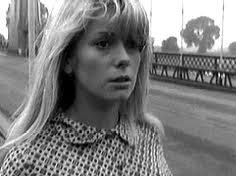 Because the central character is so conflicted, she gradually ceases to be a reliable narrator. But by the time that has happened, we have grown to trust and empathise with her so much that there can be no escape. The level of claustrophobia Polanski creates is astonishing, and the incidental score by jazz drummer Chico Hamilton keeps things at fever pitch. Occasionally the score drifts a little too close to the work of Bernard Hermann with the constant cymbals resounding, but considering the film's relationship with Psycho such indulgences are kind of appropriate.
This marriage of character conflict and intense music to create unbearable claustrophobia is brilliantly demonstrated in the murder of John Fraser's character. The scene begins with no score and the camera on Deneuve's face as she bashes Fraser's head in, out of shot, with a candlestick. We are not seeing the actual perspective of the killer, but we are seeing her mind-set, which seems calm and considered. Then, after he is dead, the reality of what she has done hits her and the score kicks in to complete the effect. We are still looking at her rather than through her, but we still feel what she feels - and that is really smart filmmaking. Repulsion could also be construed as the forerunner of Hard Candy and Teeth in its treatment of men as sexual predators. Its male characters are all defined by a desire for satisfaction in the hands of the opposite sex - whether out of love, in the case of John Fraser, or something more cold-hearted as practised by the young men in the bar. The film is a cautionary tale, advising men to think twice if they think they can dominate women just because they appear more vulnerable. Carol's actions in this respect are an extreme and irrational expression of women's desire to be independent, of both men and gender expectations (for instance, cooking and working in a beauty parlour).
 Repulsion is an excellent psychological thriller which bewitches, excites and terrifies in equal measure. It isn't quite a masterpiece, being slightly too slow in its opening minutes and with a score with is occasionally over-cranked. But this is more than made up for by the central performances, Polanski's masterful direction and the sheer amount of tension which both parties have managed to ring out of such a simple premise. A watershed moment for Polanski and a real must-see.
Rating: 
Verdict: A deeply disturbing masterclass in tension


